

By Bob Generale | May 11, 2026 (UPDATED)
Digital marketing for contractors should do more than bring traffic to a website. For builders, remodelers, and specialty trades, the real goal is to turn local search demand, paid clicks, reviews, project proof, and follow-up into better conversations and booked work.
Most contractor marketing advice stops at “run Google Ads” or “optimize your website.” That is not enough. Contractors do not just need more leads. They need fewer wasted leads, faster follow-up, and stronger proof before the first call.
This guide explains how digital marketing for contractors works differently for builders, remodelers, roofers, HVAC contractors, electricians, plumbers, flooring contractors, window and door installers, restoration companies, and concrete contractors. It covers SEO, PPC, reviews, landing pages, content, AI search, and the follow-up systems that separate contractors who win better jobs from those who chase every lead.
Definition
What Is Digital Marketing for Contractors?
Digital marketing for contractors is the use of SEO, PPC, Google Business Profile, reviews, project proof, landing pages, email, retargeting, AI search, and follow-up systems to help contractors attract better-fit leads and turn those leads into booked conversations or jobs. The best contractor marketing systems connect visibility with proof and fast follow-up.
Quick Summary: Digital Marketing for Contractors
- Contractors need local and service-area visibility.
- SEO helps buyers find the contractor before they call.
- PPC helps test demand and capture urgent searches.
- Reviews and project proof reduce buyer hesitation.
- Landing pages should make calling or requesting a quote easy.
- Follow-up systems help prevent good leads from getting lost.
See Where Your Contractor Marketing System Stands
Find out where your contractor business is visible, where leads are leaking, and what needs to change first across Google, Maps, AI search, paid media, and follow-up.
Schedule a MeetingWhy Contractor Marketing Is Different From General Construction Marketing
Contractor intent is not the same as enterprise construction intent. A homeowner searching “kitchen remodeler near me” is not the same buyer as a facility manager searching “commercial construction firm.” The search behavior, decision timeline, proof requirements, and follow-up expectations are all different.
Contractors, builders, remodelers, and specialty trades typically need:
- Local and service-area visibility in Google Maps, local search, and AI search results
- Quote-ready landing pages that make it easy to call or submit a request
- Project proof that shows completed work, before-and-after photos, and real results
- Review volume and quality that builds trust before the first conversation
- Fast follow-up that prevents good leads from going cold
- Call tracking and CRM integration that connects marketing spend to booked jobs
Most contractor marketing pages talk about SEO, PPC, websites, social media, Google Business Profile, reviews, lead generation, and reputation. That is table stakes. The real differentiator is how those channels connect to follow-up, proof, and booked work.
Percepture’s approach to digital marketing for construction companies reflects this: the goal is not traffic. The goal is better-fit jobs, better conversations, and less wasted spend.

The Contractor Trust Velocity Engine
The Contractor Trust Velocity Engine
Percepture’s system for turning local visibility, project proof, reviews, paid demand, AI search readiness, and fast follow-up into better-fit booked contractor conversations.
Visibility
Can buyers find you?
Proof
Can buyers trust you?
Conversion
Can buyers act easily?
Follow-Up
Does every lead get a response?
Measurement
Do you know what works?
The Contractor Trust Velocity Engine gives contractor owners a simple way to diagnose why marketing is not working:
- No visibility = not enough qualified traffic
- No proof = buyers hesitate
- No conversion = traffic leaks
- No follow-up = leads die
- No measurement = budget gets wasted
The Contractor Search-to-Job System
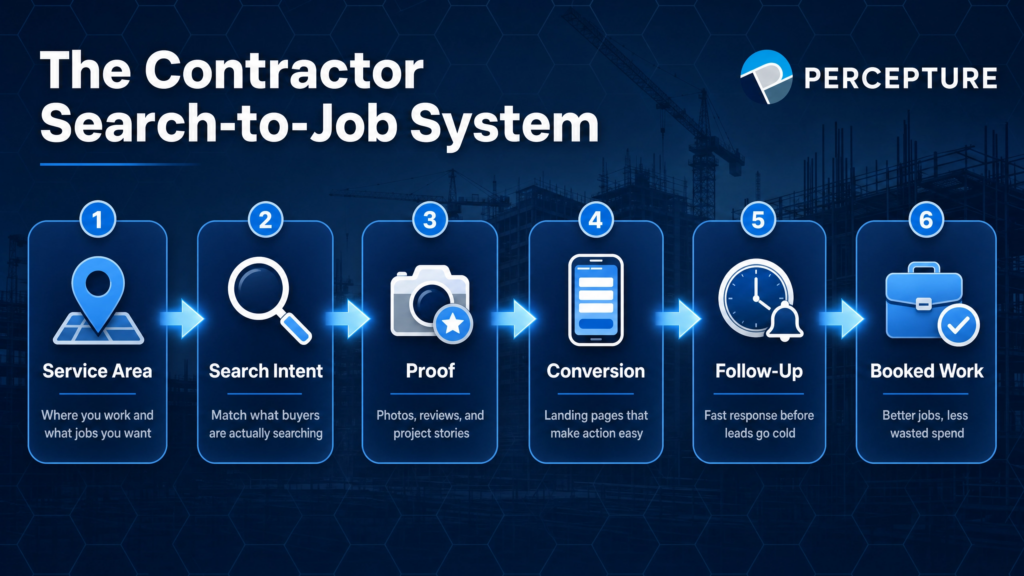
Digital marketing for contractors works best when it follows a clear system. We call this the Contractor Search-to-Job System:
Service Area → Search Intent → Proof → Conversion → Follow-Up → Booked Work
Service Area
Contractors win when Google, AI search, and buyers understand where they work and what jobs they want. Service-area clarity is the foundation of local visibility.
This means optimizing your Google Business Profile for every city and neighborhood you serve. It means creating service-area pages on your website that explain what you do in each location. It means making sure your NAP (name, address, phone) information is consistent across every directory and citation.
For contractors who serve multiple counties or regions, service-area SEO becomes even more important. A roofing contractor in the Dallas-Fort Worth metro needs different pages for Dallas, Fort Worth, Arlington, Plano, and surrounding cities. Each page should include local proof, local reviews, and local project examples.
Search Intent
A homeowner searching “bathroom remodeler near me” has different intent than a property manager searching “commercial HVAC contractor.” Understanding search intent helps contractors create content that matches what buyers actually want.
Common contractor search intent types include:
- Emergency intent: “emergency plumber,” “24/7 roof repair,” “same-day electrician”
- Quote intent: “kitchen remodel cost,” “how much does a new roof cost,” “HVAC replacement estimate”
- Comparison intent: “best roofers in [city],” “top-rated remodelers,” “contractor reviews”
- Research intent: “how long does a bathroom remodel take,” “signs you need a new roof”
- Commercial intent: “commercial electrical contractor,” “industrial HVAC services”
Each intent type requires different content, different landing pages, and different follow-up. Emergency searches need fast response. Quote searches need pricing guidance. Comparison searches need reviews and proof.
Proof

Photos, project pages, before/after stories, reviews, certifications, licenses, team experience, and case studies reduce risk and build trust before the first call.
We call this the Contractor Proof Stack:
- Project Proof: Completed work, jobsite photos, before/after stories, project constraints
- Safety Proof: Safety practices, training, checklists, culture, standards
- Process Proof: How the contractor communicates, schedules, estimates, manages change, and closes projects
- People Proof: Superintendents, PMs, estimators, trade leaders, service techs, and leadership
- Review Proof: Google reviews, testimonials, customer quotes, referral stories
- Authority Proof: PR, technical content, LinkedIn, YouTube, trade media, project pages, and AI-search-ready answers
“Most contractors do not have a marketing problem. They have a trust and follow-up problem. Buyers need to see proof fast, and the business needs to respond before that lead cools off.”
— Bob Generale, Founder, Percepture
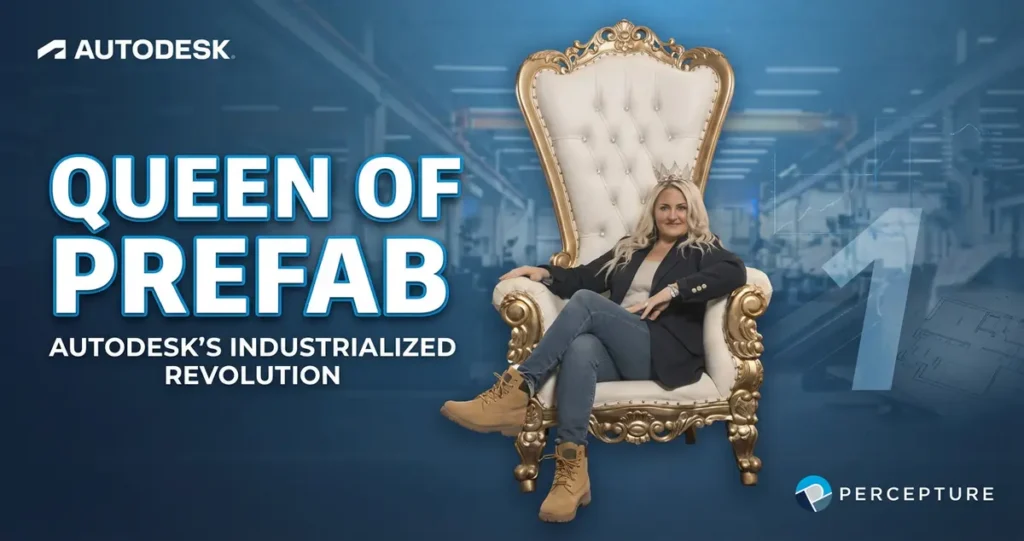
Percepture’s work around Autodesk and the Queen of Prefab showed how construction-related expertise can become category education through video, social, events, podcasts, paid promotion, and search-friendly content. That campaign generated over 5.2 million views, 31,000 watch hours, and 27,000+ subscribers, with episodes reaching #2 and #4 most popular videos on the Autodesk channel.
The lesson for contractors is simple: if the work is real, explain it. If the proof exists, package it. If a buyer asks the same question twice, turn the answer into content.
Conversion
Landing pages, calls, forms, quote buttons, financing language, project galleries, and trust signals turn traffic into action. Make it easy to take the next step.
A contractor landing page should include:
- Clear headline that matches the search intent
- Phone number visible above the fold
- Simple form with minimal required fields
- Project photos or before/after gallery
- Reviews or testimonials near the call-to-action
- Service-area clarity
- Trust signals: licenses, certifications, insurance, awards
Percepture’s conversion rate optimization services help contractors test and improve landing page performance. Small changes to headlines, button text, form fields, and trust signals can significantly increase conversion rates.
Follow-Up
Most contractor leads do not become jobs unless someone follows up fast and clearly. This is where many contractor marketing systems break down.
A homeowner who submits a quote request at 7 PM expects a response before they go to bed. A property manager who calls during lunch expects a callback within the hour. Speed matters. Clarity matters. Persistence matters.
Follow-up systems for contractors should include:
- Call tracking to capture every inbound call
- Missed-call recovery to follow up on unanswered calls
- CRM integration to assign leads to sales reps
- Email automation to nurture leads who are not ready to buy
- Retargeting to stay visible to website visitors
- AI-powered lead summaries to help sales teams prioritize
Booked Work
The goal is not traffic. The goal is better-fit jobs, better conversations, and less wasted spend.
Contractors should measure what matters:
- Booked jobs, not just leads
- Revenue per lead source
- Cost per booked job
- Lead-to-job conversion rate
- Average job value by marketing channel
When SEO, PPC, reviews, landing pages, and follow-up all connect, contractors can see which channels produce the best jobs, not just the most clicks.
The Best Digital Marketing Channels for Contractors
| Channel | Best Use | Strength | Weakness | How Percepture Connects It |
|---|---|---|---|---|
| SEO | Long-term visibility, authority building | Sustainable traffic, lower cost per lead over time | Takes 3-6 months to see results | Content strategy tied to conversion tracking |
| Local SEO / Google Maps | Service-area visibility, local leads | High-intent local traffic, review integration | Competitive in dense markets | GBP optimization with review strategy |
| PPC | Immediate lead generation, testing demand | Fast results, precise targeting | Costs increase without optimization | Keyword insights feed SEO strategy |
| Local Services Ads | Pay-per-lead for service contractors | Google-verified badge, top placement | Limited control over lead quality | Lead tracking tied to CRM |
| Paid Social | Brand awareness, project showcasing | Visual storytelling, audience targeting | Lower intent than search | Retargeting tied to website visitors |
| Retargeting | Nurturing website visitors | Keeps brand visible during decision process | Requires sufficient website traffic | Integrated with email follow-up |
| Email Follow-Up | Lead nurturing, repeat business | Low cost, high ROI for existing contacts | Requires list building | Automated sequences with AI personalization |
| AI Search / GEO | Visibility in ChatGPT, Perplexity, Google AI | Future-proofing, authority building | Emerging channel, less predictable | Entity optimization with structured content |
The best contractor marketing strategies use PPC and SEO together. PPC provides immediate data on which keywords convert. SEO builds long-term authority for those same keywords. When the two channels share data, both improve.
SEO for Contractors
Search engine optimization helps contractors get found when buyers search for services. For contractors, SEO is primarily local: ranking in Google Maps, appearing in local search results, and showing up in AI-powered search answers.
Contractor SEO includes:
- Google Business Profile optimization: Complete profile, accurate categories, service-area settings, photos, posts, and review management
- Local citations: Consistent NAP information across directories like Yelp, Angi, HomeAdvisor, and industry-specific sites
- Service pages: Dedicated pages for each service you offer, optimized for local keywords
- Service-area pages: Location-specific pages for each city or region you serve
- Project pages: Case studies and project galleries that show completed work
- Blog content: Educational articles that answer common buyer questions
- Technical SEO: Fast loading, mobile-friendly, secure, and properly structured
Percepture’s approach to SEO for construction companies emphasizes the connection between search visibility and business results. Ranking for keywords is only valuable if those rankings lead to qualified leads and booked jobs.
For contractors, local SEO often delivers the highest ROI. A roofing contractor who ranks in the Google Maps 3-pack for “roofer near me” in their service area will get more qualified calls than one who ranks #1 organically for a broad national term.
According to the U.S. Small Business Administration, 97% of consumers search online for local services before making a decision. For contractors, that means the first impression happens on Google, not at the jobsite.
PPC and Local Services Ads for Contractors
Pay-per-click advertising helps contractors capture demand immediately. While SEO takes time to build, PPC can generate leads within days of launching a campaign.
Contractor PPC strategies include:
- Google Ads Search campaigns: Targeting high-intent keywords like “kitchen remodeler near me” or “emergency plumber”
- Google Local Services Ads: Pay-per-lead ads that appear at the top of local search results with a Google Guaranteed badge
- Remarketing campaigns: Showing ads to people who visited your website but did not convert
- Display advertising: Building awareness with visual ads across the Google Display Network
- Social media advertising: Targeting homeowners on Facebook and Instagram with project photos and offers
Percepture’s paid search services help contractors build campaigns that connect ad spend to booked jobs, not just clicks. This means proper conversion tracking, call tracking, and CRM integration.
Google Business Profile, Reviews, and Local Trust
For contractors, Google Business Profile is often the most important digital asset. It determines whether you appear in the Google Maps 3-pack, how you look in local search results, and what information buyers see before they click.
Google Business Profile optimization for contractors includes:
- Complete and accurate business information
- Correct primary and secondary categories
- Service-area settings that match your actual coverage
- High-quality photos of completed projects
- Regular posts with updates, offers, and project highlights
- Active review management with responses to every review
Reviews are the trust signal that matters most for contractors. According to BrightLocal’s Local Consumer Review Survey, 87% of consumers read online reviews for local businesses. For contractors, reviews reduce the perceived risk of hiring someone to work in your home or on your property.
A review strategy for contractors should include:
- Systematic review requests after every completed job
- Easy review links sent via text or email
- Responses to every review, positive and negative
- Review monitoring across Google, Yelp, Angi, and industry sites
- Review content used on website and landing pages
Contractor Websites and Landing Pages That Turn Traffic Into Calls
Traffic without conversion is wasted spend. Contractor landing pages should make it easy for visitors to take the next step: call, submit a form, or request a quote.
High-converting contractor landing pages include:
- Clear headline: Match the search intent that brought the visitor
- Phone number above the fold: Make it easy to call immediately
- Simple form: Name, phone, email, and brief description of the project
- Project photos: Show completed work relevant to the service
- Reviews: Display testimonials near the call-to-action
- Trust signals: Licenses, certifications, insurance, awards, associations
- Service-area clarity: Confirm you serve the visitor’s location
- Financing options: If applicable, mention payment flexibility
Project Proof: The Contractor’s Best Marketing Asset
Content marketing for contractors is not about blogging for the sake of blogging. It is about creating proof that helps buyers trust you before they call.
Effective contractor content includes:
- Project pages: Detailed case studies of completed work with photos, challenges, and results
- Before/after galleries: Visual proof of transformation
- Service guides: Educational content that answers common buyer questions
- Cost guides: Transparent pricing information that qualifies leads
- Process explanations: How you work, what to expect, and how you communicate
- Team profiles: Introduce the people who will be on the jobsite
Percepture’s approach to content marketing emphasizes the connection between content and conversion. Every piece of content should serve a purpose in the buyer journey.
“A contractor’s best marketing proof is usually already sitting inside the business. It is in the photos, the field notes, the reviews, the estimates, the safety process, and the problems the team solves every day.”
— Bob Generale, Founder, Percepture
Percepture has seen this across construction technology, MEP, engineering, industrialized construction, operations science, and project-based B2B marketing. Work tied to Autodesk and Queen of Prefab showed how construction-related expertise can become category education. Internal Percepture case materials also reference engineering and construction-related work with Binsky & Snyder, Xsite Modular, Del-Sano Contracting Corporation, Factory Physics, and Project Production Institute resources.
See Where Your Leads Are Leaking
Most contractor marketing problems are not traffic problems. They are proof, page, tracking, and follow-up problems.
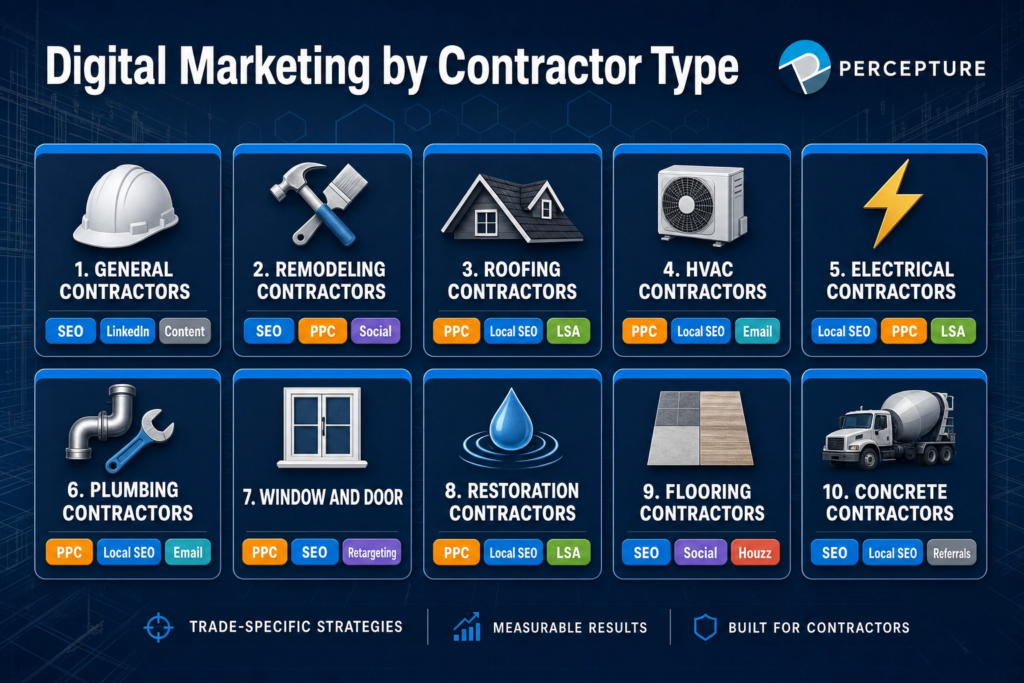
How Digital Marketing Changes by Contractor Type
Different contractor types have different buyer intent, channel mix, proof requirements, and follow-up priorities. The table below shows how digital marketing strategy changes by trade.
| Contractor Type | Buyer Intent | Best Channel Mix | Proof Needed | Follow-Up Priority |
|---|---|---|---|---|
| General Contractors | Project-based, longer decision cycle | SEO, LinkedIn, referrals, content | Project portfolios, team credentials, process | Relationship nurturing, proposal follow-up |
| Remodeling Contractors | Design-focused, emotional decision | SEO, PPC, social media, Houzz | Before/after photos, design process, reviews | Fast response, design consultation booking |
| Roofing Contractors | Emergency and planned replacement | PPC, Local SEO, Google LSA | Insurance experience, warranties, certifications | Same-day response, inspection scheduling |
| HVAC Contractors | Emergency repair and seasonal replacement | PPC, Local SEO, email, retargeting | Response time, financing, brand certifications | Immediate callback, maintenance plan upsell |
| Electrical Contractors | Emergency and project-based | Local SEO, PPC, Google LSA | Licensing, safety record, commercial experience | Fast response, clear pricing |
| Plumbing Contractors | Emergency-heavy, repeat service | PPC, Local SEO, Google LSA, email | 24/7 availability, pricing transparency, reviews | Immediate dispatch, membership programs |
| Window and Door Contractors | Planned replacement, energy savings | PPC, SEO, paid social, retargeting | Product brands, energy ratings, financing | In-home estimate scheduling, financing options |
| Restoration Contractors | Emergency, insurance-driven | PPC, Local SEO, Google LSA | Insurance relationships, certifications, response time | Immediate response, insurance coordination |
| Flooring Contractors | Design-focused, material selection | SEO, PPC, social media, Houzz | Material expertise, installation photos, reviews | Showroom visit scheduling, sample requests |
| Concrete Contractors | Project-based, commercial and residential | SEO, Local SEO, referrals | Project photos, equipment, team experience | Site visit scheduling, estimate follow-up |
How AI Search Changes Contractor Marketing
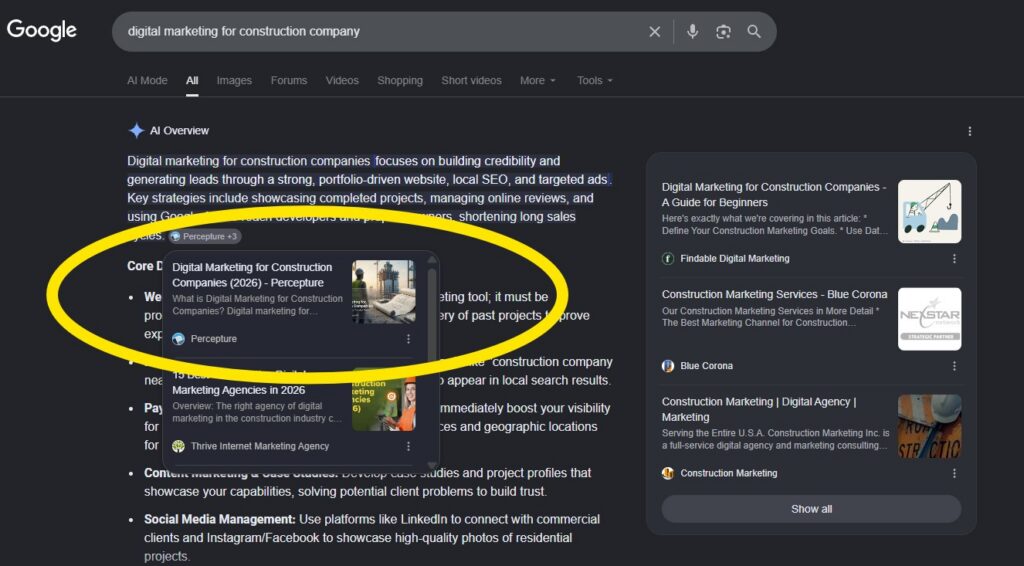
AI-powered search is changing how buyers find contractors. Google AI Overviews, ChatGPT, Perplexity, and other AI search tools now provide direct answers to contractor-related questions. This means contractors need to optimize for AI search, not just traditional SEO.
AI search optimization for contractors includes:
- Structured content: Clear headings, lists, and tables that AI can easily parse
- Direct answers: Content that directly answers common questions in 40-60 words
- Entity clarity: Clear information about who you are, what you do, and where you serve
- Schema markup: Structured data that helps search engines understand your content
- Authority signals: Reviews, citations, and backlinks that establish credibility
Percepture’s AI search optimization services help contractors prepare for the shift to AI-powered search. This includes content restructuring, schema implementation, and authority building.
The contractors who prepare for AI search now will have an advantage as these tools become more prevalent. Those who wait may find themselves invisible in the new search landscape.
How Pyra-Powered Follow-Up Helps Contractors Move Faster
Most contractor leads do not become jobs unless someone follows up fast and clearly. This is where AI-powered follow-up systems become a differentiator.
From Lead Signal to Sales Task:
Search → Click → Call/Form → Summary → Task → Follow-Up → Measurement
Pyra-powered AI systems can help contractors:
- Summarize lead context: Automatically extract key information from calls and forms
- Draft follow-up messages: Create personalized responses based on lead details
- Assign next steps: Route leads to the right sales rep with clear action items
- Track activity: Monitor follow-up completion and response times
- Measure results: Connect marketing spend to booked jobs
The key is human approval at every step. AI handles the repetitive work. Humans make the decisions that matter.
“AI does not replace follow-up. It removes the friction around follow-up. It can summarize the lead, draft the next message, assign the task, and let the human make the decision.”
— Alex Mannine, Percepture
Percepture’s internal case materials show how this approach works in practice. In modular and construction-related markets, Percepture has seen how LinkedIn and search can work together to create qualified project conversations, not just traffic.
Contractor Marketing Metrics That Actually Matter
Many contractors track the wrong metrics. Website traffic, impressions, and clicks are vanity metrics. They do not tell you whether your marketing is working.
Contractor marketing metrics that matter:
| Metric | What It Measures | Why It Matters |
|---|---|---|
| Cost per lead | How much you spend to generate each lead | Shows marketing efficiency |
| Cost per booked job | How much you spend to book each job | Shows true ROI |
| Lead-to-job conversion rate | What percentage of leads become booked jobs | Shows sales effectiveness |
| Revenue per lead source | Which channels produce the highest-value jobs | Guides budget allocation |
| Average job value | The average revenue per booked job | Helps prioritize lead types |
| Response time | How quickly you respond to new leads | Predicts conversion likelihood |
| Follow-up completion rate | What percentage of leads receive proper follow-up | Shows process discipline |
| Review velocity | How many new reviews you generate per month | Builds ongoing trust |
When you track these metrics, you can make better decisions about where to invest your marketing budget. You can see which channels produce the best jobs, not just the most clicks.
How Much Should Contractors Spend on Digital Marketing?
Contractor digital marketing programs often start around $2,500/month and scale based on service area, ad spend, content needs, SEO competition, and follow-up systems.
| Growth Stage | Monthly Range | Best For |
|---|---|---|
| Foundation | $2,500 – $4,500 | Smaller contractors fixing website, GBP, tracking, and core pages |
| Growth | $4,500 – $8,500 | Contractors investing in SEO, PPC, reviews, landing pages, and follow-up |
| Market Leader | $8,500 – $15,000+ | Multi-location, multi-trade, or aggressive service-area growth |
| Custom | Varies | Contractors needing PR, AI search, programmatic, CRM, or sales automation |
Contractor digital marketing programs with Percepture start at published rates and can scale based on SEO, PPC, content, AI search, CRO, and follow-up needs. See current pricing.
The right budget depends on your service area, competition, current visibility, and growth goals. A contractor in a small market with little competition needs less than a contractor trying to dominate a major metro area.
Where Contractor Marketing Usually Breaks Down
Common Contractor Marketing Leaks
Most contractor marketing systems leak leads at predictable points. Check your system for these common problems:
- Ads sending traffic to weak pages
- Service pages with no proof
- No reviews near the CTA
- No service-area clarity
- Project photos with no explanation
- Slow follow-up (more than 1 hour)
- Missed calls not recovered
- No call tracking
- No CRM task ownership
- No retargeting
- No email nurture
- SEO and PPC teams not sharing data
- No AI-search structure
Fix these leaks before spending more on traffic.
How to Choose a Digital Marketing Agency for Contractors
Not every digital marketing agency understands contractor marketing. The best agencies for contractors have experience with local SEO, service-area businesses, lead generation, and follow-up systems.
Questions to ask when evaluating a construction marketing agency:
- Do you have experience with contractors, builders, or specialty trades?
- How do you track leads from marketing to booked jobs?
- Do you provide call tracking and recording?
- How do you handle follow-up and lead nurturing?
- Can you show case studies from similar contractors?
- How do you report on results?
- Do you integrate with CRM systems?
- How do you approach AI search and Google AI Overviews?
Percepture’s broader industrial experience includes global PR and product marketing work across infrastructure, security, safety, air solutions, and portable power categories. That matters because contractor marketing often has to explain risk, reliability, safety, uptime, and operational value, not just price.
Percepture’s archive also includes Del-Sano Contracting Corporation, where the work included public relations, corporate communications, integrated marketing, and branding. That is the same mix many contractors need today: not one channel, but a connected trust system.
Frequently Asked Questions About Digital Marketing for Contractors
What is digital marketing for contractors?
Digital marketing for contractors is the use of SEO, PPC, Google Business Profile, reviews, project proof, landing pages, email, retargeting, AI search, and follow-up systems to help contractors attract better-fit leads and turn those leads into booked conversations or jobs.
What digital marketing works best for contractors?
The best digital marketing for contractors combines local SEO, Google Business Profile optimization, PPC for immediate demand, reviews for trust, landing pages for conversion, and follow-up systems to prevent leads from going cold. The channels that work best depend on your trade, service area, and competition.
Is SEO or PPC better for contractors?
Both have a role. PPC captures demand immediately and provides fast data on which keywords convert. SEO builds long-term visibility and reduces cost per lead over time. Most contractors benefit from using both together, with PPC insights informing SEO strategy.
How much should contractors spend on digital marketing?
Contractor digital marketing programs often start around $2,500/month for foundation work and scale to $8,500-$15,000+ for aggressive growth. The right budget depends on your service area, competition, current visibility, and growth goals.
How do contractors get more local leads online?
Contractors get more local leads by optimizing Google Business Profile, building service-area pages, earning reviews, running local PPC campaigns, and ensuring landing pages make it easy to call or request a quote. Fast follow-up is critical to converting those leads into jobs.
Does Google Business Profile matter for contractors?
Yes. Google Business Profile is often the most important digital asset for contractors. It determines whether you appear in the Google Maps 3-pack, how you look in local search results, and what information buyers see before they click.
How do reviews affect contractor marketing?
Reviews are the trust signal that matters most for contractors. 87% of consumers read online reviews for local businesses. For contractors, reviews reduce the perceived risk of hiring someone to work in your home or on your property.
Should contractors use paid search?
Yes, especially for emergency services, seasonal demand, and new market entry. Paid search captures demand immediately and provides data on which keywords and messages convert. It works best when combined with strong landing pages and fast follow-up.
What kind of content should contractors create?
Contractors should create project pages, before/after galleries, service guides, cost guides, process explanations, and team profiles. The goal is to create proof that helps buyers trust you before they call.
How does follow-up improve contractor lead quality?
Fast follow-up improves lead quality by catching leads while they are still interested. A homeowner who submits a quote request at 7 PM expects a response before they go to bed. Contractors who respond within an hour are far more likely to book the job than those who wait until the next day.
Can AI search help contractors get found?
Yes. AI-powered search tools like Google AI Overviews, ChatGPT, and Perplexity are changing how buyers find contractors. Contractors who structure their content for AI search, with clear answers, schema markup, and entity clarity, will have an advantage as these tools become more prevalent.
How do I choose a digital marketing agency for contractors?
Look for an agency with experience in local SEO, service-area businesses, and contractor marketing. Ask about call tracking, CRM integration, follow-up systems, and how they measure success. The best agencies connect marketing spend to booked jobs, not just clicks.
Build a Contractor Marketing System That Keeps Working After the Click
Percepture helps contractors, builders, and specialty trades connect SEO, PPC, reviews, landing pages, AI search, and follow-up into one system that wins better jobs.
How AI Search Changes Contractor Marketing
About the Author

Bob Generale
Founder, Percepture
Bob Generale founded Percepture’s digital department in 2010, while they were founded in 2004 as a contractor, construction, travel, telecom, helathcare and life sciences agency. He leads the agency’s work across SEO, digital PR, paid media, content marketing, AI search optimization, and lead follow-up systems. Bob has worked with construction technology, AEC, MEP, industrialized construction, and operations-science organizations including Autodesk, Factory Physics, and Project Production Institute. He has attended PPI Syposiums at Standford as O&G, Digital Infrastructure and Manufacturing companies shared how project production decreased WIP and increased throughput on large capital projects from $10 Million – $50 Billion. He believes the best contractor marketing turns field proof into buyer trust.