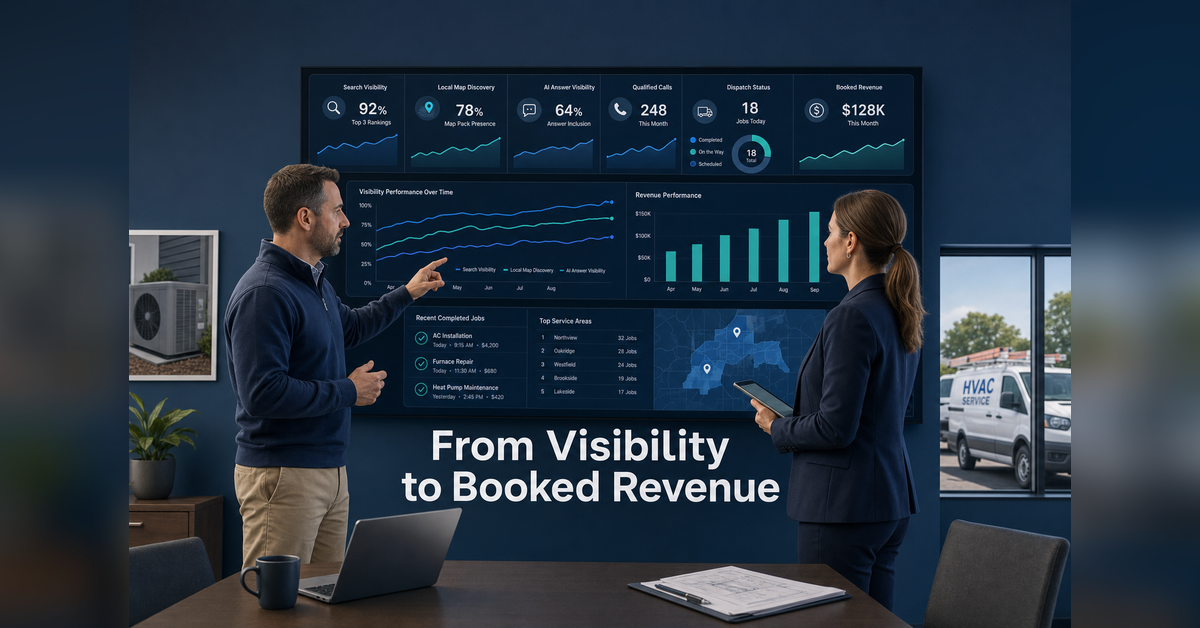

HVAC companies rarely need more disconnected marketing. They need profitable demand in the right service areas for work their teams can answer, book, dispatch, complete and retain. A capable hvac marketing agency should build around those operating limits instead of chasing lead volume alone.
Percepture approaches SEO, Maps, AI search, paid media, content, reviews, PR, conversion and reporting as one revenue system. That gives owners and marketing leaders a clearer view of where demand starts, where opportunities leak and what should change next.
Built for complex contractor growth
HVAC buyers need clear proof before they call. Percepture has worked across construction, engineering, infrastructure and complex B2B markets since 2004.






What does an HVAC marketing partner do?
An hvac marketing agency helps an HVAC company create demand, appear in search results and AI answers, establish trust, convert visitors into calls and connect those opportunities to booked and completed jobs. The right partner coordinates SEO, paid media, content, reviews, PR, website conversion, follow-up and measurement around the contractor’s territory and capacity.
For a broader introduction to channel planning, see Percepture’s digital marketing guidance for construction companies.
How to choose an HVAC marketing agency
- Verify experience with HVAC, contractors or closely related service businesses.
- Require proof with dates, baselines, spend and clear business definitions.
- Confirm that reporting connects inquiries to qualified, booked and completed work.
- Check who owns every account, asset, phone number and dataset.
- Test the plan against territory, margins, seasonality and operating capacity.
- Require coordination across search, AI visibility, paid media, trust, conversion and follow-up.
- Compare scope, access, accountability, contract terms and reporting before comparing price alone.
Executive summary
Start with economics
Priority services, margins, service areas and open capacity should shape the plan.
Connect the channels
A strong marketing partner should connect visibility, trust, conversion, response and reporting.
Measure real work
Track qualified leads, booked jobs, completed work, revenue and customer acquisition cost.
Protect your assets
Your company should own its accounts, data, phone numbers, content and access rights.
Who should hire an HVAC marketing agency?
Before hiring an outside marketing team, an established contractor should be able to identify priority services, approved territories, capacity constraints and a person responsible for lead follow-up. The company also needs access to its website, analytics, advertising accounts, Business Profiles, call records and sales data.
A smaller operator can still benefit, but the agency scope must match the business. It may be smarter to fix call handling, service-page clarity or measurement before launching a broad campaign. More inquiries will not solve unanswered calls, unavailable appointments or poor lead disposition.
Ready for an agency or fix operations first?
Use these operating conditions to decide whether a marketing partner can create useful demand now or whether internal constraints need attention first.
| Ready for an agency | Fix operations first |
|---|---|
| Priority services and territories are defined | Every service and location is treated as equal |
| Calls and forms have an accountable owner | Missed calls receive no consistent follow-up |
| Capacity can be reviewed by day or market | The dispatch team cannot absorb more demand |
| Core accounts and data are accessible | Previous vendors control key accounts or assets |
| Leadership can define a qualified opportunity | All inquiries are reported as equal leads |
Find out where good HVAC leads are getting lost
Before you spend more, check whether the problem is targeting, missed calls, poor follow-up or weak booking paths.
- Check whether leads fit your services and territory
- Find leaks between the first call and the booked job
- See the next fixes your team should make
What an HVAC marketing agency should manage
The agency scope should begin with market and opportunity planning. That means identifying profitable services, useful territories, residential or commercial priorities, seasonal pressure and work the company does not want. Percepture’s strategy and planning services are built for this type of coordinated decision-making.
The search team should connect organic visibility to technical health, useful service pages, local relevance, internal links and content that answers real buyer questions. Contractors evaluating deeper search work can review Percepture’s enterprise SEO capabilities and its guide to organic SEO services.
The agency should make the company, services, locations, expertise and proof easy for AI-search systems to understand. This work should reinforce sound SEO rather than replace it. Percepture’s generative engine optimization services address discoverability across search and answer systems.
The paid media team should separate demand capture for repair, replacement, maintenance and commercial intent where the account structure supports it. Budgets and targeting should change with capacity. Learn more about Percepture’s paid search management.
Trust also needs active management. Reviews, project evidence, leadership expertise, community authority and earned coverage help buyers evaluate an unfamiliar contractor. Percepture connects these signals through digital PR and broader public-relations programs.
The website must then turn attention into action. Service fit, location fit, emergency paths, forms, calls and next steps should be clear on mobile devices. Percepture’s conversion rate optimization services focus on these decision points.
Channel roles in an integrated HVAC program
Use this channel view to confirm that the marketing team assigns each tactic a defined job, signal and operating limitation.
| Channel | Primary job | Leading signal | Common limitation |
|---|---|---|---|
| SEO and local search | Build durable discovery for services and locations | Qualified organic calls and forms | Competitive gains can take time |
| Paid search | Capture active demand with budget control | Qualified opportunity cost | Poor targeting can waste spend quickly |
| Local Services Ads | Capture eligible local service inquiries | Valid calls and bookings | Availability and competition vary by market |
| AI search | Improve clarity and citation potential in answer experiences | Relevant mentions and referral activity | No provider can promise inclusion |
| PR and reviews | Build third-party authority and buyer confidence | Approved coverage, reviews and referral paths | Authority cannot be manufactured on demand |
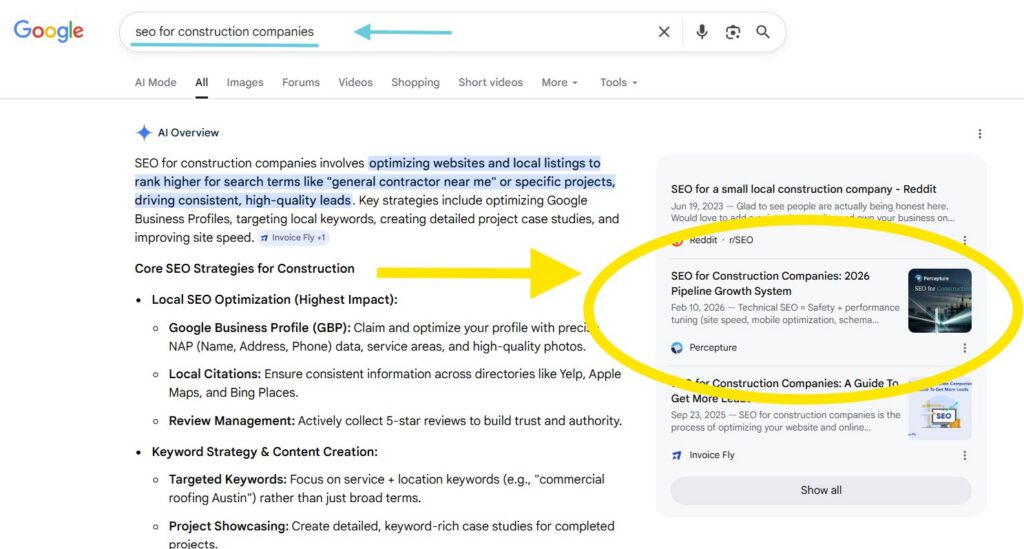
The Integrated HVAC Visibility-to-Revenue Stack
Percepture’s Integrated HVAC Visibility-to-Revenue Stack is a seven-layer operating model. It gives the agency and client one shared view of the path from market selection to completed work. Each layer has a business question, an owner and a measurable handoff.
Layer 1: Market, margin and capacity intelligence
Document priority services, territories, customer types, seasonal peaks, operating limits and exclusions. The first test for an agency is simple: does the plan reflect what the company can profitably fulfill?
Layer 2: Search, Maps and AI visibility
Coordinate technical SEO, service pages, local information, useful answers and entity clarity. Content should reflect real services and proof instead of producing interchangeable location pages. Percepture’s guide to SEO for construction companies explains the wider search foundation.
Layer 3: Paid demand capture
Segment campaigns by intent, geography and service economics. Apply negative keywords, dedicated landing paths and capacity-based budget decisions.
Layer 4: Trust, reviews, PR and proof
Place verifiable credentials, project evidence, reviews, executive expertise and earned authority near buyer decisions. The goal is not a logo wall. The goal is to answer why the contractor is credible for this job.
Layer 5: Website and conversion architecture
Make service fit, location fit and next steps obvious. Test calls, forms, booking paths, thank-you pages and tracking so the site can measure completed actions.
Layer 6: Lead activation and dispatch
The agency and client should track answer rate, response time, valid service area, valid service type, qualification, booking, dispatch, estimate and close. Percepture’s lead generation services can support this connection between demand and action.
Layer 7: Revenue, retention and learning
Review completed work, revenue, gross profit, acquisition cost, repeat business and results by channel, service and location. Feed those findings back into targeting and budget decisions.
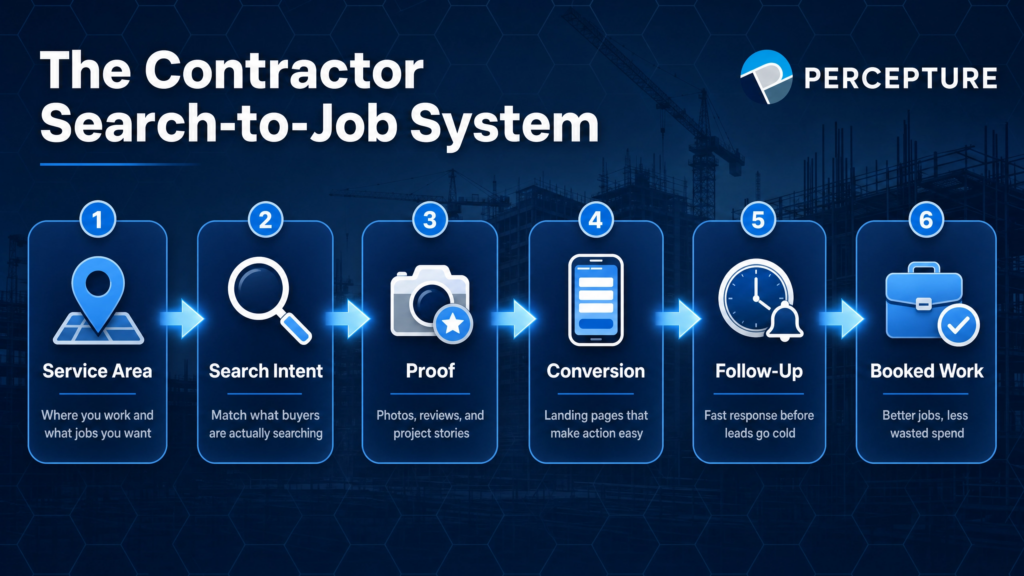
See what the work may cost
Agency proposals can look similar while covering very different work. Compare strategy, content, media, software, reporting and support before you sign.
- See clear service and pricing paths
- Match the scope to your markets and goals
- Know what is included before the work starts
Specialist, generalist, in-house team or lead vendor?
When evaluating an agency, remember that no model is right for every company. An HVAC specialist may reduce the learning curve, while a strong generalist can bring broader search, PR, content and analytics depth. An internal team offers control but must cover several disciplines. A lead vendor may provide speed without building an owned demand asset.
The best marketing partner for a particular contractor is the one whose operating model fits the company’s markets, team, data and goals. Specialization is useful only when it improves decisions and execution.
| Model | Best fit | Strength | Watch for |
|---|---|---|---|
| HVAC specialist | Contractor seeking category familiarity | Faster understanding of service demand | Narrow channel depth or rigid playbooks |
| Integrated generalist | Company needing search, PR, paid media and analytics | Cross-channel capability | Weak operating discovery if industry context is ignored |
| In-house team | Larger organization with hiring and management capacity | Direct control and daily access | Cost and difficulty covering every specialty |
| Lead vendor | Operator seeking immediate inquiry volume | Fast access to demand | Shared leads, variable quality and limited asset value |
Where most agency plans break
The first failure is optimizing for raw lead volume. A form submission outside the service area is not equal to a booked replacement job. A call that nobody answers creates no value. Reporting must preserve those differences.
The second failure is channel isolation. A connected agency team should use search content, paid keywords, call outcomes, customer questions and PR opportunities to inform each other. Percepture’s omnichannel marketing service is designed to coordinate those signals.
The third failure is unclear ownership. A proposal should identify who controls the domain, website, content, advertising accounts, analytics, Business Profiles, call numbers, creative and customer data. Access during the engagement and transfer rules at exit belong in writing.
The fourth failure is vague AI language. Ask the agency to explain the pages, entities, citations, technical controls and measurement it will work on. A credible answer will be more specific than adding an AI label to standard content production.
What practical operating experience looks like
Percepture’s documented contractor and infrastructure work has included conversion tracking tied to thank-you pages, pausing a broad paid-search term that produced wrong-intent traffic, planning industry pages, coordinating content assets and building technical lead magnets with landing pages and follow-up sequences.
A specialist agency should combine search demand with the services customers request, the locations the company has served, the proof it can publish and the work the operations team can fulfill.
This operating lesson matters because the agency must make targeting decisions with field and sales context, not keyword data alone.

HVAC marketing agency pricing and contract models
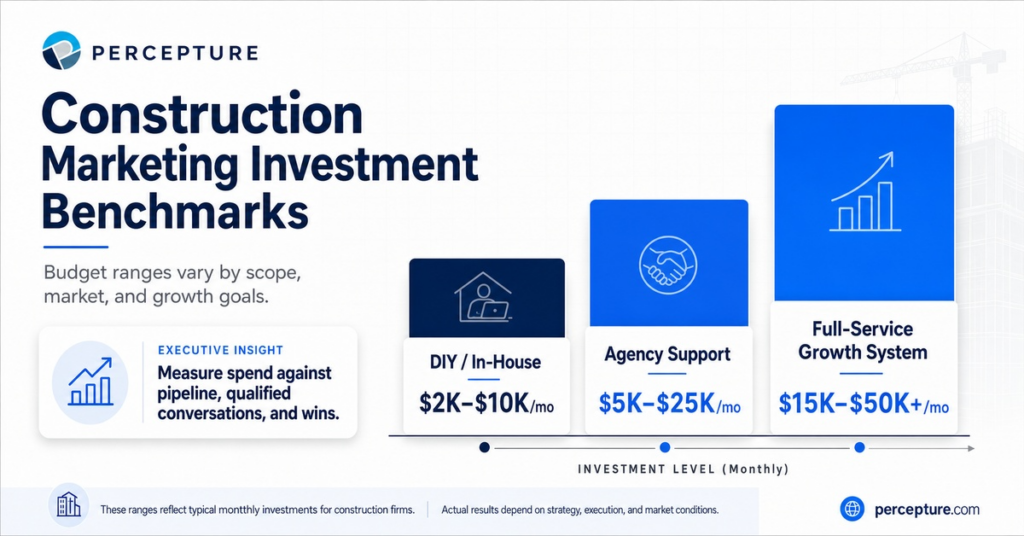
There is no useful universal agency price. Scope changes with market count, competition, website condition, content needs, media spend, tracking, software, creative production and internal support. Compare the full investment rather than a retainer in isolation.
Separate five cost buckets: agency strategy and management; media spend; website, creative and content production; tracking, call and automation tools; and internal labor for approvals, sales and implementation. This prevents a low headline fee from hiding the true operating requirement.
| Model | Best fit | Main risk |
|---|---|---|
| Fixed project | Audit, website, setup or migration | Improvement may stop after launch |
| Monthly retainer | Ongoing integrated execution | Scope and accountability may become vague |
| Percentage of media spend | Paid-media management | The fee can reward spend rather than profit |
| Performance model | Clearly defined outcomes with dependable attribution | Definitions can distort incentives |
| Pay per lead | Short-term access to inquiries | Quality, exclusivity and ownership may be limited |
| Hybrid | Mature operator with strong tracking | The contract and attribution rules are more complex |
Ask every bidder to identify what is included, excluded and billed separately. Contract length should match the work, but the agreement should also explain access, termination, asset transfer and unfinished deliverables.
What the first 90 days should accomplish
Days 1–30: Establish control and measurement
Secure access, document ownership and audit the website, analytics, calls, ads, Business Profiles, CRM data, conversion paths and baseline performance. Map services, territories, margins and capacity before making large budget changes.
Days 31–60: Build the operating foundation
Prioritize technical fixes, core service architecture, campaign changes, conversion paths, review workflows, useful content and missed-call processes. The exact order should follow the audit rather than a fixed production calendar.
Days 61–90: Learn and expand carefully
Use query, call and sales outcomes to refine targeting. Strengthen useful pages and authority signals, compare qualified and booked outcomes, and create the next-quarter plan.
A marketing partner should present milestones rather than promise a ranking date. Paid and tracking changes may generate usable data before organic search and authority programs mature, but timing varies by market, domain, budget and competition.
Reporting from inquiry to completed work
Traffic and raw leads are diagnostic numbers, not business outcomes. Percepture’s attribution and analytics services help organize the path from source to action.
Use one reporting dictionary
| Stage | Working definition | Management question |
|---|---|---|
| Raw inquiry | Any call, form, message or booking request | Did a person attempt contact? |
| Valid lead | A real person with plausible contact information | Is the inquiry genuine? |
| Qualified lead | Correct service, location, urgency and customer fit | Could the company serve this opportunity? |
| Booked job | An appointment or estimate accepted and scheduled | Did the team secure the next step? |
| Completed job | Work performed or a project closed under the company’s definition | Did the opportunity become delivered revenue? |
A useful agency report explains what happened, why it may have happened, what changed, what the client must address and what happens next. It should also show which spend should increase, decrease, pause or move.
Use the 100-point HVAC Agency Fit Scorecard
This scorecard is a Percepture decision aid, not an industry benchmark. Use it to compare each agency across the same operating criteria. Score each category from zero to ten. Require supporting evidence for high scores instead of relying on proposal language.
| Evaluation category | Points | Evidence to request |
|---|---|---|
| HVAC and service-business understanding | 10 | Discovery questions and relevant operating examples |
| Market, territory, margin and capacity planning | 10 | Targeting and exclusion process |
| SEO, Maps, content and technical competence | 10 | Audit method and implementation ownership |
| AI-search and citation methodology | 10 | Specific entity, content, technical and tracking work |
| Paid media control | 10 | Segmentation, negatives, budget and landing-page process |
| PR, reviews and authority | 10 | Ethical review and earned-authority plan |
| Website conversion and lead activation | 10 | Testing, call handling and follow-up workflow |
| Attribution to completed work | 10 | Shared definitions and source-to-revenue reporting |
| Proof quality and transparency | 10 | Dates, baselines, scope, spend and limitations |
| Ownership, access and strategic fit | 10 | Written account, asset and exit terms |
Score bands
- 0–39: High-risk vendor.
- 40–59: Partial channel provider.
- 60–74: Capable agency with important gaps.
- 75–89: Strong integrated partner.
- 90–100: Enterprise-ready visibility-to-revenue partner.
Automatic disqualifiers
- The vendor controls the client’s domain or Business Profile.
- The client cannot access advertising, analytics, call or CRM data.
- Reporting ends at impressions, traffic or raw leads.
- Case studies omit basic context.
- The vendor guarantees organic rankings.
- The plan uses fake or policy-violating review tactics.
- There is no process for missed calls or lead disposition.
- The contract blocks access to assets after termination.
- The vendor cannot explain its AI-search work.
Why Percepture approaches HVAC marketing differently
Percepture was founded in 2004 and is a five-time Inc. 5000 company and an NMSDC-certified business. Bob Generale serves as President and Partner. Those credentials provide company context; buyers should still evaluate the proposed team, scope, proof, access and reporting.
Percepture’s distinction is the integration of search, AI visibility, paid demand, PR, content, conversion and analytics. The Integrated HVAC Visibility-to-Revenue Stack keeps those disciplines tied to service economics, field capacity and completed-work data.
That does not make Percepture the right partner for every contractor. Companies looking only for shared leads or an isolated production task may prefer a narrower vendor. Percepture is better aligned with leadership teams that want coordinated strategy, transparent measurement and senior involvement.
Questions to ask during the final agency interview
- Which services, markets and customer types would you prioritize first, and why?
- How will you separate raw inquiries from qualified, booked and completed work?
- What does the client own, and what happens to every asset at exit?
- Which fees are separate from media, production, software and internal labor?
- How will capacity, missed calls and booking outcomes change campaign decisions?
- What proof can you show with dates, definitions and limitations?
- What specific SEO and AI-search work will you perform?
- Which decisions will appear in the monthly report?
Frequently asked questions
What is an HVAC marketing agency?
An hvac marketing agency plans and manages programs that help HVAC companies create demand, become discoverable, build trust and convert attention into sales opportunities. Its work may include SEO, paid search, AI-search optimization, PR, reviews, content, website conversion, lead follow-up and attribution.
How much does an HVAC marketing agency cost?
Cost depends on the number of markets, services, channels and deliverables involved. Separate agency fees from media spend, website work, content production, software and internal implementation. Compare proposals using the same scope and cost buckets rather than choosing the lowest retainer.
Is an HVAC specialist better than a general agency?
Not automatically. An HVAC specialist may understand service demand faster, while an integrated generalist may offer deeper PR, analytics, content or technical capability. Compare the actual team, method, operating questions, proof and reporting rather than relying on the specialist label.
Should one agency manage SEO, paid search and AI visibility?
One accountable partner can reduce conflicting strategies and disconnected reporting. The agency still needs qualified specialists for each discipline. Ask how search queries, paid outcomes, sales feedback, content and authority work will share data and influence decisions.
How long does HVAC marketing take to work?
Timing varies by channel, market, website condition, competition and budget. Tracking and paid-media changes can produce data sooner than organic search or authority work. A sound plan uses 30-, 60- and 90-day milestones without promising a fixed ranking date.
Should an agency guarantee rankings or leads?
Treat guaranteed organic rankings as a warning sign. Lead commitments also require precise definitions for service, location, quality, exclusivity and attribution. Ask what is controlled, what is not controlled and how invalid opportunities are handled.
Who should own the website, accounts and data?
The agreement should state ownership and access for the domain, website, content, advertising accounts, analytics, Business Profiles, call numbers, creative and CRM data. It should also explain transfer steps and access rights when the engagement ends.
Which metrics matter most?
Track raw inquiries, valid leads, qualified opportunities, booked jobs, completed work, revenue, gross profit and customer acquisition cost where dependable data is available. Also monitor answer rate, booking rate, service area, service type and lead source.
Get a clear HVAC growth plan
Percepture can review your search visibility, AI answers, paid-media waste, proof, website paths and lead handling.
- Find the biggest gaps hurting demand and bookings
- See which channels should change first
- Get a practical 90-day action plan