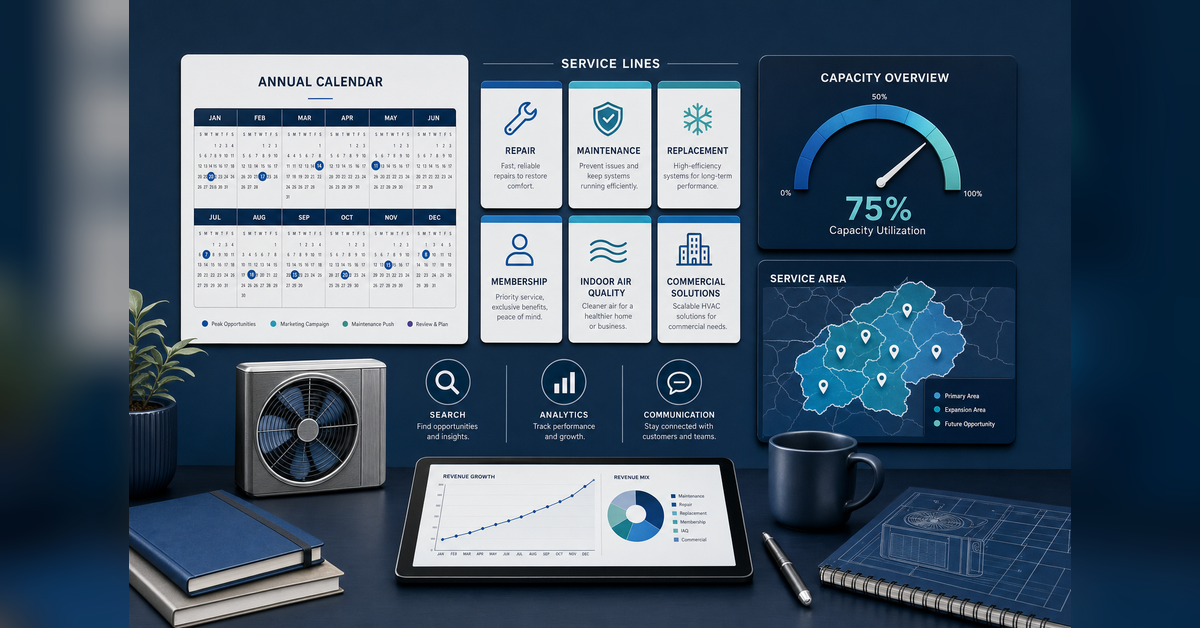

Effective hvac marketing strategies start with revenue, service mix, capacity, seasonality, and service areas—not a list of channels. The plan must show which work the company wants, when it wants that work, and whether the team can answer, sell, and fulfill the resulting demand.
This guide gives owners and marketing leaders a practical annual operating system. It connects the marketing calendar to dispatch, technicians, install crews, sales follow-up, and booked revenue so growth decisions do not sit apart from operations.
Built for contractor growth
HVAC growth plans work better when marketing, sales and operations share the same goals. Percepture has worked across construction, engineering, infrastructure and complex B2B markets since 2004.






What is the best way to build an HVAC marketing plan?
The best hvac marketing strategies set a demand target, pass that target through a capacity gate, prioritize service lines, map regional seasonality, select channels by purpose, build a 12-month calendar, repair the lead-response path, and measure booked and sold work. Channel selection comes after the company decides what profitable demand it can fulfill.
- Set revenue and capacity goals. Define the work required and the operational room available to deliver it.
- Choose priority service lines. Decide whether the plan should emphasize repair, maintenance, replacement, memberships, indoor air quality, commercial work, or a controlled mix.
- Define customers and service areas. Focus on the people, properties, and territories the company can serve efficiently.
- Map seasonality and constraints. Plan around local weather, staffing, inventory, install capacity, and shoulder seasons.
- Select the demand-channel mix. Within the HVAC growth plan, assign each channel a specific job instead of asking every channel to generate immediate leads.
- Build the annual calendar. Set monthly priorities, production deadlines, offers, proof assets, and owners.
- Connect lead response and sales follow-up. Track calls and forms through booking, estimates, sold jobs, and recorded revenue.
- Review and adjust. Stop, maintain, or scale channels based on capacity, lead quality, and financial outcomes.
Executive operating summary
Start with operations
Check technician, install, dispatch, call-center and service-area limits before increasing demand.
Plan by service line
Repair, maintenance, replacement, membership and commercial work need different plans.
Give each channel one job
Separate immediate demand, long-term visibility, authority, retention and partner demand.
Manage to jobs and revenue
Use traffic for diagnosis. Use booked jobs, sold work and profit for decisions.
These rules keep the marketing plan tied to the operating plan instead of a disconnected dashboard.
Who this guide is for
Owners and operators
Use the plan to match demand with the work your team can serve and complete.
Marketing leaders
Use one calendar and one set of business measures across every channel.
Multi-location groups
Keep shared standards while planning for local weather, staffing and market needs.
Residential and commercial teams
Build separate buyer paths when urgency, proof and sales cycles are different.
What are hvac marketing strategies?
An HVAC marketing strategy is the set of choices that determines which customers, services, markets, and types of demand the company will pursue. Effective HVAC marketing strategies turn those choices into timing, ownership, budgets, campaigns, and measurement. A tactic is one action. A campaign is a coordinated group of actions with an audience, offer, schedule, and goal.
The distinction matters. Publishing a service page is a tactic. Building local visibility for replacement searches across selected service areas is a strategy. Coordinating that page with paid search, reviews, email, landing pages, and follow-up is a campaign within the broader HVAC growth plan. The broader digital marketing for contractors guide explains how these channel roles fit across specialty trades.
Strategy, plan, tactic, and campaign comparison
Use this hierarchy to keep the HVAC growth plan focused on operating choices while plans, campaigns, and tactics handle execution.
| Level | Question answered | Typical horizon | Example |
|---|---|---|---|
| Strategy | Where will we compete and why? | Annual or multi-year | Use the HVAC growth plan to prioritize replacement demand in selected territories without exceeding install capacity. |
| Plan | What will happen, when, and who owns it? | Quarterly and annual | Map campaigns, channels, assets, deadlines, and reporting by month. |
| Campaign | How will we move one audience toward an action? | Weeks or months | Coordinate pre-season maintenance outreach across search, email, and landing pages. |
| Tactic | What specific action will we execute? | Days or weeks | Publish a service-area page or send a maintenance reminder. |
Find where good leads are getting lost
Before you spend more, check the path from the first call to the booked job.
- Check lead quality and service-area fit
- Find missed-call and follow-up gaps
- See the next fixes your team should make
The eight-step HVAC marketing plan
Strong HVAC marketing strategies follow a sequence. Skipping directly to media selection creates a plan that may generate demand for low-priority work, distant service areas, or time periods when technicians and installation crews are already full.
- Set the demand target. Translate company goals into required sold jobs, estimates, qualified leads, and calls using company-specific inputs.
- Choose the service mix. Rank services by strategic importance, capacity, sales path, customer value, and operational fit.
- Define the market. Choose residential, commercial, or mixed audiences and identify profitable territories.
- Model constraints. Document staffing, drive time, inventory, financing, scheduling, and call-handling limits.
- Build the channel portfolio. Use paid media for controlled demand, search content for compounding visibility, and retention channels for existing customers.
- Create the calendar. Assign monthly triggers, services, audiences, offers, assets, channels, KPIs, and owners.
- Fix response and follow-up. Make leads from the HVAC growth plan traceable from source through booking and sold work.
- Run a measurement loop. Review diagnostics frequently and make larger allocation decisions on a stable operating cadence.

Start with revenue, margin, and operational capacity
A useful plan converts a business goal into the amount of demand the company needs. Every input used in the HVAC growth plan is company-specific. Do not replace actual sold-job values, close rates, booking rates, or capacity limits with broad industry averages.
Revenue target
Define the revenue required from each priority service rather than giving marketing one blended company target. This prevents a surge in small repair calls from hiding a shortfall in replacement, maintenance, membership, or commercial goals.
Gross-profit target
Revenue alone does not show whether the HVAC growth plan produced desirable work. Record the gross profit associated with sold jobs by service and source when the company’s systems support that view. Use the result to question channel quality, pricing, sales execution, and service mix.
Technician capacity
Estimate available service appointments by day, territory, and skill set. Include existing demand, callbacks, maintenance obligations, travel, and realistic schedule conditions. If the schedule is full, the HVAC growth plan should shift from generating more repair calls to controlling geography, promoting a different service, or building future demand.
Installation capacity
Replacement campaigns need available survey, estimating, financing, equipment, and install capacity. A lead is not useful if the company cannot schedule the sales process or complete the work within an acceptable operating window.
CSR and dispatcher capacity
Forecast call volume from the HVAC growth plan by time of day and channel. Document answer coverage, overflow handling, missed-call recovery, qualification rules, and booking authority. More media can magnify an unanswered-call problem rather than solve a demand problem.
Geographic capacity
Map ZIP codes and service zones against drive time, route density, technician location, and service profitability before expanding the HVAC growth plan into new territories. Broad geographic reach can look attractive in an advertising interface while reducing the number of jobs a technician can complete.
Company-specific funnel math
Required revenue ÷ average sold-job value = required sold jobs
Required sold jobs ÷ close rate = required estimates
Required estimates ÷ estimate or booking rate = required qualified leads
Use separate calculations by service line so the HVAC growth plan reflects each service’s economics. Validate every input against the company’s CRM, call records, field-service platform, and financial reporting.
Service-line comparison for hvac marketing strategies
Service lines within the HVAC growth plan should not share one economics model. They differ in urgency, decision time, proof requirements, staffing, and the action marketing should produce. The table below avoids unsupported ticket and margin assumptions while showing how to plan each category.
| Service line | Demand urgency | Sales path | Capacity dependency | Proof needed | Best channel role | Primary KPI |
|---|---|---|---|---|---|---|
| Emergency repair | Immediate | Call or rapid booking | Technician and dispatch availability | Availability, service area, trust, clear next step | Demand capture | Booked qualified calls |
| Maintenance | Plannable | Appointment scheduling | Route density and appointment inventory | Process, convenience, reminders | Retention and seasonal demand | Completed appointments |
| Replacement | Mixed | Consultation, estimate, follow-up | Advisor, financing, equipment, install crew | Expertise, options, projects, reviews | Capture plus demand creation | Sold replacement jobs |
| Membership | Low to moderate | Enrollment during or after service | Future maintenance capacity | Clear terms and customer value | Retained demand | Membership conversion |
| Indoor air quality | Problem or education led | Assessment and recommendation | Diagnostic and installation skills | Plain-language education and appropriate proof | Demand creation | Qualified assessments |
| Commercial HVAC | Planned or urgent | Multi-contact evaluation, bid, or service agreement | Technical, geographic, and account capacity | Capabilities, relevant experience, process | Authority and account development | Qualified opportunities |
Choose profitable customers, markets, and service areas
Market selection for the HVAC growth plan should combine customer fit with operating reality. Residential work may depend on homeowner urgency, property characteristics, system condition, financing, and local trust. Commercial work may involve property managers, facilities teams, procurement, technical evaluation, and longer follow-up.
Evaluate new and existing customers separately. New-customer acquisition may require paid search, organic visibility, reviews, and strong landing pages. Existing customers can be reached through maintenance reminders, service history, email, referrals, and appropriate membership communication. Percepture’s customer journey service is relevant when those paths are fragmented.
Score each service area before extending the HVAC growth plan into it, using drive time, route density, climate, property mix, local competition, existing customer density, and the company’s ability to provide the promoted service. Avoid publishing thin location pages that do not give residents useful, area-specific information. Broader guidance on search architecture is available in SEO for construction companies.
Service-area fit check
Operational fit
Can the right technician or crew serve the area without hurting schedule efficiency?
Service fit
Does the territory have demand for the priority services in the plan?
Sales fit
Can the company quote, finance, follow up and close the work being promoted?
Measurement fit
Can calls, forms, appointments, sold jobs and revenue be reported by territory?
Plan around HVAC seasonality
Seasonal HVAC marketing strategies should be built from local climate triggers and available capacity, not a rigid national template. Florida, Texas, and Arizona do not share the same operating calendar as Pennsylvania or Minnesota. Each market needs editable trigger dates, service priorities, and production deadlines.
Pre-season is the time to prepare the service pages, landing pages, paid campaigns, email segments, call scripts, proof assets, and scheduling rules required by the HVAC growth plan. Cooling peak may require tighter geographic controls and daily capacity checks. Late summer can support replacement follow-up where the service and install teams have room.
Fall shoulder season can shift attention to maintenance, database reactivation, reviews, memberships, content production, and heating preparation. Winter emergency periods need accurate availability, strong call handling, and clear service-area controls. Weather can change timing, so the plan must allow operators to advance, pause, or replace campaigns.
Build a channel portfolio by job
No single channel should carry the entire HVAC growth plan. The portfolio should balance immediate demand, compounding visibility, authority, retention, and offline relationships. Percepture’s omnichannel marketing service is designed around coordinating those roles rather than managing them as isolated tasks.
Immediate demand
Paid search and tightly controlled local campaigns can help the HVAC growth plan reach people already looking for service. They need accurate targeting, dedicated landing pages, call tracking, schedule awareness, and fast response. Use paid search strategy when the company needs controllable demand by query, service, territory, or schedule.
Compounding demand
Search visibility grows through useful service pages, location information, educational resources, internal linking, technical accessibility, and ongoing improvement. An SEO program can coordinate architecture and content, while a planned construction content marketing system helps maintain a useful editorial pipeline.
Authority and AI visibility
Search engines and answer systems need clear information about the company, its services, locations, people, and expertise. Expert-led content, structured entity information, original tools, and third-party mentions can support that clarity. Explore generative engine optimization services and digital PR for the search, answer-engine, and earned-authority layers.
Retained demand
Email and customer communication give the HVAC growth plan a path to maintenance reminders, seasonal preparation, membership engagement, estimate follow-up, referrals, and reactivation. Segment messages by customer history and service relevance rather than sending every promotion to the entire database. Percepture’s email marketing service supports this retained-demand role.
Offline and partner demand
Manufacturer and distributor relationships, community involvement, truck branding, sponsorships, and referral partners can create awareness and trust. Track those influences where practical, but do not force every offline touch into a false last-click attribution model.
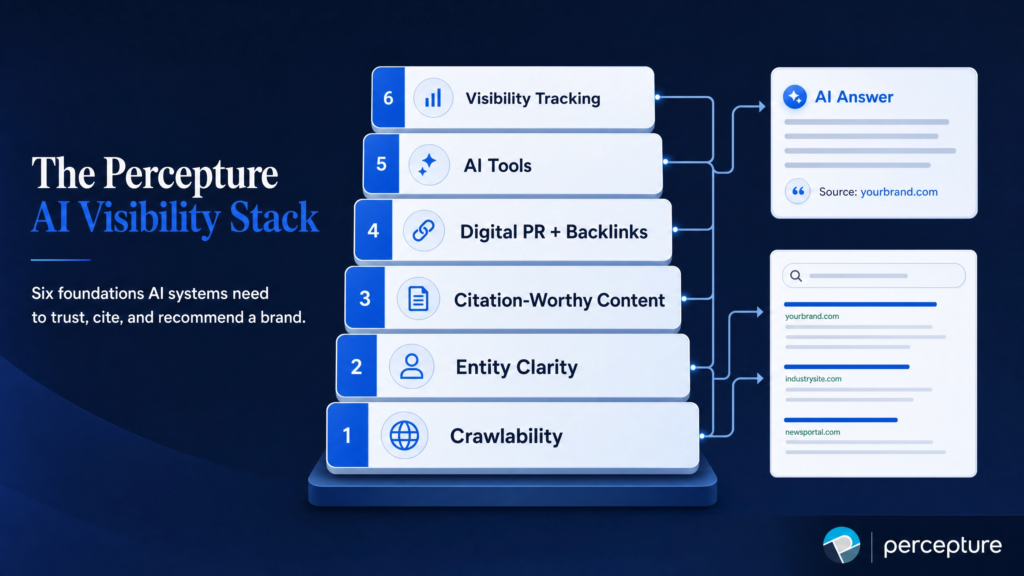
The Percepture Demand-to-Capacity System for HVAC marketing strategies
The Percepture HVAC Demand-to-Capacity Growth System is a planning model that matches profitable demand from the HVAC growth plan to the services, territories, people, and time periods an HVAC company can fulfill. It keeps marketing, dispatch, sales, field operations, and finance working from the same assumptions.
- 1Demand target: Define the sold work required by service line and market.
- 2Capacity gate: Check technician, crew, CSR, dispatcher, inventory, financing, and geographic limits.
- 3Service economics: Use company-specific values and conversion rates to determine acceptable acquisition conditions.
- 4Channel orchestration: Assign immediate, compounding, authority, retained, and partner channels their proper jobs.
- 5Measurement loop: Diagnose the path from impression and click through call, booking, estimate, sold job, and recorded revenue.
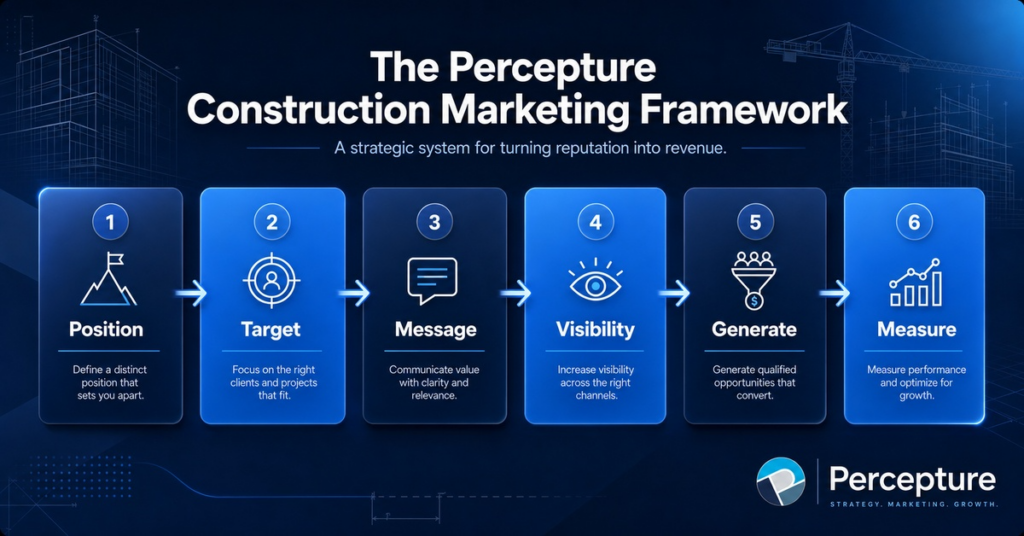
Meet with the team
Bring your service goals, markets and capacity limits. We will help you see what should change first.
- Review the plan with a senior team
- Find gaps between marketing and operations
- Leave with clear next steps
Build the 12-month HVAC growth calendar
The annual calendar turns the HVAC growth plan into production work. Each row should tell the team what trigger to watch, which service to prioritize, what assets must exist, who owns the work, and how the result will be evaluated.
| Period | Climate trigger | Priority | Primary action | Support action | KPI | Owner |
|---|---|---|---|---|---|---|
| January | Local winter conditions | Heating service or market-specific priority | Validate availability and emergency paths | Review missed calls and follow-up | Booked qualified jobs | Operations and marketing |
| February | Pre-season planning window | Maintenance and upcoming cooling needs | Build campaign assets and segments | Refresh proof and landing pages | Production readiness | Marketing |
| March | Cooling preparation | Tune-ups and maintenance | Launch based on local weather | Run customer reminders | Completed appointments | Marketing and dispatch |
| April | Rising cooling demand | Maintenance, repair, or replacement | Adjust service and territory mix | Monitor schedule capacity | Booking rate | Operations |
| May | Peak approaches | Cooling repair and replacement | Tighten paid and organic conversion paths | Prepare overflow rules | Cost per booked job | Marketing and CSR lead |
| June | Peak cooling conditions | High-urgency services | Control demand by capacity | Recover missed calls | Sold jobs by source | Operations and sales |
| July | Sustained local demand | Capacity-fit service mix | Maintain, pause, or redirect campaigns | Review geographic profitability | Gross profit by source | Leadership |
| August | Late-summer conditions | Replacement follow-up or local priority | Work aged estimates and qualified opportunities | Publish relevant proof | Estimate close rate | Sales |
| September | Shoulder-season transition | Maintenance and reactivation | Segment existing customers | Build heating assets where relevant | Repeat-customer revenue | Marketing |
| October | Heating preparation | Market-specific heating service | Activate weather-based campaigns | Check call scripts and booking | Qualified bookings | Marketing and CSR lead |
| November | Heating demand or warm-market shoulder period | Regional service priority | Use local triggers, not national timing | Review membership engagement | Revenue by service | Leadership |
| December | Winter emergency or annual review | Service response and planning | Protect response paths | Complete annual scorecard | Booked revenue and capacity use | Leadership |
See pricing options
Compare service levels before deciding what belongs in-house and what needs outside support.
- See clear service paths
- Match the work to your goals
- Know what is included
Connect marketing to call handling and sales
More leads from the HVAC growth plan amplify weak operations unless the response path is fixed. Track source, answer status, missed-call recovery, qualification, booking, estimate scheduling, follow-up, lost-lead reason, sold-job attribution, membership conversion, and recorded revenue.
Each lead should have a clear next action and owner. Calls that are not answered need a recovery process. Estimates need a follow-up cadence. Lost opportunities need consistent reason codes. Landing pages should match the promoted service and location instead of sending all paid and organic traffic to the homepage.
A conversion rate optimization program can improve the path from visit to call or form, while attribution and analytics can connect source data to deeper pipeline outcomes where systems permit.
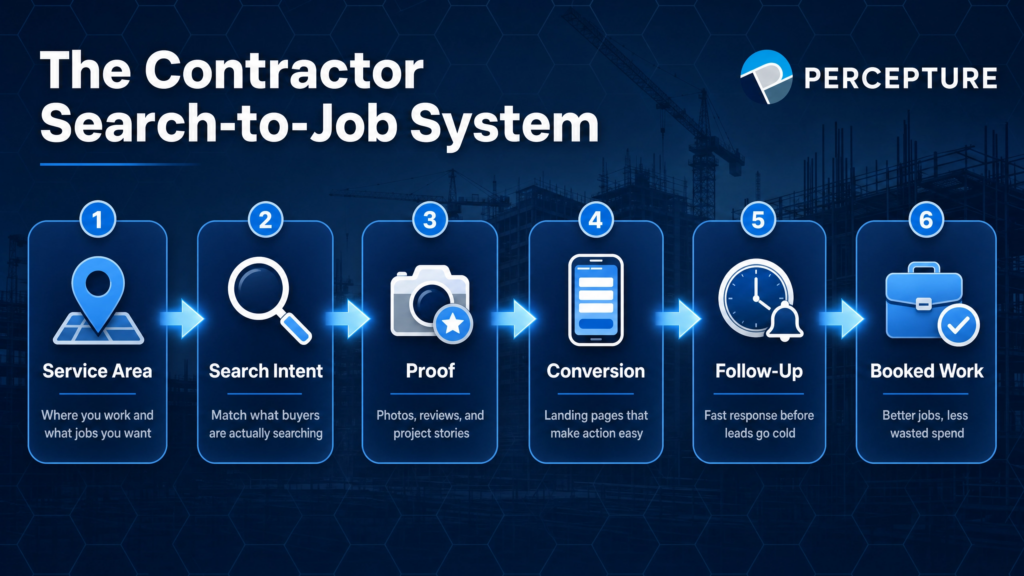
Build the budget with funnel math
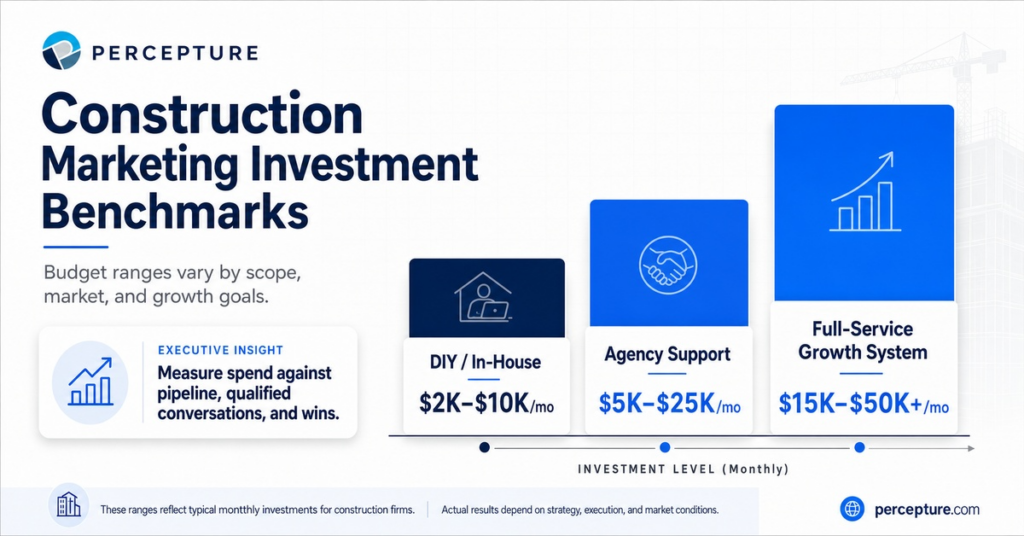
Budgeting for the HVAC growth plan should follow the sequence: goals → sold jobs → estimates → qualified leads → allowable customer acquisition cost → channel budget. Calculate the sequence by service line and use actual company data. A blended cost per lead can hide poor booking quality, weak close rates, or a low-value service mix.
Compare in-house labor, media, technology, creative production, landing pages, reporting, and outside support. The lowest media cost is not automatically the best investment if lead quality, response, or close rates are poor. Likewise, a higher acquisition cost may be acceptable for one service but not another.
Measure booked revenue, not vanity traffic
The scorecard for the HVAC growth plan should separate diagnostic metrics from financial and operational outcomes. Traffic helps explain visibility. Leads help explain response volume. Booked and sold work shows whether the HVAC growth plan is producing business value.
| Metric | Type | What it diagnoses | Decision use |
|---|---|---|---|
| Qualified leads | Diagnostic | Relevant demand reaching the company | Check targeting and offer fit |
| Answer and missed-call rates | Operational | Ability to receive demand | Adjust coverage before scaling |
| Booking rate | Operational | Qualification and call handling | Improve scripts, availability, or targeting |
| Show or estimate rate | Operational | Movement into evaluation | Review scheduling and reminders |
| Close rate | Sales | Estimate quality and sales execution | Review offer, follow-up, and fit |
| Cost per booked job | Financial | Acquisition efficiency past the lead stage | Compare channels and services |
| Customer acquisition cost | Financial | Cost to acquire sold customers | Compare against company economics |
| Revenue and gross profit by source | Financial | Business outcome by channel | Stop, maintain, or scale |
| Membership conversion | Retention | Movement into ongoing relationships | Improve enrollment path |
| Repeat-customer revenue | Retention | Value from the existing customer base | Guide reactivation and service programs |
| Lead-response time | Operational | Speed of first action | Repair routing and ownership |
HVAC channel decision matrix
Use the matrix to decide which channel role belongs in the HVAC growth plan, then scale only when response quality and capacity support it.
| Channel | Speed | Compounding value | Intent | Control | Best use | Main risk | Scale when |
|---|---|---|---|---|---|---|---|
| Paid search | Fast after launch | Low without retained learning and assets | Often high | Strong query and geographic controls | Immediate demand for priority services | Buying demand the team cannot answer | Booking quality and capacity are stable |
| Organic search | Gradual | High when maintained | Mixed by query | Content and market focus | Service, location, and educational visibility | Thin pages or intent overlap | Useful pages produce qualified actions |
| Reviews and reputation | Ongoing | High trust value | Supports evaluation | Process control, not outcome control | Proof across search and sales paths | Inconsistent requests or poor service | Service delivery supports the request |
| Email and SMS | Fast with a usable database | High retention value | Based on relationship and segment | Strong audience control | Reminders, follow-up, and reactivation | Over-messaging or weak segmentation | Customer data and consent are managed |
| Content and video | Gradual | High reusable value | Research and evaluation | Topic and format control | Education, trust, sales support | Generic production without expertise | Questions are tied to services and buyers |
| Digital PR | Variable | Authority can compound | Awareness and evaluation | Message control, limited placement control | Expert visibility and third-party authority | Weak claims or irrelevant outreach | The company has credible expertise or utility |
Sample operating priorities by company stage
Small owner-operated company
keep the HVAC growth plan focused on protecting call response, defining a tight service area, maintaining accurate local information, asking for honest reviews, reactivating suitable existing customers, and using paid demand only where schedule and follow-up can support it.
Five-to-ten-truck growth company
separate service-line reporting, assign CSR and dispatch metrics, build replacement follow-up, improve service and location pages, coordinate paid and organic demand, and review technician capacity by territory.
Multi-location company
use location-level capacity, service mix, call handling, and financial reporting. Centralize standards while allowing local climate, competition, staffing, and property conditions to shape each calendar.
Residential and commercial hybrid
maintain separate audiences, offers, proof, sales paths, reporting, and follow-up. Commercial planning can draw from a broader contractor SEO agency framework, while residential campaigns usually need faster local booking paths.
In each case, the HVAC growth plan should reflect the current operational constraint. A five-truck company with unanswered calls has a different priority from a multi-location company with excess install capacity in one market.
Common HVAC marketing planning mistakes
- Choosing channels before goals, service priorities, and capacity are documented.
- Buying calls the CSR, dispatcher, technician, or sales team cannot handle.
- Treating every service line as if it has the same urgency and sales path.
- Using one national calendar across different climate zones.
- Ignoring existing customers while paying to acquire new ones.
- Reporting leads without connecting them to bookings and sold jobs.
- Changing strategy every week before enough operating evidence exists.
- Using weak attribution as if it were a complete view of customer behavior.
- Publishing generic content without useful expertise or local relevance.
- Sending every campaign to the homepage instead of a matched path.
A social presence may support the HVAC growth plan through proof, recruiting, community visibility, and customer communication, but it should have a defined job. The principles in social media marketing for construction companies can help operators distinguish support activity from direct demand capture.
Limitations and assumptions
No annual plan can remove weather volatility, changes in competitor activity, attribution gaps, offline influence, CRM errors, call-handling problems, pricing changes, or technician availability. Marketing also cannot repair poor service delivery. Forecasts should therefore use ranges, company-specific inputs, and documented assumptions.
Channel performance can change by service, territory, offer, landing page, time of year, and team execution. Review the complete path before blaming or scaling a source. A high lead count can coexist with low booking quality, while a smaller source can produce stronger sold-job outcomes.
How proof should be evaluated
Relevant proof should identify the market, service context, work performed, measurement period, source system, and limitation. Adjacent technical-services examples may demonstrate an approach to search, content, or conversion architecture, but they should not be presented as residential HVAC performance evidence.

When reviewing a marketing partner, ask for evidence that matches the proposed service, market, and business outcome. Separate visibility evidence from lead, sales, and revenue evidence.
20-point annual plan review
- Revenue goals are separated by priority service line.
- Sold-job values and conversion inputs come from company data.
- Technician capacity is mapped by skill, day, and territory.
- Installation capacity includes estimating and financing constraints.
- Call-answer coverage and missed-call recovery are documented.
- Service areas reflect drive time and route density.
- Residential and commercial paths are separated where needed.
- Existing and new customers have distinct plans.
- Seasonal triggers are based on local conditions.
- Pre-season production deadlines are on the calendar.
- Each channel has a defined role.
- Each campaign has an audience, service, offer, owner, and KPI.
- Landing pages match service and location intent.
- Calls and forms can be traced to booking outcomes.
- Estimate follow-up has an owner and cadence.
- Lost opportunities use consistent reason codes.
- Financial reporting reaches sold work where possible.
- Stop, maintain, and scale rules are written down.
- Assumptions and limitations are visible to leadership.
- The plan is reviewed with marketing, operations, sales, and finance.
HVAC marketing plan FAQs
How often should an HVAC marketing plan be updated?
Review operational diagnostics frequently enough to catch missed calls, booking problems, capacity changes, and campaign errors affecting the HVAC growth plan. Conduct a structured monthly performance review and a deeper quarterly planning review. Change annual priorities when service economics, staffing, market conditions, or company goals materially change—not simply because one week underperformed.
How long do HVAC marketing efforts take to work?
Timing depends on the channel and the company’s starting point. Paid campaigns can begin producing activity after launch, while search visibility, content, authority, reviews, and customer retention systems build over longer periods. Response speed does not equal profitability, so evaluate booked and sold work before declaring a channel successful.
How much should an HVAC company spend on marketing?
Start with the revenue and sold jobs required by service line. Work backward through the company’s close rate, estimate rate, booking rate, and allowable customer acquisition cost. Then account for media, labor, creative, technology, landing pages, and reporting. Avoid adopting a generic percentage without testing it against capacity and economics.
Are Google Ads worth it for an HVAC company?
Paid search may be useful when the company has a priority service, a defined territory, available capacity, a matched landing page, reliable call handling, and a way to connect leads to booked and sold work. It is a poor fit when calls go unanswered or the promoted service cannot be fulfilled.
Does SEO work for HVAC companies?
SEO can help an HVAC company become visible for service, location, and educational searches when the site offers useful information and clear conversion paths. Results depend on competition, site condition, content quality, local relevance, authority, and execution. SEO should be measured through qualified actions and business outcomes, not rankings alone.
What is the best low-budget HVAC marketing action?
Begin with operational basics and the existing customer base. Confirm local business information, improve missed-call recovery, request honest reviews after completed service, follow up on open estimates, and send relevant maintenance or seasonal reminders to suitable customer segments. These actions still require staff time, clean data, and consistent service.
Should an HVAC company hire an agency or market in-house?
Keep hvac marketing strategies in-house when the team has the time, channel expertise, production ability, operating data, and authority to coordinate with sales and operations. Use outside support when important capabilities are missing or fragmented. Evaluate partners by relevant process, evidence, transparency, reporting, and their ability to work with operational constraints.
How should hvac marketing strategies account for AI search?
Publish clear, accurate, expert-led information about services, locations, processes, and common buyer questions. Keep important answers available as crawlable text, maintain strong internal links, use accurate structured data, and build credible third-party authority. AI visibility should extend sound SEO and public-relations work rather than replace it.
Schedule a call
We can help turn your HVAC marketing strategies into one practical plan that connects search, paid media, content, PR, analytics and follow-up.
- Bring your service and market goals
- Show us where leads are getting stuck
- Get a clear plan for the next 90 days