Effective hvac marketing starts with a business question: which services, customers, and service areas produce work the company can serve well and profitably? Traffic matters only when it moves through a working path from discovery to a completed job.
That path crosses search visibility, buyer trust, the website, phone response, qualification, scheduling, dispatch, service delivery, and retention. A weak handoff at any point can waste demand that was expensive to create.





What is HVAC marketing?
HVAC marketing is the system an HVAC company uses to create and capture demand, appear when local buyers search, prove it can be trusted, turn calls and visits into booked work, and retain customers. It combines local SEO, AI search, paid media, reviews, content, PR, conversion, response, dispatch, and revenue measurement.
The seven parts of a complete system
- Map profitable services, customers, and service areas.
- Capture demand across search, maps, ads, referrals, and AI answers.
- Prove trust with reviews, credentials, projects, people, and outside authority.
- Convert visitors into qualified calls, requests, and bookings.
- Respond, qualify, schedule, and dispatch while the opportunity is active.
- Measure completed jobs, gross profit, retention, and customer value.
- Improve the system with search, sales, dispatch, and operating data.
The executive view
Start with capacity
Choose markets and job types based on service radius, technician skills, scheduling room, margin, and season, then set hvac marketing priorities around that capacity.
Connect the handoffs
Treat visibility, proof, conversion, response, booking, and dispatch as parts of one operating system.
Measure finished work
Report raw leads, qualified opportunities, bookings, completed jobs, revenue, gross profit, and retention separately.
Control the channel mix
Use owned, paid, earned, local, referral, retention, and AI-mediated visibility for distinct jobs.
For an executive team, the central hvac marketing decision is not how to maximize lead volume. It is how to create the right demand without outrunning the office, sales process, technicians, or dispatch board.
Who this guide is for
Small local companies
Keep hvac marketing focused on core services, accurate local information, reviews, call handling, referrals, and narrow campaigns.
Regional operators
Use hvac marketing to coordinate location coverage, service lines, staffing, media budgets, reputation, and reporting across a wider footprint.
Multi-location platforms
Govern hvac marketing with central standards while preserving distinct local entities, market proof, location pages, and location-level accountability.
Residential and commercial teams
Structure hvac marketing around separate paths for urgent household demand and longer commercial buying cycles, stakeholder groups, procurement steps, and account growth.
Get a quick HVAC lead check
Before you spend more, check where good leads are getting lost. This quick review helps you spot gaps in targeting, calls, booking, and follow-up.
- See if your leads fit your service area
- Find leaks between the click and the booked job
- Get simple next steps your team can use now
Why HVAC marketing works differently
HVAC demand can be urgent, weather-sensitive, local, seasonal, and limited by real operating capacity. A homeowner with no cooling may act differently from a facilities leader planning a replacement, while a commercial buyer may require site review, technical input, budgeting, and several approvals. Those differences make hvac marketing planning dependent on the demand type and buying process.
Geography also changes the economics. A lead can match the advertised service but still be unattractive because of drive time, licensing, technician availability, job type, or scheduling pressure. In hvac marketing, campaign targeting should therefore follow the dispatchable market rather than the largest possible map.
Residential and commercial programs need different proof. Residential buyers often need a clear emergency path, local reviews, financing information, service expectations, and an easy way to call or book. Commercial buyers may need project context, capabilities, safety information, coverage details, technical credibility, and a clear account-development process. The hvac marketing path should reflect those different proof and decision requirements.
Small companies should protect focus. Multi-location organizations need central governance, distinct local proof, unique location information, and reporting that shows where inquiries, bookings, completed work, and losses occurred. The broader digital marketing for contractors model provides useful category context, but HVAC operators must go deeper into urgency, seasonality, dispatch, and replacement economics.
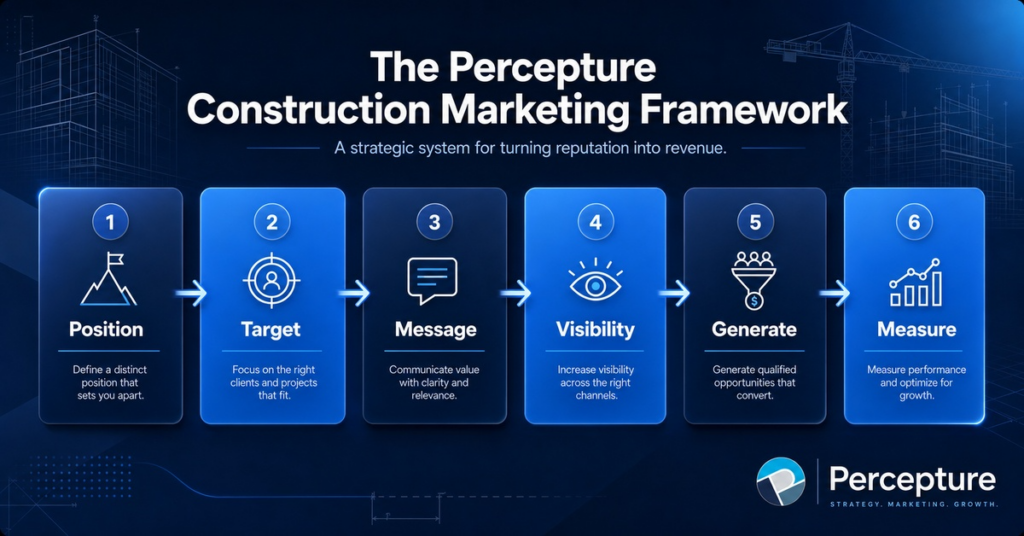
The Percepture HVAC Search-to-Service Growth System
This named Percepture methodology treats hvac marketing as a seven-stage operating model. It connects profitable local demand to visibility, trust, conversion, response, completed work, and retained revenue.
- Profitable Demand Map. Define priority services, customer types, margin logic, ZIP codes, drive times, technician skills, seasonal pressure, available capacity, and jobs to exclude. The map becomes the control layer for content, media, service pages, and reporting, keeping hvac marketing aligned with work the company wants and can serve.
- Search and AI Visibility. Coordinate local listings, organic search, service and location pages, useful answers, images, video, and clear entity information. This gives hvac marketing a consistent visibility foundation across traditional and AI-assisted discovery. Broader enterprise SEO support fits organizations that need governance across many locations, while generative engine optimization services address visibility in AI-assisted research.
- Paid Demand Capture. Use tightly controlled search and media campaigns for selected services, markets, seasons, and urgency levels. Paid search can support demand that needs immediate capture, but budgets should follow the work the operation can accept.
- Trust Velocity. Publish reviews with service context, credentials, team information, project examples, installation processes, warranties, financing explanations, and clear expectations. Digital PR can add credible third-party visibility when the company has expertise, people, data, or community work worth covering.
- Conversion. Give each visitor an obvious next step: call, request service, schedule an estimate, confirm coverage, review financing, or understand what happens after submitting. Conversion rate optimization helps diagnose where page structure or user friction is losing valid demand.
- Response, Qualification, and Dispatch. Record answer status, missed-call recovery, response time, location, job type, urgency, availability, qualification, booking, cancellation, dispatch, estimate, and close. Lead generation should be judged against this operating path rather than forms alone.
- Revenue, Retention, and Learning. Connect sources to completed jobs, revenue, direct job costs, acquisition expense, maintenance relationships, repeat work, referrals, and customer value. Attribution and analytics can connect marketing records with sales and operating outcomes.
The framework exposes a practical constraint: more visibility cannot repair weak qualification, unanswered calls, unavailable appointments, or incomplete revenue data. The first improvement should target the stage creating the largest avoidable loss.
Emergency repair vs. planned replacement
| Decision factor | Emergency repair | Planned replacement |
|---|---|---|
| Buyer state | Immediate problem and short decision window | Research, comparison, budgeting, and scheduling |
| Primary information | Availability, coverage, phone path, service expectations | Options, process, financing, efficiency, proof, and next steps |
| Campaign control | Hours, service radius, job type, and live capacity | Audience education, estimate flow, follow-up, and pipeline stage |
| Conversion event | Qualified call or service booking | Qualified estimate or consultation request |
| Operational risk | Unanswered demand or overfilled dispatch | Slow follow-up or weak proposal support |
| Useful outcome | Completed service call with acceptable economics | Completed installation and a retained relationship |
Extreme heat or cold should trigger capacity-aware hvac marketing controls, not automatic budget expansion. Update actual hours and availability, narrow job types where necessary, protect call handling, and avoid urgency language the operation cannot support. Use this distinction to keep hvac marketing messages, conversion paths, and follow-up aligned with the buyer’s decision window.
Map the buyer journey before selecting channels
A useful buyer journey starts before the call. A prospect may recognize a problem, search for possible causes, compare repair and replacement, evaluate local providers, inspect reviews, ask about cost or financing, request service, and then judge the experience after the job.
Planned buyers often ask broader questions than urgent buyers. They may compare equipment paths, installation methods, warranties, maintenance, operating cost, proposals, and company credentials. HVAC marketing content should answer the question at hand and provide a sensible next step rather than pushing every visitor into the same form.
Commercial HVAC research may involve an owner, facility manager, operations leader, finance contact, engineer, or procurement team. The content path should explain capabilities and process without pretending that one page can replace technical discovery.
A complete hvac marketing plan should document goals, priority services, service areas, capacity, buyer journeys, channel roles, proof, lead ownership, budget rules, KPIs, and review cadence. Percepture’s strategy and planning services support teams that need these decisions organized before execution.
HVAC marketing channel and investment framework
Use this framework to assign each hvac marketing channel a specific operating role, dependency, and level of control.
| Channel | Best job | Speed | Control | Main dependency |
|---|---|---|---|---|
| Local profiles and maps | Local discovery and trust | Ongoing | Medium | Accurate information, relevance, reputation, and proximity |
| Organic search | Durable service and research visibility | Builds over time | Medium | Technical health, useful pages, local proof, and authority |
| AI-assisted discovery | Conversational questions and comparisons | Ongoing | Low to medium | Clear answers, entity clarity, evidence, and crawlable content |
| Paid search | Immediate capture of selected demand | Fast | High | Targeting, landing pages, tracking, response, and capacity |
| Reviews and referrals | Trust, preference, and repeat introductions | Ongoing | Medium | Service quality and a consistent request process |
| Content and video | Education, comparison, proof, and follow-up | Builds over time | High | Subject expertise and useful production |
| PR and earned media | Authority and third-party credibility | Variable | Low | A credible story, expert, project, or original insight |
| Email and reactivation | Maintenance, renewal, education, and retention | Fast | High | Permission, segmentation, timing, and useful messages |
| Social media | Proof, recruiting, community trust, and retargeting | Ongoing | High | Consistent field material and audience relevance |
No channel has the best return in every market. Compare speed, durability, control, cost, buyer intent, trust requirements, operational capacity, and measurement quality. A balanced hvac marketing channel mix gives each omnichannel marketing component a defined role instead of making several vendors compete for the same conversion.
SEO, local visibility, and service-area architecture
SEO can be worthwhile when the company has technical stability, useful service pages, accurate location information, real local proof, internal links, and a conversion path. Results depend on the market, starting position, competition, site quality, resources, and execution, so a universal timeline would be misleading.
Local visibility begins with consistent business information and a service area the team can actually cover. Each important service page should explain the problem, service, location fit, proof, process, and next step. Location pages should contain distinct local information rather than duplicated city names. This architecture keeps hvac marketing visibility connected to genuine coverage and locally relevant proof.
Reviews support both buyer confidence and local relevance when they reflect real work. Ask consistently, follow platform policies, respond professionally, and encourage useful context without scripting praise. The wider SEO for construction companies guide explains the technical and authority foundation, while the contractor SEO agency guide helps buyers evaluate outside support.
Useful content includes service explanations, troubleshooting boundaries, cost factors, repair-versus-replacement questions, financing, maintenance, installation process, local conditions, project stories, videos, and concise FAQs. Percepture’s guide to content marketing for construction offers a broader editorial model.
How AI search changes HVAC buyer research
AI-assisted research expands the number and shape of buyer questions. A prospect can ask for comparisons, proposal questions, cost factors, maintenance considerations, provider-selection criteria, or a plain-language explanation of an unfamiliar recommendation.
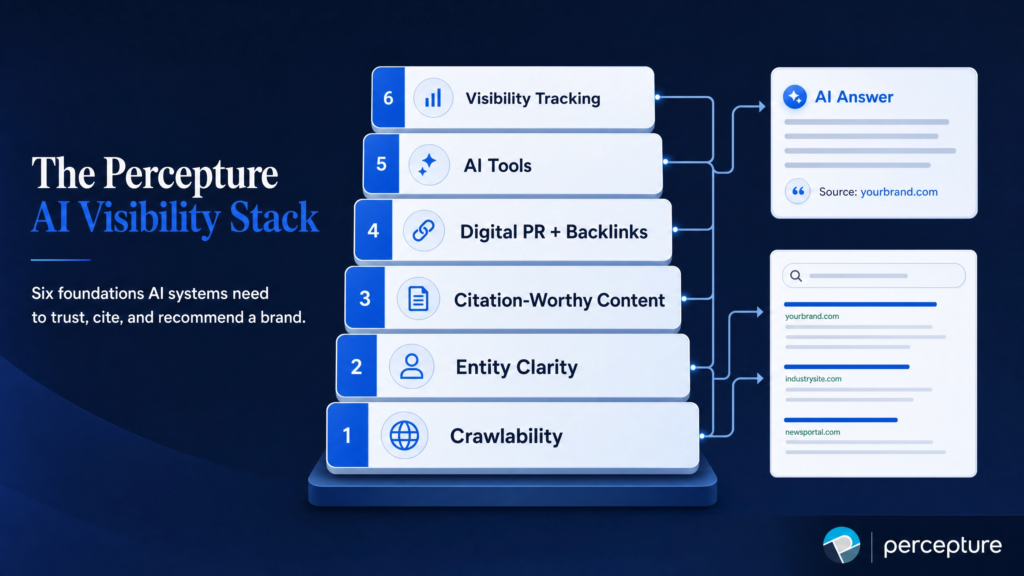
HVAC marketing content is easier for people and retrieval systems to use when it contains direct answers, descriptive headings, visible tables, clear entities, named authorship, original frameworks, internal links, and specific limitations. Important information should remain in readable page text rather than being available only inside an image or interactive tool.
Companies should publish evidence they can support: real credentials, named people, service details, project context, documented processes, and transparent next steps. They should also maintain crawlable pages and structured data that matches what visitors can see.
AI visibility is not a separate substitute for search fundamentals. It is another discovery layer that can be addressed through GEO services, useful source content, earned authority, and clear answers to the questions buyers actually ask.
See where your HVAC marketing is missing jobs
If your team is getting traffic but not enough booked work, we can review the path. We look at visibility, trust, pages, calls, forms, and handoffs.
- Simple review of your current setup
- Clear list of the biggest issues
- Practical fixes, not vague advice
Build trust before asking for the booking
Trust proof should help a buyer judge fit, not simply decorate the page. Show applicable credentials, insurance information where relevant, named team members, service standards, warranty terms, financing details, project context, review evidence, coverage, and what the customer should expect next. Effective hvac marketing places that proof near the decision it supports.
Installation and service claims must be precise. Explain the company’s process in its own terms and avoid broad superiority claims that cannot be demonstrated. Commercial pages should also explain capabilities, stakeholder communication, documentation, and project handoffs.
Social media is most useful when it reinforces proof, recruiting, maintenance education, community participation, retargeting, and referrals. The guide to social media marketing for construction companies provides a practical content model.
Email supports seasonal readiness, maintenance reminders, membership renewal, replacement education, review requests, and customer reactivation. Email marketing works best when lists are segmented by customer relationship, service history, location, and message purpose.
An operating lesson from contractor marketing
Percepture’s work in contractor and infrastructure marketing showed that traffic alone does not fix growth. The real gains came from better intent targeting, stronger landing pages, cleaner tracking, and a better handoff from marketing to the team handling the lead.
The lesson for HVAC is simple: get the right lead, make the next step easy, and measure what becomes booked and completed work.

Stop lead leakage between the click and dispatch
More leads do not automatically produce more customers. A raw lead is an inquiry. A qualified lead matches the service, geography, timing, and other operating rules. A booked job has an accepted appointment. A completed job was delivered. A retained customer returns, renews, or creates additional value.
The hvac marketing dashboard should preserve those stages instead of collapsing them into one conversion count. Otherwise, a campaign can appear successful while generating out-of-area calls, unavailable job types, duplicate requests, canceled appointments, or work that does not meet the company’s economic rules.
There is no responsible universal response-time promise for every inquiry. Create urgency tiers, assign ownership, define after-hours handling, recover missed calls, record timestamps, and compare response with qualification and booking outcomes. Emergency requests require a different workflow from planned estimates or commercial inquiries.
A website should make core services, service areas, emergency options, phone and booking paths, financing, credentials, reviews, team information, maintenance programs, project proof, FAQs, and next steps easy to find. Enterprise teams may also need system integrations and governance supported by enterprise web development.
HVAC marketing budget, pricing, and ROI decisions
A sound hvac marketing budget starts with the revenue goal, gross-margin logic, available capacity, service mix, market conditions, operating maturity, and acceptable acquisition cost. A fixed industry percentage cannot account for those differences.
| Measure | Calculation | What it reveals |
|---|---|---|
| Cost per raw lead | Acquisition cost ÷ all inquiries | Top-line demand cost, including poor-fit inquiries |
| Cost per qualified lead | Acquisition cost ÷ qualified opportunities | Targeting and qualification efficiency |
| Booking rate | Booked appointments ÷ qualified leads | Sales and scheduling effectiveness |
| Completed-job rate | Completed jobs ÷ booked appointments | Cancellation, dispatch, and delivery performance |
| Customer acquisition cost | Total acquisition cost ÷ new customers | Cost to create a customer, not merely an inquiry |
| Marketing-attributed gross profit | Attributed revenue − direct job costs − attributable marketing expense | Contribution after direct delivery and marketing costs |
Revenue alone does not prove marketing profitability. Review results by source, query, campaign, landing page, job type, service area, location, booking, completed job, gross profit, maintenance relationship, and repeat value. Public pricing options can help buyers understand Percepture engagement paths without treating one package as right for every operator.
A practical 90-day implementation sequence
Days 1–30: establish the operating truth. Define priority services, service radius, technician capacity, exclusions, lead stages, source tracking, response ownership, and baseline outcomes. Audit local information, service pages, conversion paths, call handling, reviews, and reporting.
Days 31–60: repair the main leaks. Correct local and site information, improve high-priority pages, clarify calls to action, connect forms and calls to outcomes, create missed-call recovery, and build the first set of proof and buyer-answer content. Configure hvac marketing campaigns only for markets and services the operation can support.
Days 61–90: expand with control. Add selected content, paid capture, reactivation, review requests, earned-media opportunities, and AI-answer coverage. Compare qualified leads, bookings, completed jobs, gross profit, and lost-opportunity reasons before shifting budget.
This sequence keeps hvac marketing tied to actual capacity. A small company may execute a narrow version around one market and a few services. A multi-location platform should apply shared definitions and controls while keeping local entities, proof, budgets, and reporting distinct.
Common mistakes that weaken growth
- Targeting areas the dispatch team cannot serve efficiently.
- Optimizing raw lead cost without measuring qualification or completed work.
- Using generic service and location pages with little decision value.
- Buying demand while calls, forms, or follow-up lack clear ownership.
- Publishing unsupported claims, vague credentials, or context-free reviews.
- Allowing hvac marketing, sales, and dispatch vendors to use conflicting definitions.
- Failing to separate emergency, replacement, residential, and commercial journeys.
- Expanding campaigns without checking technician capacity and appointment availability.
- Reporting revenue without direct job costs and attributable marketing expense.
Score your Search-to-Service system
Score each hvac marketing category from 0 to 5. This is a Percepture diagnostic for discussing constraints, not an industry benchmark.
| Category | 0–1 | 2–3 | 4–5 |
|---|---|---|---|
| Profitable-demand map | Undefined | Partly documented | Used to control execution |
| Local and AI visibility | Inconsistent | Visible for some needs | Structured across priority journeys |
| Paid-demand control | Broad and disconnected | Some market controls | Aligned with capacity and economics |
| Trust and proof | Thin or generic | Useful but incomplete | Specific, current, and easy to verify |
| Website conversion | Unclear next steps | Core paths work | Paths match intent and service type |
| Response and dispatch | Little ownership or tracking | Basic workflow | Measured through completed work |
| Revenue and retention | Lead-only reporting | Partial customer data | Gross profit and retained value connected |
- 0–10: Fragmented.
- 11–20: Visible but leaking demand.
- 21–27: Functional with material constraints.
- 28–31: Strong.
- 32–35: Search-to-Service leader.
A low score is useful when it identifies the next operating priority. Use the hvac marketing score to improve the weakest material stage before adding channels simply because a competitor uses them.
See pricing and support options
Not every HVAC company needs the same level of help. Use your score and your goals to see whether you need a focused fix, a bigger growth plan, or full channel support.
- Compare service options in plain English
- Match the work to your team size and goals
- See what support level fits best
In-house, freelancer, or specialist agency?
| Model | Best fit | Strength | Watch for |
|---|---|---|---|
| In-house team | Organizations with steady workload, leadership, systems, and specialist access | Daily business context and direct coordination | Coverage gaps, hiring load, and channel silos |
| Freelancer or specialist | A defined channel, project, or temporary capability gap | Focused expertise and flexible scope | Dependence on internal coordination and limited cross-channel ownership |
| Integrated agency | Organizations needing coordinated strategy, execution, analytics, content, paid media, PR, or AI visibility | Broader team and connected workstreams | Industry understanding, accountability, operating fit, and reporting depth |
Ask any outside partner how it distinguishes raw and qualified leads, connects calls to completed jobs, respects service-area and capacity limits, builds local proof, coordinates paid and owned channels, prepares content for AI-assisted discovery, and reports profit-related outcomes. The right model depends on internal time, expertise, speed, accountability, maturity, and budget.
Frequently asked questions
What is the best HVAC marketing strategy?
The best strategy aligns priority services, profitable service areas, capacity, urgency, proof, conversion, response, dispatch, and measurement. The channel mix should change by market and business maturity. Start with the largest operating constraint, then select local visibility, SEO, paid search, reviews, content, referrals, email, PR, or AI visibility to solve a defined problem.
How do HVAC companies get more customers?
Create relevant demand, make the company easy to find, provide credible proof, and remove friction from calls and bookings. Then track whether each inquiry was qualified, booked, dispatched, completed, and retained. Increasing leads without fixing response, scheduling, or service-area fit may add cost without adding customers.
How can a small HVAC company market on a limited budget?
Begin with accurate local information, strong core service pages, consistent review requests, clear phone and booking paths, missed-call recovery, customer reactivation, and referrals. Keep hvac marketing campaigns narrow by service, geography, schedule, and capacity. Expand only after the company can connect sources to qualified and completed work.
How long does HVAC SEO take?
There is no dependable universal timeline. Progress depends on the site’s starting condition, local competition, technical issues, content quality, authority, service-area scope, resources, and execution. Set milestone reviews for indexing, visibility, qualified inquiries, bookings, and completed jobs rather than treating one promised ranking date as the plan.
Should HVAC companies use paid search?
Paid search can help capture active demand when targeting, service areas, schedules, landing pages, tracking, call handling, and capacity are controlled. It should operate as part of the hvac marketing system, not as an isolated lead counter. Compare cost per qualified opportunity, booking, completed job, gross profit, and retained customer rather than clicks alone.
How much should an HVAC company spend on marketing?
Build the budget from growth goals, gross-margin logic, technician capacity, service mix, market conditions, operating maturity, and acceptable acquisition cost. Calculate what a qualified lead, booking, completed job, and customer can cost under the company’s economics. Avoid adopting a universal percentage without testing those variables.
How can an HVAC company appear in AI-generated answers?
Publish crawlable pages with direct answers, clear headings, useful tables, consistent company and service information, named authorship, supported evidence, internal links, and visible limitations. Cover cost factors, comparisons, service questions, local context, process, credentials, and buyer decisions. Structured data should match the content people can see.
How should an HVAC company market during the slow season?
Use slower periods for maintenance education, agreement renewal, customer reactivation, replacement planning, review requests, referral activity, partnerships, proof collection, content production, and preparation for the next demand peak. Match hvac marketing offers to services the company can support and use the period to repair tracking, follow-up, and website gaps.
Build an HVAC marketing system that books real work
We can review your services, markets, visibility, proof, calls, forms, and follow-up. Then we give you a clear roadmap your team can act on.
- Find your best growth areas
- Spot leaks hurting calls and bookings
- Get a simple 90-day plan

About Bob Generale
Bob Generale is President of Percepture. He helps companies turn search visibility, trust, and lead flow into real business growth. His work spans SEO, AI search visibility, PR, paid media, and practical growth strategy. Connect with Bob on LinkedIn or review the Percepture team.