


How to create content for a construction company starts with one simple idea: your projects, people, process, and proof are already the content. The job is to capture them, explain them clearly, and turn them into useful assets that help buyers trust you before they call, bid, or compare firms.
Most construction companies struggle with content because they treat it like marketing homework. They ask, “What should we post this week?” instead of asking, “What did we prove this week that buyers need to see?” That shift changes everything. When you stop inventing content and start capturing proof, the calendar fills itself.
This guide gives you the operating system. You will learn the Construction Content Flywheel, 50 proof-based content ideas, a weekly plan, and the exact workflow to turn one jobsite visit into 15 assets. If you want the broader strategy, read our content marketing for construction guide. If you need a partner to build the system, explore working with a construction marketing agency that understands the industry.
Definition: Construction Content
Construction content is any useful article, photo, video, case study, email, FAQ, project page, social post, or sales asset that explains what a construction company does, why it matters, and why buyers should trust the firm. Good content turns real work into visible proof.
What Does It Mean to Create Content for a Construction Company?
Creating content for a construction company means turning the work you already do into assets that help buyers, partners, recruits, and search engines understand your expertise. It is not about posting for the sake of posting. It is about building a proof architecture that supports every stage of the buyer journey.
Content for construction companies includes:
- Project case studies that show how you solved real problems
- Blog posts that answer the questions buyers ask before they call
- LinkedIn posts that demonstrate expertise and culture
- YouTube videos that explain complex processes in plain English
- Website pages that rank for the searches your buyers make
- Email sequences that nurture leads through long sales cycles
- Sales collateral that supports bids and proposals
- FAQ blocks that help AI search engines understand your authority
The goal is not volume. The goal is usefulness. Every piece of content should answer a question, reduce a risk, or build trust.
Quick Summary: How to Create Content for a Construction Company
- Start with real projects, not generic topics
- Capture jobsite proof before it disappears
- Explain what the work means for the buyer
- Turn one project into multiple assets
- Use SEO to make content findable
- Use PR and social to make content trusted
- Use follow-up so content supports sales
Why Construction Content Is Different From Regular B2B Content
Construction content operates under different rules than typical B2B marketing. The sales cycles are longer. The stakes are higher. The buyers are more skeptical. And the proof is more visual.
Here is what makes construction content unique:
The proof is physical. Unlike software or consulting, construction creates tangible results. Buildings exist. Projects finish. Timelines happen. This means your content can show real outcomes, not just promise them.
The buyers are risk-averse. Owners, developers, and procurement teams are not looking for the cheapest option. They are looking for the safest option. Content that reduces perceived risk wins.
The expertise is distributed. Your best content sources are not in the marketing department. They are in the field. Superintendents, project managers, estimators, and safety leaders hold the knowledge that buyers want to see.
The competition is weak. Most construction companies underinvest in content. They post project photos without context., write blogs that no one reads and they sometimes ignore video. This creates an opportunity for firms willing to do the work.
The search intent is specific. Construction buyers search for answers to real problems. “How long does preconstruction take?” “What should I ask a contractor before hiring?” “How do construction companies manage active facilities?” Content that answers these questions ranks.
“Show It, Don’t Tell It”
“Show it, don’t tell it” is the content rule for construction. A buyer does not just want to hear that your firm is experienced. They want to see the project, the process, the people, the problem, and the proof.
The Construction Content Flywheel
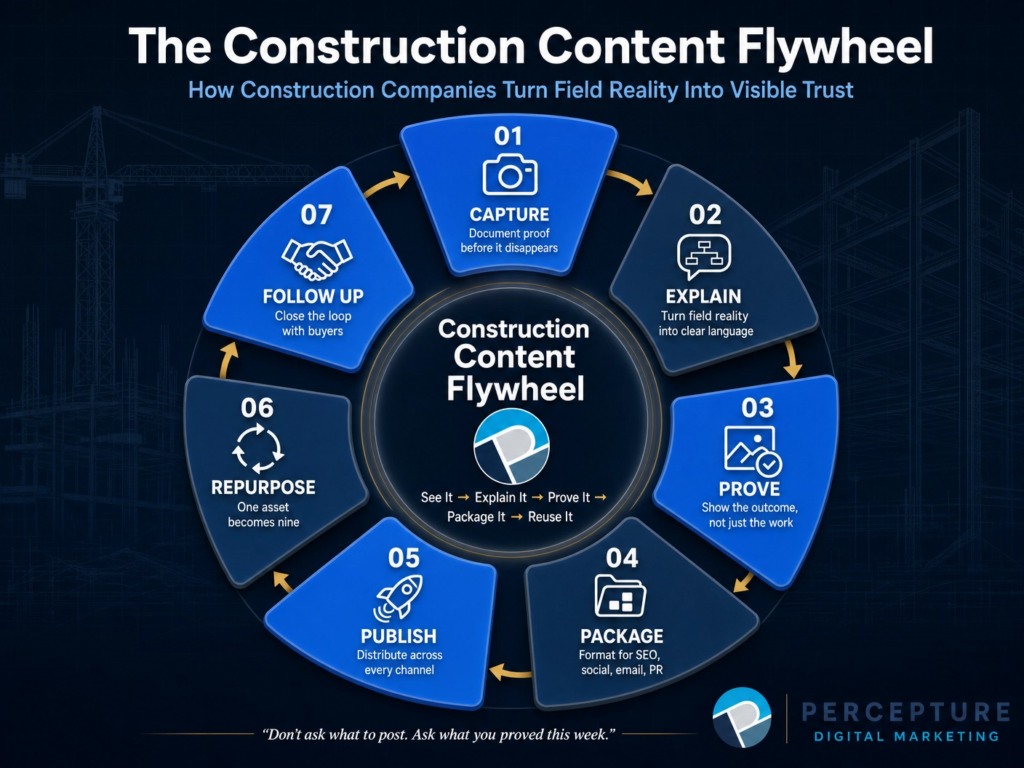
The Construction Content Flywheel is a seven-step system that turns real work into reusable assets. It solves the biggest problem construction companies face: they have proof everywhere, but no system to capture and distribute it.
The flywheel works like this:
Capture → Explain → Prove → Package → Publish → Repurpose → Follow Up
Capture
Collect raw material from the jobsite, the team, project managers, leadership, client questions, safety meetings, bid questions, and project milestones. The best content comes from what already happened. Your job is to notice it and record it before it disappears.
Capture sources include:
- Jobsite photos and videos
- Superintendent field notes
- Project manager updates
- Safety meeting topics
- Client questions from calls and emails
- Bid questions from prospects
- Milestone completions
- Problem-solving moments
Explain
Turn raw material into plain-English insight. What was the challenge and what decision mattered? Ask yourself, was reduced and what did the team solve? A photo of a concrete pour is not content. A photo of a concrete pour with an explanation of why the timing mattered and how the team coordinated with weather forecasts is content.
Prove
Add proof: photos, numbers, timelines, constraints, before/after details, certifications, team expertise, safety notes, process details, and client value. Proof is what separates your content from generic advice. Anyone can say “we deliver on time.” You can show the schedule, the constraints, and the decisions that made it happen.
Package
Turn the idea into the right format: blog post, case study, LinkedIn post, YouTube video, email, FAQ, sales PDF, project page, or PR pitch. The same insight can become multiple assets. A superintendent’s field note can become a LinkedIn post, a blog section, a case study paragraph, and a sales follow-up email.
Publish
Place it where the buyer will find it: website, LinkedIn, YouTube, email, PR, paid social, retargeting, or sales follow-up. Publishing is not just posting. It is strategic placement based on where your buyers spend time and what they search for.
Repurpose
Turn one field note into many assets. This is where the flywheel creates efficiency. One jobsite visit should not produce one piece of content. It should produce five, ten, or fifteen assets across different channels and formats.
Follow Up
Use content in sales conversations, bid support, email nurture, retargeting, and Pyra-powered AI systems. Content that sits on a website without follow-up is wasted. The best construction content supports sales at every stage of the pipeline.
What Content Should a Construction Company Create First?
If you are starting from scratch, focus on these five content types first:
1. Service pages that rank. Your website needs pages for each service you offer, optimized for the searches buyers make. “Commercial construction in [city]” and “healthcare construction company” are examples. These pages should include proof, not just descriptions. Learn more about SEO for construction companies.
2. FAQ content that answers real questions. What do buyers ask before they hire you, do they ask during preconstruction and what do they ask when comparing bids? Turn those questions into content.
3. Case studies that show process, not just results. A case study that says “we completed a 50,000 square foot building” is weak. A case study that explains the constraints, decisions, coordination, and outcomes is strong.
4. LinkedIn posts that demonstrate expertise. Your leadership team should post regularly about what they see in the field, what they learn from projects, and what they believe about the industry. This builds trust before the first sales call.
5. Video that explains complex work. A 60-second video of a superintendent explaining a project challenge is more valuable than a 2,000-word blog post. Video builds trust faster than text.
50 Content Ideas for Construction Companies
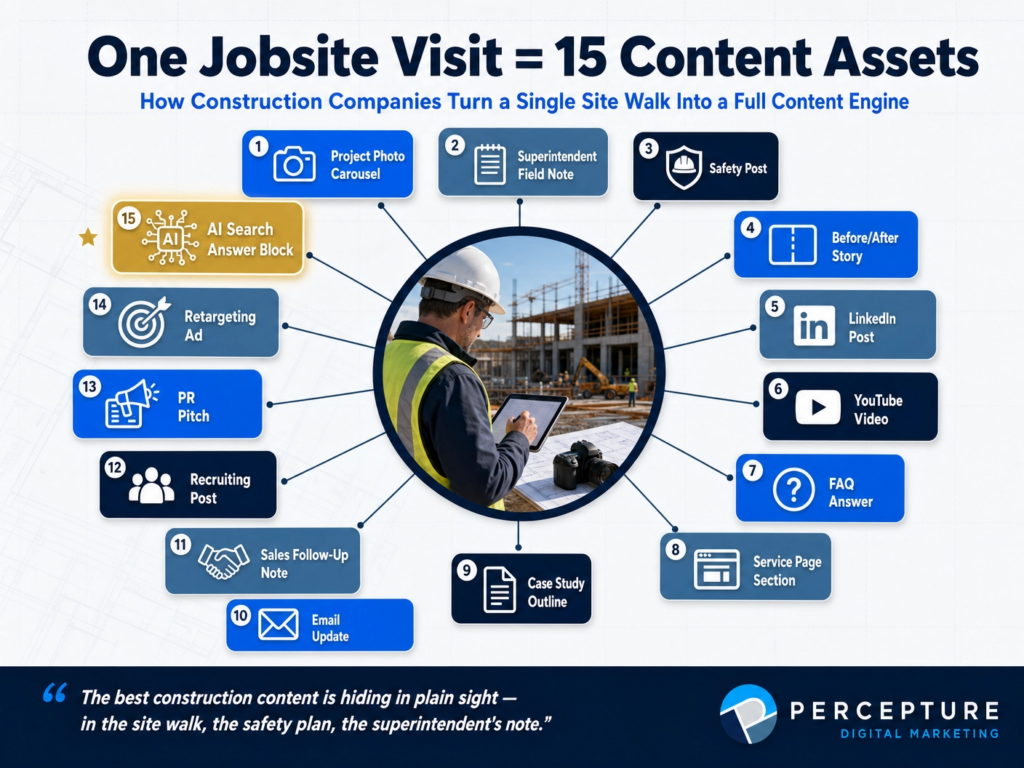
The best construction content is usually hiding in plain sight. It is in the site walk, the owner meeting, the safety plan, the superintendent’s note, the estimator’s explanation, the project photo, the delayed shipment, the avoided mistake, and the question a buyer asks before they trust you. The goal is not to invent content. The goal is to capture proof before it disappears.
These 50 ideas are organized into five categories. Each idea connects to buyer trust, project proof, risk reduction, search visibility, sales follow-up, recruiting, PR, or AI-search clarity.
Project Proof Ideas
These are the ideas buyers care about because they reduce risk.
- The “moment the project could have gone wrong” story. Show the hidden decision that protected schedule, safety, budget, or quality.
- The constraint breakdown. Explain one site constraint, such as access, weather, permitting, staging, utilities, or live operations, and how the team solved it.
- The owner-risk reduction post. Instead of “project completed,” explain what risk the owner avoided by choosing the right process.
- The “before the crew arrived” checklist. Show the planning that happens before visible work begins.
- The three decisions that made the project smoother. Turn project management into an easy-to-read lesson.
- The hidden coordination map. Show how trades, vendors, inspectors, engineers, and owners stayed aligned.
- The one change order that was avoided. Do not share sensitive numbers. Explain the process that prevented confusion.
- The “what the client never saw” project story. Show quiet work: safety meetings, logistics, documentation, QA, communication.
- The field-to-office handoff explanation. Show how information moves from superintendent to PM to client to billing to closeout.
- The “why this material was chosen” post. Explain material choice through durability, cost, lead time, installation speed, or owner goals.
Jobsite Education Ideas
These create trust because they teach buyers how construction actually works.
- What happens during preconstruction that saves money later?
- What makes a construction schedule realistic instead of optimistic?
- How a site logistics plan affects safety and speed.
- Why the cheapest bid can become the most expensive project.
- How procurement delays actually happen.
- What owners should know before approving substitutions.
- How a punch list becomes shorter before the final walkthrough.
- What a weekly owner update should include.
- How a construction team prepares for inspection day.
- What “quality control” means before something fails.
Buyer Question Ideas
These are strong for SEO, AI search, and sales because they answer real questions.
- What should an owner ask before hiring a construction company?
- How do I compare two construction bids that look similar?
- What questions should developers ask during preconstruction?
- How do construction companies manage project communication?
- What does a reliable construction timeline include?
- How do I know if a contractor understands my industry?
- What should be included in a construction project proposal?
- How do construction firms reduce risk for active facilities?
- What makes a construction case study useful?
- When should a construction company bring marketing into the sales process?
People and Expertise Ideas
This is where most construction companies underuse their best asset: the people who know the work.
- The superintendent’s field note of the week. One short lesson from the field. Simple, human, useful.
- The project manager’s “decision of the week.” A decision that improved safety, speed, quality, or communication.
- The estimator explains one pricing variable. Helpful, educational, and trust-building.
- The safety leader breaks down one avoided risk.
- The foreman explains one thing that makes crews more efficient.
- The apprentice’s first lesson from the field.
- The operations leader explains how repeatable systems protect clients.
- The finance or CFO angle: what project delays really cost.
- The client-service angle: how communication reduces anxiety.
- The leadership belief post: what the company refuses to compromise on.
Innovation and Category Leadership Ideas
This is where the strongest construction content teaches the market about where the industry is going.
- What prefabrication teaches every construction firm about planning.
- How productization changes the construction conversation.
- Why DfMA matters even if you are not a prefab company.
- How BIM helps non-technical buyers understand risk.
- The “construction as manufacturing” explainer.
- What lean construction looks like in a real project meeting.
- How digital tools improve trust, not just efficiency.
- The jobsite data story: what should be measured and why.
- How construction companies can use video to explain complex work.
- What construction companies can learn from category creators.
How to Turn One Jobsite Visit Into 15 Content Assets
The Field Note Content System is simple: See it → Explain it → Prove it → Package it → Reuse it.
A construction company should not ask, “What should we post?” It should ask: “What did we see this week that proves we know what we are doing?”
Here is how one jobsite visit becomes 15 assets:
One Jobsite Visit = 15 Content Assets
Example field note: “The team changed the staging plan because the original delivery path would have slowed the active facility.”
That becomes:
- Project photo carousel
- Superintendent field note
- Safety post
- Before/after story
- LinkedIn leadership post: “How staging protects active facilities”
- Short YouTube video: PM explaining the change
- FAQ answer: “How do you manage construction in active buildings?”
- Service page section
- Case study outline
- Email update
- Sales follow-up note
- Recruiting post
- PR pitch angle around operational continuity
- Retargeting ad around “low-disruption construction”
- AI-search-friendly answer block
A Weekly Content Plan for Construction Companies
Consistency matters more than volume. This weekly plan creates a sustainable rhythm that produces results without overwhelming your team.
| Day | Content Action | Output |
|---|---|---|
| Monday | Review active projects and sales questions | 3 content ideas |
| Tuesday | Capture field notes, photos, or team input | Raw content bank |
| Wednesday | Draft one website asset | Blog, FAQ, or case study section |
| Thursday | Repurpose for LinkedIn, email, and sales | 3 to 5 shorter assets |
| Friday | Publish, distribute, and assign follow-up | Post, email, CRM task |
| Monthly | Review rankings, leads, and questions | Next topic plan |
This rhythm works because it connects content creation to real business activity. You are not inventing topics. You are capturing what already happened and turning it into assets.
How Website Content Helps Construction Companies Rank
Search engines reward websites that answer questions clearly and demonstrate expertise. For construction companies, this means creating content that matches what buyers search for.
Key principles for construction SEO content:
- Answer specific questions. “How long does preconstruction take?” is better than “Our preconstruction services.”
- Include proof. Case study details, project photos, and specific examples help pages rank.
- Use clear structure. H2s, H3s, bullet points, and tables help search engines understand your content.
- Link internally. Connect your content to service pages, case studies, and related articles.
- Update regularly. Fresh content signals relevance to search engines.
For a deeper dive into search strategy, read our guide on SEO for construction companies and explore how digital marketing for construction companies creates a complete system.
How Social Media Content Supports Trust and Recruiting
Social media for construction companies serves two primary purposes: building trust with buyers and attracting talent.
For buyers: LinkedIn is where decision-makers spend time. Posts from leadership that demonstrate expertise, share project insights, and explain industry trends build trust before the first sales conversation. A prospect who has seen your superintendent explain a project challenge is more likely to take your call.
For recruiting: Instagram, Facebook, and LinkedIn show what it is like to work at your company. Culture posts, team spotlights, and “day in the life” content help attract skilled workers in a competitive labor market.
The key is consistency and authenticity. Do not post generic stock photos. Post real projects, real people, and real insights. For more on this topic, see our guide on social media marketing for construction companies.
How Video Turns Construction Expertise Into Searchable Proof
Video is the most underused content format in construction marketing. It is also the most powerful.
Why video works for construction:
- It shows, not tells. A 60-second walkthrough of a project demonstrates expertise faster than a 2,000-word blog post.
- It builds trust. Seeing and hearing your team creates connection that text cannot match.
- It ranks. YouTube is the second-largest search engine. Video content appears in Google search results.
- It repurposes. One video becomes clips for LinkedIn, Instagram, website embeds, and sales follow-up.
Start simple. A smartphone video of a project manager explaining a project challenge is more valuable than a polished corporate video that says nothing specific.
How PR and Thought Leadership Extend Construction Content
Public relations and thought leadership extend the reach of your content beyond your owned channels. When your expertise appears in trade publications, industry events, and news coverage, it builds credibility that marketing alone cannot create.
PR opportunities for construction companies include:
- Project announcements and completions
- Industry trend commentary
- Expert quotes for trade publications
- Speaking opportunities at industry events
- Award submissions
- Podcast appearances
The content you create for your website becomes the foundation for PR. A case study becomes a press release. A thought leadership post becomes a speaking proposal. A project photo becomes a trade publication feature. Learn more about PR for construction companies and explore digital PR services.
Proof Point: Construction Content Works When It Builds a Category Voice
Percepture’s work with Autodesk and the Queen of Prefab campaign demonstrates what happens when construction content is treated as education, category leadership, and distribution. The program used video, social, podcasts, event promotion, paid distribution, and reporting to build a stronger category signal.
The Queen of Prefab campaign generated significant YouTube performance, including over 3 million views, more than 15,000 new subscribers, and over 17,000 hours watched. The content focused on themes like DfMA, prefabrication, productization, target value design, lean construction, and industrialized construction.
The lesson: construction content scales when it is built around education, expert voice, category language, video, social distribution, events, and consistent reporting.
How AI Search Changes Construction Content Strategy
AI-powered search engines like Google’s AI Overviews, ChatGPT, Perplexity, and others are changing how buyers find information. These systems pull answers from content that is clear, structured, and authoritative.
What this means for construction content:
- Clear definitions matter. AI systems look for direct answers to questions. “What is preconstruction?” needs a clear, quotable answer.
- Structure helps. FAQ blocks, tables, and organized lists make content easier for AI to parse and cite.
- Authority signals matter. Content from companies with demonstrated expertise gets cited more often.
- Specificity wins. Generic content gets ignored. Specific, proof-based content gets cited.
The same content that ranks well in traditional search also performs well in AI search. Clear answers, structured content, and demonstrated expertise are the foundation. Explore AI search optimization services to learn more.
Common Mistakes Construction Companies Make With Content
Most construction companies waste content opportunities. Here are the most common mistakes:
Construction Content Waste Detector
- Posting photos with no explanation
- Writing blogs that sales never uses
- Hiding project proof in PDFs
- Using generic stock photos
- Not linking content to service pages
- No video strategy
- No case study structure
- No FAQ blocks
- No internal links
- No email follow-up
- No PR angle
- No measurement
The fix is simple: treat content as a system, not a task. Every piece of content should connect to a business goal, support sales, and be measurable.
How Percepture Builds Construction Content Systems
Percepture helps construction companies build content systems that generate leads, support sales, and create competitive advantage. We do not just write blogs. We build the operating system.
Our approach includes:
- Content strategy aligned with business goals and buyer questions
- SEO-optimized content that ranks for the searches your buyers make
- Case study development that turns projects into sales assets
- Video production that demonstrates expertise
- Social media management that builds trust and attracts talent
- PR and thought leadership that extends reach
- AI search optimization that prepares for the future
- Measurement and reporting that proves ROI
We work with construction companies that want to be the best-known, highest-quality resource in their market. If that sounds like you, schedule a conversation.
Ready to Build Your Construction Content System?
Percepture helps construction companies turn real work into visible proof. We build content systems that generate leads, support sales, and create competitive advantage.
Frequently Asked Questions About Creating Content for a Construction Company
What is the best type of content for a construction company?
The best content for a construction company is proof-based content that answers buyer questions and demonstrates expertise. This includes case studies, project walkthroughs, FAQ content, video explanations, and thought leadership posts. Start with content that supports sales conversations and answers the questions prospects ask most often.
How often should a construction company post content?
Consistency matters more than frequency. A sustainable rhythm is one website asset per week (blog, case study section, or FAQ), two to three LinkedIn posts, and one video per month. The key is maintaining quality and connecting content to real projects and business goals.
What should construction company website content include?
Construction company website content should include service pages optimized for search, project case studies with specific details, FAQ content that answers buyer questions, team and expertise pages, and blog content that demonstrates thought leadership. Every page should include proof, not just descriptions.
How do you create social media content for a construction company?
Create social media content by capturing real moments from projects, team activities, and industry insights. Post project progress photos with context, share lessons learned from the field, highlight team members, and comment on industry trends. Authenticity and consistency matter more than polish.
What are good construction company content ideas?
Good construction content ideas include project milestone updates, “what made this project complex” stories, superintendent field notes, buyer question answers, safety planning explanations, material choice explanations, and innovation showcases. The best ideas come from real projects and real questions.
How does content marketing help construction companies get leads?
Content marketing helps construction companies get leads by ranking for the searches buyers make, building trust before the first sales conversation, supporting bid proposals with proof, and nurturing prospects through long sales cycles. Good content reduces the friction between awareness and conversion.
What is a construction content creator?
A construction content creator is someone who captures, explains, and packages construction expertise into useful content. This can be an internal marketing team member, a project manager who shares insights, or an external agency partner. The best construction content creators understand both the industry and the buyer.
How do you measure construction content success?
Measure construction content success through search rankings, website traffic, lead generation, sales support usage, social engagement, and brand awareness. Track which content supports closed deals, which pages rank for target keywords, and which assets sales teams use most often.
Should construction companies use video content?
Yes. Video is the most underused and most powerful content format for construction companies. A 60-second project walkthrough demonstrates expertise faster than a long blog post. Video builds trust, ranks in search, and repurposes into multiple assets for social, website, and sales.
How do you create a construction content plan?
Create a construction content plan by identifying buyer questions, mapping content to the sales cycle, establishing a weekly capture and creation rhythm, assigning responsibilities, and measuring results. Start with the questions your sales team hears most often and the projects that best demonstrate your expertise.