


Tourism marketing ROI compares marketing cost with the incremental commercial, partner or economic value a program creates. A useful model connects traveler behavior to bookings, registrations, referrals, visitation, contribution margin or future demand—and states how confident the organization is in that connection.
The formula changes with the business model. A hotel measures retained room contribution, an attraction measures ticket and on-site contribution, and a DMO may create partner referrals and visitor spending without processing the final transaction.





Updated July 2026
What is tourism marketing ROI?
Tourism marketing ROI is the net incremental value attributed to marketing relative to the cost of producing that value. The return may be retained booking contribution, ticket contribution, partner value, incremental visitation, tax receipts or another defined outcome that fits the organization.
CPC is not ROI. It is one cost inside a larger visitor-value equation. The same is true of impressions, clicks, video views and platform conversions: they can explain delivery or behavior, but they do not establish complete return by themselves.
The executive measurement brief
Ask what changed
Incrementality asks what happened because of marketing. Attribution only assigns credit among observed contacts.
Value the right outcome
Use retained contribution for a direct seller. Use partner, visitor or public value for a destination organization.
Include the full cost
State whether the denominator includes media only, the complete program or fully loaded internal and external costs.
Show confidence
A measured range is more credible than false precision. Label tracked, matched, associated and modeled results correctly.
Who this guide is for
CMOs and CFOs
Use the ROI model to connect campaign investment with margin, cost, attribution confidence and the next budget decision.
Hotels and attractions
Measure direct demand, cancellations, channel costs, attendance and attributable on-site value.
Operators and agencies
Follow inquiries through quotes, deposits, departures, fees, commissions and retained contribution.
DMOs and tourism boards
Frame destination return around organizational activity, partner demand, visitor spending, public return and broader economic impact.
This guide covers return measurement across tourism business models. Readers building a wider channel plan can also use Percepture’s guide to travel and tourism marketing.
Tourism marketing ROI compared with ROAS and economic impact
A tourism return scorecard must keep these measures distinct. Treating them as interchangeable can lead a board to compare ad delivery, business profitability and destination activity as though they were the same result.
| Measure | Formula or basis | Best use | Main limitation |
|---|---|---|---|
| ROAS | Attributed revenue ÷ ad spend | Paid-media efficiency | Does not include complete cost or margin |
| Marketing ROI | (Incremental contribution − marketing cost) ÷ marketing cost | Investment and profit decisions | Requires a defensible view of incrementality |
| CPA | Marketing cost ÷ acquired customers | Acquisition efficiency | Customer quality and future value can vary |
| Cost per visitor | Campaign cost ÷ incremental visitors | Destination efficiency | Depends on credible visitation lift |
| Economic impact | Direct, indirect and induced activity | Destination and public reporting | Is not organizational profit |
| Tax return | Incremental tax receipts ÷ public investment | Public-funding analysis | Requires tax and incremental visitation data |
| Partner value | Qualified partner action × defensible value | Distributed destination demand | May depend on modeled conversion |
In tourism return reporting, ROAS measures advertising efficiency, ROI measures incremental contribution after cost, and economic impact estimates broader destination activity. Gross visitor spending is not organizational profit.
Visit Elizabeth City: direct response is the start
A Coast Guard Run program using Google, YouTube and remarketing reported 329,000 impressions, 4,210 clicks, a 5.23% conversion rate, 220 purchases and $14,800 in tracked sales over eight weeks, excluding Facebook.
The campaign produced measurable sales. A complete return calculation would subtract total program cost and use retained contribution after variable costs. It would also account for cancellations, processing costs, baseline registrations and assisted conversions.
This is the difference between tracking direct response and completing a return analysis. The first shows an observed transaction path. The second asks what the program caused, what value the organization retained and whether every relevant cost was included.
The Tourism Return Stack: a tourism marketing ROI framework
Percepture’s Tourism Return Stack provides a defensible return framework by separating delivery, traveler behavior, commercial action, partner value, economic impact, authority and future demand. It prevents a reporting team from forcing unlike outcomes into one inflated number.
| Level | What it measures | Examples |
|---|---|---|
| 1. Delivery efficiency | Cost and distribution | CPM, CPC, reach, video completion |
| 2. Qualified behavior | Planning signals | Engaged visits, itinerary use, saves, partner clicks |
| 3. Direct action | Observable conversion | Booking, ticket, registration, deposit, consultation |
| 4. Partner value | Distributed demand | Hotel referrals, attraction referrals, room-block leads |
| 5. Incremental economic value | Destination lift | Visitors, room nights, spending, tax, seasonal lift |
| 6. Authority and reuse | Durable marketing assets | Earned media, search visibility, citations, reusable content |
| 7. Future demand | Strategic value | Repeat visits, first-party audiences, partner confidence |
Do not add every level together. Combine only economically distinct values, disclose overlap and keep delivery metrics separate from business outcomes. A coordinated omnichannel marketing program should give every channel a defined role without claiming that every channel closed the booking.
Build a tourism marketing ROI model around your value pathway
Start the return worksheet by recording the objective, primary outcome, contribution basis, included costs, attribution window, data sources, assumptions, confidence level and next budget decision.
Request a Tourism ROI Measurement ReviewHow do you calculate tourism marketing ROI?
The core formula is:
(Incremental contribution attributable to marketing − marketing cost) ÷ marketing cost × 100
For this ROI model, incremental contribution is the value retained after the variable costs required to deliver the booking, visit, registration or sale. Marketing cost is the chosen cost basis. The attribution method explains how the outcome was connected with marketing.
In this return model, if a campaign produced $80,000 in incremental contribution and cost $40,000, the calculation would be ($80,000 − $40,000) ÷ $40,000 × 100, or 100%. That example illustrates the formula only. It is not a tourism benchmark.
A useful tourism return report defines each input before presenting the result. It should also show a range when contribution, baseline demand or offline behavior cannot be observed with one reliable number.
| Cost basis | What it includes | Appropriate label |
|---|---|---|
| Media only | Paid placement | Media return or ROAS analysis |
| Program cost | Media, agency, creative, technology and measurement | Program return |
| Fully loaded | Program cost plus relevant internal labor and sales handling | Fully loaded marketing return |
Teams that need the tracking and reconciliation layer can connect the formula with attribution and analytics and data visualization.
Which formula fits each tourism business model?
One formula does not fit every organization. A sound ROI numerator must reflect how the organization actually earns or creates value.
| Organization | Return model | Key inputs |
|---|---|---|
| Hotel or resort | (Incremental direct-room contribution + ancillary contribution + avoidable OTA commission − marketing cost) ÷ marketing cost | Room nights, rate, cancellations, variable cost, commission and ancillary spend |
| Attraction | (Incremental ticket + food, retail and membership contribution − marketing cost) ÷ marketing cost | Attendance, reservations, capacity, on-site purchases and repeat visits |
| Tour operator | (Incremental booking contribution − marketing and lead-handling cost) ÷ marketing cost | Qualified inquiries, deposits, departures, load factor, margin and cancellations |
| Travel agency | (Incremental fees + commissions + repeat or referral contribution − marketing and sales cost) ÷ marketing cost | Fees, commissions, consultations, bookings and reconciliation |
| Event | (Incremental registration contribution + sponsorship and ancillary value − marketing cost) ÷ marketing cost | Registrations, attendance, cancellations, variable attendee cost and sponsorship |
| DMO or tourism board | Layered partner, visitor, public and destination outcomes | Referrals, room nights, visitors, spending, tax, event leads and seasonal distribution |
For a travel agency, the ROI model should use retained fees and commissions, not total trip value. A hotel should account for channel commission and variable room costs. An event should report organizer return separately from destination overnight value.
DMO return reporting may reflect economic value the organization does not retain. Report destination return, public return and organizational metrics separately. A DMO should not be judged by hotel checkout metrics.
Channel tactics still matter, but they sit below the return model. Resources such as hotel PPC agency guidance and paid search services help improve delivery while the ROI model protects the larger business decision.
What should count as marketing cost?
Choose the cost basis before calculating return. Changing the denominator from one report to the next makes trend comparisons unreliable.
- Paid media and creator distribution
- Agency strategy, management and reporting
- Creative, video, photography and production
- Content, landing pages and campaign development
- Research, audience data and technology
- Analytics, attribution and independent measurement
- Relevant internal labor and sales handling
- Discounts, incentives and promotional costs
Do not omit a cost because it sits in another department. If the cost was required to create, distribute, measure or close the program’s response, disclose how it was treated so results remain comparable.
Attribution and incrementality are not the same
For tourism measurement, attribution assigns credit among observed contacts, while incrementality estimates what happened because of marketing. A platform can report a conversion without proving that the conversion would not have happened otherwise.
| Confidence level | Method | Accurate reporting language |
|---|---|---|
| 1 | Platform conversions | Platform-attributed |
| 2 | Analytics and CRM deduplication | Tracked across identified touches |
| 3 | Booking or visitor match | Matched to observed outcomes |
| 4 | Pre/post or comparison market | Associated lift versus baseline |
| 5 | Holdout or geographic test | Estimated incremental effect |
| 6 | Independent visitation or economic study | Modeled incremental impact |
An ROI claim should be no stronger than its method. Platform and analytics reports are useful for optimization, but causal language requires a baseline, comparison or controlled design.
Customer journey mapping can identify the roles of search, email, media, PR and partner sites before the ROI model assigns credit. Not every channel closes the booking, but every channel needs a defined role.
How should attribution windows work?
Travel decisions can include research, comparison, consultation and an offline purchase. Use windows that reflect trip price, distance, season, event date, lead time and the amount of human assistance involved.
- Report the immediate response. A short window can reveal direct campaign action.
- Report the planning cycle. A longer window can capture bookings that follow extended research.
- Compare attribution views. Review first touch, last non-direct, assisted, platform, CRM and incremental results.
Seven-day response, 30-day direct, 90-day planning and 180-day long-consideration views can be useful reporting cuts, but they are not universal rules. For tourism measurement, a short window can undercount a long travel decision, while an unlimited window can over-credit marketing.
How can tourism teams measure offline visitation?
Offline return measurement should connect digital exposure with a later observed outcome while protecting privacy and explaining the method. Useful options include:
- CRM, booking-engine and transaction matching
- Ticketing, reservation and attendance records
- Tracked calls and qualified call outcomes
- Partner UTMs, QR codes and promotional codes
- Post-visit surveys with disclosed sampling limits
- Aggregated location or card-spend studies
- Room, event and partner reporting
- Comparison markets, geographic tests and holdouts
State the match rate, observation period, baseline, exclusions and privacy controls. When a campaign sends traffic to several partner systems, conversion rate optimization services can improve the handoff without treating every referral as a completed booking.
How should DMOs value partner referrals?
| Method | Use it when | How to report it |
|---|---|---|
| Observed conversion | The partner returns booking or transaction data | Report matched bookings and retained or visitor value separately |
| Modeled action value | Validated conversion and contribution rates are available | Show the model, range and assumptions |
| Directional qualified action | No defensible financial conversion exists | Report qualified partner demand without assigning dollars |
Do not assign a booking value to every outbound click. In destination return reporting, partner referrals can be meaningful even when the destination site does not own the checkout, but the reporting language must match the evidence.
How should long-term authority be reported?
Search, PR and content may create durable value before or after a directly measured booking. Report that value in a separate authority layer rather than converting every mention into an advertising equivalent.
- Relevant earned media and qualified referral traffic
- Search visibility for destination and experience queries
- Useful links, mentions and citations
- Reusable stories, photography and campaign assets
- First-party audience growth and repeat engagement
- Assisted bookings and future branded demand
Digital PR services, content marketing services, enterprise SEO services and generative engine optimization services can support this layer. Their role should still be tied to a defined audience and decision path.
Tourism ROI examples and the lesson behind each
Visit Elizabeth City
Tracked purchases and sales establish direct response. Complete return still requires program cost, contribution, baseline demand and assisted conversion analysis.
Explore Hunterdon
The program reported 7 million impressions, 73,000 site visitors and 13,106 direct banner clicks, with click-through rate 20% above average. The next layer is partner and visitation outcomes.
Wyndham Vacation Rentals
Three reported quarters totaled approximately 117.5 million impressions and 104,000 clicks, with quarterly CPC between $0.41 and $0.45. CPC describes distribution efficiency; booking contribution is still required for ROI.
For tourism measurement, a campaign metric proves only the layer it measures. A click does not prove a booking, a booking does not equal retained contribution, and visitor spending does not equal organizational profit.
Compare the investment with the measurement gap
Review Percepture’s pricing options alongside the analytics, creative, media and reporting work required to build a defensible tourism marketing ROI model.
Review Pricing OptionsChoose tourism marketing KPIs that support a decision
Give each campaign one primary outcome, two or three diagnostic indicators and one confidence measure. This keeps the ROI model tied to a decision instead of a crowded dashboard.
| Organization | Primary outcome | Diagnostics | Confidence check |
|---|---|---|---|
| Hotel | Net direct-room contribution | Availability views and booking starts | Booking-engine or CRM match |
| Attraction | Ticket and visit contribution | Map, schedule and ticket-page use | Attendance or transaction match |
| Tour operator | Booked margin | Qualified inquiry and quote activity | CRM and departure data |
| Travel agency | Fees and commission | Consultations and proposals | Booking reconciliation |
| Event | Realized registration contribution | Registration starts | Attendance and cancellation data |
| DMO or CVB | Incremental visitor or partner value | Referral, room and itinerary actions | Lift study or matched visitor |
What should the dashboard and board report show?
A tourism marketing ROI dashboard should show investment, delivery, traveler behavior, outcome, confidence and next action. Keep leading indicators near the outcome they help explain rather than presenting a wall of unrelated metrics.
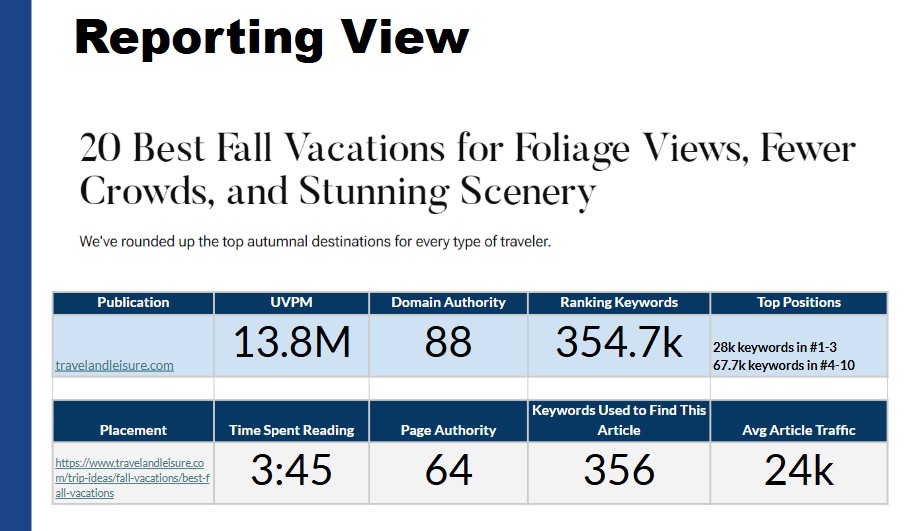
A board report should follow a simple sequence: objective, investment, audience and period, direct result, partner or economic result, incrementality method, limitations, learning and budget decision.
The report should make the cost basis and attribution window visible. It should also distinguish measured values from modeled values and avoid hiding uncertainty in a footnote.
A 90-day measurement roadmap
Days 1–30
Define the objective, primary outcome, contribution basis, costs, windows, owners and baseline. Audit the booking and partner journey before changing campaigns.
Days 31–60
Connect analytics, CRM or booking data, call tracking and partner UTMs. Build the dashboard, test data quality and document privacy controls.
Days 61–90
Run a controlled campaign, compare attribution views, reconcile transactions and calculate a tourism marketing ROI range with a budget recommendation.
Quarter two
Add holdouts, visitor-lift analysis, lifetime value, partner data and authority measurement where the decision warrants the added cost.
100-point tourism measurement readiness score
| Dimension | Points | Pass question |
|---|---|---|
| Objective clarity | 10 | Is one business decision defined? |
| Cost completeness | 10 | Is the cost basis explicit and consistent? |
| Outcome definition | 10 | Is the primary outcome observable or responsibly modeled? |
| Contribution accuracy | 10 | Does value reflect what the organization retains or creates? |
| Tracking quality | 10 | Can contacts be reconciled with outcomes? |
| Window fit | 10 | Does the window match the travel decision? |
| Incrementality | 10 | Is there a baseline, comparison or control? |
| Partner and offline data | 10 | Are important non-site outcomes represented? |
| Confidence disclosure | 10 | Are assumptions and limits visible? |
| Decision usability | 10 | Does the report recommend a next action? |
- 85–100: Defensible ROI system
- 70–84: Useful system with stated limitations
- 55–69: Attribution-heavy system with weak incrementality
- Below 55: Delivery reporting presented as return
Common measurement mistakes
- Presenting impressions or clicks as return
- Using ROAS as a synonym for profit
- Using gross trip value for an agency’s retained revenue
- Excluding creative, technology or labor without disclosure
- Using one attribution window for every trip type
- Counting the same booking in direct, partner and economic totals
- Valuing every referral as a completed booking
- Using causal language for platform-attributed data
- Applying a universal visitor-spending multiplier
- Ignoring cancellations, refunds or variable costs
- Reporting no baseline or confidence level
A benchmark is context, not a forecast. Compare results only when the market, period, audience, cost basis, outcome, attribution method and return definition are reasonably aligned.
Why Percepture approaches tourism marketing ROI as a system
Measurement is rarely an analytics-only task. Campaign structure, landing-page experience, partner handoffs, content authority and transaction data all shape what can be observed and improved.
Direct response
Visit Elizabeth City shows how campaign activity can be connected with tracked purchases and sales without overstating complete return.
Destination engagement
Explore Hunterdon shows the movement from media delivery to destination-site action and the need for a later partner-value layer.
Media efficiency
Wyndham reporting shows why CPC belongs in an efficiency layer rather than being presented as business return.
Integrated execution
Percepture combines paid media, PR, SEO, GEO, content and analytics around the organization’s value pathway.

Tourism marketing ROI FAQs
What is the basic tourism marketing ROI formula?
Use incremental contribution attributable to marketing minus marketing cost, divided by marketing cost, then multiply by 100. Define the contribution, cost basis, attribution method and reporting window before calculating the result.
How is tourism ROI different from ROAS?
ROAS divides attributed revenue by ad spend. Tourism marketing ROI accounts for incremental value, margin and the chosen marketing cost basis. ROAS is useful for media optimization, but it is not a complete profitability measure.
What is a good return for tourism marketing?
There is no universal tourism marketing ROI benchmark. A useful comparison matches the organization, market, period, cost basis, outcome, attribution window and confidence level. The return must also clear the organization’s financial or public-value requirement.
Should tourism marketers use revenue or profit?
Use retained contribution when the organization earns revenue directly. A hotel, attraction, event or operator should subtract relevant variable costs. A DMO should report partner, visitor and public value separately from organizational revenue.
How can a DMO prove marketing return?
A DMO can support tourism marketing ROI with qualified partner referrals, matched room nights, incremental visitors, visitor spending, tax receipts and seasonal or geographic distribution. Each result should state whether it is observed, matched, associated or modeled.
What does incremental visitation mean?
Incremental visitation is the estimated visitation that occurred because of marketing rather than demand that would have occurred anyway. It requires a baseline, comparison market, holdout, geographic test or another defensible method.
How should PR, SEO and creator activity be measured?
Assign each channel a role. Track qualified reach, referral behavior, search visibility, assisted action, reusable content and first-party audience growth. Report authority separately unless a defensible link to contribution or incremental visitation exists.
What should a tourism ROI board report contain?
Show the objective, investment, audience, period, direct result, partner or economic result, attribution method, incrementality method, limitations, confidence range, learning and recommended budget action.
Make the next tourism budget easier to defend and improve
A Tourism Measurement and Attribution Review maps tourism marketing ROI to the way your organization creates value. The result is a practical model for costs, contribution, partner outcomes, attribution confidence and the next investment decision.
No universal multiplier. No vanity-metric dashboard. Just a clear measurement system built around the value your organization can observe or responsibly model.
Book a Strategy Conversation
About Bob Generale
Bob Generale is President of Percepture, an integrated SEO, GEO, public relations, paid-media and analytics agency founded in 2004. He develops measurable demand and authority systems for travel, hospitality and complex organizations.