

DMO marketing is the research, positioning, promotion, sales, partnership and measurement work a destination marketing organization uses to create appropriate visitor demand and distribute its value across the local visitor economy.
The hard part is not choosing between paid media, PR, SEO, creators or email. It is deciding which demand the destination should create, which stakeholders must deliver it and which evidence will justify the next public investment.
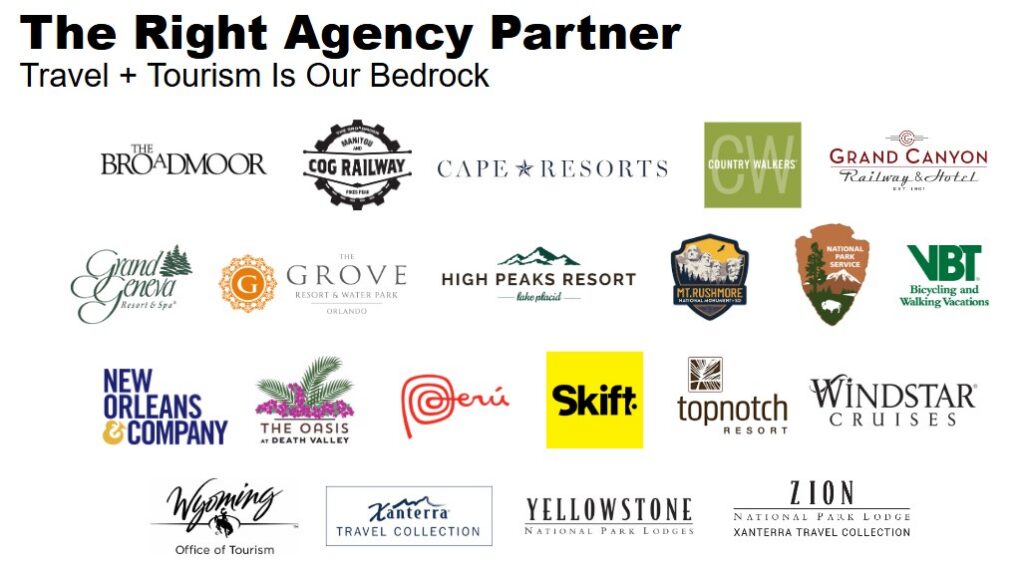
Strategy, travel PR, search and measurement experience since 2004
DMO marketing decisions carry public, partner and reputational consequences. Percepture combines destination strategy, integrated activation, earned authority, search visibility and accountable reporting.

What is DMO marketing?
DMO marketing is the coordinated work used by a destination marketing organization to attract appropriate demand and create value for visitors, tourism businesses, residents and public funders. It connects public purpose to market choices, partner pathways and measurable outcomes.
A DMO cannot optimize only for more visitors. It must attract the right demand, in the right seasons and places, while showing value to partners, residents and public funders.
The operating priorities
Start with mandate
Define what the organization is authorized, funded and expected to change before buying media.
Use place truth
Build the promise around experiences the destination and its partners can consistently deliver.
Align stakeholders
Clarify who governs, funds, delivers, converts, validates and receives value.
Shape demand
Prioritize markets, seasons, places and trip purposes instead of treating every visitor as equal.
Assign channel jobs
Give every channel a defined audience, role, pathway, owner and performance signal.
Report shared value
Separate delivered activity from traveler action, destination outcomes and community outcomes.
Who this guide is for
Executives and boards
Use the DMO marketing operating model to connect mandate, risk, investment and public reporting.
Tourism marketers
Use DMO marketing strategy to establish channel roles, partner paths and a focused demand portfolio.
Public funders
Use it to distinguish activity metrics from evidence of destination and community value.
Tourism partners
Use it to define participation, conversion pathways, data responsibilities and benefits.
What DMO marketing means in practice
A hotel controls its rooms. A tour operator controls its departures. A destination organization usually controls neither the visitor experience nor the final transaction. It influences choice by coordinating official information, positioning, promotion, sales, partner referrals and trust across a shared place.
That changes how strategy must be built. Stakeholder alignment is an operating requirement, not a communications add-on. A lodging partner may want need-period demand, a resident may want better visitor behavior, and a public funder may need evidence that investment produced useful local value.
This guide explains how a DMO aligns mandate, stakeholders and marketing. Detailed execution belongs in specialist resources, including Percepture’s strategy and planning services and omnichannel marketing approach.
Why destination organizations market differently
A DMO markets a network of lodging, attractions, restaurants, retail, culture, neighborhoods, parks, venues, transportation, residents, government and private partners. DMO marketing is accountable for influence across a system the organization does not fully control.
Product brand and destination organization comparison
| Question | Product brand | Destination organization |
|---|---|---|
| What is marketed? | An owned product | A shared place |
| Who delivers it? | One company and its partners | Many independent stakeholders |
| How is it funded? | Company revenue or owners | Public, private or mixed sources |
| Who owns conversion? | Usually the product company | Conversion is distributed among partners |
| What defines success? | Revenue and profit | Demand, partner, visitor and public value |
| How much brand control exists? | Relatively high | Coordinated but never absolute |
| What risks matter? | Product and reputation | Reputation, politics, capacity and community |
The strongest DMO strategy converts public mandate into market choices, and market choices into visible shared value. That requires a system rather than a campaign calendar.
A destination story creates value when the whole system carries it
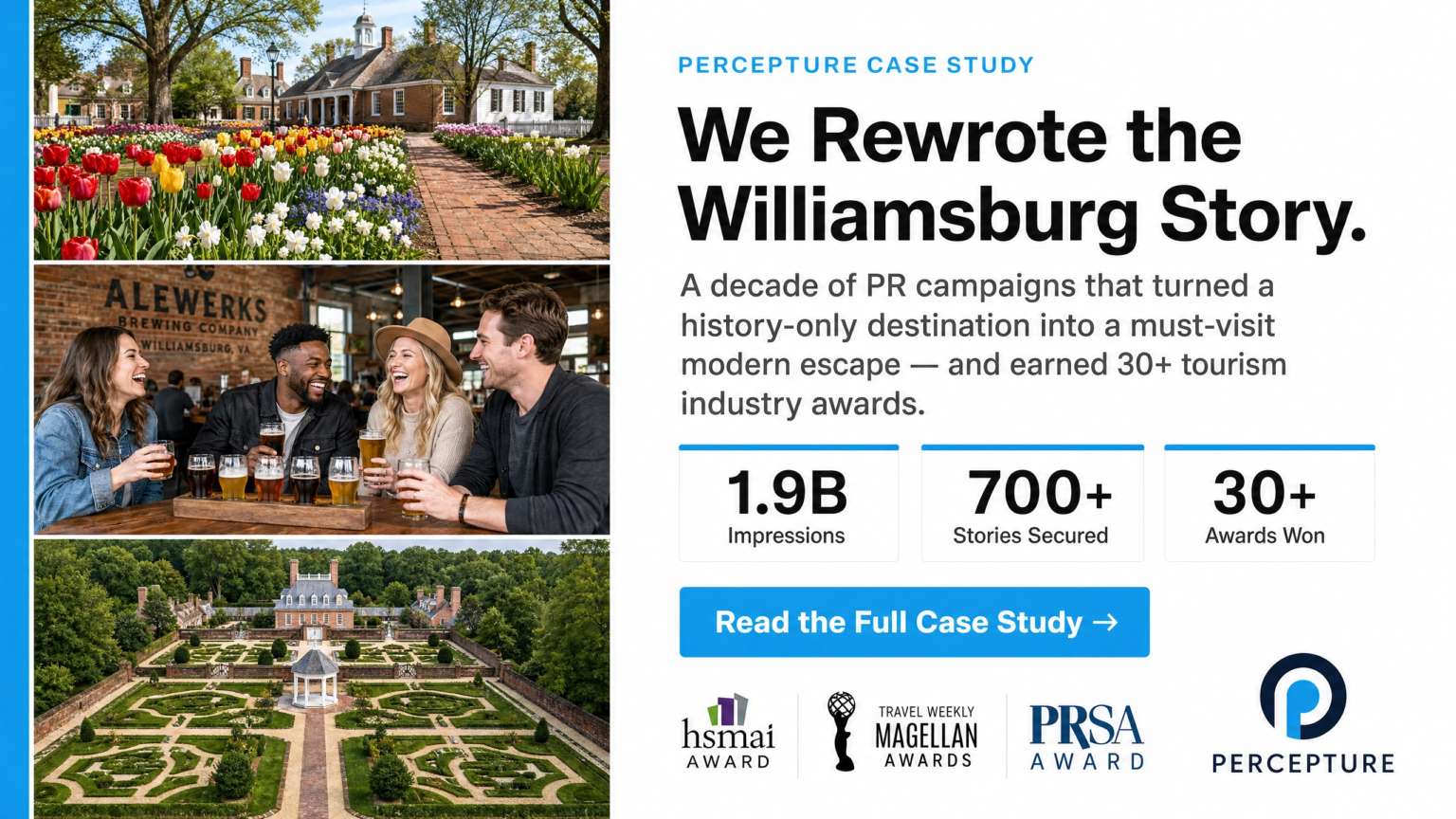
Greater Williamsburg faced a perception challenge that called for broader positioning, earned authority, search capture and useful planning content. The approved results are integrated outcomes, not proof that one channel caused the entire result.
The DMO Mandate-to-Market System
The DMO Mandate-to-Market System is Percepture’s seven-part method for turning public purpose into focused demand, partner action and measurable community value. It gives DMO marketing leaders a common decision path before teams move into campaign production.
| Layer | Governing question | Operating output |
|---|---|---|
| 1. Mandate | What is the organization authorized and funded to accomplish? | Public-Value Mandate |
| 2. Destination Intelligence | Where can changed demand create useful value? | Opportunity Map |
| 3. Place Truth | What promise can the destination reliably deliver? | Positioning Platform |
| 4. Stakeholder Compact | Who governs, funds, delivers and validates the work? | Stakeholder Compact |
| 5. Demand Portfolio | Which markets, seasons and trip purposes matter? | Demand Portfolio |
| 6. Channel Activation | Which channels perform each required job? | Activation System |
| 7. Accountability | What evidence should change the next decision? | Shared-Value Scorecard |
Framework rule: No campaign enters market until its mandate, target demand, stakeholder dependency, conversion path and reporting method are visible.
1. Mandate
Clarify the charter, funding conditions, geography, board priorities, public outcomes, reporting duties and constraints. Strategy begins with what the organization is authorized to change, not with the media formats a team wants to buy.
2. Destination intelligence
Combine visitor, lodging, access, seasonality, search, partner, resident, capacity, accessibility, media and AI signals. The aim is to locate demand problems where marketing can produce a useful change.
3. Place truth
Define a distinctive promise, its proof, the best audience, the relevant season and the claims the destination should not make. A campaign can dramatize a place truth. It cannot manufacture one.
4. Stakeholder compact
Assign governance, funding, delivery, conversion, data, approvals, community protection, crisis response and reporting. Every major stakeholder should understand what it contributes, receives and decides.
5. Demand portfolio
Prioritize the right mix of leisure, meetings, sports, groups, events, drive markets, longer stays, shoulder-season travel and geographic dispersion. Do not spread investment evenly when access, capacity and fit are unequal.
6. Channel activation
Coordinate paid, owned, earned, shared and partner channels. Each channel needs one primary job, a defined audience, an owner, a next step and a useful performance signal.
7. Accountability
Separate execution from qualified demand, partner action, traveler action, destination outcomes, community outcomes and long-term assets. Reporting should also state the confidence behind each conclusion.
Score the operating model before adding another campaign
Use the DMO marketing scorecard below to assess mandate clarity, destination intelligence, stakeholder responsibilities, demand priorities, channel roles and measurement readiness.
Review the Mandate-to-Market approachBuild strategy before selecting channels
Make choices in a fixed order: public and business outcome, demand problem, audience, source market, season, geography, capacity, destination promise, partner path, channel sequence and measurement threshold. This keeps DMO marketing strategy tied to a real destination need.
Within DMO marketing, low awareness may call for research, positioning and independent proof. Weak shoulder-season demand may call for a need-period audience, event strategy or package. Poor conversion may require better partner data and landing paths rather than more reach.
Demand shaping can be more valuable than raw demand growth. Increase demand only where the destination and community can deliver the promise.
Align DMO stakeholders
Stakeholders fill four operating roles. Boards, funders and public officials govern. Lodging contributors, members and sponsors fund. Hotels, attractions, restaurants, venues and transportation providers deliver. Visitors, residents, workers and community institutions experience and validate the result.
| Stakeholder | Primary need | Contribution | Useful evidence |
|---|---|---|---|
| Residents and neighborhoods | Quality of life and transparency | Place truth and welcome | Sentiment, dispersion and issue response |
| Lodging partners | Qualified need-period demand | Inventory, data and tax base | Referrals, room nights and market mix |
| Attractions and culture | Itinerary inclusion | Experiences and content | Partner clicks and ticket intent |
| Public funders | Accountable use | Mandate and resources | Outcomes, confidence and decisions |
| Board | Strategy and risk clarity | Governance | Scorecard and decision log |
| Meeting and sports assets | Qualified opportunities | Venue and host capacity | Leads, definite business and room blocks |
Stakeholder engagement fails when the DMO asks for support without defining what the stakeholder receives, contributes or decides. Effective DMO marketing gives major groups documented outcomes, decision rights, available data, cadence, benefit, risk and a conflict protocol.
Manage demand as a portfolio
A destination should not treat leisure, meetings, sports, groups, events and regional trips as interchangeable. Each DMO marketing demand line has different timing, dependencies, conversion paths and evidence. Portfolio decisions also prevent one partner category from defining the entire strategy.
| Demand line | Best use | Dependency | Performance signal |
|---|---|---|---|
| Leisure | Seasonal and brand demand | Product readiness | Planning activity and visitation |
| Meetings | Weekday or base business | Venue and hotel inventory | Leads, definite business and room nights |
| Sports | Need periods and repeat events | Facilities and hosts | Bids, attendance and room blocks |
| Events | A reason to travel now | Event quality and fixed dates | Tickets, lodging and incremental attendance |
| Drive markets | Regional short breaks | Road access and trip fit | Trips and seasonality |
| Dispersion | Broader geographic value | Transport and visitor-ready product | Geographic distribution |
Choose DMO marketing channels
Channel choice follows the demand problem. The channel mix is not the strategy. Strong DMO marketing gives paid, owned, earned, shared and partner activity distinct jobs instead of asking every channel to produce awareness, conversion and public proof at once.
| Channel | Primary job | Warning sign |
|---|---|---|
| Brand campaign | Build preference or change perception | Generic reach with no market choice |
| SEO | Capture destination planning | Rankings with no itinerary or partner path |
| AI search | Support accurate recommendation inclusion | Screenshots with no source analysis |
| Paid search | Capture high intent | A generic homepage landing experience |
| PR and digital PR | Earn trust and authority | Every impression treated as value |
| Creators | Demonstrate the experience | Followers without rights or reuse plans |
| Nurture planning and advocacy | One undifferentiated newsletter | |
| Co-op | Combine strategy, reach and partner value | Placements sold without a demand objective |
Percepture supports these roles through public relations, digital PR, content marketing, paid search and email marketing.
Build visibility across search and AI
The DMO website should function as an official planning layer, not merely a campaign brochure. Its pages should establish clear entities, current access information, useful itineraries, event details, maps, partner links and accurate answers to practical trip questions.
DMO marketing visibility across search and AI depends on current, corroborated source material rather than mass content production. Technical accessibility, authoritative third-party coverage and consistent partner information help discovery systems understand what the destination offers.
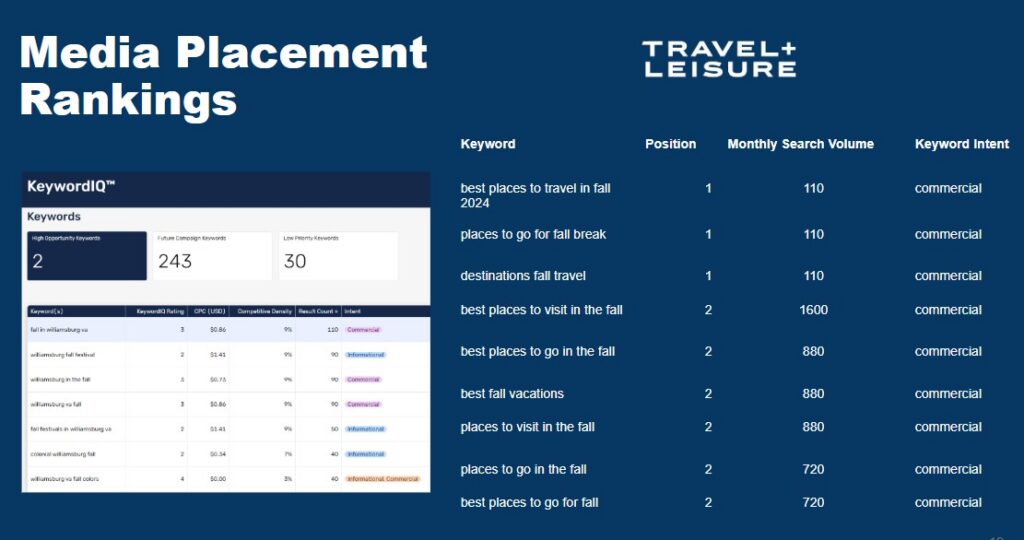
Teams that need channel support can connect destination content to enterprise SEO and generative engine optimization services.

Coordinate brand, content, PR and creators
Define the traveler, occasion, promise, proof, season, geography and excluded claims before production begins. The best DMO story is distinctive enough to earn attention and practical enough to help a traveler plan.
Content should answer planning questions and connect visitors to partners. PR should corroborate positioning and support reputation readiness. Creator programs need audience fit, disclosure, partner inclusion, usage rights, evergreen reuse and tracking.
When destination facts can change quickly, a documented update and escalation process matters. Percepture’s crisis communications service addresses the operating discipline required when access, policy, safety or reputation conditions shift.
Design co-op around partner value
A DMO marketing co-op program needs a demand objective, selected partners, target audience, shared message, funding model, creative standards, conversion path, data responsibilities and reporting method. Co-op marketing should create shared demand, not simply sell logo placement.
Matched media can extend reach but may fragment creative. Themed itineraries connect partners but require balanced participation. Need-period packages can move inventory but fail when booking paths are weak. Data partnerships can improve intelligence but need clear privacy and ownership rules.
Connect stewardship and marketing
Destination stewardship does not replace DMO marketing. It tells marketing what demand is worth creating. Resident sentiment, capacity, accessibility, workforce conditions, cultural consent, visitor behavior and geographic dispersion belong in market decisions.
Apply a four-value lens to major initiatives: traveler value, partner value, resident value and public-funder value. A campaign may create visitor interest while failing to move demand toward places or periods where the community can benefit.
Measure DMO marketing
DMO marketing measurement should move through an evidence ladder. Begin with delivered work, then examine qualified demand, partner action, traveler action, destination outcomes, community outcomes and long-term assets.
| Evidence level | Examples | Decision question |
|---|---|---|
| Delivery | Campaigns, media, content and sales activity | Did the planned work occur? |
| Qualified demand | Planning engagement, branded search and itinerary use | Did relevant interest change? |
| Partner action | Outbound clicks, package views and leads | Did demand reach the ecosystem? |
| Traveler action | Booking, ticket, RFP, registration or visit | Did someone act? |
| Destination outcome | Room nights, spend, visitation or seasonality | Did market value change? |
| Community outcome | Dispersion, sentiment, workforce or public value | Was value shared? |
| Long-term asset | Brand, rankings, links and owned audience | Did future capacity improve? |
DMO marketing reports should use evidence labels such as observed, directly tracked, platform-attributed, partner-reported, modeled, survey-estimated, assisted, incremental and unknown. Impressions are not visits, platform attribution is not automatically incrementality, and tracked sales are not the same as full return on investment.
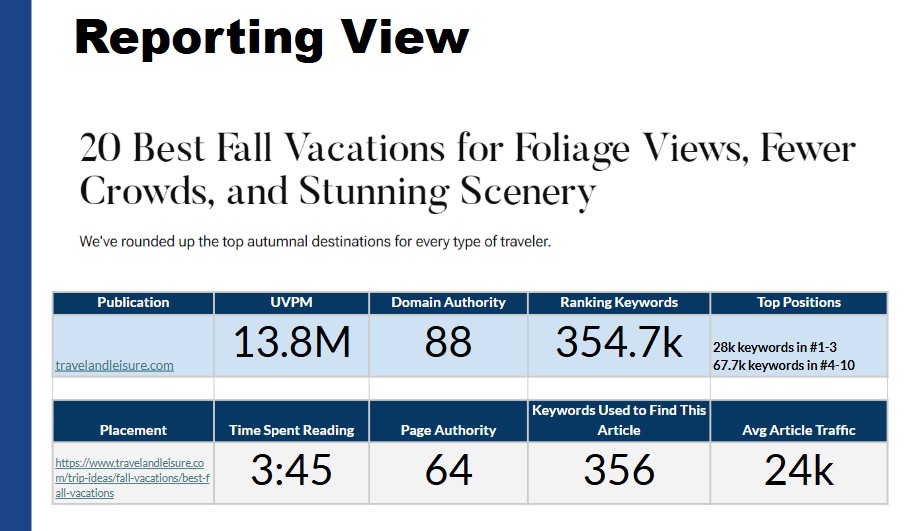
Public accountability improves when the report shows what the organization learned and changed, not only what it delivered. Attribution and analytics can strengthen this work when conclusions remain tied to their evidence limits.
Learn from DMO marketing examples
Use destination organization examples as operating patterns, not as a ranking of the best DMOs. Good examples show the problem, coordinated response, evidence and limitation.
| Example | Demonstrates | Approved evidence | Limitation |
|---|---|---|---|
| Greater Williamsburg | Positioning, media, SEO and partner pathways | More than 300 million impressions, 100 stories, 18% organic growth and more than 100,000 new organic visitors | Integrated result rather than one-channel attribution |
| Explore Hunterdon | Regional digital activation | 7 million impressions, 73,000 site visitors and 13,106 direct banner clicks | Digital evidence rather than economic impact |
| Visit Elizabeth City | Trackable event-demand capture | 329,000 impressions, 4,210 clicks, 220 purchases and approximately $14,800 in tracked sales | Full cost and incrementality were not available |
| New Orleans | Creator work extended into planning content | 17 trips, 415,000 engagements and 53 Instagram posts | Engagement is not visitation |
The useful lesson is not to copy another destination’s channel mix. It is to identify how mandate, positioning, stakeholder capacity, conversion and evidence worked together.
Score DMO readiness
The DMO Marketing Operating Readiness Score is a Percepture diagnostic, not a validated industry standard. Give each DMO marketing category up to ten points, then use the result to decide whether to scale, repair gaps or pause expansion.
| Category | Points | What strong readiness looks like |
|---|---|---|
| Mandate clarity | 10 | Authority, outcomes, geography and constraints are explicit |
| Destination intelligence | 10 | Market, access, season and capacity signals guide choices |
| Place truth | 10 | The promise is distinctive, supported and deliverable |
| Stakeholder compact | 10 | Rights, contributions, benefits and responsibilities are documented |
| Demand portfolio | 10 | Priority markets, seasons and trip purposes are clear |
| Channel architecture | 10 | Every channel has a job, owner, path and signal |
| Partner conversion | 10 | Demand can move into useful partner actions |
| Resident and stewardship fit | 10 | Capacity, sentiment and community value affect decisions |
| Measurement | 10 | Reports separate activity, action, outcomes and confidence |
| Governance and agility | 10 | Teams can reallocate, escalate and explain decisions |
- 85–100: aligned and ready to scale.
- 70–84: strong foundation with material gaps.
- 50–69: execution is outrunning strategy.
- Below 50: pause expansion and rebuild the operating model.
Avoid common mistakes
Strategy errors
- Starting with media instead of mandate
- Treating all visitors as equally valuable
- Creating a slogan before defining place truth
- Copying a larger destination’s channel mix
- Spreading budget below an effective operating scale
Stakeholder errors
- Confusing input with unanimous approval
- Letting one partner category define strategy
- Selling co-op as ad inventory
- Communicating with residents only during controversy
- Operating without a crisis protocol
Channel errors
- Using generic paid landing pages
- Running creator trips without rights or reuse
- Leaving partner-link governance undefined
- Publishing stale event, route or accessibility facts
- Producing AI content without source ownership
Evidence errors
- Reporting reach without partner action
- Presenting platform attribution as impact
- Using activity-only board reports
- Ignoring evidence confidence
- Promising experiences the destination cannot deliver
These mistakes make DMO marketing look busy while leaving leaders unable to explain what changed, who benefited or what should happen next.
Why Percepture has a point of view
Destination positioning and demand
Greater Williamsburg connected broader DMO marketing positioning with media, search and planning pathways.
Regional partner activation
Explore Hunterdon provides approved digital evidence while keeping economic-impact claims separate.
Trackable conversion
Visit Elizabeth City shows how paid activity can connect to defined traveler actions.
Authority that compounds
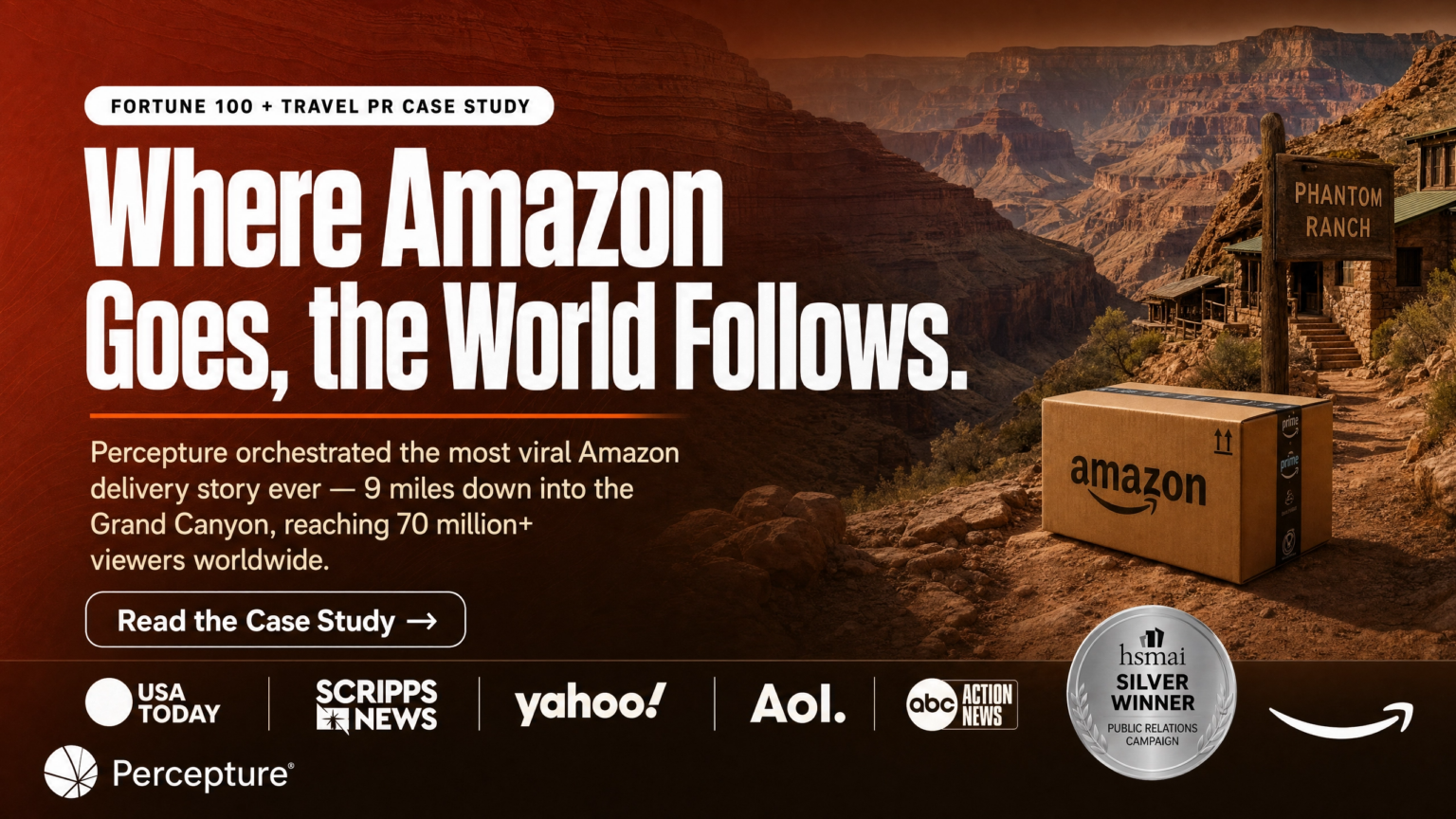
New Orleans, SKIFT and the Amazon and Phantom Ranch work illustrate earned and evergreen visibility patterns.
Explore Percepture’s travel and tourism experience.
See how destination positioning moved into market
Review the Greater Williamsburg work to see how DMO marketing connected a broader destination story with earned media, organic discovery, planning content and partner pathways.
Explore the Greater Williamsburg case studyVisual proof used in this guide
Frequently asked questions
What is DMO marketing?
DMO marketing is the research, positioning, promotion, sales, partnership and measurement work a destination organization uses to create appropriate visitor demand. It connects public purpose with audience choices, partner delivery, conversion pathways and evidence of value for visitors, tourism businesses, residents and public funders.
What does a destination marketing organization do?
A destination marketing organization coordinates DMO marketing for a place it shares with many independent stakeholders. Its work can include research, positioning, visitor information, promotion, public relations, sales, partner programs and measurement. It influences traveler choice but usually does not own the full visitor experience or transaction.
How is destination marketing different from general tourism marketing?
Tourism marketing is the broader discipline used by destinations, hotels, attractions, operators and other travel businesses. DMO marketing applies that discipline within a public or shared-place mandate. It must account for stakeholder rights, distributed conversion, resident interests, capacity and public-funder value as well as visitor demand.
What should a DMO marketing strategy include?
A strategy should define the mandate, demand problem, audience, source market, season, geography, capacity, place promise, stakeholder dependencies, partner pathway, channel sequence and measurement threshold. It should also state which claims the destination will not make and how evidence will affect the next investment decision.
Who are the main DMO stakeholders?
Main stakeholders include boards, public funders, elected officials, lodging contributors, attractions, restaurants, cultural institutions, venues, event organizers, transportation providers, residents, workers, visitors, media and travel trade partners. Their roles differ, so the DMO should document what each group contributes, receives, validates and decides.
Which destination marketing channels work best?
No DMO marketing channel works best for every demand problem. Brand campaigns can change perception, search can capture planning demand, PR can build independent authority, paid media can accelerate or capture demand, email can nurture planning, and partner channels can extend conversion. The right mix follows the chosen market outcome.
How should a DMO measure success?
DMO marketing measurement should separate delivered work, qualified demand, partner action, traveler action, destination outcomes, community outcomes and long-term assets. Label the confidence behind each conclusion, including whether evidence is directly tracked, platform-attributed, partner-reported, modeled, survey-estimated, assisted, incremental or unknown.
When should a DMO hire a marketing agency?
Hire an agency when the organization needs specialist capacity, an outside operating view or coordinated execution that the internal team cannot provide at the required depth. Before selection, define the mandate, demand problem, stakeholder dependencies, decision rights, expected outputs, data access and evidence standards the agency must support.
Align mandate, stakeholders and demand before the next campaign
A DMO marketing alignment review can map the public mandate, demand portfolio, stakeholder dependencies, channel roles, partner paths and evidence gaps that should guide the next decision.
Request a DMO Marketing Alignment Review
About Bob Generale
Bob Generale is President of Percepture, an integrated marketing, public relations, SEO, GEO, paid-media, content and analytics agency founded in 2004. He helps destination and travel organizations connect market strategy, stakeholder alignment, discoverability, partner pathways and measurable demand.