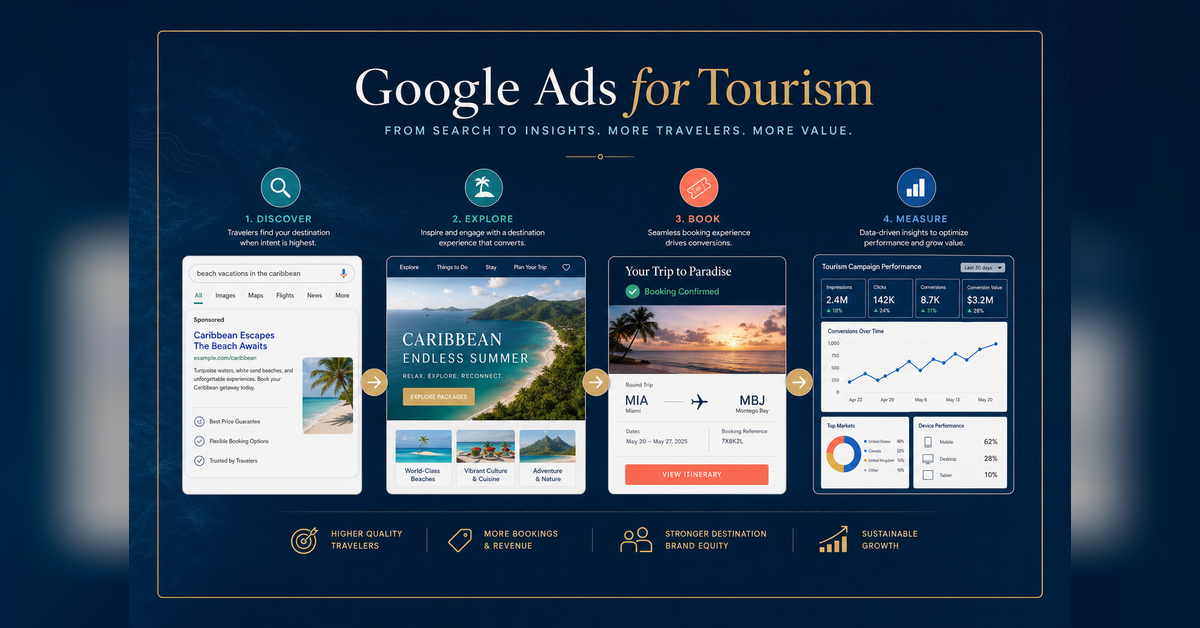

Google Ads for tourism helps destinations, hotels, tour operators and attractions reach travelers searching for places to stay, things to do, tickets, tours and trip-planning help. A strong campaign matches traveler intent with the correct market, season, inventory, landing page and measurable action, such as a booking, ticket, qualified inquiry or partner referral.
The query, traveler market, season, product, landing page and conversion must describe the same real-world decision. If they do not, the account may generate traffic while the organization still struggles to explain what the spend produced.
Travel marketing experience backed by strategy, execution and measurement
Percepture has supported tourism, hospitality and destination programs since 2004. The proof stack below combines relevant industry experience, independent recognition and campaign work.






How should tourism organizations use paid search?
Use Google Ads for tourism to capture a specific traveler decision, route that traveler to an available and relevant experience, and measure the action that matters. The action may be a booking, ticket, reservation, qualified inquiry or trackable partner referral. A click is not a visit.
The operating view
Define the conversion first
For Google Ads for tourism, choose the traveler or business action the campaign must produce before selecting a bid strategy.
Match both sides of geography
Structure Google Ads for tourism to separate where the traveler is located from the place the traveler intends to visit.
Separate products and outcomes
Rooms, restaurant reservations, event inquiries and attraction tickets should not share one undifferentiated campaign.
Control purchased demand
Search terms and negative keywords determine which traveler decisions enter the account.
Respect availability
Inventory, dates, operating hours and capacity must shape ads and landing pages.
Report decisions
Report Google Ads for tourism by connecting spend to qualified actions, value, capacity and the next budget decision.
Who this guide is for
Destinations and tourism boards
Use Google Ads for tourism to support itineraries, partner referrals, event actions, guide requests and qualified group inquiries.
Hotels and resorts
Use Google Ads for tourism to connect stay intent to current room inventory, booking paths, revenue and qualified group demand.
Tour and activity operators
Structure Google Ads for tourism around distinct activities, routes, dates, departure points and booking availability.
Attractions, museums and events
Use Google Ads for tourism to match ticket, schedule, parking, access and in-destination searches to a clear visit action.
This guide explains how Google Ads for tourism works across business models. Use Percepture’s specialist resources for hotel, tour-operator and technical execution.
Tourism paid search is a coordination problem before it is a bidding problem
Percepture has managed paid-media implementation across multi-property hospitality programs, including campaign setup, conversion instrumentation, geographic targeting, search-term governance and ongoing optimization.
The practical lesson is consistent: a Google Ads for tourism account is easier to manage when each campaign has one accountable outcome, one defined audience, current inventory and a tested conversion path. This operating discipline matters more than chasing a fashionable setting.
Paid-media review by Joe Zinda
Joe Zinda, Paid Specialist at Percepture, brings a decade of digital-strategy experience spanning Google Ads, performance marketing, audience targeting, cross-channel strategy and conversion optimization. His hospitality work includes campaign setup, query control, location strategy, tracking, bidding, reporting and ongoing optimization.
“Hotel and tourism campaigns perform better when tracking, location targeting and search-term control are fixed before the team trusts automated bidding.”
Joe’s tourism paid-search preflight
- Confirm the revenue or visitor objective.
- Define the booking, ticket, reservation, lead or partner action.
- Audit analytics and tag-management events.
- Test cross-domain booking and reservation paths.
- Separate branded and nonbranded demand.
- Review search terms and negative keywords.
- Match geography to destination intent and buying behavior.
- Align schedules with hours, events and booking windows.
- Review automated assets, bidding settings and eligibility.
- Connect reporting to traveler action and business value.
Most tourism PPC guides begin with keywords. This preflight begins with measurement because automation in Google Ads for tourism cannot repair an undefined conversion.
Why Google Ads for tourism requires a different strategy
Tourism demand crosses places and dates. The person searching may be hundreds of miles from the destination, already inside the destination or comparing several trips. A location setting in Google Ads for tourism cannot explain that context on its own.
Demand also changes before the travel date. A holiday event may need advertising months before arrival, while a restaurant or attraction may benefit from immediate mobile searches. The Google Ads for tourism campaign calendar should follow traveler decision time, not the marketing department’s publication date.
Availability is advertising data. A sold-out departure, closed attraction, unavailable room type or expired event should change the campaign, page or routing decision. Google Ads for tourism should not promote unavailable inventory, waste budget or create a poor traveler experience.
Google Ads for tourism conditions and campaign implications
| Condition | Campaign implication | Control |
|---|---|---|
| Traveler and destination differ | Separate user location from destination intent | Source-market structure and destination-qualified terms |
| Demand changes by season | Budget must follow the booking window | Season and event calendar |
| Inventory sells out | Ads must reflect what can be fulfilled | Availability owner and pause rule |
| Booking occurs off-domain | The main action may be lost | Cross-domain event testing |
| Several products share a property | Outcomes and queries can become mixed | Separate campaigns and negatives |
| The DMO does not own checkout | Direct revenue may be unavailable | Partner actions and an economic-value model |
Check campaign readiness before adding budget
Score the account against five controls: a defined outcome, current inventory, qualified geography, a relevant landing page and a tested conversion. The review shows whether the next dollar should fund media or repair the system first.
The Tourism Search-to-Visit Ads System
Percepture’s Tourism Search-to-Visit Ads System is a nine-stage method for turning search demand into bookings, tickets, qualified leads, partner referrals and measurable visitor action. It treats Google Ads for tourism as a demand-and-inventory matching system rather than a traffic-buying exercise.
The nine operating stages
- Visitor objective: define the business or visitor outcome that matters.
- Traveler intent: identify the decision being made in the search.
- Market and timing: define origin, destination, season and booking window.
- Campaign architecture: structure Google Ads for tourism by separating campaigns when outcome, audience, geography, inventory or budget differs.
- Landing and inventory: confirm that the promise can be fulfilled on a relevant page.
- Conversion instrumentation: test booking, ticket, call, form and partner events.
- Search-term control: govern keywords, search terms and shared negatives.
- Budget and bidding: fund Google Ads for tourism at a level that can produce a useful decision.
- Reporting and reallocation: show what should scale, narrow, pause or stop.
Framework rule: No tourism campaign launches without a traveler decision, available product, tracked conversion, responsible owner and stop-or-scale rule.
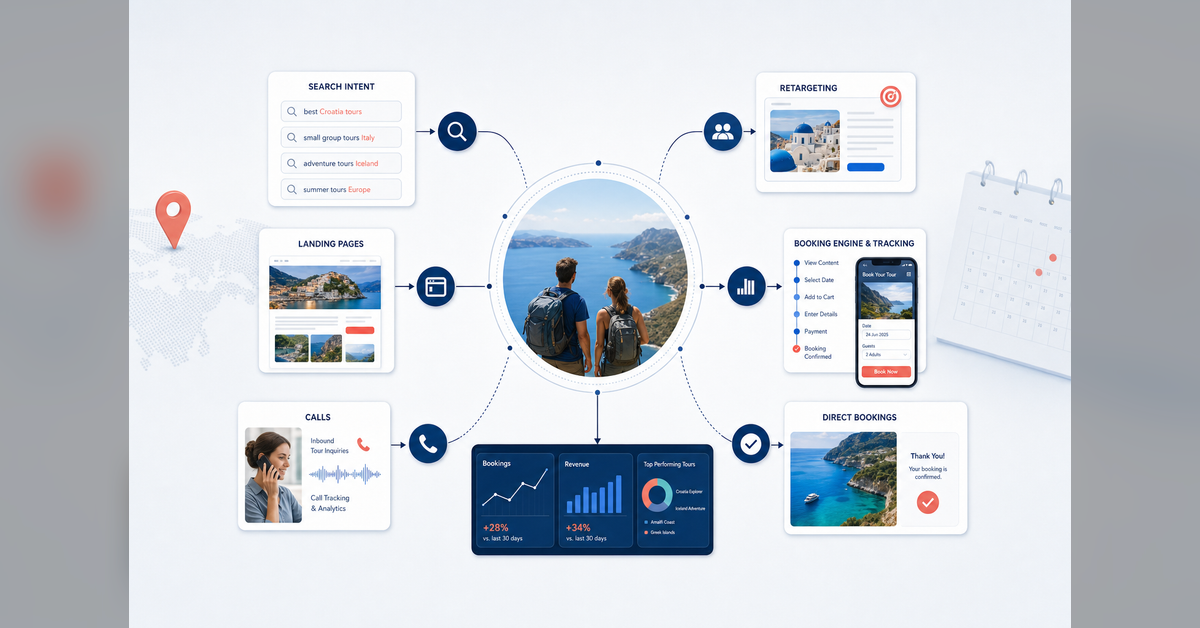
Google Ads for tourism campaign and budget framework
The right structure for Google Ads for tourism begins with the traveler decision the organization can fulfill now. Search is a practical starting point for a constrained test because the team can organize ads around explicit stay, activity, ticket, reservation or service demand.
Travel-specific formats in Google Ads for tourism may serve narrower use cases, but eligibility, data and implementation requirements must be checked against current platform documentation. The organization should not add a format simply because it is available inside an account.
Google Ads for tourism campaign approach comparison
| Approach | Best fit | Main risk | Launch condition |
|---|---|---|---|
| Controlled Search campaign | High-intent stays, tours, tickets and inquiries | Query leakage | Relevant keywords, negatives, page and conversion |
| Brand campaign | Navigation and brand-demand protection | Claiming credit for demand created elsewhere | Separate reporting from nonbrand acquisition |
| Local or in-destination campaign | Nearby dining, attractions, tickets and directions | Loose radius or schedule settings | Accurate hours, local page and action tracking |
| Remarketing support | Re-engaging prior visitors | Overstating incremental impact | Useful audience, frequency control and downstream measurement |
| Travel Promotion Ads | Eligible hotel promotion use cases | Implementation and attribution complexity | Current eligibility and property data requirements are met |
Google’s documentation describes Travel Promotion Ads as a hotel-campaign format that can display properties in Hotel Search.

Build keyword architecture around traveler decisions
The best keyword is the traveler decision the organization can fulfill now. In Google Ads for tourism, a useful term preserves the destination, traveler, timing and product constraints that determine whether the click can become a real action.
A phrase such as “family rafting tour near Asheville” carries more operational context than “vacation ideas.” That does not make broad research demand worthless, but Google Ads for tourism should not assign the two searches the same page, bid logic or conversion expectation.
Tourism keyword groups
| Group | Example pattern | Traveler decision |
|---|---|---|
| Brand | Property, attraction or destination name | Navigation and validation |
| Category and place | Hotels, tours or museums in a place | Selection |
| Activity and place | Food tour, rafting or wildlife tour | Experience selection |
| Date and season | Holiday events or summer tours | Timing |
| Audience | Family, couples, groups or accessible | Fit |
| Occasion | Wedding, retreat, reunion or honeymoon | Purpose |
| Local | Near me, open now or nearby tickets | Immediate action |
| Transaction | Book, availability, tickets or reservations | Conversion proximity |
Start controlled Google Ads for tourism tests with tightly related keyword themes. Separate brand and nonbrand demand. Broader matching requires credible conversion signals, enough budget to learn and a documented search-term review process.
Tour operators needing route, departure and activity detail can use the Google Ads for tour operators guide. Hotels should use the hotel PPC agency guide for room, metasearch and direct-booking decisions.
Negative keywords are operating policy
A negative-keyword list is a living record of demand the organization has chosen not to buy through Google Ads for tourism. It should be based on offer fit, geography, inventory and economics rather than assumptions about which travelers look prestigious.
Potential negative themes for Google Ads for tourism include unrelated destinations, jobs, training, unsupported transportation, unavailable products, supplier terms and amenities the organization does not offer. Do not automatically exclude words such as “cheap,” “budget” or “free.” A valid value-oriented product may serve those travelers.
Review search terms frequently during launch, then move to a documented recurring cadence as the campaign stabilizes. Refresh the list whenever seasons, events, schedules, inventory or offers change. A cheap click can be expensive when it reaches the wrong traveler, date, market or product.
Geography must reflect source market and destination intent
Location targeting is not a substitute for destination intent. Google Ads for tourism must account for both where the traveler is and where the traveler wants to go. A person in New York may be planning a Dallas trip, while a traveler already in Dallas may be looking for dinner tonight.
| Goal | Typical geographic approach | Operational check |
|---|---|---|
| Destination planning | Source markets plus destination-qualified searches | Compare market quality and booking windows |
| Local attraction or restaurant | City, radius and immediate-intent searches | Match hours, mobile pages and local actions |
| Wedding or event | Drive-time or regional markets | Match occasion page and qualified inquiry |
| Seasonal event | Source markets plus event and date terms | Launch during decision time |
| International demand | Separate country and language structures | Confirm fulfillment, language and booking support |
Analyze Google Ads for tourism location reports rather than assuming that a radius behaves as expected. Separate markets when their economics, timing or traveler behavior differ. Exclude areas the organization cannot serve and reroute or pause demand when inventory is unavailable.
For a broader view of touchpoints before and after paid search, review Percepture’s customer journey service and omnichannel marketing approach.
Landing pages must complete the traveler decision
Google Ads for tourism traffic should land on the smallest page that can answer the traveler’s decision completely. A homepage often asks the visitor to restart the search, locate the product and rediscover the action promised by the ad.
A ready page states the destination or product clearly, shows current dates, rates, hours or availability, explains access and planning details, works on mobile and gives the visitor one primary action. The booking or inquiry path should preserve campaign information across domains when possible.
For Google Ads for tourism, landing-page relevance is also an inventory control. If the promoted experience is unavailable, the page should offer an honest alternative, waitlist or revised date instead of presenting false urgency.
- Match the headline to the traveler intent.
- Show current product, date, rate, hour or availability information.
- Use first-hand images and useful proof.
- Explain cancellation, parking, access or meeting-point details.
- Make the primary action clear on mobile.
- Test every form, phone, ticket and booking path.
- Avoid redirecting specific paid demand to an unrelated homepage.
Percepture’s conversion rate optimization service addresses the page and journey barriers that prevent qualified traffic from acting. Its enterprise web development service supports larger implementation requirements.
Conversion tracking is campaign strategy
Conversion tracking is part of campaign strategy, not a technical task added after launch. Google Ads for tourism cannot optimize toward the organization’s real objective when the account only sees page views, button clicks or an untested booking entrance.
Primary conversions for Google Ads for tourism may include bookings, ticket purchases, reservations, qualified leads, group inquiries, qualified calls or trackable partner transactions. Secondary actions may include availability checks, itinerary downloads, guide requests, directions and booking-engine entrances.
Do not optimize Google Ads for tourism to every micro-conversion equally. A booking entrance is not a booking, and a partner click is not revenue. Label actions by role and value so reporting does not blur movement through the journey with completed business outcomes.
Common risks include off-domain engines, duplicate analytics events, form spam, unqualified calls, consent limits, cancellations and site changes that break tags. Test events before launch and after changes. Do not ask automated bidding to optimize for conversions the organization cannot measure.
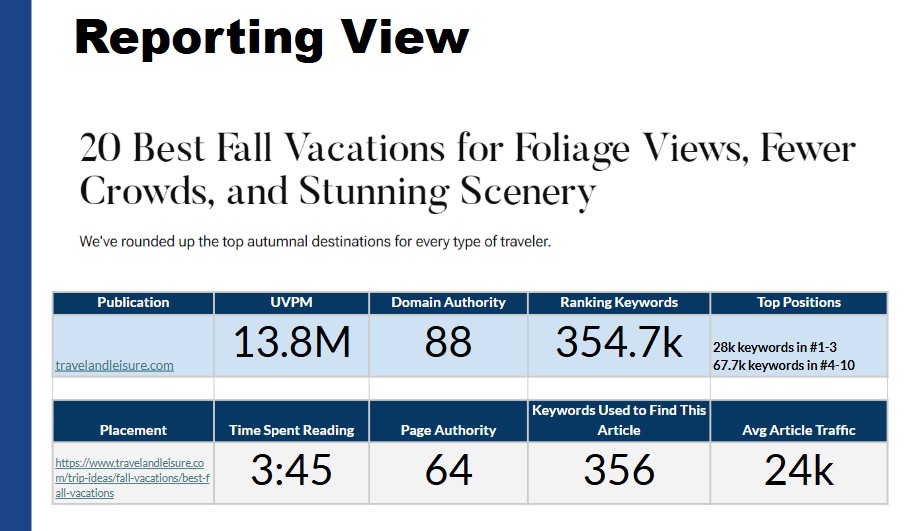
Percepture’s attribution and analytics service helps connect campaigns, cross-domain actions and reporting. Its data visualization service turns those signals into decision-ready views.
06 · InvestmentHow much should Google Ads for tourism cost?
There is no universal daily budget for Google Ads for tourism. Ten dollars per day can support a narrow local or keyword-validation test, but it is usually too small for several tourism products or competitive source markets. Twenty dollars per day may support one tightly scoped campaign when expected click costs still allow enough activity to evaluate qualified actions.
The smallest useful budget is the budget that can produce enough qualified activity to make a decision. Estimate the expected click cost, the number of clicks required to observe meaningful actions and the uncertainty of a new campaign. Then add the cost of Google Ads for tourism strategy, tracking, pages, creative, feeds, reporting and management.
Illustrative planning bands
These ranges are planning examples, not industry benchmarks or promised performance.
| Monthly media | Suitable test scope | Main constraint |
|---|---|---|
| $300–$750 | One narrow local or keyword-validation test | Limited query and conversion volume |
| $750–$2,000 | One priority product, event or local market | Requires strict focus |
| $2,000–$7,500 | Several high-intent themes or markets | Tracking and page quality become more important |
| $7,500–$20,000 | Multi-product or multi-market program | Requires clear ownership and reporting |
| $20,000+ | Scaled destination, portfolio or full-funnel program | Governance, value data and capacity controls |
Planning formula: expected click cost × clicks needed for meaningful qualified actions × learning-risk factor.
Organizations comparing management and media costs can review paid advertising pricing packages. Budget decisions should also be tied to a documented strategy and planning process.
Bidding automation needs reliable signals
Automation amplifies good conversion data—and bad conversion data. A bidding system cannot determine that an imported event represents spam, a duplicate, an unqualified call or a booking-engine entrance incorrectly labeled as a sale.
For Google Ads for tourism, use a readiness ladder. With no reliable conversion data, keep learning controlled. With reliable actions but low volume, use cautious automation and longer evaluation windows. With reliable volume and attributable values, test conversion- or value-based approaches while monitoring query quality and business capacity.
Review active Google Ads for tourism conversion actions, remove weak or duplicate goals, inspect automated assets and document major bidding or measurement changes. Avoid judging a new strategy before it has had a reasonable opportunity to gather qualified data, but do not use a learning period as an excuse to ignore obvious leakage.
Measure outcomes by tourism business model
Google Ads for tourism measurement should reflect the business model. A hotel’s primary result may be booked revenue. An attraction may prioritize ticket revenue. A tour operator may measure bookings and qualified inquiries. A destination organization may need partner referrals, event actions, guide requests or qualified RFPs because it does not own the final transaction.
ROAS is impossible to calculate honestly without attributable value. A DMO may need a visitor-value or partner-referral model instead of direct revenue. Cost per booking is stronger than cost per click, but only when booking data is complete enough to support the comparison.
Google Ads for tourism business-model measurement scorecard
| Business | Primary KPI | Supporting KPI |
|---|---|---|
| DMO or CVB | Partner referrals, RFPs or event actions | Guide, itinerary or engaged visitor action |
| Hotel | Bookings, attributable revenue or qualified group leads | Rate checks, booking entrances and qualified calls |
| Tour operator | Bookings, revenue or qualified inquiry | Availability checks and waitlist actions |
| Attraction or event | Ticket or registration revenue | Directions and planning actions |
| Restaurant | Reservations or private-event leads | Menu and booking-path clicks |
| Travel agency | Qualified trip brief or booked-trip value | Consultation and proposal actions |
A campaign may correctly lose impressions after irrelevant demand is removed. Report spend and delivery, query quality, landing engagement, primary conversions, attributable value, assisted contribution, capacity and the next action. Google Ads for tourism reporting should explain what deserves more investment, not merely what changed on a dashboard.
07 · ImplementationA practical 90-day implementation plan
Days 1–30: Define and instrument
Choose one Google Ads for tourism outcome, product, season and market. Audit queries, map traveler intent, validate inventory and pages, test conversions, separate brand from nonbrand demand and record the baseline.
Deliverables: demand brief, conversion map, market and season matrix, landing requirements and baseline.
Days 31–60: Build and launch
Create Google Ads for tourism campaigns and tightly related groups. Configure geography and schedules, improve the destination pages, test tracking, launch a controlled budget and review search terms frequently.
Deliverables: campaign map, approved assets, working tracking, dashboard and optimization log.
Days 61–90: Learn and reallocate
Compare markets, products, queries and qualified actions. Refine negatives, test page and message changes, adjust bidding only when signals support it, and decide what should scale, narrow, pause or stop.
Deliverables: decision report, revised allocation, next test and documented stop-or-scale rule.
Ninety days should produce a defensible learning system, not a promise of universal tourism growth. Google Ads for tourism should become easier to govern because the organization knows what it is buying, measuring and changing.
Common mistakes that waste tourism ad spend
The campaign fails when advertising creates demand the destination, property or operator cannot fulfill or measure. Most failures are not isolated platform errors. They are coordination failures between marketing, inventory, pages, tracking and ownership.
- Optimizing for clicks while leadership cares about visits, bookings or qualified leads.
- Sending specific traveler intent to a generic homepage.
- Mixing rooms, restaurants, weddings and events in one structure.
- Confusing user location with destination intent.
- Using radius targeting without reviewing location reports.
- Advertising sold-out dates or unavailable products.
- Using one budget and message throughout the year.
- Expanding keyword matching without signals or query governance.
- Mixing brand and nonbrand performance.
- Marking every analytics event as a primary conversion.
- Reporting booking entrances as completed bookings.
- Trusting conversion bidding before tracking works.
- Reporting partner clicks as revenue.
- Ignoring cancellations, refunds, lead quality or capacity.
- Making ROI claims without complete cost and value data.
Google Ads for tourism launch readiness scorecard
| Control | Ready | Not ready |
|---|---|---|
| One primary outcome | The campaign has a named booking, ticket, lead or partner action | The team plans to optimize for general engagement |
| Available product | Dates, capacity and ownership are current | Inventory changes are not communicated |
| Qualified market | Source market and destination intent are documented | Location settings are treated as the whole strategy |
| Relevant page | The page answers the decision and presents one clear action | Traffic is sent to a generic homepage |
| Tested tracking | Primary events have been completed and validated | The account relies on untested button clicks |
| Query control | Search-term review has an owner and cadence | No negative-keyword process exists |
| Decision rule | The team knows when to scale, narrow, pause or stop | Budget continues without an evaluation rule |
What Percepture brings to tourism paid media
Percepture’s approach joins paid search with measurement, landing-page readiness, content and the wider traveler journey. That matters when the booking path crosses systems or when a destination must measure partner actions instead of a direct checkout.
In one hospitality account, the team organized restaurant demand by cuisine and meal intent, reviewed historical queries, expanded ad assets, adjusted hours and radius, and audited tracking and negatives. The lesson was simple: ad groups should reflect how travelers choose, not the property’s internal organization chart.
In another hospitality program, wedding and event themes were separated, geographic reach was adjusted, conflicting demand was excluded, occasion-specific assets were refreshed and lead or booking-entrance tracking was corrected. The market radius, page and conversion event had to describe the same buying occasion.
Another venue used an external reservation path that initially limited measurement. Analytics and advertising events were connected before stronger conversion automation was trusted. “Maximize conversions” is not a measurement plan.
Hotels can also review Percepture’s hotel SEO agency guide, hotel SEO resource and technical SEO for hotels guide. Paid and organic programs should have separate jobs while sharing reliable destination, product and conversion information.
Compare the investment with the operating work
Campaign management is only one part of the cost. Buyers should also account for strategy, tracking, landing pages, creative, reporting and the internal work required to keep availability accurate.
Frequently asked questions
What are Google Ads for tourism?
Google Ads for tourism are paid campaigns designed to reach people making travel decisions, including where to stay, what to do, which tickets to buy or which provider to contact. The campaign must connect that intent to an available product and a measurable action. Traffic alone does not prove visits, bookings or revenue.
Do tourism Google Ads work for destinations and travel businesses?
They can work when the organization has relevant demand, a clear offer, suitable geography, current inventory, a useful landing page and reliable measurement. Results vary by market and business model. A hotel may measure bookings, while a destination organization may rely on partner referrals, guide requests or event actions.
How much should a tourism business spend?
Spend enough to test one meaningful market, product and conversion without spreading the budget across too many campaigns. Estimate likely click costs and the activity needed to observe qualified actions. Media is not the full investment; include strategy, tracking, page work, creative, reporting and management.
Is $10 per day enough for a tourism campaign?
Ten dollars per day may be enough for a narrow local test or limited keyword validation. It is usually too small for several products, seasons or competitive source markets. The decision depends on expected click costs and whether the resulting volume can produce enough qualified activity to support a useful conclusion.
Is $20 per day enough for a tourism campaign?
Twenty dollars per day may support one tightly scoped campaign when click costs still permit meaningful search-term and conversion data. It should not be divided among many destinations or products. Set the test period, primary action and stop-or-scale rule before launch so limited spend still produces a decision.
Which campaign approach should a tourism business start with?
A controlled Search campaign is a practical starting point when the organization can identify high-intent traveler queries and route them to a relevant page. Other formats require their own eligibility, data, asset and attribution checks. Choose the format after defining the outcome, not before.
Which keywords should tourism businesses target?
Target terms that preserve destination, product, traveler and timing context. Useful groups include brand, category and place, activity and place, season, audience, occasion, local and transaction terms. The best keyword is the traveler decision the organization can fulfill now, not simply the phrase with the most traffic.
Which negative keywords should tourism campaigns use?
Use negatives for demand that conflicts with the offer, such as unrelated destinations, jobs, training, unsupported products or unavailable amenities. Do not exclude value-oriented terms automatically. Search-term reports should determine the list, and the list should change when inventory, seasons, events or offers change.
How should tourism organizations target locations?
Separate traveler location from destination intent. Source-market campaigns reach people planning a trip, while local campaigns may reach visitors already near the product. Review location reports, operating hours, booking windows and market economics. Radius targeting alone does not show why a traveler is searching.
How do hotels, operators and destinations track results?
Hotels and operators should test bookings, tickets, reservations, qualified leads and calls across the full path, including external engines. Destinations that do not own checkout can measure partner referrals, guide requests, event actions or qualified RFPs. Secondary actions should not be reported as completed transactions or revenue.
Find where tourism ad spend is leaking

A paid-media review can identify gaps in campaign structure, search terms, geography, landing pages, tracking, bidding and reporting. The goal is to show which traveler demand deserves more budget and which demand should be narrowed or stopped.
Build Google Ads for tourism around measurable traveler action.

About Bob Generale
Bob Generale is President of Percepture, an integrated marketing agency founded in 2004. He develops demand systems connecting traveler intent, destination authority, paid media, conversion paths and measurable outcomes.
This guide received paid-media review from Joe Zinda, Paid Specialist at Percepture.