
Google Ads for Tour Operators gives growth-minded service companies a practical way to connect local visibility, paid demand, reviews, content, and follow-up around qualified calls and booked jobs.
For healthcare leaders, Google Ads for Tour Operators should connect technical content, buyer intent, search visibility, and sales follow-up into one operating plan.
Google Ads for tour operators can drive direct bookings when campaigns match real traveler intent, send clicks to the right tour page, and track bookings, calls, and revenue. They fail when operators buy broad travel curiosity, ignore booking engine attribution, and cannot prove which searches became paid seats.
Direct booking strategy
Turn high-intent searches into trackable tour bookings.
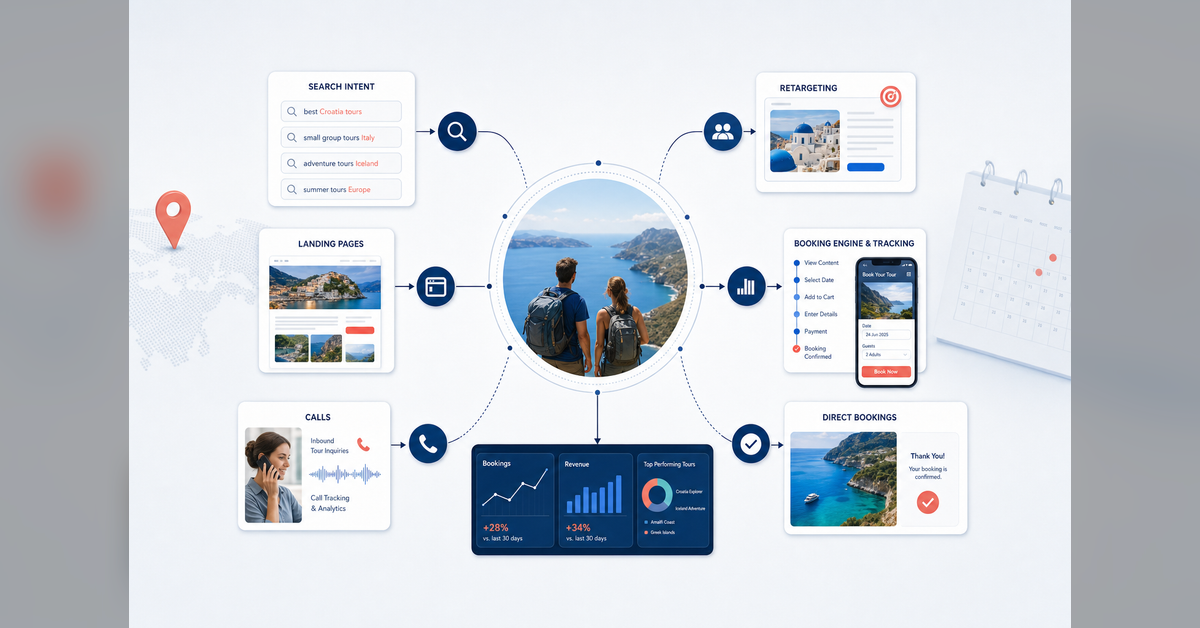
Percepture helps tourism brands connect paid search, landing pages, booking engine tracking, call measurement, retargeting, SEO, GEO, and PR into one direct-booking demand system.
The best Google Ads for Tour Operators programs measure qualified conversations and sales opportunities, not just impressions, clicks, or rankings.
What are Google Ads for tour operators?
Google Ads for tour operators are paid campaigns built to capture travelers searching for tours, attractions, activities, private charters, and things to do. The best programs connect keyword intent, tour landing pages, booking engine tracking, call tracking, retargeting, and revenue reporting.
Who needs Google Ads for tour operators?
A practical Google Ads for Tour Operators strategy also has to reflect buyer committees, proof needs, comparison searches, and long sales cycles.
Google Ads for tour operators is useful for companies that have real search demand and a booking path that can be measured. That includes boat tours, walking tours, food tours, sightseeing companies, adventure tour operators, charter operators, attractions, activity providers, and destination experience brands.
It is not only for large operators. A smaller company with one strong offer can use paid search to test direct demand. A multi-location operator can use it to defend brand demand, fill shoulder-season inventory, and scale high-margin tours. A private charter company can use it to reach people searching for higher-value group trips, corporate events, or last-minute bookings.
When Google Ads for Tour Operators is built this way, every channel supports the same revenue goal instead of acting like a separate campaign.
The key is control. A tour is perishable inventory. Seats on a boat, guide availability, time slots, weather risk, capacity caps, peak season, shoulder season, and private charter margins all affect bidding. A $49 walking tour, a $300 food tour, and a $1,200 private charter should not be treated like the same conversion.
Why Google Ads for tour operators is different from normal PPC
That is why Google Ads for Tour Operators needs both category-level execution and executive-level reporting.
Normal PPC logic often breaks in tourism because the buyer journey is fast, visual, mobile-first, and review-sensitive. Travelers compare options, check maps, read cancellation policies, look at photos, ask about weather, and often come back later before they book.
A generic account structure may chase clicks. A tourism account must protect margin. That means brand and nonbrand campaigns should be separated. Landing pages should match the tour. Calls should be measured. Booking values should be passed back when possible. Negative keywords should be reviewed often. The goal is not more clicks. The goal is more profitable direct bookings.
For healthcare leaders, Google Ads for Tour Operators should connect technical content, buyer intent, search visibility, and sales follow-up into one operating plan.
Percepture approaches this as a direct booking system, not just a channel. Paid search should connect with paid search agency strategy, retargeting, landing page conversion, analytics, and the trust signals that help a traveler choose your brand over an OTA or marketplace.
Why Are Your Google Ads Getting Clicks But No Bookings?
Use this diagnostic before you raise budget.
- Your campaigns bid on broad terms such as tours, travel, or things to do without tight negatives.
- Specific tour searches land on the homepage instead of the matching tour page.
- The booking widget opens on another domain and breaks attribution.
- Calls are not tracked, or all calls count as equal leads.
- Performance Max is running before conversion quality is proven.
- Brand, nonbrand, retargeting, and broad research terms sit in one campaign.
- Mobile checkout is slow, unclear, or hard to complete.
- Revenue value is missing, so Smart Bidding cannot learn from profitable bookings.
The best Google Ads for Tour Operators programs measure qualified conversations and sales opportunities, not just impressions, clicks, or rankings.
The Golden Triangle Direct Booking System
The Golden Triangle Direct Booking System is Percepture’s paid search framework for aligning traveler intent, trust signals, and measurable booking paths so Google Ads for tour operators drives direct revenue instead of broad travel curiosity.
A practical Google Ads for Tour Operators strategy also has to reflect buyer committees, proof needs, comparison searches, and long sales cycles.
The Golden Triangle Direct Booking System
1. Demand Capture
Map search demand by intent: book sunset cruise near me, private boat tour Tampa, best food tour Charleston, helicopter tour today, or corporate group tour.
2. Trust Layer
Show reviews, photos, safety language, cancellation policy, weather policy, meeting location, duration, price, inclusions, and group options.
3. Booking Path
Send specific searches to specific tour pages, things-to-do searches to category pages, and group searches to group inquiry pages.
4. Measurement Layer
Track online bookings, booking value, qualified calls, group inquiries, widget opens, date selection, add to cart, and confirmed revenue.
5. Waste Control
Use negatives, match type testing, location filters, brand separation, device data, seasonality, final URL control, and margin review.
Campaign types for tour operator paid search
When Google Ads for Tour Operators is built this way, every channel supports the same revenue goal instead of acting like a separate campaign.
Google Ads for tour operators works best when each campaign has a clear job. Search Ads should capture demand. Brand campaigns should protect direct demand. Retargeting should bring back comparison shoppers. Google Things to Do should be evaluated when eligibility and feed quality are strong.
Campaign Type Comparison
| Campaign type | Best use | Risk to control |
|---|---|---|
| Search Ads | High-intent tour, attraction, charter, and near-me demand. | Broad keywords and weak landing page match. |
| Brand Search | Defending direct bookings when OTAs or competitors appear. | Overpaying when there is no real auction pressure. |
| Performance Max | Scaling after clean tracking, strong creative, and revenue values. | Black-box spend before conversion quality is proven. |
| Retargeting | Reaching travelers who viewed tours but did not book. | Showing generic ads that do not match the viewed tour. |
| Google Things to Do | Tours, attractions, and activities with eligible feeds and pricing. | Poor feed quality or weak booking paths. |
| YouTube or Demand Gen | Visual demand building and remarketing support. | Optimizing for views instead of booking actions. |
| Display | Low-cost retargeting and destination awareness support. | Low-quality placements and weak audience control. |
That is why Google Ads for Tour Operators needs both category-level execution and executive-level reporting.
Search Ads for high-intent tour demand
Search Ads usually come first because they catch people who are already asking for something specific. Examples include last minute whale watching tour, skip the line museum tour, food tour near me, private charter for corporate event, winery tour bus near Nashville, and things to do with kids in Sedona.
For healthcare leaders, Google Ads for Tour Operators should connect technical content, buyer intent, search visibility, and sales follow-up into one operating plan.
The structure should separate brand, nonbrand, tour category, destination, and private group demand. This makes budget easier to control. It also makes reporting more useful because the operator can see which searches produce bookings, calls, and group inquiries.
Brand search for OTA and competitor protection
The best Google Ads for Tour Operators programs measure qualified conversations and sales opportunities, not just impressions, clicks, or rankings.
Brand search may look simple, but it matters when OTAs and marketplaces appear for your name or close variations. Viator, GetYourGuide, Tripadvisor, Klook, Headout, and Expedia-type surfaces can capture demand the operator already created.
If a traveler searches your company name and clicks an OTA result, the booking may still happen, but the margin may be worse. Brand search defense is not always required at the same level year-round. It should be reviewed based on auction pressure, destination competition, organic strength, and OTA presence.
A practical Google Ads for Tour Operators strategy also has to reflect buyer committees, proof needs, comparison searches, and long sales cycles.
OTA Leakage Can Quietly Drain Direct Booking Margin
OTAs and marketplaces can be useful distribution channels, but they should not quietly take demand your brand created. Use direct booking pages, brand search defense, retargeting, reviews, SEO, PR, and clear booking paths to reduce avoidable commission leakage.
Performance Max for tour operators: when to use it and when not to
When Google Ads for Tour Operators is built this way, every channel supports the same revenue goal instead of acting like a separate campaign.
Performance Max can help tour operators reach people across Google inventory, but it should not replace Search before tracking is clean. Google Ads for tour operators needs clear conversion quality first. If the account cannot tell a completed booking from a soft widget open, automated bidding can learn from weak signals.
Use Performance Max after the account has strong creative assets, conversion values, audience signals, final URL controls, and a clear view of which bookings are profitable. Start with guardrails. Review search terms, placements where available, landing pages, conversion mix, and brand/nonbrand impact.
That is why Google Ads for Tour Operators needs both category-level execution and executive-level reporting.
Retargeting for travelers who do not book on the first visit
Travelers often compare before they book. They may look at photos, reviews, maps, cancellation policies, and weather before they choose. Retargeting helps bring them back, but it should not be lazy.
For healthcare leaders, Google Ads for Tour Operators should connect technical content, buyer intent, search visibility, and sales follow-up into one operating plan.
A person who viewed a sunset cruise should not see a generic tourism ad. A person who viewed a private charter should see proof that supports high-value group bookings. Retargeting can also extend into broader media buying services when the operator needs programmatic display, video, CTV, or more advanced audience testing.
Google Things to Do ads for tours, activities, and attractions
The best Google Ads for Tour Operators programs measure qualified conversations and sales opportunities, not just impressions, clicks, or rankings.
Google Things to Do can help eligible partners surface tours, attractions, and activities through free listings and dynamic ad formats. It should be treated as one part of the direct-booking system, not a replacement for search structure, landing page quality, or tracking.
Before launch, evaluate eligibility, connectivity provider support, feed quality, pricing accuracy, images, cancellation details, landing pages, and booking path. Many operators use a reservation technology or connectivity provider instead of building direct integrations. Common names in this space include Bokun, FareHarbor, Rezdy, Ventrata, Xola, and Zaui.
A practical Google Ads for Tour Operators strategy also has to reflect buyer committees, proof needs, comparison searches, and long sales cycles.
Landing pages that turn ad clicks into bookings
A good tour landing page answers the traveler’s next question without making them hunt. It should show the exact tour, price or starting price, duration, location, availability, reviews, real photos, what is included, weather policy, cancellation policy, meeting point, FAQs, phone option, and a clear booking button above the fold.
When Google Ads for Tour Operators is built this way, every channel supports the same revenue goal instead of acting like a separate campaign.
Do not send all paid traffic to the homepage. Specific search to specific tour page is the rule. Things-to-do search can go to a strong category or destination page. Group or private tour search should go to an inquiry page built for higher-value leads. This is where conversion optimization services can change the economics of Google Ads for tour operators.
Conversion tracking for tour operator Google Ads
That is why Google Ads for Tour Operators needs both category-level execution and executive-level reporting.
Tracking is the line between paid search and guesswork. Google Ads conversion measurement should focus on valuable actions such as purchases, sign-ups, and phone calls. For tour operators, the primary conversion set should include completed online bookings, booking value, qualified calls, group/private inquiries, and gift card purchases when relevant.
Secondary actions can help diagnose friction. These include booking widget open, date and time selection, add to cart, click-to-call, email click, chat interaction, and newsletter signup. But secondary actions should not be treated the same as completed revenue. Percepture often connects this work to attribution and analytics because booking, call, revenue, and ROAS reporting must be trusted before spend scales.
For healthcare leaders, Google Ads for Tour Operators should connect technical content, buyer intent, search visibility, and sales follow-up into one operating plan.
Booking engine tracking through FareHarbor, Peek, Checkfront, Rezdy, Bokun, Xola, Ventrata, Zaui, TourCMS, or custom systems
Booking engines can break attribution when the checkout flow moves across domains or hides the confirmation path. FareHarbor, Peek Pro, Checkfront, Rezdy, Bokun, Xola, Ventrata, Zaui, TourCMS, TripWorks, and custom systems each need careful QA.
The best Google Ads for Tour Operators programs measure qualified conversations and sales opportunities, not just impressions, clicks, or rankings.
Google Ads for tour operators should not scale until the tracking path is tested from ad click to booking confirmation. That means GA4, Google Tag Manager, Google Ads conversion tags, cross-domain tracking where possible, transaction IDs, thank-you pages, revenue values, and test bookings.
Booking Engine Tracking Checklist
- List every booking platform, widget, checkout domain, and confirmation path.
- Confirm GA4 and Google Tag Manager are installed where tracking is possible.
- Set primary conversions for completed bookings, booking value, qualified calls, and group inquiries.
- Pass transaction IDs and revenue values when the system supports it.
- Set secondary events for widget opens, date selection, add to cart, and click-to-call.
- Test FareHarbor, Peek Pro, Checkfront, Rezdy, Bokun, Xola, Ventrata, Zaui, TourCMS, TripWorks, and custom paths before launch.
- Compare Google Ads, GA4, booking engine reports, and call tracking reports each month.
A practical Google Ads for Tour Operators strategy also has to reflect buyer committees, proof needs, comparison searches, and long sales cycles.
Call tracking and qualified phone leads
Phone calls matter in tourism. Last-minute travelers, older buyers, group planners, and private charter prospects may call before they book. Call tracking should capture source, keyword, campaign, call length, and call quality where possible.
When Google Ads for Tour Operators is built this way, every channel supports the same revenue goal instead of acting like a separate campaign.
Do not count every call as a sale. A 12-second wrong-number call is not the same as a five-minute private charter inquiry. Call quality should inform bidding, staffing, landing page copy, and budget allocation.
Budget ranges and sample allocation
That is why Google Ads for Tour Operators needs both category-level execution and executive-level reporting.
Google Ads for tour operators can start small, but the budget must be large enough to produce learning. The right budget depends on margin, capacity, CPC, booking value, seasonality, conversion rate, location, and destination competitiveness.
Budget Range and ROI Worksheet
| Budget level | Monthly ad spend | Best for |
|---|---|---|
| Starter Test | $1,500-$3,000/month | Smaller operators, shoulder-season testing, one location, or one to three core offers. |
| Growth | $3,000-$10,000/month | Operators with multiple tours, stronger margins, active booking demand, and a website that converts. |
| Seasonal Scale | $10,000+/month | Competitive destinations, peak-season pushes, multi-location operators, attractions, private tours, and OTA competition. |
Sample $3,000 monthly allocation
| Brand defense | $300-$450 |
| High-intent Search | $1,500-$1,800 |
| Tour/category Search | $450-$600 |
| Retargeting | $150-$300 |
| Testing / PMax / Things to Do | $300-$600 |
For healthcare leaders, Google Ads for Tour Operators should connect technical content, buyer intent, search visibility, and sales follow-up into one operating plan.
What tour operators should not do with Google Ads
Do not bid broadly on tours, travel, or things to do without tight controls. Do not send all paid traffic to the homepage. Do not run campaigns without booking and call tracking. Do not optimize only for clicks or impressions. Do not ignore mobile checkout speed.
The best Google Ads for Tour Operators programs measure qualified conversations and sales opportunities, not just impressions, clicks, or rankings.
Do not let Performance Max run before conversion quality is clean. Do not mix brand, nonbrand, retargeting, and broad research terms in one campaign. Do not pause everything in the off-season if travelers book ahead. Do not ignore OTAs bidding on similar terms.
Most important: do not treat a low-price ticket and a high-value private charter as the same conversion. Google Ads for tour operators should move budget toward the tours that create profitable revenue, not just toward the ads that look busy.
A practical Google Ads for Tour Operators strategy also has to reflect buyer committees, proof needs, comparison searches, and long sales cycles.
Google Ads, SEO, PR, and AI search should work together
Paid search catches demand that exists now. SEO, PR, and AI search visibility help create trust before the click. Google’s AI search guidance still depends on crawlable, helpful, well-structured content. OpenAI has also described public web discoverability as a path into ChatGPT search when sites allow crawling.
When Google Ads for Tour Operators is built this way, every channel supports the same revenue goal instead of acting like a separate campaign.
That matters for tour operators because travelers ask full questions now. They do not only search keywords. They ask what to do with kids, what is safe in bad weather, what is worth the price, and which local tour is best for a short trip. Percepture connects paid search with generative engine optimization services, digital PR services, and direct booking strategy so the same promise appears across ads, organic results, AI answers, earned media, and landing pages.
Percepture’s travel and hospitality content cluster also supports this work. Related resources include the hotel ppc agency guide, the hotel digital marketing agency guide, the travel PR guide, and Percepture’s travel marketing case studies hub.
That is why Google Ads for Tour Operators needs both category-level execution and executive-level reporting.
Paid media should be judged by booking economics, not dashboard noise.
Percepture was founded in 2004 and has worked through the shift from early SEO and paid media into retargeting, CRO, AI-assisted search, and GEO. In travel and hospitality strategy work, Percepture evaluates paid media through the lens of bookings, conversion rate, ROAS, retargeting, and AI search visibility.
Tour operators do not need more clicks. They need cleaner intent, cleaner tracking, and a booking path that does not leak money.
Tour Operator Google Ads options compared
For healthcare leaders, Google Ads for Tour Operators should connect technical content, buyer intent, search visibility, and sales follow-up into one operating plan.
Tour Operator Google Ads Options Compared
| Option | Best fit | Main risk |
|---|---|---|
| In-house operator | Small tests and simple brand campaigns. | Limited tracking depth and time for weekly optimization. |
| Generic PPC agency | Basic campaign setup and search management. | May miss booking engines, OTA leakage, seasonality, and margin logic. |
| Tourism-only tool provider | Operators that want a narrow tour PPC platform. | May not connect paid search with SEO, PR, GEO, CRO, and analytics. |
| Percepture direct-booking system | Tourism brands that need paid search, tracking, landing pages, AI visibility, PR, and direct booking strategy aligned. | Best for operators ready to manage the full path from click to revenue. |
Buyer committee matrix
The best Google Ads for Tour Operators programs measure qualified conversations and sales opportunities, not just impressions, clicks, or rankings.
What Each Buyer Needs to See
| CEO | A direct-booking system that protects brand demand and reduces waste. |
| CFO | Clean revenue tracking, margin-aware bidding, and budget guardrails. |
| VP Marketing | Campaign structure, creative, landing pages, retargeting, and reporting. |
| VP Sales | Qualified calls, group inquiries, and high-value private tour demand. |
| Operator / Technical | Booking engine QA, GA4, GTM, tags, transaction IDs, and confirmation-path testing. |
Why Percepture
A practical Google Ads for Tour Operators strategy also has to reflect buyer committees, proof needs, comparison searches, and long sales cycles.
Percepture is not trying to make Google Ads for tour operators look easy. The hard parts are usually not the ads alone. They are the booking path, the margin model, the tracking gap, the OTA pressure, and the trust layer around the tour page.
Percepture brings paid search, SEO, GEO, digital PR, analytics, CRO, media buying, and travel/hospitality strategy into one plan. That matters when a traveler sees your brand in ads, organic search, AI answers, travel media, reviews, and retargeting before making a booking decision.
People Also Ask: Google Ads for tour operators
Do Google Ads work for tour operators?
Yes, Google Ads work for tour operators when campaigns target booking intent, use relevant landing pages, and track bookings, calls, and revenue. They are much weaker when the account buys broad travel traffic, sends visitors to the homepage, or cannot prove which clicks became paid seats.
How much should a tour operator spend on Google Ads?
A focused test often starts at $1,500-$3,000 per month in ad spend. Growth programs often run $3,000-$10,000 per month. Seasonal scale or competitive markets may require $10,000+ per month. The right number depends on margin, capacity, CPC, destination competition, booking value, and tracking quality.
What campaign type works best for tour operators?
Search Ads usually come first because they capture active booking demand. Brand search protects direct demand when OTAs or competitors appear. Retargeting supports comparison shoppers. Google Things to Do may help eligible operators. Performance Max should usually come after conversion tracking and creative assets are strong.
Should tour operators use Google Things to Do ads?
Tour operators should evaluate Google Things to Do ads, especially for tours, attractions, and activities with strong feed data. Eligibility, connectivity partner support, pricing accuracy, images, cancellation details, and landing pages matter. It should support the direct-booking system, not replace Search Ads or tracking discipline.
How do I get listed on Google Things to Do?
Many individual operators work with an approved connectivity provider instead of integrating directly. Common providers in the tour booking ecosystem include Bokun, FareHarbor, Magpie Travel, Rezdy, Ventrata, Xola, and Zaui. Operators should review feed quality, images, pricing, landing pages, and booking paths before launch.
Should tour operators use Performance Max?
Performance Max can support scale and retargeting, but it should complement Search, not replace it. Use it after conversion tracking, revenue values, creative assets, and landing page controls are strong. If the account optimizes for weak signals, Performance Max can spend before it learns what a profitable booking looks like.
What should tour operators track in Google Ads?
Track completed online bookings, booking value, qualified calls, group inquiries, booking widget events, add-to-cart events, and confirmed revenue. Secondary actions are useful for diagnosis, but they should not be weighted the same as a paid booking or high-value private tour inquiry.
How do I track Google Ads through FareHarbor, Peek, Checkfront, or Rezdy?
Audit the booking system and test the full path from ad click to confirmation. Set up GA4, Google Tag Manager, Google Ads conversion tags, cross-domain tracking where possible, transaction IDs, and conversion values. Then compare Google Ads, GA4, the booking engine, and call tracking reports.
Can Google Ads reduce OTA dependence?
Google Ads can help reduce OTA dependence when paired with brand defense, direct booking pages, retargeting, reviews, SEO, and PR. They do not eliminate OTAs by themselves. The goal is to capture more demand directly when the traveler already knows your brand or is ready to compare options.
Should tour operators bid on their own brand name?
Often yes, if OTAs or competitors are bidding on the brand name or if the operator wants to protect direct booking traffic. Brand bidding should be reviewed against organic strength, auction pressure, OTA presence, and cost. It should not run blindly at the same level forever.
Should tour operator ads go to the homepage or a landing page?
Specific searches should go to specific tour pages or landing pages, not the homepage. A search for a private boat tour should land on the private boat tour page. A group event search should land on a group inquiry page. The less a traveler has to hunt, the better.
What keywords should tour operators avoid?
Avoid or tightly control broad terms such as tours, travel, things to do, free, jobs, cheap, and low-intent research queries. These terms can burn budget fast unless they are paired with strong negatives, location controls, landing page controls, and clear reporting.
How long does it take to know if Google Ads are working?
Most operators need 30-90 days to judge early performance, depending on spend, search volume, seasonality, booking window, and tracking quality. A simple brand campaign may show signals faster. A seasonal adventure tour or private charter program may need more time and cleaner revenue data.
Why are my Google Ads getting clicks but no bookings?
Common causes include broad keywords, poor landing page match, slow mobile checkout, missing call tracking, broken booking attribution, weak reviews, unclear cancellation policies, and no negative keyword review. Clicks are easy to buy. Profitable direct bookings require intent, trust, tracking, and booking path control.
What is a good landing page for tour operator Google Ads?
A good landing page shows the exact tour, price, duration, location, availability, reviews, real photos, cancellation policy, weather policy, FAQs, phone option, and a clear booking button above the fold. It should also load fast on mobile and match the promise in the ad.
Ready to Capture High-Intent Travelers Without Wasting Budget?
If your paid search account gets clicks but cannot prove direct bookings, Percepture can help you audit intent, tracking, landing pages, calls, retargeting, OTA leakage, and budget control.

About the author: Bob Generale
Bob Generale is President of Percepture. He leads senior strategy across SEO, GEO, paid media, digital PR, analytics, and conversion programs for companies that need marketing to connect with measurable business outcomes.
Frequently Asked Questions
Do Google Ads work for tour operators?
Yes, Google Ads work for tour operators when campaigns target booking intent, use relevant landing pages, and track bookings, calls, and revenue.
How much should a tour operator spend on Google Ads?
A focused test often starts at $1,500-$3,000 per month in ad spend. Growth programs often run $3,000-$10,000 per month. Seasonal scale or competitive markets may require $10,000+ per month.
What campaign type works best for tour operators?
Search Ads usually come first because they capture active booking demand. Brand search protects direct demand, retargeting supports comparison shoppers, Google Things to Do may help eligible operators, and Performance Max should come after tracking is clean.
Should tour operators use Google Things to Do ads?
Tour operators should evaluate Google Things to Do ads, especially for tours, attractions, and activities with strong feed data. Eligibility, connectivity partner support, pricing accuracy, images, cancellation details, and landing pages matter.
How do I get listed on Google Things to Do?
Many individual operators work with an approved connectivity provider instead of integrating directly. Common providers in the tour booking ecosystem include Bokun, FareHarbor, Magpie Travel, Rezdy, Ventrata, Xola, and Zaui.
Should tour operators use Performance Max?
Performance Max can support scale and retargeting, but it should complement Search, not replace it. Use it after conversion tracking, revenue values, creative assets, and landing page controls are strong.
What should tour operators track in Google Ads?
Track completed online bookings, booking value, qualified calls, group inquiries, booking widget events, add-to-cart events, and confirmed revenue.
How do I track Google Ads through FareHarbor, Peek, Checkfront, or Rezdy?
Audit the booking system and test the full path from ad click to confirmation. Set up GA4, Google Tag Manager, Google Ads conversion tags, cross-domain tracking where possible, transaction IDs, and conversion values.