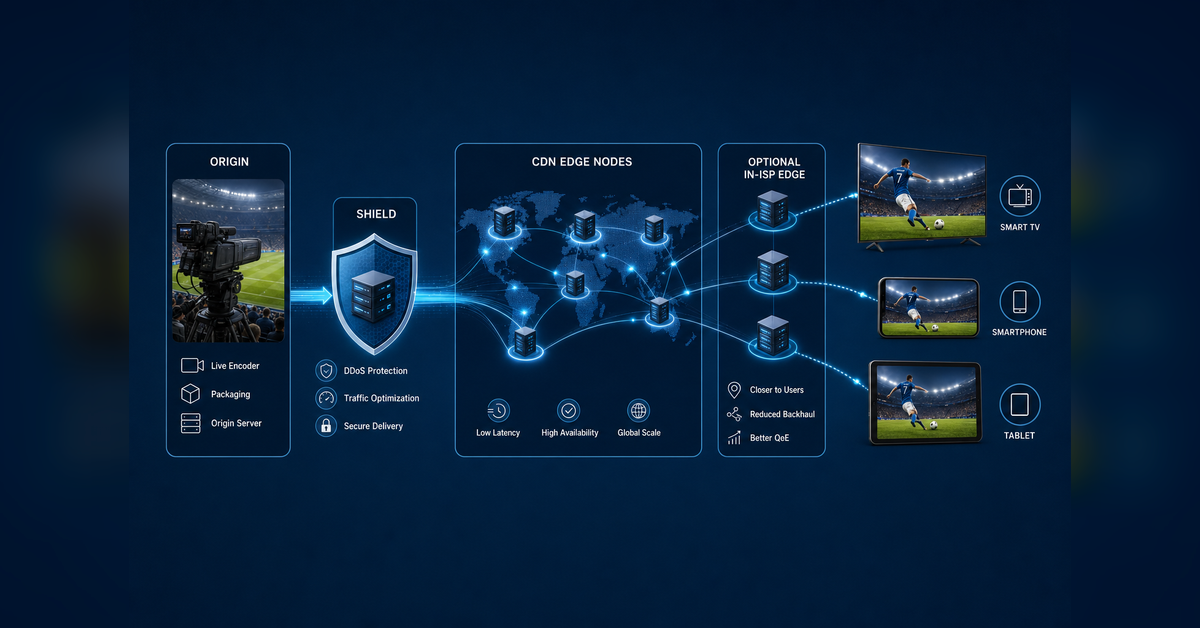

Best CDN for streaming depends on whether you need live-event scale, 24/7 linear delivery, video on demand, a managed video workflow or delivery inside participating ISP networks. Akamai, Fastly, Google Media CDN and Amazon CloudFront are media-delivery choices. Cloudflare Stream, Mux and Bunny Stream package more of the video workflow. Qwilt uses a different model centered on federated, in-ISP edge delivery.
Start with the workload, audience and failure plan, not a logo list. A platform that fits a small VOD library may be wrong for a high-value live sports event. This guide separates the categories, compares provider fit and gives buyers a practical test to run before contract.
Percepture credibility for telecom and streaming markets





What is the best CDN for streaming in 2026?
There is no universal best CDN for streaming. Akamai fits enterprise live, linear and VOD evaluation. Fastly fits engineering-led teams seeking programmable control and origin protection. Google Media CDN and CloudFront fit cloud-centered stacks. Cloudflare Stream, Mux and Bunny Stream package video workflow functions. Qwilt should be evaluated for federated delivery inside participating service-provider networks.
Executive selection summary
Live events
Test forecast peak, origin protection, failover, live logs, rights controls and named escalation.
VOD libraries
Model cache behavior, startup, rebuffering, long-tail demand, storage, encoding and unit cost.
Managed workflow
Compare ingest, encoding, storage, player, analytics and delivery as one platform cost.
ISP-edge delivery
Verify which viewers are reachable, where delegated content is served and how misses or failures return upstream.
The best CDN for streaming is the option that clears the workload’s stop conditions, not the provider with the longest feature list.
Reviewed and updated July 2026. Provider capabilities, coverage, terms and pricing should be verified against the buyer’s current workload and audience.
Who this guide is for
Business leadership
CEOs and CFOs can use the cost and failure model to determine whether the streaming delivery plan protects audience, rights, revenue and exposure.
Technical leadership
CTOs, architects and video engineers can test whether a streaming CDN candidate fits the architecture, observability and proof-of-concept requirements.
Operations and security
SRE, NOC and security teams can evaluate whether a provider supplies the required logs, escalation, failover, access controls and incident ownership.
Procurement and growth
Commercial teams can normalize streaming delivery quotes while growth teams assess discoverability, partner fit and qualified demand.
Why current “best CDN” lists confuse buyers
Many comparison pages place delivery-only CDNs, full video platforms and edge architectures in one ranked list. That hides the first decision: what category of product is being purchased? The right streaming provider can only be identified after that category decision.
A CDN delivers media. A video platform may ingest, encode, store, analyze and play it. ISP-edge delivery changes where eligible content is served. Multi-CDN changes how delivery paths are selected. Compare within category before comparing vendors.
Media-delivery CDN
Delivers packaged HLS or DASH objects from an origin. The buyer usually integrates more of the workflow.
Managed video platform or API
Combines several functions such as ingest, encoding, storage, playback, analytics and delivery.
ISP-embedded or federated edge
Serves eligible content inside participating provider networks. Qwilt is a commercial implementation associated with Open Caching architecture, while the specifications are maintained by the Streaming Video Technology Alliance.
Multi-CDN and origin protection
Uses steering and protective layers when the value of resilience justifies added operating work.
Publisher-side CDN selection also differs from choosing infrastructure for a network operator. See the separate guide to best CDN providers for ISPs, plus the practical distinctions in Open Caching vs traditional CDN and edge caching vs CDN.
Live streaming vs VOD vs linear video
The workload changes the shortlist. A provider suited to a scheduled final is not automatically the right video-on-demand CDN for a deep catalog.
| Workload | Primary buying test | Operational focus |
|---|---|---|
| Live event | Forecast peak and burst behavior | Capacity planning, origin load, failover, logs, rights and escalation |
| 24/7 linear | Steady-state reliability | Redundant contribution, monitoring, ad markers and continuous support |
| VOD | Catalog and audience economics | Cache efficiency, startup, long-tail behavior, storage and access control |
| User-generated video | Secure workflow at volume | Uploads, processing, abuse controls, moderation integration and lifecycle cost |
Record protocols, DRM, captions, advertising, devices, geography and rights before requesting a quote. Without that common input, streaming proposals are not comparable.
The Percepture Seven-Gate Streaming CDN Fit Test
The Seven-Gate Test removes options that cannot meet the stream’s workload, audience, quality, workflow, architecture, control or economic requirements. Use it before deciding which provider is the best CDN for streaming your specific service.
- Workload: Define live event, linear, VOD, UGC, premium OTT or mixed delivery. Record protocol, DRM, captions, ads and devices.
- Audience and peak: Map normal and peak concurrency, regions, ISP or ASN mix, bitrate ladder, device share and burst shape.
- Latency and QoE: Set targets for glass-to-glass delay, startup, rebuffering, start failures, bitrate stability and playback errors.
- Video workflow: Mark who owns ingest, encode, package, store, secure, monetize, deliver, play, measure and retain.
- Edge and origin: Trace origin, shield, edge, peering, transit, optional ISP cache, cache fill and viewer paths.
- Control, security and observability: Test configuration, purge, logs, APIs, tokens, geo controls, DRM, DDoS protection and incident access.
- Resilience and economics: Compare capacity, failover, portability, support, remedies and full cost.
Score each gate from 0 to 5. A score of 0 or 1 for peak handling, origin protection, failover, observability, security or audience reach stops a major live-event selection. Do not name an option the best CDN for streaming by averaging away a failure that can take the stream off air.
Find the gaps before the vendor demo
Use the Seven-Gate Streaming CDN Scorecard to document workload, audience, latency, origin, security, failover and cost requirements before building a shortlist.
Best CDN providers for streaming and live video
This table compares fit, not absolute speed. Performance depends on geography, ISP mix, bitrate, protocol, cache state, origin, configuration and test method. The best CDN for streaming should be tested against production-like traffic rather than a generic ranking. Use each evaluation-fit column to decide which candidates for the best CDN for streaming merit that test.
| Provider | Category | Evaluation fit | Primary limitation or test |
|---|---|---|---|
| Qwilt | Federated ISP edge | Large OTT publishers evaluating in-ISP delivery and Open Caching | Verify active audience reach, delegation, fallback, controls and commercial fit |
| Akamai | Enterprise media CDN | Global live, linear and VOD evaluation | Breadth and contracting may exceed smaller-team requirements |
| Fastly | Programmable media CDN | Engineering-led delivery, control and origin protection | Programmability requires operating skill |
| Google Media CDN | Cloud media CDN | Google Cloud-centered media architecture | Model current features, footprint, quotas, support and cost |
| Amazon CloudFront | Cloud CDN | AWS-centered media architecture | Compare full-stack and origin-egress costs |
| Cloudflare Stream | Managed video platform | Unified API-driven video workflow | Compare as a platform, not as delivery bandwidth alone |
| Mux | Video API and platform | Developer-led product workflow and playback data | Model peak, rights, failover and scale economics |
| Bunny Stream | Managed video platform | Self-service VOD and cost-sensitive use | Test enterprise live, rights, support and event requirements |
Partner disclosure and comparison method
Percepture may refer qualified readers to Qwilt. Qwilt must still be evaluated against the buyer’s audience, workload, architecture, coverage, operational and commercial requirements.
Provider comparisons should use official product documentation, architecture guides, current terms and direct answers. Volatile items such as footprint, capacity, SLA, pricing, protocol support and commercial terms should be checked when the shortlist is built.
Qwilt for OTT, live events and ISP-edge delivery
Qwilt belongs in the federated ISP-edge category. It is a commercial implementation associated with Open Caching, not the standard itself. Buyers considering Qwilt as the best CDN for streaming should verify where each stream is served, which viewers are reachable, what happens on a miss or failure, and which controls and logs are included.
The model is most relevant to large OTT publishers evaluating delivery inside participating provider networks. It should not be treated as proof of universal ISP or viewer reach.
- Map active reach against the actual audience and ISP mix.
- Document delegation, cache-fill and fallback behavior.
- Test live, VOD and required low-latency modes.
- Confirm security, observability, support and commercial terms.
Next step: compare Qwilt’s documented reach, control model and fallback path with your production audience map.

Akamai and Fastly
Akamai
Akamai belongs in an enterprise media-CDN evaluation for global live, linear and VOD workloads. Buyers should test required formats, geo controls, event support, security integrations, capacity planning, failover, service levels and price.
Fastly
Fastly fits engineering-led teams evaluating programmable delivery, live visibility, origin protection and multi-CDN operation. Its value depends on whether the buyer has the skill and runbooks to use that control under event pressure.
Google Media CDN and Amazon CloudFront
Google Media CDN
Google Media CDN fits evaluation by media teams centered on Google Cloud. Buyers should compare current protocols, origin options, security, logs, quotas, support and pricing. A cloud relationship does not remove the need for audience-specific testing.
Amazon CloudFront
CloudFront fits AWS-centered architectures where origins, packaging, security and operations already sit in that ecosystem. Compare the combined cost of transfer, origin egress, requests, logs, security, support and the rest of the video stack.
Cloudflare Stream, Mux and Bunny Stream
These options should first be compared as managed video platforms rather than delivery-only CDNs.
Cloudflare Stream
Evaluate it when a unified API-driven workflow for ingest, encoding, storage and playback is more useful than assembling separate components.
Mux
Evaluate it for developer-led applications that value video processing and playback data. API simplicity does not remove peak, rights, cost or failover planning.
Bunny Stream
Evaluate it for straightforward VOD and price-sensitive self-service use. Entry price alone does not establish suitability for a major live sports event.
Best CDN for live sports
For live sports, the best CDN for streaming is the provider or delivery design that survives forecast peak, protects the origin and supports rapid recovery. Buy to the event peak, not the monthly average.
| Control | Evidence to collect | Failure question |
|---|---|---|
| Event capacity | Production-like load test and documented event plan | What happens when the burst exceeds forecast? |
| Origin protection | Shield behavior, request collapse and origin telemetry | Can synchronized misses overload origin? |
| Failover | Rehearsed runbook with owners and timing | Can traffic move without breaking access controls? |
| Observability | Live delivery logs and player QoE | How fast can the team isolate an ISP, region or device issue? |
| Rights and security | Token, geo, DRM and incident tests | Do protections remain consistent during failover? |
| Support | Named escalation path and post-event review | Who owns the incident while the event is live? |
Collect evidence for every control before approving the best CDN for streaming a rights-sensitive live event.
Best CDN for VOD
For VOD, the best CDN for streaming should match catalog shape, audience geography, bitrate, cache behavior and workflow. Prioritize startup time, start failures, rebuffering, long-tail titles, access controls, storage, encoding and full cost.
A managed platform may be the best CDN for streaming when the team does not want to integrate encoding, storage, player and delivery components. A delivery-only CDN may offer more architectural control when those functions are already owned.
Low-latency streaming
Use the lowest delay the business actually needs. Lower delay reduces the player’s recovery buffer, so a latency target can increase sensitivity to network variation and failures.
Test glass-to-glass delay on real devices, regions and access networks. Include startup, rebuffering, bitrate stability, playback errors and recovery after origin or route degradation. The best CDN for streaming at low latency is the one that meets the business delay target without hiding a larger QoE or resilience problem.
Single CDN vs multi-CDN
| Model | Use when | Operating burden |
|---|---|---|
| Single CDN | One provider proves audience fit and risk tolerance, and simplicity has value | Fewer configurations, logs, cache fills and security policies to coordinate |
| Multi-CDN | Rights, revenue or reputation cannot tolerate one delivery path | Requires steering, consistent security, unified telemetry, cache-fill planning and rehearsed failover |
Multi-CDN is not free resilience. It adds moving parts and can increase origin load during a switch. Include the control plane, authentication and player behavior in the rehearsal before calling the design the best CDN for streaming.
Origin-to-viewer architecture
Trace the full path: contribution or upload → ingest → encode → package → origin or storage → shield → CDN edge → ISP, peering or transit → optional in-ISP cache → viewer and player → QoE analytics.
The encoder creates the bitrate ladder. The packager produces HLS or DASH. The origin holds authoritative objects. A shield can absorb duplicate misses. The edge caches eligible media. Network paths carry it to viewers, while the player adapts bitrate and telemetry reports experience.
A cache hit serves an eligible stored object. A cache miss requests it upstream and may prime the cache for later requests. Misses are normal, but synchronized misses can threaten origin. Test shielding, request collapsing and pre-positioning where the workload supports them.
Map failures across origin, shield, edge, route or ISP, control plane, authentication and player. Assign detection, ownership and recovery for every layer before naming the best CDN for streaming.
Best CDN for streaming: pricing, ROI and QoE framework
Transfer price is only one line. Normalize every quote for the best CDN for streaming to the same geography, ISP mix, live-to-VOD ratio, bitrate, peak concurrency, transfer, cache assumptions, logs, security, support and term.
Full cost = CDN transfer + origin or cloud egress + storage + encoding + requests + logs and analytics + security and DRM + player or platform + support and event services + steering or multi-CDN + engineering and operations + overage + failure exposure.
| KPI group | Measures |
|---|---|
| Viewer | Startup, start failure, rebuffering, bitrate, errors, exits, latency and completion |
| Delivery | Cache or offload, origin fill, throughput, errors, availability, configuration time, audience reach and failover |
| Workflow | Origin egress, shield efficiency, ingest, encoder and packager health, segment errors and DRM latency |
| Operations | Alert, diagnosis, resolution, escalation, log delay, rollback and runbook completion |
| Economics | Cost per TB, viewing hour, successful start, egress or transit avoided and revenue at risk |
22-point live-event readiness test
- Use production-like media.
- Match the live and VOD mix.
- Cover the top regions.
- Cover the top ISPs and ASNs.
- Use real devices and players.
- Use the production bitrate ladder.
- Test a cold cache.
- Test a warm cache.
- Run forecast peak.
- Burst above peak.
- Measure origin and shield behavior.
- Degrade the origin.
- Remove the origin path.
- Simulate edge or provider failure.
- Run steering or failover.
- Test token access.
- Test geography and rights rules.
- Run emergency purge and configuration changes.
- Compare live logs with player QoE.
- Use the named escalation path.
- Reconcile the test invoice.
- Complete a remediation review.
Score each item from 0 to 5. Peak, origin protection, failover, rights and security, telemetry and support are stop conditions. This test keeps the best CDN for streaming decision tied to evidence rather than a sales demonstration.
Mistakes to avoid
A shortlist for the best CDN for streaming becomes unreliable when buyers make any of these category, testing or operating mistakes:
- Ranking providers before defining the product category.
- Using monthly averages for a high-concurrency event.
- Comparing transfer rates while ignoring origin egress and operations.
- Treating a low-latency setting as proof of better viewer experience.
- Assuming an edge location automatically improves the real viewer path.
- Buying multi-CDN without staffing steering, logs and failover rehearsals.
- Accepting a cache-hit percentage without measuring dollars, origin load and QoE.
- Signing before testing access controls, incident ownership and exit terms.
Hunter Newby on the physical delivery layer

“Peering is the road. Caching is the local warehouse. Both keep traffic off the long-haul highway, but they work at different layers.”
Hunter Newby, interconnection pioneer and founder of Newby Ventures
Local caching can reduce middle-mile pressure and transit expense when traffic volume, subscriber density, peering and local demand support it. A miss normally fetches an object from upstream and may prime the cache for later requests.
Newby also advises buyers to “Always measure in dollars, not just percentages.” That means evaluating transit savings, offload, fill latency, subscriber experience and cache efficiency together rather than treating hit ratio as the whole result.

Percepture proof and services
Percepture’s role is not to engineer a buyer’s CDN. It is to turn technical expertise into category clarity, search visibility, AI-answer visibility, authority and qualified demand.
In the approved Broadstaff Global case study, 90% of tracked keywords reached page one within 12 months and qualified leads increased threefold. Carrie Charles said, “What they’ve done for Broadstaff has been really nothing short of miraculous.”
For telecom and infrastructure companies, Percepture connects telecom marketing, enterprise SEO services, generative engine optimization services, digital PR services, content marketing services, B2B lead generation services and omnichannel marketing.

Read the supporting guide to AI search optimization for telecom for the visibility side of the strategy.
See the visibility and lead-generation proof
The Broadstaff Global case study shows how Percepture turned technical category expertise into page-one visibility and stronger qualified demand.
Best CDN for streaming FAQs
What is the best CDN for streaming?
There is no universal best CDN for streaming. Start by choosing the right category: media CDN, managed video platform, federated ISP edge or multi-CDN architecture. Then test audience reach, peak concurrency, latency, origin protection, controls, security, observability, failover and full cost using production-like traffic.
What is the best CDN for live sports?
The best CDN for streaming live sports is the provider or architecture that proves forecast-peak handling, origin protection, rapid failover, real-time visibility, rights enforcement and named event support. A multi-CDN model can be warranted when rights, revenue or reputation cannot tolerate one delivery path and the team can manage the added complexity.
What is the best CDN for VOD?
The best CDN for streaming VOD should fit catalog shape, audience geography, cache behavior, startup, rebuffering, storage, encoding, access control and unit cost. A managed video platform may fit teams that want one workflow, while a media CDN may fit teams that already own the rest of the video stack.
Which CDN does Netflix use?
Netflix operates Open Connect for Netflix traffic. It is not a general-purpose CDN sold to unrelated publishers. Buyers seeking the best CDN for streaming should not treat Netflix’s architecture as a vendor recommendation for another workload, audience or commercial model.
Does a CDN support live streaming?
Many media CDNs support delivery of packaged live video, but support must be assessed at the product level. To identify the best CDN for streaming, confirm protocols, latency modes, event planning, capacity, origin protection, logs, security, failover and support. A managed video platform may also provide ingest, encoding, storage and playback functions around delivery.
What is the difference between a video CDN and a video platform?
A video CDN primarily delivers packaged media from an origin. A video platform may combine upload or ingest, encoding, storage, playback, analytics and delivery. Compare products within their category first because a low bandwidth rate does not identify the best CDN for streaming or describe the cost and operating model of the full platform.
When should streaming use multi-CDN?
Use multi-CDN when the value of resilience exceeds the cost and operating burden. The team must manage steering, consistent security, logs, cache fills, origin load and rehearsed failover. One well-tested CDN may be the best CDN for streaming when the alternative is two providers connected by an untested control plane.
How much does a streaming CDN cost?
Cost depends on transfer, geography, peak behavior, origin egress, storage, encoding, requests, logs, security, player or platform fees, support, multi-CDN steering and operations. Normalize quotes for the best CDN for streaming against the same workload and include failure exposure. Comparing bandwidth rates alone can produce a misleading shortlist.
Build a stronger streaming-category position
Percepture can review how your technical proof, buyer questions, partner ecosystem, search visibility and AI-answer visibility work together before buyers create a shortlist.

Bob Generale
Bob Generale is President of Percepture, a five-time Inc. 5000 marketing and public relations agency founded in 2004. He works with telecom, data-center, fiber, infrastructure and complex B2B companies on SEO, GEO, digital PR, content authority and qualified-demand programs.
Bob’s approach starts with the buyer’s real decision, the proof required to support it and the entities search engines and AI systems must understand. That same method shaped the category definitions, comparison logic and buyer questions in this best CDN for streaming guide.
Connect with Bob Generale on LinkedIn or review Percepture’s telecom marketing experience.