Data center interconnect is the physical and logical network that links two or more data centers so applications, data and services can move between them. A DCI may use dark fiber, optical wavelengths, Ethernet, IP routing or software-defined connectivity.
The right DCI is not chosen by bandwidth alone. Workload, distance, latency, physical route diversity, security, control, growth and recovery requirements determine the architecture and provider model.





How does DCI connect separate data centers?
Data center interconnect, or DCI, connects separate facilities through physical links and logical network services. The physical layer may include fiber and optical transport. The service layer may use Ethernet, IP routing, EVPN/VXLAN or software control. Organizations use DCI for recovery, replication, workload movement, hybrid cloud and distributed applications. Resilient designs also require route proof, monitoring, ownership and tested failover.
Executive summary
Start with the workload
Define the business outcome, recovery objectives, traffic pattern and application tolerance before requesting data center interconnect bandwidth.
Prove the physical path
Two provider names do not prove two data center interconnect routes. Check conduit, entrance, lateral, cross-connect and shared-risk segments.
Separate the decisions
Fiber and optical transport are not the same data center interconnect decision as Ethernet, IP routing, overlays or automation.
Test the application
A passing circuit test does not prove that the application can recover within its stated objective.
Who this guide is for
Technology leaders
CIOs and CTOs can use the guide to connect data center interconnect strategy with workload priorities, risk and operating ownership.
Network and cloud teams
Architects can use it to separate the physical, optical, Ethernet, IP, overlay and cloud-access choices within data center interconnect.
Security and continuity teams
Operators can identify the data center interconnect encryption, route, monitoring and recovery evidence that must be tested.
Procurement and finance
Buyers can model the full cost of data center interconnect rather than comparing unlike services by bandwidth alone.
What is data center interconnect?
Data center interconnect is the complete network path used to exchange traffic between data centers. Data center interconnection may serve campus, metro, regional or global sites. Optical DCI refers to the optical transport portion of that path, not every logical or operational layer around it.
Is DCI physical or virtual?
It is both. A virtual connection may be provisioned through software, a switched platform or an application programming interface, but it still terminates on physical ports, optics, fiber and powered equipment. Software can change how a service is ordered and controlled. It does not remove the underlying facility and route dependencies.
What DCI is not
Network DCI is not an intra-data-center server fabric, a server component interconnect, a public Internet connection by definition or an electric-grid interconnection request. A cross-connect can be one local component of DCI, while a cloud on-ramp can be one access method. Neither represents the entire end-to-end architecture.
The physical layer comes first
“Interconnection starts with a physical process that happens in a specific, geographic location.”
Hunter Newby, owner of Newby Ventures and co-founder and former chief strategy officer of Telx
A buyer should verify the facility, meet-me room, tenant presence, cross-connect process, route, growth capacity and operating owner. A location shown on a map is not the same as a completed handoff.
How does DCI work?
A data center interconnect carries application traffic through a chain of local networking, handoffs, physical transport and remote delivery. Ownership may change several times along that chain.
- The workload creates traffic. An application, database, storage system or user request initiates communication.
- The local network moves traffic to the edge. Switching and routing apply local policy and select an exit.
- A port and cross-connect provide the handoff. The customer equipment connects to a provider, optical platform or facility fabric.
- Fiber and optical systems carry the signal. The route may use customer-controlled fiber, a managed wavelength or another transport service.
- Ethernet, IP or an overlay delivers the service. The logical design determines addressing, segmentation, forwarding and failure behavior.
- The remote edge reaches the destination. Traffic enters the second data center and is delivered to the target workload.
- Assurance systems verify health. Monitoring, policy, support and recovery processes determine whether the service performs as intended.
This end-to-end view prevents a common procurement error: treating one circuit description as proof of the whole operating system.
The Percepture Workload-to-Wire DCI Stack
The Percepture Workload-to-Wire DCI Stack is a seven-layer method for evaluating data center interconnect from the original business need through physical delivery, operating control, economics and tested recovery. DCI is a workload-to-recovery chain, not one circuit.
Seven layers to document and test
- Business outcome and workload. Prove the use case, recovery time objective, recovery point objective, application tolerance, traffic pattern and compliance boundary. The failure is buying bandwidth before defining success.
- Sites, facilities and handoffs. Name every facility, meet-me room, port, cross-connect and cloud handoff. The failure is assuming a listed building means service is ready.
- Physical fiber and route. Map entrances, laterals, conduits, rights-of-way and shared segments. The failure is buying two providers that share one physical risk.
- Optical transport. Choose dark fiber, wavelengths, dense wavelength division multiplexing or managed optical transport according to distance, ownership and operating skill. The failure is inheriting equipment the team cannot support.
- Ethernet and IP service. Define topology, maximum transmission unit, virtual LAN, virtual routing and forwarding, and the Layer 2 or Layer 3 boundary. The failure is treating transport and logical design as one choice.
- Control, security and automation. Specify access control, encryption, segmentation, telemetry, change approval and supported automation. The failure is assuming private means encrypted.
- Assurance, recovery and economics. Measure latency, loss, jitter, utilization, failover, application recovery and total cost. The failure is stopping after a successful ping test.

Free planning tool
Map the full DCI path before buying a circuit
Use the Workload-to-Wire checklist to document the workload, facilities, handoffs, physical routes, service boundaries, security controls, operating owners and recovery test.
- Identify every physical and logical dependency.
- Expose shared-route and ownership risk.
- Turn the requirements into a cleaner provider brief.
No form. Continue to the checklist inside this guide.
What are the main DCI components?
Edge routers and switches
Purpose: Forward traffic and apply policy. Owner: Usually the network team. Check: Port capacity, redundancy, routing and failure behavior.
Ports, optics and cross-connects
Purpose: Create the physical handoff. Owner: Customer, facility or provider. Check: Connector, optic, demarcation, lead time and recurring charges.
Fiber and routes
Purpose: Carry signals between places. Owner: May involve several parties. Check: Shared segments, entrances, laterals and repair responsibility.
Optical transport
Purpose: Move high-capacity signals over fiber. Owner: Customer or managed provider. Check: distance, equipment, protection, capacity and operations.
Ethernet and IP services
Purpose: Define logical connectivity. Owner: Provider and customer teams. Check: topology, routing, segmentation, MTU and convergence.
Control and automation
Purpose: Provision, change and observe supported services. Owner: Platform and operations teams. Check: permissions, auditability, APIs and change safeguards.
Monitoring, security and support
Purpose: Detect problems and coordinate response. Owner: Shared. Check: telemetry, escalation, encryption, service levels and recovery tests.
Why do companies use DCI?
The workload determines the correct data center interconnect architecture. Recovery, replication, migration, cloud and artificial intelligence traffic do not share one universal latency, bandwidth or Layer 2 requirement.
Use-case scorecard
| Use case | Main requirement | Common approach | Primary risk | Measure |
|---|---|---|---|---|
| Disaster recovery | Recover within stated objectives | Diverse routed or Ethernet paths | Untested application failover | Recovery time and data loss |
| Replication | Consistent data movement | Optical, Ethernet or routed service | Latency or loss exceeds tolerance | Replication lag and completion |
| Active-active services | Controlled traffic distribution | Application-aware routed design | Expanded failure domain | User and application health |
| Workload mobility | Verified network and platform compatibility | Layer 2 adjacency or routed migration plan | Assuming mobility is universal | Migration success and rollback |
| Hybrid cloud | Private access to cloud resources | DCI plus cloud access | Treating the on-ramp as the whole design | Application performance and cost |
| Consolidation | Predictable migration windows | Temporary or permanent high-capacity links | Underestimating peak transfer demand | Completion time and errors |
| AI training | Large data movement | High-capacity optical or routed paths | Ignoring storage and compute bottlenecks | Transfer throughput and job completion |
| AI inference | Proximity to users and data | Distributed routed connectivity | Using training assumptions for inference | End-to-end response time |
| Content distribution | Efficient regional movement | Routed mesh or hub design | Poor traffic engineering | Delivery time and path utilization |
| Partner or exchange access | Controlled external connectivity | Facility or platform interconnection | Weak segmentation or ownership | Reachability and policy compliance |
What are the main types of DCI?
By distance
Campus DCI links nearby buildings. Metro DCI connects sites within a metropolitan market. Regional and long-haul DCI cover greater distances, while international designs may involve terrestrial and subsea systems. Distance affects optical engineering and latency, but the actual route matters more than straight-line mileage.
By transport or service
Options include dark fiber, managed wavelengths, Ethernet private lines, Ethernet virtual private lines, multiprotocol label switching, routed IP services, encrypted Internet connectivity and software-controlled services. The data center interconnect options guide provides a focused decision path without turning this pillar into a provider ranking.
By topology
Point-to-point connects two sites. Hub-and-spoke concentrates traffic through selected locations. Partial or full mesh provides more direct paths, while ring designs can support protected transport. Site count, traffic pattern, failure tolerance and operating skill should drive the choice. Use the data center interconnect design guide for deeper topology planning.
Layer 2 vs Layer 3 DCI
Layer 2 extends an Ethernet domain and may support verified adjacency or mobility requirements. It can also enlarge the failure domain. Layer 3 separates routed domains, improves isolation and often provides a cleaner default for scale. Ethernet Virtual Private Network and Virtual Extensible LAN can deliver selected services over an IP underlay, but they do not erase physical-path risk.
Logical boundary comparison
| Choice | Best fit | Main strength | Main caution |
|---|---|---|---|
| Layer 2 | Verified adjacency requirement | Same Ethernet domain across sites | Larger broadcast and failure domain |
| Layer 3 | Most routed inter-site designs | Isolation, policy and scale | Applications must support routed separation |
| EVPN/VXLAN | Selective services over an IP fabric | Control-plane learning and segmentation | Added design and operating complexity |
See the focused Layer 2 vs Layer 3 DCI guide before extending a subnet between facilities.
Hybrid cloud and software-defined connectivity
A native cloud connection reaches a cloud provider. It does not automatically define the complete data center interconnect architecture, local handoffs, backup paths or application recovery process. The cloud on-ramp connectivity guide explains that access layer.
Software-defined DCI automates supported service lifecycle actions, while network as a service describes a consumption and operating model. Automation can improve ordering and change speed, but teams still need route evidence, access controls, monitoring and rollback procedures. Read the software-defined data center interconnect guide for a deeper evaluation.
DCI for AI workloads
Artificial intelligence training and inference create different network demands. Training may emphasize large transfers among compute and storage environments. Inference may emphasize proximity to users, data sources and network exchanges. Neither should inherit a universal latency or port-speed rule.

“The application decides the latency budget. The network just delivers the bill.”
Hunter Newby
Network planning must be coordinated with fiber availability, compute density, storage, power and cooling. A fast circuit cannot correct a bottleneck elsewhere in the workload chain.
What performance requirements matter?
Performance and acceptance scorecard
| Requirement | What it means | How to test | Warning sign |
|---|---|---|---|
| Latency and round-trip time | Time needed to traverse the path | Test the real route under load and failover | Using straight-line distance as proof |
| Jitter | Variation in delay | Measure during normal and peak periods | Stable averages hide unstable peaks |
| Packet loss | Traffic not delivered | Test sustained and burst traffic | Application retries conceal loss |
| Bandwidth and bursts | Normal, peak and short-duration demand | Measure replication and migration windows | Sizing from averages only |
| MTU | Maximum supported frame or packet size | Test the complete path | Inconsistent settings across handoffs |
| Availability and convergence | Service continuity and path recovery | Fail the primary path during a controlled test | Only the steady state is measured |
| Route diversity | Separation of physical risks | Review mapped routes and shared segments | Different provider names on one conduit |
| Telemetry | Operational visibility | Validate alarms, timestamps and ownership | No shared incident record |
| Change time | Time needed to scale or modify service | Run a controlled change | Port, cross-connect or construction dependency |
| Application recovery | Business service restoration | Execute the documented recovery plan | The network recovers but the application does not |
Record median and tail behavior, including p50, p95 and p99 results. Reserve operating headroom and test the application under load. For data center interconnect capacity, compare normal, peak and burst demand with growth, upgrade dependencies and provider lead times.
“Bandwidth grows like a staircase. Traffic bursts like a wave. Design for the wave.”
Hunter Newby
Security, encryption and resilience
Private data center interconnect is not automatically encrypted. Confirm whether encryption is required, where it begins and ends, which method is supported, who controls the keys and how access is audited. Options may include Media Access Control Security where supported, IP Security or documented link encryption.
Segmentation may use virtual LANs, virtual routing and forwarding, routing policy and access control. Security reviews should also cover role-based access, audit logs, physical authorization, control-plane exposure and change approval.
Provider diversity vs route diversity
| Design | What it proves | What it does not prove |
|---|---|---|
| Two services from one provider | Separate commercial services | Separate entrances, conduits or devices |
| Two different providers | Separate provider contracts | Separate underlying fiber paths |
| Mapped routes with separate entrances and shared-risk review | Documented physical separation | Application recovery |
| Controlled infrastructure and application failover test | Observed recovery behavior | Future performance under every event |
“A different carrier on the same fiber route is not diversity. It is a shared risk priced twice.”
Hunter Newby
Resilience requires four proofs: physical separation, logical convergence, operational ownership and application recovery. As Hunter Newby states, “A recovery plan that has not been tested is a hope, not a plan.”
What does data center interconnect cost?
There is no useful universal price because location, construction, distance, bandwidth, protection, handoffs, equipment, service model and contract structure vary. Compare total cost rather than a quoted transport charge.
Total cost framework
| Cost area | What to include | Common omission |
|---|---|---|
| Facility access | Ports, cross-connects, meet-me-room work and recurring facility fees | Assuming the provider quote includes the facility handoff |
| Access construction | Laterals, local loops, installation and permits | Ignoring off-net construction |
| Transport | Fiber, wavelength, Ethernet, IP or platform service | Comparing unlike service boundaries by Mbps |
| Equipment | Routers, switches, optics, optical systems and spares | Ignoring refresh and support |
| Cloud and platform | Cloud ports, transfer charges and platform fees | Leaving usage charges out of the model |
| Operations | Monitoring, security, support, staffing and escalation | Treating labor as free |
| Resilience | Secondary paths, devices, power and testing | Pricing only the primary circuit |
| Lifecycle risk | Upgrades, change fees and termination exposure | Ignoring future growth and exit costs |
Dark fiber can shift equipment and operating responsibility to the buyer. Managed wavelengths and Ethernet services package different portions of the path. Internet with encryption may lower access barriers but changes performance and risk assumptions. Finance teams can place these choices within a broader data center financing structures comparison.
How should a buyer choose an architecture or provider?
Ten questions for the buying team
- Which workload and business outcome does the data center interconnect support?
- What are the exact facilities, rooms, ports and handoffs?
- What latency, loss and jitter can the application tolerate?
- What are normal, peak, burst and three-year capacity requirements?
- Is Layer 2 truly required, or can the design use routed separation?
- Which physical segments, entrances, power systems or devices are shared?
- Who owns each layer and the escalation path?
- Where must encryption, segmentation and audit controls apply?
- How quickly can the service change or scale, including dependencies?
- What controlled test proves that application recovery meets the objective?
“A logo on a website is not a cross-connect in a Meet-Me Room.”
Hunter Newby
Use the best data center interconnect solutions guide when the project moves from architecture to provider evaluation.
Turn requirements into an architecture
Use the detailed design guide to turn route evidence, handoffs, topology, logical boundaries, security, ownership and acceptance criteria into a complete architecture.
Open the Complete DCI Design GuideBest for teams preparing an architecture review, provider shortlist or request for proposal.
PacketFabric as a software-controlled DCI example
PacketFabric is the featured partner for this guide. Its official PacketFabric data center interconnect page presents its current service information. Buyers should review supported locations and service details directly with PacketFabric before making an architecture or procurement decision.

Featured partner example
PacketFabric can be evaluated when a team wants software-controlled connectivity between supported facilities without operating the complete optical layer.
Where the model may fit
- Supported facility-to-facility DCI.
- Software-controlled ordering and service management.
- Ethernet connectivity alongside cloud or exchange access.
What buyers still need to prove
- On-net status, cross-connects and construction dependencies.
- Physical routes, shared risks and demarcation ownership.
- Latency, topology, encryption, scale, support and total cost.
Partner disclosure: Percepture may refer qualified readers to PacketFabric. Buyers should still validate current coverage, design, terms and service fit directly with the provider.
Data center interconnect implementation roadmap
Twelve visible implementation steps
- Inventory workloads. List applications, dependencies, data flows and owners.
- Define objectives. Record recovery time, recovery point, latency and performance requirements.
- Select sites and handoffs. Name facilities, rooms, ports, cloud connections and demarcations.
- Map routes. Document entrances, conduits, laterals and shared-risk segments.
- Choose topology. Match point-to-point, hub, mesh or ring designs to traffic and failure needs.
- Choose transport and service. Separate fiber and optical choices from Ethernet or routed services.
- Set the logical boundary. Decide Layer 2, Layer 3 and overlay requirements.
- Define security and operations. Assign access, encryption, monitoring, changes and escalation.
- Model cost and growth. Include all handoffs, equipment, labor, redundancy and upgrade dependencies.
- Run a pilot. Validate connectivity and operating procedures with controlled traffic.
- Test failures and recovery. Fail paths and confirm application behavior.
- Document and review. Maintain diagrams, owners, runbooks, invoices and recurring tests.
Proof-of-concept and acceptance test
A production acceptance plan should cover handoffs, port and optic compatibility, cross-connect completion, route maps, shared risks, latency distributions, jitter, loss under load, MTU, peak throughput, traffic policy, Layer 2 or Layer 3 behavior, encryption, key ownership, access control, audit logs, monitoring and alarms.
It should also test primary-path failure, relevant device or power failures, application recovery, support escalation and invoice accuracy. A data center interconnect should not be accepted solely because interfaces are up and traffic can pass.
Common DCI mistakes
| Mistake | Why it fails | Better action |
|---|---|---|
| Buying bandwidth before defining the workload | The service may not match application behavior | Set workload and recovery requirements first |
| Treating carrier names as route proof | Providers may share physical infrastructure | Review mapped paths and shared-risk segments |
| Extending Layer 2 just in case | It can enlarge the failure domain | Require a documented adjacency need |
| Treating a cloud on-ramp as the entire design | It omits local, backup and application layers | Map the complete end-to-end path |
| Assuming private means encrypted | Privacy and encryption are separate properties | Document method, endpoints and key ownership |
| Using straight-line distance as latency proof | The real fiber route may differ | Test the delivered path under load |
| Ignoring construction and cross-connects | The core service may be ready before access is complete | Track every dependency and owner |
| Comparing unlike services by bandwidth | Ownership and service boundaries differ | Compare total scope, risk and cost |
| Assuming a portal means full automation | Some lifecycle actions may remain manual | Test supported workflows and rollback |
| Sizing from average traffic | Bursts and replication windows may exceed the plan | Measure normal, peak and burst demand |
| Skipping application recovery tests | Network recovery may not restore the service | Test the complete business process |
| Using outdated location or service data | Availability and terms can change | Confirm current details with the provider |
Glossary
- DCI
- Data center interconnection between two or more data centers.
- Cross-connect
- A physical connection between parties or systems within a facility.
- Meet-me room
- A controlled facility area where networks establish physical handoffs.
- Carrier-neutral facility
- A facility designed to support access from multiple network providers.
- Dark fiber
- Fiber strands provided without an active optical service.
- Wavelength
- An optical channel carried over fiber.
- DWDM
- Dense wavelength division multiplexing, which carries multiple optical channels on fiber.
- Coherent optics
- Optical technology used to transmit and recover high-capacity signals.
- EPL
- Ethernet Private Line, a point-to-point Ethernet service.
- EVPL
- Ethernet Virtual Private Line, a virtual Ethernet service between defined endpoints.
- MPLS
- Multiprotocol Label Switching, a method used to forward traffic through labeled paths.
- BGP
- Border Gateway Protocol, used to exchange routing information.
- EVPN
- Ethernet Virtual Private Network, a control-plane approach for Ethernet and related services.
- VXLAN
- Virtual Extensible LAN, an encapsulation used to carry virtual network segments.
- VRF
- Virtual routing and forwarding, which separates routing tables.
- MTU
- Maximum transmission unit, the largest supported frame or packet size for a path.
- MACsec
- Media Access Control Security, a link-layer encryption method where supported.
- IPsec
- IP Security, a suite used to protect IP traffic.
- Cloud on-ramp
- A connectivity method used to reach a cloud provider.
- RTO
- Recovery time objective, the target time for restoring a service.
- RPO
- Recovery point objective, the acceptable amount of data loss measured in time.
- Shared-risk link group
- Links that could fail together because they share infrastructure or another dependency.
Turning technical expertise into searchable demand
“What they’ve done for Broadstaff has been really nothing short of miraculous.”
Carrie Charles, CEO of Broadstaff Global
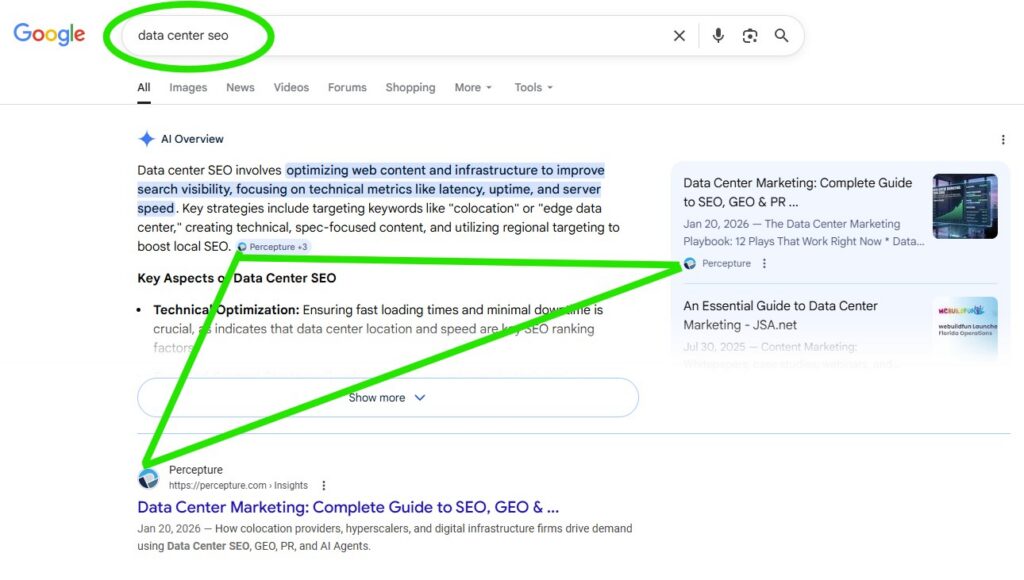
The Broadstaff Global search visibility case study reports that 90% of tracked keywords reached page one and qualified leads increased threefold within 12 months.
Percepture combines telecom marketing, organic SEO services, generative engine optimization services, technical SEO audit service, enterprise SEO and digital PR for complex B2B topics.
See the proof
See how technical authority becomes qualified demand
The Broadstaff case study shows how Percepture connected technical-market expertise, search visibility and buyer trust. Review the evidence before deciding whether the same approach fits your data center or telecom market.
Frequently asked questions
What is data center interconnect?
Data center interconnect is the physical and logical system used to exchange traffic between two or more data centers. It can include facility handoffs, fiber, optical transport, Ethernet, IP routing, overlays, software control, monitoring and recovery processes. The correct design starts with the workload and ends with a tested application outcome.
What does DCI stand for?
DCI stands for data center interconnection or data center interconnect. The term describes connectivity between separate data center environments. It should not be reduced to one circuit because the delivered service depends on physical routes, equipment, logical services, security controls, ownership and operational support.
How are two data centers connected?
A data center interconnect carries traffic from a workload through local switching or routing to an edge port and cross-connect. Fiber and optical systems carry it between sites. Ethernet, IP or overlay services then deliver it to the remote network. Monitoring and recovery processes verify whether the complete path supports the application.
What is the difference between DCI and a cross-connect?
A cross-connect is a physical connection within a facility. Data center interconnect is the broader end-to-end system connecting data centers. A DCI path may include cross-connects at both ends, transport between facilities, logical services, security, monitoring and recovery procedures.
What is the difference between DCI and cloud interconnect?
Cloud interconnect provides access to a cloud provider. Data center interconnect connects data center environments and may include cloud access as one component. A cloud connection does not by itself define local facility handoffs, backup routes, logical boundaries or application recovery across the complete architecture.
Is DCI Layer 2 or Layer 3?
Data center interconnect can use Layer 2, Layer 3 or selected overlay services. Layer 2 may support a documented adjacency requirement but can enlarge the failure domain. Layer 3 separates routed environments and often provides stronger isolation and scale. The application requirement should determine the boundary.
Which technologies are used for DCI?
Common data center interconnect technologies include fiber, optical wavelengths, dense wavelength division multiplexing, Ethernet private services, IP routing, multiprotocol label switching, EVPN, VXLAN, encrypted IP connectivity and software-controlled platforms. These technologies operate at different layers and should not be treated as interchangeable choices.
Does DCI require dark fiber or DWDM?
No. Dark fiber and dense wavelength division multiplexing are possible data center interconnect transport choices, not universal requirements. A project may instead use a managed wavelength, Ethernet service, routed service, encrypted Internet path or software-controlled platform. Distance, capacity, control, staff and cost determine the fit.
How much does DCI cost?
Data center interconnect cost depends on locations, cross-connects, construction, distance, capacity, service model, equipment, cloud transfer, monitoring, support, redundancy and contract terms. Buyers should model the full lifecycle cost rather than compare only a monthly transport charge or price per Mbps.
How do you make DCI resilient and secure?
For resilient and secure data center interconnect, document separate physical routes and entrances, test logical convergence, assign operational ownership and run application recovery tests. Confirm segmentation, access controls, audit logs, encryption endpoints and key ownership. Private connectivity should not be assumed to include encryption.
Final planning principles
- Start with the workload and recovery objective.
- Verify every facility handoff and physical path.
- Separate transport, Layer 2 or Layer 3, overlays and control.
- Model total cost, growth and operating ownership.
- Test application recovery, not just circuit reachability.
The strongest data center interconnect design is the one whose route, service boundaries, controls, economics and recovery behavior have been documented and tested.
For data center and telecom companies
Make your technical expertise easier to find and trust
Percepture helps digital-infrastructure companies turn complex expertise into search visibility, AI citations, industry authority and qualified demand.
- Review the search questions buyers ask.
- Find gaps across Google, AI answers and digital PR.
- Build a practical authority and content plan.
Tell us your market and priority. The first conversation is focused on fit and next steps.

About the author
Bob Generale
Bob Generale is President and Partner at Percepture. His work spans SEO, generative engine optimization, digital PR and AI-search strategy for telecom, data center and complex B2B organizations.
Bob focuses on turning specialist knowledge into clear content systems that buyers, Google and AI answer engines can evaluate. Percepture was founded in 2004 and integrates strategy, technical SEO, content, authority development and conversion planning.
Connect with Bob on LinkedIn