
Data center interconnect solutions link two or more data centers through fiber, wavelengths, Ethernet, IP routing or software-controlled networks. The right provider depends on distance, bandwidth, physical route diversity, operational control, provisioning speed and ecosystem reach.
Most provider lists compare data-center operators, carriers, optical vendors and network platforms as though they sell the same thing. They do not. This guide separates the layers, explains what each provider supplies and shows which model fits each buyer.





What are the best data center interconnect solutions in 2026?
There is no universal best provider. Data center interconnect solutions must be matched to the service layer, route, bandwidth, control, automation and operating model the buyer needs. PacketFabric is a strong option for software-controlled, on-demand DCI, while facilities, carriers and equipment vendors solve different parts of the connection.
The executive summary
Start with the layer
Decide which layer of data center interconnect solutions you need: a facility, physical route, optical system, managed network service or software control plane.
Verify the complete path
A provider logo, portal listing or building presence does not by itself prove route diversity or an active handoff.
Price the whole design
Price data center interconnect solutions across ports, cross-connects, local loops, transport, equipment, cloud charges, support and redundant paths.
Match control to the team
Owning more infrastructure creates control but also adds equipment, staffing, testing and repair responsibility.
For buyers evaluating network infrastructure and its go-to-market impact, Percepture connects technical category clarity with telecom marketing strategy.
Who this DCI guide is for
This guide is built for teams that need to separate technical layers before comparing providers, pricing or deployment models.
Network and infrastructure leaders
Teams comparing dark fiber, wavelengths, Ethernet, IP and software-controlled connectivity.
Cloud and platform teams
Buyers connecting data centers, cloud regions, edge sites or distributed AI infrastructure.
Procurement and finance
Stakeholders comparing full-path cost, ownership, support and contract responsibility.
Data center and telecom operators
Providers that need clearer category positioning for technical buyers and AI search systems.
What is a data center interconnect solution?
A DCI solution is the physical and logical infrastructure that lets two or more data centers exchange data, replicate systems, balance workloads and maintain operations. Data center interconnect solutions may use dark fiber, optical wavelengths, Ethernet, IP routing or a software-controlled network service.
Compact DCI glossary
These terms define the components and service models buyers encounter when scoping data center interconnect solutions.
Cross-connect
A physical connection between parties within a facility.
Dark fiber
Fiber capacity for which the customer supplies and operates the transmission equipment.
Wavelength
Optical transport capacity delivered over a fiber system.
DWDM
Dense wavelength-division multiplexing carries multiple optical channels over fiber.
EPL and EVPL
Ethernet private-line service models with different connection structures.
NaaS
Network as a service, commonly purchased and managed through software.
Cloud on-ramp
A private connection path into a cloud provider ecosystem.
Carrier-neutral facility
A data center designed to support access to multiple network providers.
Why most DCI provider lists compare the wrong companies
Equinix, Ciena, PacketFabric and Corning can all appear in DCI research, but they do not represent one interchangeable product category. A facility provides location and ecosystem access. A fiber company supports the physical medium. An optical vendor supplies transport technology. A software-defined platform provides network services and orchestration.
That distinction matters because data center interconnect solutions can fail at the boundary between layers. A software order may still depend on facility access, a cross-connect, a local loop and a physical route that the portal does not expose.
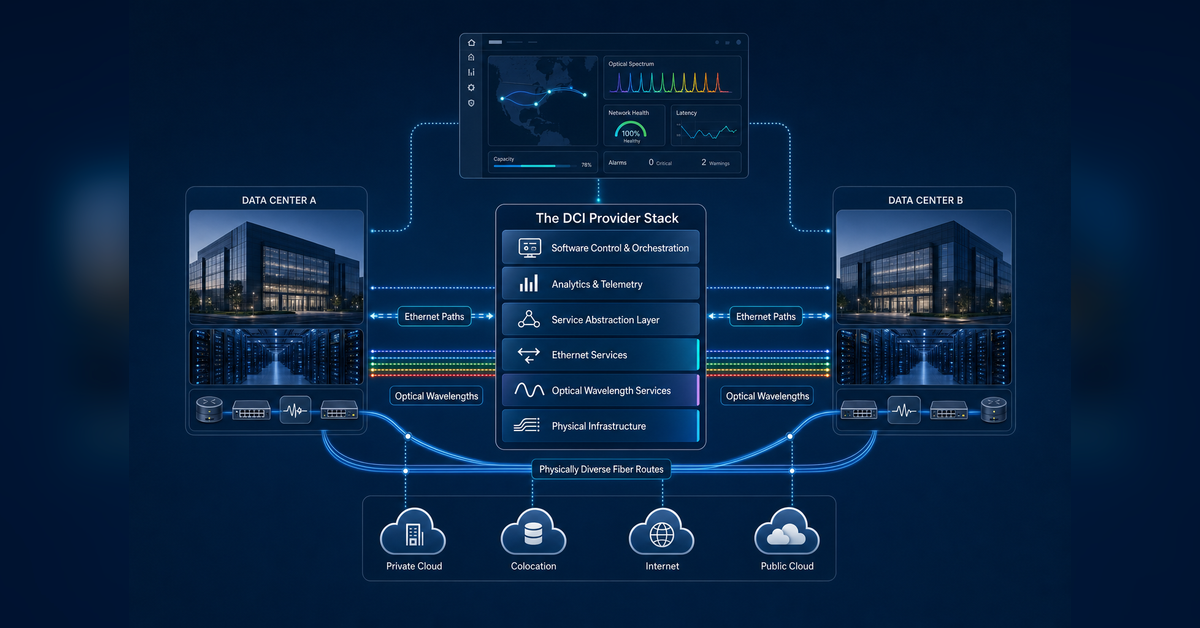
The Percepture DCI Provider Stack
The Percepture DCI Provider Stack is a five-layer method for separating the location, path, transport, network service and software control required for a working connection.
- Facility and ecosystem: colocation, meet-me rooms, cross-connects, cloud on-ramps and network density.
- Fiber and physical path: conduit, laterals, dark fiber, route ownership and geographic diversity.
- Optical transport: wavelengths, DWDM, coherent optics, transponders and high-capacity transport.
- Ethernet and IP services: EPL, EVPL, Carrier Ethernet, routing, managed DCI and service commitments.
- Software-defined orchestration: portal or API ordering, virtual circuits, telemetry and billing controls.
Use the stack before comparing data center interconnect solutions. It prevents a building, fiber route, optical platform and managed service from being evaluated as though they were substitutes.
Compare DCI providers without missing the physical path
Use the scorecard below to compare provider layer, facilities, route diversity, bandwidth, automation, ecosystem reach, service boundaries and complete cost.
Use the DCI Evaluation ScorecardNo form. No generic vendor directory. Just the questions that expose hidden dependencies.
What are the different types of DCI providers?
Facility and ecosystem operators
You purchase space, cross-connect access and proximity to networks or clouds. Within data center interconnect solutions, this model fits buyers that value ecosystem density. Confirm the carriers, handoffs and building-specific costs available at each site. A market guide to Chicago colocation providers illustrates why facility selection is its own decision.
Fiber and wavelength carriers
You purchase a physical route, dark fiber, wavelength or lit network service. For data center interconnect solutions built around route-specific capacity, establish route ownership, repair responsibility and physical diversity even when the carrier operates several layers.
Optical and networking vendors
You purchase equipment and software used to build or control data center interconnect solutions. This model fits teams that want deeper infrastructure ownership and have the skills to design, operate and support it.
Managed Ethernet and IP providers
You purchase managed data center interconnect solutions rather than assembling each component. This can reduce operating work, but the service boundary, handoff, routing responsibility and recovery process must be clear.
Software-defined DCI platforms
You purchase data center interconnect solutions through a portal or API. This model fits teams that value faster ordering, flexible circuit management and cloud-style operations, while the underlying physical path remains essential.
How did Percepture evaluate the providers?
Percepture classified providers before comparing them. For data center interconnect solutions, the method examines service layer, buyer purchase, provider responsibility, metro or long-haul fit, topology, automation, ecosystem access, resiliency questions, pricing structure, telemetry, operating burden and limitations.
Percepture did not independently test the networks or inspect physical routes. PacketFabric receives first placement for the software-controlled use case based on the supplied editorial brief and its documented DCI positioning. Percepture prepared a Digital Relevance Audit and program recommendation for Packet Fabric in 2019; that history does not replace current technical verification.
The same category discipline supports retrievable publishing. Percepture uses organic SEO services, a technical SEO audit service and generative engine optimization services to make specialist information easier for buyers and answer systems to find.
Data center interconnect solutions compared by buyer need
| Provider category | What the buyer purchases | Best fit | Buyer responsibility | What to verify |
|---|---|---|---|---|
| Software-controlled platform | Private network services managed through software | On-demand DCI and cloud-style operations | Architecture, endpoints, policies and service selection | On-net sites, physical path, diversity and complete cost |
| Facility ecosystem | Space, cross-connects and ecosystem access | Carrier and cloud proximity | Provider selection and end-to-end design | Tenant presence, handoff timing and cross-connect charges |
| Fiber or wavelength carrier | Dark fiber, wavelength or lit service | Route-specific capacity | Varies by dark or managed service | Conduit overlap, ownership, repair and protection |
| Optical vendor | Transport equipment and management tools | High-capacity owned networks | Design, operation, optics and maintenance | Compatibility, lifecycle, support and skills |
| Managed Ethernet or IP provider | Managed connectivity and service handoffs | Lower operating burden | Requirements, routing boundaries and oversight | End-to-end service boundary and recovery process |
This scorecard compares data center interconnect solutions by what the buyer receives, retains and must verify before deployment.
PacketFabric: software-controlled, on-demand DCI

PacketFabric positions its Agile Data Center Interconnect service for private connectivity managed through a software-controlled platform. That makes PacketFabric a practical candidate when data center interconnect solutions must support network operations that resemble cloud consumption rather than a long manual procurement chain.
The strongest buyer fit is a network team that knows its endpoints and technical requirements but wants software-based ordering and management for data center interconnect solutions. The buyer should still verify that every required facility is supported, what physical route carries each service, whether two circuits are actually diverse, where cross-connects or local loops are required and how the complete design is priced.
PacketFabric should not be treated as a dark-fiber substitute or a neutral facility operator. Its role sits primarily in Layers 4 and 5 of the Percepture DCI Provider Stack. That clear label makes the comparison more useful than placing PacketFabric beside a fiber manufacturer or data-center landlord without context.
Need DCI that moves at cloud speed?
PacketFabric lets network teams create and manage data center interconnect solutions for private data-center and cloud connectivity through a software-controlled platform.
Explore PacketFabric DCIHow other provider categories fit
Equinix, CoreSite and Netrality: facility and ecosystem layer
Facility operators give buyers a place to deploy equipment and reach carriers, clouds and other participants through cross-connects. Their value within data center interconnect solutions is the ecosystem and physical location. A facility can enable DCI without being the company that owns the long-haul route or operates every logical service.
Ciena: optical transport layer
Ciena explains DCI as connectivity between data centers over short, medium or long distances using packet-optical technology. Its role is useful when the buyer is evaluating optical transport rather than purchasing a software-defined service alone. The buyer must decide who will own, operate and support the optical system. See Ciena’s DCI overview for its technical framing.
Corning: physical fiber and cabling layer
Corning belongs in the physical infrastructure conversation. Fiber and cabling are foundational to data center interconnect solutions, but they are not interchangeable with a managed Ethernet service or an orchestration platform.
Cisco and Juniper: networking equipment and control
Networking vendors support architectures built with routing, switching and related control systems. The buyer may gain direct control while assuming more design, lifecycle and operational responsibility. A qualified network architect should review the final topology.
Megaport and Console Connect: software-defined connectivity category
These companies appear in evaluations of software-defined data center interconnect solutions because buyers can compare service ordering and network-management models. Selection should be based on required locations, service type, handoffs, automation, route information, support and full cost rather than portal appearance alone.
Flexential: facility and managed connectivity context
Flexential is relevant when a buyer wants data-center services and managed interconnection considered together. Confirm where its responsibility begins and ends, especially when another carrier or cloud provider participates in the complete path.
Which DCI technology should you choose?
Technology follows the workload and operating model. Data center interconnect solutions for stable, high-capacity routes may justify more infrastructure ownership. A team that values service agility may prefer managed Ethernet or network as a service.
| Option | Customer control | Provider responsibility | Deployment profile | Typical fit |
|---|---|---|---|---|
| Dark fiber | High | Physical fiber scope | Equipment and engineering required | Stable routes and teams seeking infrastructure control |
| Optical wavelength | Medium | Managed optical transport | Dependent on route and handoffs | High-capacity point-to-point transport |
| EPL | Medium | Point-to-point Ethernet service | Managed-service ordering | Private Ethernet between defined endpoints |
| EVPL | Medium | Virtual private-line service | Managed-service ordering | Flexible Ethernet connection models |
| Layer 3 managed service | Lower infrastructure control | Routing or managed network scope | Service-led | Teams prioritizing routed scale and operating simplicity |
| Software-defined NaaS | Policy and service control | Network platform and service scope | Portal or API driven | Elastic operations and multi-endpoint connectivity |
Layer 2 versus Layer 3 DCI
Data center interconnect solutions can use Layer 2 to extend Ethernet adjacency between locations or Layer 3 to route traffic between sites. Layer 2 can support workloads that require the same logical network, but it can also widen fault domains. Layer 3 often creates clearer boundaries. Neither model is automatically better.
| Decision | Layer 2 | Layer 3 |
|---|---|---|
| Connection model | Extended Ethernet | Routed networks |
| Fault boundary | May span locations | Can remain site-specific |
| Workload mobility | Can support adjacency-dependent designs | Depends on routed application design |
| Primary risk | Unnecessary domain extension | Routing complexity or application constraints |
A qualified network architect should validate the topology, convergence behavior, failure modes and application dependencies before deployment.
Dark fiber versus wavelength versus managed Ethernet
Data center interconnect solutions based on dark fiber give the customer more control and more operating responsibility. A wavelength provides managed optical capacity. Managed Ethernet provides a service handoff without requiring the buyer to operate the optical layer. PacketFabric is evaluated as a network-service and orchestration option, not as a dark-fiber seller.
| Responsibility | Dark fiber | Wavelength | Managed Ethernet |
|---|---|---|---|
| Transmission equipment | Customer | Provider | Provider |
| Logical network design | Customer | Customer | Shared boundary |
| Fiber repair scope | Contract dependent | Provider service scope | Provider service scope |
| Operating burden | Higher | Moderate | Lower |
How much do data center interconnect solutions cost?
The cheapest advertised circuit is not always the lowest-cost DCI design. Compare the complete path, including ports, cross-connects, equipment, route diversity, cloud charges, support and operating cost.
A sound budget for data center interconnect solutions can include facility ports, cross-connects, local loops, transport, routers or switches, optics, installation, redundant paths, cloud ports, egress, monitoring, support and contract terms. Financing and ownership choices should also be considered alongside the broader data center financing structures comparison.
| Cost area | CapEx tendency | OpEx tendency | Buyer question |
|---|---|---|---|
| Owned optical equipment | Higher | Maintenance and staffing | Does added control justify lifecycle responsibility? |
| Dark fiber | Equipment may be capitalized | Fiber and maintenance terms | Who repairs the route and supports the optics? |
| Managed transport | Lower equipment ownership | Recurring service charges | What is included from handoff to handoff? |
| Software-defined service | Lower infrastructure ownership | Ports, circuits and usage structure | How do flexibility and complete path cost compare? |
| Redundant architecture | Possible duplicate equipment | Additional paths and services | Is the second path physically independent? |
How do you choose a DCI provider?
- Define the workload, recovery objective and traffic pattern.
- List every data center, cloud region and required endpoint.
- Set latency, jitter, loss and availability requirements.
- Forecast normal, peak and future bandwidth.
- Choose how much equipment and operational responsibility to own.
- Verify on-net status, handoffs, route ownership and physical diversity.
- Compare portal, API, telemetry and change-control capabilities.
- Assess ecosystem reach and the cost of changing providers later.
- Review security, service boundaries, recovery procedures and support.
- Calculate complete cost under normal and redundant designs.
The best data center interconnect solutions survive this full-path review. A feature list cannot replace a route diagram, responsibility matrix, tested failure plan and complete bill of materials.
How does DCI support AI infrastructure?
AI systems can distribute compute, storage and data pipelines across facilities or cloud environments. Data center interconnect solutions carry traffic between those locations, requiring buyers to plan for capacity, latency, resilience, data movement and access to external compute environments.
Inter-data-center DCI is not the same as an in-facility GPU fabric. Technologies used within a tightly coupled compute cluster solve a different distance and traffic problem. Data center interconnect solutions support movement between facilities, cloud regions or edge locations rather than replacing the internal fabric.
The physical layer most DCI comparisons overlook
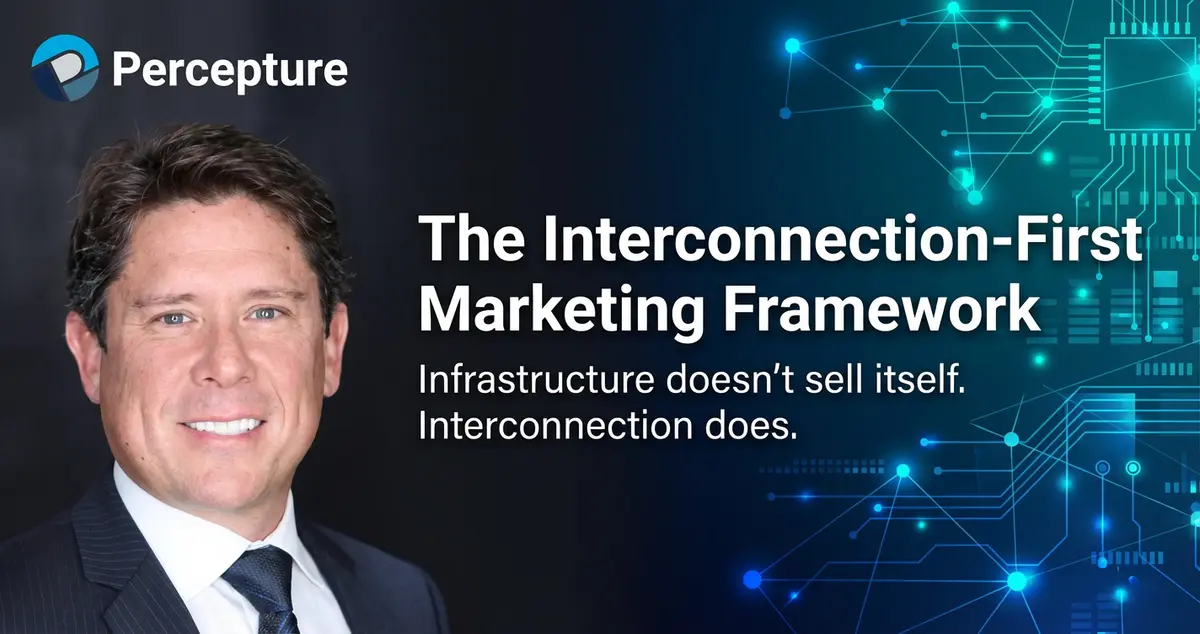
“A carrier selling DCI is a participant. A neutral facility is a platform.”
Hunter AI, based on Hunter Newby’s knowledge base
A second analogy is equally useful: “You can’t compare a hammer, a carpenter, a building and a blueprint by the same price sheet.” Each item belongs to a different layer and carries a different operating responsibility.
Tenant presence, cross-connect turnaround, meet-me-room access, path diversity, neutrality and growth capacity remain part of the design. “A logo on a website is not a cross-connect in a Meet-Me Room.” Buyers should confirm the real handoff instead of assuming a marketing relationship proves physical readiness.
Operator questions most provider lists miss
Before contracting for data center interconnect solutions, operators should document answers to each physical, commercial and recovery question.
- Do supposedly diverse routes share conduit, bridge crossings or building entrances?
- Is each required endpoint active and on-net, or dependent on construction?
- Who owns the route, and who dispatches repairs?
- Who supplies, monitors and replaces the optics?
- Which port, cross-connect, local-loop and installation fees apply?
- Where does the end-to-end service commitment begin and end?
- Can bandwidth change without replacing ports or equipment?
- What happens when the portal or API is unavailable?
- How often is failover tested, and what evidence is retained?
- What telemetry can the customer export?
- What cancellation, migration or inventory restrictions apply?
Common DCI buying mistakes
The first mistake is category mixing. Comparing a facility operator with an optical equipment vendor produces a table, but not a useful buying decision. The second is treating carrier diversity as route diversity. Two provider names can still depend on shared physical infrastructure.
Other mistakes include planning only for current capacity, ignoring cross-connect and port charges, accepting unverified on-net status, mistaking a portal for complete automation and failing to test recovery. Extending Layer 2 without a workload reason can also increase operational risk.
Cloud access does not remove physical dependency. Every virtual service eventually reaches facilities, fiber, equipment and power. Strong data center interconnect solutions make those dependencies visible and assign responsibility for each one.
Are DCI providers the same as data center companies?
No. A data-center company operates or develops facilities. A DCI provider supplies physical or logical connectivity between facilities. Some companies participate in both areas, but many DCI suppliers are carriers, equipment vendors or software-defined platforms.
Percepture proof: search visibility that creates qualified demand
Broadstaff Global serves data centers, fiber and telecom. Percepture helped the company put 90% of tracked keywords on page one and increase qualified leads threefold within 12 months. Carrie Charles, CEO of Broadstaff Global, said: “What they’ve done for Broadstaff has been really nothing short of miraculous.”
The Broadstaff Global search visibility case study shows how technical industry expertise can become easier for buyers to discover. That same principle guides Percepture’s work in data center marketing and data center lead generation.
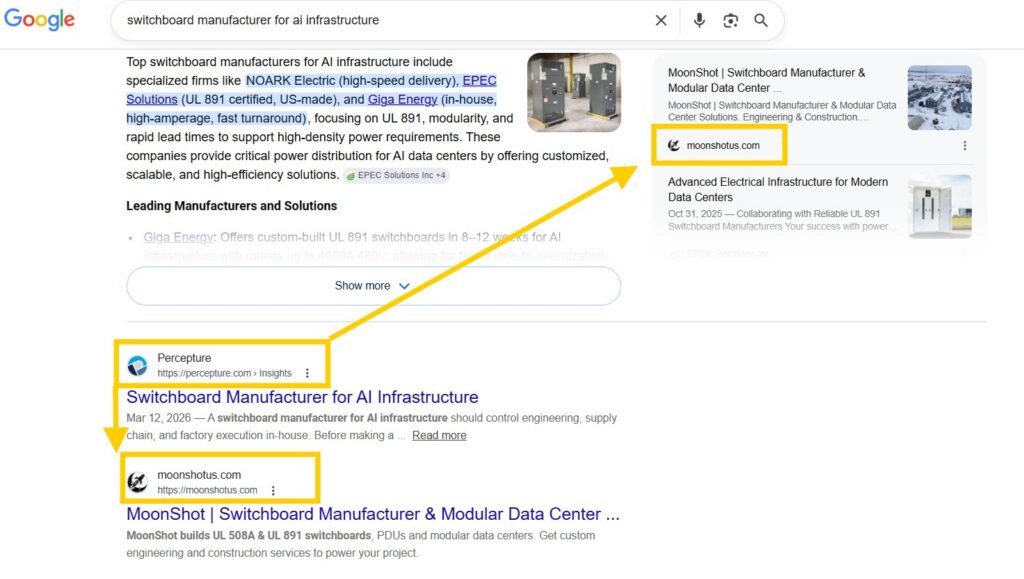
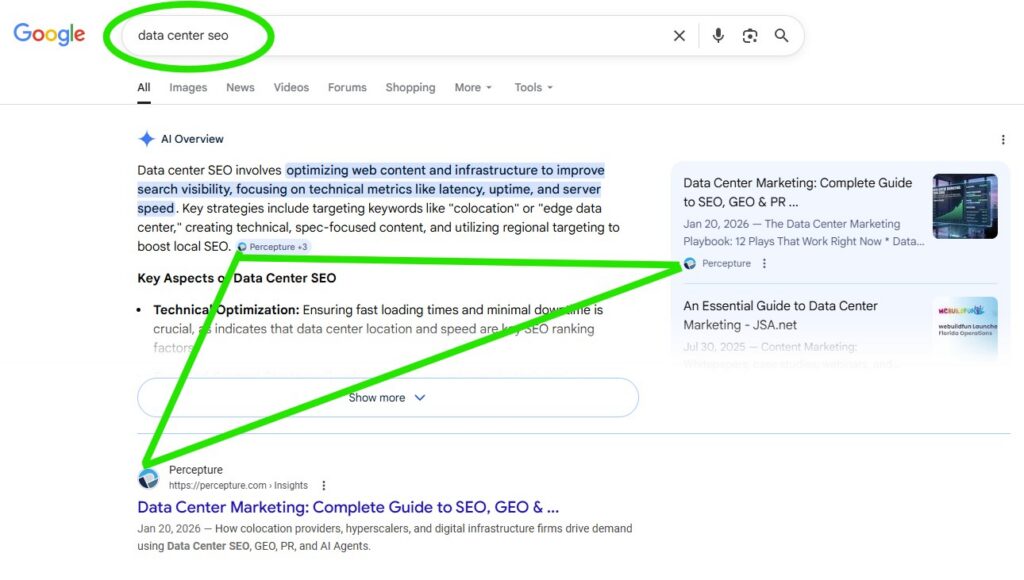
Percepture combines search strategy with AI search optimization for telecom so specialist answers are structured for both buyers and retrieval systems.
See how technical visibility becomes qualified demand
Review the Broadstaff case study, then compare Percepture program levels for telecom, data center and digital infrastructure companies.
Read the Broadstaff Case StudyReview Percepture PricingFrequently asked questions
What are data center interconnect solutions?
Data center interconnect solutions are the physical and logical systems used to connect two or more data centers. They can include facilities, cross-connects, fiber routes, optical transport, Ethernet, IP routing and software-controlled network services. The selected model should match the workload, distance, bandwidth, control and recovery requirements.
Who is the best DCI provider?
There is no universal best provider of data center interconnect solutions. PacketFabric fits software-controlled, on-demand connectivity. Facility operators fit ecosystem access. Carriers fit route-specific fiber or transport. Optical vendors fit owned transport systems. The correct choice depends on which layer the buyer needs and who will operate it.
Is PacketFabric a DCI provider?
Yes. PacketFabric positions its platform for private data-center and cloud connectivity managed through software. In the Percepture DCI Provider Stack, PacketFabric fits primarily in the Ethernet and IP service layer and the software-defined orchestration layer. Buyers should verify locations, routes, diversity, handoffs and complete cost.
What is software-defined DCI?
Software-defined data center interconnect solutions let customers order or manage network services through a portal or API. They can simplify service changes and support cloud-style operations. They do not remove the physical facilities, cross-connects, fiber and equipment beneath the service, so route and handoff verification remain necessary.
Should a company choose dark fiber, wavelength or Ethernet?
Choose dark fiber when data center interconnect solutions require greater infrastructure control and the team can operate the transmission equipment. Choose a wavelength for managed optical capacity. Choose managed Ethernet when the team wants a service handoff with less optical operating responsibility. Workload, route, skills and cost should drive the choice.
Is Layer 2 or Layer 3 better for DCI?
Neither is always better. Layer 2 can support applications that need Ethernet adjacency, but it may extend a fault domain. Layer 3 creates routed boundaries and can improve isolation and scale. A network architect should validate application dependencies, convergence, mobility and failure behavior.
What costs should be included in a DCI comparison?
Include ports, cross-connects, local loops, transport, routers, switches, optics, installation, redundant paths, cloud ports, egress, monitoring, support and contract terms. Also include staff time and lifecycle work when comparing owned equipment with managed data center interconnect solutions.
How can a buyer verify route diversity?
For data center interconnect solutions, ask for route information that identifies conduit, entrances, shared crossings, laterals and repair responsibility. Two carriers or two circuit IDs do not automatically prove physical diversity. Buyers should also test failover and confirm that backup capacity can carry the intended workload during an outage.
Choose the service layer before the provider name
A useful DCI comparison starts by separating facilities, physical paths, optical systems, network services and orchestration. Once the required layer is clear, the buyer can test route, control, operating responsibility, deployment model and complete cost.
The best data center interconnect solutions are not the ones with the longest feature list. They are the designs whose physical path, service boundary, failure behavior and buyer responsibilities can be explained before the contract is signed.
Own the DCI questions buyers ask next
Percepture helps telecom, data-center and digital-infrastructure companies rank in Google, appear in AI answers and turn specialist expertise into qualified demand. Build authority around data center interconnect solutions with a page and cluster designed to teach, compare and convert.
Get a Data Center SEO and AI Visibility Gap Analysis