Edge caching stores reusable content on infrastructure closer in the network path to users. When a request matches a fresh cached object, the edge can serve it without retrieving the same content from the original source again. This can reduce delay, upstream traffic and origin work, but the result depends on policy, placement, routing, capacity and fallback.
For ISPs, edge caching can keep popular video, software, gaming or web traffic inside the provider network. The strongest deployments start with traffic evidence, content participation and measurable economics. Topic note: This guide explains network caching for CDNs, ISPs, applications and streaming platforms. It does not cover clearing the cache in the Microsoft Edge browser.
Technical authority needs visible proof
Edge and ISP buyers need technical clarity, commercial credibility and evidence that the team understands how infrastructure, search and demand work together.





What is edge caching?
Edge caching is the process of storing cacheable content or reusable responses at a network edge near the users requesting them. The edge checks for a valid copy. A hit is served locally. A miss, stale object or bypass is fetched or validated through a parent cache, CDN or origin and may be stored for later matching requests.
Edge caching is not a browser-clearing action and not merely “a CDN server near the user.” It is a controlled system for storing, selecting, refreshing, serving and measuring reusable content at one or more delivery edges.
Executive summary
Start with demand
A distributed-cache plan should measure repeated, eligible objects by requests and bytes. Total traffic alone is not a sizing model.
Prove the path
“Near” must be demonstrated through topology, routing, market coverage and the congestion point being addressed.
Test the miss
A production review must cover cold fill, stale content, purge, bypass, overload and upstream failure.
Count dollars
The deployment has commercial value only when avoided costs, capacity effects and operating costs reconcile.
Who this guide is for
ISP and network leaders
CTOs, network vice presidents and NOC teams comparing delivery models, on-net placement and operational ownership.
Publishers and platforms
Streaming, gaming, software and application teams deciding what the cache can reuse safely and where.
Commercial buyers
CEOs, CFOs and procurement teams testing whether performance claims produce defensible economic value.
Product, marketing and sales
Teams explaining delivery architecture, provider fit, measurable outcomes and buyer risk without flattening the technical details.
Core terms buyers should separate
| Term | Plain-English definition | What it is not |
|---|---|---|
| Edge caching | Storing and serving reusable content at a delivery edge. | A browser support procedure. |
| Edge cache | The storage and serving function that performs edge caching for eligible objects or responses. | Automatically a complete CDN. |
| Edge node or server | Infrastructure that runs cache, delivery or compute functions at an edge location. | Proof that the node is on the best user path. |
| Origin | The authoritative application, server or storage source for content. | A system that disappears when a cache is deployed. |
| CDN | A managed delivery system that may combine caches, routing, security, analytics and operations. | One cache server by itself. |
| ISP edge cache | A cache placed within a service-provider network. | Necessarily a last-mile or one-hop deployment. |
| Open Caching | An interoperability and delegation architecture supported by specifications and APIs. | A synonym for every ISP or CDN cache. |
How does edge caching work?
The request path is simple to describe, but each step contains a control decision. Routing may use DNS, anycast, delegation, subscriber mapping, topology, health and load. The selected node then applies a cache key and policy before deciding whether it can serve a stored copy.
The seven-step request flow
- A user or device requests content.
- Routing sends the request to an eligible edge node.
- The edge builds a cache key from the request and policy.
- The node checks for a matching fresh object.
- On a hit, the node serves the object locally.
- On a miss or stale result, it fetches or validates through a parent cache, upstream CDN or origin.
- If the response is eligible, the node stores and logs it for later matching requests.
Private, uncacheable, authenticated or excluded requests can bypass a shared cache. A miss does not always travel directly to the origin.
Edge caching architecture
A common delivery hierarchy is: user or device → access network → ISP or CDN edge → regional parent or shield → upstream CDN or publisher cache → origin application → storage. A real design may omit or combine layers, but ownership and fallback must remain clear.
The client starts the request. The routing layer selects a delivery destination. The node stores and serves eligible objects. Policy defines keys, freshness, purge, bypass and stale behavior. A parent or shield consolidates misses before they reach the origin. The control plane distributes configuration, while the data plane handles requests and objects. Logs and telemetry show what actually happened.
Caching can be physically deep but operationally weak, or geographically broad but well controlled. Buyers need useful placement and reliable control. Teams comparing edge caching vs CDN should judge the full operating system, not one server diagram.
Hit, miss, stale, revalidation and bypass
Hit
A matching object is present and usable under current policy. The cache can serve it without a full retrieval from the original source.
Miss
No matching usable object is present. The request follows the configured hierarchy and may fill the cache.
Stale
The stored response has passed its freshness lifetime. Policy decides whether to validate, fetch, serve stale under allowed conditions or fail.
Revalidation
The cache checks with an upstream source to learn whether its stored copy remains valid.
Bypass
The request is deliberately not served from shared storage because of method, authentication, privacy, policy or other controls.
“A cache miss isn’t a mistake. It’s a learning opportunity.”
A first request, expiry or eviction can create a normal miss. Repeated avoidable misses can expose weak keys, limited storage, bad routing, poor policy or an incorrect demand model.
Cache keys, TTL, freshness and invalidation
A cache key identifies which requests may share a stored response. It often begins with the URL and can incorporate host, method, headers, query parameters or other approved variants. TTL defines a freshness lifetime. Cache-Control communicates caching rules, while Vary identifies request headers that can change the selected representation.
A purge or invalidation marks stored content unusable. Versioned URLs take a different approach by publishing changed content at a new address. Eviction removes objects to make room. Warming requests selected objects before expected demand, but it must not overload fill paths.
Targeted invalidation usually limits disruption better than a purge-all action. A broad purge can produce synchronized misses and a fill storm. Incorrect keys can also expose one user’s data to another. Authenticated or private responses must not enter shared storage unless the application and policy explicitly make reuse safe. These controls align with the HTTP caching model in RFC 9111.
What content can edge caching store?
| Policy class | Examples | Buyer requirement |
|---|---|---|
| Usually strong candidates | Images, code, fonts, downloads, software packages, game files and video segments | Confirm rights, integrity, freshness and demand. |
| Cache with policy | HTML, manifests, public catalogs, public APIs and selected data responses | Design keys, variants, authentication rules and purge behavior. |
| Usually bypass or tightly control | Accounts, carts, checkout, dashboards, regulated data, personalized output and fast-changing financial data | Protect privacy and correctness before pursuing reuse. |
“Static” and “dynamic” are not enough to make the decision. Rights, privacy, method, authentication, headers, cookies, regional variation, freshness and purge capability matter more. Public HTML or API data can be reusable under explicit controls. Personalized output may be unsafe even when it looks technically cacheable.
The Percepture Edge Cache Operating Stack
The Percepture Edge Cache Operating Stack is a six-plane method for deciding whether edge caching can move eligible content closer to users safely and produce measurable value. It prevents a buyer from choosing a system based only on node count or one blended hit ratio.
1. Demand and eligibility
Evidence: top objects, bytes, requests, audience concentration, rights and freshness.
Failure sign: sizing from total traffic without isolating eligible demand.
2. Placement and topology
Evidence: route, ASN, market, facility, peering and congestion mapping.
Failure sign: “near users” without path evidence.
3. Request routing and control
Evidence: routing, delegation, keys, TTL, purge, overload and fallback ownership.
Failure sign: nobody can explain who sends or stops traffic.
4. Storage and delivery operations
Evidence: throughput, storage, fill, eviction, encryption, logs and maintenance.
Failure sign: peak demand exceeds node or network capacity.
5. Assurance and resilience
Evidence: hits, misses, percentiles, stale rate, errors, node health and failover.
Failure sign: one average hides market or tail-performance problems.
6. Economics and governance
Evidence: total cost, avoided traffic, capacity effect, data rights, SLA and exit terms.
Failure sign: claimed savings do not reconcile with invoices or logs.
Map your edge caching readiness
Use a practical scorecard to organize eligible demand, placement, routing, operations, resilience, KPIs and economics before a vendor discussion.
- Identify which traffic is reusable and valuable.
- Map where requests, misses and fallback paths actually travel.
- Define the evidence required for performance, safety and ROI.
You receive a clear planning outline for the questions technical, finance and procurement teams should answer next.
Benefits of edge caching and the proof each requires
- Lower response time for hits: verify with real-user p50, p95 and p99 measurements by market and content class.
- Reduced origin load: measure requests, bytes, compute and egress avoided rather than assuming every hit creates equal value.
- Reduced upstream traffic: measure valuable bytes kept local and peak traffic removed from constrained links.
- Peak-event resilience: test releases, patches, popular live objects and cold-fill pressure under expected concurrency.
- Improved delivery stability: examine startup, buffering, bitrate, throughput, completion and errors where those metrics apply.
- Possible capacity deferral: require engineering and finance to validate the timing and cost effect.
- ISP participation in delivery: define control, support, data rights and commercial terms before counting revenue.
“A cache is a transit bill shrink-ray.”
That is an economic analogy, not a promise. Prove the result using eligible bytes, applicable rates, node cost, power, space, support and operating labor.
Limitations and when not to deploy
A cache can move the problem instead of solving it. Low eligible traffic, poor placement, cold-fill pressure, slow purge, weak keys, stale content, private-data exposure, uneven coverage and opaque logs can erase the expected advantage. Hardware, power, maintenance, integration and lock-in also belong in the decision.
Do not deploy when demand is low, the audience is widely scattered, most responses are private or highly personalized, upstream capacity is inexpensive and unconstrained, no operations owner exists, fallback is unsafe or total cost exceeds measurable benefit. A high request hit ratio can still be weak if the hits are tiny and the costly objects continue upstream.
What is ISP edge caching?
ISP edge caching stores eligible content inside a broadband, cable, telco or mobile operator’s network. A subscriber request can be served from within that provider realm rather than retrieving the same object across external transit, peering or upstream CDN paths each time.
The model is most relevant when a provider sees repeated large video, software or game traffic, synchronized peaks, concentrated subscriber demand or constrained upstream paths. It does not mean every cache sits in the access network or one hop from a subscriber. Topology and coverage still require proof.
“Peering is the road. Caching is the local warehouse. Both keep traffic off the long-haul highway.”
Peering determines where networks exchange traffic. Caching stores repeatable content near demand. Both depend on fiber, facilities, routing and operations.
Infrastructure context from Hunter Newby



Four ISP edge-caching models
ISP edge caching describes placement. Open Caching describes an interoperability and delegation model. They overlap, but they are not identical.
| Model | Ownership and control | Strength | Limitation | Buyer test |
|---|---|---|---|---|
| Content-owner appliance or program | Publisher and ISP responsibilities depend on the program. | Localizes eligible traffic from a participating publisher. | It is not a universal CDN. | Which traffic, markets and failure duties are included? |
| Commercial CDN on-net node | The CDN controls delivery policy while the ISP supports local deployment. | Brings participating CDN traffic inside the network. | Scope and economics depend on the agreement. | Which users and content are actually delegated? |
| Operator-controlled cache or CDN | The operator owns more platform and product decisions. | Offers greater control and possible service options. | Requires more engineering, sales and operations. | Can the operator support the complete lifecycle? |
| Federated Open Caching | Participating parties delegate traffic through defined interfaces. | Can connect publisher demand with ISP-hosted capacity. | Adoption, APIs, logs and business terms must be proven. | Do production participation and measurements fit the use case? |
Buyers who need deeper standards context can review Open Caching architecture, benefits and providers and the boundary between Open Caching and a traditional CDN.
When should an ISP evaluate a deployment?
Useful triggers include meaningful repeatable large-object traffic, upstream congestion, recurring release peaks, concentrated subscribers, available rack and power, routing readiness, reliable telemetry, publisher or CDN participation, safe fallback and measurable total cost.
The Percepture ISP Edge Cache Readiness Test
Score each deployment readiness item from 0 to 2: eligible traffic, content concentration, transit pressure, peak congestion, subscriber density, rack and power, routing and peering readiness, NOC ownership, publisher participation, logging and billing, miss and failover behavior, and commercial exit terms.
- 0–8: fix prerequisites before testing a platform.
- 9–16: consider a limited pilot with narrow scope.
- 17–24: consider a controlled production proof of concept, subject to validation.
This is an editorial decision framework, not a technical certification.
The output may be “fix data and network visibility first,” a publisher-specific pilot, an on-net CDN deployment, an operator-controlled platform, an Open Caching pilot or a hybrid. Operators comparing vendors can also review the best CDN providers for ISPs.
Use cases
Streaming
Eligible VOD and live media segments can be reused across viewers. Packaging, DRM, ad decisions and player logic remain separate responsibilities. Measure startup time, rebuffering, bitrate, completion, errors and miss latency. A publisher evaluating delivery choices may also use Percepture’s guide to the best CDN for streaming.
Gaming and software
Large packages, patches, downloadable assets and versioned software can produce concentrated demand. Protect cold-fill paths and verify file integrity. Real-time multiplayer state is a different workload and should not be treated like a reusable game package.
Web and ecommerce
Public assets, selected pages and catalogs can benefit from controlled keys and purge workflows. Accounts, carts and checkout should not be blanket-cached. Regional inventory, price and promotion differences require explicit variants and freshness rules.
APIs and data
Selected public responses may be reusable when method, authentication, query, privacy and freshness rules are explicit. Edge caching should never turn private application output into a shared response by accident.
Enterprise video and AI systems
Enterprise caches can reduce repeated WAN retrieval for training and internal broadcasts. AI systems may reuse public data or model assets, but edge compute executes logic. Personalized AI output is not automatically safe shared content.
Where Qwilt fits
Partner disclosure: Percepture may refer qualified readers to Qwilt. Buyers should still validate current coverage, architecture, operations, support, security and commercial terms for their own use case.

Qwilt is a commercial content-delivery and edge-cloud company whose platform places caching and compute software inside participating service-provider networks and federates those resources through a cloud control system and open APIs. Qwilt is one implementation of ISP-edge and Open Caching architecture, not the definition of edge caching or the SVTA standard.
Qwilt describes its Open Edge platform as using ISP-embedded capacity and an API-driven federated system. Buyers should confirm production markets, node placement, supported content, subscriber mapping, delegation, purge control, failure behavior, logs, billing, security, support, infrastructure ownership and exit terms for their own use case.
Explore federated ISP-edge delivery
Confirm the current edge caching footprint, content support, integration responsibilities and commercial fit directly with Qwilt.
Edge caching economics and KPIs
A practical delivery model is: monthly value equals avoided upstream transport or egress, plus verified origin savings, plus defensible capacity deferral, plus evidence-backed revenue or retention effects, minus hardware, software, integration, power, space, support, staff and risk-adjusted operations.
“Always measure in dollars, not just percentages.”
A 90% request hit ratio can be economically weak when the hits are tiny. A lower request ratio can matter more when it serves large video, software or game objects. Use both byte and request ratios, then reconcile the result with network and finance records.
| Category | KPIs | Decision question |
|---|---|---|
| Traffic | Byte hit ratio, request hit ratio, peak and average offload | Which valuable traffic stayed local? |
| Delivery | p50, p95 and p99 latency; throughput | Did relevant users and markets improve? |
| Streaming | Startup, rebuffering, bitrate and errors | Did viewer experience change? |
| Origin | Requests, bytes, compute and egress avoided | Did the origin system perform less work? |
| ISP network | Transit, backhaul and peak reduction | Was a constrained or costly path relieved? |
| Operations | Fill latency, purge time, stale rate, errors and node health | Can the NOC operate the system safely? |
| Economics | Cost per GB, total cost and capacity timing | Does the value reconcile in dollars? |
| Coverage | Eligible users, ASNs, markets and availability | Does the deployment reach the intended demand? |
A 20-point proof-of-concept test
- Inventory eligible content.
- Baseline traffic, cost and experience.
- Select representative markets.
- Document nodes and request paths.
- Test routing accuracy.
- Test cache-key variants.
- Run normal cold fill.
- Run spike cold fill.
- Measure byte and request hits.
- Measure p50, p95 and p99.
- Test TTL, revalidation and versioning.
- Test targeted and broad purge.
- Test allowed stale protection.
- Verify private and authenticated bypass.
- Simulate node failure.
- Simulate upstream constraint or failure.
- Reconcile logs between parties.
- Reconcile traffic, billing and savings.
- Test NOC and support escalation.
- Test rollback, data export and exit.
Agree on pass criteria before the test. Cover performance, safety, observability, cost, support and rollback. Do not allow a test to use only easy objects, strong markets or quiet time windows.
Myths and buying mistakes
- Every edge cache is a CDN: a CDN commonly uses caches, but a single cache is not automatically a complete delivery network.
- The closest building always wins: routing, peering, topology, load, health and cache state influence the selected node.
- A hit never uses upstream systems: revalidation, logging, control and other functions may still communicate upstream.
- All dynamic content is reusable: privacy, personalization, authentication and freshness may require bypass.
- A miss means failure: first requests, eviction and expiry create normal misses.
- More nodes guarantee better results: useful coverage and consistent operations matter more than a raw count.
- Caching replaces peering or transit: those network paths remain part of fill, bypass and fallback.
- Purge-all is safest: broad invalidation can create a synchronized upstream spike.
The future of distributed delivery
Fact: distributed caches already serve reusable content across CDN, cloud, enterprise and ISP systems. The SVTA Open Caching initiative publishes specifications covering functions such as routing, configuration, content management, logging and performance measurement.
Observation: video, game releases and software updates create repeated large objects and synchronized peaks. ISPs can use subscriber topology and network data to decide whether local placement addresses a real path or capacity problem.
Prediction: “The ISP that treats caching as a strategic asset will have an AI advantage.” The possible advantage comes from connecting local traffic, data, interconnection, delivery and compute operations. It is not a guarantee, and it does not make private AI responses safe to share.
Prediction: “The winning platforms will be the most neutral, distributed and physically diverse.” That direction favors multiple routes, useful facilities, standard interfaces and clear governance. Future systems may combine reusable model assets, selective data caching and edge compute without blanket reuse of personalized output.
How Percepture turns infrastructure expertise into qualified demand
Percepture maps architecture, provider, risk and use-case questions before writing. The team interviews experts, checks primary sources, structures direct answers for search and AI retrieval, and connects technical education with a clear buyer path.
That work can combine telecom marketing, generative engine optimization services, digital PR services, enterprise SEO services, B2B lead generation services and content marketing services. The goal is to make difficult expertise findable, understandable and useful to the buying committee.
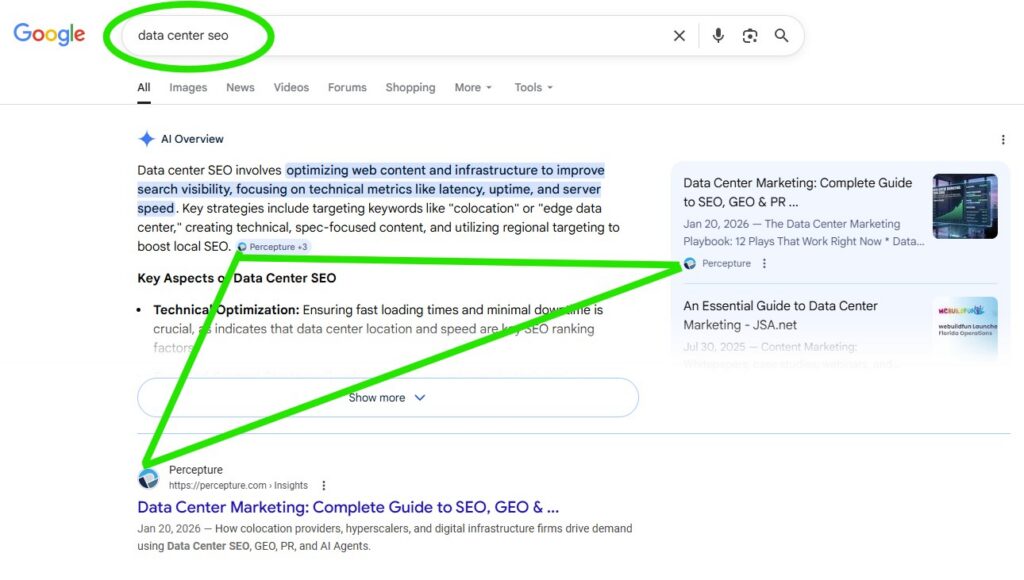

See the authority-to-demand process in practice
Review the Broadstaff Global case study for an example of positioning technical expertise such as edge caching for search visibility and qualified lead generation.
Read the Broadstaff case studyFrequently asked questions
What does edge caching mean?
Edge caching means storing eligible, reusable content at a network or compute edge closer in the delivery path to users. A matching fresh object can be served from that location. Misses, stale objects, bypassed requests and failures still rely on parent caches, CDNs, applications or origins.
What is the difference between a CDN and an edge cache?
An edge cache is a storage and serving function used for edge caching. A CDN is a broader managed delivery system that may combine many caches with routing, security, traffic management, analytics and operations. One cache is not automatically a CDN, and not every cache must operate as part of a public CDN.
How is a network edge cache cleared or purged?
Operators use the platform’s invalidation workflow, often targeting a URL, key, tag or content version. A broad purge should be used carefully because synchronized misses can increase fill traffic and origin load. This is network cache guidance, not Microsoft Edge browser guidance.
What is an edge caching strategy?
A caching strategy defines eligible content, node placement, request routing, cache keys, freshness, revalidation, purge, bypass, fallback, observability and economics. It also assigns responsibility for overload, maintenance and failure. A useful strategy starts with repeated demand and ends with measurable technical and financial outcomes.
What happens on a cache miss?
The node follows its configured upstream path. That path may lead to a parent cache, regional shield, upstream CDN, publisher cache or origin. If the returned response is eligible, the node may store it for later matching requests. A miss is normal during first access, expiry or eviction.
What should not be stored in a shared cache?
Private accounts, carts, checkout sessions, regulated data, personalized output and authenticated responses generally require bypass or strict controls. Safety depends on application behavior, keys, headers, cookies, privacy rules and freshness. A response should not enter shared storage merely because it is technically possible.
What is ISP edge caching?
ISP edge caching places eligible content inside a service-provider network so repeated subscriber requests can be served locally. The business case depends on valuable bytes kept local, congestion avoided, service experience, operations and total cost. It does not mean every node is in the last mile.
How does Qwilt use edge caching?
Qwilt describes a commercial platform that places caching and compute software inside participating service-provider networks and connects those resources through cloud control and open interfaces. Buyers should confirm current coverage, content support, delegation, logs, failure behavior, responsibilities and commercial terms directly with Qwilt.
Edge caching works when the full operating system works
Edge caching moves reusable content to a controlled delivery edge where a valid match can be served without repeating the full upstream retrieval. Its value depends on eligible demand, useful placement, accurate routing, safe keys, freshness controls, resilient fallback and measurable economics. ISPs should judge valuable bytes kept local, tail performance, origin relief, operational safety and total cost rather than relying on node count or one hit-rate slide. Qwilt is one commercial implementation of federated ISP-edge delivery. Percepture’s framework helps technical companies explain these decisions clearly to search engines, AI systems and buyers.
Own the edge caching questions buyers ask next
Percepture helps telecom, ISP, CDN and digital-infrastructure companies build source-backed authority, improve Google and AI visibility, and connect technical content with qualified demand.
Request an Edge Caching Visibility Review Explore Percepture telecom marketing servicesWhat happens next: Percepture reviews the search, AI-answer and conversion gaps around your technical offer, then outlines the highest-priority fixes.