
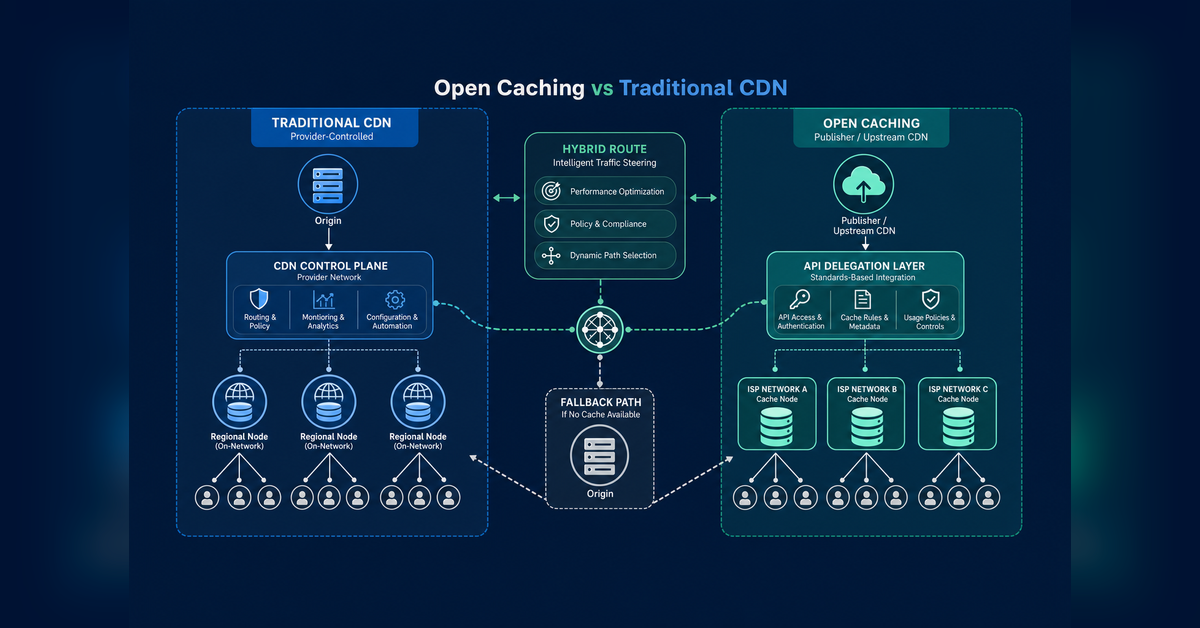

For an operator or publisher, open caching vs CDN is not simply a choice between a local cache and a global network. The real decision covers ownership, routing, edge depth, service breadth, economics, measurement and what happens when a delivery path fails.
Traditional CDNs and Open Caching can also work together. A CDN may keep publisher-facing control, security and broad coverage while eligible traffic is delegated to participating ISP caches through standardized interfaces.
Percepture has worked across telecom, data centers, digital infrastructure and complex B2B markets since 2004.





What is the main difference in open caching vs CDN?
Open Caching and a traditional CDN both deliver content closer to users, but they use different operating models. A traditional CDN runs a proprietary network and control plane. Open Caching uses standardized interfaces so an upstream CDN or publisher can delegate delivery to caches inside participating ISP networks. Many organizations can use both together.
- A traditional CDN is typically a complete commercial delivery service and operating network.
- Open Caching is a standards-based delegation and interoperability model.
- CDN reach follows the provider’s available footprint and integrations.
- Open Caching reach follows active participating ISP footprints and publisher integrations.
- A CDN can operate as the upstream CDN while an ISP cache operates as the downstream CDN.
Executive summary
Choose a traditional CDN when
In a delivery-model review, favor a traditional CDN when broad coverage, one-vendor operations and bundled security or application services carry the most weight.
Evaluate Open Caching when
The Open Caching case is strongest when high-volume cacheable traffic and measurable ISP-edge placement may improve the delivery path in specific networks.
Use a hybrid when
A hybrid design fits when the CDN should retain coverage and service breadth while selected ISP footprints serve eligible traffic.
How to judge the two models
Compare active reach, edge depth, control, services, total path cost, evidence and fallback. Do not decide from node count alone.
Who this guide is for
ISP and network operators
Use a structured assessment to compare transit, backhaul, infrastructure, operations and publisher participation.
Streaming and software publishers
For this architecture review, compare active subscriber reach, delivery quality, integrations, security and fallback.
CTOs and architects
Define routing, cache policy, purge, logs, APIs, failure ownership and escalation across the proposed delivery paths.
CFO and procurement teams
Model total path cost rather than treating price per delivered unit as the whole decision.
These questions also matter to companies building a clear telecom marketing position around a technical platform. The public explanation must separate standards, vendors, deployments and active traffic.
Make the category easier to understand and easier to buy
When buyers confuse a standard, a platform and a network service, demand stalls. Percepture builds the technical content, SEO, GEO and PR structure that makes the category clear before the sales call.
Open caching vs CDN: 15-factor comparison
The table compares typical operating models. Contracts and implementations can shift responsibility, so buyers should test every row against the proposed design.
| Factor | Traditional CDN | Open Caching | Buyer implication |
|---|---|---|---|
| Definition | Commercial delivery service and provider-operated network. | Specifications and interfaces for interoperable content delegation. | Compare a service category with an operating model, not two identical products. |
| Architecture | Provider-controlled routing, delivery and control plane. | Upstream and downstream systems exchange routing and delivery information. | Map every party and handoff. |
| Node placement | Regional, metro, on-net or other provider locations. | Inside participating service-provider networks, with depth varying by deployment. | Ask where traffic is actually served. |
| Ownership | Typically controlled by the CDN provider. | Hardware, software and operations may be divided among several parties. | Put ownership in the contract. |
| Control plane | Usually centralized through proprietary systems. | Responsibility is distributed and exchanged through defined interfaces. | Document routing, purge and fallback authority. |
| Standards | May support standards but commonly uses proprietary portals and APIs. | Built around interoperable specifications. | Compliance does not guarantee operational parity. |
| Reach | Follows available CDN regions, networks and customer configuration. | Follows active participating ISP footprints and integrations. | Verify markets and subscribers. |
| Integration | One provider integration may expose a broad service set. | Standards may reduce custom work, but commercial and operational integration remains. | Count engineering and onboarding effort. |
| Service breadth | May include WAF, DDoS protection, DNS, bots, application acceleration and edge compute. | Specifications focus on interoperable content delivery; added services depend on implementation. | List every required non-cache service. |
| Content focus | Can support static, streaming and application delivery according to provider capability. | Often evaluated for high-volume cacheable traffic, including streaming. | Measure the eligible share of traffic. |
| ISP relationship | A CDN may peer with or place nodes inside an ISP. | The participating service provider has a direct role in downstream delivery. | Do not assume every on-net cache is Open Caching. |
| Performance | Depends on placement, route, capacity, workload and operations. | Depends on the same factors plus delegation and downstream execution. | Neither model is automatically faster. |
| Economics | Includes delivery, request, region, security, support and commitment terms. | May include hardware, hosting, integration, operations, support, platform and settlement costs. | Compare total path cost. |
| Observability | Typically delivered through provider analytics, logs and APIs. | Logs and performance data cross organizational boundaries. | Test completeness, timing and billing alignment. |
| Resilience | Provider manages capacity, failover and origin paths under its design. | Miss, overload and failure behavior depend on implementation and upstream fallback. | Run failure tests before expansion. |
Primary technical references include the SVTA Open Caching specifications and the upstream-CDN/downstream-CDN model described in RFC 8804.
Does your technical platform make sense to buyers?
Percepture helps telecom, CDN and digital-infrastructure companies turn complex architecture into a clear buyer story that can rank, earn citations and create qualified conversations.
Why “global CDN versus local cache” is incomplete
A traditional CDN may run regional points of presence, peer with access networks or place equipment inside an ISP. Open Caching deployments may connect caches across several participating service providers. Location alone does not settle the comparison because location does not define either model.
The category difference matters more. A CDN is a commercial service and operating network. Open Caching is a set of specifications for delegation and data exchange. A commercial CDN can be the upstream party in that model, which is why the models should not be treated as a forced either-or choice.
Security is also separate from cache location. A nearby node does not prove that the path includes WAF, DDoS protection, bot controls, authoritative DNS or dynamic application acceleration. Those capabilities must be named and tested.
How a traditional CDN works
A traditional CDN routes requests through a provider-controlled network of edge locations. The provider manages the control plane, cache policy, routing, analytics and any bundled security or compute. Nodes may be regional or embedded inside service-provider networks.
A user request is directed to an available delivery location. If the requested object is cached and valid, the node serves a hit. If not, the system obtains the object from another cache or the origin according to its configuration. Purge tools and cache rules determine when stored objects must be refreshed or removed.
The operating advantage is consolidation. One provider can supply routing, delivery, analytics, support and other services through a common portal and contract. That can reduce the number of operational handoffs for a buyer.
The limits are not universal, but they can include proprietary APIs, switching cost, pricing complexity and uneven edge depth across markets. In a delivery-model evaluation, a global footprint also does not mean equal subscriber proximity or capacity in every access network.
How Open Caching works with a CDN
Open Caching does not remove the CDN, an important distinction in delivery planning. RFC 8804 describes a commercial CDN acting as an upstream CDN while an ISP caching system acts as a downstream CDN. Standards-based interfaces support delegation and data exchange.
- The publisher or upstream system identifies traffic that is eligible for downstream delivery.
- The upstream system checks the downstream system’s advertised capability.
- Request routing delegates an eligible request.
- An ISP node serves the object when it has a valid cached copy.
- A miss or failure follows the configured acquisition or fallback path.
- Logs and performance information return to the parties that need them.
This is the operating context for the comparison. Buyers who need a broader primer can review how infrastructure operators explain technical projects to affected communities, then apply the same clarity to network roles and accountability.
Architecture comparison in plain English
Traditional path
Origin → proprietary CDN control → CDN point of presence or on-net node → user.
Open Caching path
Publisher or upstream CDN → standardized delegation → participating ISP cache → user.
Hybrid path
Publisher → CDN or multi-CDN control → eligible ISP caches plus conventional CDN locations → fallback or origin.
These paths describe operating models. They do not represent every implementation or contract.

Ownership, control and interoperability
Traditional CDN control is usually centralized in one provider. Open Caching distributes responsibility across the publisher or upstream CDN, the platform and the service provider. In a hybrid design, standards can reduce one-off integration only when contracts, telemetry and escalation are clear.
| Control area | Traditional model | Open Caching model | Question to settle |
|---|---|---|---|
| Hardware | Typically provider-managed. | Ownership and hosting may vary. | Who replaces failed equipment? |
| Software | Provider release process. | May involve platform and ISP teams. | Who controls upgrades? |
| Routing | Provider policy and APIs. | Upstream policy plus downstream capability. | Who can stop delegation? |
| Eligibility | Configured in the provider service. | Defined before downstream delegation. | Which traffic qualifies? |
| Purge | Provider portal or API. | Instructions cross system boundaries. | How quickly is removal confirmed? |
| Logs | Provider analytics and export. | Data must cross parties. | Are records complete and billable? |
| Failure | Handled within provider operations. | May span upstream, platform and ISP teams. | Who owns the incident? |
Reach and edge depth
PoP count is not the same as subscriber proximity. A node described as “inside an ISP” may be in a core, metro, aggregation or deeper access location. Each position has different traffic and congestion implications.
Open Caching reach exists where an ISP footprint, delivery platform and publisher integration are active for the proposed traffic. A traditional CDN may provide wider immediate coverage and fallback. Open Caching may provide deeper placement in selected networks. The comparison record should therefore be built at market level rather than from a global total.
| Market | CDN availability | Participating ISP availability | Edge depth | Fallback | Evidence date |
|---|---|---|---|---|---|
| Required market A | Document contracted path | Document active integration | Core, metro, aggregation or access | Record tested route | Record test date |
| Required market B | Document contracted path | Document active integration | Core, metro, aggregation or access | Record tested route | Record test date |
| Required market C | Document contracted path | Document active integration | Core, metro, aggregation or access | Record tested route | Record test date |
Service breadth and security
A traditional CDN may bundle WAF, DDoS protection, DNS, TLS management, bot controls, image optimization, API protection, application acceleration and edge functions. The available set depends on the provider and contract.
Open Caching specifications focus on interoperable content delivery. A commercial implementation may provide added capabilities, but those capabilities should not be assumed from the Open Caching label.
Open Caching is not automatically a replacement for a CDN security stack. In a hybrid architecture, a buyer may keep a CDN for global routing, WAF, DDoS protection and dynamic applications while delegating eligible cacheable content to ISP nodes.
Open caching vs CDN cost and commercial model
Neither model is always cheaper. A useful financial comparison covers the full delivery path, the eligible workload and the cost of running a reliable fallback.
| Model | Cost inputs to examine | Common blind spot |
|---|---|---|
| Traditional CDN | Delivery volume, requests, regions, egress, security, support, commitments and overages. | Assuming one blended rate reflects every market and service. |
| Open Caching | Hardware or hosting, operations, integration, support, eligible traffic, platform fees and settlement. | Counting possible network savings without integration and fallback costs. |
| Hybrid | Both contracts, operational coordination, fallback and any capacity benefit. | Paying for overlapping paths without measuring which traffic moved. |
The executive calculation should include eligible volume, peak throughput, cacheable share, expected offload, transit or backhaul inputs, CDN costs, hosting, integration, labor, support, security, fallback, term and growth. Use conservative assumptions and run sensitivity cases.
Performance and quality
Neither model wins automatically. Proximity helps only when node placement, request routing, capacity, cache policy and operations perform as designed. The performance test should use the same workload, markets and time window.
| Metric | What it reveals | Why a single number can mislead |
|---|---|---|
| Cache or offload rate | Share served without the original delivery path. | A hit may have little value if it avoids no constraint or meaningful cost. |
| Start time and buffering | User experience for streaming workloads. | Averages can hide poor results in specific networks. |
| Latency and jitter | Path responsiveness and stability. | Different content types react differently. |
| Peak capacity | Ability to handle traffic spikes. | Installed capacity may not equal usable capacity. |
| Availability | Successful service over time. | It must include miss and fallback outcomes. |
| Log completeness | Operational and commercial visibility. | Missing records can undermine billing and diagnosis. |
| Subscriber coverage | Users who can receive the intended path. | Node totals do not prove active traffic reach. |
Can Open Caching replace a traditional CDN?
It can replace or augment a defined cacheable-delivery path when footprint, features, operations and fallback meet requirements. It does not automatically replace global coverage, dynamic delivery, security or multi-CDN control.
Before expanding an Open Caching replacement, require proof of market coverage, traffic eligibility, routing and purge behavior, security boundaries, telemetry, service commitments and recovery. Replacement should be scoped by workload and market, not declared at platform level after one test.
When a hybrid model is strongest
A hybrid model can fit a publisher with broad global demand but concentrated traffic in selected participating ISPs. It can also fit event peaks, large software delivery, constrained middle-mile paths or a multi-CDN design that wants deeper reach in specific networks.
The publisher can retain a CDN as the coverage, security or control layer while delegating eligible objects. The ISP path should be piloted with a clear fallback and a matched baseline. Expansion follows evidence, not architecture preference.
Where Qwilt fits
Qwilt describes a commercial content-delivery and edge platform that uses and contributes to SVTA Open Caching specifications. Its model connects publisher delivery with service-provider edge capacity. In this comparison, Qwilt is a commercial implementation and ecosystem, not the standard.
For a Qwilt evaluation, buyers should document active market reach, eligible content, capacity, onboarding, logs, service commitments, security boundaries, support, commercial terms, fallback and exit options. Vendor footprint or performance claims should be assessed against the buyer’s markets and workload.
Open caching vs CDN decision matrix
The Percepture Content Delivery Choice Matrix turns the decision into six factors: reach, edge depth, control and interoperability, service breadth, economics, and evidence with resilience.
| Decision signal | Traditional CDN | Open Caching candidate | Hybrid candidate |
|---|---|---|---|
| Reach | Broad coverage is required now. | Traffic is concentrated in participating ISP footprints. | Broad coverage and selected deeper footprints are both valuable. |
| Edge depth | Current placement meets measured needs. | On-net depth addresses a measured constraint. | Depth matters only in selected networks. |
| Control | One-provider operations are preferred. | The team can manage distributed responsibility. | Central policy can coordinate multiple paths. |
| Services | Bundled security and application features dominate. | The workload is mainly eligible cacheable content. | Security stays with the CDN while cacheable traffic is delegated. |
| Economics | The contracted service has the best tested total path cost. | A conservative model supports an ISP-edge path. | Selective offload improves the combined case. |
| Evidence | Existing operations meet targets. | A pilot proves quality, logging and fallback. | Matched testing proves when each path should operate. |
The Percepture Five-Proof Test
Use this method before choosing a delivery model or expanding a hybrid deployment.
- Footprint proof: Show active markets, networks, subscribers and eligible traffic.
- Performance proof: Compare matched workloads using quality, capacity and availability measures.
- Operations and fallback proof: Test miss, overload, node failure and upstream recovery.
- Interoperability proof: Confirm routing, configuration, purge, logs and escalation across parties.
- Commercial proof: Model total path cost, commitments, support, settlement and exit.
Myths and buying mistakes
These myths can obscure the actual architecture, contractual roles and evidence requirements.
- “Open Caching is merely an ISP-owned CDN.” Ownership can vary, while the defining idea is standardized delegation and interoperability.
- “Qwilt owns the standard.” Qwilt is a commercial implementation, not the standard.
- “Traditional CDNs never deploy on-net.” A traditional CDN may place nodes inside service-provider networks.
- “Open Caching is always faster or cheaper.” Results depend on traffic, placement, capacity, operations and total cost.
- “The models cannot coexist.” Upstream and downstream delivery can form a combined path.
- “Open Caching replaces WAF and DDoS protection.” Security capabilities depend on the implementation and retained services.
- “More nodes mean better delivery.” Active reach, edge depth and usable capacity matter more than a raw count.
- “Open means open-source.” Open Caching refers to interoperable specifications, not an automatic software licensing model.
- “A cache miss is always a failure.” A miss can trigger acquisition or fallback as designed.
The future of CDN and Open Caching
One reasonable direction is greater coordination between CDN, multi-CDN and ISP-edge control systems. More content delivery may move toward ISP or exchange-adjacent locations where workload and economics support it, but adoption will remain tied to active integrations and operating discipline.
Edge compute and AI infrastructure may share facilities or network locations with delivery systems. That does not mean Open Caching automatically orchestrates AI inference or general edge compute.
For companies explaining these shifts, technical content marketing, enterprise SEO services and generative engine optimization services help turn precise architecture language into retrievable buyer education.
Technical authority must connect definitions, evidence and demand
A strong technical comparison separates the standard, vendor platform, network deployment and active traffic. It also gives buyers testable questions rather than repeating vendor categories.
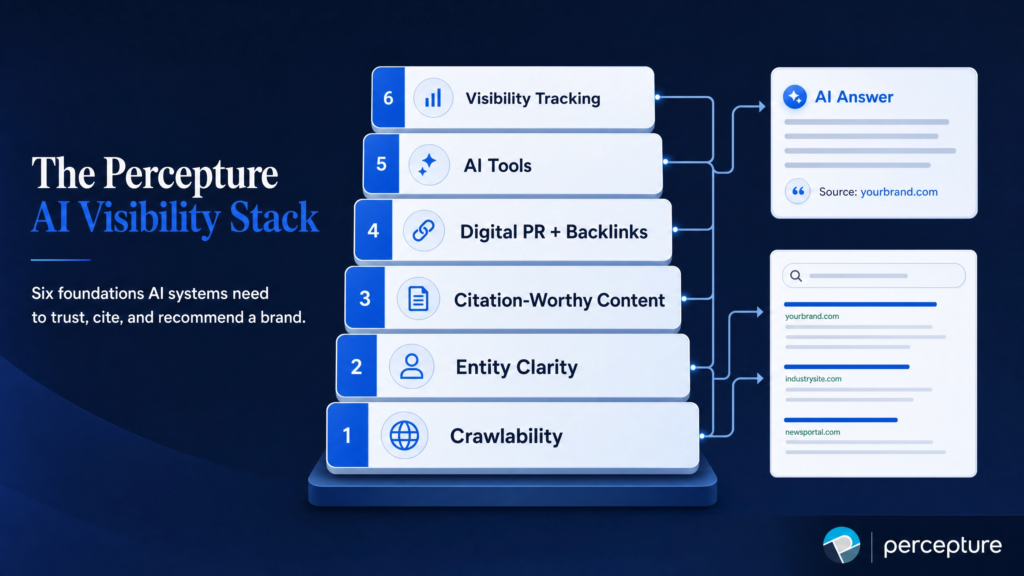

Percepture combines digital PR services, B2B lead generation services and omnichannel marketing to connect specialist knowledge with visibility and buyer action.
Turn the comparison into a funded evaluation
Percepture can turn this decision framework into a content, search and PR program built around buyer questions, proof requirements and the commercial decision path.
Key takeaways
The decision should remain grounded in operating roles, measured reach and tested delivery outcomes.
- A CDN is a service and operating-network category. Open Caching is a standards-based delegation model.
- The two models can work together through upstream and downstream delivery roles.
- Location matters, but control, services, operations, evidence and economics matter too.
- Qwilt is a commercial implementation and ecosystem, not the Open Caching standard.
- Choose from measured footprint, workload, security boundaries, fallback and total path cost.
Open Caching and CDN FAQs
What is the difference between open caching vs CDN?
In open caching vs CDN, a traditional CDN is typically a complete commercial delivery service with a provider-controlled network and control plane. Open Caching is a standards-based model for delegating eligible delivery to a downstream system, often inside a participating ISP. A commercial CDN can remain upstream, so the models can complement each other.
Is Open Caching a CDN?
The category distinction starts with category: Open Caching is not one CDN or one vendor network. It is a suite of specifications and interfaces for interoperable content delivery. A downstream Open Caching system can perform CDN functions, while a commercial CDN can act as the upstream system that delegates eligible requests.
Can Open Caching replace a traditional CDN?
In a replacement plan, Open Caching can replace or augment a defined cacheable-delivery path when active footprint, required features, operations, telemetry and fallback meet the buyer’s requirements. It does not automatically replace global coverage, dynamic delivery, WAF, DDoS protection, DNS or multi-CDN control.
Can a traditional CDN use Open Caching?
Yes. The upstream-CDN and downstream-CDN model allows a commercial CDN to delegate eligible delivery to another system. The parties still need clear routing policy, capability exchange, logging, purge behavior, commercial terms and failure procedures.
Is Qwilt the Open Caching standard?
No. Qwilt is a commercial content-delivery and edge platform associated with Open Caching implementations and specifications. The Open Caching specifications are developed through the Streaming Video Technology Alliance. Buyers should assess Qwilt as a vendor and ecosystem, not as the standard itself.
Which model is cheaper?
Neither option is always cheaper. Compare delivery charges, requests, regions, security, hardware or hosting, integration, labor, support, settlement, eligible traffic and fallback. A useful decision uses total path cost and conservative traffic assumptions rather than one unit rate.
Which model is faster?
Neither model is automatically faster. Performance depends on node placement, routing, available capacity, cache policy, workload, subscriber coverage and operations. Run matched tests for start time, buffering, latency, throughput, availability, misses and fallback in each required market.
Does Open Caching include WAF or DDoS protection?
Open Caching specifications focus on interoperable content delivery. Security services may be supplied by a commercial implementation or retained CDN, but they are not guaranteed by the Open Caching label. Define each security control and the party responsible for it.
What happens on a cache miss?
A cache miss follows the configured acquisition or fallback path. The downstream system may obtain the object from an upstream source, or the request may return to another delivery path. Buyers should test normal misses, overload, stale content, node failure and upstream failure.
Own the technical questions buyers and AI systems ask
Percepture helps telecom and digital-infrastructure companies turn specialist knowledge into clear search content, AI-answer visibility, digital PR and qualified sales conversations.
Bring us the category, the buyer and the proof. We will build the path from technical authority to demand.

About Bob Generale
Bob Generale is President of Percepture, a digital marketing and PR agency founded in 2004. He works with telecom, data center, AI infrastructure and complex B2B companies to connect technical authority with SEO, GEO, digital PR and qualified demand. He prepared this open caching vs CDN guide to help technical buyers separate standards, platforms, deployments and measurable outcomes.