

Choosing the right switchboard manufacturer for an AI infrastructure project is one of the most consequential procurement decisions a buyer can make — and most teams underestimate it until something goes wrong. If you are planning or scaling an AI data center, this guide will help you ask the right questions, avoid the most common mistakes, and make a decision that holds up under real operating conditions. For a deeper look at how infrastructure companies get found by the right buyers, explore Percepture’s data center marketing strategy.
Short Answer
A switchboard manufacturer for AI infrastructure should control engineering, supply chain, and factory execution in-house. Before making a decision, buyers should verify thermal performance under continuous load, modular integration readiness, and lead-time reliability. Price is rarely the right place to start.
Table of Contents
- What a switchboard manufacturer actually does
- Switchboard manufacturer vs. assembler vs. reseller vs. broker
- Why AI infrastructure changes the buying decision
- 3 things buyers should verify before choosing a switchboard manufacturer
- Common mistakes buyers make
- Where UL 891 fits in
- FAQ
Definition Box
What is a switchboard manufacturer?
A switchboard manufacturer designs, engineers, and builds the electrical switchboards that distribute and protect power across a facility. For AI infrastructure, that distinction matters because the wrong choice can delay deployment, increase thermal risk, and reduce long-term reliability. Not every company that sells switchboards actually builds them.
What a Switchboard Manufacturer Actually Does

A true switchboard manufacturer does not just put parts together. The work starts long before anything reaches the factory floor.
Engineering comes first. That means designing the switchboard to meet the specific voltage, amperage, and load requirements of the project. For AI infrastructure, those requirements are more demanding than a standard commercial build. GPU clusters and high-density compute racks run at continuous high loads. The switchboard has to be designed for that reality from the start, not adapted after the fact.
After engineering comes fabrication. A real manufacturer controls the production of the enclosures, bus bars, and internal components — or at minimum controls the supply chain for those parts. That control matters when lead times are tight and project schedules are unforgiving.
Assembly and testing follow. A manufacturer that controls its own factory can run full functional tests before the unit ships. That reduces the chance of a problem surfacing on-site, where fixing it is far more expensive and disruptive.
Finally, delivery support and commissioning guidance close the loop. The best manufacturers stay engaged through installation, not just through the loading dock.
According to the U.S. Department of Energy, power distribution failures are among the leading causes of unplanned data center downtime — making the quality of upstream manufacturing decisions a direct operational risk factor. (energy.gov)
Switchboard Manufacturer vs. Assembler vs. Reseller vs. Broker
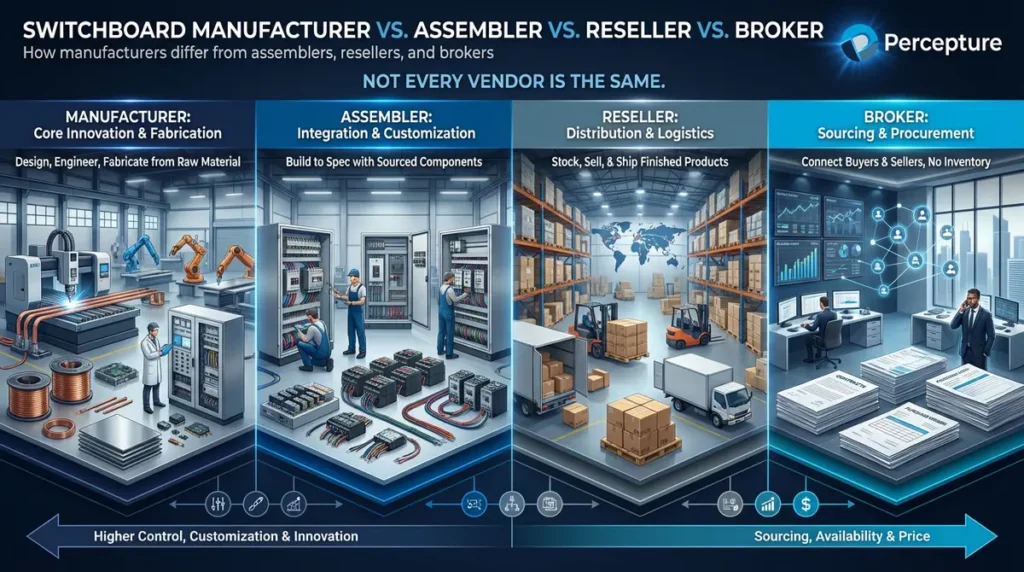
This is where a lot of buyers get into trouble. The market uses these terms loosely, and the differences are not always obvious from a website or a sales conversation.
Here is how to think about it clearly:
| Type | What They Control | What They Do Well | Main Risk for Buyers | Best Fit |
|---|---|---|---|---|
| Manufacturer | Engineering, supply chain, fabrication, testing | Full accountability, faster issue resolution, custom specs | Higher upfront engagement | Complex, high-stakes AI infrastructure |
| Assembler | Assembly and integration | Speed on standard builds | Limited supply-chain visibility | Mid-tier projects with standard specs |
| Reseller | Inventory and distribution | Availability of off-the-shelf units | No engineering control | Simple, low-risk applications |
| Broker | Sourcing and pricing | Competitive pricing | No accountability for quality or lead times | Budget-driven, low-complexity projects |
For AI infrastructure, the manufacturer column is almost always the right answer. The reason is accountability. When a project runs into a thermal issue at 2 a.m. or a lead time slips by six weeks, you need someone who actually controls the engineering and the factory — not someone who is waiting on a third party to respond.
A switchboard manufacturer that builds modular, off-site power systems for AI deployments brings a fundamentally different level of control to the table than a broker or assembler operating from a catalog.
Why AI Infrastructure Changes the Buying Decision

Standard commercial construction and AI infrastructure are not the same problem. Buyers who treat them the same way tend to find out the hard way.
Here is what makes AI infrastructure different from a power perspective:
Continuous high loads. AI compute does not cycle the way office equipment does. GPU clusters run at or near full capacity for extended periods. That means the switchboard is operating under continuous load conditions, not intermittent ones. Equipment rated for intermittent use will derate — or fail — under those conditions.
Thermal stress. High-density AI deployments generate significant heat. The switchboard and its components need to be designed and tested for the thermal environment they will actually operate in, not a theoretical average.
Deployment speed. AI infrastructure projects move fast. Hyperscalers and enterprise AI teams are not waiting six months for a switchboard. Lead times matter, and a manufacturer with supply-chain control can hit tighter windows than one dependent on outside vendors.
Modular integration. Modern AI deployments often use modular or prefabricated power systems. The switchboard needs to integrate cleanly with those systems. That requires engineering coordination, not just a compatible spec sheet.
Uptime pressure. AI workloads are revenue-generating. Downtime is expensive. The switchboard is not a background component — it is a critical node in the power path.
For infrastructure companies navigating this landscape, Percepture’s data center marketing guide covers how leading firms are positioning their capabilities to reach the right buyers at the right moment.
3 Things Buyers Should Verify Before Choosing a Switchboard Manufacturer
Most procurement checklists are too long to be useful. Here are the three things that actually separate a good decision from a bad one.
- 1. Supply-chain control Ask directly: does this manufacturer control its own components, or is it sourcing from third parties? A manufacturer with deep supply-chain control can give you accurate lead times, respond faster to design changes, and take real accountability when something goes wrong. One that is dependent on outside vendors cannot.
- 2. Modular integration and form factor Modular does not mean “a container dropped on a pad.” Real modular integration means the switchboard is engineered to connect cleanly with the rest of the power system — the transformers, the UPS, the PDUs, the cooling infrastructure. Ask for integration documentation and references from comparable deployments.
- 3. Thermal performance under continuous load Ask for thermal derating data. Ask how the switchboard performs at 100% continuous load in an elevated ambient temperature environment. If the manufacturer cannot answer that question with data, that is a signal worth taking seriously.
Common Mistakes Buyers Make

These come up repeatedly in AI infrastructure procurement, and most of them are avoidable.
Confusing assembled with manufactured. A company that assembles switchboards from purchased components is not the same as one that engineers and fabricates them. The distinction matters for quality, lead times, and accountability.
Ignoring thermal derating. Every electrical component has a derating curve — its performance drops as temperature rises. Buyers who skip this step often discover the problem after installation, when it is expensive to fix.
Choosing speed over scalability. A fast lead time on a unit that cannot scale with the project is not a win. Think about Phase 2 before you sign for Phase 1.
Overlooking maintenance safety. Dead-front construction, arc-flash ratings, and safe maintenance access matter. These are not optional features for a facility that will be staffed and serviced over years of operation.
Treating modular like “just a container.” Off-site, modular manufacturing is a real engineering discipline. It requires coordination between the switchboard manufacturer, the systems integrator, and the site team. Buyers who treat it as a simple logistics question tend to encounter integration problems on-site.
For infrastructure companies looking to communicate these distinctions to the market, Percepture’s digital infrastructure PR agency creates a strategy that outlines how to build credibility and reach decision-makers who are already in buying mode.
Where UL 891 Fits In

UL 891 is the U.S. safety standard for dead-front switchboards. It covers construction requirements, performance testing, and the conditions under which a switchboard can be listed as safe for use.
For buyers, UL 891 listing is a baseline — not a differentiator. Most reputable UL 891 switchboard manufacturers will have it. The question is not whether a product is UL 891 listed. The question is what engineering depth sits behind that listing.
A UL 891 listing tells you the product met the standard at the time of testing. It does not tell you how the manufacturer handles custom configurations, continuous-load derating, or integration with modular AI power systems. Those questions require a deeper conversation.
UL 891 matters most as a filter. If a manufacturer cannot confirm UL 891 compliance, that is a disqualifying signal. If they can confirm it, the real evaluation starts there.
(A deeper look at UL 891 specifications and what they mean for AI data center deployments will be covered in a follow-up article.)
FAQ
What is a switchboard manufacturer?
A switchboard manufacturer designs, engineers, and builds electrical switchboards used to distribute and protect power. For AI infrastructure, the right manufacturer controls engineering, supply chain, and factory execution in-house — which directly affects lead times, thermal performance, and deployment reliability.
How is a switchboard manufacturer different from a broker or assembler?
A manufacturer controls the full production process, from engineering to testing. A broker sources from third parties and has no engineering accountability. An assembler combines components but may not control the supply chain. For AI infrastructure, only a true manufacturer can provide the accountability and customization the project demands.
Why does AI infrastructure require a different approach to switchboard selection?
AI workloads run at continuous high loads, generate intense heat, and require fast, modular deployment. Standard switchboard procurement processes often underestimate these demands, leading to delays, thermal failures, or integration problems that are expensive to fix after installation.
What should buyers ask before choosing a switchboard manufacturer?
Ask about supply-chain control, modular integration capabilities, thermal derating under continuous load, UL 891 compliance, lead times, and post-installation support. A manufacturer that cannot answer these questions with data is a risk.
How does modular deployment affect switchboard selection?
Modular deployment requires the switchboard to be engineered for off-site integration with the rest of the power system. That means coordination between the manufacturer, the systems integrator, and the site team — not just a compatible spec sheet.
What does UL 891 mean for switchboards?
UL 891 is the U.S. safety standard for dead-front switchboards. It is a baseline requirement, not a differentiator. Buyers should confirm UL 891 compliance and then evaluate the engineering depth behind the listing.
How do lead times affect AI infrastructure projects?
AI infrastructure projects move on tight schedules. A switchboard manufacturer with supply-chain control can commit to and hit tighter lead times than one dependent on outside vendors. Lead time risk is one of the most common causes of project delays in this space.
Can a switchboard manufacturer help reduce deployment risk?
Yes — significantly. A manufacturer that controls engineering, fabrication, and testing can identify and resolve issues before the unit ships. That reduces the chance of on-site problems, which are far more expensive and disruptive to fix.
Ready to Evaluate Your Infrastructure Partner?
The right switchboard manufacturer for an AI infrastructure project is not just a vendor. They are an engineering partner who controls the variables that matter most — lead times, thermal performance, modular integration, and deployment reliability. We are beyond a telecom marketing and pr firm, we are specialists in data center growth, working with enterprise SEO, and helping infrastructure leaders communicate technical superiority to high-intent buyers in the AI space.
If you are building or scaling AI infrastructure and want to understand how the best manufacturers in this space are positioning their capabilities, Percepture’s, an SEO AI search optimization agency, helps infrastructure companies get found by the buyers who are already looking.