

Building a data center is a race against time. While UL 891 switchboards are the standard safety choice for power, just having the label isn’t enough. In the fast world of AI, you need gear that stays cool and arrives on site fast. Many buyers make the mistake of only looking at the safety sticker. But if your equipment can’t handle the heavy heat of AI chips or takes a year to ship, your project will fail. At Percepture, our Data Center Marketing Strategy helps brands show buyers why speed and smart design matter more than just a basic rating.
What is a UL 891 Switchboard?
UL 891 is the safety standard for dead-front low-voltage switchboards used to distribute electrical power. For critical infrastructure, the best UL 891 switchboard manufacturers also stand out in lead times, thermal design, scalability, maintenance access, and modular deployment readiness. It does not mean every manufacturer builds with the same speed, flexibility, or performance.

What UL 891 Actually Means
UL 891 is a safety standard published by Underwriters Laboratories. It applies to dead-front low-voltage UL switchboards, the large electrical panels used to receive and distribute power in commercial and industrial buildings.
What does “dead-front” mean?
Dead-front means the live electrical parts are not exposed on the front of the panel. You cannot accidentally touch a live wire when the door is open. This is a basic safety requirement for any switchboard used in a professional environment.
What does a low-voltage switchboard do?
It takes incoming power — usually from a utility or generator — and splits it into smaller circuits. Those circuits feed lighting, HVAC, servers, cooling systems, and other loads throughout a facility.
Why does UL 891 matter to buyers?
It means the product has been tested and meets a defined set of design requirements. Most building codes, insurance carriers, and project specifications require UL-listed equipment. Without it, you may not be able to get a permit or pass an inspection.
But here is the key point: UL 891 sets a floor, not a ceiling. Two switchboards can both carry the UL 891 label and perform very differently under real operating conditions.
Why UL 891 Matters in Critical Infrastructure
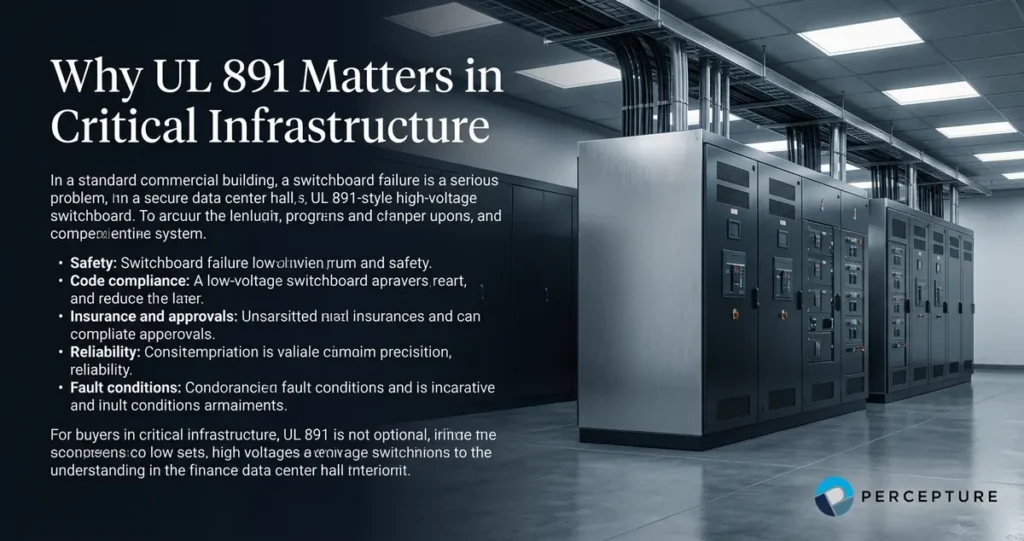
In a standard commercial building, a switchboard failure is a serious problem. In critical infrastructure, such as data centers, telecom facilities, and power substations, it can mean hours of downtime and millions of dollars in losses. The right switchboard manufacturer matters, learn why UL 891 is important:
Here is why UL 891 compliance matters in these environments:
- Safety: Dead-front design protects workers during maintenance and operation.
- Code compliance: Most jurisdictions require UL-listed equipment for commercial and industrial electrical systems.
- Insurance and approvals: Insurers and project owners often require UL listing as a condition of coverage or contract.
- Reliability: UL testing verifies that the switchboard can handle its rated load under defined conditions.
- Fault conditions: UL 891 includes short-circuit and interrupting ratings that matter when faults occur.
For buyers in critical infrastructure, UL 891 is not optional. It is the starting point. The question is what comes after that starting point.
Why AI Infrastructure Changes the Stakes

AI infrastructure — including high-density compute facilities, GPU clusters, and edge deployments — puts new pressure on electrical systems. This is not a future concern. It is happening now.
Here is what changes:
- Continuous high loads. AI workloads run at or near full capacity for extended periods. A switchboard rated for a certain load may be derated when that load is continuous. Buyers need to understand how a manufacturer handles continuous-load ratings.
- Thermal stress. High, sustained loads generate heat. If a switchboard is not designed for thermal performance under continuous operation, it can degrade faster, trip unexpectedly, or fail.
- Uptime expectations. AI infrastructure often requires near-zero downtime. That means the switchboard needs to be reliable, maintainable, and serviceable without taking the whole system offline.
- Fast deployment. AI buildouts move quickly. Lead times matter. A switchboard that takes 30 weeks to deliver can hold up an entire project.
- Modular and off-site integration. Many AI and data center projects use modular deployment — pre-built power skids or containerized systems assembled off-site. The switchboard needs to fit that workflow.
Percepture’s Digital Infrastructure PR Strategy practice works with companies navigating exactly these pressures. The infrastructure buyers we see are asking harder questions than they were three years ago — and they should be.
Want more traffic, leads, and visibility?
We help digital infrastrucutre brands dominate AI Search, Digital PR and Paid Targeting with custom growth strategies starting at $3,000/mo
Not All UL 891 Switchboards Are Equal
The UL 891 label tells you a product passed a test. It does not tell you how the manufacturer handles lead times, thermal design, or future expansion. Here is a side-by-side look at what baseline compliance covers versus what stronger manufacturers do.
Comparison Chart: UL 891 Switchboard Manufacturer Evaluation
| Evaluation Area | What Baseline Compliance Covers | What Stronger Manufacturers Do | Why It Matters to the Buyer |
|---|---|---|---|
| Code Compliance | Meets UL 891 listing requirements | Maintains full documentation, test records, and field support | Speeds up permitting and inspections |
| Thermal Performance | Passes standard temperature-rise tests | Designs for continuous-load derating and real-world heat management | Prevents failures under sustained AI/data center loads |
| Lead Times | No standard requirement | Controls supply chain, maintains inventory, offers shorter lead times | Keeps projects on schedule |
| Scalability | Rated for a fixed configuration | Offers expandable bus, future breaker positions, and modular options | Supports growth without full replacement |
| Breaker Flexibility | Accepts listed breakers | Supports multiple breaker brands and frame sizes | Reduces vendor lock-in |
| Maintenance Access | Dead-front design required | Adds draw-out breakers, rear access, and safe isolation features | Reduces downtime during service |
| Modular Integration | Not addressed by the standard | Designs for skid, containerized, or off-site assembly | Fits modern deployment workflows |
| Testing / QA | Factory test per UL 891 | Full production testing, witnessed testing options, detailed QA records | Gives buyers confidence before delivery |
4 Things Buyers Should Verify Before Choosing a UL 891 Switchboard Manufacturer
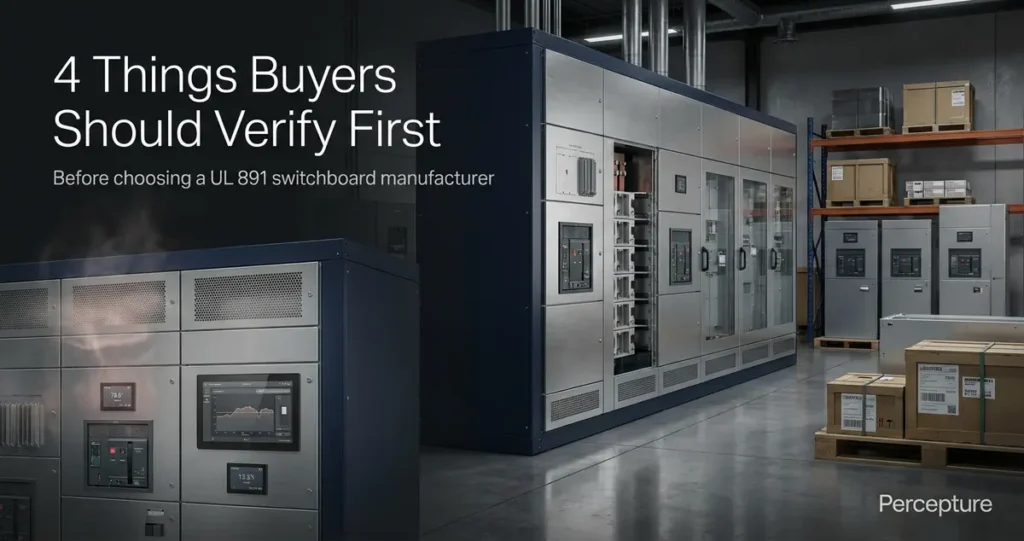
Not sure where to start? Use these four filters before you sign a purchase order.
1. Thermal Performance Under Continuous Load
Ask the switchboard manufacturer how they rate their switchboards for continuous operation. A switchboard rated at 4,000A may need to be derated to 3,200A under continuous load. If the manufacturer cannot explain their thermal derating approach, that is a red flag.
2. Lead-Time and Supply-Chain Control
Ask for a realistic lead time — and ask what drives it. Does the manufacturer control their own production? Do they stock common components? A manufacturer with a 40-week lead time can derail a project. One with 12–16 weeks and supply-chain visibility is a different conversation.
3. Scalability and Breaker Flexibility
Ask whether the switchboard can accept additional breakers in the future. Ask which breaker brands and frame sizes are supported. If you are building a facility that will grow, you need a switchboard that grows with it, not one that forces a full replacement in three years.
4. Maintenance Access and Safety
Ask how the switchboard is serviced. Can breakers be isolated or removed without de-energizing the whole board? Is there rear access? Are there draw-out options? Maintenance safety is not just a compliance issue; it is an operational one. A switchboard that is hard to service will eventually become a liability.
Common Mistakes Buyers Make
Even experienced buyers make these mistakes when evaluating UL 891 switchboard manufacturers.
- Assuming UL 891 means all options perform the same. It does not. The label sets a floor. Performance above that floor varies widely.
- Focusing only on the quote. The lowest price often comes with the longest lead time, the least flexibility, or the weakest support.
- Ignoring thermal derating. A switchboard that is not sized for continuous load will underperform or fail in high-density environments.
- Overlooking future expansion. Buying a switchboard with no room to grow forces a costly replacement when the facility expands.
- Missing maintenance access issues. A switchboard that cannot be safely serviced under load creates downtime risk and safety exposure.
- Not asking how the switchboard fits into modular deployment. If your project uses pre-built power skids or containerized systems, the switchboard needs to be designed for that workflow from the start.
Percepture’s Data Center Marketing Guide covers how infrastructure companies communicate these differentiators to buyers, because the gap between a compliant product and a high-performance one is real, and buyers deserve to understand it.
How UL 891 Connects to Speed, Safety, and Scale
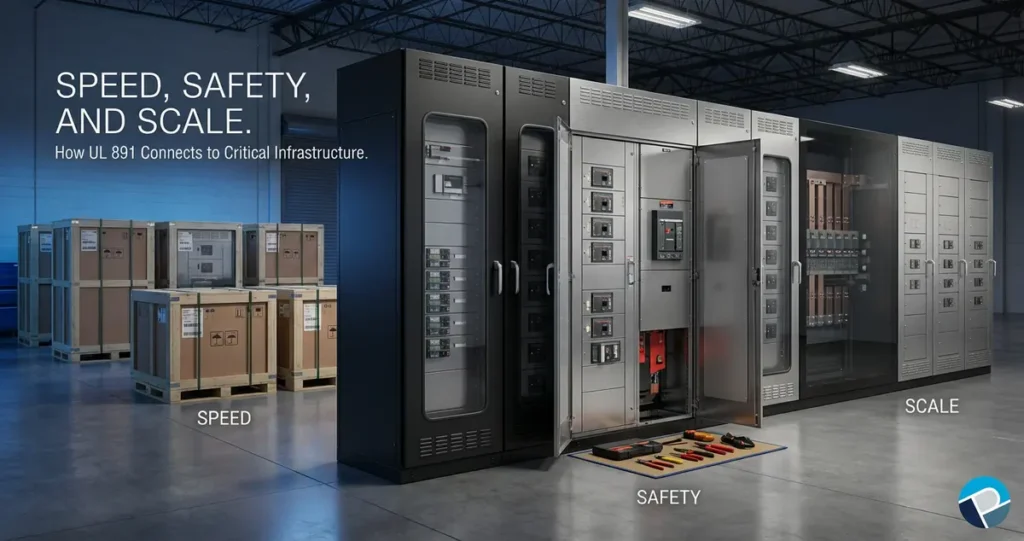
Let’s bring this together.
Speed means lead times and deployment readiness. A UL 891 switchboard that takes 40 weeks to deliver is not a fast solution. The best manufacturers control their supply chain, maintain inventory, and can commit to realistic timelines. For modular deployment, speed also means the switchboard is designed to integrate off-site — not retrofitted after the fact.
Safety means more than passing a test. It means dead-front design, proper thermal management, short-circuit ratings that match the application, and maintenance features that protect workers during service. UL 891 establishes the baseline. Strong manufacturers go further.
Scale means the switchboard can grow with the project. That includes expandable bus capacity, flexible breaker positions, support for multiple breaker brands, and a design that fits into modular or phased deployment. Buyers who think about scale at the time of purchase avoid costly replacements later.
If you are sourcing power distribution equipment for critical infrastructure, AI buildouts, or telecom facilities, these three dimensions — speed, safety, and scale — are the right lens. UL 891 is where the conversation starts. It is not where it ends.
Percepture is an AI-driven telecom marketing and PR agency that helps infrastructure companies show up in both Google and AI-generated answers for exactly these buyer questions. If your company builds or sells UL 891 switchboards, visibility with an enterprise seo agency or AI search firm can help accelerate your growth. Below are related resources:
- To understand the specific phases of a large-scale campaign, you should review the How Long Does Enterprise SEO Take? (2026 Timeline Model) to see how trust velocity impacts your results.
- Before finalizing your budget, use the Enterprise SEO ROI Calculator: Measure Your Search… to accurately forecast the potential financial impact of your organic growth.
Be the top choice in Google and AI Answers
Get more leads with AI SEO growth plans. Simple pricing and deliverables starting at $4000/mo
FAQ
Q: What does UL 891 mean?
UL 891 is the Underwriters Laboratories safety standard for dead-front low-voltage switchboards. It confirms that a switchboard has been tested and meets specific design requirements for power distribution.
Q: What is a dead-front switchboard?
A dead-front switchboard is one where live electrical parts are not exposed on the front panel. This protects workers from accidental contact with energized components during operation or maintenance.
Q: Are all UL 891 switchboards the same?
No. UL 891 sets a baseline for safety and design. It does not standardize lead times, thermal performance, scalability, or maintenance features. Buyers should evaluate manufacturers on all of these dimensions, not just the UL label.
Q: Why does UL 891 matter for critical infrastructure?
Critical infrastructure — including data centers, telecom facilities, and AI compute environments — requires equipment that is code-compliant, insurable, and reliable under fault conditions. UL 891 listing satisfies those baseline requirements.
Q: What should buyers ask a UL 891 switchboard manufacturer?
Ask about thermal derating under continuous load, realistic lead times, breaker flexibility, scalability for future expansion, and how the switchboard integrates into modular or skid-based deployment.
Q: How does modular deployment affect UL 891 switchboards?
Modular deployment means the switchboard may be assembled off-site, integrated into a pre-built power skid, or shipped as part of a containerized system. Not all UL 891 switchboards are designed for this workflow. Buyers should confirm compatibility early.
Q: Can UL 891 switchboards support future expansion?
Some can, some cannot. Buyers should ask whether the switchboard has spare breaker positions, expandable bus capacity, and support for multiple breaker frame sizes before purchasing.
Q: What is the biggest mistake buyers make when comparing UL 891 switchboards?
Assuming that all UL 891-listed products perform the same. The label confirms baseline compliance. It does not reflect lead times, thermal design quality, scalability, or long-term serviceability.
What Buyers Should Verify First in a UL 891 Switchboard
| Priority | Suggested Weight |
|---|---|
| Thermal Performance | 30% |
| Lead-Time Control | 25% |
| Scalability | 25% |
| Maintenance Safety | 20% |