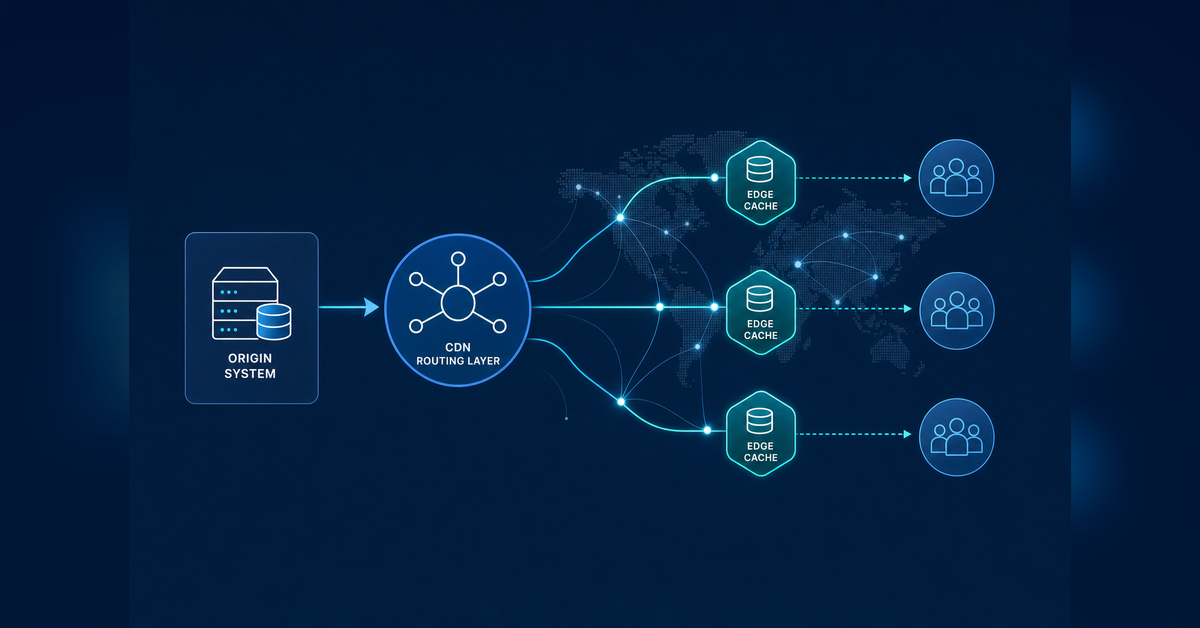

Edge caching vs CDN is not a choice between two equivalent products. Edge caching is the practice of storing reusable content near users, while a content delivery network is the broader delivery system and managed service that commonly performs that function.
The useful comparison is where the cache lives, who controls it, what content is eligible, how requests are routed and which services surround delivery. Those questions matter to publishers, application owners, ISPs and the teams responsible for performance, risk and cost.






Is edge caching the same as a CDN?
No. Edge caching is the practice of storing reusable content on servers near users. A content delivery network is the distributed network, routing system and managed service that often performs edge caching. The useful technical distinction is function versus system, not dynamic content versus static files.

“Edge caching and a CDN are not opposing choices. One describes where reusable content is stored. The other describes the delivery system around it. The buyer wins when cache policy, routing and the failure path are clear before the vendor conversation starts.”
Bob leads SEO, GEO, digital PR and technical-market positioning to turn complex infrastructure expertise into clear buyer education and qualified demand.
Edge caching vs CDN in five points
Function
Edge caching stores eligible responses near an audience so a local cache can serve later requests.
System
A CDN combines distributed infrastructure, request routing, operations and delivery services. Caching is commonly one capability within it.
Placement
A cache can run in a CDN point of presence, an ISP network, a cloud edge or private infrastructure.
Policy
Cacheability depends on content, headers, authentication, privacy, freshness, invalidation and business risk.
Decision
For caching and CDN decisions, buyers should evaluate placement, content, control, performance and economics rather than treating the concepts as substitutes.
Who this guide is for
This edge caching vs CDN guide is built for the teams that own content, network delivery, customer experience, technical positioning and commercial risk.
Publishers and application owners
Use the comparison to decide which responses can be reused, how freshness should work and what delivery services must surround the cache.
ISPs and network operators
Map subscriber concentration, in-network placement, eligible traffic, operational ownership and the economic case for local delivery.
CDN and platform teams
Separate cache behavior from request routing, security, observability, edge compute and the managed operating model.
Marketing and revenue leaders
Turn a technical architecture into accurate buyer education without collapsing edge caching, CDNs and Open Caching into one vague claim.
Edge caching vs CDN: What is the difference?
The edge caching vs CDN comparison starts with category clarity. Edge caching is a technique. A CDN is a platform, distributed network and managed service that can use that technique. Most CDNs cache content, but caching can also operate inside service-provider, cloud or private environments. In delivery-architecture planning, the buyer usually needs deliberate cache rules within a wider delivery architecture—not one instead of the other.
Fifteen-factor edge caching vs CDN comparison
| Factor | Edge caching | CDN | Buyer implication |
|---|---|---|---|
| Category | Storage and delivery function | Distributed delivery system and service | Do not compare them as equivalent products. |
| Purpose | Reuse eligible responses closer to users | Route and deliver traffic across distributed infrastructure | Define the outcome before selecting the architecture. |
| Components | Cache storage, keys, policy and lifecycle controls | Nodes, routing, control plane, operations and optional services | Review what the CDN package includes. |
| Location | Can run at CDN, ISP, cloud or private edges | Typically operates through distributed points of presence or on-net nodes | Map the real request path. |
| Control | Depends on the operator and implementation | Shared between customer configuration and provider systems | Assign ownership for policy and incidents. |
| Routing | Does not define a complete routing system by itself | Typically includes request steering | Placement has little value if routing is weak. |
| Cache policy | Defines keys, eligibility, TTL and invalidation | Supplies tools for configuring and operating policy | Test policy against real content behavior. |
| Content | Can store assets, pages, media and selected API responses | Can deliver cached and non-cached traffic | Static versus dynamic is not the deciding line. |
| Miss path | Fetches or revalidates upstream when required | Manages the route to a shield or origin | Measure miss latency and failure recovery. |
| Reach | Depends on node placement and eligible traffic | Depends on provider deployment and routing | Validate coverage for the actual audience. |
| Security | Not inherent to caching | May include WAF, DDoS controls, TLS and other services | Confirm the security scope separately. |
| Edge compute | Separate from stored-response reuse | May be offered alongside caching | Do not treat code execution as caching. |
| Operations | Requires monitoring, purging and policy management | Typically includes a managed operating layer | Price staff and process, not only traffic. |
| Commercial model | Depends on infrastructure and operator | Depends on provider terms and service scope | Compare total cost and contractual fit. |
| Metrics | Hit ratio, offload, freshness and miss behavior | Delivery, routing, availability, security and cost metrics | Use a balanced scorecard. |
Why static versus dynamic is the wrong distinction
Modern cache systems can store images, CSS, JavaScript, fonts, downloads, HTML, media segments and selected API output when policy allows. The word “dynamic” does not automatically make a response unsafe to cache, and the word “static” does not eliminate the need for correct headers and invalidation.
The real test is whether a response is safe and useful to reuse. Method, cookies, authentication, privacy, cache keys, freshness, purge behavior and the cost of serving stale data all affect that decision. This precision also helps technical brands produce more reliable answers through generative engine optimization services and AI search optimization for telecom .
Content-policy starting point
| Usually cacheable | Cache with explicit policy | Usually bypass or keep private |
|---|---|---|
| Images, CSS, JavaScript, fonts and versioned downloads | HTML, public catalogs, media manifests and safe shared API responses | Accounts, carts, private dashboards, authenticated data and rapid transactions unless deliberately designed for caching |
The edge caching vs CDN difference is not static versus dynamic. The difference is whether a response is safe and useful to reuse, where it is stored and who controls its lifecycle.
Map the technical buyer journey before choosing a message
Use Percepture’s P-C-C-P-E questions to document placement, content, control, performance and economics before an edge caching vs CDN content plan, vendor evaluation or architecture review.
Build the technical content planThe Percepture Five-Layer Cache Placement Map
The edge caching vs CDN decision becomes clearer when placement and control are mapped separately. The Percepture Five-Layer Cache Placement Map reframes edge caching vs CDN as a placement and control problem. It helps a buyer trace where a reusable response can live, who governs it, what benefit it creates and where the request travels when that layer cannot answer.
Five cache layers
1. Device or browser
Location: user device. Controller: browser behavior and HTTP policy. Benefit: repeat access can avoid another network request. Limit: it serves that device, not a shared audience. KPI: repeat-request behavior.
2. Application or origin
Location: near the application or database. Controller: application team. Benefit: reduces backend compute. Limit: it does not shorten the full user-to-origin path. KPI: backend response time and compute avoided.
3. CDN edge
Location: distributed CDN nodes. Controller: provider systems and customer policy. Benefit: shared delivery across markets. Limit: results depend on routing, cache state and configuration. KPI: valuable bytes served, latency and origin offload.
4. ISP or in-network edge
Location: within a service-provider network. Controller: depends on the deployment. Benefit: selected traffic can be served within the access network. Limit: eligible traffic, capacity and operations determine value. KPI: local traffic, backhaul, QoE and node utilization.
5. Federated or Open Caching layer
Location: participating service-provider caches connected through delegation interfaces. Controller: shared across defined roles. Benefit: connects upstream delivery with in-network capacity. Limit: participation and integration are not universal. KPI: delegated traffic, reliability and audience coverage.
Visible edge caching vs CDN request path: user or device cache → CDN or ISP edge → regional shield or upstream cache → origin or application cache → database or storage. A hit at one tier can stop the request from moving farther upstream.

How a CDN uses edge caching
A CDN uses edge caching through a request, policy and fallback process. The exact routing method varies by implementation, but the operating sequence gives delivery-architecture buyers a consistent process to diagnose.
The seven-step cache process
- The request reaches the CDN routing layer.
- The CDN selects an eligible edge node.
- The edge checks the cache key and freshness state.
- On a hit, the stored response is served.
- On a miss or stale response, the edge fetches or revalidates upstream.
- An eligible response may be stored under its headers and configured rules.
- Logs and metrics support operations, troubleshooting and policy changes.
Cache-control glossary
Cache key
The request attributes used to decide which stored object matches.
TTL
The period for which a stored response may remain fresh under policy.
Hit
A matching, usable response is available in the checked cache.
Miss
The cache cannot serve the request and must go upstream.
Revalidation
The cache checks whether stored content remains current.
Purge
An instruction that removes or invalidates selected stored content.
Origin shield
An upstream cache layer that can consolidate requests before origin.
Stale while revalidate
A policy that may allow a stored response while an update occurs in the background.
Where edge caching can run outside a conventional CDN
An delivery-architecture review should account for caches in service-provider, private, cloud and telecom environments, not only conventional CDN nodes.
ISP or in-network edge
An ISP can host cache capacity within its own network. The business case depends on subscriber concentration, eligible traffic, node location, routing, transit or backhaul conditions, operational effort and measured user results. An ISP marketing plan should translate those technical facts into buyer outcomes without making universal savings claims.

Private enterprise edge
An enterprise may operate caches for controlled locations, private applications or specialized distribution. This can increase control, but it also leaves the organization responsible for capacity, software, security, observability and recovery.
Cloud or compute edge
Cloud platforms may place caching and code execution near users. Those functions should be evaluated separately: storing reusable output is caching, while running application logic is edge computing.
Telecom or MEC edge
Telecom edge environments can host applications, network functions or caches. “Edge” has no universal distance. Ask for the market, facility, network path, intended users and operating owner rather than accepting a proximity label by itself.
Edge cache vs edge server vs edge computing
| Term | Plain-English meaning | Important boundary |
|---|---|---|
| Edge cache | A stored reusable response located near an audience or network boundary | It describes stored content and policy, not the complete platform. |
| Edge server or node | Infrastructure that can host cache storage, routing functions or compute | The server is the host, not the cached object. |
| Edge computing | Application logic executed near users, devices or a network boundary | Running code is different from reusing stored output. |
| CDN | A distributed delivery system and operating service | It may provide caching, compute, security and other capabilities. |
In an delivery architecture, an edge server can host both caching and compute. Caching stores reusable output; edge computing runs code. A CDN may provide either or both.
Content, freshness and invalidation
Cache policy starts with content ownership. An caching implementation should define TTLs, Cache-Control behavior, versioned URLs, purge scope, tags or surrogate keys, revalidation and personalization rules before increasing cache coverage.
A broad purge can create a sudden wave of upstream requests. An incomplete purge can leave stale material in circulation. Incorrect cache keys can mix responses that should remain separate. These are operating risks, not reasons to avoid caching; they are reasons to design, test and monitor it.
Do not cache blindly
- Private or authenticated responses without an explicit shared-cache design
- Carts, accounts and checkout flows
- Regulated or sensitive data
- Fast-changing prices, inventory or financial information without freshness controls
- Personalized content when cache keys do not separate users correctly
- Content where staleness creates legal, safety or material revenue risk
Origin load and cache misses
A hit can reduce origin requests and upstream traffic for that response. It does not remove the origin from the architecture. Misses, expiry, revalidation, bypass rules, purges and failures still send traffic upstream.
The miss path is: request → edge miss → shield or origin fetch → validation → response → optional cache fill. A cold cache will naturally miss more often. Request collapsing may reduce duplicate upstream work, while planned warming can prepare selected content, but each technique requires implementation-specific testing.
Miss behavior belongs in the delivery acceptance test. Measure latency, errors, upstream capacity and recovery during normal misses, overload and failover—not only the fast path shown in a sales demonstration.
Edge caching vs CDN for websites and APIs
A global public website commonly benefits from a CDN plus clear caching rules. Marketing and editorial pages can use versioned assets, suitable TTLs and controlled purges. Ecommerce teams can cache public assets and catalog responses while protecting cart, account and checkout traffic.
Public APIs may cache safe, idempotent, shared responses when keys and freshness rules are correct. Personalized applications should use selective page, fragment or data caching instead of blanket full-page storage. A single-region internal application may gain more from application and database caching than from a large delivery network. These workload differences should shape the delivery architecture.
Do not add a CDN only because the category is familiar. A small local audience, low-volume non-cacheable traffic, strict architectural constraints or operating complexity greater than the benefit can weaken the case. Security or availability services may still justify a CDN even when cache offload is modest. That is why delivery evaluation must include the services surrounding delivery.
Technical companies can turn this architecture into useful buyer education through content marketing services , organize the topic cluster through enterprise SEO services and connect education to pipeline through B2B lead generation services .
Streaming, gaming and software delivery
Streaming delivery may cache media segments, manifests and popular video-on-demand objects. Live events create short freshness windows and sharp demand peaks. Game and software distribution can involve large reusable files and release-driven traffic spikes, making workload shape central to an delivery assessment.
Caching does not perform every media function. Packaging, transcoding, digital rights management and application compute are separate capabilities even when a platform offers them together. Relevant measurements include startup time, buffering, bitrate, throughput, completion, miss latency, availability, peak capacity and upstream traffic.
ISP edge caching and Open Caching
In delivery terminology, ISP-edge caching describes placement inside a service-provider network. Open Caching describes a standards and API framework for delegating delivery among publishers, CDNs and participating service providers. Not every ISP cache uses Open Caching, and not every edge cache sits inside an ISP.
A CDN may cache at regional points of presence or on-net servers. ISP-edge caching places selected content inside the access provider. Open Caching adds defined interfaces through which an upstream publisher or CDN can delegate delivery to participating service-provider caches.
For the complete standards and provider context, see Open Caching architecture, benefits and providers . For the narrower delivery-system comparison, read Open Caching vs traditional CDN . The SVTA Open Caching initiative is the primary reference for the framework.
In delivery-architecture planning, ISP placement can add another layer rather than replace the CDN or publisher architecture. Telecom teams explaining that relationship can align technical facts with commercial positioning through telecom marketing and extend credible research through digital PR services .

Where Qwilt fits
Qwilt is a commercial content-delivery and edge-cloud company that places caching software within participating service-provider networks and connects those nodes through publisher-facing architecture and open APIs. Qwilt is an ISP-edge and Open Caching implementation, not the definition of edge caching, a CDN or the SVTA standard.
For an delivery-architecture review, buyers should ask Qwilt which ISPs and markets are active for their audience, where nodes sit, which formats and traffic are eligible, who controls routing and purge policy, what logs are available and what happens during a miss, overload or outage. Security scope, integration work, support, service levels, commercial terms and exit provisions also belong in the evaluation.
Any footprint, capacity, reach or performance statement should come from current Qwilt material for the proposed deployment. The same discipline applies to vendor comparisons: validate the path and eligible audience instead of relying on a global total.

Move eligible content closer to subscribers
Qwilt describes an Open Caching-based architecture that connects publishers with edge capacity inside participating service-provider networks. Confirm current reach, fit, integration requirements and service terms directly with Qwilt as part of the edge caching vs CDN evaluation.
Performance, cost and KPI comparison
A useful edge caching vs CDN scorecard cannot stop at hit ratio. Raw hit ratio is not enough for an delivery scorecard. A high request hit ratio may represent small objects while large, expensive transfers continue upstream. Measure valuable bytes served locally, origin and network capacity avoided, audience performance and the reliability of misses, purges and failover.
Any delivery-cost comparison should include delivery charges, origin egress, transit or backhaul, hardware, integration, observability, staffing, support and contract terms. There is no universal answer that one model is always faster or cheaper.
Edge caching vs CDN operational KPI scorecard
| KPI group | Measures | Decision question |
|---|---|---|
| Cache value | Hit ratio by requests and bytes, origin offload, eligible traffic | Is the system serving valuable reusable traffic? |
| User performance | p50, p95 and p99 latency, TTFB, throughput and media QoE | Are target users receiving a measurable benefit? |
| Correctness | Stale responses, cache-key errors, purge propagation and bypass behavior | Is speed being achieved without content or privacy errors? |
| Resilience | Availability, miss latency, overload behavior and failover | Does the architecture recover cleanly? |
| Economics | Egress, transit, backhaul, capacity, hardware, integration and operations | Does the measured value exceed total cost? |
| ISP operations | Congestion, node utilization, local bytes, subscriber QoE and upgrade pressure | Does in-network placement improve the target network path? |
Edge caching vs CDN decision matrix
Use the Percepture P-C-C-P-E Decision Test before selecting a design: Placement, Content, Control, Performance and Economics. This keeps caching and CDN decisions tied to the audience and request path instead of provider labels.
The edge caching vs CDN P-C-C-P-E Decision Test
Placement
Where is each node relative to users, network boundaries and congestion points?
Content
Which responses are reusable, personalized, live, private or freshness-sensitive?
Control
Who owns cache keys, TTLs, purges, routing, logs, eligibility and fallback?
Performance
What do user measurements, hit behavior, misses and recovery show?
Economics
Which traffic, capacity, egress, hardware, integration and operating costs change?
| Outcome | Best fit | Watch for |
|---|---|---|
| A. Origin or application caching first | Concentrated users, backend bottlenecks or limited reusable public traffic | The full network path remains. |
| B. CDN with standard edge caching | Distributed public audiences needing managed routing and delivery | Default rules may not fit every response. |
| C. CDN with advanced page, API or compute configuration | Teams with mature policy, observability and invalidation processes | Complexity and cache-key correctness. |
| D. CDN or publisher architecture plus ISP-edge pilot | Concentrated, high-volume eligible traffic with a measurable in-network case | Coverage, integration, operations and fallback. |
Myths and mistakes that weaken the decision
The first mistake is treating edge caching and a CDN as alternatives. That category error distorts every later requirement. A sound delivery-architecture review also rejects the claims that a CDN only caches static files, edge caching always stores full pages, a hit eliminates future origin use or the physically closest node always wins.
More points of presence do not prove better delivery for a specific audience. Browser caching is not CDN caching. Edge compute is not stored-response reuse. ISP caching is not automatically Open Caching. Qwilt does not define or own the standard. Caching can support user experience, but it does not guarantee search rankings.
Teams should also avoid using hit ratio as the only ROI measure, purging everything as a routine control or using generic keys for personalized responses. A cache cannot repair weak routing, poor capacity planning or unclear operational ownership by itself.
How Percepture turns technical expertise into qualified demand
Percepture researches edge caching vs CDN buyer questions, structures clear expert answers for search and AI systems, supports the page with visible evidence and connects technical education to demand. That method combines enterprise search strategy , content architecture, GEO and digital PR without claiming to operate or test CDN infrastructure.
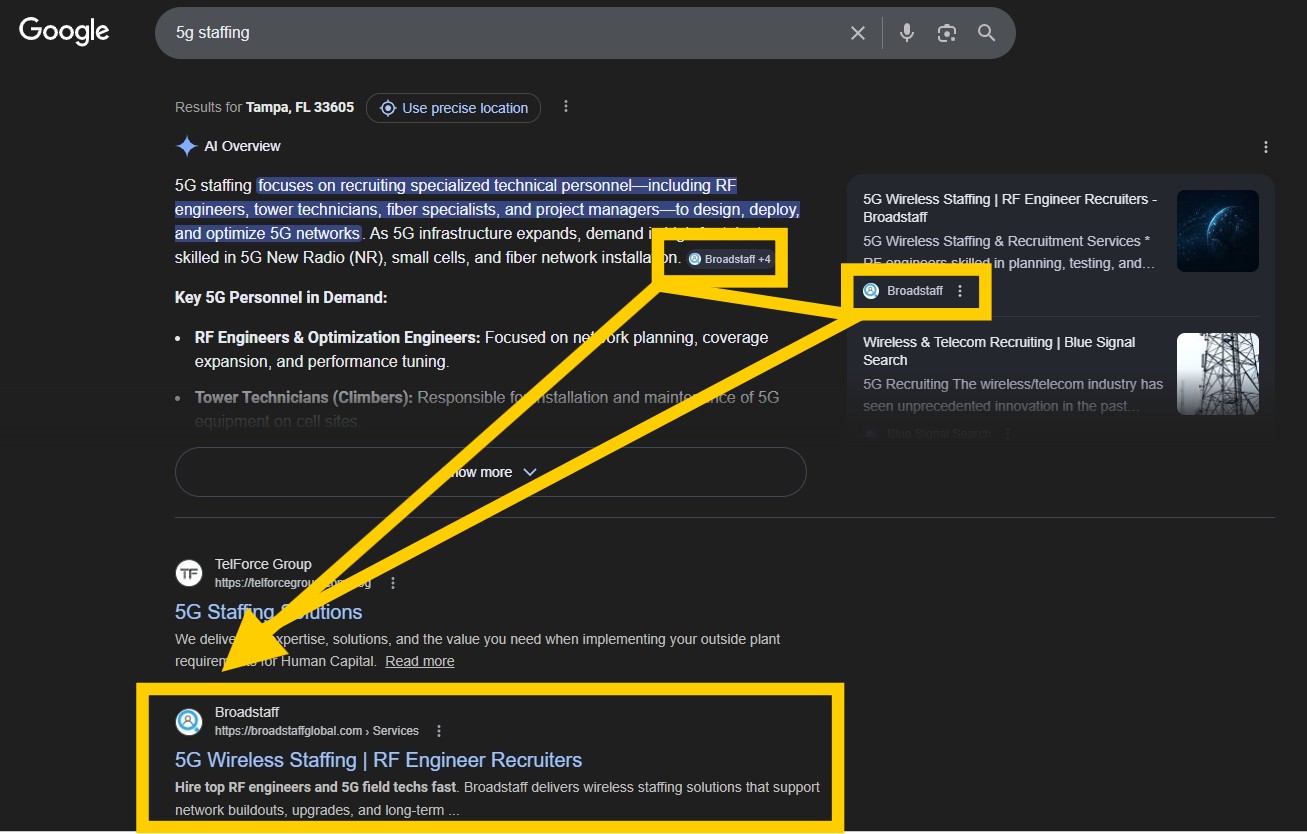
Clear expertise becomes more valuable when buyers can find it
Broadstaff operates across telecom, fiber and data-center staffing. Its results show how technical-market authority, search visibility and lead generation can reinforce one another through a disciplined content program.


See how technical authority becomes qualified demand
Review the strategy, execution and reported outcomes behind a telecom and digital-infrastructure search program, then apply that evidence-led approach to technical buyer education.
Read the Broadstaff case studyFrequently asked questions
What is the difference between edge caching vs CDN?
Edge caching vs CDN compares a function with a broader delivery system. Edge caching stores reusable responses near users. A CDN combines distributed nodes, request routing, operations and optional services, commonly including caching. A cache may also run inside an ISP, cloud platform or private environment, so the terms overlap without meaning the same thing.
What is the difference between a CDN and caching?
In an edge caching vs CDN comparison, caching is the reuse of a stored response under defined eligibility and freshness rules. A CDN is an operating system for distributed delivery. It may route cached and non-cached requests, manage TLS, provide analytics and offer security or compute services. Caching is therefore one capability a CDN can provide.
When should you not use a CDN?
An delivery assessment may find limited CDN value when an application serves a small local or internal audience, traffic is low and mostly non-cacheable, strict constraints prevent third-party delivery or the added operating complexity exceeds the measured benefit. Security, availability or routing services can still justify one, so assess the whole service rather than cache offload alone.
Does a CDN do caching?
Yes. In edge caching vs CDN terms, a CDN commonly performs the caching function. On a cache hit, an eligible CDN edge can serve a stored response. On a miss or revalidation, it retrieves the response from an upstream cache or origin and may store it under the applicable rules. A CDN also supplies routing, operations and other delivery capabilities beyond caching.
Can a CDN cache dynamic content and APIs?
A CDN can cache HTML and selected API responses when the method, headers, keys, authentication model, privacy rules and freshness requirements make shared reuse safe. Personalized, private or rapidly changing responses are often bypassed unless the application is specifically designed to separate and invalidate them correctly.
What happens during a cache miss?
The edge sends the request upstream to another cache, a shield or the origin. The upstream system validates or generates the response, returns it and may allow the edge to store it for later requests. Misses are normal, which is why teams must measure miss latency, origin capacity, errors and fallback behavior.
Is edge caching the same as edge computing?
No. Edge caching stores reusable output, while edge computing runs application logic near users or devices. An edge server may host both functions, and a CDN may sell both capabilities, but their controls, risks and operating requirements differ.
Which KPIs prove caching is working?
An caching KPI set should track hit ratio by requests and bytes, valuable traffic served locally, origin offload, latency percentiles, TTFB, throughput, media QoE, stale and error rates, purge propagation, availability, miss behavior and failover. Pair those measures with egress, transit, backhaul, capacity, integration and operating costs.
Final answer
The final edge caching vs CDN answer is simple: a CDN is the broader delivery system, and edge caching is a capability that can operate within that system or elsewhere. Map the content, users, cache policy, request path, operational control, measured performance and total economics before choosing an architecture. Qwilt is one commercial example of an ISP-edge and Open Caching implementation. Percepture uses this buyer-centered structure to help technical companies explain complex systems accurately and turn that authority into search and AI visibility.
Own the edge caching vs CDN questions buyers ask next
Percepture helps telecom, data-center and digital-infrastructure companies make caching and CDN expertise clear, findable and useful across Google, AI answers and the buyer journey.
Get an SEO and AI visibility gap analysis Explore telecom marketing