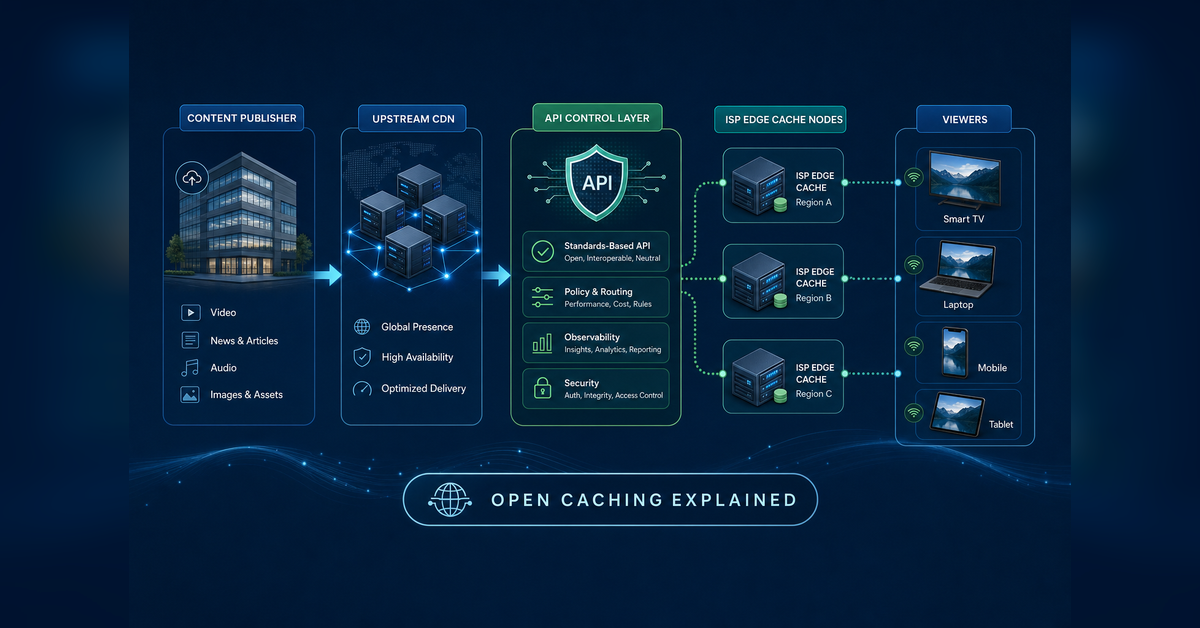

Open caching is a standards-based content-delivery architecture developed through the Streaming Video Technology Alliance. It lets a commercial CDN delegate eligible delivery requests to caching systems embedded inside internet service provider networks, closer to viewers. It is not a CDN brand, browser cache, or geocaching service. Qwilt is one commercial implementation and ecosystem participant.
The value is not just local storage. The architecture defines common interfaces for routing, configuration, content management, logging, security, and performance. Those interfaces can help publishers, CDNs, and network operators use shared edge capacity, but standards compliance alone does not guarantee adoption, feature parity, or business-model alignment.





Last updated: July 16, 2026
What is open caching?
Open caching is a standards-based interoperability model that lets an upstream commercial CDN delegate eligible content delivery to a downstream caching system inside an ISP network. The model defines how participants exchange routing, configuration, content-management, logging, security, capacity, and performance information.
- Open Caching
- SVTA specifications and APIs for interoperable content delivery.
- uCDN
- The upstream CDN that faces the publisher and delegates eligible requests.
- dCDN or OCS
- The downstream CDN or Open Caching System operating in the service-provider network.
- OCN
- An Open Caching Node that can store and serve eligible content.
- CDNI
- The Content Delivery Network Interconnection standards context used for CDN-to-CDN delegation.
Executive summary
The operating idea
A publisher-facing CDN can use compatible downstream capacity located in a service-provider network.
The buyer test
Before adoption, confirm the interfaces, physical footprint, performance baseline, operating ownership, and commercial model.
The main limitation
API compatibility creates a common language. It does not create universal reach, identical features, or guaranteed results.
Qwilt’s role
Qwilt offers a commercial implementation and participates in the standards ecosystem. Qwilt is not the standard itself.
Who this open caching guide is for
ISP and network leaders
Evaluate embedded delivery capacity, topology, operations, traffic economics and partner demand.
Publishers and streaming teams
Understand delegation, policy control, eligible footprint, logs, fallback and measurable viewer outcomes.
CDN and platform teams
Separate standards compatibility from feature parity, service accountability and commercial reach.
Infrastructure investors and commercial teams
Test whether the deployment has real interoperability, physical reach, operating ownership and durable economics.
Why open caching is often misunderstood
Most explanations collapse a standards architecture, a commercial implementation and an edge location into one claim. That creates buyer confusion. The model should be evaluated as a chain of entities, interfaces, physical nodes, operating responsibilities and commercial agreements.
Percepture applies the same entity discipline in its telecom marketing work: define the system accurately before turning it into a market promise.
Is Open Caching the same as geocaching?
No. In this guide, the term describes a streaming and content-delivery architecture. Opencaching also names communities and websites used to locate physical geocaches. The two meanings are unrelated. The technical meaning here concerns publishers, CDNs, ISPs, APIs, and network delivery.
What the content-delivery model is not
- It is not one vendor’s CDN.
- It is not an open-source cache product by itself.
- It is not browser caching.
- It is not automatically the same as generic edge caching.
- It does not mean every CDN can use every ISP cache.
- It does not prove performance without deployment data.
- It has no relationship to finding physical geocaches.
Test readiness before a vendor presentation controls the agenda
Use the Percepture Open Caching Readiness Review to map participants, interfaces, physical footprint, baseline performance, operating ownership and commercial incentives before comparing platforms.
Review the strategy-planning processThe goal is not to pick a logo first. It is to prove whether the complete delivery model can work in your network and market.
How does open caching work?
The request path can vary by implementation, but the operating sequence is consistent: an upstream delivery party determines whether a compatible downstream system can serve eligible traffic under the required policy.
- The publisher defines eligibility. Content rights, security requirements, delivery rules, and audience policies establish what may be delegated.
- The upstream CDN controls or receives the request. The uCDN remains the publisher-facing delivery participant.
- The uCDN checks downstream capability. Footprint, capacity, service configuration, and supported functions affect the decision.
- Routing delegates the request. DNS or HTTP routing workflows can direct eligible traffic toward the downstream system.
- The ISP node serves eligible cached content. Delivery occurs from the service-provider environment when the object and policy permit it.
- Miss and fallback rules protect delivery. Traffic returns to the designated source when the node cannot serve it.
- Logs and performance data close the loop. Delivery records support operations, accountability, measurement, and commercial reconciliation.
The IETF RFC 8804 request-routing extensions describe CDNI routing functions relevant to the upstream and downstream relationship. The broader interface categories and working documents are maintained through the SVTA ecosystem.
The Percepture Open Caching Interoperability Stack
The Percepture Open Caching Interoperability Stack is a six-layer method for tracing content, requests, policy, delivery data, and economics from the publisher to the viewer. Each layer has a distinct owner and failure mode.
1. Content owner or publisher
Controls: rights, security, audience, quality, and delivery policy.
Failure if missing: Content may be delegated without a clear eligibility or rights rule.
2. Upstream CDN
Controls: publisher-facing delivery and delegation by footprint and capability.
Failure if missing: No accountable party decides which requests can move downstream.
3. Control and API layer
Controls: provisioning, configuration, routing, content operations, logs, authentication, capacity, and performance exchange.
Failure if missing: Participants fall back to custom integrations and inconsistent workflows.
4. ISP caching system
Controls: storage and delivery from nodes inside the service-provider environment.
Failure if missing: The downstream capacity exists only as a logical promise, not a delivery resource.
5. Access network and viewer
Controls: the physical path through the last-mile network.
Failure if missing: A cache may be called edge infrastructure while remaining too distant to affect the intended path.
6. Measurement and settlement
Controls: KPIs, logs, support, accountability, cost allocation, and revenue terms.
Failure if missing: Participants cannot agree on results, responsibility, or payment.
Framework rule: API compliance creates a common operating language. It does not guarantee identical performance, universal adoption, complete feature parity, a commercial agreement, or a successful deployment.

What components and APIs are involved?
The SVTA work groups related functions into specifications and interfaces. Buyers should check the current document status because a published specification and an active draft are not the same thing. The SVTA Open Caching hub is the primary source for current documents, code, testbed material, participating organizations, and performance resources.
Provisioning
Provisioning establishes the service relationship and the information required for one delivery network to recognize another. A procurement team should ask how credentials, endpoints, supported capabilities, and lifecycle changes are exchanged.
Configuration
Configuration defines cache and service policy. It can include how hosts, paths, metadata, delivery rules, and other service instructions are represented. The operational question is whether both sides interpret a policy the same way.
Request routing
Routing decides whether a request is delegated and where it should go. The workflow must account for location, capability, capacity, policy, errors, and fallback rather than assuming that the nearest node is always eligible.
Content management
Content operations cover acquisition, refresh, purge, and related control. Buyers should test how quickly a stale or restricted object can be removed and who owns the incident when a command fails.
Logging
Delivery and operational records give participants a shared account of requests, outcomes, errors, and traffic. Log completeness, timeliness, field consistency, retention, and access rights belong in the deployment plan.
Performance measurement
Comparable ingress, egress, delivery, and quality indicators help teams judge the downstream path against an agreed baseline. A dashboard is not enough unless the workload, time period, population, and comparison method are known.
Authentication and security
Delegated workflows need authenticated parties, protected interfaces, and clear authority. Security review should cover credential handling, signed requests where applicable, access control, abuse response, and audit trails.
Capacity and control
Capacity interfaces communicate available capability and operating state. The uCDN needs a reliable way to avoid a downstream resource that is constrained, unavailable, or unable to meet the delivery policy.
Who participates in the ecosystem?
| Participant | Role | Value sought | Evidence required | Main concern |
|---|---|---|---|---|
| Content owner or publisher | Sets rights and delivery policy | Standards-based reach, capacity, and consistent control | Eligible footprint, policy enforcement, and logs | Quality, security, and loss of control |
| Upstream CDN | Faces the publisher and delegates traffic | Downstream reach and resilience | Compatible workflows, capacity, and fallback | Feature parity and accountability |
| ISP or service provider | Hosts downstream delivery capacity | Traffic efficiency and delivery participation | Demand, topology fit, operations, and economics | Underused assets and support burden |
| Commercial implementation vendor | Packages software, orchestration, and services | Platform adoption | Documented interfaces, deployments, and support | Interoperability and concentration risk |
| Infrastructure partner | Supplies compute, networking, facilities, or interconnection | Workload growth | Placement, power, route diversity, and capacity | Physical constraints |
| Standards body | Develops common technical documents | Interoperable industry practices | Published documents and transparent status | Adoption lag |
| End user | Receives content | Reliable viewing or download experience | Measured service quality | Failures and inconsistent performance |
Participating in standards work and selling an operational service are different claims. Commercial teams should preserve that distinction in sales material, technical documentation, telecom marketing strategy, and partner announcements.
What are the potential benefits?
Benefits for ISPs and service providers
Potential benefits include reducing repeated upstream traffic, using network capacity more efficiently, improving peak handling, gaining delivery visibility, and participating in content-delivery economics. These outcomes depend on eligible traffic, node placement, cache effectiveness, operating costs, and commercial terms. An ISP marketing plan should describe measured customer value rather than treating cache deployment as proof by itself.
Benefits for publishers and streaming platforms
Publishers may gain access to compatible downstream capacity closer to viewers through a more consistent integration model. Other possible advantages include common policy exchange, additional peak-event capacity, shared logs, and another delivery path. The publisher still needs meaningful audience coverage and reliable controls before the integration earns its cost.
Benefits for CDNs
A CDN may use the model to extend delivery into service-provider footprints, federate downstream capacity, reduce some custom integration work, and add coverage or resilience. The value falls when downstream features, logs, security, or service levels do not match the upstream commitment to the publisher.
Benefits for viewers
Serving content through a compatible ISP node from a well-placed ISP node may shorten the network path and reduce exposure to upstream congestion. Faster starts, less buffering, higher bitrate attainment, and more stable delivery are possible when the implementation performs as designed. Those outcomes must be measured, not assumed.
Where does Qwilt fit?
Qwilt is not the standard. Qwilt is a commercial content-delivery and edge-cloud company whose implementation uses and contributes to SVTA specifications. Qwilt describes a model that federates service-provider edge deployments into a delivery platform for publishers and application providers.

What Qwilt provides
A managed commercial implementation intended to connect publisher demand with service-provider edge capacity.
How it relates to SVTA
Qwilt is an ecosystem participant and implementer. The standards remain industry specifications rather than Qwilt-owned technology definitions.
Who should investigate it
Service providers evaluating embedded delivery and publishers evaluating federated edge reach can compare the offering with their requirements.
What to verify
Confirm exact footprint, eligible traffic, integration scope, logs, support, security, baseline performance, commercial terms, fallback, and exit procedures.
Explore a commercial implementation
Qwilt presents its implementation as a way to connect publishers with federated service-provider edge capacity through standards-based interfaces and a managed delivery platform.
Explore Qwilt Open CachingWhich companies support the model?
A defensible provider landscape separates three categories. First are organizations that contribute to standards documents or code. Second are commercial companies offering an implementation or platform. Third are service-provider networks that announce deployments or partnerships. One organization can appear in more than one category, but each claim requires its own evidence.
| Category | Documented example | What the category proves | What it does not prove |
|---|---|---|---|
| Standards participant or contributor | Organizations listed in current SVTA materials | Participation in document, code, testbed, or working-group activity | Commercial availability or deployment scale |
| Commercial implementation | Qwilt | A marketed platform based on the standards ecosystem | Universal interoperability, independent performance, or exclusive provider status |
| Service-provider deployment or partnership | Operators identified in official, dated announcements | A stated relationship or deployment | Current traffic volume, subscriber reach, or measured outcome |
A buyer should reject an unsupported ranking of “best providers.” Compare documented roles, service availability, exact geography, node placement, publisher participation, supported workflows, operations, and commercial responsibility instead.
Performance and KPI requirements
Performance evidence needs a baseline and a workload. Useful measures include cache-hit or offload rate, buffering ratio, video-start failure, play failure, startup time, bitrate attainment, latency, origin or transit reduction, peak capacity, availability, fallback success, and logging completeness.
Performance evidence checklist
| Evidence field | Question to answer | Why it matters |
|---|---|---|
| Workload | Was the test live video, on-demand video, software, games, or another object type? | Different traffic behaves differently. |
| Region and topology | Where were viewers, nodes, origins, and interconnection points? | Physical path affects the result. |
| Baseline | What delivery path was used for comparison? | An undefined baseline makes improvement claims weak. |
| Period and population | How long did measurement run, and how many requests or sessions were included? | Short or narrow tests may not represent normal operation. |
| Source | Was the result operator-reported, vendor-reported, publisher-reported, or independently tested? | The source affects how broadly the finding can be applied. |
| Fallback | Were misses and failures counted? | Successful delivery includes recovery behavior. |
The SVTA performance resources include dated operator-reported examples. Treat each example as evidence about that reported environment, not as universal proof for every network, publisher, or implementation.
Open caching vs traditional CDN
A traditional CDN usually operates a proprietary network and manages the publisher relationship, routing logic, cache platform, and delivery operations within its own service model. Open caching adds an interoperable downstream relationship in which eligible traffic can be delegated to capacity embedded in an ISP network.
| Decision factor | Standards-based ISP delegation | Traditional CDN model |
|---|---|---|
| Ownership model | Multiple parties coordinate upstream and downstream delivery | One CDN generally controls its delivery platform |
| Cache location | May be embedded inside a service-provider network | Located within the CDN’s selected footprint |
| Interoperability | Uses common specifications and interfaces | Often relies on provider-specific integration |
| Integration | Requires compatible workflows across organizations | Publisher integrates with the selected CDN service |
| Control | Responsibilities are divided and must be explicit | Control is more concentrated within the CDN |
| Scale | Depends on participating ISP footprints and eligible traffic | Depends on the CDN’s network and commercial reach |
| Commercial relationship | Requires incentives and settlement across more parties | Usually centers on the publisher-CDN agreement |
| Best fit | Buyers seeking compatible access to service-provider edge capacity | Buyers seeking a unified delivery service from one CDN |
This comparison is a framework comparison, not a universal cost verdict. Pricing depends on traffic, geography, integration, facilities, support, contracts, and the alternatives already available to each participant.
How is it different from edge caching?
Edge caching is a broad technique for storing content closer to users. Open caching is narrower. It defines an interoperability and delegation model involving publishers, upstream CDNs, and downstream service-provider caches.
An edge cache can exist without supporting the relevant interfaces. A compatible downstream system can also include operational functions that go beyond storage, including policy, routing, content management, logs, security, capacity reporting, and fallback. Calling hardware “edge” does not establish where it sits in the access topology or which organizations can use it.
Is open caching dead, stalled, or changing?
Open caching is neither proven universal infrastructure nor merely a theoretical idea. Specifications, working groups, code, testbed activity, commercial implementations, and reported deployments exist. Adoption can still be limited by integration gaps, control concerns, business incentives, measurement trust, and the need for enough publisher demand and service-provider footprint.
Signals of active development
- Published specifications and continuing document work
- CDNI standards context
- Commercial implementation activity
- Operator-reported performance examples
- Standards participants and test resources
Barriers to broad adoption
- Compatibility does not create feature parity
- CDNs may protect routing and operational control
- Publishers need enough useful footprint
- ISPs need eligible traffic and viable economics
- Logging, security, fallback, and settlement must work
- Standards can move slower than proprietary features
The practical answer is not a binary label. Buyers should examine whether a specific implementation has repeatable interoperability, meaningful physical reach, credible measurements, clear operating ownership, and a commercial model that keeps all required parties engaged.
The Percepture Five-Proof Adoption Test
| Proof | Required evidence | Strong signal | Red flag |
|---|---|---|---|
| Interoperability | Documented interfaces and tested workflows | Successful routing, policy, logging, purge, and fallback tests | Compatibility asserted without test records |
| Footprint | Named networks, regions, and node placement | Eligible audiences mapped to useful access locations | Global totals without relevant local detail |
| Performance | Dated measurements with workload and baseline | Repeatable results across representative periods | One unexplained chart or isolated test |
| Operations | Monitoring, security, fallback, support, and failure ownership | Runbooks, escalation paths, and service accountability | Unclear responsibility during a delivery incident |
| Commercial | Publisher demand, ISP incentives, and settlement terms | Each party can explain why continued participation pays | Economics depend on traffic or partners that are not committed |
When should an ISP consider the model?
- Streaming, software, or game traffic creates measurable peak or backhaul pressure.
- The subscriber footprint can justify the proposed node placement.
- The operator can supply facilities, power, routing, security, and support.
- Publisher or CDN demand exists for the available footprint.
- Logs and performance can be validated against a defined baseline.
- Commercial responsibilities and settlement rules are clear.
- Security, purge, miss, and fallback workflows are tested.
- The deployment complements the operator’s peering and transit strategy.
- Scale-out economics compare favorably with practical alternatives.
- Contract, data access, renewal, and exit terms are acceptable.
Technical readiness is only half of an adoption decision. Operators also need a plan for explaining the offering to publishers and partners, creating qualified demand, and proving buyer value. That is where B2B lead generation services and precise technical positioning must support the network plan.
Open caching, IXPs, and the physical edge
These APIs operate on physical infrastructure. Cache effectiveness still depends on node placement, access-network topology, backhaul, peering, route diversity, power, facilities, and day-to-day operations. A cache in a distant metro is not equivalent to one embedded deeper in the access network.
Buyers should map the full packet path rather than rely on an “edge” label. Ask where traffic enters the network, where requests are redirected, where objects are stored, what path a miss takes, how congestion is observed, and who responds when a node or route fails.

How could AI and edge compute change caching?
Several developments are plausible, but they should be treated as forecasts. Static content delivery may expand toward more dynamic and compute-assisted workflows. AI inference may increase demand for local compute, model assets, data movement, and low-latency delivery. ISP caches may also evolve toward shared edge platforms or infrastructure near interconnection points.
The existing specifications should not be described as a complete AI inference orchestration system. Buyers exploring AI inference infrastructure must separately evaluate compute scheduling, model distribution, data governance, accelerators, observability, and application-specific latency.

How technical authority becomes searchable buyer education
A technically correct technical page can still fail if buyers cannot retrieve, compare, or trust its answers. Strong content marketing services turn standards language into a usable operating model. Enterprise SEO services connect that model to search intent, internal architecture, and crawlable evidence.
AI answer systems also benefit from clear named entities, direct definitions, stable headings, self-contained answers, and primary sources. Percepture’s generative engine optimization services and guide to AI search optimization for telecom focus on that retrieval layer.
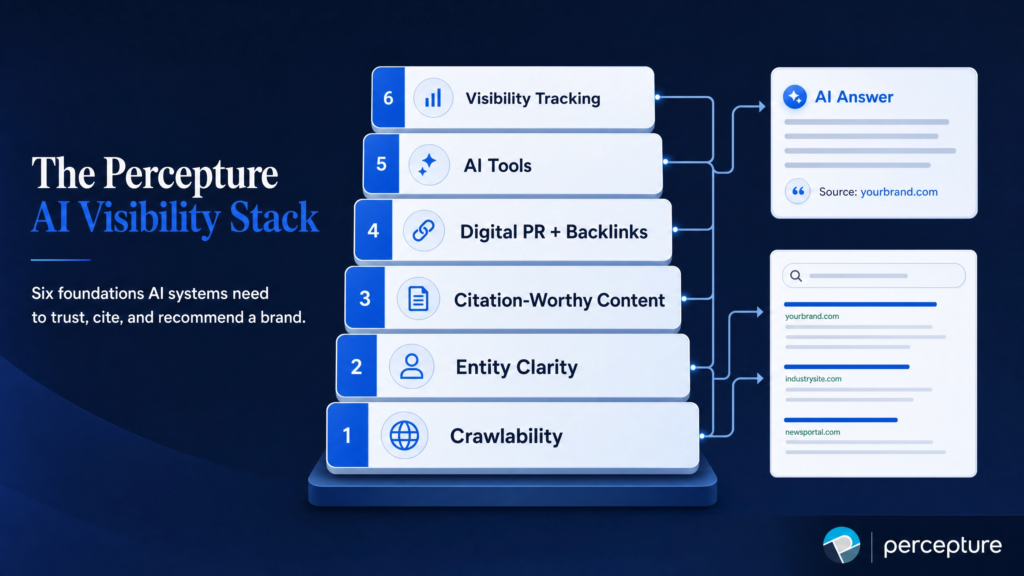
Distribution matters after the page is accurate. Relevant digital PR services can place the framework in front of industry publications, standards participants, partners, and analysts. An omnichannel marketing strategy can then connect the technical explanation to partner education, sales enablement, events, email, and executive outreach.
See how technical authority becomes qualified demand
Percepture helped Broadstaff Global turn telecom and infrastructure expertise into stronger search visibility and qualified lead growth. The same discipline applies here: define the entity, prove the system and make the answers easy to retrieve.
Read the Broadstaff Global case studyCommon mistakes to avoid
- Confusing the technical meaning with geocaching.
- Calling the architecture a CDN vendor.
- Calling every ISP cache standards compliant.
- Assuming “open” means open-source.
- Treating standards participation as commercial deployment.
- Quoting a vendor footprint as independent measurement.
- Presenting one operator test as universal performance.
- Ignoring purge, logs, security, fallback, and settlement.
- Assuming a common API guarantees feature or performance parity.
- Using the word “edge” without stating physical location.
- Ranking providers without documented category and service evidence.
- Discussing benefits without naming the baseline and measurement method.
Key takeaways
It is an architecture
The architecture defines interoperable relationships and interfaces, not a single branded CDN.
Delegation is the core action
An upstream CDN can direct eligible delivery toward a compatible downstream ISP system.
Physical placement still matters
Topology, facilities, routes, capacity and operations determine whether the intended edge advantage is real.
Qwilt is an implementation
Qwilt participates commercially in the standards ecosystem but does not own or equal the standard.
Adoption requires five proofs
Interoperability, footprint, performance, operations and commercial evidence must align.
Frequently asked questions
What is open caching?
Open caching is a standards-based interoperability model developed through the Streaming Video Technology Alliance. It lets an upstream CDN delegate eligible delivery to a compatible downstream caching system inside an ISP network.
Is open caching a CDN?
No. Open caching is an architecture and set of interoperability specifications, not one CDN brand. A commercial CDN may act as the upstream CDN, while an ISP-hosted system serves as the downstream delivery environment.
Is Qwilt the same as open caching?
No. Qwilt is a commercial company and implementation that participates in the SVTA ecosystem. Buyers should evaluate Qwilt’s service separately from the status and meaning of the specifications.
What are uCDN, dCDN and OCN?
The uCDN is the upstream, publisher-facing CDN. The dCDN is the downstream CDN that can receive delegated traffic. An Open Caching Node, or OCN, stores and serves eligible content inside the downstream environment.
Can open caching reduce buffering?
It can improve delivery conditions when content is served from a well-placed node with adequate capacity and reliable operations. The result must be measured against a defined baseline, workload, geography and time period.
How is open caching different from edge caching?
Edge caching is a broad technique for storing content near users. Open caching is a narrower interoperability and delegation architecture involving publishers, upstream CDNs and downstream service-provider caching systems.
How should an ISP compare open caching providers?
Compare documented interfaces, tested workflows, exact node placement, eligible traffic, publisher participation, performance methodology, security, purge and fallback behavior, logs, support, commercial responsibility and exit terms.
When should an ISP consider open caching?
An ISP should consider open caching when repeated traffic creates measurable network pressure, the subscriber footprint supports useful node placement, publisher or CDN demand exists, operations can support the platform and the economics work for every required participant.
How long does an open caching evaluation take?
The timeline depends on traffic analysis, topology, procurement, facilities, security review, API integration, publisher or CDN demand, testing and commercial negotiation. A scoped readiness review should come before a production pilot.
Turn technical expertise into a market position buyers can verify
Percepture helps telecom, ISP, CDN and digital-infrastructure companies clarify technical entities, build searchable buyer education, earn authority and connect the story to qualified demand.
Request an open caching visibility and positioning review
About Bob Generale
Bob Generale is President of Percepture, a five-time Inc. 5000 marketing and communications firm. He works with telecom, data center and complex B2B leadership teams to turn technical expertise into clear market positioning, organic search visibility, AI-answer visibility and qualified demand.
Bob’s approach connects entity clarity, first-party expertise, structured buyer education, digital PR and conversion architecture. Connect with Bob Generale on LinkedIn.