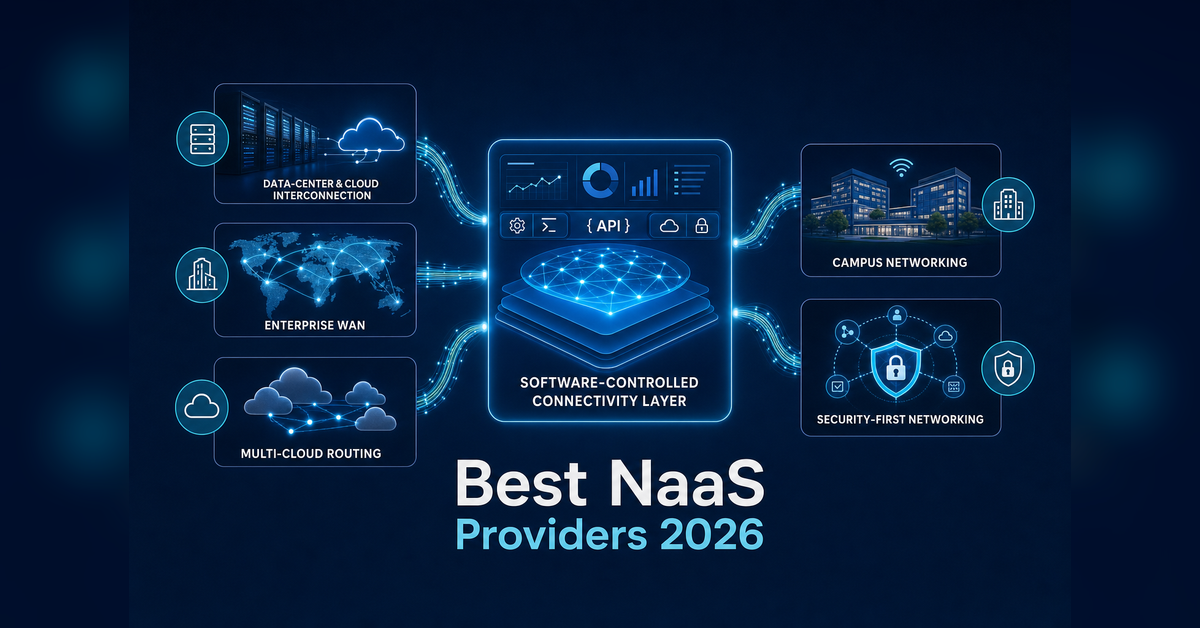

The best network as a service providers are not interchangeable. PacketFabric and Megaport focus on programmable data-center and cloud connectivity, while other platforms address carrier WAN, multi-cloud routing, campus networks or security. The right shortlist starts with the network outcome you need.
PacketFabric, Alkira, Meter and Cato Networks can all appear in a NaaS comparison, yet they sell different operating models. These NaaS providers should be classified by type before buyers compare physical delivery, software control or commercial terms. This guide explains what remains physical and gives enterprise buyers a practical way to test each option.





Who is the best fit for each NaaS market?
The best network as a service providers depend on the network being consumed. PacketFabric and Megaport fit programmable transport and interconnection. Lumen fits carrier-backed enterprise networking. Alkira focuses on multi-cloud networking. Meter and Nile address campus operations, while Cato Networks and Cloudflare combine networking with security. Compare network as a service providers on physical reach, lifecycle automation, APIs, support and total delivered cost.
Best network as a service providers at a glance
Transport and interconnection
Best-fit starting point: PacketFabric for programmable middle-mile, data-center and cloud connectivity.
Broad SDN ecosystem
Best-fit starting point: Megaport for software-defined connectivity across its supported ecosystem.
Carrier-backed WAN
Best-fit starting point: Lumen for enterprise buyers evaluating carrier-backed services.
Multi-cloud networking
Best-fit starting point: Alkira for cloud-native orchestration across cloud environments.
Campus networking
Best-fit starting point: Meter or Nile for managed office and campus outcomes.
Security-first networking
Best-fit starting point: Cato Networks or Cloudflare when security and network policy are central.
Reviewed and updated July 2026. Provider placement is based on documented service scope and buyer fit, not a universal numeric score. Product names, availability, commercial terms and physical delivery should be checked for the endpoints in your architecture before contracting with a provider.
Who this Network as a Service provider guide is for
Network and cloud architects
Use the guide to separate transport, multi-cloud, campus, WAN and security-first platforms before drawing a shortlist.
Infrastructure and operations leaders
Compare APIs, telemetry, support, physical delivery, recovery ownership and the work that still remains manual.
Procurement and finance teams
Model total delivered cost across platform fees, ports, cloud charges, access, facilities, support and internal labor.
Telecom and NaaS growth teams
See how accurate category language, proof and buyer education can support search visibility and qualified demand.
What is a Network as a Service provider?
A Network as a Service provider supplies network capabilities through a cloud-like consumption and operating model. Depending on the market, that can include on-demand access, software control, observability, flexible capacity and managed lifecycle operations. The term describes how a network outcome is consumed; it does not identify one specific product category. That operating-model distinction is the starting point for evaluating NaaS providers.
This distinction matters when comparing providers. A programmable transport platform, managed campus service and SASE platform may all use the NaaS label while addressing different infrastructure layers.
Which NaaS outcome are you buying?
Sort NaaS providers by the outcome they deliver before comparing features or requesting proposals.
Connect facilities and clouds
Start with transport and interconnection platforms. Check supported endpoints, cross-connects, route diversity and lifecycle control when comparing network as a service providers in this market.
Modernize enterprise WAN
Examine carrier-backed services, native versus partner delivery, support boundaries and consistency across regions.
Control multi-cloud routing
Assess routing, segmentation, governance, observability and the underlay assumptions behind the orchestration layer.
Operate an office or campus
Clarify whether design, hardware, installation, monitoring, support and refresh are included by the providers under consideration.
Unify networking and security
Separate the secure overlay from the underlying access service, then test policy, identity and connectivity boundaries.
Why provider lists compare different products
NaaS is a consumption and operating model, not one product category. A provider may sell transport NaaS, campus NaaS, cloud networking or security-first NaaS. The first buying decision is which network outcome must be consumed as a service, because NaaS companies do not all compete at the same infrastructure layer.
The main NaaS provider types are transport and interconnection platforms, carrier-backed enterprise WAN services, cloud-native multi-cloud platforms, campus and office services, and security-first networking platforms. Ranking all five in one flat list creates false equivalence.
The five NaaS markets
| Market | Primary outcome | Example shortlist | Core buyer test |
|---|---|---|---|
| Transport and interconnection | Private connections among data centers, clouds and other supported endpoints | PacketFabric, Megaport, Console Connect, Equinix Fabric | Does the platform support software-controlled provisioning over a deliverable transport path? |
| Carrier-backed enterprise WAN | Enterprise connectivity supported by carrier operations | Lumen | What is native, what is partner-delivered and how consistent is the operating experience? |
| Cloud-native multi-cloud | Routing, segmentation and governance across cloud environments | Alkira | Does orchestration simplify control without hiding transit, egress and underlay dependencies? |
| Campus and office | LAN, Wi-Fi, switching and lifecycle operations | Meter, Nile | Which design, hardware, deployment and operational responsibilities are included? |
| Security-first NaaS or SASE | Networking combined with cloud-delivered security policy | Cato Networks, Cloudflare | Is the buyer purchasing connectivity, a secure overlay or both? |
This market scorecard keeps network as a service providers aligned with the outcome and service layer each one actually addresses.
Score the shortlist before the sales calls
Use the Percepture True NaaS Test to compare every provider against the same automation, visibility, security, flexibility and physical-delivery requirements.
Use the True NaaS TestWhat counts as true NaaS?
The Percepture True NaaS Test separates genuinely programmable network as a service providers from traditional circuit offerings wrapped in a modern interface. It tests automation, visibility, control, security, flexibility, modularity and physical deliverability. The last test matters because software control has little value when the service cannot reach the required building, cloud on-ramp or meet-me room.
The Percepture True NaaS Test
- On-demand: Can the buyer quote, order, activate, modify and cancel eligible services without restarting a traditional sales process? Instant quoting must not be confused with instant physical activation.
- Observable: Can the customer see utilization, service state, events, performance and billing? Ask whether telemetry is real time, near real time or delayed.
- Manageable: Can bandwidth, endpoints, routing and configurations be changed after activation? Record which actions still require a support ticket.
- Programmable: Does a documented API cover the service lifecycle rather than inventory lookup alone? Review authentication, errors, versioning, webhooks, sandboxes and infrastructure-as-code support.
- Secure: Examine logical isolation, encryption options, identity controls, audit logs and available security functions. Private connectivity should not be assumed to mean encrypted connectivity.
- Flexible: Separate technical flexibility from billing flexibility. Compare increments, terms, upgrades, downshifts, temporary services and usage options.
- Modular: Can the buyer add cloud, data-center, exchange, SaaS or security functions without replacing the operating model?
- Physically deliverable: Identify what is on-net, what is off-net, where cross-connects are required and whether redundant paths are physically diverse.
The first seven attributes align with the NaaS characteristics described by Mplify. Percepture adds physical deliverability as the buyer-side foundation for comparing network as a service providers.

How we evaluated the providers
Percepture evaluated the providers using the public documentation supplied for this guide. The review considered service scope, physical reach, automation, portal and API control, observability, flexibility, security, commercial model and buyer fit. Providers were separated by market because unlike services should not receive a fake common score.
Percepture did not conduct hands-on product testing for this guide. Documented features are separated from editorial buyer-fit judgments. PacketFabric is a Percepture referral partner, and its placement reflects its fit within the transport and interconnection category. Buyers comparing network as a service providers should complete architecture, security, support and commercial due diligence.

The same evidence discipline guides Percepture’s telecom marketing, enterprise SEO services and generative engine optimization services. Providers may submit factual corrections, but promotional rewrites do not determine category placement.
Compare the commercial path before procurement
Document scope, endpoints, proof requirements and buying-stage questions before requesting proposals from shortlisted providers. That keeps the comparison tied to delivered outcomes rather than polished demos.
Best network as a service providers for enterprise connectivity
Provider comparison and buyer-fit matrix
| Provider | NaaS market | Best for | Physical or virtual model | Control model | Commercial approach | Main consideration | Best-fit buyer |
|---|---|---|---|---|---|---|---|
| PacketFabric | Transport and interconnection | Programmable middle-mile, data-center and cloud connectivity | Software platform over private optical infrastructure | Portal, API and Terraform documented | Usage or monthly options documented | Verify endpoints, cross-connects, diversity and off-net delivery | Network, cloud and data-center teams |
| Megaport | Transport and interconnection | Software-defined cloud and data-center ecosystem access | Virtual services over supported connectivity infrastructure | Portal and API | Verify for required service | Confirm footprint, service boundaries and support | Cloud and network architects |
| Console Connect | Transport and interconnection | Carrier-backed on-demand connectivity | Digital platform with carrier network foundation | Portal and API | Verify for required service | Check regional reach, assurance and endpoint delivery | Enterprises with international connectivity needs |
| Equinix Fabric | Facility-centered interconnection | Buyers operating in the Equinix ecosystem | Virtual interconnection tied to supported facilities and services | Digital service control | Verify ports, connections and facility costs | Separate facility presence from virtual service scope | Colocation and hybrid-cloud teams |
| Lumen | Carrier-backed enterprise WAN | Enterprise network services backed by carrier operations | Carrier network plus digital service layer | Service-dependent | Verify terms and services | Confirm native versus partner-delivered scope | Enterprise infrastructure and procurement teams |
| Alkira | Cloud-native multi-cloud | Multi-cloud routing, segmentation and governance | Cloud-native orchestration over underlying connectivity | Software-managed | Verify architecture and consumption terms | Model egress, transit and underlay dependencies | Cloud networking and platform teams |
| Meter | Campus and office | Managed office and campus networking | Physical campus infrastructure with managed operations | Managed service interface | Verify project and service scope | Confirm geography, installation and lifecycle boundaries | IT teams operating offices |
| Nile | Campus and office | Enterprise campus networking as a service | Campus hardware, software and operations | Outcome-focused management | Verify service commitments | Test deployment, support and performance boundaries | Enterprise campus teams |
| Cato Networks | Security-first networking | Integrated networking and SASE | Cloud-delivered security and network services | Central policy control | Verify access and service package | Separate secure overlay from underlying access | Network and security leaders |
| Cloudflare | Security-first connectivity cloud | Cloud-delivered connectivity and security | Cloud service using internet, interconnection or customer access | Software and policy control | Verify selected services | Define underlay, private interconnection and service boundaries | Security, application and network teams |
Use the table to create a first-pass shortlist, not a final award. The strongest network as a service providers for one buyer may be unsuitable for another because endpoints, service layers, geography and operating responsibilities differ.
PacketFabric: Best for programmable middle-mile, data-center and cloud connectivity

PacketFabric describes its offering as a NaaS software platform running on private optical infrastructure with end-to-end automation. Its documented services include point-to-point connectivity and cloud connectivity, with portal, REST API and Terraform control.
PacketFabric fits the transport and interconnection NaaS category because it makes supported physical infrastructure consumable through software. That model distinguishes transport-focused network as a service providers from campus, multi-cloud and security-first platforms. The PacketFabric NaaS platform does not make buildings, fiber entrances, cross-connects or local construction disappear.
Best-fit buyers include enterprises, cloud teams, carriers, SaaS companies and data-center users that need private connectivity among supported facilities and services. Buyers should verify PacketFabric locations, service type, bandwidth, off-net dependencies, cross-connect timing, route diversity, support, SLA and current terms.
Technical teams can examine the documented PacketFabric API and Terraform provider documentation. A proof of concept should confirm that the required workflow works end to end for the buyer’s actual endpoints.

Need a programmable network between data centers and clouds?
PacketFabric lets qualified buyers create and manage supported private connections through a software-controlled platform. Buyers comparing transport-focused network as a service providers should verify locations, service type, physical delivery and commercial terms for their architecture.
Additional NaaS provider profiles
Megaport: Broad software-defined ecosystem connectivity
Category: Transport and interconnection. Best for: Buyers comparing software-defined cloud and data-center connectivity. Its public materials describe portal and API-driven services across its supported ecosystem. Compare these controls with other transport-focused network as a service providers, then test endpoint availability, virtual routing, support, provisioning boundaries and total delivered cost. Official source reviewed: Megaport.
Console Connect: Carrier-backed on-demand connectivity
Category: Transport and interconnection. Best for: Enterprises comparing a digital connectivity platform backed by carrier infrastructure. Test regional strengths, cloud and data-center reach, portal and API workflows, service assurance, usage terms and escalation. Official source reviewed: Console Connect.
Equinix Fabric: Facility-centered virtual interconnection
Category: Facility-centered interconnection. Best for: Buyers already operating within supported Equinix facilities and ecosystems. When comparing facility-centered network as a service providers, keep the facility, port, cross-connect and virtual service as distinct cost and delivery components. Official source reviewed: Equinix Fabric.
Lumen: Carrier-backed enterprise networking
Category: Carrier-backed enterprise WAN. Best for: Enterprises that want network services backed by carrier operations. Compare supported services, digital provisioning, security, terms, support and partner-delivered components. Test whether the experience remains consistent across required regions and service types. Official source reviewed: Lumen.
Alkira: Cloud-native multi-cloud networking
Category: Cloud-native multi-cloud. Best for: Cloud networking and platform teams managing routing, segmentation and governance across cloud environments. Buyers comparing multi-cloud network as a service providers should test observability, network-function integration, policy workflows, pricing and underlay assumptions. Include cloud transit and egress in the cost model. Official source reviewed: Alkira.
Meter: Managed office and campus networking
Category: Campus and office. Best for: IT leaders seeking managed network infrastructure for offices. Clarify which hardware, cabling, installation, Wi-Fi, switching, monitoring and operational responsibilities are included. Test geography, deployment process, support and refresh boundaries. Official source reviewed: Meter.
Nile: Enterprise campus networking as a service
Category: Campus and office. Best for: Enterprise teams evaluating an outcome-focused campus service. Compare campus-focused network as a service providers on deployment, hardware, automation, security, performance commitments and support. Test the service in the intended campus design rather than relying on a portal demonstration. Official source reviewed: Nile.
Cato Networks: Security-first networking and SASE
Category: Security-first networking. Best for: Network and security teams seeking one policy layer across connectivity and security functions. SASE is not identical to transport NaaS. Test access circuits, underlay ownership, security policy, failure handling and support as separate workstreams. Official source reviewed: Cato Networks.
Cloudflare: Cloud-delivered connectivity and security
Category: Security-first connectivity cloud. Best for: Teams evaluating cloud-delivered networking and security services. Buyers comparing security-first network as a service providers should clarify which workflows use public internet, private interconnection or customer-provided access. Cloudflare’s NaaS definition provides useful vendor context, but buyers still need endpoint-specific due diligence.
NaaS vs managed networking vs SD-WAN vs SASE
They can overlap, but they are not synonyms. This distinction prevents buyers from comparing network as a service providers against products that solve only one adjacent layer.
| Model | What it means | Key buying question |
|---|---|---|
| NaaS | A consumption and operating model that can apply across network layers | Which lifecycle actions and network outcomes are available as a service? |
| Managed networking | A provider operates equipment or services for the customer | Who owns, configures, monitors and replaces each component? |
| SD-WAN | A software-defined WAN overlay for path selection and traffic policy | Which underlay circuits carry the traffic? |
| SASE | A cloud-delivered networking and security architecture | What connectivity is included, and what customer underlay is required? |
| MPLS or Ethernet | Transport service types that may be purchased through a NaaS model | How are ordering, control, billing and physical delivery handled? |
SD-WAN can choose the route; NaaS can make the underlying network capacity available and changeable. SASE adds cloud-delivered security. The architecture can include all three without making them the same product, so network as a service providers must be evaluated against the layer they supply.
What should an enterprise compare?
- Required outcome: Define whether the need is transport, WAN, multi-cloud, campus or security.
- Supported endpoints: List every building, facility, cloud region and service destination supported by the network as a service providers being considered.
- Native and partner reach: Identify who delivers and supports each segment.
- Physical path and diversity: Confirm entrances, facilities, cross-connects and shared failure points.
- Portal control: Record which lifecycle actions are self-service.
- API lifecycle: Test quote, order, modify, observe and cancel workflows.
- Observability: Compare telemetry, events, service state and billing data.
- Security: Separate isolation, encryption, identity and security services.
- SLA and support: Map monitoring, escalation and restoration responsibilities.
- Pricing and term: Compare the complete delivered service and commitment.
- Migration: Plan coexistence, cutover, rollback and operational ownership.
- Exit and portability: Document cancellation, configuration export and replacement paths.
A true NaaS API should cover meaningful lifecycle actions, use documented authentication and errors, provide versioning and expose enough service state for automation. Inventory lookup alone does not make a service programmable.
How much do network as a service providers cost?
There is no responsible universal rate for network as a service providers. Costs can include ports, bandwidth, virtual connections, cross-connects, cloud-provider charges, egress, security services, hardware, installation, off-net access, support, commitments, usage billing and redundant paths.
Compare total delivered cost
| Cost layer | Questions to ask | Commonly overlooked dependency |
|---|---|---|
| Platform and virtual service | Is billing hourly, monthly, committed or usage-based? | A low virtual connection price may exclude ports and access. |
| Physical delivery | Are cross-connects, construction or off-net circuits required? | Lead time and recurring facility charges. |
| Cloud | Which provider, transit and egress charges apply? | Traffic direction and regional architecture. |
| Security and equipment | Are encryption, appliances, CPE or security functions separate? | Installation, licensing and lifecycle support. |
| Resilience | Are protected services or diverse paths required? | Two bills do not prove physical route diversity. |
| Operations | What support tier, escalation and integration work is required? | Internal engineering and automation effort. |
Compare the total delivered service across network as a service providers, not only the platform price. A low virtual-circuit rate can be outweighed by ports, cross-connects, cloud fees, last-mile access, security and support. PacketFabric publishes a pricing resource for its services, but the applicable architecture still determines delivered cost.
How to run a NaaS proof of concept
A proof of concept for network as a service providers should test the buyer’s real workflow, not only the vendor’s preferred demo. Use the same endpoints, identities, automation tools and support path intended for production.
The Percepture NaaS POC checklist
- Provision an eligible test service and record every manual handoff.
- Change bandwidth and compare the requested, billed and observed state.
- Add and remove an endpoint.
- Repeat the workflow through the API.
- Test Terraform or another supported automation method.
- Compare portal state with the actual service state.
- Reconcile measured usage with the invoice format.
- Trigger a controlled error and observe recovery information.
- Test support intake and escalation.
- Verify how SLA performance is measured and reported.
- Confirm physical route diversity using path evidence.
- Document cancellation, configuration export and replacement steps.
When network as a service providers claim end-to-end automation, the POC should reveal where automation ends. Record quote time, activation dependencies, change controls, telemetry delay, error handling and billing reconciliation.
Portal demo vs proof of concept
| Test area | Portal demo | Buyer-run proof of concept |
|---|---|---|
| Workflow | Vendor-selected path | Buyer-selected production scenario |
| Endpoints | Known supported examples | Required facilities, clouds and services |
| Errors | Happy path | Failed request, partial delivery and recovery |
| Automation | Visible interface | API, credentials, errors and infrastructure as code |
| Operations | Product presentation | Support, escalation, telemetry and invoice reconciliation |
When NaaS is the wrong choice
Network as a service providers may be a poor fit when a required location needs a long off-net build, the buyer needs direct dark-fiber or IRU control, or the network is static enough that elasticity creates little operational value. NaaS can also fail when the API is immature, the organization cannot integrate automation or platform cost exceeds the work removed.
Regulated operating models may require different ownership or control. Vendor lock-in can also outweigh convenience when configurations, telemetry and service dependencies cannot be moved. Balanced evaluation of network as a service providers includes the option not to use NaaS.
How NaaS supports hybrid cloud, AI and data-center growth
NaaS can help teams create cloud on-ramps, connect facilities, adjust temporary capacity, manage multi-cloud routes and express network changes through infrastructure as code. It can also support regional interconnection and diverse routes when the necessary physical paths exist.
Inter-data-center connectivity should not be confused with the specialized fabric inside an AI compute cluster. The former moves traffic between facilities or services; the latter serves tightly coupled compute inside a cluster. Buyers comparing network as a service providers should state which problem they are solving.

The physical network beneath NaaS
Carrier hotels, meet-me rooms, internet exchanges, cloud on-ramps, cross-connects and fiber entrances determine whether instructions from network as a service providers can become working connectivity. A provider may automate its portion of the service while a building connection, off-net tail or facility cross-connect follows a separate process.
Software changes how a network is ordered and controlled. It does not repeal distance, construction, fiber availability or shared failure points. This physical-first perspective also informs Percepture’s data center marketing work, where technical claims must match the infrastructure buyers can verify.
Common NaaS buying mistakes
- Choosing a brand before defining the NaaS market.
- Mistaking a portal for full lifecycle automation.
- Ignoring off-net access, last-mile construction and cross-connects.
- Confusing billing diversity with physical route diversity.
- Assuming private connectivity is automatically encrypted.
- Testing only the happy path.
- Ignoring cloud egress and facility fees.
- Comparing list price instead of delivered total cost.
- Failing to test the API lifecycle.
- Overlooking cancellation and portability.
- Treating NaaS, SD-WAN and SASE as synonyms.
- Accepting a global claim without checking exact endpoints.
The most expensive mistake is selecting network as a service providers from a brand list before documenting the outcome, endpoints and operating boundaries. Procurement works better when architecture and POC evidence shape the shortlist first.
Turning technical visibility into qualified demand
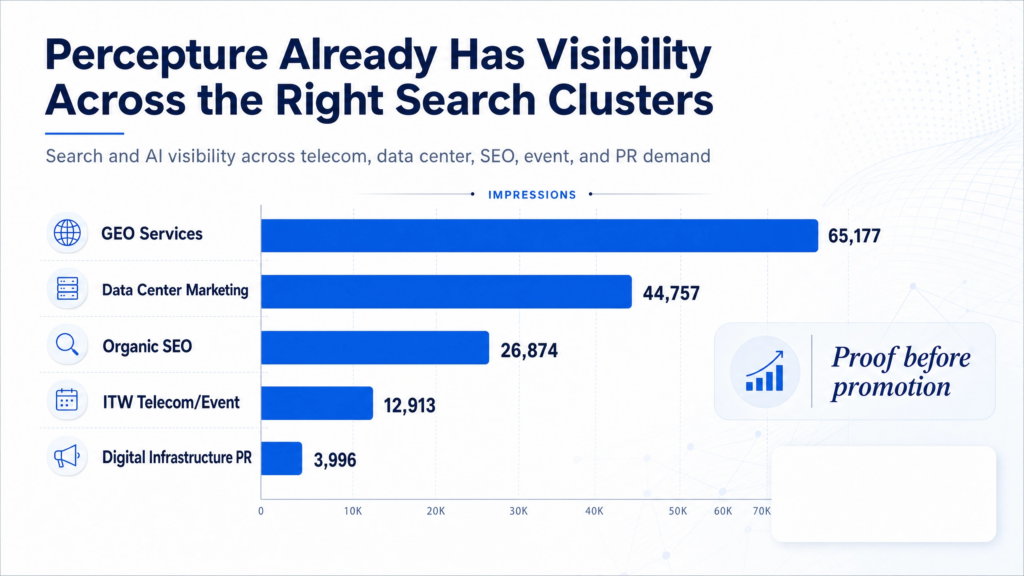
Commercial comparison pages work when technical precision supports the buyer journey. Percepture combines content marketing services, digital PR services, B2B lead generation services and omnichannel marketing around that goal.
See how technical authority becomes qualified demand
Review the Broadstaff case study, then compare Percepture’s telecom, SEO, GEO and digital PR approach with the buying journey your market actually follows.
Frequently asked questions
What is a NaaS provider?
A NaaS provider makes a network capability available through a service-based operating and consumption model. Depending on the category, that capability may be transport, multi-cloud routing, campus infrastructure, managed WAN or security-first networking. Buyers should identify the service layer before comparing network as a service providers.
Who are the best network as a service providers?
The best network as a service providers depend on the required outcome. PacketFabric and Megaport fit transport and interconnection shortlists. Lumen fits carrier-backed networking, Alkira fits multi-cloud orchestration, Meter and Nile fit campus use cases, and Cato Networks or Cloudflare fit security-first evaluations. Endpoint and architecture validation remain essential.
Is PacketFabric a Network as a Service provider?
PacketFabric describes itself as a NaaS software platform operating over private optical infrastructure. Its supplied documentation covers point-to-point and cloud connectivity, portal and API control, and Terraform support. Buyers comparing transport network as a service providers should verify service availability, physical delivery, diversity, support and commercial terms for their endpoints.
What is transport NaaS?
Transport NaaS makes eligible connectivity among supported data centers, clouds and other endpoints available through software-driven ordering and control. Transport-focused network as a service providers can simplify provisioning and modification, but physical ports, fiber paths, cross-connects and off-net access can still affect delivery.
How is NaaS different from SD-WAN?
NaaS and SD-WAN are not the same. NaaS describes a service consumption and operating model that can apply to transport or other network layers. SD-WAN is an overlay that applies traffic policy across WAN paths. An enterprise can consume underlay connectivity from network as a service providers and control traffic through SD-WAN.
How is NaaS different from SASE?
SASE combines networking and cloud-delivered security functions within an architecture. NaaS describes how network capabilities are consumed and operated. Security-first network as a service providers may use a SASE architecture or NaaS-like commercial model, but buyers must still determine whether access connectivity is included or supplied separately.
Is NaaS cheaper than traditional networking?
It depends on the architecture and operating model. Network as a service providers can reduce manual work or align capacity with demand, but total cost may include ports, cloud fees, cross-connects, access circuits, equipment, security, support and internal integration. Compare the complete delivered service over the expected term.
Does NaaS replace physical circuits?
No. Network as a service providers can change how eligible circuits and network functions are ordered, controlled, observed and billed. Traffic still depends on physical infrastructure somewhere in the delivery path. Buildings, fiber entrances, meet-me rooms, ports, cross-connects and routes remain part of availability and resilience.
What should a company look for in a NaaS platform?
Evaluate network as a service providers on required outcomes, supported endpoints, native and partner delivery, physical diversity, portal control, API lifecycle coverage, observability, security, SLA, support, total cost, migration and exit options. Run a buyer-controlled proof of concept before making a production commitment.
What are the disadvantages of NaaS?
Potential disadvantages include endpoint limits, off-net lead times, incomplete APIs, platform dependency, opaque delivered costs and operational lock-in. Network as a service providers may also add another control layer without removing enough manual work. Test the actual architecture and cancellation path before signing.
Own the network questions enterprise buyers ask next
Companies competing with network as a service providers need more than a provider page. They need a clear category position, technically accurate answers, search visibility and a path from buyer research to qualified demand. Percepture helps network as a service providers connect that technical authority to commercial intent.