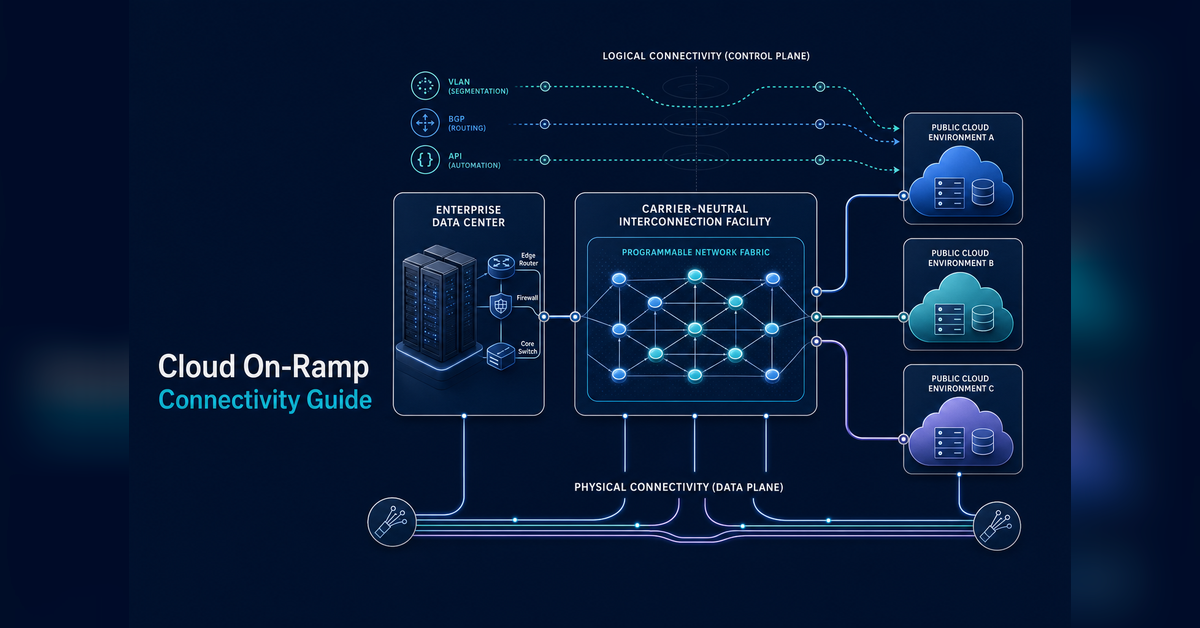

Cloud on ramp connectivity is a private or provider-managed path between an enterprise network and a public cloud service. The path can include customer equipment, transport, a physical interconnection facility, a native or platform handoff, VLANs, BGP, security controls and cloud-side routing.
Most guides compare product labels instead of the complete physical and logical path. That creates buying risk because a port, virtual circuit, access line and optimized internet route are different services with different owners, costs and failure domains.




What is cloud on-ramp connectivity?
Cloud on ramp connectivity is an end-to-end connection between an enterprise network and a public cloud environment. The physical handoff usually occurs at an interconnection facility or cloud-connect location. VLANs and BGP establish the logical connection, while routing, security and cloud configuration determine where traffic can go.
Executive summary
Map the full path
Evaluate cloud on ramp connectivity across the customer edge, access transport, facility, cloud or platform edge, and logical configuration as one system.
Separate the models
Native access, hosted access, software-defined interconnection, SD-WAN and VPN solve different problems.
Test real diversity
Two circuits are not physically diverse when they share a device, entrance, conduit, fiber route or cloud location.
Price every segment
The quoted port is only one part of cloud on ramp connectivity. Include transport, cross-connects, cloud charges, redundancy and operations.
Reviewed and updated July 16, 2026. Provider availability, cloud locations and commercial terms should be confirmed for the exact endpoints in your architecture.
Who this guide is for
CIO and CTO
Use the cloud on ramp connectivity framework to expose ownership, resilience and exit-strategy issues before approval.
Network and cloud architects
Trace the physical and logical handoffs, routing boundaries and failure domains behind cloud on ramp connectivity.
Security leaders
Separate private-path exposure from encryption, segmentation, identity and monitoring.
Procurement and finance
Compare complete cloud on ramp connectivity cost rather than a single port, circuit or platform fee.
Why cloud on-ramp comparisons fail
Most cloud on-ramp comparisons start with a product name and stop at a port speed. The buyer still has to connect the building, facility, platform and cloud environment into one accountable path.
Incomplete path
A cloud port does not include every router, cross-connect, local loop, facility or cloud-side configuration required to carry traffic.
Assumed security
A private route reduces public-internet exposure, but it does not prove encryption, segmentation, identity controls or monitoring.
Assumed redundancy
Two circuits can share one device, entrance, conduit, fiber route or cloud location. Contract diversity is not physical diversity.
Make the cloud-connectivity buying path easier to understand
Percepture can review the questions, entities, proof gaps and competitor claims shaping how buyers discover and compare your cloud-connectivity offer.
See Percepture’s AI Search ApproachCloud on ramp connectivity terms buyers should know
A cloud on-ramp is the access path into a cloud provider or cloud-access ecosystem. A native connection creates a direct commercial and technical relationship with a cloud provider’s named connectivity service. A hosted connection uses a partner to provide access to that native service.
A virtual circuit is the logical service delivered over physical infrastructure. A cloud exchange or fabric lets customers create connections to supported destinations through a shared platform. A carrier-neutral facility houses multiple networks and gives customers choices for transport and interconnection.
A cross-connect is the physical cable between parties in a facility. A VLAN separates logical traffic, while BGP exchanges routes. A VPC or VNet is a cloud-side network environment. Multicloud connectivity links an enterprise to more than one cloud, but it does not automatically provide cloud-to-cloud routing.
The Percepture Five-Handoff Cloud On-Ramp Model
The Percepture Five-Handoff Cloud On-Ramp Model maps every physical, logical, operational and commercial dependency between the enterprise and the cloud. It helps buyers compare complete cloud on ramp connectivity paths instead of isolated ports.
1. Enterprise edge
Identify the router, firewall, SD-WAN edge, cloud router or data-center port that originates the connection. Document ownership, interfaces, power, capacity, routing, encryption and monitoring.
Buyer question: Can the edge fail or scale without a redesign?
2. Access and transport
Map the cross-connect, local loop, Ethernet service, wavelength, fiber or software-controlled transport used to reach the cloud-access ecosystem.
Buyer question: Is the source on-net, and who owns each physical segment?
3. Interconnection location
Name the building, meet-me room, entrance and provider equipment where the networks meet. Facility selection affects access options, route diversity and operating responsibility.
Buyer question: Where does the physical handoff occur?
4. Cloud or platform edge
Identify the native cloud port, hosted connection, partner fabric, virtual circuit or cloud router that reaches the selected cloud service.
Buyer question: Is the service native, partner-mediated or platform-based?
5. Routing, security and cloud configuration
Document the VLANs, BGP sessions, advertised routes, gateways, segmentation, encryption options, telemetry and failover behavior that govern cloud on ramp connectivity.
Buyer question: Who configures, monitors and restores the service?
Where does a cloud on-ramp physically connect?
“A cloud on-ramp is not in the cloud. It’s in a room, in a building, on a specific floor, connected by a specific cable.”
Hunter Newby, interconnection expert and author of The Internet Is Physical


The visible path is: enterprise router → cross-connect or access circuit → cloud-connect facility → native or platform port → VLAN and BGP handoff → VPC or VNet.
The facility is only one layer. A buyer may need a data-center operator, access carrier, cross-connect, platform provider and cloud provider to complete one path. The same distinction matters when evaluating Chicago colocation providers or planning a broader data center marketing strategy around an interconnection ecosystem.
What are the main cloud on-ramp connectivity models?
The five practical cloud on ramp connectivity models are native dedicated connectivity, hosted partner connectivity, software-defined interconnection, SD-WAN or SASE steering, and VPN over the public internet. A sound comparison separates physical delivery, logical service, routing control, encryption options, commercial boundaries and workload fit.
Cloud on-ramp model comparison
| Model | Physical presence | Provisioning and scale | Control | Path and encryption | SLA boundaries | Cost categories | Best fit |
|---|---|---|---|---|---|---|---|
| Native dedicated | Typically requires access to a supported cloud-connect location | Physical delivery and capacity planning affect timing | High direct control | Private path; encryption depends on architecture and supported options | Customer, transport, facility and cloud segments can differ | Edge, transport, facility, port, transfer and operations | Stable, high-volume workloads and direct cloud control |
| Hosted partner | Partner provides access to the native service | Can reduce the customer’s direct physical requirements | Shared with partner boundaries | Private provider-managed path; encryption is a separate decision | Partner and cloud terms both matter | Access, hosted service, cloud and transfer charges | Lower-capacity access or organizations without direct presence |
| Software-defined platform | A physical source port or access path still exists | Virtual connections can be software-controlled | Portal or API control within platform capabilities | Private platform path; supported encryption options vary | Access, platform and cloud responsibilities differ | Port, cross-connect, transport, virtual service and cloud fees | Hybrid cloud, multicloud and changing destinations |
| SD-WAN or SASE | Uses branch edges and provider points of presence | Policy can change application paths | Application and security policy control | Private or internet underlays; encryption depends on design | Underlay, overlay and application terms may differ | Edges, licenses, underlays and security services | Branches, distributed users and application-aware steering |
| VPN over internet | No cloud-connect facility is required for the basic model | Usually quick to establish; internet performance can vary | Customer controls tunnels and routing | Encrypted tunnel over public internet | Internet and VPN components have separate limits | Internet access, gateways, operations and cloud transfer | Small, temporary, backup, dev/test or tolerant workloads |
Native cloud on-ramp vs interconnection platform
“Native is direct. Platform is flexible.”
Hunter Newby
Native cloud on ramp connectivity fits stable scale and teams that want a direct relationship with the cloud service. The enterprise accepts more responsibility for physical access, equipment, ordering, capacity and cloud-specific operations.
A software-defined interconnection platform can simplify cloud on ramp connectivity to supported clouds and destinations. It can also provide software control over virtual services. The source port, cross-connect, transport and cloud-side configuration still exist, and each segment can have a different owner or service commitment.
Many enterprises use both. A stable production workload may use native capacity while a platform handles changing destinations, additional clouds or temporary requirements. The decision should follow workload needs, not the product label.
Is SD-WAN Cloud OnRamp the same as private cloud connectivity?
No. SD-WAN Cloud OnRamp commonly uses policy to optimize branch, SaaS or multicloud application paths through selected underlays and provider points of presence. Private cloud on-ramp connectivity establishes dedicated or provider-managed access into a cloud provider. The two can work together, but neither automatically supplies the other.
An SD-WAN design can steer traffic toward a private circuit when that circuit exists. It can also use broadband or other internet paths. Buyers should ask whether the proposed service includes native cloud access, a partner connection, an optimized internet route or only application policy.
AWS Direct Connect vs Azure ExpressRoute vs Google Cloud Interconnect
AWS Direct Connect, Azure ExpressRoute and Google Cloud Interconnect are named cloud-provider services used to deliver cloud on ramp connectivity. The category is broader than any one service. Exact locations, connection models, routing capabilities, encryption options and fees depend on the provider and selected architecture.
Native cloud-service decision framework
| Cloud | Named service | Connection path | Routing responsibility | Redundancy question | Fee categories to examine | Best-fit decision |
|---|---|---|---|---|---|---|
| Amazon Web Services | AWS Direct Connect | Dedicated or partner-enabled access | Customer, provider and AWS configuration | Are devices, paths and locations independent? | Access, ports, transport, cloud and data transfer | Use when AWS connectivity requirements justify a managed private path |
| Microsoft Azure | Azure ExpressRoute | Provider-enabled or direct access model | Customer, connectivity provider and Azure configuration | Does access diversity extend beyond the cloud edge? | Provider, circuit, facility, cloud and transfer charges | Use when Azure network design calls for private provider connectivity |
| Google Cloud | Cloud Interconnect | Dedicated or partner-enabled access | Customer, partner and Google Cloud configuration | Are the interconnect locations and customer paths diverse? | Ports, access, facility, cloud and data transfer | Use when Google Cloud workloads require a private interconnect |
Oracle Cloud FastConnect and IBM Cloud Direct Link serve comparable category needs for their respective cloud environments. Provider documentation should govern the final architecture, location and commercial comparison.
How do businesses choose a cloud on-ramp provider?
Choose a cloud on ramp connectivity provider by documenting the full path and rating each requirement as documented, unclear or not offered. The scorecard should cover physical delivery, cloud compatibility, routing, automation, security, service boundaries, complete cost and migration options.
Percepture Cloud On Ramp Connectivity Provider Scorecard
| Evaluation area | Documented | Unclear | Not offered | Evidence to request |
|---|---|---|---|---|
| Exact source location and on-net status | □ | □ | □ | Facility, room, port and access method |
| Supported cloud, region and native service | □ | □ | □ | Cloud destination and location documentation |
| Native, hosted or platform model | □ | □ | □ | Responsibility diagram and order form |
| Bandwidth and scaling process | □ | □ | □ | Limits, change process and physical dependencies |
| Portal, API and infrastructure-as-code lifecycle | □ | □ | □ | Create, change, monitor and delete demonstration |
| BGP, VLAN, route and MTU support | □ | □ | □ | Technical service specification |
| Physical lead time and dependencies | □ | □ | □ | Cross-connect and transport delivery plan |
| Route diversity | □ | □ | □ | Building entrances, conduits, fiber routes and devices |
| Encryption and security controls | □ | □ | □ | Supported controls and customer responsibilities |
| SLA scope and exclusions | □ | □ | □ | Terms for every provider-controlled segment |
| Observability and alerts | □ | □ | □ | Latency, loss, utilization and BGP telemetry |
| Escalation and cloud coordination | □ | □ | □ | Support ownership and escalation process |
| Contract and billing flexibility | □ | □ | □ | Terms, minimums, usage and cancellation rules |
| Complete total cost | □ | □ | □ | Edge-to-cloud bill of materials |
| Multicloud or cloud-to-cloud options | □ | □ | □ | Supported paths and routing model |
| Exit and migration plan | □ | □ | □ | Rollback, cancellation and replacement steps |
How PacketFabric provides cloud on-ramp connectivity
PacketFabric positions its hybrid cloud connectivity service as a software-controlled way to provide cloud on ramp connectivity to supported destinations. It fits the platform layer of the Five-Handoff Model rather than the facility or native-cloud-provider layer.
“NaaS platforms are the software that makes carrier hotels programmable.”
Hunter Newby
Before selecting cloud on ramp connectivity, check the source facility, exact cloud destination, hosted or dedicated model, required port and cross-connect, physical route diversity, bandwidth, BGP and VLAN design, encryption options, cloud fees, support boundaries and SLA scope.
PacketFabric does not remove the enterprise edge, physical access path, cloud configuration or cloud-provider charges. Buyers should review supported cloud on-ramp locations against the required source and destination before designing the path.

Need private cloud connectivity that can move at software speed?
PacketFabric provides supported cloud on ramp connectivity for hybrid and multicloud environments through a software-controlled network platform. Confirm the source facility, cloud destination, physical delivery, bandwidth, routing and commercial terms for your architecture.
Explore PacketFabric Cloud ConnectivityReview PacketFabric cloud on-ramp locationsHow do you design redundant cloud on-ramp connectivity?
“Two connections on the same fiber path is not redundancy. It’s a shared failure point with a backup invoice.”
Hunter Newby
Resilient cloud on ramp connectivity requires independent failure domains across the customer edge, access route, facility, provider equipment, cloud edge and logical configuration. Provider-side redundancy does not prove customer access diversity.
- Use redundant customer-edge routers and power.
- Order separate access ports and devices.
- Use different building entrances and documented fiber routes.
- Separate provider and cloud ports where the workload requires it.
- Use two interconnection locations for high-impact workloads.
- Configure independent BGP sessions and route policies.
- Test route withdrawal, convergence and failover.
- Name a support owner for every segment.
- Monitor latency, loss, utilization and BGP state.
- Schedule failover tests and maintain current runbooks.
Failure-domain test
| Domain | What can be shared | Evidence of separation |
|---|---|---|
| Device and port | Chassis, line card, power or interface | Named devices, ports and power feeds |
| Facility | Building, meet-me room or entrance | Independent locations and entrances |
| Fiber route | Conduit, splice point or carrier segment | Documented physical route information |
| Platform and cloud edge | Provider device, cloud location or service edge | Separate ports, devices or locations |
| Configuration | Route policy, template or administrator error | Reviewed policies, change controls and rollback |
| People and process | Single escalation path or undocumented ownership | Named owners, runbooks and tested escalation |
How much does cloud on ramp connectivity cost?
“The cloud on-ramp port is the ticket. The cross-connect, colo space, and egress are the ride. Budget for the whole trip.”
Hunter Newby
There is no useful universal price for cloud on ramp connectivity because the complete path depends on location, access method, capacity, cloud destination, redundancy and commercial terms. Compare the same bill of materials for every option.
Complete monthly path cost = customer edge + facility + cross-connect + access transport + platform or service + cloud port + data transfer + redundancy + operations.
Cloud on ramp connectivity cost framework
| Cost layer | Items to include | Common buying error |
|---|---|---|
| Customer edge | Routers, firewalls, optics, licenses, power and support | Assuming existing equipment has enough ports or capacity |
| Facility | Space, power, remote hands and meet-me-room access | Ignoring the physical location requirement |
| Physical access | Cross-connect, local loop, Ethernet, wavelength or fiber | Pricing only the cloud-facing port |
| Platform or hosted service | Source port, virtual circuit, cloud access and usage terms | Assuming software activation removes physical delivery |
| Cloud charges | Cloud port, service, region and data-transfer categories | Assuming private access removes every transfer charge |
| Resilience and operations | Second path, monitoring, professional services and support | Leaving redundancy and testing out of the initial budget |
Direct connectivity may improve predictability or change transfer economics, but it does not universally remove egress or data-transfer charges. Procurement should compare the complete monthly path and one-time delivery costs under the same traffic assumptions.
Is cloud on ramp connectivity more secure than the public internet?
It can reduce exposure to public-internet routing and improve control, but private is not the same as encrypted. Security depends on physical access, logical isolation, routing filters, segmentation, supported MACsec or IPsec options, identity, key management, audit logs, cloud controls, monitoring and incident response.
For cloud on ramp connectivity, ask which segments are encrypted, who controls the keys and what happens at each handoff. Also review route advertisements, cloud IAM, security groups, logging and operational access. A private path alone does not establish compliance.
When is a cloud on-ramp better than VPN or public internet?
“VPN is a rental car on a toll road. Cloud on-ramp is owning the road.”
Hunter Newby
The analogy highlights control, but VPN remains valid for smaller, temporary, backup or performance-tolerant workloads. The choice between VPN and cloud on ramp connectivity depends on traffic volume, latency sensitivity, operating skill, deployment time, resilience and complete cost.
Cloud on-ramp vs VPN
| Requirement | Private cloud on-ramp | VPN over public internet |
|---|---|---|
| Setup | Physical access and provider coordination may be required | Can be established without a cloud-connect facility |
| Performance | Designed around a controlled provider path | Depends on public-internet conditions |
| Encryption | Must be selected and designed separately | The tunnel encrypts traffic over the internet |
| Scale | Fits stable, high-volume and latency-sensitive workloads when properly designed | Fits smaller, temporary or tolerant workloads |
| Resilience | Requires independent physical and logical paths | Can serve as a backup path when tested |
| Cost | Includes edge, facility, access, service, cloud and operating costs | Includes internet, gateways, cloud transfer and operations |
What should a cloud-on-ramp proof of concept test?
“A portal on top of a manual process is just a nicer way to wait.”
Hunter Newby
A cloud on ramp connectivity proof of concept should test the full service lifecycle, not just initial activation. Ask the provider to demonstrate what is automated, what remains manual and which teams own delayed or failed changes.
- Quote-to-order workflow and disclosed physical lead time
- Virtual activation and service-status visibility
- API lifecycle using documented interfaces
- Infrastructure-as-code create, change and delete operations
- Bandwidth-change process and physical limits
- BGP sessions, route policies, VLAN behavior and MTU
- Throughput, latency, jitter and packet loss
- Failover, route convergence and service restoration
- Alerts, telemetry and billing reconciliation
- Escalation, cloud coordination, cancellation and rollback
Common cloud on-ramp mistakes
- Treating private connectivity as automatically encrypted
- Comparing port prices without the rest of the path
- Treating SD-WAN steering as a native private circuit
- Buying two circuits that share one physical route
- Ignoring customer-side or cloud-side redundancy
- Failing to check exact facilities and cloud locations
- Ignoring BGP, VLAN, MTU or route constraints
- Assuming one SLA covers every provider and segment
- Building only for current capacity
- Skipping scheduled failover tests
- Forgetting cloud data-transfer economics
- Buying a portal without testing lifecycle automation
How technical authority becomes qualified demand
Technical buyers researching cloud on ramp connectivity search with architecture, risk, cost and provider questions. Clear definitions, responsibility maps, decision tables and evidence make that expertise easier to retrieve in search and easier for a buying committee to trust.
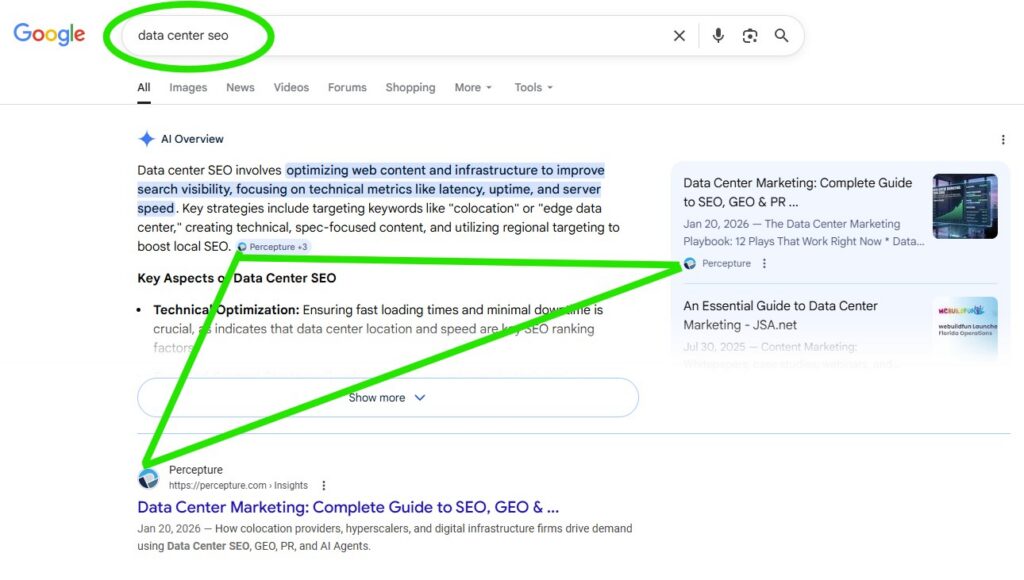
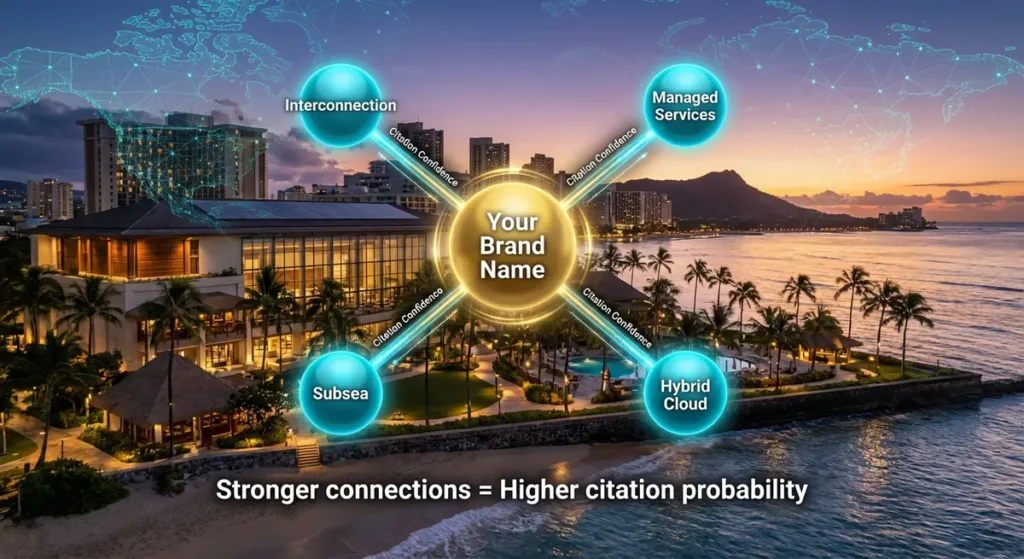

Percepture combines telecom marketing expertise, enterprise SEO services and generative engine optimization services to structure technical knowledge for Google and AI-assisted search.
Supporting programs can include technical content strategy, digital PR services and B2B lead generation services. The operating goal is to connect technical authority to qualified buyer intent without flattening the facts.
Turn technical expertise into a buyer-facing market advantage
See how Percepture connects technical authority, search visibility and qualified demand in a complex telecom market.
Read the Broadstaff Global Case StudyCloud on-ramp FAQs
What is cloud on ramp connectivity?
Cloud on ramp connectivity is a private or provider-managed path from an enterprise network into a public cloud environment. It usually combines customer equipment, physical transport, an interconnection location, a native or platform cloud handoff, routing, security controls and cloud-side configuration.
Where is a cloud on-ramp physically located?
Cloud on ramp connectivity is physically delivered through real infrastructure, often at a carrier-neutral facility, cloud-connect location or other interconnection site. The path can include a customer port, cross-connect, access circuit, meet-me room, provider equipment and a cloud-facing handoff.
What is the difference between a cloud on-ramp and AWS Direct Connect?
Cloud on-ramp is the broader connectivity category. AWS Direct Connect is Amazon Web Services’ named connectivity service within that category. A complete AWS path may still include customer routers, a facility, transport, a partner or platform, BGP configuration and AWS-side networking.
Is SD-WAN Cloud OnRamp a private cloud connection?
Not automatically. SD-WAN Cloud OnRamp generally applies routing policy and path selection to branch, SaaS or cloud application traffic. It may use private or public underlays. A native or provider-managed private cloud connection is a separate service that can be used with SD-WAN.
Is private cloud connectivity encrypted?
Private connectivity is not automatically encrypted. It can reduce exposure to public-internet routing, but encryption depends on the selected architecture and supported options. Buyers should document encryption for every segment, key ownership, termination points, routing filters, segmentation and monitoring.
Does a private cloud connection remove egress fees?
No universal rule removes all egress or data-transfer charges. The cloud provider, region, service, traffic direction and commercial model can affect the bill. Compare cloud charges together with customer-edge, facility, cross-connect, transport, platform and redundancy costs.
How is cloud on-ramp redundancy designed?
Redundant cloud on ramp connectivity requires independent customer-edge devices, ports, power, building entrances, physical routes, provider or cloud ports, interconnection locations and BGP sessions where the workload warrants them. Two logical services on the same physical path do not provide physical diversity.
When is VPN a better choice?
VPN can fit small-volume, temporary, dev/test, remote-access, backup or performance-tolerant workloads. It may also be useful while a physical connection is being delivered. The decision should compare deployment time, traffic volume, performance, resilience, operating effort and complete cost.
Own the cloud-connectivity questions buyers ask next
Percepture helps telecom, data-center, cloud and infrastructure companies turn technical expertise into search visibility and qualified demand. If your market needs a definitive guide to cloud on ramp connectivity, start with the buyer questions, proof and responsibility boundaries competitors leave unclear.
Get a Telecom and Data Center Visibility Review See the Broadstaff Global case studyFinal cloud on ramp connectivity decision logic: Map the five handoffs, verify the physical route, compare full cost, test failover and choose native, hosted or platform access, SD-WAN or VPN based on workload requirements rather than labels.

About Bob Generale
Bob Generale is President of Percepture, a digital marketing and PR agency founded in 2004. He helps telecom, data center, fiber and complex B2B companies turn technical expertise into search visibility, AI-answer visibility and qualified demand.
His work combines SEO, GEO, digital PR, content architecture, conversion strategy and AI systems. Bob’s approach starts with proof, entity clarity and the real questions technical buyers ask before a sales conversation.