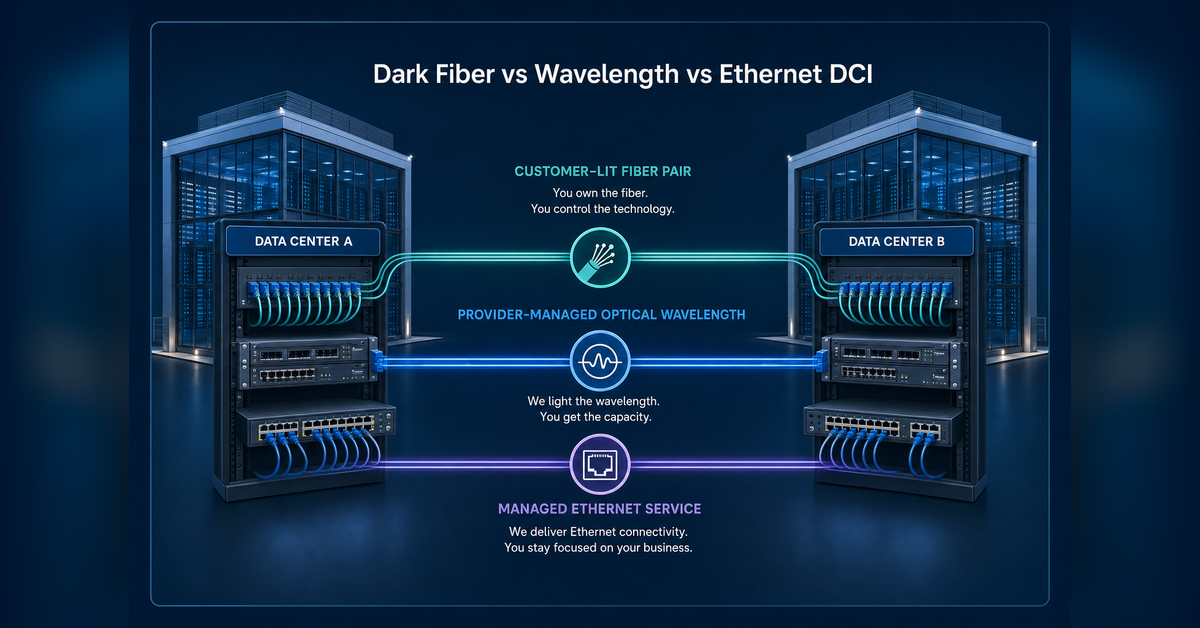

Dark fiber vs wavelength is a choice between controlling unlit glass and buying a managed optical channel. Dark fiber requires the customer to supply and operate the optics. A wavelength service is lit and managed by the provider. Ethernet DCI is a managed Layer 2 service delivered between data-center handoffs, often over wavelength and DWDM infrastructure.
The best option is not simply the one with the most bandwidth. Route availability, capacity growth, optical skills, security, recovery, contract term and the full cost of operating the connection determine the right model.
Research grounded in telecom and interconnection experience
Dark fiber, managed wavelengths and Ethernet DCI sit at different technical and commercial layers. Percepture has worked across telecom, fiber, data centers, infrastructure and complex B2B markets since 2004.





Reviewed and updated July 2026. This guide uses optical primary sources, approved Hunter Newby interview material and current PacketFabric documentation. PacketFabric is presented as a partner option and must be assessed against the buyer’s actual endpoints and requirements.
Which DCI transport model should you choose?
The dark fiber vs wavelength decision starts with responsibility, not bandwidth. Choose dark fiber when a suitable route exists, optical control matters and the organization can operate the equipment. Choose a managed wavelength for a provider-run optical channel. Choose managed Ethernet DCI for an Ethernet handoff and simpler service operations. Many networks use more than one model.
Executive summary
Dark fiber
The buyer receives unlit strands or a fiber pair and supplies the optical system. This offers the most optical control but also creates equipment, staffing and lifecycle duties.
Managed wavelength
The buyer receives a provisioned optical channel on the provider’s WDM system. The provider runs the line system while the buyer manages its edge and applications.
Managed Ethernet DCI
The buyer receives an Ethernet service between handoffs. The physical and optical underlay stays with the provider, subject to the service design and contract.
Main buying test
A dark fiber vs wavelength buying test must compare exact endpoints, physical routes, protection, capacity growth, operations, repair duties and full-term cost. A bandwidth quote alone cannot answer the decision.
Who should use this transport comparison?
The decision crosses engineering, operations, security, finance and procurement. Use one requirements baseline so every option is judged against the same endpoints, recovery needs and service boundary.
Network and optical teams
Map fiber routes, handoffs, line systems, link budgets, interfaces, monitoring and the skills required to operate each model.
Data center and cloud architects
Connect transport choices to workload movement, replication, latency, Layer 2 or Layer 3 boundaries and cloud-access dependencies.
Security and continuity teams
Verify physical diversity, encryption, key ownership, incident evidence, failover behavior and application recovery.
Finance and procurement
Compare construction, equipment, recurring service, staffing, maintenance, protection, contract and exit costs over the same term.
Definitions that prevent a bad comparison
A dark fiber and wavelength comparison must distinguish a commercial service from an optical transmission value. A wavelength service is a commercial, provider-managed optical channel delivered at a stated interface and capacity. An optical wavelength is light expressed in nanometers. Questions about 850, 1310 or 1550 nm concern transmission windows and optics, not the commercial terms of a managed wave.
Keep the transport layers separate
- Dark fiber: unlit glass that the customer lights with its own optical system.
- WDM and DWDM: technologies that carry multiple optical channels on one fiber. Ciena’s WDM overview explains the underlying multiplexing concept.
- Spectrum service: access to a defined portion of optical spectrum rather than one channel or the complete fiber pair.
- Lit fiber: a broad description for fiber carrying a signal.
- Ethernet DCI: a managed network service delivered through Ethernet interfaces, not a physical medium.
Dark fiber vs wavelength vs Ethernet DCI
The three options sit at different layers. A sound dark fiber and wavelength comparison asks who controls the glass and optical system. Adding Ethernet DCI asks whether the buyer wants a managed service interface instead. For broader context, see this introduction to data center interconnect.
Transport responsibility scorecard
| Feature | Dark fiber | Managed wavelength | Managed Ethernet DCI |
|---|---|---|---|
| Buyer receives | Unlit strands or fiber pair | Managed optical channel | Managed Ethernet service |
| Primary layer | Physical and optical | Optical service | Layer 2 service |
| Glass owner | Specified in lease, IRU or ownership records | Provider or its supplier | Provider or its supplier |
| Optics owner | Customer or contracted operator | Provider line system; customer edge | Provider underlay; customer edge |
| Handoff | Fiber demarcation | Specified optical or client interface | Ethernet port |
| Capacity unit | Pair, spectrum and deployed channels | Purchased channel | Service bandwidth |
| Change process | Customer engineering and equipment | Provider order and provisioning | Provider service change |
| Optical control | Highest of the three | Limited to contracted service | Abstracted behind Ethernet |
| Required skill | Optical design and operations | Service validation and escalation | Ethernet and IP operations |
| Monitoring | Split across customer and plant owner | Provider service plus customer edge | Provider service plus customer edge |
| Restoration | Split active and outside-plant duties | Contracted provider process | Contracted provider process |
| Encryption | Must be designed | Must be specified | Must be specified |
| Cost profile | Equipment, facilities, people and fiber terms | Install, recurring channel and upgrades | Install, recurring service and operations |
| Best fit | Control and scalable optical programs | Stable high-capacity channels | Managed, flexible Ethernet connectivity |
| Main risk | Hidden operating and repair burden | Shared physical dependencies | Route abstraction and service constraints |
What is dark fiber?
In a dark fiber and wavelength evaluation, dark fiber is the unlit optical fiber assigned to a customer. The customer or its contractor supplies, operates and refreshes the equipment that places light on the strands. A lease or indefeasible right of use can grant use of fiber without transferring ownership of the conduit, route or repair organization.
The operating process starts by documenting the A and Z demarcations, route, fiber type, attenuation, splices and access. The team then builds required laterals or cross-connects, installs optics and line equipment, monitors the link and follows the contractual maintenance split. The data center interconnect design guide covers the broader implementation sequence.
Where dark fiber fits in a dark fiber and wavelength decision
Strong reasons to evaluate it
- Optical control is a business or engineering requirement.
- Several channels may be needed on one route.
- The organization can support the optical lifecycle.
- Long-term growth justifies a full cost model.
Five disadvantages
- Suitable fiber may not exist at the exact handoffs.
- Laterals and construction can alter the economics.
- Optics, power, rack space, monitoring and spares add cost.
- Optical engineering and field coordination are required.
- Outside-plant repair still depends on contractual parties.
Dark fiber is not unlimited. Usable capacity depends on the glass, route loss, splices, spectrum, line system, modulation, amplification, power, rack space and operating skill. It is also not automatically encrypted, physically diverse or the shortest-latency path.
What is a wavelength service?
Within a dark fiber and wavelength assessment, a wavelength service, also called a managed wavelength or lambda, is a provider-managed channel on a WDM or DWDM system. The provider engineers, provisions, monitors and restores the optical service. Other channels may share fiber, amplifiers, ROADMs, huts, conduit or repair dependencies.
The buyer orders endpoints, interface and capacity. The provider provisions the path and presents the contracted handoff. The customer still operates its edge, validates performance and tests application recovery. Protected service should not be treated as physically diverse until the routes, entrances and shared facilities are documented.
What is managed Ethernet DCI?
Managed Ethernet DCI provides an Ethernet service between data-center interfaces. Ethernet Private Line, or EPL, is a point-to-point model. EVPL supports a virtual private service model. Both ride over provider-managed optical or packet infrastructure rather than replacing the underlying fiber.
In a dark fiber and wavelength review, this model fits teams that want a familiar handoff, provider operations and service changes without owning the line system. Buyers must still validate footprint, port and service bandwidth, committed rate, MTU, VLAN behavior, transparency, telemetry, protection and escalation. See Layer 2 vs Layer 3 DCI for the logical boundary above the transport.
Official materials for PacketFabric point-to-point Ethernet describe its managed service approach. Confirm endpoint availability, design, protection, features, terms and current pricing for the specific order.
DWDM vs dark fiber
The dark fiber and wavelength distinction also clarifies where DWDM belongs. Dark fiber is glass. Dense wavelength division multiplexing, or DWDM, is equipment and a transmission method that carries multiple optical channels on that glass. A dark-fiber operator may deploy DWDM, while a wavelength customer consumes a channel from a system operated by someone else.
| Question | Dark fiber | DWDM |
|---|---|---|
| What is it? | Unlit physical fiber | Optical multiplexing technology |
| What does the buyer operate? | The buyer lights the fiber | The system operator manages channels and optical performance |
| Can they be used together? | Yes | Yes, DWDM can run over dark fiber |
850 nm, 1310 nm, 1550 nm and commercial wavelength service
A dark fiber and wavelength service decision should not be reduced to nanometer values. Nanometer values describe optical wavelengths, not service contracts. The 850 nm range is commonly associated with short-reach multimode optics. The 1310 nm and 1550 nm ranges are common single-mode transmission windows, with use depending on the standard, optics, fiber plant and engineered reach. Do not use a generic reach chart as a substitute for current standards and manufacturer specifications.
The Percepture Transport Control Ladder
The Percepture Transport Control Ladder is a five-layer method for exposing the duties hidden behind a transport label. Applied to dark fiber and wavelength, it replaces a speed-first comparison with a responsibility map covering route, optics, service, recovery and economics.
Five layers to document
- Glass, route and access: identify ownership, lease or IRU structure, A and Z demarcations, conduit, entrances, splice points, rights-of-way and access. Do not call carrier diversity route diversity.
- Light, spectrum and optics: assign responsibility for transponders, muxponders, amplifiers, ROADMs, coherent optics, monitoring and spares.
- Capacity, interface and protocol: define whether the purchased unit is a pair, spectrum, wavelength, EPL, EVPL or virtual circuit. Record line rate, committed rate, MTU, VLAN handling and upgrades.
- Operations, protection and recovery: document fault isolation, tickets, dispatch, fiber repair, failover and application recovery. Protection alone does not establish physical diversity.
- Economics, term and scale: model installation, recurring charges, construction, optics, facilities, people, maintenance, protection, financing, refresh and exit at base, 2x and 5x demand.
In dark fiber and wavelength planning, the transport label matters less than the responsibility hidden behind it.
Physical-layer perspective from Hunter Newby

“Dark fiber is the dirt road. You bring your own car. A wavelength is a rental car. Ethernet DCI is a chauffeur.”
Newby’s approved dark fiber and wavelength interview guidance is direct: verify the exact route, shared conduit, entrances, condition records where available, splices, maintenance, repair process, OTDR traces and protection. Separate fiber ownership, optical operations, service operations and outside-plant repair.

Compare the whole transport stack before choosing
The DCI comparison worksheet turns the transport review into a common set of route, demarcation, capacity, equipment, staffing, power, maintenance, protection, repair, contract and five-year cost inputs.
- Document what the buyer owns and operates.
- Expose shared routes and recovery gaps.
- Compare full-term cost on the same service boundary.
You will receive a clear planning conversation, not a generic circuit quote.
Dark fiber vs wavelength cost: use full-term economics
There is no universal dark fiber and wavelength break-even point. Route availability, construction, channel demand, equipment, staffing, protection, finance and contract structure can reverse the result. Compare the same endpoints, physical diversity, capacity and term before drawing a conclusion.
Full-cost model
| Model | Cost inputs |
|---|---|
| Dark fiber | Lease or IRU, construction, laterals, cross-connects, line system, optics, rack, power, monitoring, staff or contractor, maintenance, spares, protection, refresh, finance and exit |
| Wavelength | Installation, ports, cross-connects, recurring channel charge, protection, upgrades, edge equipment, monitoring, support, applicable usage charges and exit |
| Ethernet DCI | Installation, ports, access, recurring or usage-based service charges, protection, edge equipment, operations, support, upgrades and exit |
A defensible break-even method
A defensible dark fiber and wavelength break-even analysis uses the same service boundary and operating assumptions for both models.
- Normalize the endpoints, route evidence, protection and service boundary.
- Model 36, 60 and 84-month terms without assuming one is the correct buying horizon.
- Test base, 2x and 5x capacity demand.
- Include optical equipment, facilities, staff, contractors, spares and refresh.
- Separate expected spend from downtime and recovery exposure.
- Test sensitivity to construction, delayed delivery, growth and exit terms.
- Validate the model with route-specific quotes and contract language.
For finance teams, OpEx is not automatically cheaper and CapEx is not automatically better. The appropriate structure depends on term, risk, flexibility and the organization’s cost of capital. Related context appears in the data center financing structures comparison.
Capacity and scale
A fiber pair, optical spectrum, a channel and Ethernet service bandwidth are different units. dark fiber and wavelength capacity depends on the engineered system, while Ethernet capacity depends on the contracted service and underlay. Do not treat a pair as infinite spectrum or assume every provider supports the same interface rates.
For dark fiber and wavelength capacity planning, compare upgrade mechanics, increments, equipment refresh, provisioning time and stranded capacity. A fixed route with recurring channel growth may justify modeling customer-controlled optics. A changing endpoint map may favor managed connectivity. Review other data center interconnect options when the route or topology is not stable.
Latency, jitter and application performance
The physical route establishes the latency floor. Optical equipment, regeneration, packet processing, congestion and application design add delay. Ask for measured p50, p95 and p99 latency, jitter and loss under load, plus the actual route, regeneration points and failover behavior.
Straight-line distance is not the optical path. Line rate is not application throughput. A dark fiber and wavelength test should include the production packet sizes, traffic patterns and failure states that matter to the workload.
Security and encryption
A dark fiber and wavelength security review should begin with the fact that all three models can provide private connectivity, but private is not the same as encrypted. Dark fiber does not remove the need for a security design. A dedicated wavelength can still share physical infrastructure. Ethernet DCI security depends on the service, edge design and controls above it.
Security questions
Use these questions to keep dark fiber and wavelength security claims tied to the actual design:
- Who can access the route, facilities, demarcations and repair process?
- Is optical or link encryption supported and included?
- Will the design use MACsec, IPsec or another approved control?
- Who owns and rotates encryption keys?
- Do portals and APIs support MFA, role-based access and audit logs?
- What incident evidence and compliance records will the provider deliver?
Resilience and repair
Two carriers can use the same trench, entrance, conduit or underlying fiber. Separate invoices do not prove diversity. For dark fiber and wavelength resilience, require physical-route evidence and document what happens when glass, optics, power, facilities or control systems fail.
| Area | Required evidence |
|---|---|
| Route diversity | Maps or records showing separate entrances, conduits and shared-risk points |
| Protection | Trigger, alternate path, capacity and restoration behavior |
| Monitoring | Alarm ownership, visibility and escalation thresholds |
| Dispatch | Who opens tickets, locates damage and sends field resources |
| Repair | Maintenance party, access process and repair targets |
| Spares | Location, ownership and replacement process for active equipment |
| Maintenance | Notice, maintenance windows and exclusions |
| Relocation | Rights and cost allocation if the route must move |
| Credits | Eligibility, exclusions and claim process |
| Application recovery | Tested failover and return-to-service procedure |
“A different carrier on the same fiber route is not diversity. It is a shared risk priced twice.”
Staffing and operating tools
Staffing can decide a dark fiber and wavelength outcome. Dark fiber needs optical architecture, link budgets, line-system knowledge, monitoring, spares and field coordination. OTDR, optical power and spectrum tools may be required depending on the responsibility split. Contractors are valid, but their cost, access and response terms belong in the business case.
On the managed side of a dark fiber and wavelength comparison, wavelength customers need enough optical knowledge to validate the handoff, monitor the SLA and escalate faults. Ethernet teams need Ethernet and IP design skills covering VLANs, VRFs, MTU, quality of service, telemetry and edge devices. Automation can change the operating model, as explained in software-defined data center interconnect.
Dark fiber vs wavelength decision matrix
The correct transport choice is conditional. Use the matrix to narrow the field, then validate route, operations and full cost. “Possible” means the model may work but requires more evidence.
| Condition | Dark fiber | Wavelength | Ethernet DCI |
|---|---|---|---|
| Fixed route with several channels | Strong fit if operations are funded | Possible; compare recurring channel cost | Possible; validate service scale |
| No optical team or partner | Weak fit | Strong fit | Strong fit |
| Optical control required | Strong fit | Weak fit | Weak fit |
| Changing topology | Weak fit | Possible | Strong fit where supported |
| Construction required | Possible after cost and schedule review | Possible if provider can deliver | Possible if provider can deliver |
| Stable high-capacity channel | Possible | Strong fit | Possible |
| Temporary migration | Weak fit | Possible | Strong fit if terms align |
| Regulated workload | Possible with complete controls | Possible with complete controls | Possible with complete controls |
| AI training or inference | Workload and route dependent | Workload and route dependent | Workload and route dependent |
| Disaster recovery | Possible with tested diversity | Possible with tested diversity | Possible with tested diversity |
Six-step decision tree
Use this sequence to turn the dark fiber and wavelength choice into a documented operating decision:
- Is suitable fiber available at the exact handoffs? If not, compare managed wavelength and Ethernet.
- Do you need multiple channels, spectrum or line-system control? If yes, model dark fiber.
- Do you have optical skill or a managed optical partner? If not, favor a managed model.
- Do you need one or a few stable high-capacity channels? Evaluate wavelength service.
- Do you need flexible Ethernet capacity, endpoints or automation? Evaluate Ethernet DCI.
- Is route diversity or repair responsibility unclear? Stop the selection until it is documented.
Where PacketFabric fits
In this dark fiber and wavelength comparison, PacketFabric is positioned as a managed Ethernet DCI alternative, not as a dark-fiber lessor. Its official EPL documentation describes an Ethernet Private Line service model. Buyers should confirm supported locations, access, service bandwidth, protection, physical diversity, automation, contract terms and current pricing for their design.
Partner disclosure: Percepture may refer qualified readers to PacketFabric. Buyers should still validate serviceability, route design, protection, security, support and commercial terms for their own endpoints.

PacketFabric’s official materials describe point-to-point Ethernet and agile data center interconnect across supported locations. The service can simplify ordering and operations, but physical handoffs, access, route dependencies and contract terms still determine the delivered result.
Procurement checklist
A dark fiber and wavelength procurement package should collect comparable evidence for each responsibility model.
Dark fiber
- Legal model, term, renewal, assignment and exit
- A and Z demarcations, strands and fiber type
- Route, conduit, entrances and shared-risk points
- Attenuation, splices, OTDR traces and records where available
- Laterals, cross-connects, facility access and reserve pairs
- Locate, maintenance, repair, escalation and restoration targets
Managed wavelength
- Handoff, capacity and protection model
- Dedicated channel or spectrum definition
- Route, shared facilities and regeneration
- Measured latency and optical service metrics
- Upgrade, maintenance and encryption options
- Credits, exclusions, escalation and exit
Managed Ethernet
- EPL or EVPL service definition
- Port speed, service bandwidth, CIR and EIR
- MTU, VLAN, QoS and protocol transparency
- Protection, route evidence and shared risks
- Portal, API, telemetry and change lifecycle
- Term, upgrades, cancellation and escalation
Every dark fiber and wavelength procurement package should state who owns and operates each layer, what can fail together, how a fiber cut is handled and how application recovery will be tested. Provider selection belongs downstream of that work. The best data center interconnect solutions guide addresses the broader solution set.
Proof of concept and acceptance testing
Acceptance should reproduce real operating conditions rather than confirm only that the circuit passes traffic. The dark fiber and wavelength test plan should assign signoff to application, finance, security and operations owners.
Twenty acceptance checks
- Demarcations
- Cross-connects
- Route evidence
- Handoff configuration
- Optical health where applicable
- Interface errors
- Latency p50, p95 and p99
- Jitter
- Packet loss
- Throughput and bursts
- MTU
- VLAN and QoS behavior
- Alerts
- Encryption and key control
- Portal or API change
- Primary-path failure
- Protection behavior
- NOC escalation
- Application recovery
- Invoice and TCO reconciliation
Common buying mistakes
| Mistake | Better test |
|---|---|
| Calling dark fiber unlimited | Model the actual glass, loss, spectrum, equipment and operations |
| Using a universal break-even | Build route-specific scenarios |
| Comparing monthly price only | Use full-term cost and recovery exposure |
| Treating a pair as an owned route | Read the legal and maintenance terms |
| Calling two carriers diverse | Prove separate physical paths |
| Confusing protection with diversity | Document the protection route and shared facilities |
| Calling private encrypted | Specify encryption and key ownership |
| Confusing a service with nanometers | Separate commercial service from optical wavelength |
| Treating Ethernet as the medium | Document the physical and optical underlay |
| Accepting a map or logo as proof | Verify the cross-connect, route and service design |
| Sizing to average traffic | Test peaks, bursts and failure states |
| Skipping failover testing | Run application recovery and return-to-service tests |
How Percepture turns technical proof into market visibility
Technical buyers reject vague claims, while search and AI systems need clear definitions, entity relationships and retrievable evidence. Percepture combines content marketing packages, digital PR services and B2B lead generation services to connect subject-matter expertise with qualified demand.
Proof from a complex telecom market
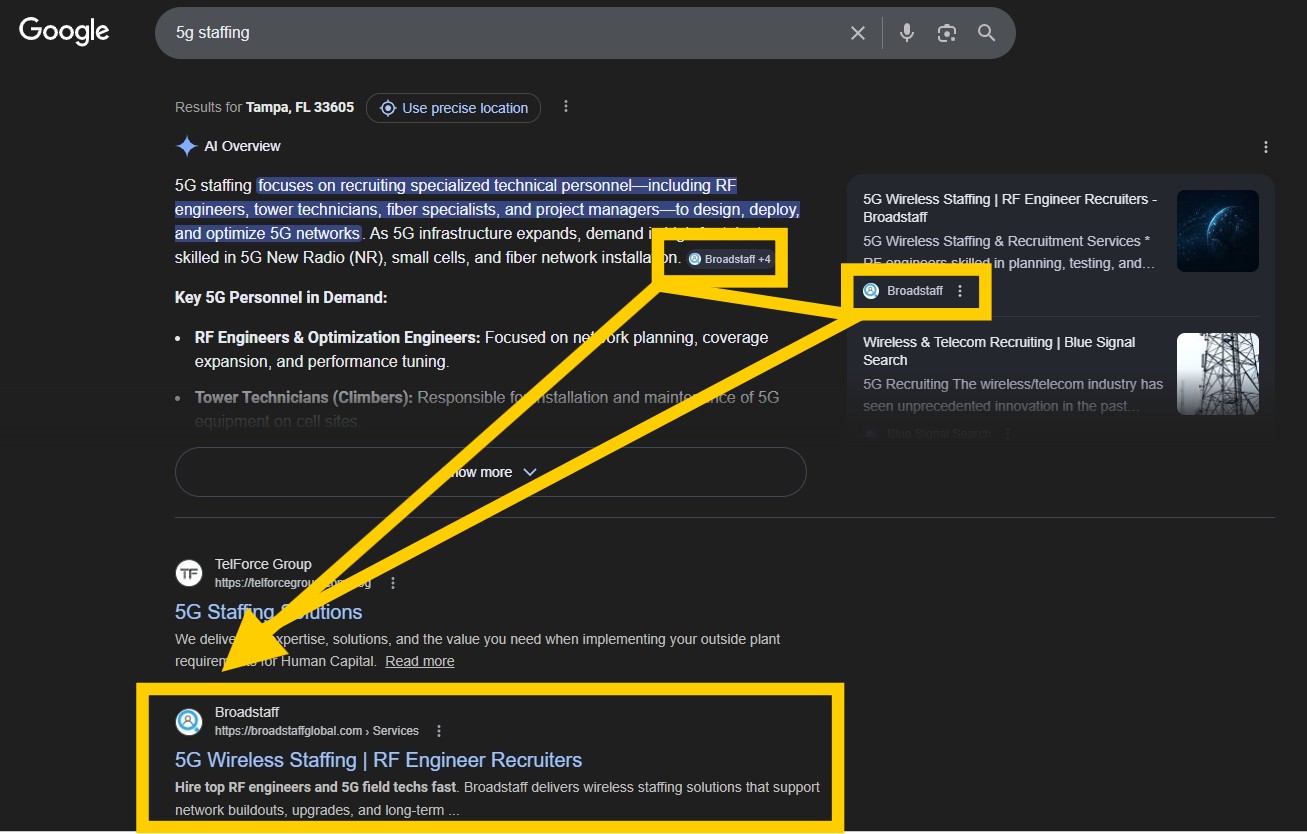
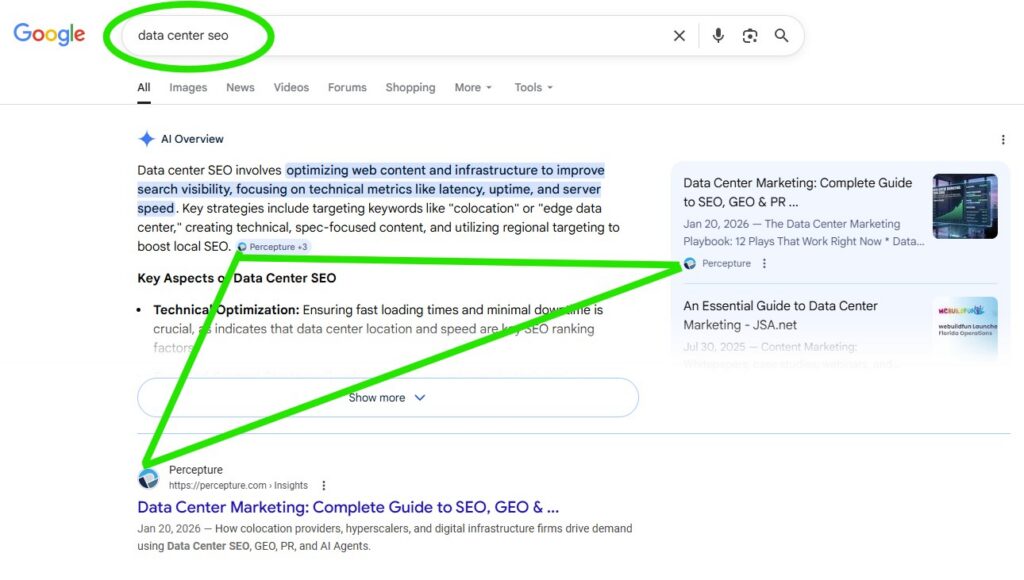
The Broadstaff case study and Percepture ranking examples demonstrate marketing and search work in complex infrastructure markets. They do not represent a transport purchase or engineering endorsement.
“What they’ve done for Broadstaff has been really nothing short of miraculous.”
Turn technical infrastructure expertise into qualified demand
Percepture helps telecom, fiber and data center companies turn technical proof into content that buyers can find, understand and verify across Google and AI-assisted search.
- Clarify the service, buyer and physical dependencies.
- Build a connected SEO, GEO and digital PR topic architecture.
- Move qualified visitors toward a clear commercial next step.
Final decision standard
Choose the responsibility model before the bandwidth label. Prove the physical route and shared risks. Model equipment, people, maintenance, protection and recovery over the same term. Test application failover before acceptance. Those steps produce a defensible dark fiber vs wavelength decision, with Ethernet DCI as a managed alternative.
Frequently asked questions
What is the difference between dark fiber vs wavelength service?
The central dark fiber vs wavelength difference is responsibility: dark fiber is unlit glass that the customer lights and operates, while a wavelength service is a managed optical channel on a provider’s WDM system. The first gives the customer more optical control and responsibility. The second places the line system, optical monitoring and service restoration with the provider under the contract.
Which is better for DCI: dark fiber, wavelength or Ethernet?
No transport model is universally better. Dark fiber fits organizations that need optical control and can operate the equipment. Wavelength service fits stable high-capacity channel requirements without a customer-run line system. Ethernet DCI fits teams that want a managed Ethernet handoff, subject to endpoint, service and route validation.
What are the disadvantages of dark fiber?
The main disadvantages are route availability, possible construction, upfront equipment, optical engineering, power and rack requirements, monitoring, spares, repair coordination and long contractual commitments. A dark-fiber lease can provide dedicated strands without giving the buyer control of the conduit or outside-plant repair crews.
What is the point of dark fiber?
The point is customer control over the optical system placed on a fiber pair. That can support protocol choice, multiple channels and customer-managed upgrades. The value depends on route availability, growth, staffing, equipment lifecycle and full-term cost rather than a universal bandwidth threshold.
What is the difference between DWDM and dark fiber?
Dark fiber is the unlit physical glass. DWDM is technology that carries multiple optical channels over fiber. A customer can deploy DWDM over leased dark fiber, while a managed wavelength buyer uses one channel from a provider-operated WDM or DWDM system.
Does a wavelength service use dedicated fiber?
Not necessarily. A wavelength can be a dedicated optical channel while sharing fiber, amplifiers, ROADMs, huts, conduit and repair dependencies with other services. Buyers should ask what is dedicated, what is shared and whether any protected path is physically diverse.
Is dark fiber more secure?
Dark fiber can provide greater control over the optical system and path information, but it is not automatically encrypted or immune to interception. Security depends on facility access, repair controls, encryption, key ownership, monitoring, incident response and the network design above the optical layer.
When does dark fiber become cost-effective?
There is no universal month or capacity threshold at which dark fiber becomes cheaper than wavelength service. Model the route, construction, lease or IRU terms, line system, optics, facilities, staff, maintenance, spares, protection, refresh, financing and exit. Compare those costs with equivalent wavelength and Ethernet services over the same endpoints, protection and term.
Is Ethernet DCI the same as a wavelength?
No. Ethernet DCI is a managed network service delivered through Ethernet interfaces. A wavelength is an optical channel. The Ethernet service may ride over wavelength and DWDM infrastructure, but the buyer purchases and operates at a different service layer.
What should an AI data center use for interconnect?
The right interconnect for an AI data center depends on the workload. Evaluate traffic pattern, capacity growth, latency budget, endpoint stability, optical skill, route diversity, security and recovery. Training, inference and storage replication can create different requirements, so the buyer should model each route and application rather than assign one transport model to every AI workload.
Can buyers find and understand your infrastructure expertise?
Percepture can review how your dark fiber and wavelength expertise appears across organic search, AI answers, technical content, digital PR and conversion paths.
- We identify missing buyer questions and weak entity signals.
- We map the proof, content and internal links needed to compete.
- You receive a clear visibility and conversion action plan.