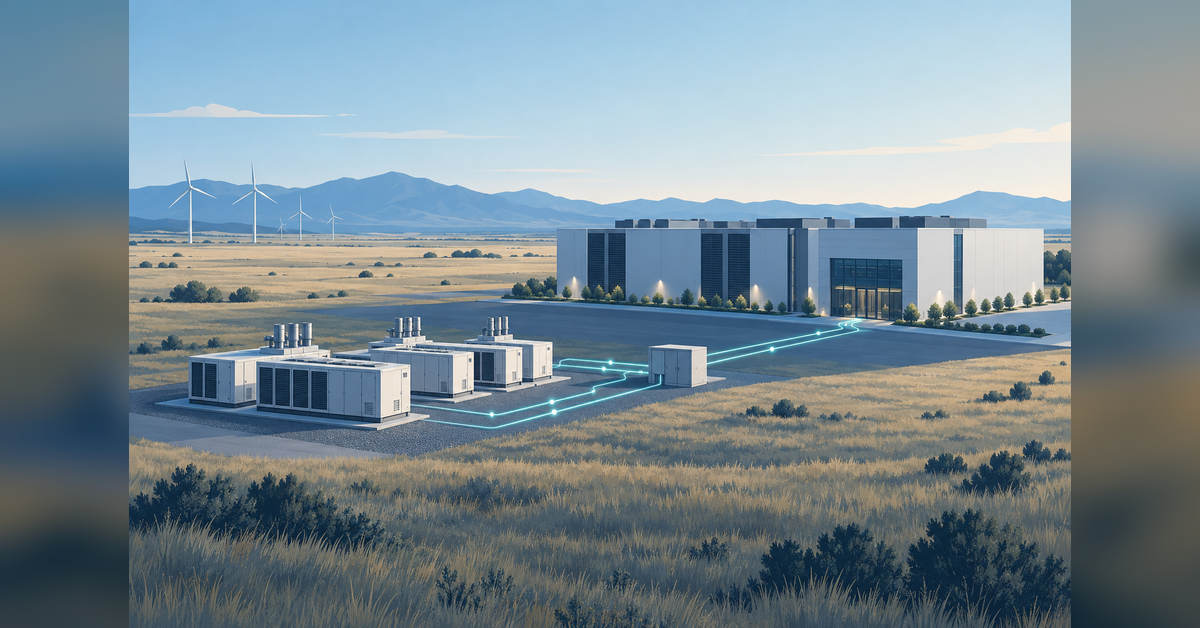

The Google AEP power deal connects a long-term electricity agreement with a planned generation project. In its October 14, 2026 announcement, AEP described approximately $4 billion of planned investment in a 702 MW fuel-cell facility near Cheyenne, Wyoming, supported by a 20-year Google power purchase agreement.
For AI infrastructure buyers, the distinction is between a generation plan and a usable computing service. The announcement provides a starting point for evaluating power supply. Delivery dates, facility readiness, workload requirements and network access still need to be assessed together.
What is the Google AEP power deal?
It is a 20-year power purchase agreement, or PPA, supporting a planned 702 MW natural-gas fuel-cell generation project near Cheyenne. AEP describes approximately $4 billion in planned investment, construction planned for 2026 and full operation expected by the end of 2028. Those are announced plans, not evidence that the capacity is operating today.
The Google AEP power deal: announced facts and buyer questions
AEP’s announcement describes the investment, generation technology, ownership and expected timing. Keep those facts attached to their qualifiers: approximately, planned and expected. Removing those words would turn a development announcement into a claim about completed infrastructure.
The table separates AEP’s stated plan from questions a buyer would need answered before making a deployment commitment. The questions are not findings that the project lacks a capability.
| Announcement item | What AEP states | What buyers still need to establish | Why it matters |
|---|---|---|---|
| Location | Near Cheyenne, Wyoming. | Site-specific delivery and commissioning dependencies. | Regional location is not a complete deployment plan. |
| Generation | 702 MW using Bloom fuel-cell technology and natural gas. | Delivered power, service-level design and usable IT load. | Generation capacity is not installed computing capacity. |
| Commercial agreement | A 20-year Google PPA. | Delivered economics and relevant performance obligations. | Agreement duration does not establish workload cost. |
| Ownership | Cheyenne Fuel Cell LLC is approximately 92% AEP-controlled and nearly 8% owned by funds advised by Basalt. | Which party is responsible for each delivery obligation. | Ownership and contractual responsibility are different questions. |
| Timing | Construction planned for 2026; full operation expected by end-2028. | Commissioning milestones and customer acceptance conditions. | Expected operation is not a commissioning record. |
| Carbon capture | Carbon capture is planned. | Operating scope, measurement boundaries and demonstrated performance. | A plan does not establish achieved emissions performance. |
| Connectivity | The power announcement establishes no project-specific route inventory. | Physical routes, service availability, access terms and resilience. | Megawatts alone do not establish network reach. |
Source: AEP’s October 14 announcement. The final column and buyer questions are Percepture’s editorial interpretation.
A fair reading also recognizes the value of the announced agreement. A long-term customer commitment and a defined generation plan deserve attention without requiring the release to function as an engineering data room. The mistake would be either dismissing that progress or treating it as proof that every downstream dependency has been resolved.
For decision-makers comparing announcements, distinguish proposed generation, committed delivery and energized usable capacity. That is the practical starting point for evaluating data center power availability, rather than grouping every announced megawatt into one supply figure.
Fuel cells are not geothermal, and a plan is not an operating plant
AEP identifies Bloom fuel-cell technology using natural gas. This is not a geothermal project. A chart about geothermal development, however relevant to a broader energy discussion, would not explain this facility’s technology or establish its environmental characteristics.
The distinction matters because a generation label is not an emissions assessment. For this project, the source-grounded description is a planned natural-gas fuel-cell facility with planned carbon capture. Neither the technology label nor the capture intention establishes operational zero-emission performance.
A useful environmental question therefore has several parts: what equipment is included, what emissions boundary is being measured, when capture would operate and how results would be documented. Buyers should ask the responsible specialists for those answers instead of substituting a general impression of fuel cells for project-specific evidence.
The same discipline applies to schedule language. A planned construction start, a targeted operating date and demonstrated operation describe different stages. An announcement can establish the first two without establishing the third. Updates should identify which milestone has changed, rather than quietly replacing an expected date with the language of completed delivery.
There is also a reasonable counterargument to demanding every detail at announcement: development communications have a narrower purpose than customer acceptance testing. The appropriate response is not to assume failure. It is to preserve the difference between a public development milestone and the evidence needed for a particular purchasing decision.
What 702 MW tells us—and what it cannot tell us
The announced 702 MW figure describes rated generation power. MW measures power; MWh measures energy over time. Neither unit, by itself, describes how many servers are installed, how many GPUs are working or how many AI requests a service can complete.
To connect generation with computing capacity, a buyer needs several additional inputs: power delivered to the facility, facility overhead, redundancy arrangements, equipment configuration and utilization. PUE, or power usage effectiveness, is another relevant input. The announcement does not supply a basis for turning its generation rating into a universal rack or GPU count.
IT load should remain a separate line in the analysis. It concerns the electricity used by computing equipment, rather than the headline rating of the generation project. A comparison that places generation capacity beside a different facility’s IT load without identifying the different boundaries would invite the wrong conclusion.
The commercial boundary matters just as much. Approximately $4 billion of planned investment is not a disclosed electricity price, customer operating cost or workload cost. A buyer should not divide the investment by the announced capacity and present the result as the price of power delivered to an AI service.
Ask for a chain of evidence instead: generation capability, delivery arrangements, facility acceptance, usable IT capacity and workload performance. Each step answers a different question. A convincing answer at one step should not be borrowed to fill a gap at the next.
This also sharpens comparisons between sites. Before asking which location offers more capacity, establish whether the quoted figures refer to planned generation, contracted delivery, facility capacity or IT load. Only then can a comparison support a decision rather than reward whichever announcement uses the largest number.
Apply the 5P AI Corridor model to deployment readiness
Percepture’s published AI Corridor readiness model organizes infrastructure questions around Power, Place, Path, Peering and Policy. Applied here, it is a way to organize due diligence—not a completed engineering assessment of AEP’s project.
| 5P | Evidence in the announcement | Question for the responsible specialist |
|---|---|---|
| Power | 702 MW planned generation and expected full operation by end-2028. | What supports firm delivery, commissioning and contingency arrangements? |
| Place | A project near Cheyenne. | Which site-specific dependencies must be completed before customer use? |
| Path | The announcement does not establish a physical network route inventory. | Which routes are available, physically diverse and deliverable on schedule? |
| Peering | The announcement does not establish project-specific exchange or cloud access. | Which networks and cloud destinations can customers reach, under what terms? |
| Policy | A development plan that includes intended carbon capture. | What permits, utility arrangements, local processes and emissions evidence apply? |
Power: Separate the generation project’s expected operating date from the customer’s usable-service date. Request the milestone sequence and identify who accepts each stage. If a workload requires continuity through maintenance or disruption, ask how that requirement is addressed rather than assuming the headline rating answers it.
Place: Treat regional location as the beginning of site evaluation. A buyer’s deployment plan needs site-specific evidence and named dependencies. Percepture’s data center site selection checklist provides a broader context for organizing those questions without making this news article the owner of every siting issue.
Path: Ask for physical routes, delivery dates and failure-domain explanations. Two commercial offers should not automatically be treated as two physically independent paths. The evaluation question is what the proposed services actually share and what remains available when a component is unavailable.
That is why a discussion of data center interconnect options belongs beside power due diligence. The task is to connect the workload’s destinations with the proposed site, not merely to confirm that a carrier name appears in a presentation.
Peering: Distinguish network presence from usable access. Ask which destinations can be reached, through which arrangements, with what service terms and on what delivery schedule. Do not infer project-specific cloud access from the city name or from another facility’s capabilities.
Policy: Assign questions to the organizations qualified to answer them. Permitting, utility arrangements, emissions measurement and local process require their own evidence. A communications team can make those dependencies understandable; it should not convert unanswered specialist questions into implied approvals.
The model’s value is coordination. It gives the energy, property, network, commercial and policy teams a shared set of headings while preserving their different responsibilities. The result should be a clearer decision record, not a score that disguises missing information as precision.
Training, batch inference and real-time inference need different trade-offs
“AI-ready” is incomplete unless the intended workload is named. Training, batch inference and latency-sensitive inference raise different questions about power, network access and deployment geography. These are considerations to test against an application, not universal siting rules.
| Workload | Evaluation priority | Network questions | Power and cooling questions |
|---|---|---|---|
| Training | Intra-cluster fabric, utilization and energy requirements. | How will training data arrive, and how will checkpoints and outputs move? | What supports the proposed equipment density and operating pattern? |
| Batch inference | Throughput and completion deadlines. | Can input and output transfers fit within the processing window? | Can available capacity support the scheduled workload? |
| Latency-sensitive inference | End-to-end response budget and endpoint geography. | What are the measured paths to users and application dependencies? | What resilience and operating arrangements support the service? |
For training, distinguish communication inside the computing cluster from movement across a wide-area network. A statement about one does not establish the performance of the other. Ask which measurement is being discussed before comparing latency claims.
For batch inference, start with the deadline. Identify when inputs become available, how long transfers take, when processing must finish and where results must go. A location decision should reflect that sequence rather than assuming that every inference task needs the same proximity to end users.
For interactive applications, evaluate the complete response path. The relevant question is not simply whether the model runs quickly, but whether the application can meet its response budget across the dependencies involved. There is no universal latency threshold established by this power announcement.
The term AI inference infrastructure therefore needs an application-specific definition. Security, resilience and data residency may also dominate a placement decision. The useful comparison is between documented requirements and documented capabilities—not between broad labels such as remote, central or edge.
For this agreement, the correct starting point remains modest: AEP has described a generation project and a long-term customer arrangement. The workload table identifies what a prospective infrastructure user would investigate next; it does not assign an undisclosed workload to the project.
Research Q&A: Bob Generale with AI Hunter Newby
Edited from a supplied discussion with AI Hunter Newby. This is an AI-assisted research discussion, not a human interview or a project-specific engineering assessment.
Bob: What network evidence would you request after a major power announcement?
The supplied AI response states that its research does not cover this Google-AEP agreement specifically. Its useful contribution is a set of questions: which networks are active, which routes are physically diverse, what access terms apply, how cloud destinations can be reached and what supports confidence in power delivery.
Applied to this story, those questions should become requests for route information, service availability and delivery commitments. They should not become an assertion that the announced project has no connectivity.
Bob: What cannot be inferred from the word “inference” alone?
The discussion distinguishes compute-intensive work from applications constrained by round-trip delay. That distinction supports asking about the actual workload before choosing between locations. It does not support a blanket rule that power always wins or that network proximity always wins.
Keep intra-cluster hardware latency separate from wide-area network latency. Then ask how each affects the application’s completion or response requirement. A single latency number without its measurement boundary cannot settle the location decision.
Bob: Why is a long-term power agreement not proof of immediate deployment readiness?
“A PPA or utility letter is a financial/legal instrument, not a construction schedule.”
AI Hunter Newby, supplied research discussion
The practical follow-up is to request commissioning, delivery and contingency evidence. This is a distinction between contractual commitment and execution milestones, not an allegation that AEP cannot deliver its announced plan.
There is related historical context in Hunter Newby’s February 26, 2025 article, “Is the AI data centre boom under threat?”, where he wrote: “The risk is within the structure of the deal.” That earlier observation concerns the relationship between commitments and execution; it predates this agreement and is not a comment on its specific terms.
What buyers, operators and communities should ask next
Start by defining the decision. An enterprise evaluating future computing capacity needs a different evidence package from a local stakeholder evaluating project impacts. Both deserve clear answers, but a single headline or generalized readiness score cannot serve both purposes.
For a prospective customer, request a milestone record that connects generation, power delivery, facility commissioning, network availability and workload acceptance. Identify the responsible party and acceptance evidence for each step. Where dates depend on another party’s work, keep that dependency visible in the deployment plan.
For commercial teams, separate the power customer, generation owner, developer and infrastructure partners. The broader question of who pays for data center growth should be answered through documented responsibilities, not assumptions based on a prominent company’s involvement.
Similarly, a PPA should not be presented as proof that every related financing or construction obligation has been satisfied. Readers comparing data center financing structures should keep the customer agreement, capital arrangements and physical delivery schedule distinct. Each may inform the others without replacing them.
For communities, ask which local impacts have been studied, which public processes apply and where project-specific answers will be published. Do not substitute a national data center statistic for local evidence about water, emissions, public services or taxes. Effective data center community engagement starts with questions people can trace to the responsible organization.
For builders and project communicators, use milestone-specific language. Distinguish announced, under construction, commissioned and available for customer use. The same principle belongs in construction content marketing: explain what a milestone establishes, what it depends on and what comes next.
That approach also makes future updates more useful. A new commissioning record, network-service commitment or emissions measurement should change the corresponding part of the assessment. It should not require readers to untangle an earlier claim that everything was already complete.
Frequently asked questions
What is the Google AEP power deal?
AEP describes a 20-year Google power purchase agreement supporting a planned 702 MW fuel-cell generation project near Cheyenne, Wyoming, with approximately $4 billion in planned investment. It is an announced generation and commercial arrangement, not evidence that 702 MW of computing equipment is installed or operating.
Where is the planned project?
AEP places the planned fuel-cell project near Cheyenne, Wyoming. That regional description should not be treated as a complete account of site infrastructure, network routes or customer service availability. Buyers need site-specific documentation for those questions rather than borrowing capabilities from other facilities in the area.
Is 702 MW available now?
The announcement does not establish that the planned 702 MW is operating. AEP states that construction is planned for 2026 and full operation is expected by the end of 2028. Those expected milestones should remain separate from evidence of commissioning, power delivery and customer acceptance.
Does fuel-cell generation mean zero emissions?
No zero-emissions conclusion follows from this announcement. AEP describes natural-gas fuel-cell generation and planned carbon capture. Assessing environmental performance requires project-specific operating evidence and a defined measurement boundary. A capture plan is not the same as demonstrated capture performance or a verified lifecycle emissions result.
Is this the same as Google’s geothermal agreements?
No. The AEP project described here uses natural gas and Bloom fuel-cell technology, not geothermal generation. Separate geothermal projects should not be used to illustrate this facility’s technology, imply its operating characteristics or establish its carbon profile. Keep different energy agreements separate when comparing their scope.
Does a PPA guarantee a data center completion date?
A PPA alone is not evidence that a data center is complete or ready for a workload. Buyers should examine the relevant contractual obligations alongside construction, commissioning, power-delivery and network milestones. The announced 20-year duration does not, by itself, establish when a particular computing service becomes usable.
Why does network connectivity matter if power is available?
Power availability does not establish how an application reaches its users, data sources or other services. Evaluate physical routes, access terms, delivery dates and resilience against the intended workload. Also distinguish communication within a computing cluster from traffic crossing a wide-area network; they answer different performance questions.
What should a buyer ask before calling a site AI-ready?
Name the workload first. Then request evidence for usable power, facility acceptance, cooling requirements, network paths, access arrangements and relevant policy obligations. Connect those records to a dated deployment plan with responsible parties. A capacity headline or general readiness label should not substitute for that workload-specific evaluation.
The decision is about dependencies, not just size
The Google AEP power deal offers a defined generation proposal and a long-term customer agreement. Its significance should be assessed on those terms, without promoting expected capacity into an operating-service claim or treating unanswered buyer questions as evidence of failure.
Read the announcement, identify the workload and request the records connecting each delivery milestone. For organizations explaining infrastructure capabilities and timelines to customers or communities, Percepture’s public relations services offer a relevant communications next step. Engineering, utility and commissioning decisions remain with the responsible specialists.

About Bob Generale
Bob Generale is President of Percepture. His work spans strategic SEO, digital PR and B2B communications for telecom and data center audiences. In this analysis, he applies Percepture’s Power, Place, Path, Peering and Policy model to distinguish announced infrastructure plans from the evidence buyers need for deployment decisions.