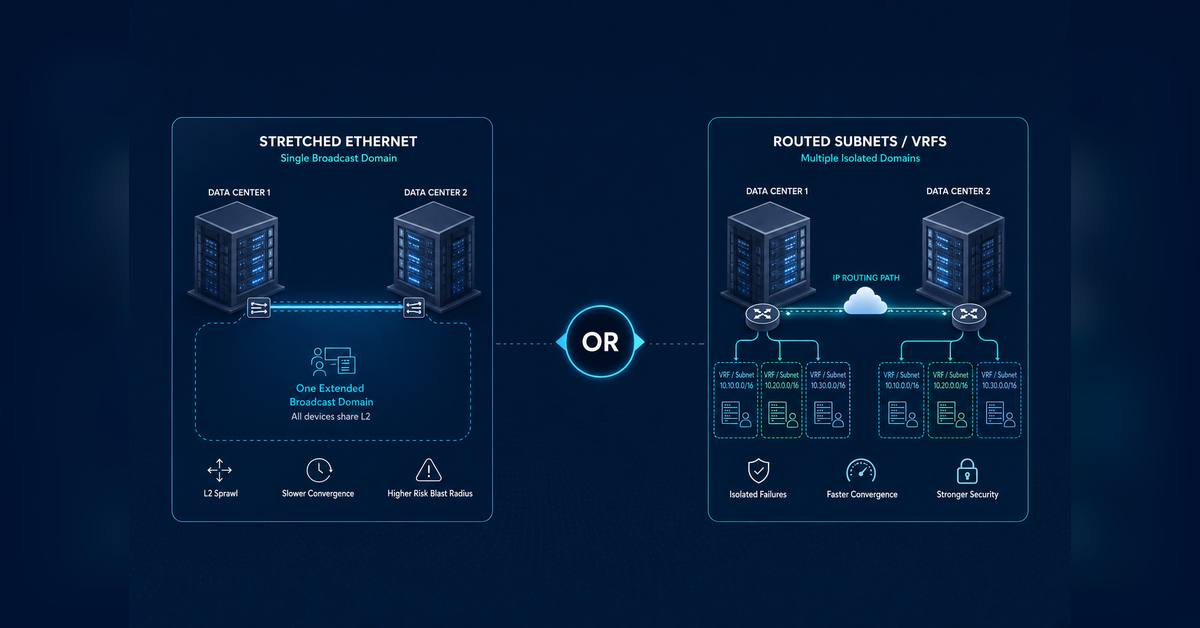

Layer 2 vs Layer 3 DCI should start with a routed boundary. Use Layer 2 only when a verified application dependency requires same-subnet adjacency or IP preservation and the team can contain and test the wider failure domain.
This is an application, operations and resilience decision—not a contest between switch types. The transport, service boundary, overlay, control plane and physical route must each be evaluated separately.





What is the right default for a data center interconnect?
For most data center interconnects, Layer 2 vs Layer 3 DCI should resolve to Layer 3 by default because routing separates site failure domains and supports explicit policy. Choose Layer 2 only when a verified workload requires the same subnet across sites. EVPN/VXLAN can carry selected Layer 2 segments over an IP underlay, but it does not remove physical-path, security, BGP or operating requirements.
Route by default. Bridge only with evidence.
Executive summary
A DCI boundary review should identify the application dependency, failure boundary, operating model and physical path before selecting a service.
Layer 2 is an exception
Use a bridged segment for a documented adjacency or IP-preservation requirement. Give every extension a defined scope, owner and exit plan.
Layer 3 is the baseline
Use separate site networks when applications can communicate through gateways, routing policy, load balancers, DNS or service discovery.
Hybrid is selective
Use an IP underlay with EVPN/VXLAN only where mixed services, scale or multi-tenancy justify the added control-plane work.
Layer 1 still decides resilience
Two logical services can share one trench, entrance, device or power domain. Verify the physical path before calling a design diverse.
Who this Layer 2 vs Layer 3 DCI guide is for
Network architects
Use the comparison and Five-Gate test to define where routing should stop and where a narrow Layer 2 exception is justified.
Cloud and platform teams
Validate whether mobility, clustering, licensing or application behavior truly requires same-subnet adjacency across sites.
Operations and security leaders
Model blast radius, route policy, gateway ownership, visibility, rollback and incident response before production.
Procurement and finance
Compare the complete service, including transport, facilities, equipment, software, support and the cost of operating complexity.
Layer 2 vs Layer 3 DCI: What is the difference?
L2 DCI bridges selected Ethernet segments between sites and forwards traffic using MAC information. L3 DCI routes between separate IP prefixes or virtual routing and forwarding instances. A hybrid architecture can use a routed underlay while extending only approved Layer 2 services.
- Layer 2 packet walk: host MAC → local switch → bridge or overlay → remote switch → remote host.
- Layer 3 packet walk: host → default gateway → route-policy decision → DCI underlay → remote gateway → remote host.
An end-to-end design can contain both. In a DCI boundary assessment, the useful question is where the broadcast and failure boundaries should stop.
Layer 2 vs Layer 3 DCI comparison
Use this Layer 2 vs Layer 3 DCI matrix to compare addressing, isolation, scale, policy and operational readiness rather than treating the layer label as the complete architecture.
| Decision factor | Layer 2 DCI | Layer 3 DCI | Selective EVPN/VXLAN |
|---|---|---|---|
| Addressing | Can preserve a subnet across sites | Sites normally use separate routed domains | Preserves selected segments over an IP underlay |
| Broadcast domain | Extends with the bridged segment | Stops at the routed boundary | Extends only approved VNIs or segments |
| Failure isolation | Broader unless tightly contained | More natural site separation | Depends on overlay and underlay design |
| Scale | Best kept constrained | Fits larger routed topologies | Can support mixed multi-site requirements |
| Workload mobility | Fits a verified same-subnet requirement | Uses routing, service identity or application methods | Extends only workloads that require it |
| Policy and ECMP | Limited by the service design | Explicit routing and path policy | Available with added control-plane complexity |
| BUM traffic | Must be bounded and monitored | Contained by the routing boundary | Requires an intentional handling design |
| Operational skill | Bridging, loops, MAC and gateway behavior | Routing, convergence and route policy | BGP, EVPN, VXLAN, overlay and underlay visibility |
| Typical best fit | Proven adjacency exception | Most new DCI designs | Selective mixed service at justified scale |
| Major risk | A local fault gains a multi-site blast radius | Bad policy or convergence affects reachability | Complexity exceeds operating readiness |
| Default | Exception | Starting point | Evaluated exception, not automatic compromise |
Seven architecture claims buyers should correct
These corrections keep a DCI scorecard focused on the actual service boundary, control plane and transport.
- Layer 2 service can use a BGP EVPN control plane.
- Layer 3 does not automatically require workload renumbering.
- Dark fiber and wavelength are transport choices that can carry Layer 2 or Layer 3.
- MPLS can deliver an L2VPN or an L3VPN.
- VXLAN provides encapsulation; EVPN provides control-plane functions.
- The layer number does not determine whether traffic is encrypted.
- A mixed design still has skills, failure modes and physical dependencies.
Clear taxonomy also improves technical content retrieval. Percepture applies this principle through its generative engine optimization services and its guide to AI search optimization for telecom.
How do you make a Layer 2 vs Layer 3 DCI decision?
The Percepture Five-Gate DCI Boundary Test gives an interconnect review a repeatable way to determine whether a workload can cross a site boundary through Layer 3, needs a limited Layer 2 extension or should be redesigned before interconnection.
- Application dependency: Prove whether the workload must retain the same IP or subnet. Check the current platform, version and deployment model. Test whether load balancing, DNS, service discovery, anycast, NAT or redesign can remove the dependency.
- Failure-domain tolerance: Model loops, MAC moves, ARP or neighbor-discovery growth, broadcast, unknown-unicast and multicast traffic, and control failure. Reject a stretch when its blast radius exceeds business tolerance.
- Scale and topology: Count sites, VLANs, VRFs, prefixes, MAC addresses, tenants and expected changes. Frequent change, multiple sites, ECMP and complex policy normally favor routing.
- Operating model: Confirm ownership, BGP and overlay skills, change control, telemetry and rollback. Select the simplest architecture the team can operate during an incident.
- Physical and recovery proof: Verify routes, entrances, cross-connects, devices, power, latency, loss, jitter, MTU, convergence and application failover.
“Use Layer 3 unless you are forced to use Layer 2.”
Hunter Newby, approved Percepture interview quote
Green
Routed Layer 3 DCI with documented policy and recovery behavior.
Amber
Selective Layer 2 over EVPN/VXLAN with strict scope, containment and an exit plan.
Red
Broad Layer 2 stretch without a documented dependency, operating plan or physical diversity.
A simple count can organize the workshop, but it cannot replace engineering review. The Layer 2 vs Layer 3 DCI decision record must explain each dependency and accepted failure mode.
Free planning tool
Score your DCI boundary before you stretch it
Use the Layer 2 vs Layer 3 DCI Decision Scorecard to document application dependencies, failure domains, scale, operating readiness and physical-path proof.
When is Layer 2 DCI truly required?
Layer 2 DCI is justified when an application has a verified same-subnet or IP-preservation requirement that cannot be removed safely within the project window. Possible cases include a specific live-migration design, a legacy license tied to addressing, a documented cluster dependency or a temporary migration bridge. In the final architecture decision, each case should be validated against the current product version and deployment model.
Requirements vary by product, version and deployment model. Do not assume that every cluster, database or mobility platform needs Layer 2.
Layer 2 advantages
- Address continuity for an approved use case
- Transparent Ethernet handoff
- Lower near-term application-change burden
- A constrained point-to-point service model
Layer 2 controls and risks
Before approval, require application-owner sign-off, vendor documentation, latency and MTU limits, maximum distance, security controls, failure-domain acceptance and an end date.
When is Layer 3 DCI the safer default?
Choose Layer 3 when sites can use separate subnets and communicate through explicit routing policy. In most DCI evaluations, it is a strong fit for disaster recovery, three or more sites, cloud-native platforms, applications behind load balancers, segmented environments, M&A integration and workloads that need controlled paths.
Routing supports fault containment, summarization, ECMP, segmentation and clearer change boundaries. It still requires sound convergence, route-leak controls, firewall placement and stateful-path planning. Layer 3 is not automatically simple, secure or resilient.
Does Layer 2 vs Layer 3 DCI affect IP addressing?
Not always. A service can retain its identity while backend addresses change; anycast can advertise a service from another site; DNS or service discovery can shift users; an application can move behind a load balancer; or a selective Layer 2 segment can preserve an address for one exception.
Verify the platform and version before promising seamless mobility. A Layer 2 vs Layer 3 DCI topology alone does not prove application recovery.
How do EVPN, VXLAN and BGP fit into modern DCI?
VXLAN carries Ethernet frames across an IP underlay. EVPN uses MP-BGP to distribute MAC and IP reachability and support functions such as multihoming. In a modern DCI architecture, they can provide selective Layer 2 extension and integrated routing without making every VLAN part of one broad domain.
A virtual tunnel endpoint handles encapsulation. A virtual network identifier identifies a segment, while MAC-VRFs, IP-VRFs, route targets, route policy, anycast gateways and BUM handling define how the service behaves. The underlay must remain reachable and observable. See RFC 7348 for VXLAN and RFC 7432 for BGP MPLS-based EVPN.
For a simple two-site Layer 2 vs Layer 3 DCI design, BGP routing may be enough. Evaluate EVPN/VXLAN when selected Layer 2 services, multiple sites or multi-tenancy justify the added operating model.
Start with the infrastructure beneath the overlay
“Everything starts at Layer 1. Without it, there is no Layer 2, 3, or cloud.”
Hunter Newby, approved Percepture interview quote


Transport is not the same as Layer 2 or Layer 3
| Transport or service | What it provides | Possible boundary |
|---|---|---|
| Dark fiber | Physical fiber controlled with customer-selected optics and service design | Layer 2 or Layer 3 |
| Wavelength | Managed optical capacity | Layer 2 or Layer 3 |
| EPL or EVPL | Managed Ethernet service | Commonly Layer 2 |
| MPLS L2VPN | Managed bridged service | Layer 2 |
| MPLS L3VPN | Managed routed service | Layer 3 |
| Internet with IPsec | Encrypted routed overlay over internet transport | Layer 3 |
| NaaS platform | Consumption and automation model | May expose Ethernet, routing or cloud services |
Choose the physical transport, service boundary, overlay and control plane as four separate Layer 2 vs Layer 3 DCI decisions. A guide to Chicago colocation providers can help illustrate why facility presence and interconnection location also matter.
How PacketFabric fits Layer 2 and Layer 3 DCI
PacketFabric can be evaluated as one service platform within a Layer 2 vs Layer 3 DCI procurement process. Its supplied product materials describe Ethernet DCI options and a Virtual Cloud Router offering. Buyers should match the service to their exact endpoints, demarcation and ownership model. The Layer 2 vs Layer 3 DCI review should also verify who owns routing, gateways, security policy and incident response.

| Service path | Potential fit | Buyer checks |
|---|---|---|
| EPL or EVPL DCI | Point-to-point or virtual-circuit Ethernet requirements | Endpoint availability, VLAN handling, MTU, protection, demarcation and route diversity |
| Virtual Cloud Router | Managed Layer 3 connectivity for supported endpoints | BGP ownership, gateway responsibility, supported topology, route policy and failure behavior |
| Customer routing over Ethernet | Routed customer design delivered across an Ethernet service | Device ownership, handoff, addressing, security, telemetry and complete cost |
“Chart your course based on where the actual Layer 2 and Layer 3 infrastructure is being built, not just where the marketing says it is.”
Hunter Newby, approved Percepture interview quote
The commercial review should connect technical fit to qualified demand and buyer education. That is also the role of Percepture’s B2B lead generation services for complex infrastructure offers.
Partner disclosure: PacketFabric is identified in the supplied brief as a partner.
Compare Layer 2 vs Layer 3 DCI options with PacketFabric
Use the Layer 2 vs Layer 3 DCI requirements for your sites to review the available Ethernet DCI and Virtual Cloud Router paths, then validate demarcation, physical route, BGP ownership, SLA terms and complete cost.
How should Layer 2 vs Layer 3 DCI security be designed?
Layer number alone does not determine security. A Layer 2 vs Layer 3 DCI security review should cover segmentation, route import and export, prefix limits, control-plane protection, storm handling, MAC and neighbor behavior, firewall placement, identity, logging and shared responsibility.
Use MACsec, IPsec or another approved method where encryption is required. Private transport does not automatically encrypt traffic. The security design must also cover portal access, role-based permissions, multifactor authentication, audit logs and physical cross-connect authorization.
How should resilient DCI be built?
“Two connections on the same fiber path is not redundancy. It’s a shared failure point with a backup invoice.”
Hunter Newby, approved Percepture interview quote
- Verify two physically diverse routes.
- Use separate entrances where the risk model requires them.
- Separate ports, devices and power domains.
- Document routing and bridging failure domains.
- Measure latency, loss, jitter and MTU.
- Define loop and BUM containment.
- Define convergence and route policy.
- Provide gateway and stateful-service redundancy.
- Monitor overlay and underlay behavior.
- Fail links, devices, gateways, control planes and sites.
- Maintain rollback and out-of-band access.
- Keep diagrams, ownership and runbooks current.
Layer 3 contains site faults more naturally, but poor routing can still fail broadly. EVPN can improve control and multihoming behavior, but it cannot create physical diversity. Every DCI resilience claim should therefore be checked against the actual fiber routes, entrances, devices and power domains.
What does Layer 2 vs Layer 3 DCI cost?
There is no responsible single price without locations, capacity, handoffs, protection and operating requirements. A Layer 2 vs Layer 3 DCI cost comparison should measure total cost instead of one port or circuit charge.
| Cost area | Layer 2 consideration | Layer 3 or hybrid consideration |
|---|---|---|
| Facilities | Ports, optics, cross-connects, entrances and off-net delivery | |
| Transport | Circuits, capacity, term, protection and usage terms | |
| Platform | Switching, gateway and Ethernet feature requirements | Routers, licenses, BGP, EVPN/VXLAN and automation |
| Security | Encryption, firewalls, segmentation, identity and logging | |
| Change | May reduce near-term application change | May require application or addressing work |
| Operations | Monitoring, loop control and MAC troubleshooting | Route policy, convergence and overlay/underlay troubleshooting |
| Lifecycle | Migration, testing, support, cloud egress and exit work | |
Budget the full handoff, service and operating model. Percepture uses the same full-funnel discipline in its strategy and planning services.
Layer 2 vs Layer 3 DCI examples
These scenarios show how a Layer 2 vs Layer 3 DCI starting boundary changes with application behavior, site count and the evidence available.
| Scenario | Starting boundary | Required proof |
|---|---|---|
| Temporary migration retaining an IP | Time-boxed selective Layer 2 | Dependency, blast radius, recovery test and removal date |
| Two-site disaster recovery | Layer 3 | Application recovery and route-convergence tests |
| Three or more active sites | Layer 3 with selective overlays if justified | Scale, policy, skills and underlay visibility |
| Cloud-native platform | Layer 3 with service or load-balancing model | Service identity, security and failover behavior |
| Legacy active-active cluster | Limited Layer 2 only after validation | Vendor and version support plus failure containment |
| AI or GPU sites | Based on workload communication and routing needs | Physical paths, latency, congestion and application behavior |
What should a Layer 2 vs Layer 3 DCI proof of concept test?
“A demo is a carefully choreographed dance. A proof of concept is a stress test.”
Hunter Newby, approved Percepture interview quote
- Document the application dependency and current vendor requirements.
- Map endpoints, demarcation and physical routes.
- Measure latency, loss, jitter and MTU.
- Test normal east-west traffic.
- Test broadcast, unknown-unicast, multicast and ARP or neighbor-discovery behavior.
- Test MAC movement and duplicate conditions where relevant.
- Test loop and storm containment.
- Test BGP sessions, filters and prefix limits.
- Test route withdrawal and convergence.
- Test ECMP and asymmetric routing.
- Fail each link, device, gateway and site.
- Verify overlay and underlay visibility.
- Test application recovery, not only ping.
- Verify encryption and security-policy behavior.
- Compare portal or API state with network state.
- Review invoiced service components.
- Test support escalation and rollback.
- Document renumbering, exit or Layer 2 removal.
The Layer 2 vs Layer 3 DCI proof of concept should end with a documented boundary, accepted failure modes, ownership assignments and rollback criteria.
Technical authority should become qualified demand
Technical decision content can support a broader data center marketing strategy when it answers the questions buyers ask before procurement. A technically exact Layer 2 vs Layer 3 DCI guide can clarify requirements before provider evaluation. Percepture pairs that work with technical content marketing, enterprise SEO services and digital PR services.
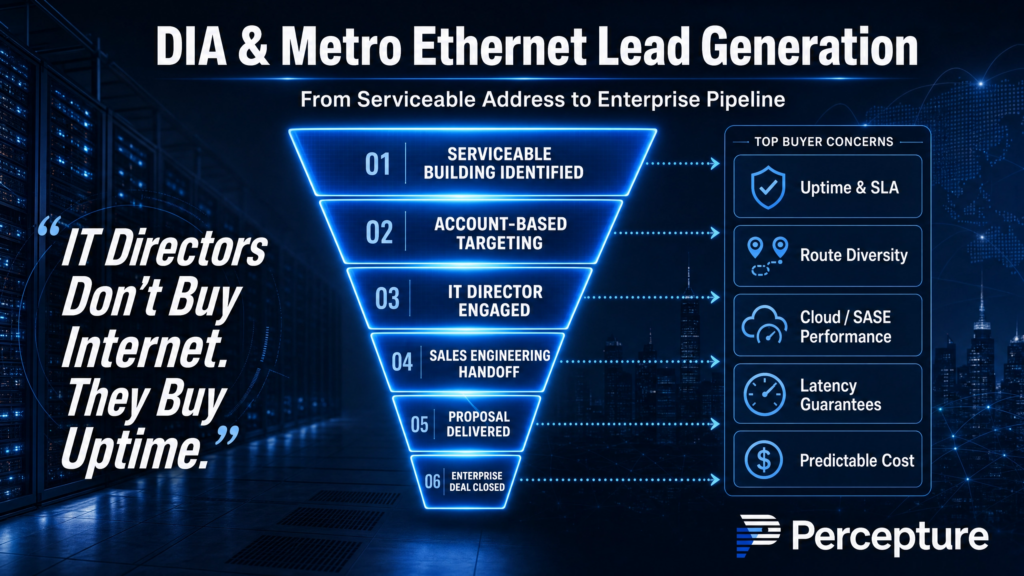

From expertise to qualified demand
Turn technical DCI authority into a visible market position
Percepture helps telecom, fiber, cloud and data center companies organize technical expertise into search architecture, AI-ready answers, digital PR proof and lead-generation paths.
Common Layer 2 vs Layer 3 DCI mistakes
Most Layer 2 vs Layer 3 DCI mistakes come from selecting a logical service before validating the dependency, operating responsibility or shared physical path.
- Stretching Layer 2 in case it becomes useful later
- Allowing a temporary migration bridge to become permanent
- Classifying dark fiber as Layer 3
- Treating VXLAN as a complete architecture
- Deploying EVPN without BGP operating skill
- Confusing logical diversity with physical diversity
- Assuming private connectivity is encrypted
- Ignoring MTU or stateful-path symmetry
- Testing the circuit without testing the application
- Selecting a provider before defining demarcation and ownership
Final decision
- Start with separate routed sites.
- Prove every same-subnet dependency.
- Keep each Layer 2 extension narrow, monitored and removable.
- Use EVPN/VXLAN when mixed services or scale justify it.
- Prove physical diversity and application recovery before production.
The defensible Layer 2 vs Layer 3 DCI rule is simple: route by default, bridge with evidence, and test where the packets meet the pipe.
Frequently asked questions
What is the difference between Layer 2 and Layer 3 DCI?
In a Layer 2 vs Layer 3 DCI comparison, Layer 2 DCI bridges an Ethernet segment between sites and can preserve same-subnet adjacency. Layer 3 DCI routes traffic between separate site networks. Routing is the normal starting point because it creates clearer boundaries. A selective EVPN/VXLAN design can carry approved Layer 2 segments over a routed underlay when a verified application dependency requires them.
Is Layer 2 or Layer 3 better for data center interconnect?
Layer 3 is the better default for most new designs because it separates site networks and supports explicit route policy. Layer 2 is appropriate when a current, documented workload requirement cannot be met safely through routing, load balancing, DNS, service discovery or application changes. The final choice still depends on topology, skills, physical paths and recovery testing.
When is Layer 2 extension required?
A Layer 2 extension may be required when a specific workload must retain the same IP or subnet across sites. Examples can include a validated migration, cluster or legacy licensing design. The application owner should document the exact platform and version requirement, acceptable blast radius, security controls, latency and MTU limits, recovery test and removal plan.
Does Layer 3 DCI require changing IP addresses?
No. Layer 3 DCI does not always require an address change. A service may move behind a load balancer, preserve a service identity while backends change, use anycast, or shift users through DNS or service discovery. Some workloads will be deliberately renumbered, while a narrow Layer 2 exception may preserve an address when the dependency is verified.
What is EVPN/VXLAN DCI?
EVPN/VXLAN DCI uses VXLAN to encapsulate Ethernet traffic across an IP network and EVPN with MP-BGP to exchange reachability information. It can support selective Layer 2 extension and integrated routing. It still requires a stable underlay, route policy, BGP skill, security controls, physical diversity and visibility into both overlay and underlay behavior.
Can dark fiber carry Layer 2 and Layer 3?
Yes. Dark fiber is a physical transport, not a Layer 2 or Layer 3 service by itself. The customer selects the optics, equipment and logical architecture placed over it. That architecture can carry Ethernet bridging, IP routing or both. Buyers should evaluate the physical route, entrances, cross-connects, equipment, protection and operational ownership separately from the logical boundary.
How should Layer 2 vs Layer 3 DCI be tested?
A Layer 2 vs Layer 3 DCI proof of concept should test the application dependency, latency, loss, jitter, MTU, BUM behavior, MAC movement, loop containment, BGP policy, convergence, ECMP, security controls and application recovery. It should also fail links, devices, gateways and sites while checking overlay, underlay, support and rollback behavior.
Can PacketFabric support Layer 2 and Layer 3 connectivity?
The supplied PacketFabric materials describe Ethernet DCI services and a Virtual Cloud Router service. Buyers should verify current endpoint availability, supported topology, VLAN and MTU handling, BGP and gateway ownership, physical route diversity, protection, encryption, demarcation, SLA terms and complete cost before selecting either path for a production design.
Technical visibility for infrastructure companies
Own the Layer 2 vs Layer 3 DCI questions buyers ask before the circuit order
Percepture helps telecom, data center, fiber and cloud companies turn Layer 2 vs Layer 3 DCI expertise and other technical knowledge into clearer search visibility, AI-ready answers, digital authority and qualified demand.

About the author
Bob Generale
Bob Generale is President of Percepture, a marketing, public relations, SEO and AI-search agency founded in 2004. He works with telecom, fiber, data center, cloud and complex B2B companies to turn technical expertise into clearer market positioning, search visibility and qualified demand.
His work connects engineering subject matter with buyer questions, entity clarity, digital PR, conversion architecture and the content systems used by Google and AI answer engines.