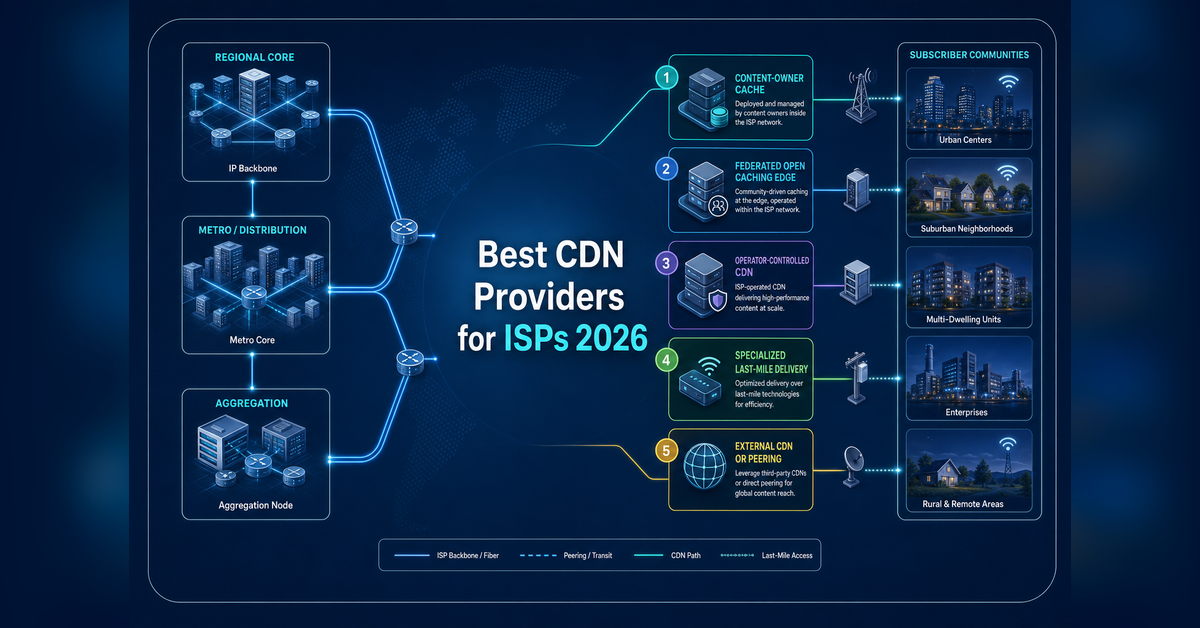

The best CDN for ISPs is not the same as the best CDN for a website. An ISP must compare where content is cached, which traffic is covered, how requests are steered, who operates each component, what happens on a miss, and whether the deployment improves network economics and subscriber experience.
For many operators, the right answer is a portfolio. A content-owner cache can localize eligible traffic from one source, a federated edge platform can support participating publishers, operator CDN software can provide more control, and peering or external delivery can remain part of the traffic strategy.






What is the best CDN for ISPs?
The best CDN for ISPs is the model or portfolio that matches the operator’s eligible traffic, subscriber geography, edge locations, control requirements, failure plan, operating resources, and full economic case. Qwilt, content-owner cache programs, operator-controlled CDN software, specialized last-mile platforms, and external CDNs address different jobs. They should not be treated as interchangeable products or ranked as one universal category.
Executive summary
Start with traffic
The best CDN for ISPs must localize bytes that matter on links that matter. Measure traffic by source, market, busy hour, and eligibility before selecting hardware or software.
Separate the models
A publisher cache, federated Open Caching implementation, private operator CDN, specialized last-mile platform, and external CDN have different content scope and operating duties.
Test failure paths
Cache misses are normal. The buying process must examine fill, stale delivery, fallback, overload, link failure, node failure, and recovery.
Use portfolio logic
An operator may combine publisher-specific programs, shared edge infrastructure, private software, peering, and transit rather than force one provider into every role.
Who should use this guide?
A best CDN for ISPs evaluation crosses financial, technical, capacity, product, and procurement responsibilities.
CEO and CFO
Use the best CDN for ISPs analysis to connect subscriber outcomes, resilience, avoided network spend, deferred upgrades, operating cost, and commercial risk.
CTO and network engineering
Use it to inspect topology, steering, content coverage, fill paths, telemetry, control, security, ownership, and failure behavior.
Peering and capacity teams
Use it to separate caching, peering, transit, and external delivery while measuring busy-hour effects.
Product and procurement
Use it to define subscriber quality metrics, support duties, data rights, contract terms, lifecycle responsibility, and exit conditions.
Why generic CDN lists fail ISP buyers
A generic comparison usually starts with website acceleration, security features, developer workflows, and publisher pricing. A best CDN for ISPs assessment instead starts with subscriber demand, constrained links, content eligibility, node placement, operational ownership, and traffic localization.
That difference changes the decision. The best CDN for ISPs cannot be selected from a feature checklist built for a website owner. The operator must identify where the request enters the network, where it can be served, where a miss is filled, and which link carries the fallback traffic.
Category errors create weak business cases. A content-owner appliance does not serve every publisher. Peering exchanges traffic but does not automatically store it. An external CDN may deliver traffic efficiently without giving the ISP a shared on-net cache. Readers who need the underlying distinctions can review edge cache and CDN differences.
The five ISP content-delivery models
| Model | Primary job | Best fit | Main limit |
|---|---|---|---|
| Content-owner cache | Localize eligible content from one owner | A measurable share of traffic comes from that owner | It is not a multi-publisher CDN |
| Federated Open Caching and ISP edge | Use service-provider edge capacity and interfaces for participating delivery relationships | Operators evaluating multi-publisher edge delivery | Coverage, control, logs, ownership, and terms must be established |
| Operator-owned or licensed CDN | Give the operator more direct control of the delivery stack | Operators with sufficient scale, skills, and content relationships | Integration and lifecycle responsibility increase |
| Specialized last-mile platform | Address a defined remote, rural, or constrained delivery use case | Markets where a specialized architecture matches the physical problem | The fit cannot be generalized across every network |
| External CDN, cloud CDN, or peering | Deliver or exchange traffic outside a shared ISP-hosted cache model | Traffic that remains external or benefits from better interconnection | It may not provide shared on-net caching |
The best CDN for ISPs often combines two or more rows. The portfolio should reflect traffic concentration, geography, subscriber density, available facilities, operating skill, and the cost of constrained paths.
The Percepture ISP CDN Fit Matrix
The Percepture ISP CDN Fit Matrix is a six-part methodology for deciding whether to deploy, expand, pilot, complement, or wait. It applies the same best CDN for ISPs questions to every option instead of awarding unsupported provider scores.
- Traffic fit: Measure traffic by source, application, market, and busy hour. Separate total bytes from traffic that is eligible for the proposed delivery model.
- Edge placement: Name the building, node, aggregation layer, regional core, middle-mile path, fill route, and subscribers served. “Edge” without a physical and logical location is not enough.
- Content coverage: Establish participating traffic, formats, and markets. Separate technical compatibility from contracted or active coverage.
- Control and interoperability: Test steering, application programming interfaces, logs, purge, time-to-live policy, role-based access, privacy, data export, and exit.
- Operations and resilience: Test cold starts, misses, fill, stale behavior, overload, node and site failure, software changes, monitoring, escalation, rollback, and disaster recovery.
- Economics and subscriber QoE: Compare avoided transit or backhaul, deferred upgrades, direct costs, people costs, support effects, and measurable quality of experience.
Under this framework, the best CDN for ISPs is the option that survives both the traffic test and the operating test. A promising cache ratio cannot compensate for weak content coverage, poor placement, an expensive fill path, or unclear failure ownership.
Free ISP planning tool
Score your CDN and caching strategy before the pilot
Use one scorecard to compare traffic fit, content coverage, edge placement, control, resilience and economics. The goal is a cleaner shortlist and a pilot with measurable pass-or-fail criteria.
- Map eligible traffic
- Test the miss and failure path
- Model the full annual value
Best CDN for ISPs comparison by operating model
Some entries are content-owner programs, some are commercial platforms, and some are operator CDN products. A best CDN for ISPs comparison groups them because an ISP may evaluate each model when building a traffic-localization strategy, not because they are identical products.
| Provider or program | Model | Best for | Content scope | ISP control | Deployment | Main limit | Buyer proof required |
|---|---|---|---|---|---|---|---|
| Qwilt | Federated Open Caching and service-provider edge | Operators evaluating participating multi-publisher edge delivery | Traffic supported through applicable publisher and delivery relationships | Depends on architecture and agreement | Service-provider edge | Participation cannot be assumed for all content | Active traffic, locations, ownership, steering, logs, security, fallback, support, economics, and exit |
| Netflix Open Connect | Content-owner cache and interconnection program | Eligible Netflix traffic | Netflix content | Program-specific | Interconnection or qualifying embedded deployment | Not a general-purpose CDN | Eligibility, placement, routing, facilities, operations, capacity, and reporting |
| Google cache and peering infrastructure | Content-owner infrastructure and peering | Eligible Google traffic | Google platform traffic covered by the applicable arrangement | Program-specific | Peering or applicable network deployment | Not a multi-publisher CDN | Current program, eligibility, traffic scope, equipment, operations, and telemetry |
| Velocix | Operator-controlled CDN software and services | Operators seeking more architecture and policy control | Depends on deployment and content relationships | Potentially high | Operator-selected architecture | More control brings integration and lifecycle work | Architecture, formats, integrations, analytics, staffing, upgrades, support, and exit |
| Netskrt | Specialized last-mile edge CDN | Defined rural, remote, or constrained streaming use cases | Depends on active content relationships | Deployment-specific | Last-mile or local edge locations | Specialized fit is not universal | Content, footprint, hardware, telemetry, references, support, and economics |
| External commercial CDNs | External or publisher-facing CDN | Off-net delivery and publisher-controlled distribution | Customer and platform dependent | Limited from the ISP perspective | External network edge | Not automatically an ISP-hosted shared cache | Traffic path, interconnection, telemetry, failure behavior, and any separate embedded program |
No row receives a universal rank. The useful comparison is model, fit, limitation, and proof. That makes the best CDN for ISPs a network decision rather than a brand popularity contest.

Provider profile
Where Qwilt fits service-provider edge delivery
Qwilt describes its offering as service-provider edge infrastructure using distributed edge nodes, cloud-based control, Open Caching and APIs. It fits the federated edge category rather than the content-owner appliance category.
Before moving forward, verify active publishers and traffic by market, node ownership, hardware duties, steering, logs, security, fallback, support, commercial commitments, data rights and exit procedures.
Review Qwilt Edge Cloud for ISPsDisclosure: Qwilt is a featured Percepture partner for this guide. The article also includes competing delivery models, limitations and buyer-verification questions.
How publisher-specific caches fit the portfolio
Netflix Open Connect
Netflix documents Open Connect as its content-delivery program, including settlement-free interconnection and embedded Open Connect Appliances for qualifying networks. An ISP should evaluate it when eligible Netflix traffic represents a meaningful network use case.
The program remains a Netflix delivery complement, not a general-purpose CDN. Review current eligibility, appliance placement, rack space, power, ports, routes, fill, maintenance, capacity, reporting, and failure behavior through the official Netflix Open Connect documentation.
Google traffic and peering infrastructure
Google-related infrastructure belongs in the content-owner and peering category. The buyer should establish the current program name, eligibility, content scope, equipment duties, routing, telemetry, operations, and fallback directly for the proposed network and market.
Neither publisher-specific option should be called the best CDN for ISPs across all traffic. Each can be valuable when the eligible traffic source and physical placement justify it, and each can sit beside a federated edge platform, private CDN, or stronger peering strategy.
Operator-controlled and specialized CDN options
Velocix for operator control
Velocix represents the operator-owned or licensed CDN category. This model is relevant to a best CDN for ISPs evaluation when the operator wants more control over architecture, policy, capacity, integrations, or service design and has the resources to carry the associated work.
Evaluate live and on-demand support, control-plane design, multitenancy, analytics, integrations, managed services, upgrades, security, staffing, and lifecycle ownership. More control can be strategically useful, but it can also move more responsibility into engineering and operations.
Netskrt for a specialized last-mile case
Netskrt is positioned in the supplied research as an option for rural, remote, and last-mile streaming use cases. Treat it as a specialized candidate rather than a default answer for every ISP.
Before placing it in a best CDN for ISPs shortlist, establish active content relationships, supported traffic, deployment footprint, hardware requirements, telemetry, operating responsibilities, references, fallback, and market-level economics.

Talk with Bob Generale
Make your ISP CDN story easier to understand and easier to buy
Percepture helps network and infrastructure companies explain technical differences without flattening the engineering. We connect the right buyer questions to search visibility, AI discovery, digital PR and qualified demand.
What you will get: a focused review of your positioning, proof, buyer journey and visibility gaps.
Request a Telecom Visibility ReviewWhere external commercial CDNs fit
Akamai, Cloudflare, Fastly, and Amazon CloudFront are external or publisher-facing content-delivery networks. They can affect how traffic reaches an ISP and where interconnection occurs, but that does not make them identical to a shared cache installed inside the operator’s network.
The ISP should examine traffic paths, peering locations, congestion, telemetry, and fallback. Any embedded-network program should be evaluated separately. The best CDN for ISPs decision must preserve the distinction between the CDN serving a publisher and infrastructure the ISP hosts or controls.
Peering vs. transit vs. CDN vs. caching
The best CDN for ISPs assessment should document how each mechanism changes the traffic path, economic effect, and fallback plan.
| Mechanism | Purpose | Typical location | Controller | Economic effect | Failure or fallback question |
|---|---|---|---|---|---|
| Peering | Exchange traffic directly | Interconnection facility or private link | Participating networks | Changes traffic exchange and upstream path | Where does traffic move if the session or link fails? |
| Transit | Purchase reach to the wider internet | Upstream connection | Transit provider and customer | Creates a contracted upstream cost | Which alternate upstream path carries traffic? |
| CDN | Coordinate distributed delivery | Provider, cloud, exchange, or operator locations | CDN operator under the delivery arrangement | Can change delivery path and resource use | Which node, region, or origin serves the request next? |
| Cache | Store eligible content near demand | On-net, near-net, regional, or external edge | Depends on the cache program | Can reduce repeated traffic on selected paths | How are miss, fill, stale content, overload, and recovery handled? |
“Peering is the road. Caching is the local warehouse. Both keep traffic off the long-haul highway, but they work at different layers.”
Hunter Newby, approved AI-assisted Percepture interview based on his interconnection knowledge base


Which model is best for your ISP?
Use observed network conditions to narrow the best CDN for ISPs model before comparing individual providers or programs.
| Observed situation | Model to evaluate | Decision condition |
|---|---|---|
| One eligible publisher dominates a constrained path | That publisher’s cache or interconnection program | Eligible bytes, placement, and operating duties produce a defensible market case |
| Diverse, high-volume streaming crosses constrained links | Federated or multi-publisher edge delivery | Active content coverage and locations match the network |
| The operator wants architecture and policy control | Operator-controlled CDN software | Scale, engineering capacity, content relationships, and lifecycle resources support ownership |
| A rural or remote path creates a distinct delivery problem | Specialized last-mile platform | The provider can document content, placement, operations, telemetry, and economics for that market |
| Traffic is low, fragmented, or well served upstream | Peering, transit improvement, external delivery, or a limited pilot | On-net caching does not yet produce a strong case |
| Several conditions exist at once | Portfolio | Each component has a defined traffic scope, owner, metric, and fallback path |
The best CDN for ISPs with mixed traffic is often a portfolio. The operator should avoid paying twice for the same benefit, creating conflicting steering rules, or leaving failure ownership between vendors.
How to test the economics of the best CDN for ISPs
Begin the best CDN for ISPs economic test with a market baseline: traffic by source and application, busy-hour and 95th-percentile upstream demand, unit costs, congestion windows, subscriber quality indicators, support patterns, existing peering, installed caches, rack capacity, power, ports, and planned network upgrades.
Annual net value = transit, backhaul, or egress avoided + upgrades deferred + measurable support, retention, or QoE value + delivery or partnership revenue − hardware, cloud, and licensing − rack, power, ports, and cross-connects − integration and engineering − monitoring, security, and operations − support, refresh, and exit costs.
“Always measure in dollars, not just percentages.”
Hunter Newby
A hit rate is not an economic result. Show request hits and byte hits, average and busy-hour performance, constrained-link offload, fill traffic, latency, loss, utilization, startup time, rebuffering, throughput, errors, availability, failover, mean time to repair, and NOC effort.
A high request hit rate on small objects can save fewer bytes than a lower byte-hit rate on video. The best CDN for ISPs should therefore be evaluated by the traffic removed from the target path, the subscriber outcome, and the full annual cost.
What happens on a cache miss or failure?
A cache hit serves an eligible object from the selected cache. A miss triggers a defined fill or fallback path. That event is expected behavior, not proof that the cache is broken.
“A cache miss isn’t a mistake. It’s a learning opportunity.”
Hunter Newby
To validate a best CDN for ISPs candidate, test cold and warm cache behavior, request collapse, time-to-live rules, purge, revalidation, stale delivery, fill latency, overload, and origin protection. Then fail a node, link, site, software component, and control plane. Record where traffic moves, whether subscriber QoE changes, how alarms fire, and who owns recovery.
The best CDN for ISPs must have a designed miss path and a tested failure path. A cache that performs well only during normal traffic does not provide enough evidence for production expansion.
Twenty-point proof-of-concept checklist
Apply this checklist to each best CDN for ISPs candidate under the same market, traffic, operating, and failure conditions.
- Choose representative markets and constrained paths.
- Capture at least two weeks of baseline data, including peaks.
- Split traffic by source, application, and eligibility.
- Map subscriber, node, fill, peering, and upstream paths.
- Document rack, power, ports, optics, addressing, and routes.
- Identify physical and logical failure domains.
- Obtain written content-participation scope for the pilot.
- Test portal access, APIs, roles, and permissions.
- Validate logs, timestamps, export, retention, and ownership.
- Compare request-hit and byte-hit rates.
- Measure constrained-link and busy-hour offload.
- Measure miss and fill latency.
- Test cold cache, warm cache, eviction, purge, and revalidation.
- Fail a node, link, site, software component, and control plane.
- Test overload, request collapse, stale delivery, and fallback.
- Measure subscriber QoE during normal and peak periods.
- Reconcile telemetry, reports, and commercial statements.
- Test NOC escalation, maintenance, rollback, and recovery.
- Model full annual economics by market.
- Set expand, revise, stop, and exit thresholds before launch.
Score each item for the buyer’s deployment: 0 means missing, 1 means partial or manual, and 2 means documented and tested. This is a readiness score, not a provider rating. The best CDN for ISPs should earn expansion through observed pilot evidence.
Common ISP CDN buying mistakes
A best CDN for ISPs process should explicitly guard against these category, measurement, infrastructure, and contract errors.
- Using a generic top-five provider list built for website owners.
- Treating one publisher’s appliance as a general-purpose CDN.
- Choosing from total traffic without measuring eligible traffic.
- Using hit ratio as the only performance or economic metric.
- Calling peering, transit, caching, and CDN delivery the same thing.
- Accepting the word “edge” without a building, path, and subscriber map.
- Ignoring fill capacity, route diversity, and origin protection.
- Leaving rack, power, ports, security, people, and refresh costs out of the model.
- Skipping busy-hour node, link, site, and control-plane failures.
- Signing without data rights, support duties, rollback, and exit terms.
These mistakes make the best CDN for ISPs look simpler than it is. A disciplined buyer defines the traffic, location, owner, metric, fallback, and economic threshold for every component.
Turning technical authority into qualified visibility
Percepture does not build or operate CDN infrastructure. Its role is to translate technical differentiation into accurate market categories, useful buyer education, search visibility, AI-answer visibility, digital public relations, and measurable buyer journeys.
That work can combine a telecom marketing agency perspective with enterprise SEO services, generative engine optimization services, digital PR services, technical content marketing, and B2B lead generation services.


Engagement options
See what an ISP visibility and demand program costs
Review Percepture’s engagement levels for technical content, SEO, AI search visibility, digital PR and qualified pipeline. The pricing page shows the starting points before you schedule a conversation.
View Percepture Pricing
Built for ISP growth teams
Turn network advantage into subscriber growth
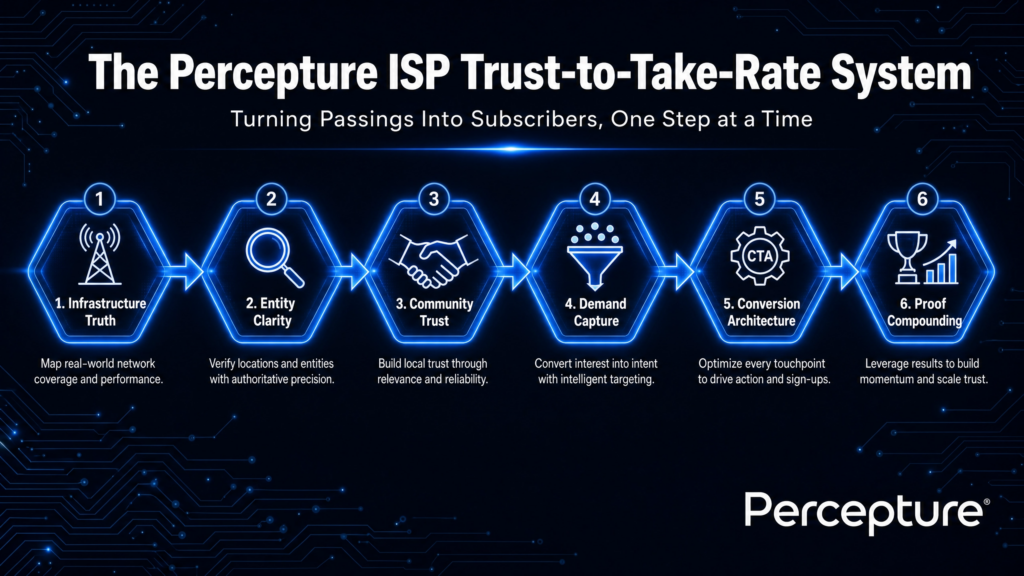
See how Percepture connects address-level demand, buyer education, local visibility, AI search, PR and lead follow-up to move more passings toward installs and subscribers.
Explore Percepture’s ISP Growth SystemFrequently asked questions
What is the best CDN for ISPs?
The best CDN for ISPs is the provider model or portfolio that matches eligible traffic, subscriber geography, edge placement, operating resources, failure requirements, and economics. A publisher cache may fit concentrated traffic, federated edge delivery may fit diverse participating traffic, and private CDN software may fit an operator seeking more control.
Does an ISP need its own CDN?
Not always. The best CDN for ISPs may be a portfolio of publisher caches, federated edge capacity, external CDNs, peering, transit improvements, or operator-controlled software. The decision depends on traffic concentration, constrained paths, subscriber density, content participation, facilities, operating skills, and whether the full annual value exceeds the deployment and lifecycle cost.
Is Netflix Open Connect a general-purpose CDN?
No. Netflix Open Connect is a Netflix content-delivery and interconnection program. It can be relevant for qualifying networks with material eligible Netflix traffic, but it does not provide general multi-publisher delivery. An ISP can evaluate it as one component of a broader caching, CDN, peering, and transit portfolio.
What is Open Caching?
Open Caching is a specification family intended to support interoperable content delivery using service-provider edge capacity. It is not a provider name. A commercial platform may implement Open Caching, while content participation, deployment, control, telemetry, ownership, support, and commercial terms still depend on the applicable relationships.
How does Qwilt fit an ISP CDN strategy?
Qwilt fits the federated Open Caching and service-provider edge category. It can be evaluated by operators seeking participating multi-publisher edge delivery rather than one content owner’s appliance. Buyers should establish active content by market, placement, steering, logs, ownership, security, fallback, support, economics, and exit terms.
What traffic level justifies an on-net cache?
There is no universal traffic threshold. The case depends on eligible bytes, busy-hour demand, constrained-link costs, placement, fill traffic, subscriber density, provider eligibility, rack and power costs, operating effort, resilience, and deferred upgrades. Model the decision by market and link instead of using a generic subscriber or traffic cutoff.
Which KPIs prove ISP CDN value?
The best CDN for ISPs scorecard should track local bytes and requests, constrained-link offload, peak and 95th-percentile reduction, fill traffic, latency, loss, byte-hit and request-hit rates, content coverage, miss latency, startup time, rebuffering, throughput, errors, availability, failover, NOC effort, avoided spend, deferred upgrades, and full net value by market.
Can an ISP use multiple CDN and caching providers?
Yes. A portfolio can combine content-owner caches, federated edge delivery, private CDN software, specialized last-mile platforms, peering, transit, and external CDNs. Each component should have a defined traffic scope, placement, steering rule, operating owner, metric, fallback path, commercial purpose, and exit condition.
Next step
Make your infrastructure company the clear answer
Percepture helps technical companies turn complex infrastructure into a clear category position, credible proof, search and AI visibility, digital PR and qualified conversations.
Start with: a 30-minute strategy conversation focused on your market, priority buyers and the proof needed to win.
Book the Strategy Conversation
About the author
Bob Generale, President of Percepture
Bob Generale works with telecom, fiber, data-center and complex B2B companies on search strategy, AI visibility, digital PR, buyer education and demand generation. His work focuses on making technical categories easier for buyers, search engines and answer systems to understand.
Percepture was founded in 2004 and combines senior strategy, content, SEO, GEO, PR, analytics and conversion planning in one growth system.