

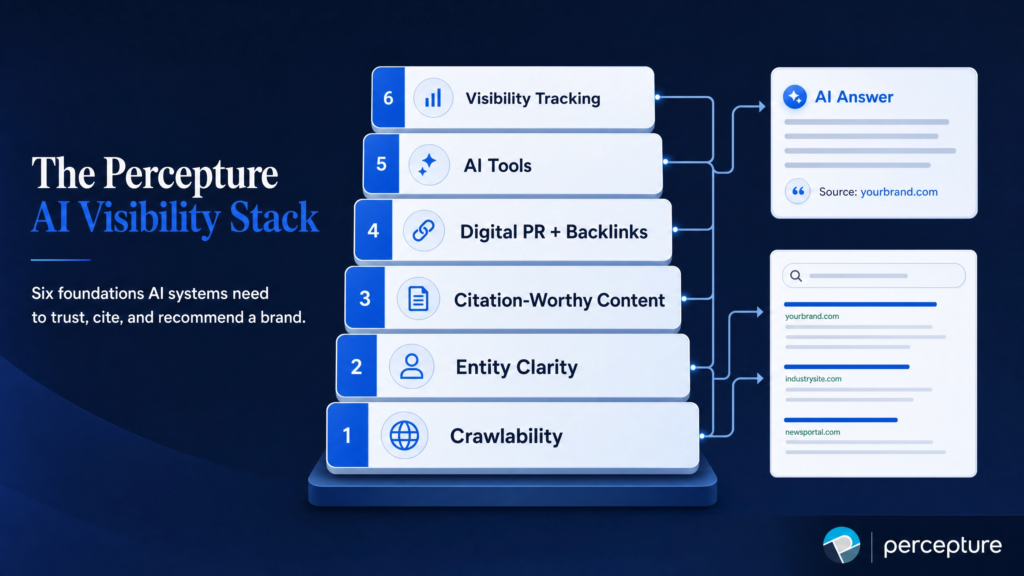
An AI visibility expert helps a brand improve how it is found, described, cited, and considered in AI-assisted search. The work connects buyer questions, technical SEO, useful content, source quality, entity clarity, authority, and conversion. It is not limited to watching prompts or adding markup.
The proof standard should be simple. The expert should show where the brand appears, which sources shape the answer, what is missing or inaccurate, what can be changed, and why the change matters to the business. Claims without a question, engine, date, source, and next action are weak evidence.
AI-search strategy built on search, authority, and measurable action
Percepture has worked across telecom, data centers, life sciences, staffing, SaaS, and other complex B2B categories since 2004. This guide reflects active work in SEO, GEO, digital PR, executive visibility, analytics, and search-to-sales execution.
What is an AI visibility expert?
An AI visibility expert measures how a brand appears across important AI-search questions, traces those answers to sources, diagnoses technical and authority gaps, and directs the work needed to improve accurate discovery. The role extends SEO into AI answers while keeping search fundamentals, evidence, and commercial outcomes in view.
Four principles that separate useful work from dashboard theater
Measure the right questions
Start with the questions buyers ask while defining a problem, comparing options, and selecting a provider. A large prompt list has little value when it is detached from buying intent.
Separate the evidence
A mention, citation, and recommendation are different observations. Record each separately, along with the engine, mode, date, answer, and cited source.
Fix the actual bottleneck
The gap may sit in crawlability, content, entity clarity, third-party authority, digital PR, or conversion. A specialist should identify the owner and action, not just display a score.
Connect visibility to demand
Useful reporting combines search health, repeated AI observations, source patterns, referral activity, conversions, and sales feedback. Visibility is a means, not the final business result.
When the role is a good fit
Your market is already changing
Buyers are using AI-assisted research, but the company cannot explain where it appears or which sources influence the answers.
Teams have disconnected data
SEO, content, PR, analytics, and sales each hold part of the picture. An AI visibility expert can own the question-to-source-to-action loop.
A dashboard has stalled
The company can see prompt observations but lacks a system for prioritizing, publishing, earning authority, and measuring qualified action.
What does an AI visibility expert actually do?
The job begins before anyone opens a tracking tool. First, identify a compact set of valuable buyer questions. These should reflect the language used by executives, evaluators, and technical stakeholders as they move from a problem to a decision.
That question set creates a stable measurement base. The expert can then observe whether the brand is mentioned, cited, or recommended; which competitors appear; and which sources support the response. Results should remain separated by engine and mode because one blended score can hide the real gap.
- Establish buyer questions. Map questions to commercial categories, buyer stages, and decision risks.
- Record dated observations. Capture the exact prompt, engine, mode, response, brand presence, and cited sources.
- Inspect the source set. Determine whether engines rely on the brand’s site, independent publications, directories, forums, competitors, or other sources.
- Diagnose the gap. Test crawlability, indexing, snippet eligibility, content quality, entity consistency, authority, and reputation signals.
- Assign and implement fixes. Route work to technical SEO, editorial, subject-matter experts, digital PR services, development, or conversion teams.
- Rerun and connect. Recheck the stable question set and compare findings with organic performance, referrals, qualified actions, and sales use.
This work still depends on a sound search foundation. Google’s current guidance says established SEO practices remain relevant to AI Overviews and AI Mode, with no extra technical requirements or special AI schema. Review the Google Search Central guidance for AI features, Percepture’s guide to organic SEO services, and its generative engine optimization services.
AI visibility expert vs. SEO expert vs. GEO consultant vs. software
AI visibility extends SEO; it does not replace it. Search engines and AI-answer systems still need accessible pages, clear information, and trustworthy sources. AI visibility work also studies how selected systems assemble, represent, and support answers.
Choose the model that matches the current bottleneck
| Option | Main job | Measures | Changes | Best fit | Common limitation |
|---|---|---|---|---|---|
| SEO expert | Improve organic discovery and search performance | Queries, pages, rankings, clicks, and technical health | Technical SEO, content, and internal authority | Brands with weak organic foundations | May not inspect AI answers or source patterns |
| GEO consultant | Improve discovery in generative and AI-assisted search | Mentions, citations, sources, and answer patterns | Content, entities, sources, and authority | Brands extending a sound SEO program | May lack implementation capacity |
| AI visibility expert | Connect search, AI answers, sources, authority, and business action | Search health, engine-level observations, citations, accuracy, and outcomes | Prioritized work across SEO, GEO, content, PR, and conversion | Leaders who need senior diagnosis and accountable action | Results still depend on access, execution, and third-party systems |
| Software | Collect and organize observations at scale | Prompts, responses, sources, competitors, and trends | Usually none without a human operating team | Teams with owners ready to interpret and act | A dashboard cannot validate every claim or choose the right business response |
| In-house team | Apply daily company and market context | Internal and external performance data | Work within available skills and capacity | Companies with cross-functional ownership | Specialist coverage may be uneven |
A SaaS company often needs more than a single specialist. Technical teams may handle access and templates, subject-matter experts may supply original knowledge, communications teams may build third-party authority, and revenue teams may define qualified action. Percepture’s omnichannel marketing approach is relevant when these workstreams must support one buyer journey.
The seven tests of a real AI visibility expert
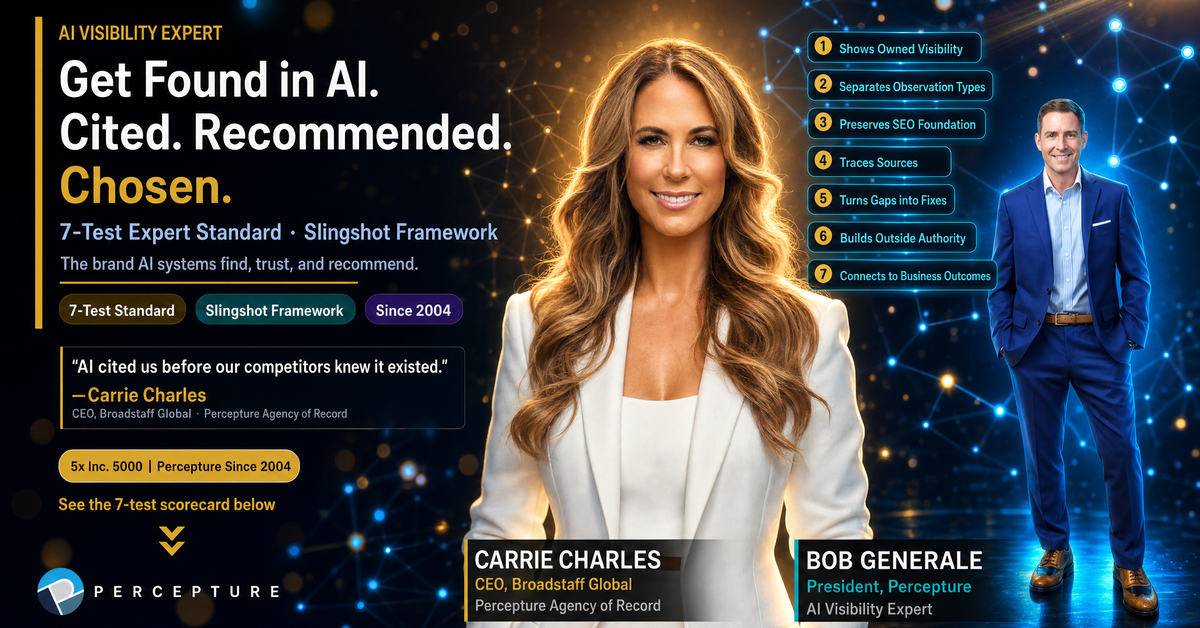
Anyone can adopt a new title. A safer buying decision comes from testing what the provider can demonstrate. The Percepture AI Visibility Expert Standard is a seven-point buyer framework. It is not a metric from Google, OpenAI, Bing, or any other platform.
Percepture AI Visibility Expert Standard
| Test | What strong evidence looks like | Buyer question |
|---|---|---|
| 1. Shows owned visibility | Dated examples with the query or prompt, platform, mode, and visible source | Can you demonstrate your method on your own organization? |
| 2. Separates observation types | Mentions, citations, and recommendations recorded as different fields | Are you measuring distinct events or rolling everything into one score? |
| 3. Preserves SEO | Technical access, indexing, content quality, and organic performance remain part of the plan | How does your work support our existing search foundation? |
| 4. Traces sources | Answers connected to cited pages, source types, and competitor evidence | Which sources are shaping this response? |
| 5. Turns gaps into fixes | Each finding has a priority, owner, action, and recheck method | What happens after the audit? |
| 6. Builds outside authority | The plan includes relevant earned sources instead of relying only on owned pages | How will you improve the source environment around our brand? |
| 7. Connects to business outcomes | Reporting includes qualified actions, referrals, conversion evidence, and sales use where available | How will this work support a real buying conversation? |
Scoring: 0–2 indicates weak coverage; 3–4 is incomplete; 5–6 is credible; and 7 indicates a strong fit for further evaluation. This score evaluates vendor coverage, not search-engine authority.
A credible specialist should also explain the limits. No provider controls how every AI system retrieves, summarizes, or changes an answer. Results can vary by wording, mode, date, account, and location. The goal is to improve the probability of accurate discovery through better access, content, sources, and authority.
Score your current AI visibility approach
Use the seven tests to evaluate whether an expert, agency, software platform, or internal program can provide the evidence and action you need. Record the evidence behind each point before deciding what to fix.
How AI visibility should be measured
AI visibility is not one score. A useful measurement system keeps engine-level observations intact and places them beside organic search data, source evidence, and business outcomes. A single number may be convenient, but it can conceal a strong result in one system and a weak result in another.
Begin with a defined question set and dated observation window. For each question, record the engine and mode, the full response, whether the brand was mentioned, whether a source was cited, whether a recommendation occurred, and which competitors appeared.
Next, inspect the cited pages and source types. Determine whether the answer depends on a competitor, independent publication, directory, forum, or owned page. That source map tells the team whether the response calls for better content, stronger entity signals, technical repairs, earned authority, or reputation work.
Prompt tracking is directional. Repeating a stable, commercially useful set is more informative than reporting one favorable response as a permanent rank. Google Search Console and a technical SEO audit service remain important because AI visibility cannot compensate for pages that search systems cannot reliably access or understand.
A practical measurement cycle
- Observe. Define buyer questions, engines, modes, and dates. Capture mentions, citations, recommendations, sources, and competitors separately.
- Diagnose and act. Find the bottleneck, select the business priority, assign an owner, and implement the most credible fix.
- Recheck and connect. Rerun the stable set and compare the change with organic search, referrals, conversions, and sales feedback.
Software can make observation faster. An AI visibility expert still decides which questions matter, whether a claim is true, whether a source deserves trust, and what the company can credibly publish. Prime provides measurement and intelligence; Percepture applies strategy and managed execution. Observation without action rarely changes the buyer’s experience.
The Percepture AI Visibility Slingshot
The AI Visibility Slingshot turns scattered findings into a repeatable operating system. It follows six stages: Detect, Select, Build, Launch, Activate, and Compound.
From evidence to compounding authority
Detect
Map buyer questions, organic search performance, AI responses, citations, source patterns, competitors, media, and entity gaps.
Select
Choose an opening tied to a commercially important category or decision. Do not spread resources across every possible prompt.
Build
Create a clear answer supported by original expertise, evidence, structured information, useful media, and relevant internal links.
Launch
Publish the asset so it is crawlable, indexable, snippet eligible, and understandable to people and machines.
Activate
Support the asset through SEO, GEO, PR, executive commentary, partners, sales use, and other legitimate discovery surfaces.
Compound
Extend proven demand into related resources, service authority, case evidence, executive profiles, and sales materials.
This framework keeps the work focused on a commercially important decision instead of chasing every variation. The build stage can involve content marketing; activation may require public relations and earned sources; and conversion rate optimization can make resulting traffic more useful.
What proof should an AI visibility expert show?
Proof should match the claim. A screenshot can show an observed answer, but it cannot establish a permanent position. Search Console can document organic exposure, but it does not prove that an AI system recommended the brand. A CRM record can support a business outcome only when attribution and qualification are defined.
Match each claim to the right evidence
| Claim | Strong evidence | Weak evidence |
|---|---|---|
| “We rank” | Query, page, engine, date, and Search Console or visible-result evidence | An undated screenshot without the query or page |
| “We are cited” | Exact prompt, platform, mode, date, answer, and source URL | One unexplained brand mention |
| “We improved visibility” | A stable before-and-after method with engine-level records | A proprietary blended score without its inputs |
| “We built authority” | Relevant earned sources connected to the subject and entity | Random or paid mentions with no topical value |
| “We drove business” | Qualified lead, CRM, conversion, or sales-use evidence with a defined window | A traffic chart by itself |
Percepture measures the visibility it also has to earn
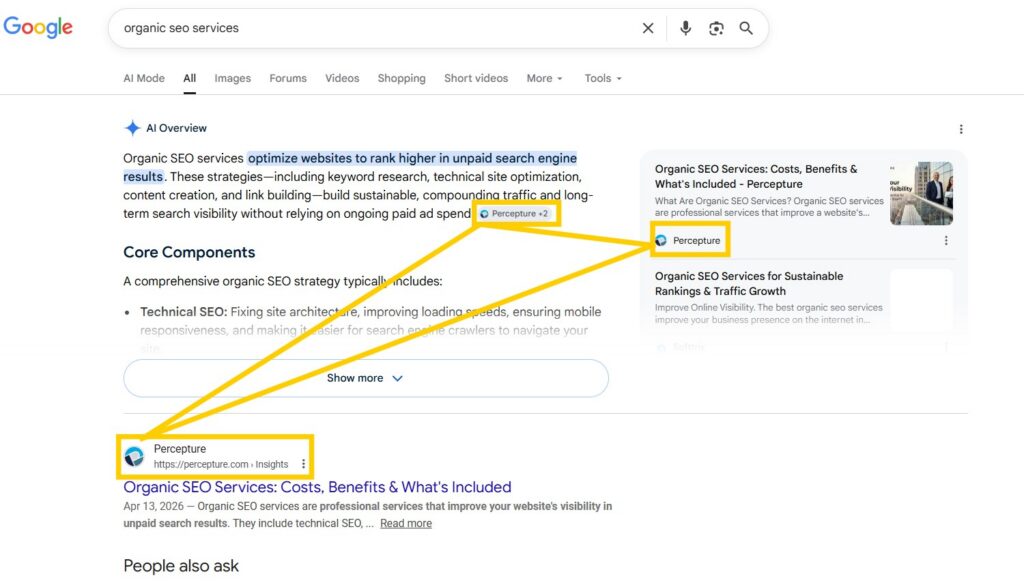
A credible partner should be able to apply its method to its own organization. This dated result example shows the evidence Percepture retains while separating observed visibility from a permanent-ranking promise.
GEO visibility requires the same evidence discipline
AI-assisted answers should be recorded with the prompt, platform, mode, date, response, and source context. A screenshot is an observation to investigate—not a universal or permanent rank.
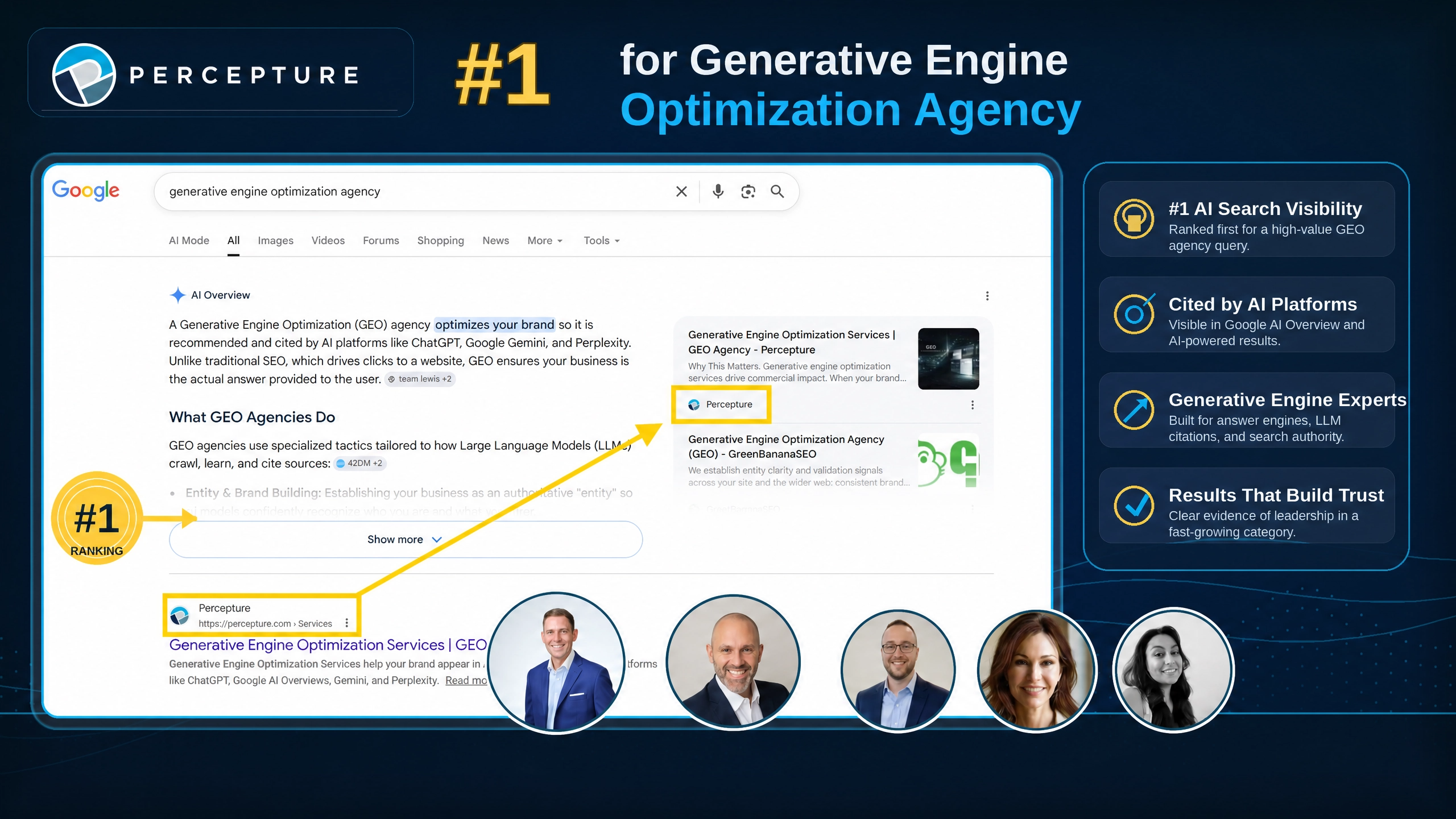
Ask a provider to walk through one example from question to business reason. A real AI visibility expert should show the question, engine, answer, source, gap, fix, and reason for doing the work. If any link is missing, the proposed program may be observation rather than implementation.
Percepture’s article on SEO sprints offers one model for turning diagnosis into focused execution. Its guide to choosing among SEO experts provides additional vendor-evaluation context.
Expert, agency, software, or in-house team?
The right structure depends on the size of the gap and the people available to close it. Choose an expert when senior diagnosis and cross-functional direction are immediate needs. An agency can coordinate technical, editorial, PR, analytics, and conversion work. Software can monitor observations. An internal team brings daily product, customer, and market context.
| Model | Choose it when | Plan around |
|---|---|---|
| Solo expert | You need senior diagnosis, a roadmap, or executive guidance | Limited production capacity and dependence on internal teams |
| Agency | You need coordinated strategy and execution across several disciplines | Clear access, ownership, subject expertise, and governance |
| Software | You have people ready to interpret data and implement fixes | Method transparency, sampling limits, and lack of direct execution |
| In-house | You have steady demand, specialist skills, and operating capacity | Coverage gaps across search, PR, content, and measurement |
| Hybrid | You need external specialization with internal product and market knowledge | Defined decision rights, reporting rules, and handoffs |
For SaaS companies, a hybrid model is often worth evaluating because product accuracy, technical implementation, and subject expertise usually sit inside the company. External teams can add search, measurement, authority, and execution capacity. The SaaS SEO agency guide covers related fit questions.
What does an AI visibility expert cost?
There is no responsible universal price. Cost depends on the question universe, engines and modes monitored, technical access, number of products or markets, content remediation, authority work, reporting depth, and who implements changes.
An audit-only engagement should cost less than a managed program because it stops after diagnosis and prioritization. A program that includes technical fixes, subject-matter interviews, content production, digital PR, distribution, analytics, and conversion has a wider scope. Compare deliverables, owners, and recheck methods instead of treating a dashboard subscription and execution program as the same service.
Review Percepture’s published GEO pricing and package factors for a clearer view of scope. If the program spans demand creation, media, and conversion, Percepture pricing options provide broader planning context.
Compare scope before you compare price
Ask each provider to list the questions, platforms, technical work, content, authority building, reporting, and implementation included in the proposal. A low price can still be expensive when the result is a dashboard with no owner or action plan.
Red flags to avoid
Be cautious when a provider guarantees rankings, mentions, or citations. Search and AI platforms control retrieval and presentation. A provider can improve access, relevance, sources, and authority but cannot promise a permanent response across every user, date, location, and mode.
- Guaranteed AI citations or permanent rankings
- A secret schema that allegedly bypasses normal search requirements
- Claims that one text file is a Google AI ranking lever
- One favorable prompt presented as a stable rank
- No Search Console, crawlability, or technical SEO review
- A dashboard without priorities, owners, or implementation
- Mass production of thin pages for every prompt variation
- Claims that a provider can train a public AI system on demand
- Proof without the platform, mode, date, question, or source
- Reporting that stops at share of voice and ignores qualified action
An experienced specialist should correct these assumptions before a contract is signed. Google says no special AI schema or AI text file is required for its AI features. OpenAI separately documents the controls publishers can use for OAI-SearchBot and its other crawlers. Straight answers about limits are part of the proof standard.
Frequently asked questions
Can an AI visibility expert guarantee citations?
No. An expert can improve crawlability, content quality, entity clarity, source coverage, and authority, then measure repeated observations. No provider can guarantee that every AI system will cite or recommend a brand for every wording, user, date, location, or mode.
How long does AI visibility work take?
Timing depends on the bottleneck and implementation scope. Technical access issues may be addressed faster than authority, reputation, or source gaps. A sound plan defines a baseline, implements prioritized fixes, and reruns the same useful question set instead of promising a universal deadline.
Is AI visibility just SEO?
No, but the two are connected. SEO supports crawlability, indexing, page quality, and organic discovery. AI visibility adds engine-level answer observation, citation analysis, source mapping, entity accuracy, and recommendation context.
Does special AI schema improve rankings?
Google does not require special AI schema for its AI features. Structured data can still help systems understand eligible page content when it accurately matches visible content. It is not a hidden shortcut or a substitute for accessible, useful information.
Does llms.txt improve Google AI rankings?
Google does not require a special AI text file for visibility in its AI features. Buyers should not treat llms.txt as a proven Google ranking lever. Technical priorities should begin with crawlability, indexing, snippet eligibility, content quality, and clear site architecture.
How often should AI visibility be measured?
Use a stable schedule that fits the buying cycle, publishing cadence, and pace of implementation. Keep the same commercially useful question set long enough to observe patterns while recording the engine, mode, and date. Avoid major decisions from one response.
What happens after an AI visibility audit?
The team should trace weak or inaccurate answers to likely sources, identify the technical, content, entity, authority, or conversion gap, assign an owner, and implement the fix. Then rerun the same question set and compare it with organic and business data.
How can a company correct inaccurate AI information?
First identify the exact inaccurate statement and the sources supporting it. Correct owned pages, strengthen entity consistency, and address relevant third-party sources where possible. Recheck the same question over time. No provider can directly edit every public AI answer.
Bring the questions your buyers use to compare options
Meet with Bob Generale to review a focused question set, inspect the current search footprint, examine selected AI answers and sources, identify the likely bottleneck, and choose a practical next action.
No generic AI presentation. Bring a category, product, or question that matters to revenue.
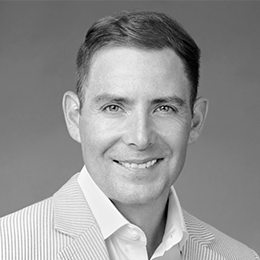
About Bob Generale
Bob Generale wrote and authored this guide. He is President of Percepture and advises owners, investors, executives, and revenue teams on SEO, GEO, AI-search visibility, digital PR, and search-to-sales strategy. His work turns complex market evidence into clear positioning, credible authority, and measurable commercial action.
Bob has led integrated growth programs in technical, regulated, and infrastructure-driven markets since 2004. He focuses on the decisions that matter to leadership: where a company is visible, what sources shape buyer trust, which gaps deserve investment, and how marketing supports a qualified conversation. Meet the Percepture team.