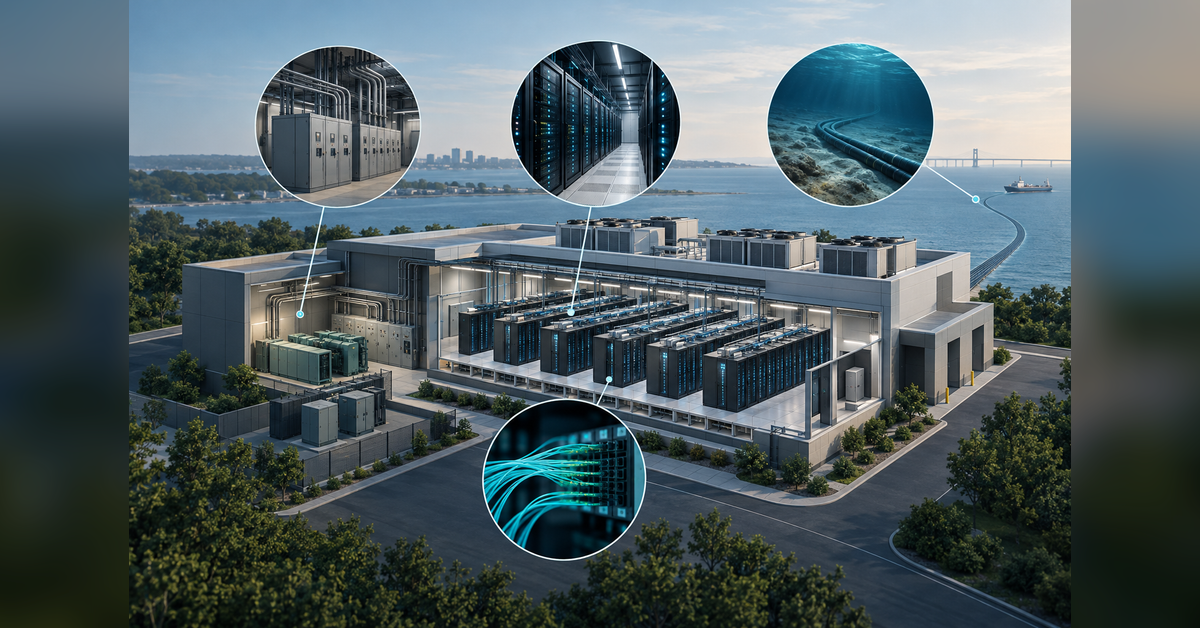

A campus name is not a deployment commitment. The best Virginia data centers for your business are the ones that can connect your required networks, support your equipment and deliver contracted power when you need to launch.
Start with the workload, then compare buildings—not regional marketing claims. This guide gives business leaders and infrastructure buyers a provider shortlist, a regional comparison and a practical way to separate an attractive proposal from a deliverable deployment.
What are Virginia data centers?
Virginia data centers are facilities that house computing equipment and supporting power, cooling, security and connectivity. Colocation buyers lease space and services rather than an entire building. This guide helps enterprise buyers compare Equinix, Digital Realty, CoreSite and Globalinx by use case, geography, interconnection, power, cooling, risk and contract terms—not a single statewide ranking.
Which providers belong on a Virginia colocation shortlist?
Use different starting points for different requirements. An enterprise connecting several networks, a GPU deployment with a demanding cooling specification and a business evaluating international routes should not receive the same recommendation simply because all three searched for Virginia colocation.
The shortlist below uses five purchasing criteria: network access, power commitment, cooling compatibility, physical diversity and all-in contract cost. It identifies alternatives to investigate, not measured winners. Regional descriptions establish where to start; building-specific proposals establish what you can buy.
Virginia Colocation Decision Matrix
| Buyer use case | Geography | Provider or facility example | Published starting point | Evidence to request before selection | Primary source |
|---|---|---|---|---|---|
| Evaluate an Ashburn deployment | Ashburn / Loudoun | Equinix Ashburn campus | Equinix’s Washington, DC regional directory includes its Ashburn facilities. | Exact building and suite; required carriers and cloud access; cross-connect terms; committed power; cooling configuration; physical routes. | Equinix regional directory |
| Compare Northern Virginia deployment and expansion proposals | Ashburn / wider Northern Virginia | Digital Realty Northern Virginia facilities | Digital Realty publishes a Northern Virginia facility directory. | Specific facility and delivery phase; service scope; usable IT power; expansion rights; network handoffs; complete commercial schedule. | Digital Realty facility directory |
| Evaluate a Reston campus, including a GPU-specific inquiry | Reston / Fairfax | CoreSite VA1, VA2 and VA3 | CoreSite identifies its Reston campus facilities and describes VA3 as NVIDIA DGX-Ready. | Which building supports the proposed equipment; rack-level density; cooling delivery and support boundaries; network access; committed capacity. | CoreSite Northern Virginia overview |
| Investigate subsea-related connectivity | Virginia Beach / Hampton Roads | Globalinx data center and landing/interconnection project | A Virginia Beach announcement describes a Globalinx project involving Marea, Brusa and Dunant connections. | Service-ready handoff; cable-system access arrangements; terrestrial backhaul; carrier contract; route diversity; delivery milestones. | Virginia Beach project announcement |
Treat CoreSite’s DGX-Ready statement as a provider claim about VA3, not an independent benchmark or a promise that any proposed GPU configuration is supported. Request the engineering specification for your exact racks. A designation alone does not establish your cooling interface, available electrical allocation or delivery date.
Likewise, the Globalinx announcement describes a project. Do not turn an announced connection into a claim of a service-ready circuit. Virginia Beach’s landing and interconnection ecosystem also answers a different buying question from an inland campus comparison.
For Equinix and Digital Realty, require the exact building identifier in the proposal. A regional directory is useful discovery material, but it is not a substitute for a facility schedule.
Ashburn, Reston, Manassas, Richmond or Virginia Beach?
Use geography to organize the search, not to award automatic advantages in price, resilience or launch speed.
Ashburn and Loudoun: investigate the actual connection point
For an Ashburn proposal, name the networks, cloud destinations and counterparties you need to reach. Then ask whether each connection is available inside the proposed building, through a campus connection or through a separately purchased transport service. Keep those delivery models distinct in both the design and the budget.
Reston and Fairfax: evaluate the building, not the city label
CoreSite’s VA1, VA2 and VA3 provide specific Reston examples to investigate. Compare each proposed building against the same workload specification used for Ashburn. Do not assume that a Reston address settles the power, cooling or connectivity question—or that an Ashburn address settles it better.
Prince William and Manassas: reopen the same diligence questions
Include Prince William and Manassas when broadening the geographic search, but carry the same requirements into every request. Ask for utility milestones, access routes, carrier delivery, cooling support and expansion terms. Do not move a GPU workload there on the assumption that a different jurisdiction automatically resolves its constraints.
Richmond and Central Virginia: test the recovery design
If Richmond enters the shortlist as a recovery location, examine what it would actually separate. Request evidence about shared network paths, dependencies and operational access. A different city is a starting point for a resilience discussion, not a completed failure-domain assessment.
Virginia Beach and Hampton Roads: buy the whole route
For a Virginia Beach option, identify the relevant cable system, landing arrangement, terrestrial segment and final application destination. Ask for address-specific flood information and route drawings. Do not infer either resilience or unacceptable risk from a coastal address alone.
Why network concentration matters—and what it does not prove
Hunter Newby’s published chapter, Networks Go Where Networks Are, provides a useful way to think about interconnection: existing network relationships matter when evaluating where to connect.
Turn that principle into a purchasing question: Which of our required counterparties can we reach from this exact space, through which physical and commercial arrangements?
Keep three terms separate:
- Meet-me room, or MMR: a physical location where networks and customers can establish connections.
- Cross-connect: a physical connection between specified endpoints. Ask who supplies it, where it terminates and what it costs.
- Internet exchange, or IX/IXP: infrastructure through which participating networks exchange traffic. Ask which exchange service is reachable and how your port is delivered.
A building-level cross-connect is not the same thing as access to an entire regional exchange fabric. Nor does the presence of several carrier names prove that your proposed circuits take independent physical paths.
Ask for entrances, conduits, shared segments, handoff locations and responsibility for last-mile construction. For a cloud connection, specify the cloud destination, service, port capacity and failover arrangement rather than accepting “cloud connected” as a complete answer.
The practical measure is not the largest logo collection. It is the number of suitable options you can contract, connect and operate within your requirements.
Available power is a contract question, not a campus headline
Loudoun County’s energy guidance acknowledges grid strain and lead-time considerations. That makes power delivery an early qualification question, not something to revisit after choosing a preferred building.
Separate four entries in every proposal:
- Design capacity: the capacity described for a building or campus design.
- Energization milestone: when the relevant electrical service is scheduled to become available.
- Your allocation: the usable IT power reserved for the proposed deployment.
- Acceptance conditions: the tests, dependencies and remedies attached to delivery.
Ask for supporting utility documentation where applicable, the provider’s contractual commitment and a schedule that names remaining dependencies. Record whether the proposal concerns an operating space, a later fit-out or a future phase.
For GPU equipment, attach the equipment specification to the request. Ask the provider to respond to rack-level power, cooling interfaces, heat rejection, water or coolant requirements, maintenance responsibility and the proposed acceptance test. Do not substitute “AI-ready” for those answers.
Separate grid-policy research from the charges in your contract
Virginia’s 2024 JLARC data-center study addresses statewide growth, energy and economic impacts. It is useful policy context; it should not be used as a substitute for the tariff, service agreement and lease terms applicable to a particular purchase.
Ask who bears each proposed utility-related charge, how it is calculated, whether it can change and what happens if an upgrade is delayed. Have procurement and counsel examine pass-through language rather than assuming that a statewide headline identifies the payer under your agreement.
The Ashburn Interconnection-Power Trade-off
A useful comparison must let different workloads produce different decisions. The illustrative weights below are an editorial purchasing tool, not measurements of provider performance and not a proprietary engineering standard.
First eliminate offers that fail a mandatory requirement: your launch deadline, required connection, equipment compatibility or minimum contractual protection. Only then compare preferences among the remaining offers.
Illustrative weighting for two workload types
| Criterion | Network-heavy enterprise | GPU-heavy deployment | Evidence to obtain |
|---|---|---|---|
| Required carrier presence and peering options | 25% | 10% | Facility-specific service and handoff information for named networks. |
| Cross-connect delivery and charges | 10% | 5% | Installation schedule, recurring charges and responsibility for each connection. |
| Physical fiber diversity and last-mile work | 15% | 10% | Route drawings, entrances, shared segments and construction dependencies. |
| Committed power and energization | 15% | 25% | Relevant utility documentation, allocation, delivery milestones and contractual remedies. |
| Rack density and cooling compatibility | 5% | 25% | Equipment-specific design response and acceptance criteria. |
| Long-haul or subsea path requirements | 10% | 5% | End-to-end route design, path testing and contracted service levels. |
| Permitting and operating conditions | 5% | 5% | Applicable approvals, generator and emissions conditions, and remaining milestones. |
| All-in price, contract and expansion | 15% | 15% | Comparable commercial schedules, escalation terms and enforceable expansion rights. |
If you use numerical scores, define the scale before opening proposals. Require written evidence for every mandatory requirement before calculating a total. A polished presentation should not compensate for a missing delivery commitment.
Worked example: a network-heavy enterprise
Suppose a business needs 12 racks within 90 days, connections to two named carriers and access to a specified cloud service. Those are hypothetical requirements, not facility availability claims.
Send the same requirement sheet to the Ashburn and Reston candidates. Require each response to identify the building, connection method, installation dates, physical paths and reserved power. Remove any offer that cannot contractually meet the launch requirement. Then compare the surviving offers using the network-heavy weights and a common cost schedule.
Worked example: a GPU deployment
Now suppose the buyer specifies 60 kW per rack and a particular liquid-cooling interface. Treat those as buyer requirements—not as a statement about what any listed facility supplies.
Ask each provider for an equipment-specific design response. Evaluate committed power and cooling compatibility before favoring one city or campus. If those gates are satisfied, compare network delivery, resilience and contract economics. This reverses the order of investigation without declaring that GPU workloads universally belong in a different market.
Compare Virginia colocation prices on the same basis
Request an itemized proposal instead of comparing a headline rack rate with a headline power rate. Use the same deployment size, contract period, power assumptions and service scope for every candidate.
Include installation and migration, committed space and power, electricity treatment, cross-connects, transport, cloud connections, remote hands, cooling-related services, escalation, deposits and exit obligations. Put one-time and recurring charges in separate columns.
Also price the operating consequences: when billing begins, what happens during delayed delivery, how an expansion is reserved and whether an unused commitment remains payable. Ask providers to explain exclusions in writing.
If the decision includes an owned build or a development commitment rather than a straightforward lease, Percepture’s guide to data center financing structures provides a separate starting point for evaluating funding choices. Keep financing structure and facility operating cost as different workstreams.
Avoid three shortcuts: declaring an entire Virginia market cheaper without comparable quotes, counting announced megawatts as purchasable capacity, and treating a certification label as proof that every service in your proposal falls within its scope.
Send an RFQ that makes proposals comparable
Use one evidence request across the shortlist. Require the provider to identify exceptions rather than returning an unrelated sales deck.
- Facility identity: building, address, suite, delivery phase and contracting entity.
- Delivery: reserved IT power, space, milestones, dependencies, acceptance tests and remedies.
- Connectivity: named networks, handoffs, MMR arrangements, cross-connect schedule, charges and physical route documentation.
- Cooling: supported equipment configuration, operating boundaries, maintenance responsibilities and expansion implications.
- Security and compliance: required controls, current supporting reports, covered locations and the services within scope.
- Site risk: address-specific flood information, access arrangements, network dependencies and recovery assumptions.
- Commercial terms: full price schedule, escalation, utility-related charges, service levels, renewal, expansion and exit provisions.
Before signing, reconcile the technical response with the commercial documents. If a capability or deadline matters to the decision, identify where it appears in the agreement and who is responsible for delivering it.
The best offer is not necessarily the one with the highest weighted score. It is the offer that clears your mandatory gates and presents the most defensible trade-off among the remaining choices.
Virginia colocation buyer questions
Is Ashburn the same as Northern Virginia colocation?
No. Ashburn is one location within the broader Northern Virginia search area. Keep Ashburn/Loudoun, Reston/Fairfax and Prince William/Manassas as separate geographic filters, then compare exact buildings. A regional label does not identify the facility, utility delivery schedule or physical network route in a proposal.
Which Virginia data center is best for carrier connectivity?
Start with the carriers and destinations your application requires, not a statewide winner. The Equinix, Digital Realty and CoreSite directories provide Northern Virginia starting points. Request facility-specific carrier access, handoff locations, connection dates, charges and physical route evidence before selecting an offer.
Is Reston better than Ashburn for AI workloads?
Compare the proposed buildings against your equipment specification. CoreSite describes Reston VA3 as NVIDIA DGX-Ready, but the purchasing decision still requires an equipment-specific response on power, cooling, connectivity and delivery. Do not infer a city-wide advantage from a facility designation.
Is an advertised megawatt number guaranteed available to a buyer?
Do not treat it as your allocation. Ask what the number describes, which delivery phase it concerns and how much usable IT power the provider will reserve for you. Require the delivery date, dependencies, acceptance conditions and remedies in the agreement.
Does proximity to a subsea landing guarantee a faster international connection?
No. For a Virginia Beach proposal, request the complete route, cable-system access arrangement, terrestrial backhaul and service-level terms. Require path testing for the endpoints you care about. A landing-related project announcement is not an end-to-end latency commitment.
How should buyers evaluate meet-me rooms and dark fiber?
Identify the endpoints and the work required to make the connection usable. For an MMR connection, request installation responsibility and charges. For dark fiber, request the route, handoffs, equipment responsibilities and restoration terms. Compare the complete operating arrangement, not just the connection label.
Who pays for grid upgrades serving a Virginia data center?
For your procurement decision, request the applicable tariff and service agreement, then trace each proposed charge into the lease or colocation contract. Ask who bears upgrade costs, how pass-throughs are calculated and what happens after a delay. Have counsel assess the provisions applicable to the transaction.
What should enterprise buyers demand before signing a colocation contract?
Demand an exact facility identity, reserved space and IT power, equipment-specific cooling terms, named network delivery, physical route evidence, acceptance tests and a complete commercial schedule. Reconcile the proposal with the agreement so important capabilities and deadlines are contractual commitments rather than presentation language.
For operators: publish the information buyers need to decide
A useful facility page should make the building, service scope and next procurement step easy to identify. Separate operating services from future phases, explain the connection model and tell buyers what belongs in a facility-specific inquiry.
Percepture’s data center marketing guide provides the marketing-side companion to this buyer guide: use it when planning how to explain an operator’s offer, rather than when choosing an engineering design.
Make your facility offer easier to evaluate
For data center operators assessing marketing support, explore Percepture’s omnichannel marketing services and review the agency’s pricing options. These are marketing-service resources, not colocation quotes or infrastructure procurement services.

About Bob Generale
By Bob Generale, President of Percepture
Bob Generale is President of Percepture and works with executives in telecom, interconnection and digital infrastructure on market positioning, AI search and data center thought leadership. He collaborated with Hunter Newby’s AI Interconnection knowledge project; Hunter’s published book credits Bob for proposing its AI-led interview format. His approach connects market research with buyer decisions about interconnection, power, cooling, site selection and cost. In this guide he distinguishes manufacturer and facility-operator statements from independently documented government findings, and he does not substitute AI-generated research responses for an actual facility inspection or recorded expert quotation.