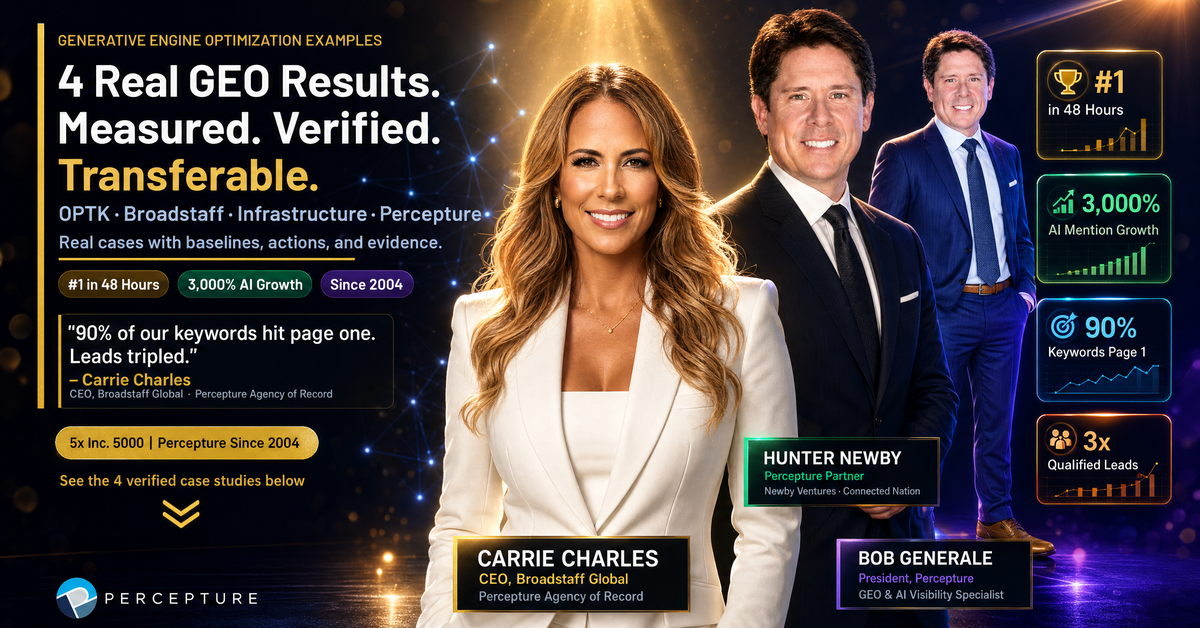

Useful generative engine optimization examples show a measurable change, the work behind it, the result surface, the time window, the evidence, and a clear limitation. This page documents four bounded cases instead of relabeling common tactics as proof.
Results can appear as AI mentions, citations, Google AI-assisted visibility, organic search visibility, or downstream demand. A mention names a brand. A citation links or points to a source. Neither one screenshot nor one prompt response proves a permanent position. Read what generative engine optimization is if you need the fundamentals first.
Experience matters most when the evidence is visible
Percepture has operated since 2004 and works across search, AI visibility, digital PR, telecom, data centers, staffing, and complex B2B markets. The cases below separate the proof from the claim.




What does a useful GEO example prove?
The best generative engine optimization examples connect a baseline to a specific action, search or AI surface, measurement window, documented result, and source. They also state what cannot be inferred. That structure separates a measured campaign from an isolated screenshot, brand observation, or list of untested tactics.
Evidence leaders should look for
Result before theory
Strong generative engine optimization examples state what changed before explaining the method.
Bounded measurement
Every result needs a surface and a window, such as a 48-hour search result, a 90-day AI mention period, or a 12-month integrated program.
Separate outcome layers
Visibility, traffic, leads, and revenue are different measures. A case should not treat one as proof of another.
Visible limitations
Credible generative engine optimization examples explain why a point-in-time result can document experience without becoming a promise about future performance.
For CEOs, CMOs and marketing operators, the practical question is the same: does the case show a bounded result, a source, a window and an honest limitation?
See where your brand is missing before you change anything
Start with buyer questions that matter, record where your company is mentioned or cited, and separate repeat visibility from one-off answers. The goal is a baseline you can defend.
Generative Engine Optimization Examples: Results at a Glance
These generative engine optimization examples use public Percepture cases, Search Console data, client testimony, first-party reporting, and proof images. The scorecard keeps each surface, window, result, and evidence source visible so generative engine optimization examples can be compared without merging unlike metrics. Point-in-time results are not permanent. Video testimony provides campaign context, while analytics and case records support separate visibility or lead claims.
| Example | Surface | Window | Reported result | Evidence | What it shows |
|---|---|---|---|---|---|
| OPTK Networks | Search with AI opportunity intelligence | 48 hours | Number-one search-position case | Public case pages and client video | A defined opportunity can move quickly when intelligence and execution align. |
| Infrastructure technology company | AI mentions | 90 days | More than 3,000% mention growth, from almost no daily mentions to thousands | Public Percepture material and comparison image | An established company can still begin with low AI visibility. |
| Percepture GEO services | Google AI-assisted and organic visibility | Point-in-time screenshot plus a separate 90-day Search Console period | Category visibility in the screenshot; 12,158 impressions and 5.10 average position for a related query during March 24 through June 22, 2026 | Screenshot and Search Console export | Percepture applies the method to its own category. |
| Broadstaff Global | Search with AI-visibility support | 12 months | 90% of tracked keywords on page one and 3x qualified leads | Public case and client video | An integrated visibility program can connect search gains with measured demand. |
The Percepture GEO Case Verification Ledger for Generative Engine Optimization Examples
Percepture evaluates generative engine optimization examples with a nine-part ledger: baseline, action, surface, window, result, evidence, business context, limitation, and lesson. Missing fields weaken the claim. This framework does not assign an official AI rank. It creates a consistent way to compare evidence.
- 01Baseline: What was absent, weak, or newly available?
- 02Action: What work changed?
- 03Surface: Where did the result appear?
- 04Window: When and for how long was it measured?
- 05Result: What moved, using a defined metric?
- 06Evidence: Which case, report, screenshot, video, or analytics record supports it?
- 07Business context: Was a downstream result measured separately?
- 08Limitation: What does the evidence not prove?
- 09Lesson: Which part can another team use?
Prime AI Visibility can serve as an intelligence and monitoring input for buyer questions, mentions, citations, and gaps. KeywordIQ keyword intelligence helps prioritize attainable opportunities with business value. Neither input replaces strategy, expertise, content, technical work, authority, or measurement. Teams reviewing generative engine optimization examples should verify that those operating inputs appear in the case record rather than crediting a tool alone.
4 Real Generative Engine Optimization Examples
The four cases below follow the same ledger. Each starts with the result, then explains the context, supported action, evidence, limitation, and transferable lesson.
1. OPTK Networks: A Number-One Search Result in 48 Hours
Result: Percepture documents one OPTK Networks campaign reaching a number-one search position within 48 hours. Among the generative engine optimization examples on this page, it is the fastest bounded result. It is not a standard delivery promise.
- 48-hour window
- Number-one search position
- Client video
- Public case record
OPTK had a defined market opening that could become a searchable story. Prime AI Visibility helped identify the opening. Intelligence alone did not create the result. Percepture’s public case describes a wider effort that included strategy, subject expertise, content, technical execution, internal linking, and distribution.
The action matters because fast results are often described as if one tool, prompt, or page caused them. This case shows a chain of work. The opportunity had to be found, framed, published, connected to related material, and distributed in a way that search systems could process.
The public case and Cody Clegg video provide the supporting record. Readers can review the full OPTK AI search case study and the public 48-hour campaign account. That source pairing is stronger than a screenshot with no campaign context.
Limitation: The evidence documents one result for one defined campaign. It does not show that every query can reach the same position or that a result will remain fixed.
Lesson: Intelligence finds an opening. Strategy, expert input, content, technical execution, links, and distribution turn that opening into a result.
2. Infrastructure Company: More Than 3,000% AI Mention Growth in 90 Days
Result: Public Percepture material reports that a long-established infrastructure and technology services company increased AI mentions by more than 3,000% over 90 days, moving from almost no daily mentions to thousands.
- 90-day window
- AI mention measurement
- Anonymized company
- First-party comparison image
This case started with a gap between real-world authority and AI visibility. The company had an established operating history, but the measured AI-answer set rarely mentioned it at the baseline. The trigger was not a lack of business experience. It was a lack of representation in the observed AI answers.
The generative engine optimization examples that matter most often expose this type of gap. A known company can still be absent when buyers ask systems about suppliers, capabilities, or market topics. Percepture measured the baseline, worked on visibility, and compared the later period against the same program record.

An AI mention means the company was named in an observed answer. It does not automatically mean the answer linked to the company, sent a visit, created a lead, or produced revenue. The presentation of mentions and sources also varies by system.
Limitation: Mention growth is a visibility measure. It must not be relabeled as citation growth, traffic, or revenue without separate records.
Lesson: Measure AI visibility before assuming market reputation carries into generated answers. The baseline can reveal a large gap that offline authority alone does not show.
3. Percepture: GEO Category Visibility Across Google and Organic Search
Result: A Screenshot documents Percepture’s point-in-time visibility for a GEO-services query across Google AI-assisted and organic search. A separate Search Console period recorded 12,158 impressions and an average position of 5.10 for the related query “generative engine optimization agency.”
- Google visibility
- Point-in-time screenshot
- Separate 90-day GSC period
- Self-application
This is one of the self-applied generative engine optimization examples. Percepture used its own category as the test surface rather than discussing GEO only through client work. The screenshot records what appeared at one moment. The Search Console record covers March 24 through June 22, 2026.
The distinction is important. Search Console average position is a period metric calculated across impressions. It is not the exact position shown in a screenshot. Combining the two into one rank claim would overstate what either source says.
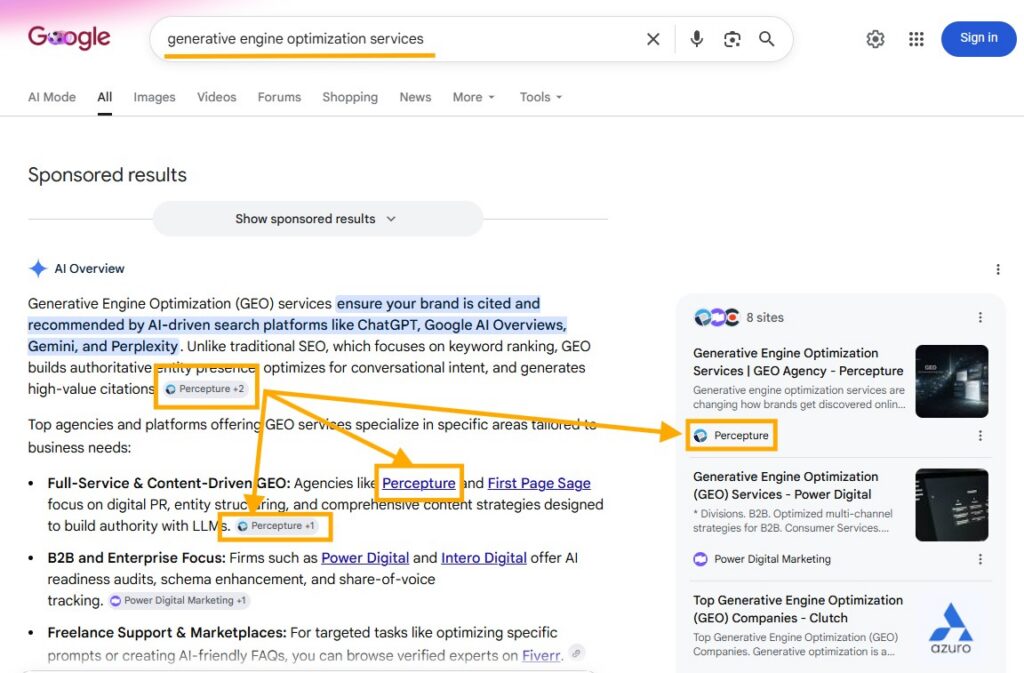
Percepture’s related GEO service page received 12,158 impressions for the agency query during the period. That data supports category visibility and topical permission. It does not show how every user saw the result or establish a permanent placement.
Limitation: Self-proof demonstrates operating experience, not independent validation or a future outcome for a client.
Lesson: A useful self-case keeps screenshots, period data, queries, and limitations separate. Readers can compare this GEO evidence with broader SEO examples and ranking results.
4. Broadstaff Global: 90% Page-One Visibility and 3x Qualified Leads
Result: Percepture’s public Broadstaff Global case reports that 90% of tracked keywords reached page one and qualified leads increased 3x within 12 months.
- 12-month window
- 90% of tracked keywords on page one
- 3x qualified leads
- Client video
Broadstaff Global operates in digital-infrastructure staffing. The program joined search strategy, on-page work, content, authority building, AI-search visibility support, and monitoring. This makes the case useful to leaders who need visibility work to support a longer buying cycle.
The reported result is stronger than a lone ranking screenshot because it includes a tracked keyword set, a 12-month window, and a separately reported qualified-lead change. It also shows why generative engine optimization examples should preserve attribution boundaries.
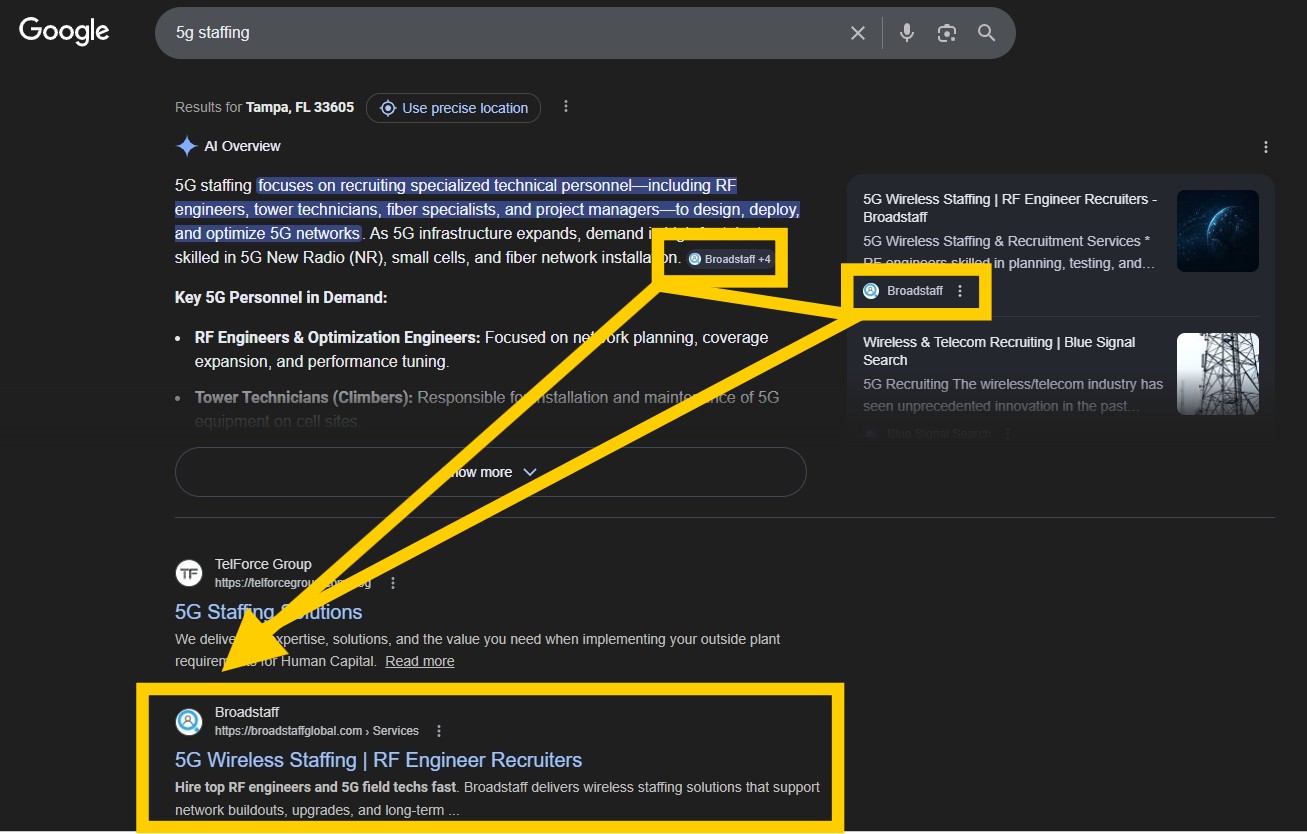
AI visibility was one part of an integrated program. The case does not establish that GEO alone produced the lead increase. Search strategy, content, on-page work, authority, monitoring, and the client’s sales process can all affect the business result.
Read the complete Broadstaff Global case study for the campaign record.
Limitation: The 3x lead result belongs to the integrated program. It should not be attributed to one GEO action, AI answer, or search position.
Lesson: The strongest case connects visibility to qualified demand while keeping the attribution honest. Teams that need this separation can pair GEO reporting with attribution and analytics.
Broadstaff: put the numbers beside the client experience
The public case supplies the 12-month window, 90% page-one result and 3x qualified-lead metric. Carrie Charles adds the operating context. Keeping those evidence types separate makes the case easier to trust.

Compare the full proof records
These generative engine optimization examples are summaries. Review the source cases before applying a lesson to your market, technical state, authority, or buying cycle.
What These GEO Case Studies Actually Teach
Four cases do not create a universal formula. They do show how generative engine optimization examples can support a repeatable way to plan, assess, and report work without turning every positive screen into a success story.
1. Measure the baseline before claiming a win
A baseline turns a result into a comparison. OPTK had a defined opportunity. The infrastructure company began with almost no measured daily mentions. Broadstaff used a tracked keyword set. Without the starting point, generative engine optimization examples become observations rather than cases.
2. Target buyer questions with economic meaning
Prompt volume alone does not make an opportunity useful. When assessing generative engine optimization examples, confirm that the targeted questions reflect buyer value rather than visibility for its own sake. KeywordIQ can help weigh search demand, competition, attainability, and buyer value. High paid competition may signal commercial interest, but it does not prove conversion. Low competition may create efficiency, but only when the intent fits the business.
3. Intelligence finds gaps; execution earns outcomes
Prime AI Visibility can show where a company appears, where a source is cited, and where an answer gap exists. That is an intelligence input, and generative engine optimization examples should identify the execution that followed it. OPTK’s result also required strategy, expertise, content, technical execution, links, and distribution. Companies evaluating content marketing should treat expert source material as part of the operating system, not as filler added after keyword research.
4. Search, AI answers, and outside authority can reinforce one another
GEO should not damage working SEO. Clear pages, crawlable evidence, strong internal links, expert sources, and outside authority can support both search and AI discovery. Percepture combines this with enterprise SEO, digital PR, and an omnichannel marketing program when the buyer journey requires more than one surface.
5. Visibility and business outcomes belong on separate layers
An AI mention is not a lead. A citation is not revenue. An impression is not a sale. Generative engine optimization examples should keep those outcome layers separate. Broadstaff is useful because the public case reports both visibility and qualified leads while describing the integrated program. The attribution boundary makes the evidence more credible, not less.
For broader planning beyond these cases, review how to improve brand visibility in AI search.
How to Compare Generative Engine Optimization Examples
Use this matrix to identify what different evidence types can support before comparing generative engine optimization examples across campaigns.
| Evidence type | Useful for | What it cannot prove alone | Better companion evidence |
|---|---|---|---|
| Single screenshot | Recording one visible moment | Stable rank, repeat visibility, traffic, or leads | Capture context and a repeated measurement window |
| AI mention report | Showing whether a brand was named | Citations, clicks, or revenue | Source tracking, referral analytics, and lead records |
| Search Console period | Impressions, clicks, CTR, and average position | The exact position seen in one screenshot | Query, page, date range, and screenshot context |
| Client testimony | Operating context and client experience | A metric that is not supported by records | Analytics, tracked results, and a public case |
| Integrated campaign result | Connecting multiple channels with business movement | Causality from one channel without attribution | Channel records and an explicit limitation |
How to Read a GEO Case Study Without Getting Fooled
Apply the verification ledger before treating any result as guidance. Good generative engine optimization examples make it easy to find the starting point, action, surface, time window, metric definition, evidence, and limitation.
GEO evidence checklist
- Is there a baseline or trigger?
- Is the query or buyer question identified when the source supports it?
- Does the case name the search or AI surface?
- Is there an exact date or bounded measurement period?
- Does the case distinguish a screenshot from repeated measurement?
- Is a mention kept separate from a citation?
- Are visibility, traffic, leads, and revenue reported as different layers?
- Is the client case, video, report, screenshot, or analytics source linked?
- Does the writer state what the result cannot prove?
Treat the switchboard image below as illustrative context, not a measured result.
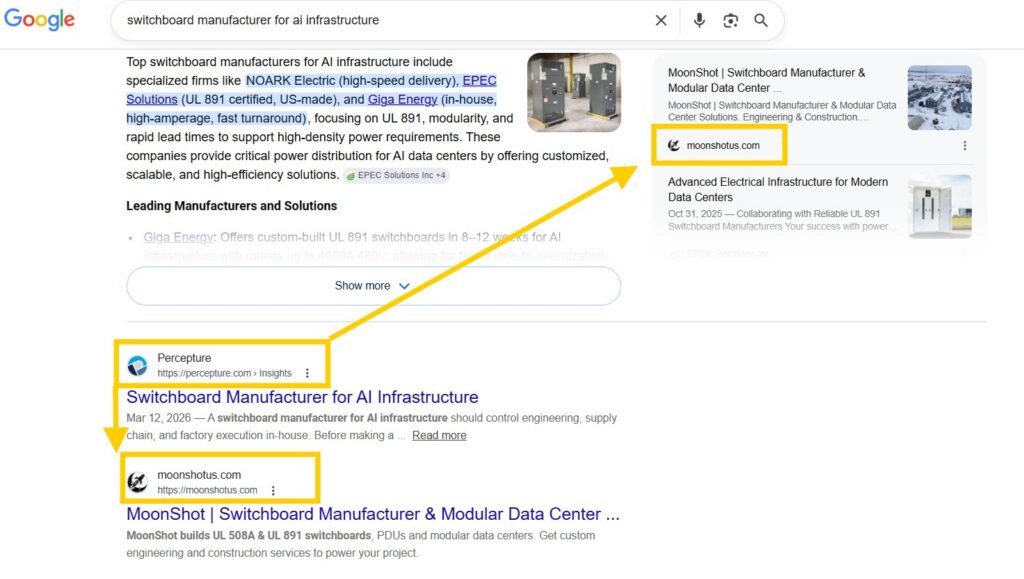
That exclusion is part of the method. A smaller set of supported cases is more useful than a large gallery with missing baselines or unclear attribution. The same standard should guide quarterly proof audits as results, interfaces, and buyer questions change.
Frequently Asked Questions
What is an example of generative engine optimization?
An example is a campaign that measures a baseline, changes content or authority signals, tracks a defined search or AI surface, and records the result over a stated period. The OPTK case is one example: Percepture documents a number-one search-position result within 48 hours while stating that the result does not set a standard timeline.
What should generative engine optimization examples include?
Generative engine optimization examples should include the baseline, action, surface, time window, result, evidence source, business context, limitation, and lesson. If a case shows only a screenshot or a brand appearing in one answer, it documents a moment but does not establish a measured campaign.
How quickly can GEO produce results?
There is no fixed GEO timeline, so generative engine optimization examples should always state their measurement windows. OPTK documents one result within 48 hours, while the other cases on this page use 90-day and 12-month windows. Timing varies with the opportunity, competition, existing authority, technical condition, source quality, publishing speed, and execution.
How do you measure a GEO case study?
To measure generative engine optimization examples consistently, start with a baseline and repeat a stable set of buyer questions or search queries. Track mentions, citations, visibility, Search Console data, referral traffic, and downstream outcomes as separate measures. Record the engine or search surface, date range, prompt or query context, source, and known limits.
Are AI mentions the same as citations?
No. A mention names a company, product, or person in an observed answer. A citation links or points to a source. Interfaces vary across AI systems, so the report should define what it counted. Neither measure proves a visit, lead, or sale without separate analytics.
Can GEO improve qualified leads?
Generative engine optimization examples can show how GEO contributes to a wider visibility and demand program, but attribution must remain clear. Percepture’s Broadstaff case reports 3x qualified leads within 12 months alongside search, content, authority, monitoring, and AI-visibility support. The evidence does not assign the full lead increase to GEO alone.
Want your next GEO result to be a case you can actually defend?
Percepture can structure generative engine optimization examples around your actual operating record by mapping the baseline, buyer questions, search and AI visibility, evidence gaps, and measurement boundaries before making an outcome claim.
Talk With Percepture About GEO View AI Search and GEO Pricing