
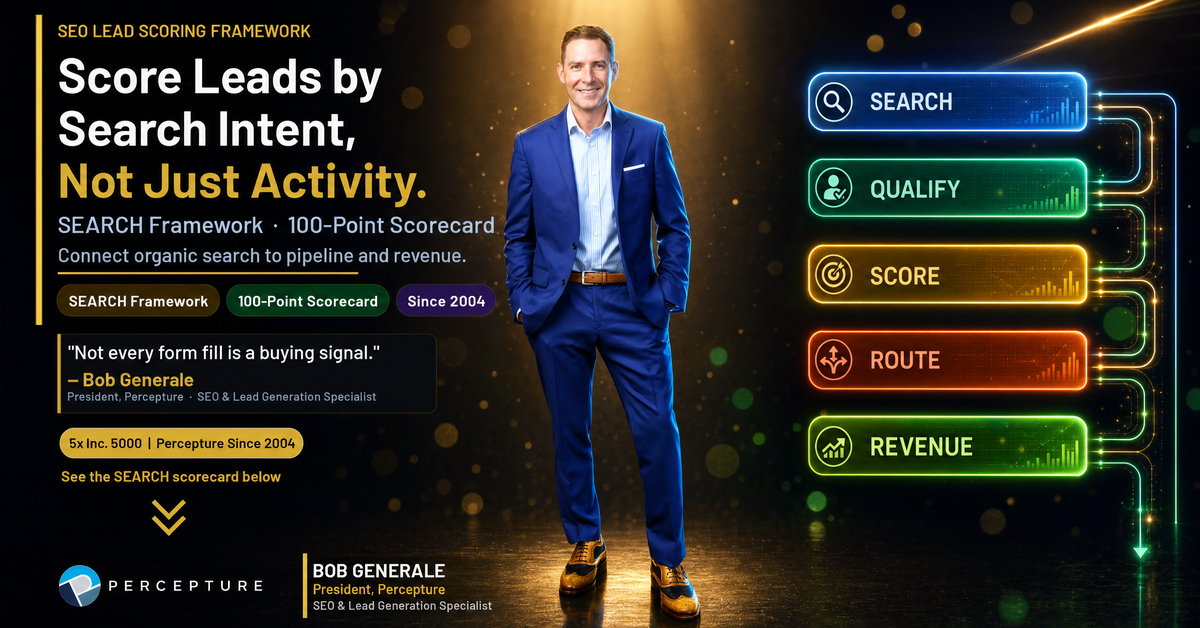

SEO Lead Scoring helps revenue teams decide which organic prospects deserve sales attention and which need more evidence, qualification, or time. It replaces the assumption that every form fill carries the same intent.
The practical goal is not to reward activity. It is to connect search context, business fit, proof-seeking behavior, commitment, data confidence, and sales outcomes in one transparent operating model.
What is a reliable way to score an organic lead?
SEO Lead Scoring is the process of ranking an organic-search prospect by likely search intent, entry-page value, account fit, research behavior, conversion commitment, and identity confidence, then improving that score with sales acceptance, opportunity, pipeline, and revenue data.
Executive summary
Effective SEO Lead Scoring separates an attractive activity trail from a credible buying signal. Leaders should be able to see why a lead earned each point, how reliable the underlying data is, and what action the score triggers.
Score meaning, not volume
A commercial landing page, relevant case study, pricing visit, and return session carry more meaning than a string of unrelated pageviews.
Grade data confidence
A high score built on an unverified identity or conflicted attribution should enter verification, not the senior-sales queue.
Subtract noise
Career interest, vendor pitches, unsupported needs, duplicate records, spam, and weak identity data require penalties or disqualification.
Learn from revenue
Sales acceptance, meeting quality, opportunities, pipeline, wins, losses, and cycle time should change future weighting decisions.
A lead score is only as useful as the evidence behind it
Search intent, proof consumption and sales acceptance all depend on credible source material. This is why the model treats proof-seeking behavior as a signal rather than rewarding raw pageviews.
Teams that need search data to make better revenue decisions
Revenue and sales leaders
Use the framework to keep high-value sales capacity focused on prospects with stronger intent, fit and verification.
SEO and demand teams
Use it to connect landing pages, buyer journeys and proof consumption with downstream lead quality.
Marketing operations
Use it to define CRM fields, routing rules, confidence grades, penalties and score-version governance.
Analytics and RevOps
Use it to test whether accepted leads, opportunities, pipeline and revenue support the assumptions built into the score.
Why SEO Lead Scoring needs more than fit and engagement
Traditional scoring often combines demographic fit with engagement. That is a useful base, but organic search adds context that a general activity score can miss. The page that attracted a prospect may represent a definition, a problem, a vendor comparison, a service evaluation, or a direct request for help.
SEO Lead Scoring should also examine what happened after arrival. A visitor who moves from an educational article to a commercial service page, a relevant proof page, and pricing is reducing risk. A visitor who opens five unrelated articles may simply be browsing.
This distinction also changes how SEO Lead Scoring values conversions. A newsletter subscription is a light commitment. A detailed commercial inquiry is stronger. Neither action should override poor company fit, an invalid identity, or a need the business cannot support.
Organizations building a broader demand program can connect this logic to lead generation services, while teams trying to interpret account activity can use B2B intent data as supporting evidence rather than unquestioned truth.
Can you identify the exact Google query for every lead?
No. Search query reporting is generally useful at an aggregate, page, or cohort level, but it should not be treated as a clean person-level CRM field for every named organic lead. Some query information may also be absent.
The safer SEO Lead Scoring approach is to assign an intent prior to a landing page or query cluster. Then raise or lower the prospect’s score using the pages visited, form responses, company and contact data, self-reported source, return behavior, and CRM outcomes.
Run a lead quality diagnostic
Apply SEO Lead Scoring to a small batch of recent organic inquiries before changing CRM automation. Compare the original handoff with identity quality, sales acceptance, and opportunity status.
Test 5 Verified LeadsFor example, SEO Lead Scoring can give a page built around pricing or hiring a provider a stronger commercial prior than a basic definition page. The model should still wait for behavior and fit evidence before declaring the person sales-ready. Teams reviewing the search foundation can use Percepture’s guides to organic SEO services and the role of a technical SEO audit service.
The SEO Lead Scoring SEARCH-to-Revenue Framework
The Percepture SEARCH-to-Revenue Framework is a transparent 100-point method for estimating an organic lead’s likely buying intent and business value. This SEO Lead Scoring model pairs the numeric result with a separate confidence grade and uses revenue outcomes to recalibrate its weights.
SEARCH Score = S + E + A + R + C + H − Noise Penalty
S: Search Intent Strength
Up to 25 points for the commercial strength of the landing-page or query-cluster intent.
E: Entry Page and Path Value
Up to 15 points for the discovery page and meaningful movement toward evaluation.
A: Account and Audience Fit
Up to 20 points for industry, company size, geography, role, influence, and use case.
R: Research Depth
Up to 15 points for proof-seeking behavior and Trust Velocity rather than raw pageview totals.
C: Conversion Commitment
Up to 15 points based on the information, urgency, and effort contained in the conversion.
H: Human Verification
Up to 10 points for a verified identity, credible need, working contact method, and clear owner.
The 100-point SEARCH scorecard
This scorecard keeps SEO Lead Scoring inspectable by separating the six positive components before confidence and noise are applied.
| Component | Maximum | Question to answer |
|---|---|---|
| Search Intent Strength | 25 | What decision or problem likely brought this cohort to the entry page? |
| Entry Page and Path Value | 15 | Did the path move from learning toward proof, comparison, pricing, or contact? |
| Account and Audience Fit | 20 | Does the company, person, market, and use case fit the service? |
| Research Depth and Trust Velocity | 15 | Did the buyer consume evidence that reduces perceived risk? |
| Conversion Commitment | 15 | How much information, effort, and commercial intent did the action contain? |
| Human Verification and Handoff | 10 | Can the identity, need, contact route, and sales owner be verified? |
| Maximum positive score | 100 | Apply the confidence grade and any noise penalty before routing. |
How to score each SEARCH dimension
Search Intent Strength: 0 to 25 points
Assign intent at the page or query-cluster level. Direct commercial themes such as services, consultation, pricing, or hiring can receive 22–25 points. Vendor comparisons can begin around 18–22, solution evaluation around 14–18, problem-aware research around 10–14, and broad education around 4–9.
These ranges are starting rules, not universal truth. Validate SEO Lead Scoring intent ranges against your own accepted leads and opportunities. Percepture’s KeywordIQ can support query and topic analysis, while generative engine optimization services address visibility across search and AI-answer environments.
Entry Page and Path Value: 0 to 15 points
A pricing, contact, or consultation entry can receive up to 15 points. Commercial service and comparison pages may receive 12–14. A high-value framework or decision guide may receive 8–11, while a broad educational article may start at 3–7.
SEO Lead Scoring should use path signals to add context without letting pageviews inflate the category forever. A relevant service page after an educational article can add two points. Pricing or ROI can add three. A relevant case study can add two. Cap the entire category at 15.
Account and Audience Fit: 0 to 20 points
Divide fit into industry, company size, geography or serviceability, role and influence, and use-case match. A useful starting allocation is five points for industry, four for company size, three for geography, four for role, and four for use case.
Do not force every business unit into one SEO Lead Scoring ideal customer profile. The buyer for enterprise SEO may not match the buyer for another service. Score the account and contact separately when the CRM allows it, and treat enrichment as evidence that can be corrected.
Research Depth and Trust Velocity: 0 to 15 points
Trust Velocity measures how quickly a prospect consumes the evidence normally checked before a buying conversation. Relevant case studies, pricing, process, ROI, leadership, credentials, comparisons, and return visits carry more meaning than random activity.
Within SEO Lead Scoring, a return within seven days, three or more relevant pages, or a case-study visit can each add three points. Pricing, ROI, or a comparison can add two. Leadership or credential research can add one. The category remains capped at 15.
Conversion Commitment: 0 to 15 points
A consultation or proposal request can receive 15 points. A detailed commercial form, pricing request, audit request, or account review may receive 11–15. A qualifying assessment can receive 9–12, while a framework download may receive 3–5 and a newsletter signup 1–3.
The SEO Lead Scoring operating rule is simple: a download is a micro-conversion, not automatic proof of sales readiness. Teams can use conversion rate optimization to improve the path while keeping qualification standards separate from conversion volume.
Human Verification and Handoff: 0 to 10 points
A verified business identity and domain can add three points. A corroborated company and role can add two. A specific, commercially plausible need can add two. A credible trigger, working contact method, correct owner, and defined next action complete the category.
This SEO Lead Scoring category is also a gate. A lead with a high numeric score and a C confidence grade should enter verification before senior-sales routing. Automation can assist with follow-up, but AI sales agents should operate inside clear identity, consent, routing, and escalation rules.
Confidence-grade matrix
| Result | Interpretation | Default action |
|---|---|---|
| 88-A | High apparent intent with verified source, identity, company, and CRM mapping | Route under the high-priority service rule. |
| 88-C | High apparent intent with identity, source, or attribution gaps | Verify before senior-sales routing. |
| 67-A | Reliable fit and data without enough commitment | Use personalized nurture or discovery review. |
| 34-B | Early research with mostly reliable data | Educate without consuming expensive sales time. |
In SEO Lead Scoring, A means the core source, identity, company, and CRM mapping are verified. B means the data is mostly reliable with limited gaps. C means identity, source, or attribution requires verification.
Negative scoring and the noise penalty
Positive-only SEO Lead Scoring models create false confidence. They reward every action while ignoring the reasons a record should be slowed, suppressed, or removed. The SEARCH model permits up to 40 negative points and supports direct disqualification where required.
Suggested noise penalties
| Negative signal | Starting penalty | Reason |
|---|---|---|
| Careers or employment intent | −25 | The visitor is not evaluating the offered service. |
| Vendor solicitation or agency pitch | −20 | The submission is selling rather than buying. |
| Invalid or unverifiable identity | −20 to −30 | The apparent opportunity cannot be trusted yet. |
| Bot, spam, or repeated fake submission | −30 to −40 | The record should not consume sales capacity. |
| Unsupported need or service area | −10 to −20 | The business cannot responsibly fulfill the request. |
| Research-only or student intent | −8 to −12 | The activity may be genuine without being commercial. |
| Duplicate lead or opportunity | −5 to −10 | Duplicate scoring can distort volume and ownership. |
| Consent or suppression conflict | Disqualify | The record should not enter an outreach workflow. |
SEO Lead Scoring comparison: which model fits?
| Model | What it scores | Best use | Primary limitation |
|---|---|---|---|
| Basic points | Actions such as opens, clicks, and pageviews | A simple first model | Activity can rise without buying intent. |
| Fit and engagement | Profile data plus behavior | General B2B qualification | Organic origin and revenue feedback may remain weak. |
| Predictive scoring | Patterns in historical outcomes | Teams with enough clean outcome data | The result can be opaque or learn from bad definitions. |
| BANT | Budget, authority, need, and timeline | Structured sales discovery | It often enters after self-directed research has begun. |
| Percepture SEO Lead Scoring | Intent, path, fit, proof, commitment, verification, and revenue | Organic demand and search-to-revenue operations | It requires CRM discipline and scheduled recalibration. |
The best SEO Lead Scoring choice depends on data quality and operating maturity. A transparent rules-based model is often easier to inspect and correct. Predictive methods can be added later when the organization has enough clean acceptance, opportunity, loss, and revenue outcomes.
SEO Lead Scoring bands and follow-up actions
| Score and confidence | Meaning | Starting action |
|---|---|---|
| 80–100, A or B | Sales-ready under the current model | Human follow-up within the defined high-priority service level. |
| 80–100, C | Strong apparent intent with weak confidence | Verify identity and attribution before senior routing. |
| 60–79 | Qualified interest | Review, personalize nurture, or begin discovery. |
| 40–59 | Developing intent | Send topic-specific proof and watch for stronger behavior. |
| 20–39 | Early research | Use education or low-frequency nurture. |
| 0–19 | Weak fit or noise | Suppress, disqualify, or use passive nurture as appropriate. |
An SEO Lead Scoring band is incomplete unless it names an owner and response expectation. The CRM should make clear who reviews a C-grade identity, who handles a 60–79 lead, and which events can move a nurtured record back into review.
Four worked organic-lead examples
These examples show why SEO Lead Scoring needs both arithmetic and judgment. The weights are starting values for the SEARCH-to-Revenue Framework, not a substitute for calibration against an organization’s outcomes.
1. Commercial buyer with verified fit: 92-A
A prospect enters through a commercial search cluster, visits a service page and relevant proof, then submits a consultation form. The contact is a verified marketing leader at a company that matches the service profile.
- S: 24
- E: 14
- A: 18
- R: 12
- C: 15
- H: 9
- Penalty: 0
Action: Route under the high-priority response rule.
2. Useful researcher without verified fit: 26-C
A reader enters through a definition query, reads the framework, and downloads a scorecard. The company and role remain unknown.
- S: 6
- E: 8
- A: 2
- R: 5
- C: 4
- H: 1
- Penalty: 0
Action: Educate and gather better fit evidence. Do not declare an MQL from the download alone.
3. Strong claims with weak verification: 51-C
A visitor moves from a service page to a contact form and describes an urgent, high-value need. The identity and company information cannot be corroborated. The preliminary positive score is 76, followed by a 25-point identity penalty.
Action: Verify the person and need before assigning expensive sales attention.
4. Quiet, high-fit account: 68-A
A verified director at a strong-fit company enters through a technical guide, reads proof, visits pricing, and returns four days later without completing a form.
- S: 14
- E: 13
- A: 20
- R: 14
- C: 0
- H: 7
Action: Review account-level intent and use responsible outreach or personalized nurture according to consent and company policy.
Implement SEO Lead Scoring in the CRM
SEO Lead Scoring implementation works best when the CRM stores both the total and the evidence behind it. A single unexplained number makes troubleshooting difficult and hides disagreements between marketing, sales, and analytics.
A practical implementation sequence
- 01Map the evidence. Capture the SEO Lead Scoring inputs: original landing page, entry-page type, intent cluster, relevant service and proof events, conversion type, company fit, identity status, and source confidence.
- 02Build fields and routing. Store the six category scores, noise penalty, total, confidence grade, model version, sales owner, acceptance status, and rejection reason.
- 03Close the loop. Record meetings, meeting quality, opportunities, pipeline, wins, losses, cycle time, and the original score so future weights can be tested.
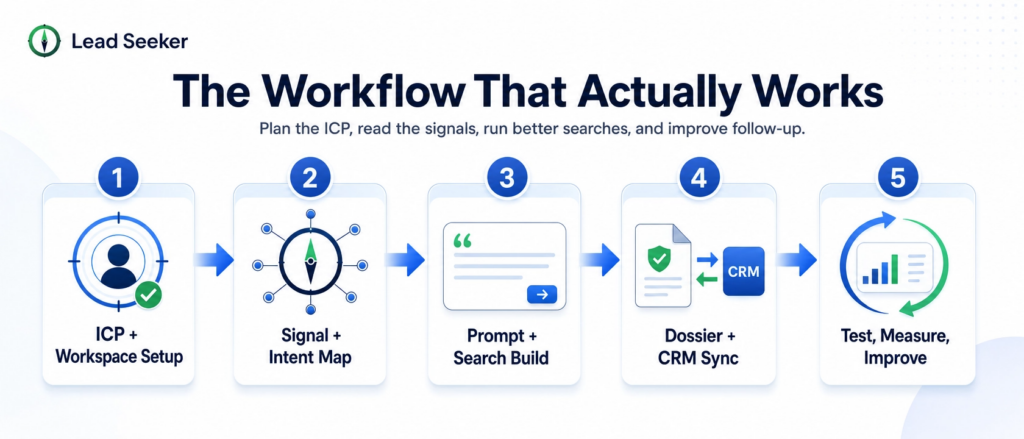
In HubSpot, the model can use fit and engagement groups plus custom properties for intent, confidence, and penalties. In Salesforce, teams can use Lead and Contact fields, campaign or first-touch context, landing-page fields, stage dates, rejection reasons, and opportunity outcomes.
Use marketing attribution and analytics to reconcile source and revenue fields. If the business runs several channels, an omnichannel marketing view can keep the organic score from being mistaken for the whole buyer journey.
CRM readiness checklist
- Original organic landing page is preserved.
- Entry-page type and intent cluster are defined.
- Company and contact fit are stored separately where possible.
- Proof, pricing, comparison, and return-visit events are meaningful and deduplicated.
- Conversion actions have different commitment values.
- Identity and source confidence are visible.
- Noise penalties and disqualification reasons are recorded.
- Sales acceptance and rejection reasons are required.
- Opportunity, pipeline, win, loss, and cycle-time fields return to the model.
- Every record stores the score version used.
How sales outcomes recalibrate the score
SEO Lead Scoring is not finished when a form reaches the CRM. The score becomes useful when teams compare the original judgment with sales acceptance, meeting quality, opportunity creation, pipeline, closed revenue, and cycle time.
Review SEO Lead Scoring on a regular operating cadence. Compare each score band with acceptance and opportunity rates. Find signals that received too many points and signals that predicted revenue without attracting attention. Change weights carefully, record the effective date, and preserve the prior version for comparison.
The Three Truths Validation Rule
Search truth
What problem or decision likely brought the buyer to the site?
Buyer truth
Does the person and account fit, and are the actions and identity credible?
Revenue truth
Did sales accept the lead, create an opportunity, and produce a commercial outcome?
When the three truths disagree, investigate rather than hiding the conflict. A strong search signal with poor fit may require nurture or disqualification. A low original score that later produces revenue exposes a missed signal.
SEO Lead Scoring mistakes that weaken the model
- Treating every conversion as an MQL. A content download and a detailed consultation request show different commitment.
- Scoring raw pageviews. The meaning and sequence of pages matter more than an uncapped activity count.
- Claiming an exact query for each person. Use page and cohort intent unless person-level evidence is genuinely available.
- Ignoring identity confidence. Attractive claims should not override missing or conflicted contact data.
- Using one fit model for every service. Different offers can have different buyers, markets, and qualification rules.
- Never subtracting points. Positive-only models send more noise toward sales.
- Discarding rejection reasons. Sales feedback is required to diagnose bad weights and definitions.
- Letting systems disagree silently. Source, lifecycle, and opportunity fields must be reconciled.
- Keeping one version forever. A model that never learns from outcomes becomes a historical assumption.
- Using predictive methods before outcomes are clean. Automation can reproduce bad definitions at greater speed.
Teams deciding how search fits into corporate growth may also find Percepture’s explanation of corporate SEO useful. Organizations that need a shorter corrective work cycle can review what an SEO sprint is.
What makes the framework testable?
The framework publishes its formula, point ceilings, confidence grades, penalties, routing bands, examples, and feedback fields. That allows marketing, sales, finance, and revenue operations to challenge the same visible assumptions.
- Every point has an identified source.
- Every high score carries a confidence grade.
- Every rejection can return a reason.
- Every version has a defined effective period.
- Every weight can be compared with opportunity and revenue outcomes.
Percepture’s broader case studies provide additional context for evaluating marketing work through business outcomes rather than activity alone.

Compare the scoring model with your current funnel
Take 10 recent organic leads and compare the original handoff with identity quality, sales acceptance, opportunity status and revenue. Then review where your current model rewards noise or misses quiet buying signals.
Review Percepture PricingFrequently asked questions
What is SEO Lead Scoring?
SEO Lead Scoring ranks organic prospects using likely search intent, landing-page value, business fit, research behavior, conversion commitment, and identity confidence. A mature model also records sales acceptance, opportunities, pipeline, and revenue so its weights can improve.
How do you score leads based on SEO intent signals?
For SEO Lead Scoring, start by assigning an intent range to the entry page or query cluster. Add evidence from the visitor’s path, company and role fit, proof-seeking behavior, conversion action, and identity verification. Apply negative points for noise, then pair the total with a confidence grade.
Can analytics show the exact keyword for every organic lead?
Teams should not assume that every named lead can be tied to an exact organic query. Use aggregate query intelligence and the landing page as intent evidence, then strengthen the judgment with on-site behavior, form data, enrichment, self-reported source, and CRM outcomes.
What is a good organic lead score?
A good score is one that predicts accepted leads and commercial outcomes in your business. In the SEARCH framework, 80–100 with an A or B confidence grade begins as the sales-ready band. That threshold should be tested and recalibrated rather than treated as universal.
Should a content download count as an MQL?
Not by itself. A download shows some commitment, but the prospect may still have weak fit, educational intent, or an unverified identity. Combine the action with entry-page context, research depth, company fit, and confidence before assigning a sales-ready stage.
What is negative lead scoring?
Negative lead scoring subtracts points for evidence that reduces commercial value or trust. Examples include employment intent, vendor solicitation, unsupported needs, duplicate records, suspicious identities, spam, and research-only behavior. Some consent or suppression conflicts should trigger disqualification rather than a smaller penalty.
How often should the model be recalibrated?
Use a regular review cadence that matches available lead volume and sales-cycle length. Compare original scores with acceptance, meeting quality, opportunities, pipeline, wins, losses, and cycle time. Record each weight change and preserve the score version used on prior records.
Can AI create a predictive score?
AI can help identify patterns when the organization has enough clean historical outcomes. It should not replace transparent definitions, identity checks, or human review. If acceptance, opportunity, loss, and revenue data are incomplete, a predictive model can learn and scale the wrong behavior.
Build your SEO Lead Scoring model
Turn organic visibility into a clearer SEO Lead Scoring system for qualification, verification, routing, and revenue attribution. Percepture can help map the signals, CRM fields, score bands, and feedback loop around your actual sales process.
Book a Strategy Conversation