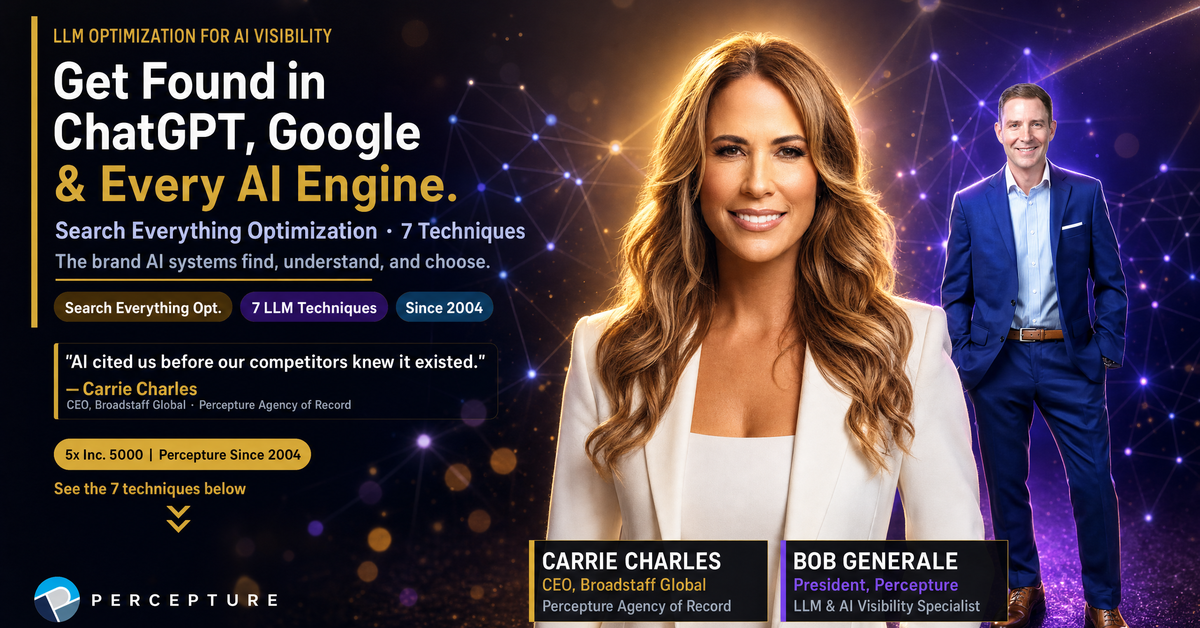

LLM optimization for AI visibility starts with the same foundation that made search work before generative AI: create useful information, make it accessible, connect it to a clear entity and reinforce it with credible outside evidence. The difference is that AI systems can synthesize that evidence into an answer instead of simply returning a list of links.
The useful mental model is not “SEO is dead.” It is Search Everything Optimization. Google, Bing, AI answer engines, social platforms, publications, directories and databases all have discovery or retrieval systems. The tactic changes by surface, but the operating job stays the same: make the right brand evidence easier to find, understand, verify and choose.
Search, PR and AI visibility under one operating model
Percepture’s approach did not begin with a new acronym. It grew out of years of connecting search visibility, earned authority, reputation and conversion.



What is LLM optimization for AI visibility?
LLM optimization for AI visibility is the work of making a brand’s public evidence easier for AI-powered systems to retrieve, understand, verify and use in generated answers. The strongest programs combine technical SEO, buyer-question research, entity clarity, answer-ready source content, topic architecture, independent corroboration and repeated measurement.
Important distinction: LLMs are not literally search engines, and not every answer uses live web retrieval. For marketing strategy, however, the useful model is an answer layer that may synthesize search indexes, native model knowledge, connected tools and other retrievable sources. If strong public evidence does not exist, there is less reliable material available to retrieve or cite.
The seven priorities
Think “Search Everything,” not “SEO versus AI”
Bob Generale’s operating view is that SEO, GEO, AI search, social, PR and content increasingly sit inside the same discovery system. Every platform has a way of deciding what gets found, surfaced, recommended or trusted. The algorithms are different. The need for strong evidence is not.
The takeaway: do not build one “AI trick.” Build a public evidence system that performs across the surfaces your buyers and retrieval systems actually use.
Bob was already connecting PR distribution, publisher authority, links, branded reputation and unbranded SEO in 2006. Percepture later described the broader idea as Landscape Domination for category visibility and Protect the Queen for branded reputation. AI search adds a new synthesis layer, but the underlying principle is familiar: build trustworthy sources before you need an algorithm to understand the story.
LLMO vs. SEO vs. GEO vs. AEO
These labels overlap. The cleanest way to use them is to assign each term a job instead of building duplicate strategies around acronyms.
| Discipline | Primary job | What you measure | Role in AI visibility |
|---|---|---|---|
| SEO | Make owned pages discoverable and competitive in search | Indexation, rankings, clicks, conversions | Creates the retrieval and source foundation |
| AEO | Answer specific questions clearly | Answer coverage, snippets, usefulness | Makes passages easier to understand and extract |
| GEO | Improve brand/source presence in generated answers | Mentions, citations, recommendations, cited URLs | Connects owned and earned evidence to generative surfaces |
| LLMO | Improve how LLM-powered systems understand and describe the brand | Accuracy, mentions, citations, source mix, recommendation rate | Focuses the work on retrievable brand evidence |
| Search Everything Optimization | Coordinate visibility across search, AI, PR, social and other discovery systems | Surface-level visibility plus qualified demand | Prevents teams from optimizing one channel while weakening the overall evidence graph |
Percepture’s answer engine optimization strategies guide covers AEO in more depth, while generative engine optimization services addresses the broader commercial GEO program.
See how AI systems describe your brand
Benchmark the buyer questions that matter, the competitors that appear, the sources answer systems cite and the facts they get wrong before publishing another round of content.
Check AI VisibilityThe 7 best LLM optimization techniques for AI visibility
These LLM optimization techniques are ordered by dependency. A P0 problem can block retrieval, distort the brand description or make measurement useless. Authority work compounds after the foundation is dependable.
Protect the SEO and retrieval foundation
Start with crawlability, renderability, indexation, canonical consistency, internal links, descriptive titles and visible server-rendered content. Important facts should not exist only behind a script, interaction or inaccessible component.
Google states that normal Search technical requirements apply to its AI features, and no special AI markup is required. OpenAI also publishes crawler controls for publishers. Review current Google Search Central AI guidance, OpenAI crawler guidance and use a technical SEO audit service when access or architecture is uncertain.
Start with buyer questions, not random prompts
Prompt tracking is useful only when the questions reflect decisions a buyer may actually make. Build the set from sales calls, customer FAQs, site search, Search Console, comparison queries, pricing questions, objections and subject-matter interviews.
Percepture uses dated AI visibility baselines to record whether the brand and competitors appear, which URLs are cited and whether the description is accurate. Keyword IQ then prioritizes the opportunity by search demand, difficulty, commercial value and cluster fit.
Make the brand and its entities unambiguous
Clarify the public company name, brand, category, products, services, industries, experts, locations, credentials and approved proof. The same factual identity should appear across the website and credible public sources.
Organization, Person, Product and Service schema can reinforce visible facts when the markup matches the page. Schema should never be used to introduce claims users cannot see. Compare important owned claims with credible third-party descriptions and correct outdated names or conflicting categories.
Publish original, answer-ready source material
Answer the question close to the heading. Use short self-contained passages, clear nouns, useful tables, first-party experience, approved case evidence and expert commentary. Write for people first, then check whether an extracted paragraph still makes sense without the surrounding copy.
The competitive advantage is information gain. A competitor can repeat generic “LLM optimization” advice. It cannot duplicate your operating data, expert interviews, methodologies, research, customer evidence or decisions. Percepture’s content marketing services connect those source materials to search intent and conversion paths.
Build topic coverage without doorway pages
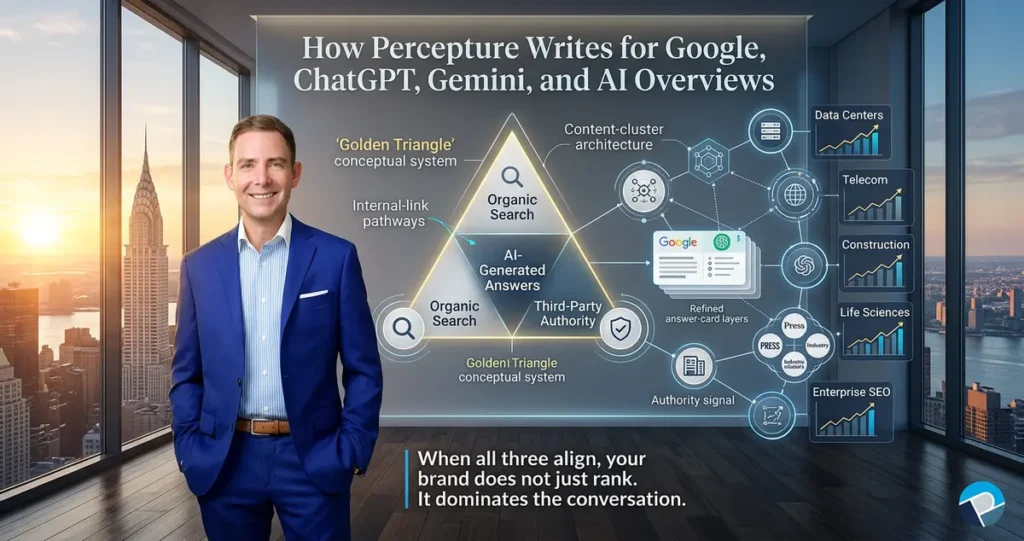
Build connected coverage around a buyer problem rather than one thin page for every possible wording. A durable architecture connects strategy, specialist guides, proof, case studies, expert authority and a commercial service page.
Every supporting page needs distinct intent and information gain. Internal links should explain the relationship between sources, not simply repeat a keyword. An enterprise SEO services program can coordinate large-site architecture without creating near-duplicate AI pages.
Earn independent corroboration through PR, social and trusted sources
Owned content explains the claim. Independent sources help verify it. Trade media, associations, expert interviews, conferences, customer-approved case studies, reputable reviews, communities and legitimate directories can all contribute to the public evidence graph.
Digital PR matters here for more than backlinks. A credible third-party article can rank, be cited, influence branded research and reinforce the same entity story. Social matters too, but not as one universal Google ranking factor. Social platforms have their own discovery systems and can create discussions, expert context, branded demand and public evidence.
Percepture’s digital PR services and guide to digital PR for AI search connect earned authority to the broader search and AI system.
Measure mentions, citations, accuracy and demand separately
A mention is not a citation. A citation is not a recommendation. A visit is not a qualified lead. Compressing those events into one visibility score can hide where the system is working and where it is failing.
For each priority question, record the prompt, engine or mode, date, brand mention, recommendation, cited URL, third-party source, factual accuracy and competitor presence. Then connect identifiable referral behavior with attribution and analytics, CRM outcomes and qualified demand where defensible.
Do not treat one screenshot as stable visibility. Establish a baseline, repeat comparable checks and explain methodology changes.
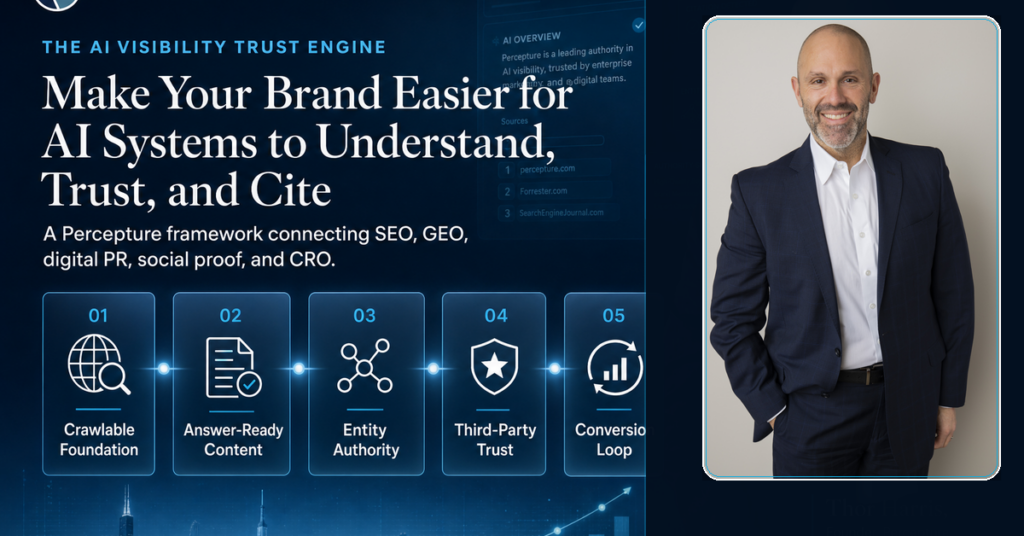
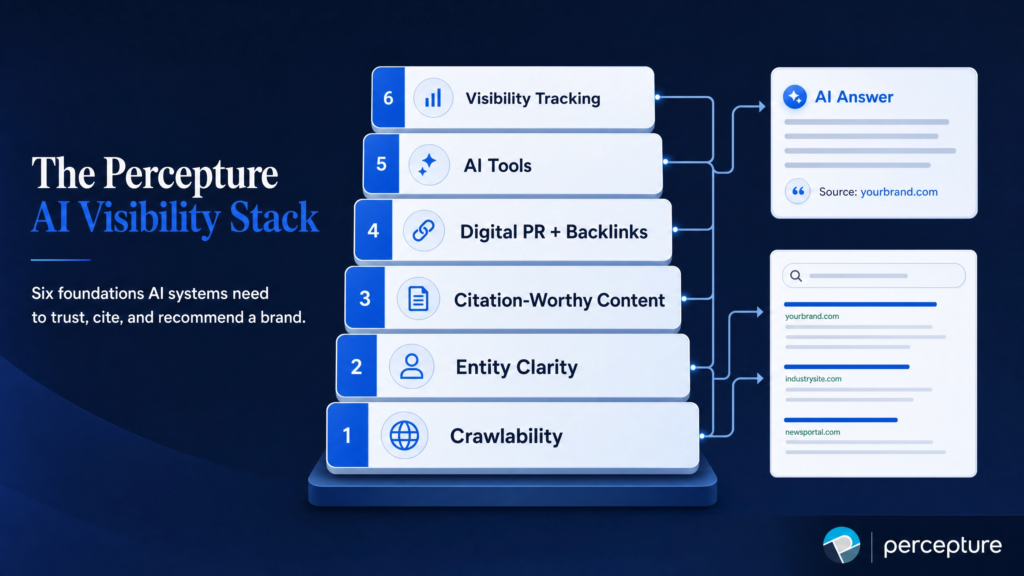
The Percepture Search Everything Evidence Loop
The framework turns LLM optimization for AI visibility into a repeatable system. It also prevents a common failure: optimizing a page for an AI answer without strengthening the underlying search, authority and conversion system.
Landscape Domination and Protect the Queen in AI search
These two Percepture concepts make the off-site strategy easier to understand.
| Operating pattern | Job | What it looks like in LLM optimization |
|---|---|---|
| Landscape Domination | Condition the market around unbranded commercial topics | Strong owned pages plus credible earned articles, expert discussions, case studies and supporting sources repeatedly explain the category and brand role. |
| Protect the Queen | Defend the highest-value brand, executive, product or narrative | Branded search results, expert profiles, positive third-party evidence and accurate owned sources create a stronger factual record before misinformation or negative coverage appears. |
The point is not to “control an LLM.” The point is to build a stronger public record so search engines, AI systems and buyers have better evidence available when they evaluate the brand.
Which LLM optimization technique should you fix first?
| Symptom | Likely failure | First move | Primary KPI |
|---|---|---|---|
| Important page is never cited | Retrieval or source-quality gap | Audit crawl, indexation, structure and answer completeness | Retrieval + citation rate |
| AI describes the company incorrectly | Entity or public-evidence conflict | Align owned facts, experts, schema and credible third-party descriptions | Description accuracy |
| Competitors appear for buyer questions you do not | Intent or topic-coverage gap | Map buyer questions and build distinct supporting sources | Prompt coverage |
| Owned pages appear but the brand is not recommended | Authority or proof gap | Strengthen case evidence, digital PR and corroboration | Recommendation + third-party citation rate |
| Visibility rises but pipeline does not | Positioning or conversion gap | Review offer clarity, CTA, proof and downstream experience | Qualified meetings + pipeline |
LLM optimization tactics that do not deserve your budget
AI-search execution and ranking examples
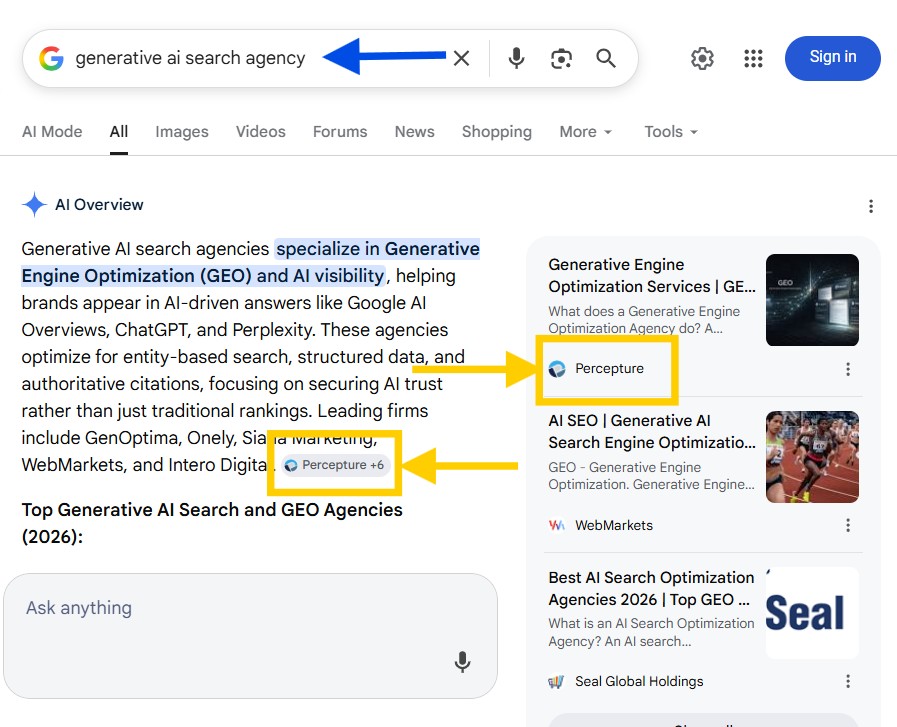
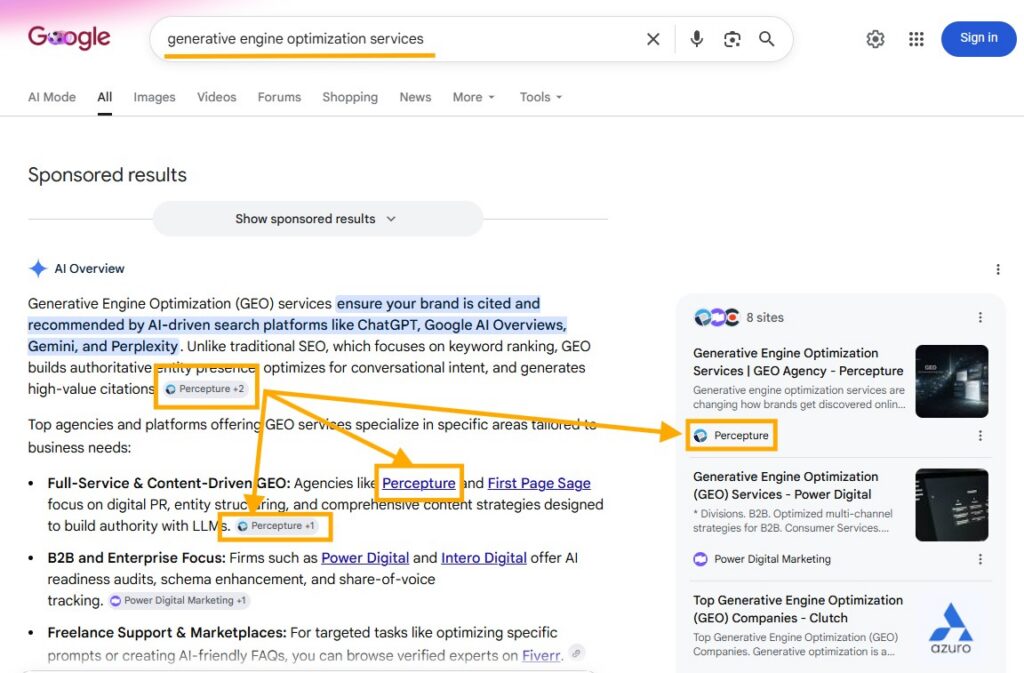
Ranking screenshots are shown full width so readers can actually inspect the example. They are point-in-time proof of Percepture’s visibility in emerging search categories, not a guarantee of future placement.
Generative AI Search Agency
Generative Engine Optimization Services
Measured AI mention growth

Find the visibility gap first
Review the access, entity, source, authority and measurement gaps before funding another content cycle. If the gap is commercial, compare the current AI search pricing and scope against the work actually required.
Request an AI Visibility AuditFrom AI visibility to qualified demand
LLM optimization is commercially useful only when visibility helps the right buyer understand the offer and take a useful next step. That is why LLM optimization for AI visibility should connect source quality with positioning, proof and conversion design.
The Broadstaff Global case study provides a broader search example of that principle. Stronger visibility supported qualified demand when it was connected to positioning, proof and conversion. It does not show that one AI citation created one lead. Teams can pair AI-search work with conversion rate optimization and omnichannel marketing after discovery.

Related Percepture resources
Frequently asked questions
What is LLM optimization for AI visibility?
LLM optimization for AI visibility improves the public evidence AI-powered systems may use when describing, citing or recommending a brand. It combines technical access, buyer-question mapping, entity clarity, useful source content, connected topic coverage, independent corroboration and repeated measurement.
Is LLM optimization the same as SEO?
No, but they overlap heavily. SEO focuses on discoverability and performance in search engines. LLM optimization focuses on how LLM-powered systems retrieve, understand and describe a brand. Strong SEO pages often become part of the source foundation, but an organic position does not automatically transfer to every AI answer.
How do you improve LLM visibility?
Start by measuring priority buyer questions. Then fix the smallest evidence gap: crawlability, entity confusion, missing source content, weak topic coverage, insufficient third-party authority or poor conversion. Remeasure the same questions over time rather than assuming one tactic works everywhere.
Do backlinks help LLM visibility?
Backlinks can support SEO authority and discovery, but LLM visibility should not be reduced to link count. The stronger goal is credible independent corroboration: relevant publications, expert mentions, case studies, reviews, associations and sources that help verify the brand’s claims.
Does social media help with LLM optimization?
Social can help, but not because there is one universal “social signal” that directly ranks every page. Social platforms have their own search and recommendation systems. They can also create expert discussions, branded demand, public references and context that strengthen the broader evidence environment.
How do you get cited by ChatGPT or other AI systems?
No publisher or agency can guarantee a citation. Improve the odds by making useful source material accessible, clear and factual, then reinforce important claims with credible external evidence. Monitor which URLs and third-party sources appear for the buyer questions you care about.
Do I need llms.txt or special AI schema?
No universal file or special markup guarantees AI visibility. Use accurate structured data when it supports visible content, maintain normal technical SEO and follow current platform crawler guidance. A file or markup change is not a substitute for source quality and authority.
Can a brand rank number one in an LLM?
Not in the same stable way a page can hold a conventional organic position. AI responses can vary by model, mode, prompt wording, location, retrieval path and date. Measure mention rate, recommendation presence, citations, cited URLs and accuracy across a defined prompt set instead of claiming one permanent rank.
What should an LLM visibility report measure?
A useful report separates mention, recommendation, citation, source URL, factual accuracy, competitor presence, referral traffic and qualified demand. It should also record the engine or mode, prompt, date and methodology so future comparisons are defensible.
What are the best LLM optimization techniques for AI visibility?
The seven best techniques are: protect the SEO and retrieval foundation, map real buyer questions, clarify entities, publish original answer-ready content, build connected topic authority, earn independent corroboration and measure mentions, citations, accuracy and demand separately.
Make your brand easier to find, understand and cite
Percepture can identify which LLM optimization for AI visibility gap deserves attention first, then connect the fix with SEO, GEO, content, digital PR, measurement and conversion rather than treating AI search as a separate campaign.
Talk to Percepture
About Bob Generale
Bob Generale is President of Percepture. His work connects SEO, public relations, social, reputation, content, AI search and conversion as one visibility system. He was using PR distribution and publisher authority to reinforce search strategy in 2006, well before GEO or LLMO became industry terms.
That operating history shaped Percepture’s Landscape Domination and Protect the Queen frameworks. Today Bob applies the same source-building logic to generative engine optimization and LLM visibility: establish the facts, make them retrievable, reinforce them with credible third-party evidence and measure whether the right buyers can find and trust the result.