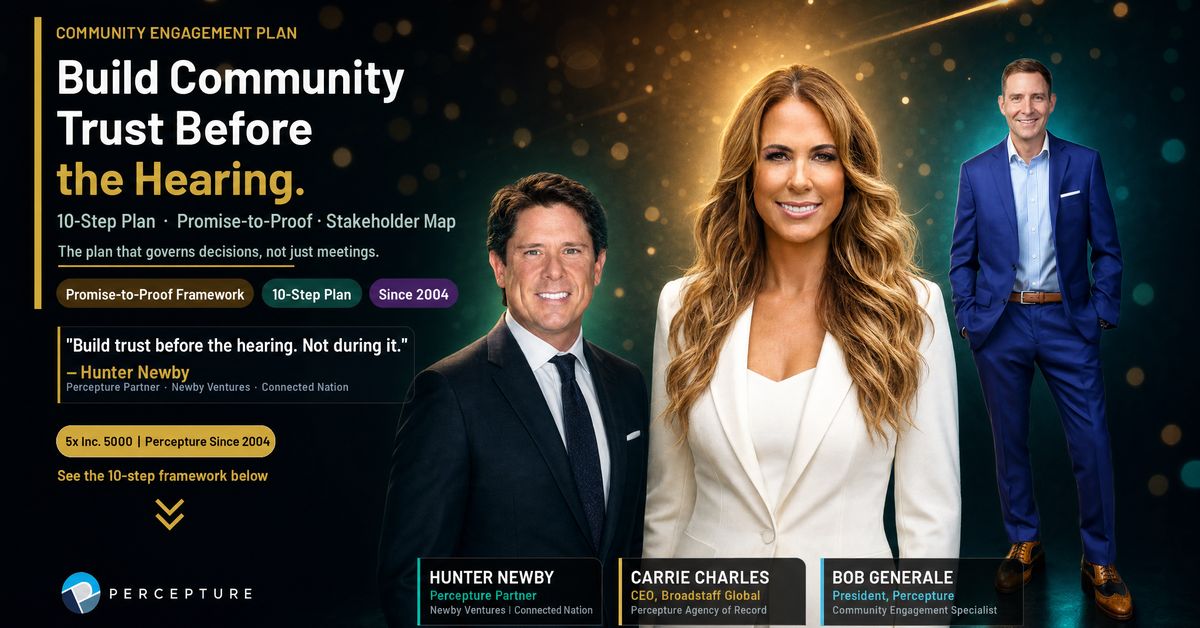

A Community Engagement Plan should do more than schedule meetings, surveys, mailers, and social posts. For a major project, it should connect decisions, stakeholders, evidence, commitments, risks, owners, and reporting from early exploration through operations.
The goal is not to manufacture approval. The goal is to give project leaders and community members a clear process for sharing facts, defining influence, recording feedback, and showing what happens next.
Trusted where reputation and project momentum meet
Since 2004, Percepture has helped organizations in telecom, fiber, data centers, construction, life sciences, staffing, and other complex B2B markets communicate with clarity and credibility.
We connect executive positioning, public relations, search visibility, stakeholder engagement, and measurable follow-through so each part of the strategy strengthens the next.
- Operating since 2004More than two decades of B2B strategy and execution
- Infrastructure fluencyTelecom, fiber, data centers, and complex projects
- Executive-led strategyBuilt for owners, investors, and growth leadership
- Evidence-led communicationClear claims, accountable owners, and measurable action
What is a Community Engagement Plan?
A Community Engagement Plan is the operating document that defines who a project will engage, what people can influence, which methods will be used, who owns each response, how commitments will be tracked, and how results will be reported. It should remain active as project facts, risks, schedules, and stakeholder concerns change.
Updated August 10, 2026
Enter a community with trusted partners already there
“Do not enter a community as if the relationships begin with your project. Enter with respect for the partners, institutions, and trusted voices already there. We help project teams identify those relationships, explain the facts clearly, and build a transparent engagement system that can earn durable trust.”
— Bob Generale, President and Partner, Percepture
Percepture helps project leaders map local organizations, infrastructure partners, public institutions, technical experts, media, economic-development stakeholders, and community voices before a high-stakes announcement or approval cycle. The purpose is not to manufacture support. It is to build informed relationships, publish verifiable information, and create a documented path from questions to decisions.

Community progress often begins with aligned institutions
Connected Nation and a Newby Ventures entity formed a joint venture to pursue carrier-neutral Internet Exchange Points in regional communities. Their public materials show how infrastructure, nonprofit mission, universities, government programs, technical expertise, and local education can work together around a shared community outcome.

Executive summary
A strong Community Engagement Plan gives leadership one governed source of truth instead of separate spreadsheets, talking points, contact lists, and meeting notes.
Define the decision
State what has been decided, what remains open, and what is constrained by technical, financial, contractual, or regulatory conditions.
Map affected people
Track impact, influence, position, access needs, relationships, concerns, internal owner, and next action.
Control public claims
Give each material claim a source, owner, reviewer, approval status, and update date before it is repeated across channels.
Close the loop
Record feedback, responses, commitments, deadlines, completion evidence, and the way each outcome is reported back.
Who needs a formal plan?
High-impact projects
Use a formal Community Engagement Plan when construction, traffic, land use, utilities, noise, access, public services, or other project activity may affect nearby people.
Long project lifecycles
A governed Community Engagement Plan is useful when engagement must continue through site review, permitting, construction, commissioning, operations, or expansion.
Large buyer committees
The Community Engagement Plan should connect executives, development, public affairs, legal, technical teams, construction, operations, and communications.
Fast-moving narratives
A Community Engagement Plan provides a verified source of truth when meetings, news coverage, search results, social posts, and AI answers can spread incomplete information.
This guide addresses public-facing construction, data center, energy, manufacturing, life sciences, broadband, and infrastructure projects. It does not replace legal, engineering, environmental, health, safety, or permitting counsel.
The working Community Engagement Plan should also connect with the broader project communications system. Percepture’s strategy and planning services align objectives and ownership, while omnichannel marketing helps keep approved information consistent across meetings, email, web, search, and social channels.
Pressure-test your Community Engagement Plan
Start by testing the people, issues, evidence, and next actions already identified in your Community Engagement Plan. Gaps found early are easier to govern than gaps discovered during a hearing, construction disruption, or public dispute.
Plan, strategy, outreach, and communications are not the same
A strategy establishes principles, desired outcomes, and the project’s approach to public influence. A Community Engagement Plan converts that strategy into owners, activities, records, controls, deadlines, and measures.
Outreach is one-way distribution or an invitation to participate. Engagement creates a two-way process in which the project receives input, evaluates it, responds, and explains the result. A communications plan governs messages and channels, but it does not necessarily define decision boundaries or track commitments.
Public relations remains part of the operating system. Public relations services can support media briefings and public updates, while a separate crisis communications program establishes escalation roles when an issue becomes urgent.
Build partnerships, public understanding, and government readiness
Major projects rarely succeed through communications alone. They require credible local partners, accurate public information, responsive project leadership, and a government-relations process that respects disclosure, registration, procurement, ethics, and lobbying rules.
1. Partnership development
Identify organizations and leaders with legitimate knowledge of the community. Define the shared purpose, each party’s role, decision authority, disclosure requirements, and the value the partnership should create locally.
2. Public education
Explain the project before an urgent request is placed before the community. Use plain-language pages, briefings, visual evidence, local media, search, and accessible updates to clarify benefits, impacts, tradeoffs, timelines, and unknowns.
3. Transparent government relations
Coordinate with qualified legal, public-affairs, or government-relations counsel when advocacy is required. Disclose sponsorship, preserve accurate records, avoid false grassroots activity, and never present paid or organized support as independent community sentiment.
4. Geographic communications
Use lawful geographic and contextual media to distribute factual project information to affected areas. Apply privacy, platform, election, and public-sector advertising rules, and do not use sensitive personal data or covert targeting to pressure individual officials.
5. Commitment and response
Record what the project heard, what changed, what could not change, and why. Durable trust comes from repeated follow-through, not a single campaign burst.
How to create a Community Engagement Plan in 10 steps
The ten steps below turn a Community Engagement Plan into a working management system. Complete them in sequence, then revisit them whenever the project enters a new stage or a material fact changes.
1. Establish the project facts
Start with the project description, location, lifecycle stage, proposed schedule, known impacts, current approvals, assumptions, and unresolved questions. In the Community Engagement Plan, separate verified facts from targets and estimates.
Create a fact register with a source, owner, reviewer, and update date. If the technical team cannot support a public statement, the communications team should not publish it as fact.
2. Define the decision and public influence
Every engagement activity should connect to a real decision. Classify each decision as fixed, open, or constrained.
- Fixed: The decision has already been made or cannot be changed through this process.
- Open: Community input can shape the choice among feasible options.
- Constrained: Input can affect part of the decision, but technical, contractual, financial, or regulatory limits apply.
Explain these boundaries before asking for input. Do not invite people to influence a decision that the project team has already closed.
3. Assess community context
Review local history, trust conditions, demographics, languages, access barriers, previous projects, media coverage, known concerns, and respected messengers. Online listening can help, but it should not replace local conversations.
The U.S. Environmental Protection Agency’s situation assessment guidance describes assessment as a way to understand stakeholders, issues, relationships, and participation conditions before selecting a process.
4. Build the stakeholder register
Include people who may be affected, people who can influence the process, and internal teams responsible for project decisions. The stakeholder register gives the Community Engagement Plan a governed record of these relationships. Depending on the project, the register may include nearby residents, landowners, elected officials, agencies, community organizations, businesses, schools, emergency services, contractors, employees, utilities, and local media.
For each stakeholder, track impact, influence, current position, key concerns, preferred access method, relationship owner, last contact, next action, and privacy classification. Percepture’s guide to data center community engagement shows why local context must be addressed before project narratives harden.
5. Create the issue and risk baseline
Record each issue with its source, affected stakeholders, likelihood, potential impact, evidence, owner, status, response, and escalation trigger. Keep an issue separate from a rumor, complaint, question, or formal commitment.
Define when an issue moves to executive, legal, technical, security, or crisis review. A trigger might involve immediate safety concerns, a public information error, a missed commitment, organized opposition, or rapid media attention. The trigger starts review; it does not assume the concern is valid or invalid.
6. Set decision-linked objectives
Each Community Engagement Plan objective should state the audience, desired result, measure, and timeframe. Useful measures include representation, understanding, response time, issue resolution, commitment completion, and the number of decisions informed by documented feedback.
Do not confuse activity with outcome. A meeting count is an output. A documented design change, resolved access issue, completed commitment, or improved understanding is an outcome.
7. Select methods and channels
Match the method to the stakeholder, decision, project stage, influence level, access needs, and risk. Record the selected mix in the Community Engagement Plan. Interviews support depth. Surveys support structured reach. Open houses support flexible discussion. Town halls support public visibility but can limit individual conversation.
Use project portals, email, SMS, direct mail, social media, hotlines, and local partners as parts of a mixed system. Percepture’s content marketing services can help convert approved technical material into clear updates without changing the underlying facts.
8. Build the message and evidence system
Create an approved claim library. Each claim should identify what is known, what remains uncertain, the supporting evidence, the reviewer, the channels where it may appear, and the next review date.
The same verified source should feed public meetings, media responses, project pages, email, search content, social posts, and AI-readable answers. GEO services can help structure public information for search and AI retrieval, but structured publishing cannot correct an unsupported claim.
9. Assign governance and stage gates
Use a RACI structure to identify who is responsible, accountable, consulted, and informed. Assign owners for stakeholder relationships, technical facts, approvals, public responses, commitments, records, reporting, and escalation.
Set gates for site exploration, pre-permitting, permitting, pre-construction, construction, commissioning, operations, and future expansion. A project should not pass a communications gate when required facts, notices, approvals, or response workflows are incomplete.
10. Track feedback, commitments, and results
Maintain a feedback log and a separate commitment register. The feedback log records what was heard, how it was assessed, who responded, and how the result was communicated. The commitment register records the exact promise, owner, deadline, dependency, status, completion evidence, and public update.
Keep the Community Engagement Plan current through version control, scheduled reviews, stage changes, and issue-based updates. A plan that stops at groundbreaking cannot govern construction notices, disruption, restoration, commissioning, or operational relationships.
The Percepture Promise-to-Proof framework
The Promise-to-Proof framework gives a Community Engagement Plan a disciplined way to move public claims from intention to repeated verification. It has five stages: Promise, Paper, Physical, Proof, and Trust.
| Stage | What the project says | What the project shows | Verifier | Update date | Community action |
|---|---|---|---|---|---|
| Promise | State the intended result and the known unknowns. | Plain-language goal, limits, assumptions, and owner. | Executive and technical owners | When the intent changes | Ask questions and identify concerns. |
| Paper | Explain what has been documented or authorized. | Relevant studies, agreements, policies, schedules, permits, or approvals. | Authorized project reviewer | When documentation changes | Review the cited material and submit input. |
| Physical | Describe work that can be observed. | Crews, construction, signage, equipment, restoration, or operational preparation. | Construction or operations owner | At the project reporting cadence | Report conflicts, access issues, or discrepancies. |
| Proof | Report whether a commitment or outcome occurred. | Completion records, testing, delivery evidence, or documented mitigation. | Named accountable owner | After verification | Review the result and unresolved items. |
| Trust | Continue reporting performance, changes, and misses. | Repeated updates, corrected records, completed actions, and open issues. | Project sponsor | Through operations | Continue the feedback relationship. |
The framework prevents goals from being presented as completed outcomes. It also makes delays and misses visible, which gives the project team a controlled way to correct the record.

Connect planning with investment
Community Engagement Plan scope depends on project stage, stakeholder complexity, technical review, reporting needs, channel mix, and issue exposure. Review Percepture’s service options before deciding whether the work belongs entirely in-house or requires outside support.
Community Engagement Plan method comparison
No single method can carry a Community Engagement Plan. Choose a mix that fits the decision, stakeholder group, access conditions, and project stage.
| Method | Best use | Main strength | Operating caution |
|---|---|---|---|
| One-to-one interviews | Early discovery and sensitive issues | Depth and relationship context | Findings may not represent the wider community. |
| Survey | Structured input across a defined audience | Comparable responses | Question design and distribution can shape results. |
| Open house | Project explanation and individual discussion | Flexible participation | Requires a clear method for recording conversations. |
| Town hall | Visible public discussion | Shared questions and answers | A few speakers can dominate the session. |
| Community advisory group | Continuing input through multiple stages | Relationship continuity | Membership, authority, and reporting rules must be explicit. |
| Project portal | Central facts, updates, documents, and feedback | Persistent source of truth | Content must be maintained and accessible. |
| Direct mail, email, or SMS | Notices, reminders, and targeted updates | Direct distribution | Contact permissions and delivery records must be governed. |
| Hotline | Construction questions and time-sensitive reports | Clear intake path | Response ownership and escalation times must be defined. |
Manage the plan across the project lifecycle
The Community Engagement Plan should change as the project moves from exploration to operations. Early work focuses on context, decision boundaries, affected people, and known unknowns. Construction work shifts toward notices, access, safety coordination, disruption, complaints, commitments, and restoration.
| Stage | Engagement focus | Required control |
|---|---|---|
| Exploration | Local context, initial stakeholders, decision boundaries | Fact and assumption register |
| Pre-permitting | Early listening, issues, access, public influence | Stakeholder and risk baseline |
| Permitting | Process information, formal input, technical evidence | Approved claim library and records |
| Pre-construction | Schedule, access, notices, contractor coordination | Readiness gate and contact workflow |
| Construction | Disruption, progress, complaints, commitments | Issue escalation and completion evidence |
| Commissioning | Testing, operational preparation, remaining work | Verified status reporting |
| Operations | Continuing relationships, performance, open commitments | Reporting cadence and named owner |
| Expansion or closure | New impacts, changed decisions, transition planning | Updated assessment and plan version |
What belongs in a Community Engagement Plan template?
A practical Community Engagement Plan template uses both a narrative document and a controlled tracker. The document explains purpose, scope, governance, decision boundaries, methods, escalation, and reporting. The tracker manages records that change frequently.
Plan document
- Project profile, purpose, scope, facts, and assumptions
- Decision boundaries and public influence
- Community context and stakeholder approach
- Objectives, methods, access, and inclusion
- Message architecture and evidence controls
- Governance, escalation, stage gates, and reporting
- Approvals, version history, privacy, and limitations
Operating tracker
- Stakeholders and relationship owners
- Issues, risks, triggers, and responses
- Activities, dates, channels, and attendance
- Messages, evidence, reviewers, and update dates
- Feedback, decisions, and response status
- Commitments, owners, deadlines, and proof
- Metrics, contacts, and next actions
Protect confidential contact information with role-based access and retention rules. The public-facing record should explain outcomes without exposing personal or sensitive stakeholder data.
Community Engagement Plan readiness scorecard
| Readiness question | Ready | Watch | Not ready |
|---|---|---|---|
| Are project facts separated from goals and assumptions? | Sources, owners, and dates are recorded. | Some facts lack review dates. | Talking points are the only record. |
| Can the team explain what the public may influence? | Fixed, open, and constrained decisions are documented. | Boundaries are understood but not published. | The team is asking for input without defined influence. |
| Does every material claim have evidence? | Claims have sources and reviewers. | Evidence exists in separate systems. | Claims rely on memory or estimates. |
| Are feedback and commitments tracked separately? | Both logs have owners and statuses. | Records exist but lack governance. | Promises remain in notes or email. |
| Are escalation triggers defined? | Owners and response paths are documented. | Escalation depends on informal judgment. | No cross-functional response path exists. |
| Can leaders see outcomes, risks, and overdue actions? | An executive dashboard is current. | Reports focus mainly on activity. | No shared reporting system exists. |
Several “watch” or “not ready” results indicate a Community Engagement Plan governance gap. Fix source ownership, decision boundaries, and commitment controls before adding more channels or events.
Adapt the operating system to the industry
A construction Community Engagement Plan should emphasize access, schedule changes, contractor coordination, disruption, complaint intake, and restoration. Percepture’s construction guidance also explains how content marketing for construction can support clear project updates.
Data center and digital infrastructure teams may need to explain project stages, construction activity, utility coordination, and continuing operations in plain language. A broader digital infrastructure PR strategy can connect local engagement with media, executive, search, and stakeholder communications.
Broadband projects should track service-area facts, construction notices, restoration, serviceability, and the difference between intended coverage and verified availability. Energy, transmission, manufacturing, pipeline, life sciences, and mining projects require their own technical and jurisdiction-specific review rather than copied language from another industry.
Measure outputs, outcomes, risks, and commitments
Executive reporting should distinguish activity from change. Report outputs such as interviews, meetings, notices, portal visits, and responses. Then report outcomes such as resolved access issues, decisions informed by feedback, completed commitments, response performance, and open risks.
Community reporting should answer four questions: What did the project hear? What did the team evaluate? What changed or did not change? What happens next? If an input cannot be adopted, explain the constraint without dismissing the concern.
Digital publishing should follow the same evidence rules. A project page can act as a crawlable source of truth, while a data center marketing guide or other industry resource can support broader discovery. Search visibility does not make a claim accurate; it makes evidence control more important.
Ten mistakes that weaken the plan
A Community Engagement Plan loses value when the document exists but the operating controls do not. Watch for these common failures:
- Starting late. The team begins outreach after major choices are closed or public concern is already organized.
- Seeking approval instead of honest influence. Engagement is treated as a campaign to win support rather than a process for informed input.
- Overpromising. Goals, estimates, or possible benefits are presented as completed facts.
- Mapping only supporters. The register ignores affected, undecided, skeptical, or hard-to-reach people.
- Using one method. A single town hall, survey, or social channel is treated as representative.
- Skipping technical review. Public language moves faster than the evidence and approval process.
- Leaving promises in meeting notes. Commitments lack exact wording, owners, deadlines, and completion proof.
- Measuring activity only. Reports count contacts but do not show decisions, outcomes, risks, or issue resolution.
- Ignoring search and AI narratives. Outdated or unclear public information remains available without a correction workflow.
- Stopping at groundbreaking. The team has no system for construction, commissioning, operations, or expansion.
When an issue accelerates, use a defined escalation path rather than improvising. Percepture’s guide to crisis communications agency support explains how specialized crisis work differs from routine project updates.
Community Engagement Plan cost and delivery options
There is no single responsible price for every project. Scope depends on lifecycle stage, geography, stakeholder complexity, technical review, meeting needs, public records, digital channels, reporting, and the urgency of known issues.
| Delivery model | Best fit | What the project must supply | Main risk |
|---|---|---|---|
| Internal team | Clear facts, limited exposure, and experienced local staff | Cross-functional authority, time, tools, and technical reviewers | Engagement becomes an extra duty without operational ownership. |
| Specialist advisor | Complex stakeholders, public visibility, or major lifecycle transitions | Executive sponsor, access to facts, and decision-maker participation | The advisor cannot fix delayed decisions or unsupported claims alone. |
| Hybrid team | Projects that need local ownership plus outside process and communications support | Clear roles, one source of truth, and shared reporting | Overlapping responsibilities create inconsistent responses. |
Outside support is most useful before the team faces a compressed hearing schedule, conflicting public claims, organized opposition, overdue commitments, or a construction issue without an established response path.
Frequently asked questions
How often should a Community Engagement Plan be updated?
A Community Engagement Plan should be reviewed at each project stage gate and whenever a material decision, schedule, impact, stakeholder condition, claim, commitment, or risk changes. Use version control so the team can identify what changed, who approved it, and which public materials require correction.
Who should own community engagement planning?
A named project leader should be accountable for the Community Engagement Plan, but ownership must be cross-functional. Development, public affairs, legal, technical teams, construction, operations, and communications should have defined responsibilities. Relationship owners should not make technical or contractual commitments without the appropriate review.
What can the community actually influence?
The answer depends on the project and jurisdiction. The project team should publish a decision matrix that separates fixed, open, and constrained choices. Input should be connected to a real evaluation process, and the team should report whether the input changed a decision, informed mitigation, or could not be adopted.
Is a town hall enough for community engagement?
No single method is enough for most major projects. Town halls provide visible discussion but may not reach people with scheduling, language, mobility, technology, or trust barriers. Combine public meetings with interviews, open houses, surveys, direct notices, digital information, and a documented feedback workflow.
What is a commitment register?
A commitment register records the exact promise, intended recipient, owner, deadline, dependencies, status, completion evidence, and reporting method. It should be separate from the feedback log because receiving a request is not the same as making a commitment.
Can an internal communications team create the plan?
Yes, when the team has executive authority, access to technical facts, local knowledge, project-management capacity, and a clear approval process. Outside support can help when stakeholder conditions are complex, the schedule is compressed, or the team lacks an integrated system for evidence, issues, commitments, and reporting.
How should a project handle misinformation?
First verify the underlying facts. Publish a dated correction in plain language, cite the supporting source, explain uncertainty, and update the channels where the incorrect information appeared. Avoid repeating a false claim more widely than necessary, and keep a record of the correction and approval process.
How do search engines and AI systems find project information?
They can retrieve crawlable public pages, headings, tables, links, and structured data. Projects should maintain one accurate public source of truth, use clear language, date material updates, and correct stale information. Schema can describe visible content, but it cannot replace evidence or guarantee a citation.
Build a governed Community Engagement Plan
Percepture can help your leadership team build a Community Engagement Plan that connects stakeholder intelligence, public relations, crisis readiness, digital publishing, commitments, and executive reporting. Start with the project stage, location, known concerns, decision timeline, and the records your team already has.