


AI search visibility metrics KPIs should tell leaders more than whether a brand appeared in an answer. They should show where the brand appears, whether the answer is accurate, which sources support it, and whether that exposure produces qualified business activity.
The measurement problem is not a lack of numbers. It is a lack of shared definitions, evidence rules, ownership, and a clear path from visibility to revenue.
What should an AI-search measurement system track?
AI search visibility metrics KPIs measure prompt coverage, brand inclusion, recommendation, citations, narrative accuracy, competitive share, identifiable referrals, qualified demand, pipeline, revenue, and measurement confidence. A useful KPI also has a defined formula, target, owner, reporting cadence, and evidence trail.
Updated August 9, 2026
See how visibility becomes business evidence
Carrie Charles of Broadstaff Global discusses Percepture’s search, digital PR, and AI-search work. The example shows the kind of integrated execution this measurement framework is designed to evaluate: useful visibility, stronger authority, qualified demand, and a record leaders can inspect.
Read the testimonial summary
Carrie describes Broadstaff Global’s experience with Percepture’s search, digital PR, and AI-search work. This is a plain-language summary, not a word-for-word transcript or a guarantee that another company will receive the same result.
Percepture measures the visibility it also has to earn
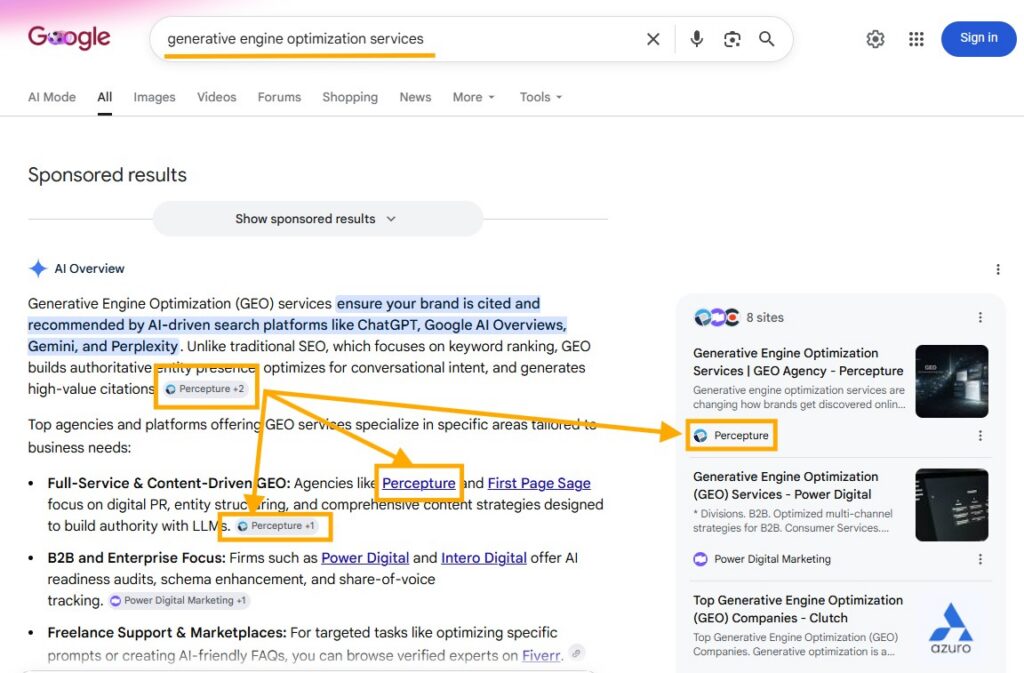
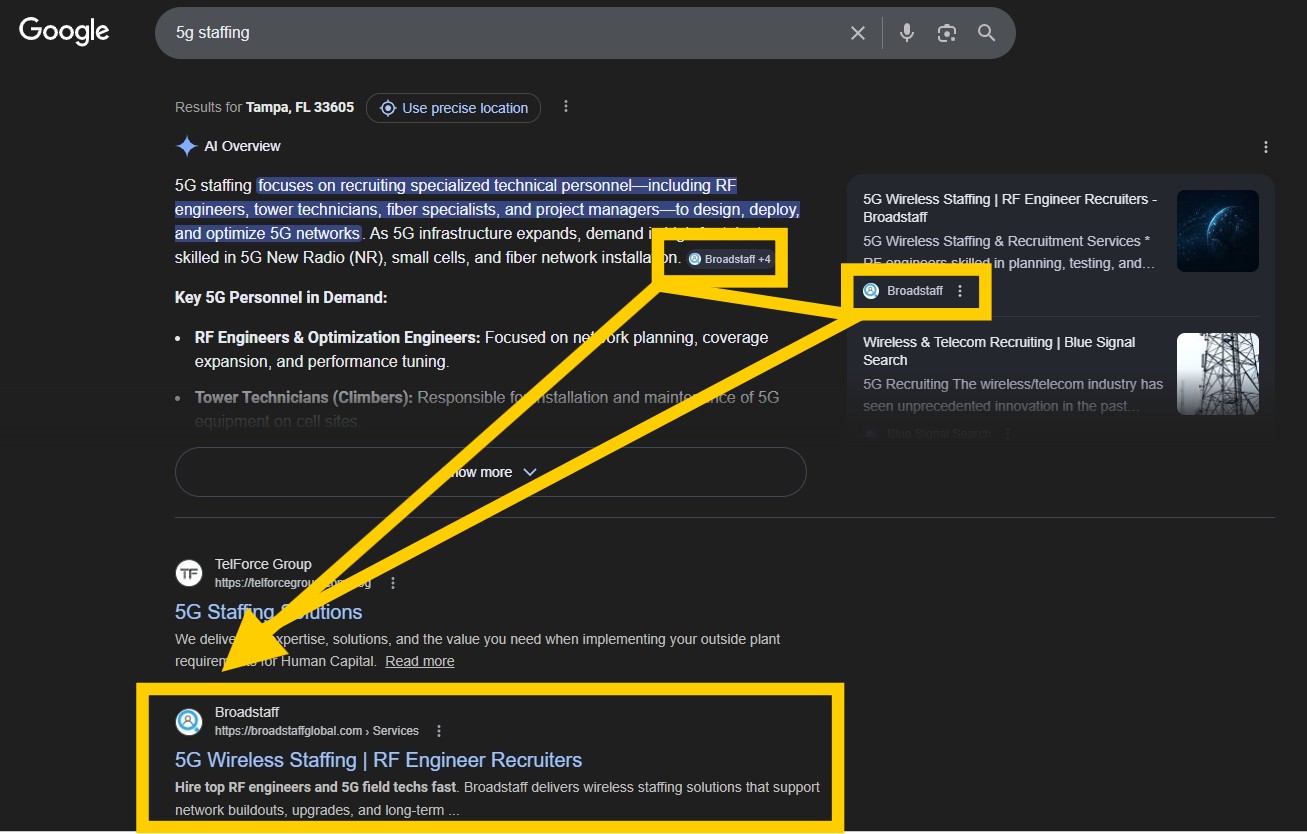
A credible AI-search partner should be able to show its own search visibility, explain the limits of each screenshot, and connect measurement with useful execution. These examples demonstrate method and market experience; rankings and generated answers can change.
The executive view
Measure presence
Track whether the brand appears across priority buyer questions, platforms, markets, and stages of the buying process.
Measure trust
Separate mentions from citations, then inspect source quality, narrative accuracy, recommendation language, and competitor context.
Measure action
Connect identifiable AI referrals and assisted evidence to engagement, accepted leads, opportunities, and revenue.
Measure confidence
Disclose the prompt set, platform, geography, test date, repeat count, formula, volatility, and known attribution gaps.
The operating rule is simple: AI search visibility metrics KPIs are useful only when they lead to a decision, an owner, and a documented next action.
Why AI-search reporting needs a different measurement model
Traditional search reporting starts with queries, rankings, impressions, clicks, and conversions. Those signals still matter, but an AI-generated response introduces additional questions. A company can be mentioned without being recommended, cited without receiving a click, or described in a way that is incomplete or wrong.
Answers can also vary by platform, prompt wording, user context, geography, language, and test timing. One answer run is therefore an observation, not a stable market benchmark. Leaders need repeated testing and a retained record of what the system returned.
This is why AI search visibility metrics KPIs must connect enterprise SEO, source authority, analytics, conversion, and sales data. The dashboard should not isolate AI search as a new reporting island.
Metric, KPI, vendor score, or diagnostic?
These terms are often treated as interchangeable. They are not.
- Metric: A measured value, such as the number of answers that mention a company.
- KPI: A selected metric tied to an objective, target, owner, and reporting cadence.
- Vendor score: A platform-defined calculation that combines or weights signals according to its own method.
- Diagnostic: A signal used to locate a problem or opportunity, rather than declare business success.
A visibility score without its prompt set, platform, geography, date, sample size, and formula is not a business KPI. It is an estimate produced under a specific measurement method.
Who this measurement guide is for
CEO
Needs to know whether the company is recommended, represented accurately, and gaining category authority.
CMO
Needs a defensible view of prompt coverage, citations, competitive position, demand, and channel action.
CFO
Needs cost, attribution confidence, tool overlap, opportunity evidence, and revenue rules.
SEO, PR, analytics, and RevOps
Need formulas, raw evidence, data ownership, source preservation, and a practical action queue.
Each stakeholder should use AI search visibility metrics KPIs that match their decisions while sharing the same definitions and evidence standards.
See what AI search can verify about your brand
Before adding another dashboard, test priority buyer prompts, record the sources AI systems select, and identify where inaccurate answers, missing evidence, or weak conversion paths limit the value of your visibility.
AI search visibility metrics KPIs in the VISIBLE-to-Revenue Framework
The Percepture VISIBLE-to-Revenue Framework organizes measurement from the prompt universe through economic impact. It prevents teams from treating a mention as the finish line and gives each department a defined place in the reporting chain.
The Percepture VISIBLE-to-Revenue Framework
V — Validated Prompt Universe
Define the buyer questions being tested, their intent, funnel stage, persona, geography, language, platform, and test frequency. AI search visibility metrics KPIs begin with a prompt universe that reflects real buying situations rather than a convenient list of branded questions.
Prompt Coverage Rate: tracked priority prompt clusters ÷ planned priority prompt clusters × 100.
I — Inclusion and Prominence
At this stage, AI search visibility metrics KPIs measure whether the brand appears, whether it is recommended, where it appears in the response, and whether inclusion persists across platforms and repeated runs.
Brand Inclusion Rate: answers mentioning the brand ÷ total valid answer runs × 100.
Recommendation Rate: commercial-intent answers explicitly recommending the brand ÷ commercial-intent runs × 100.
S — Source and Citation Strength
Count citations separately from mentions. Record owned citations, earned-media citations, source diversity, citation position, and page-level frequency. Effective AI search visibility metrics KPIs show which sources support the brand and which sources support competitors.
Citation Rate: valid answer runs containing a citation to the brand or an authoritative brand source ÷ total valid runs × 100.
Owned Citation Share: citations to owned pages ÷ all citations collected for the prompt set × 100.
I — Interpretation and Narrative Accuracy
Use AI search visibility metrics KPIs to review service descriptions, factual accuracy, entity confusion, competitor confusion, sentiment, and narrative consistency. A visible answer that misstates the company is a reputation and conversion problem.
Accuracy Rate: accurate brand descriptions ÷ answers mentioning the brand × 100.
B — Benchmark and Competitive Share
Competitive AI search visibility metrics KPIs compare brand inclusion, recommendation, prompt-cluster wins, platform wins, and unweighted share of voice against a controlled competitor set. Vendor formulas may apply different prompt, position, or source weights, so scores from separate tools should not be treated as equivalent.
Unweighted Share of Voice: brand mentions ÷ all tracked competitor-brand mentions × 100.
L — Lead and Demand Signals
Track identifiable AI referrals, engaged visits, calls, forms, key events, self-reported discovery, branded-demand movement, and sales acceptance. This is where AI search visibility metrics KPIs move from exposure to observable action.
AI Referral Conversion Rate: key events from identifiable AI referral sessions ÷ identifiable AI referral sessions × 100.
E — Economic Impact
Economic AI search visibility metrics KPIs measure qualified opportunities, influenced pipeline, cost per opportunity, accepted-lead value, sales-cycle movement, and revenue only when the evidence rule is explicit.
AI-Influenced Pipeline: the sum of opportunity value for records that meet the company’s defined AI-touch evidence standard.
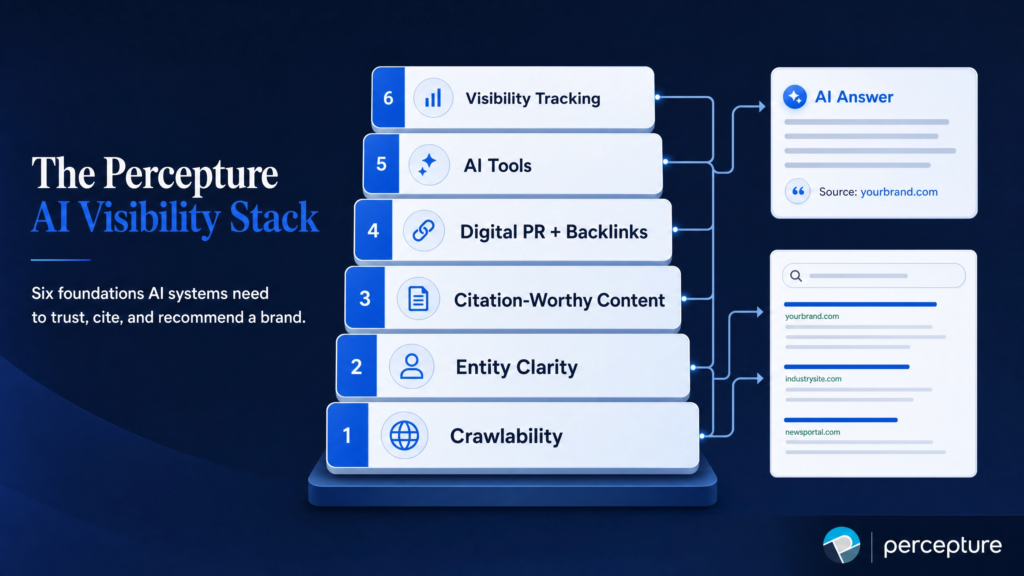
The framework is designed to work with broader generative engine optimization services. AI search visibility metrics KPIs find the gap; content, technical work, authority building, conversion design, and sales operations close it.
Build the KPI hierarchy before building the dashboard
A flat list makes every number look equally important. A hierarchy shows what each signal can prove and where it belongs in the decision process. Use the following structure to organize AI search visibility metrics KPIs from technical eligibility through reliability.
AI-search metric hierarchy
| Level | Metrics | Business question |
|---|---|---|
| Eligibility | Indexing, crawl access, bot access, page accessibility | Can search and answer systems retrieve the company’s information? |
| Visibility | Prompt coverage, inclusion, prominence, recommendation | Is the brand present for priority buyer questions? |
| Authority | Citation rate, citation share, source quality, source diversity | Is the answer supported by credible sources? |
| Representation | Accuracy, sentiment, entity clarity, narrative consistency | Is the company represented correctly? |
| Competition | Share of voice, prompt wins, platform wins | Which companies own the category conversation? |
| Demand | Referrals, engagement, calls, forms, branded demand | Is visibility producing observable action? |
| Revenue | Accepted leads, opportunities, pipeline, revenue | Is that action creating business value? |
| Reliability | Repeatability, volatility, sample size, evidence retention | Can leaders trust the report? |
This hierarchy keeps AI search visibility metrics KPIs aligned with the business question each measurement can answer.
How to measure mentions, citations, and recommendations
Within AI search visibility metrics KPIs, a mention means the answer names the company, a citation means the answer links to or identifies a source associated with the statement, and a recommendation means the answer presents the company as an option for a relevant need. These events can overlap, but they prove different things.
A mention can improve awareness without establishing authority. A citation can validate a source without recommending the company. A recommendation may create demand even when the user does not click immediately. Report all three separately.
Source analysis should combine owned content with digital PR and broader earned and owned media. If competitors are repeatedly cited, inspect the pages and publications that support them before producing more content.
For strategy outside the measurement layer, see how to improve brand visibility in AI search and how digital PR supports AI-search authority.
Platform reporting and evidence collection
No dashboard should imply that every AI experience provides the same fields or level of reporting. AI search visibility metrics KPIs should identify the platform and evidence source for every row of data.
Google AI experiences
Use the reporting available in the organization’s Search Console account alongside page, query, country, device, and date analysis. Document which AI-related reporting views are available when AI search visibility metrics KPIs are reported. Keep standard search performance and controlled prompt observations separate when their collection methods differ.
Technical eligibility still depends on accessible, understandable pages. Teams should review crawl and index conditions as part of the same operating plan used for focused SEO execution.
ChatGPT search
Capture the answer, cited sources, prompt, date, and visible experience used during the test so AI search visibility metrics KPIs retain a reviewable evidence trail. Analytics can record identifiable referral sessions when source information survives the visit, but click-only reporting will not reveal every assisted or no-click interaction.
Perplexity, Gemini, Claude, and Copilot
Monitoring may require a combination of controlled prompts, approved monitoring tools, manual evidence review, analytics, and CRM records. Do not present a vendor’s synthetic monitoring output as first-party platform analytics.
Tool-assisted workflows can improve consistency, but the tool must expose enough method detail to support review. The guide to AI search optimization tools provides additional context for using technology without letting a score replace analysis.
The evidence record for every answer run
Reliable AI search visibility metrics KPIs depend on retaining the following fields for every valid observation:
- Platform and visible product experience
- Prompt text and prompt cluster
- Buyer intent and funnel stage
- Branded or non-branded classification
- Persona, geography, and language
- Date and time of collection
- Brand and competitor mentions
- Recommendations and answer prominence
- Cited source names and URLs
- Narrative accuracy review
- Screenshot or retained raw output where permitted
- Reviewer, next action, and change-log entry
The Measurement Confidence Card
AI search visibility metrics KPIs need a confidence layer because generated answers can vary. The confidence card does not make the data certain. It makes the limits visible so leaders can decide how much weight to place on the result.
Measurement Confidence Card
Scope
- Platform
- Model or experience
- Prompt set
- Prompt intent
- Branded and non-branded split
Context
- Persona
- Geography
- Language
- Run date and time
- Repeat count
Method
- Formula
- Sample size
- Raw evidence retention
- Volatility or confidence band
- Known attribution gaps
Accountability
- Data owner
- Business owner
- Target
- Reporting cadence
- Next action
How to handle repeatability
Run priority prompts more than once and retain each valid observation. Report the range or volatility rather than averaging away instability. If one platform produces wide variation, that variation should accompany its AI search visibility metrics KPIs as part of the finding.
Do not mix different prompt sets, markets, or formulas into a trend line without documenting the change. A change log should state what changed in the method, what moved in the results, and what the team will do next.
Connect AI visibility to demand, pipeline, and revenue
The strongest reporting model separates evidence classes instead of forcing every touch into one revenue number. This makes AI search visibility metrics KPIs more credible with finance, sales, and RevOps.
AI attribution evidence ladder
| Evidence class | What it means | Reporting treatment |
|---|---|---|
| Directly attributable referral | An identifiable AI referral reaches the site and completes a measured action. | Report source, session, event, and downstream CRM outcome. |
| Assisted AI touch | Documented AI exposure appears within a broader buying path. | Report as assisted evidence under a stated attribution rule. |
| Self-reported discovery | A prospect says an AI system contributed to discovery or research. | Store the response and distinguish it from click-based attribution. |
| Branded-demand correlation | Branded search or direct demand moves during the measurement period. | Report as correlation unless a stronger causal record exists. |
| Unattributed influence | The influence is plausible but no identifiable evidence survives. | Disclose the gap; do not assign the activity to AI revenue. |
The evidence class determines how AI search visibility metrics KPIs can be connected to pipeline and revenue without overstating attribution.
Use marketing attribution and analytics to preserve source data, define key events, and connect qualified records to opportunities. Pair that work with conversion rate optimization so increased visibility has a clear next step.
Lead volume alone is not enough. Sales acceptance, rejection reasons, meeting quality, opportunity creation, and sales-cycle movement show whether AI-influenced demand fits the business. Lead generation services and B2B intent data can help align visibility with the accounts and buying signals that matter.
Assign five KPIs to each owner
One company dashboard can serve several teams, but each leader should receive a focused view. AI search visibility metrics KPIs become harder to act on when every stakeholder receives the same undifferentiated report.
Executive and operator dashboard
| Owner | Five primary KPIs |
|---|---|
| CEO | Recommendation rate, competitive share, narrative accuracy, qualified pipeline, revenue evidence |
| CFO | Program cost, cost per opportunity, influenced pipeline, attribution confidence, tool overlap |
| CMO | Prompt coverage, inclusion rate, citation rate, competitive share, branded-demand movement |
| SEO | Crawl and index eligibility, inclusion, owned citations, identifiable referrals, page-level actions |
| PR | Earned citation share, source quality, narrative accuracy, sentiment, source gaps |
| Sales | Accepted leads, meetings, opportunities, rejection reasons, sales-cycle movement |
| RevOps | Source preservation, identity matching, routing time, opportunity mapping, data completeness |
These views translate shared AI search visibility metrics KPIs into decisions that match each owner’s responsibilities.
A cross-functional reporting plan works best when channel data shares definitions. Percepture’s omnichannel marketing approach can help connect search, content, PR, paid activity, conversion, and sales around one buyer journey.

Turn the dashboard into an operating system
A strong technical plan defines how prompts are stored, how evidence is retained, how platform differences are labeled, and how AI search visibility metrics KPIs become assigned fixes.
AI search visibility metrics KPIs: measurement model comparison
Buyers can approach AI search visibility metrics KPIs through software, advisory support, or a managed program. The right model depends on internal skills, prompt volume, platform coverage, languages, competitors, reporting depth, and the amount of execution required.
Software, advisory, and managed measurement
| Model | Best fit | Buyer retains | Main risk |
|---|---|---|---|
| Software-only | Teams with established analytics, SEO, PR, and data operations | Prompt design, quality review, interpretation, action planning, attribution | A vendor score is reported without enough method or business context. |
| Software plus advisory | Teams that can execute but need help defining methods and priorities | Data operation and most implementation | Advice does not become an owned action queue. |
| Fully managed measurement and execution | Teams needing integrated GEO, content, PR, analytics, and conversion support | Executive decisions, access, governance, and internal coordination | Scope becomes too broad unless outcomes and ownership are defined. |
For a broader cost discussion, review AI search SEO pricing. Compare scope rather than headline price: two programs may use the same label while measuring different prompts, markets, platforms, and outcomes.
Set benchmarks without inventing universal thresholds
A universal “good” visibility score is rarely useful when prompt sets and formulas differ. Benchmarks for AI search visibility metrics KPIs should reflect the company’s starting position and buying priorities.
- Establish a controlled four-to-eight-week baseline.
- Set targets by platform and prompt cluster.
- Record a consistent competitor baseline.
- Define the desired change for inclusion, citations, accuracy, and demand.
- Attach a volatility or confidence band.
- Pair every visibility target with a business outcome target.
Use a reporting cadence that matches the decision
- Weekly: Review anomalies, technical issues, prompt changes, source losses, and urgent accuracy problems.
- Monthly: Review KPI movement, competitor changes, citation patterns, conversion activity, and the action queue.
- Quarterly: Review strategy, budget, platform mix, source ecosystem, qualified pipeline, and revenue evidence.
- Event-driven: Run focused reviews after launches, major press, market changes, crises, or material changes to a monitored platform.
Every report should end with three lines: what changed, what moved, and what happens next. That format keeps AI search visibility metrics KPIs tied to management rather than dashboard maintenance.
What credible proof should include
A case example should identify the baseline, date range, prompt set, platforms, geography, repeat method, changes made, visibility movement, demand evidence, and attribution limits. If those fields are missing, treat the example as directional rather than conclusive.
Do not substitute rankings, screenshots, or citations for qualified business outcomes. Each can support the story, but each proves a different part of it.
Compare the investment models
Review the available engagement paths before choosing a tool or reporting scope. The useful comparison for AI search visibility metrics KPIs is not the number of dashboard widgets; it is the depth of measurement, interpretation, execution, and accountability included.
A 30-day AI visibility baseline plan
Use the first month to establish method and ownership rather than chase a composite score. This plan turns AI search visibility metrics KPIs into a repeatable operating process.
Four weeks from questions to action
- Week 1 — Define: Select business outcomes, buyer questions, prompt clusters, competitors, platforms, markets, and owners.
- Week 2 — Observe: Run repeated baseline tests, retain evidence, label invalid runs, and review accuracy and citations.
- Week 3 — Connect: Align Search Console, analytics, CRM, call tracking, forms, and self-reported discovery fields.
- Week 4 — Decide: Set targets, identify technical, content, source, and conversion gaps, then assign the first action queue.
At the end of the month, AI search visibility metrics KPIs should have stable definitions, named owners, retained evidence, and an initial action queue.
Fifteen measurement mistakes to avoid
- Tracking one prompt once.
- Treating every mention as positive.
- Treating mentions and citations as the same event.
- Comparing scores from different tools as if the formulas match.
- Ignoring prompt intent and funnel stage.
- Ignoring geography, language, and persona.
- Hiding the formula or prompt universe.
- Reporting visibility without retaining source evidence.
- Counting every direct visit as AI influence.
- Stopping the report at traffic.
- Ignoring sales acceptance and rejection reasons.
- Publishing unsupported universal benchmarks.
- Optimizing for inauthentic mentions rather than useful answers.
- Building a separate thin page for every prompt variation.
- Letting dashboards replace decisions.
Avoiding these errors keeps AI search visibility metrics KPIs defensible across marketing, sales, finance, and executive review.
Teams working on broader answer visibility can also review these answer engine optimization strategies and the guide to winning visibility in AI answers for B2B buyers.
Frequently asked questions
What are the most important AI search visibility metrics KPIs?
The core AI search visibility metrics KPIs are prompt coverage, brand inclusion, recommendation rate, citation rate, citation share, narrative accuracy, competitive share of voice, identifiable AI referrals, accepted leads, qualified opportunities, pipeline, revenue evidence, and measurement confidence. The final set should match the company’s business objective and data maturity.
How are AI mentions different from citations?
Within AI search visibility metrics KPIs, a mention names the company while a citation identifies or links to a source supporting the answer. A company can be mentioned without receiving a citation, and its content can be cited without the answer recommending the company. Track both events separately.
How is AI share of voice calculated?
A simple unweighted calculation divides brand mentions by all tracked competitor-brand mentions and multiplies the result by 100. The result is valid only for the disclosed prompt set, platforms, markets, and test period. Vendor formulas may use additional weights.
Why do AI visibility tools show different scores?
Tools may calculate AI search visibility metrics KPIs with different prompts, platforms, locations, test schedules, repeat counts, source rules, position weights, and formulas. Their scores are not automatically comparable. Review the method behind each score before using it as a KPI or procurement criterion.
Can AI-search visibility be tied to revenue?
AI search visibility metrics KPIs can be connected to revenue when the business defines acceptable evidence, preserves identifiable referral or assisted-touch data, and maps that evidence into CRM opportunities. Self-reported discovery and branded-demand movement can add context, but they should not be combined into direct AI revenue without clear rules.
How long does it take to establish a baseline?
A controlled baseline can be organized over four to eight weeks. The appropriate period depends on prompt volume, platform coverage, answer volatility, markets, and buying cycles. The method should remain stable enough to make the comparison meaningful.
Which AI visibility KPIs belong in a board report?
A compact board view of AI search visibility metrics KPIs can include recommendation rate, competitive share of voice, narrative accuracy, qualified pipeline, and revenue evidence. Include a short confidence statement explaining the prompt universe, platforms, reporting period, and attribution limits.
What affects the cost of AI-search measurement?
Cost depends on prompt volume, platforms, markets, languages, competitor count, test frequency, evidence retention, integrations, reporting depth, advisory support, and managed execution. Compare scope and accountability before comparing prices.
Build an accountable AI visibility measurement plan
Percepture can help define the prompt universe, formulas, confidence rules, dashboard ownership, attribution evidence, and action plan. Bring your current AI search visibility metrics KPIs, tools, and reporting questions to the conversation.