

SEO examples are useful when they connect a specific action to a documented change in search visibility, qualified behavior, leads, or revenue. The strongest cases explain what changed, where the result appeared, how it was measured, and which business conditions affect whether the lesson can transfer.
This guide combines simple optimization examples with point-in-time ranking screenshots, Google Search Console averages, video testimonials, and Percepture’s verification framework. A screenshot records one moment. The method, date, search conditions, measurement window, and buyer context determine whether the evidence is meaningful.
What makes a useful SEO example?
A useful example records the starting point, specific action, search surface, measurement method, business outcome, and limits. A title rewrite, technical repair, internal link, local profile change, relevant mention, or conversion test becomes meaningful only when the team documents what changed and checks the result against a defined goal.
Top ranking evidence across organic and AI-supported search
The images below are point-in-time records. They document visible search positions at particular moments. The accompanying Search Console figures use a separate March 24 through June 22, 2026 measurement window and should not be treated as one permanent rank.
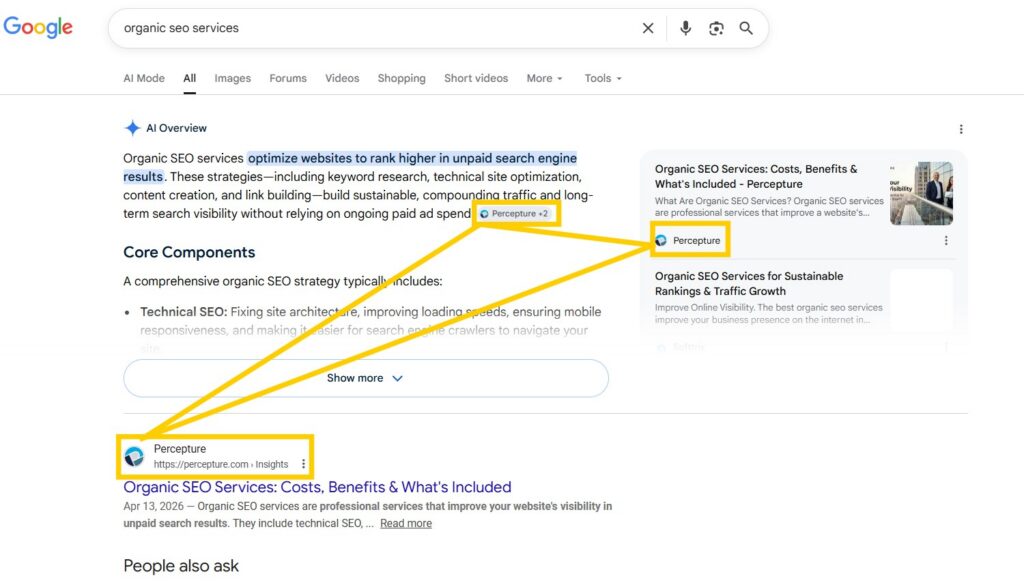
Organic SEO services
Separate Google Search Console data for the matching query recorded 6,772 impressions and an average position of 2.74 during the 90-day period.
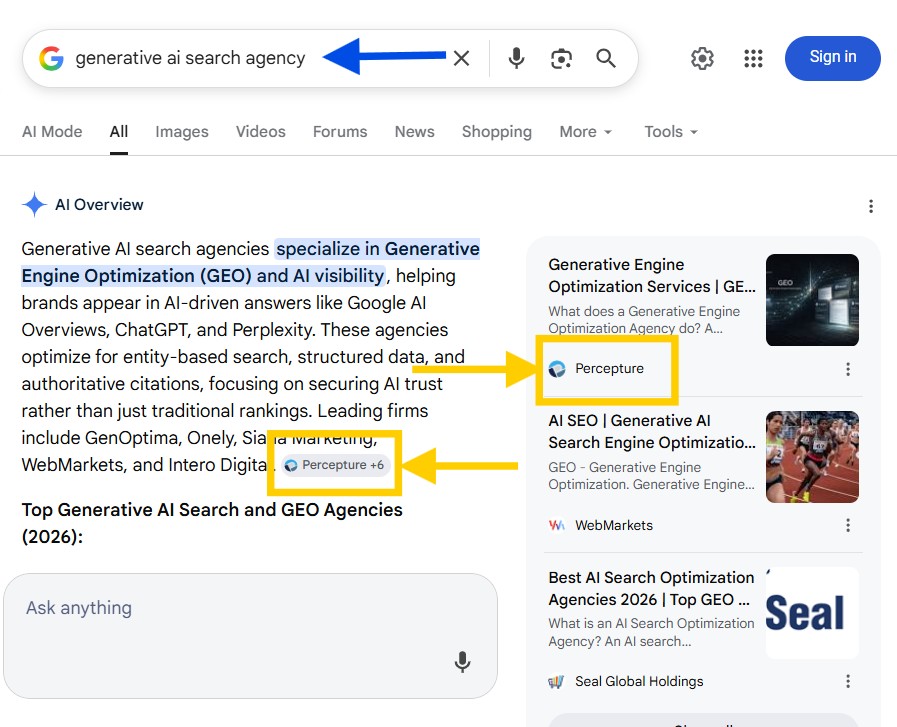
Generative AI search agency
This image records one search moment. It illustrates how an authoritative source can appear in an emerging category, but it does not guarantee the same position for every user, device, date, or location.
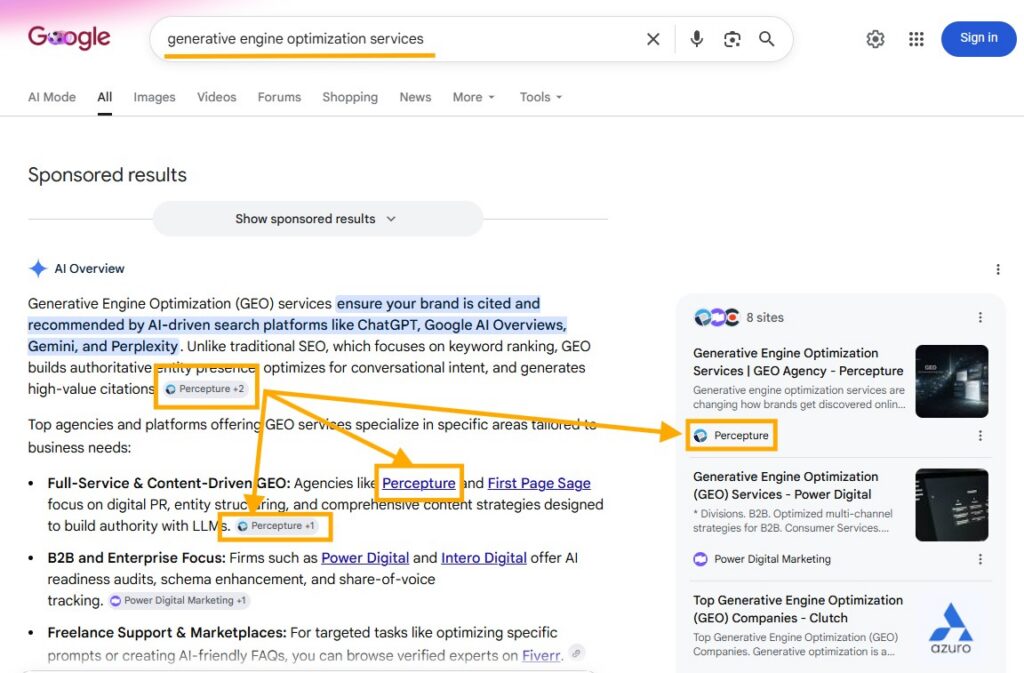
Generative engine optimization services
Separate Search Console data for the related “generative engine optimization agency” query recorded 12,158 impressions and an average position of 5.10 during the period.
OPTK Networks: a focused SEO and AI-search case study
The OPTK Networks video provides a client perspective on a targeted effort documented as reaching a number-one result in 48 hours. The useful lesson is not that every query should move at the same speed. It is that a bounded problem, a clear source page, coordinated search visibility, and documented proof can create a fast test of the strategy.
How to evaluate the OPTK case study
- Confirm the target query, source URL, date, and result type.
- Separate the point-in-time screenshot from period-based performance data.
- Identify the content, technical, internal-link, authority, and distribution work completed.
- Check whether visibility influenced qualified visits, meetings, sales use, or another business outcome.
- Use the case as a bounded test, not a promise that every market will move in 48 hours.




The executive summary
Teach
Useful cases explain the action in plain language and connect the work to a real buyer need.
Measure
Track impressions, average position, clicks, qualified behavior, leads, opportunities, or revenue according to the goal.
Transfer
Check whether your authority, market, resources, page type, and conversion path resemble the original case.
Protect
Maintain valuable pages with technical checks, fresh evidence, relevant links, supporting content, and conversion review.
Who this guide is for
Business and marketing leaders
You need to distinguish useful evidence from screenshots that lack the work, measurement, or commercial context.
SEO and content teams
You need examples that connect page intent, technical access, content quality, internal links, authority, and conversion.
PR and communications teams
You need to understand how relevant earned coverage can reinforce search authority, entity clarity, and buyer trust.
Sales and revenue teams
You need visibility reporting that connects to qualified behavior, meetings, opportunities, pipeline, and the next action.
How search optimization evolved
The central job remains clear: make useful information accessible, understandable, credible, and easy to act on. What changed is the number of surfaces where that information can appear.
| Era | What changed | Operator lesson |
|---|---|---|
| 1990s | Directories, early search engines, basic keyword matching, and link-based ranking emerged. | Make each page discoverable and clearly focused. |
| 2000s | Google grew while crawlability, links, local results, and mixed search features gained importance. | Build useful pages and earn relevant authority. |
| 2010s | Quality systems, semantic matching, mobile use, and stronger spam controls reduced simple shortcuts. | Match intent, improve usability, and protect trust. |
| 2020–2023 | Page experience, helpful content, entities, video, and experience signals became more visible. | Add first-hand value and make evidence easy to understand. |
| 2024–2026 | AI answers and multi-engine discovery expanded the search surface. | Create one reliable source that can rank, explain, support citations, and convert. |
Bob Generale’s documented digital work begins in the early 2000s and includes digital media, PR optimization, enterprise search, analytics, site architecture, keyword research, content systems, and integrated visibility strategy.
The Percepture SEO Examples Verification Standard
The six-part standard separates instructive evidence from screenshots that omit the starting point, action, search surface, measurement, business outcome, or limitations.
- 1Starting point
Record the old position, page condition, traffic baseline, technical problem, or visibility gap.
- 2Action
Describe the specific content, technical, linking, PR, local, or conversion work.
- 3Search surface
Name the organic result, AI answer, local result, image, video, news result, or citation.
- 4Measurement
Use Search Console, analytics, CRM data, server logs, or documented screenshot conditions.
- 5Business outcome
Connect the work to qualified visits, calls, leads, meetings, opportunities, revenue, or sales use.
- 6Transfer rule
State which authority, intent, market, resources, timing, and limitations affect repeatability.
Which search opportunity should your business pursue first?
Choose one page, one keyword group, and the shortest route to a measurable improvement. Diagnose traffic quality and buyer fit before adding more activity.
Run a Lead Quality Diagnostic15 SEO examples and what each one teaches
The examples move from basic page work to technical, authority, local, industry, AI-search, and conversion decisions. Each includes an action, measurement, and transfer rule.
Match a keyword to the right intent
A service page should answer the commercial question behind its target query. Explain scope, fit, timing, evidence, and the next action instead of repeating a phrase. A page about organic SEO services should fully satisfy that intent without competing with another page.
Measure: query coverage, impressions, average position, qualified visits, and CTA activity.
Improve a title and search snippet
Write a title that identifies the subject and gives the searcher a reason to choose the page. Keep the promise aligned with the content.
Measure: impressions, click-through rate, engagement, and conversions.
Make on-page structure easier to scan
Use the page’s main heading, focused H2 sections, a short answer, examples, descriptive links, tables, proof, and a clear next step. A broader content marketing strategy can coordinate pages, evidence, and distribution.
Repair a technical indexing problem
A technical case may involve an incorrect canonical, blocked page, broken link, missing sitemap entry, slow template, poor mobile behavior, or inaccessible rendered content. Percepture’s technical SEO audit service page recorded 4,205 impressions and a 3.37 average position for its matching query in the measurement period.
Add a contextual internal link
Link from a relevant, established page to a page that needs stronger discovery or topical context. The anchor and surrounding sentence should explain why the reader benefits.
Refresh useful content without changing its job
Update stale facts, examples, links, expert context, answers, evidence, and calls to action while preserving the page’s primary intent. An attribution and analytics plan can connect search activity with later buyer actions.
Earn a relevant mention through digital PR
A useful third-party mention supports the same subject as the target page and gives readers independent context. Integrated digital PR services can connect expert commentary, owned content, search goals, and earned coverage.
Improve local discovery and call handling
Combine accurate business information, service categories, photos, reviews, location content, citations, relevant links, and a reliable response process.
Explain a complex B2B service
A B2B page should help technical users, marketing leaders, sales teams, finance leaders, and executives understand the same offer. A focused B2B SEO agency guide can support that evaluation.
Build search coverage for a construction buyer
Map each intent to the correct service or educational page. Percepture’s guide to construction SEO recorded 5,056 impressions and a 6.03 average position for the query period.
Add trust safeguards to healthcare content
Healthcare pages require accurate definitions, review, authorship, local relevance, and conversion paths that do not overstate outcomes. A comparison such as best medical SEO companies can help buyers evaluate fit.
Use a sprint for one bounded problem
A sprint selects one measurable problem, a limited page set, a short execution window, and an agreed measurement plan. The article explaining an SEO sprint recorded 11,732 impressions and a 4.84 average position. Percepture also offers a defined SEO Sprint service.
Build a Golden Triangle around one query
Combine an AI-supported appearance, a strong organic result, and another supporting feature. A deeper search engine positioning guide explains the model.
Prepare a source for AI-supported search
Create a crawlable page with concise answers, expert context, tables, links, media, and clear entities. Percepture’s generative engine optimization services connect search foundations with AI-search monitoring.
Improve conversion on a page that already ranks
Change the offer, evidence order, CTA wording, mobile layout, form friction, or lead routing when qualified visitors do not act. Pair ranking data with conversion rate optimization.
How to read the ranking data behind these SEO examples
The figures below come from the Google Search Console export covering March 24 through June 22, 2026. Average position is an impression-weighted period metric.
| Query | Impressions | Average position | Period description |
|---|---|---|---|
| organic SEO services | 6,772 | 2.74 | Top-three average |
| technical SEO audit service | 4,205 | 3.37 | Top-four average |
| generative engine optimization agency | 12,158 | 5.10 | Top-six average |
| SEO sprint | 11,732 | 4.84 | Top-five average |
| construction SEO | 5,056 | 6.03 | Top-seven average |
| search engine positioning | 943 | 4.91 | Top-five average |
Use screenshots to document a moment and period data to understand broader performance. Keep the forms of evidence separate.
Golden Triangle, Landscape Domination, and Defensive Optimization
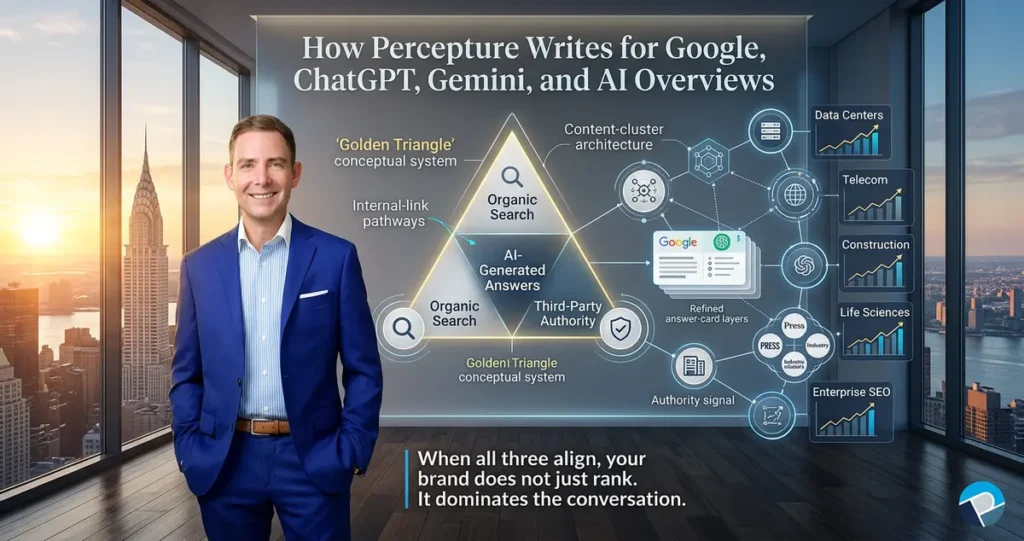
The Golden Triangle focuses on three visible positions around one query: an AI answer or AI Overview mention, a strong organic result, and a supporting feature. Landscape Domination expands the model to paid results, PR coverage, images, video, profiles, and reputation assets. Defensive Optimization protects the page that ranks and converts.
Five-question opportunity scorecard
- Intent: Does one page clearly satisfy the query and buyer stage?
- Access: Can search engines crawl, render, index, and canonicalize the page?
- Evidence: Does the page show experience and support important claims?
- Authority: Do internal pages and independent sources reinforce the topic?
- Action: Can the right visitor understand the offer and complete a sensible next step?
Broadstaff: search visibility, digital PR, and qualified B2B demand
Broadstaff is an adjacent complex-B2B case rather than a universal SEO result. Its relevance is the connection between technical expertise, search-visible authority, client confidence, and qualified demand.
90% page-one visibility
The Broadstaff source reports that 90% of target keywords reached page one within 12 months.
3× qualified leads
The same source reports a threefold increase in qualified leads during the case-study period.
See how search, AI visibility, and distribution work together
Use these SEO examples to match the diagnosed constraint to the right investment path, then define the page, market, evidence, implementation, and measurement plan before scaling.
Review Pricing OptionsRelated Percepture resources
Enterprise SEO ROI calculator
Model the relationship between search investment, traffic, conversion, and business value.
What is corporate SEO?
Understand how governance, architecture, teams, and measurement change at larger organizations.
Organic SEO services
Review the scope, operating model, measurement, and buyer questions behind an organic search program.
Generative engine optimization services
Connect technical eligibility, source quality, entity clarity, authority, and AI-answer monitoring.
Frequently asked questions
What are SEO examples?
SEO examples are real or illustrative cases that connect a search optimization action with an intended or measured result. Useful cases explain the starting point, work completed, search surface, measurement method, business outcome, and limits. A screenshot alone records a moment but does not explain why the result occurred.
What are the four main types of SEO?
The four common groups are on-page, technical, off-page, and local SEO. On-page work improves content and structure. Technical work supports crawling, rendering, indexing, and performance. Off-page work builds relevant authority through mentions and links. Local work supports location-based discovery, profiles, reviews, and calls.
What is an on-page SEO example?
An on-page example is improving a service page around one buyer need. The team may rewrite its title, add a short answer, organize headings, include expert detail, add descriptive internal links, improve proof, and clarify the next action. Results can be evaluated through query coverage, engagement, qualified visits, and conversions.
What is a technical SEO example?
A technical example is repairing an incorrect canonical that points search engines to the wrong URL. Other cases include unblocking an important page, fixing broken links, improving mobile performance, updating a sitemap, reducing duplicates, or making rendered content accessible to crawlers.
What is an SEO strategy example?
An SEO strategy starts with a business goal, maps valuable search intents to the correct pages, removes technical barriers, improves content, builds internal and external authority, and strengthens conversion. The team then measures visibility, qualified behavior, leads, opportunities, or revenue according to the original goal.
How long does SEO take to show a result?
There is no single timeline for every site or action. Crawl timing, competition, authority, technical condition, content quality, market demand, implementation speed, and the size of the change all affect the result. Set a baseline, record the implementation date, monitor leading indicators, and evaluate business outcomes over an agreed period.
Is SEO still useful when buyers use AI search?
Yes. AI-supported discovery still depends on accessible, understandable, useful sources. Current SEO examples can track answer appearances, citations, cited URLs, referral sessions, images, video, and third-party evidence across several platforms. Each platform and result type should be measured separately rather than treated as one universal rank.
How should a company prove a ranking result?
Record the query, URL, date, device, location, signed-in state, result type, and screenshot conditions. Pair that point-in-time evidence with period data from Search Console or another suitable source. Then connect visibility to qualified visits, leads, opportunities, or another business measure without claiming that one tactic caused every change.
What is the Percepture Golden Triangle?
The Percepture Golden Triangle describes coordinated visibility around one query: an AI-supported answer or AI Overview mention, a strong organic result, and a supporting feature such as a source card, image, video, news result, or snippet. Each appearance should be documented separately because the surfaces use different ranking and retrieval systems.
Can an SEO agency guarantee rankings?
No agency controls a search engine, AI answer, competitor action, algorithm change, or every market condition. A responsible provider can define the work, measurement method, dependencies, risks, and review cadence. Treat permanent ranking guarantees as a warning sign rather than proof.
Build the next SEO case around your business
Bring one page, one keyword group, and one business goal. Percepture will map the work, evidence, timing, dependencies, and measurement plan instead of prescribing a generic list of tactics.
Build My SEO Plan
About Bob Generale
Bob Generale is President of Percepture. His documented work includes early digital media and PR optimization, enterprise SEO beginning in the 2000s, analytics, site architecture, keyword research, content systems, digital PR, generative search, and conversion.
He leads Percepture’s Golden Triangle, Landscape Domination, and Defensive Optimization approach to multi-surface visibility across complex B2B, telecom, data centers, construction, healthcare, and other long buyer journeys.
Key takeaway: the most useful SEO examples do more than display a ranking. They document the starting point, action, surface, measurement, business outcome, limitations, and the conditions required to repeat the lesson.