
A B2B LinkedIn marketing agency should not start by buying the broadest audience LinkedIn can build. In enterprise campaigns, company and job-title filters can spend money on thousands of employees who have no role in the decision, no influence over procurement, and no reason to act.
Percepture’s point of view is intent-first: identify winnable accounts, confirm the buying group and approved-vendor path, reach relevant professionals across the open web when demand signals appear, and then use LinkedIn to retarget, nurture, and support a sales conversation that already has context.



What does a LinkedIn agency do for a B2B company?
A B2B LinkedIn marketing agency should connect account selection, buying-group research, paid distribution, executive authority, retargeting, nurture, sales follow-up, and revenue measurement. For complex enterprise sales, LinkedIn often performs better as part of an intent-led sequence than as the only place where the campaign starts.
The executive view
Choose winnable accounts
Start with contract value, margin, buying complexity, vendor readiness, and sales capacity. A famous logo is not automatically a good target.
Use intent as context
Public research, site behavior, first-party engagement, and account signals can improve timing. No signal proves that an account is ready to buy.
Earn the second touch
Use programmatic media, search, PR, events, email, and useful content to create context. Retarget eligible engagement on LinkedIn when it adds value.
Follow the account to revenue
Track buying-group coverage, qualified actions, sales acceptance, opportunity creation, pipeline, revenue, CAC, and payback, not impressions alone.
Which LinkedIn need describes your team?
We need paid LinkedIn campaigns
You have a defined audience, a useful offer, conversion-ready pages, and enough sales capacity to act on qualified responses. A B2B LinkedIn marketing agency with a specialist or integrated paid social marketing services team may fit.
We need organic authority
Your executives have useful expertise, but profiles and publishing are inconsistent. A B2B LinkedIn marketing agency should turn that expertise into credible posts, documents, articles, comments, and sales-enablement assets.
We need a pipeline system
Your paid, organic, search, sales, and reporting teams operate separately. An integrated B2B LinkedIn marketing agency should give them one account plan, one proof strategy, and shared definitions for qualified activity.
What a B2B LinkedIn marketing agency should own
The agency should begin with business fit. A B2B LinkedIn marketing agency needs to understand which accounts can buy, which contracts are profitable, who joins the decision, what evidence each role needs, and what your sales team can support. Audience size alone does not answer any of those questions.
A capable B2B LinkedIn marketing agency should then translate that commercial plan into audience rules, content, ads, landing pages, nurture, sales handoffs, and measurement. The work may include company targeting, role targeting, exclusions, conversion events, creative testing, executive content, retargeting, and CRM reporting.
The boundaries also matter. A responsible B2B LinkedIn marketing agency should not replace a channel that is already capturing stronger demand at a better cost or automate uncontrolled messages. An intent signal should start account research, not be treated as proof that a person is ready to buy.
The strongest plan also separates account fit from media availability. LinkedIn may be able to reach people at a company, but the company may still be unwinnable because the contract is too small, the team is not an approved supplier, the buying committee is already aligned with an incumbent, or procurement requirements cannot be met.
Do not let LinkedIn’s available audience become your strategy
“LinkedIn is often most valuable after the account has shown a reason to care. The goal is not to reach everybody who works at an enterprise. It is to create context with the right buying group, then use LinkedIn to reinforce trust and move the relationship forward.”
Bob Generale, President of Percepture
A company is not a buying committee
Large-enterprise targeting can include thousands of people outside the decision. Company, industry, seniority, and job-title filters still need exclusions, role logic, account priorities, and frequency controls.
Reach does not create vendor readiness
For many enterprise accounts, the practical gate is approved vendor status, also called approved supplier status. That usually requires vendor onboarding and may involve an MSA, security review, insurance, legal terms, or a vendor-of-record arrangement.
Relationships and incumbents are invisible to ad platforms
Existing agency relationships, internal champions, procurement preferences, budgets, and team politics can determine whether a target is truly winnable. Account research must continue after an audience is built.
Intent should change the next action
A signal should help the team decide what to research, which proof to share, where to advertise, and whether sales should follow up. It should never be treated as proof that a specific person is ready to purchase.
The programmatic-to-LinkedIn sequence
Percepture’s preferred sequence for complex B2B accounts starts with commercial fit and timing, not the channel. The exact mix changes by audience, privacy requirements, sales cycle, and available data.
- Select winnable accounts.Define the ICP, exclusions, contract economics, geography, buying group, procurement path, and internal sales capacity.
- Look for evidence of need.Use public buying signals, first-party engagement, search behavior, account research, events, and source-backed dossiers to develop a timing hypothesis.
- Reach the account across the open web.Where permitted, programmatic platforms can combine account lists with firmographic, persona, technographic, and intent data to reach relevant professionals across native, display, video, and other inventory. Specific publisher placement is never guaranteed.
- Retarget eligible engagement on LinkedIn.LinkedIn Matched Audiences can support website, company-list, contact-list, and engagement retargeting when audience, consent, platform, and minimum-size requirements are met.
- Align marketing and sales.Give sales the account rationale, pages viewed, source context, likely buying roles, approved proof, and next-step recommendation. Measure whether the account advances.
| Layer | Useful capability | Important limitation |
|---|---|---|
| LinkedIn company targeting | Build audiences from company lists and refine with professional attributes such as function or seniority. | List and matched-audience minimums can make very small account sets difficult to activate. A matched employee is not automatically part of the deal. |
| LinkedIn retargeting | Re-engage eligible website visitors, Page visitors, video viewers, Lead Gen Form users, event participants, and other engaged audiences. | The Insight Tag, consent rules, data policy, audience thresholds, and sensitive-page restrictions must be respected. |
| Programmatic ABM | Combine account lists with firmographic, persona, technographic, first-party, and intent segments across open-web inventory. | Data quality, match rates, brand safety, frequency, publisher availability, and attribution require active control. |
| Website visitor intelligence | Tools such as Dealfront Leadfeeder can identify visiting companies and show source, pages viewed, and engagement patterns. | Company identification is not the same as identifying every individual visitor. Sales still needs human research and responsible contact selection. |
Platform references: Review LinkedIn’s company-list requirements, website-retargeting guidance, StackAdapt’s B2B ABM capabilities, and Dealfront’s explanation of the Leadfeeder Tracker before implementation.
Pressure-test your target account plan with Percepture
Before media launches, Percepture can review account fit, buying-group coverage, procurement readiness, channel sequence, conversion paths, and the sales handoff. The goal is to identify wasted reach before it consumes budget.
How to compare B2B LinkedIn marketing agency models
Agency labels often hide major delivery differences, so a buyer should define which operating gaps the B2B LinkedIn marketing agency must own. One firm may manage ads only. Another may write posts but never touch conversion tracking. An outbound provider may focus on connection requests and appointments. An integrated team may coordinate LinkedIn with omnichannel marketing, search, PR, nurture, and analytics.
LinkedIn agency model comparison
| Agency model | Best fit | Paid | Organic | Outbound | Intent and nurture | Attribution | Common limitation |
|---|---|---|---|---|---|---|---|
| Pure ad specialist | Teams with strategy, content, pages, and sales operations already in place | Primary focus | Usually limited | Usually limited | Varies by scope | Platform and conversion reporting | May depend on the client to repair gaps outside LinkedIn |
| Organic content agency | Executive visibility and consistent publishing | Often separate | Primary focus | May support social selling | Usually limited | Attention and engagement reporting | May not connect content to opportunity data |
| Outbound agency | Defined offers that benefit from direct prospect conversations | Usually limited | Supporting role | Primary focus | Sequence focused | Replies, meetings, and accepted leads | Can underinvest in authority, landing pages, and long-cycle nurture |
| Fractional demand team | Companies needing channel management without a full internal team | Often included | Often included | Coordinated with sales | Depends on team depth | Funnel reporting | Specialist depth can vary across workstreams |
| Integrated B2B authority agency | Complex sales involving search, content, paid media, PR, nurture, and CRM | Integrated | Integrated | Governed coordination | Account research and cross-channel follow-through | Campaign through revenue | Requires access to multiple teams, systems, and approval owners |
Choose the narrowest B2B LinkedIn marketing agency model that can solve the actual constraint. If your internal team already owns account strategy, content, conversion, and analytics, a paid specialist may be enough. If those functions are disconnected, a low management fee will not fix the operating gap.
Enterprise readiness comes before audience reach
Reaching the right company is not the same as being ready to win its contract. Before a B2B LinkedIn marketing agency targets a large account, the team should review contract value, gross margin, sales-cycle length, approved vendor status, vendor onboarding, procurement, security, legal review, insurance, proof requirements, buying-group complexity, and the maximum acceptable acquisition cost.
A recognizable company can still be a poor paid-media target, and a strategic B2B LinkedIn marketing agency should identify that mismatch before launch. Your offer may be too small for the sales effort. The buying committee may need proof you do not yet have. Your company may not be ready for the vendor review. Sales may lack the capacity to follow up across a long evaluation.
Enterprise contract-readiness checklist
- Economics: The likely contract value and margin can support media, agency, sales, and delivery costs.
- Procurement: The company can complete likely vendor, legal, security, privacy, and insurance reviews.
- Proof: Each buying role can find relevant evidence, not just broad brand claims.
- Capacity: Sales can respond, research the account, and continue the conversation with context supplied by the B2B LinkedIn marketing agency.
- Conversion: The website offers a sensible next step for the buyer’s level of readiness.
- Measurement: Marketing and sales agree on qualified actions, accepted leads, opportunities, and attribution rules.
Healthcare and life-sciences buyers can add regulatory, privacy, clinical, security, and procurement questions to this review. LinkedIn targeting does not remove those obligations. Teams selling into this market should align campaigns with their legal and compliance processes and can review Percepture’s broader healthcare marketing capabilities.
LinkedIn operates as five connected engines
A B2B LinkedIn marketing agency should treat LinkedIn as more than a single advertising channel. It can act as a professional identity and research layer, an organic publishing engine, a paid distribution platform, a relationship network, and a source of campaign and conversion evidence.
The five LinkedIn engines
Search and identity
Buyers inspect people, companies, services, experience, posts, and mutual context. In that limited sense, LinkedIn is part search engine, although it does not function like Google.
Organic authority
Expert posts, documents, videos, newsletters, and informed comments can build familiarity and give sales teams useful proof to share.
Paid distribution
Sponsored content and other eligible ad formats can distribute selected messages to defined professional audiences. LinkedIn describes its advertising options and measurement approach on its official advertising page.
Relationships and outbound
Approved connection, event, account, and sales activity can move a known relationship forward. Human judgment should govern the target, message, timing, and follow-up.
Revenue intelligence
A B2B LinkedIn marketing agency can use campaign, website, conversion, and CRM evidence to evaluate which accounts engaged and what happened later in the sales process.
The Percepture framework for B2B LinkedIn targeting
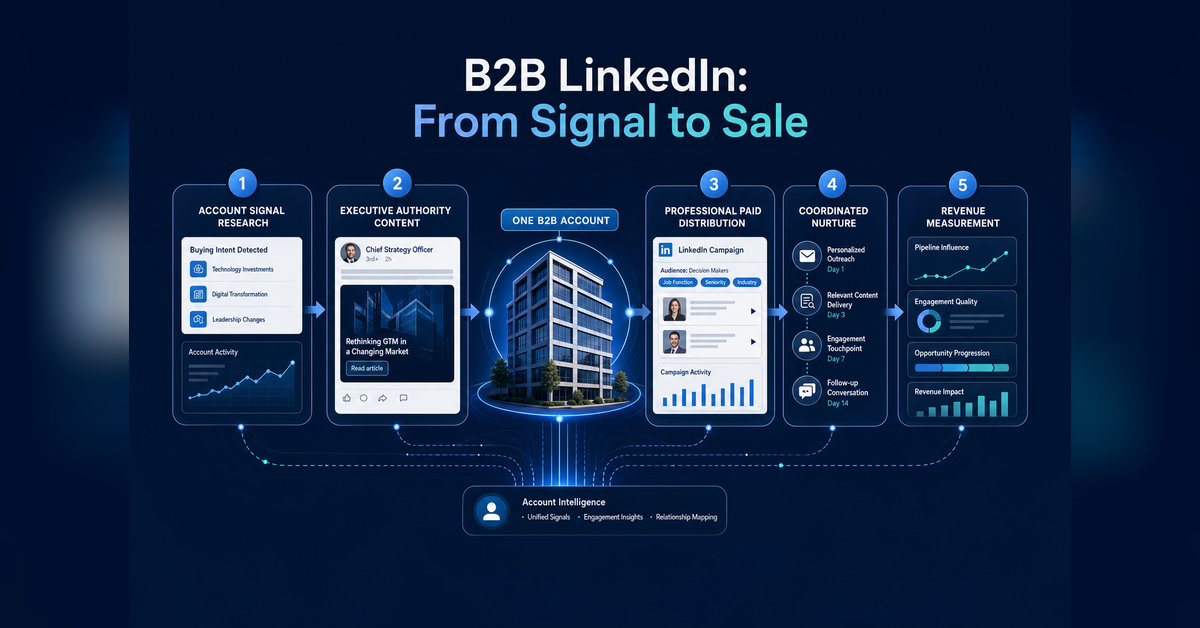
Percepture uses the LinkedIn Signal-to-Sale System, a five-stage method for connecting account intelligence, authority, distribution, nurture, and revenue evidence. It gives a B2B LinkedIn marketing agency a disciplined way to prevent channel activity from getting ahead of account readiness or ending at surface-level engagement.
The LinkedIn Signal-to-Sale System
- Select the account.Define the ICP, exclusions, buying group, contract economics, procurement readiness, public signals, and sales capacity. Use B2B intent data as research context, not as proof of purchase intent.
- Build the evidence.Create role-specific proof through expert content, case studies, research, search-visible pages, digital PR, executive profiles, and clear procurement information.
- Activate the right channel.Use programmatic media, LinkedIn, search, events, email, and sales outreach according to demand temperature. The channel follows the account strategy.
- Nurture the buying group.Change the message as the account learns. A first-touch explainer, technical proof, business case, implementation guide, and procurement asset have different jobs.
- Attribute the sale.Review engaged accounts, buying-group coverage, qualified actions, sales acceptance, meetings, opportunities, pipeline, revenue, CAC, and payback.
Use account signals without overstating intent
Account selection is one of the clearest differences between a channel operator and a strategic B2B LinkedIn marketing agency. A channel operator may begin with titles, industries, and company sizes. A strategic team asks why an account fits, what changed, who may own the problem, and what evidence supports the timing hypothesis.
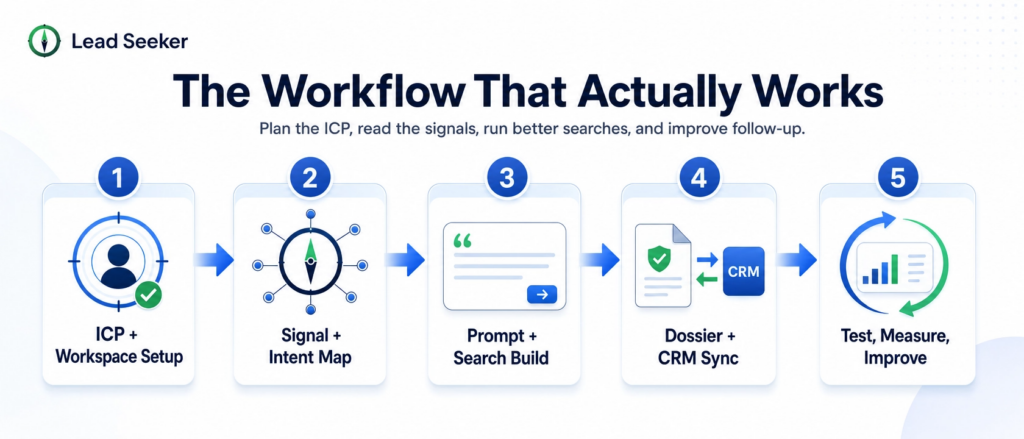
The Lead Seeker lead intelligence platform supports ICP definition, research into public signals, useful contact verification, source-backed account dossiers, and CRM-ready context. It does not turn a public signal into guaranteed purchase intent, and it does not replace LinkedIn’s own campaign tools.
The dossier should help a B2B LinkedIn marketing agency and sales team answer practical questions: Why was this account selected? Which business issue may matter? Who may influence the decision? What proof should be shared first? Which assumptions still require human research?
Leadfeeder, now part of Dealfront, adds company-level website context. It can show which organizations visited, how they arrived, which pages they viewed, and how long they engaged. It does not reliably name every individual visitor. The responsible use is to prioritize account research and coordinate marketing with sales, not to pretend an anonymous visit identifies a specific buyer.
Paid, organic, and outbound should share one audience plan
Organic work gives a B2B LinkedIn marketing agency evidence about useful topics, objections, and executive points of view. It can also improve the quality of the profile and company-page experience a buyer sees after an ad, search, referral, or sales message.
A B2B LinkedIn marketing agency can use paid distribution to extend proven content to selected audiences and test which messages earn qualified attention. Outbound can add a relevant human conversation when the account, timing, and message justify it. The goal is not to make every motion identical. It is to prevent them from contradicting one another.
A B2B LinkedIn marketing agency should also inspect the destination experience. If the landing page is slow, vague, or mismatched to the ad, better targeting will not solve the conversion problem. Percepture’s conversion rate optimization services address offers, pages, forms, and campaign paths.
Social attention may lead to branded searches, direct visits, links, relationships, or later demand. It should not be presented as proof that likes directly improve organic rankings.
Choose among direct response, courtship, and capture-and-compound
One campaign mode does not fit every buying cycle. A B2B LinkedIn marketing agency should choose the motion based on demand temperature, contract value, risk, sales-cycle length, and how much proof the buyer needs.
Campaign-mode decision matrix
| Situation | Recommended motion | Primary job | Useful next step | Watch for |
|---|---|---|---|---|
| Warm audience, clear need, low-friction offer | Direct response | Convert known demand | Assessment, registration, consultation, or useful download | Asking for more commitment than the buyer is ready to give |
| Large contract, long review, many stakeholders | Enterprise courtship | Build confidence over time | Expert content, research, case material, event, or working session | Repeating one sales pitch to every role |
| Qualified audience with uncertain timing | Capture and compound | Create permission for future value | Follow, subscribe, visit, download, or enter an approved nurture path | Paying to reach the same buyer once with no follow-through |
| Strong active search demand | Search first | Capture buyers already looking for a solution | High-intent service or comparison page | Moving budget away from a more efficient source of demand |
| Weak proof or low category awareness | Organic authority first | Build evidence and sharpen the message | Executive content, cases, research, and profile improvements | Scaling paid reach before the company can answer buyer doubts |
Connect search, AI visibility, PR, and events to LinkedIn
LinkedIn rarely creates every touch in a complex sale. A buyer may first encounter the company through Google, an AI answer, a trade publication, an event, a referral, or a sales conversation. A B2B LinkedIn marketing agency should map how eligible audiences move between these sources.
Search content can expose recurring buyer questions and high-intent pages. Generative engine optimization services can strengthen entity clarity and the source material available to AI-assisted research. PR and event activity can supply third-party context and timely reasons for account outreach.
Where consent, platform policy, and technical requirements allow it, eligible visitors can receive a relevant next message. Not every visitor can or should be identified at the person level. The operating plan should document audience creation, exclusions, suppression, retention, access, and approval rules.
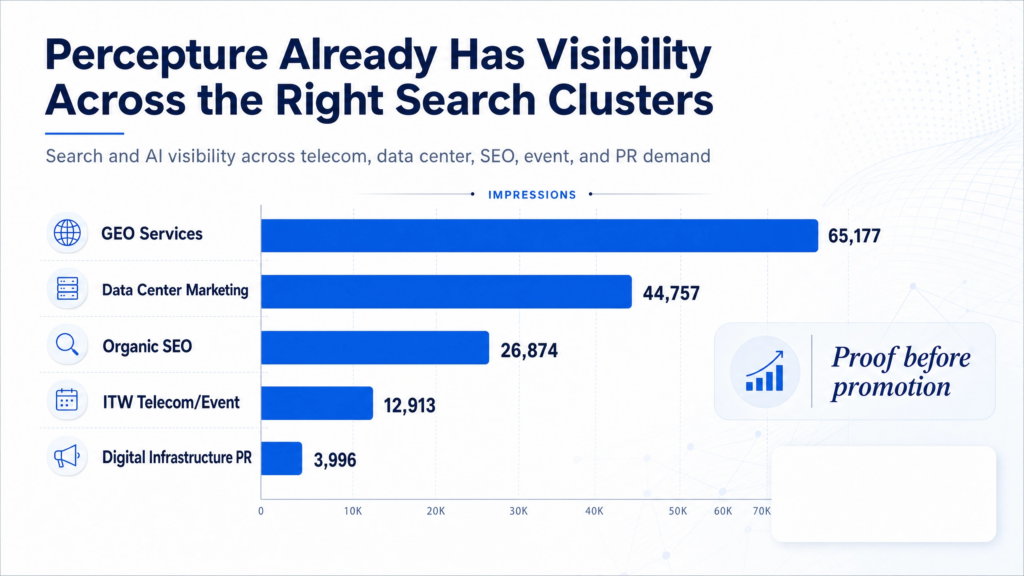
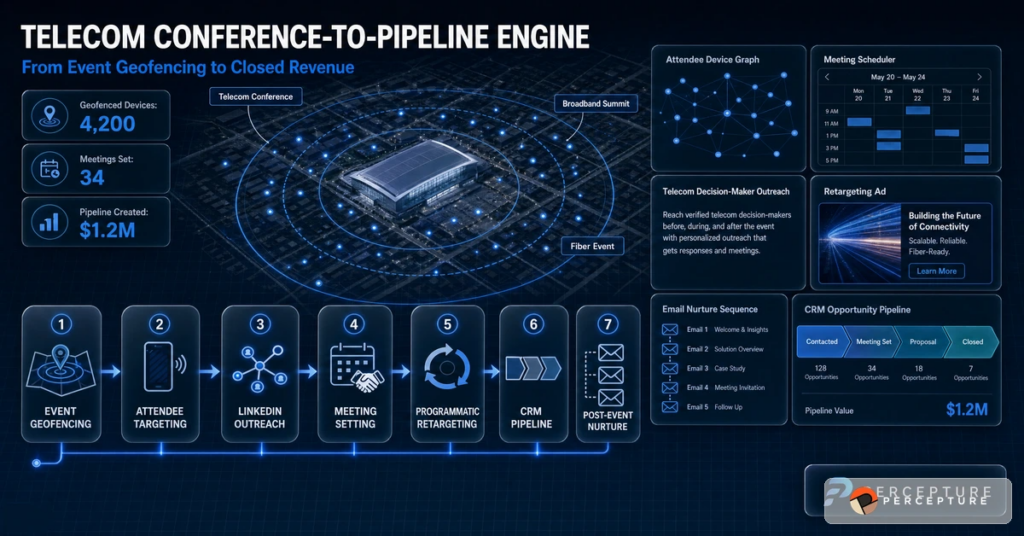
In telecom, dark fiber, data centers, and digital infrastructure, this sequence is especially important. The buying universe is small, technical proof matters, conferences create relationship signals, and many target accounts have long vendor and procurement processes. Programmatic media can maintain visibility across business and industry publications, while LinkedIn can reinforce executive credibility and retarget eligible engagement.
Coordinate follow-through beyond LinkedIn
LinkedIn is a closed professional platform. Open-web media, search, email, and sales systems operate differently. An integrated team can coordinate these channels without pretending they are one inventory source.
Percepture’s media buying agency capabilities can help a B2B LinkedIn marketing agency support broader channel allocation, while AutoNURTURE can help organize approved touchpoints. A practical journey may move from search, PR, an event, or an ad to eligible retargeting, useful content, CRM activity, human follow-up, and opportunity measurement.
The message should change as the relationship develops. A first-touch explainer, a technical proof asset, a procurement guide, and a sales conversation have different jobs. Repeating the same offer across every channel creates frequency without progress.
What credible proof should show
Proof from a B2B LinkedIn marketing agency should separate the roles played by LinkedIn, search, paid media, content, landing pages, nurture, and sales. It should state the period measured, define a qualified lead or opportunity, and avoid assigning an integrated result to one channel without evidence.
Business context
Industry, audience, buying complexity, starting constraint, and the commercial goal.
Operating changes
Audience decisions, content, media, page, nurture, sales, and measurement changes made during the program.
Measurement rules
Definitions for qualified actions, accepted leads, sourced pipeline, influenced pipeline, and the reporting period.
Two proof examples to inspect
Galorath integrated search and LinkedIn
Percepture’s historical Galorath case-study materials reported a 76% increase in qualified traffic through search and LinkedIn. The program combined targeted LinkedIn campaigns, SEO, paid search, link development, custom sales funnels, and programmatic remarketing.
Broadstaff connected visibility to qualified demand
The Broadstaff case study demonstrates the broader principle: specialist B2B authority becomes more valuable when search visibility, proof, sales intelligence, and lead generation work together.
Important: Historical and client examples explain the operating method. They do not guarantee the same result, cost, or timeline for another company.
Build the targeting plan before the media plan
Meet with Percepture to connect LinkedIn, programmatic media, intent data, executive authority, landing pages, nurture, and sales follow-up around the accounts your company can actually win.
Meet With PercepturePrefer to review proof first? Read the Broadstaff case study.
Measure from attention to revenue
A B2B LinkedIn marketing agency needs three connected scorecards. Attention metrics explain delivery and engagement. Conversion metrics explain useful actions. Revenue metrics show what sales and finance accepted as business progress.
The LinkedIn revenue measurement ladder
| Level | Measures | Decision supported |
|---|---|---|
| Attention | Reach, frequency, video or document engagement, profile activity, follower growth, and engaged accounts | Is the intended audience receiving and responding to the message? |
| Conversion | Lead forms, landing-page actions, downloads, registrations, assessments, and qualified conversations | Is attention producing a meaningful next step? |
| Sales | Sales-accepted leads, meetings, buying-group coverage, opportunity creation, and progression | Does sales agree the activity has commercial value? |
| Revenue | Sourced and influenced pipeline, wins, deal size, sales cycle, CAC, ROAS, payback, and closed revenue | Should the program stop, change, hold, or scale? |
Sourced pipeline and influenced pipeline should not be combined without explanation. Sourced pipeline has a qualified entry reasonably tied to the program. Influenced pipeline may have encountered LinkedIn but entered through another source. Both can be useful, but they answer different questions.
When LinkedIn is not the next best dollar
A good B2B LinkedIn marketing agency should tell you when LinkedIn is not the best use of the next dollar.
- Search is already capturing active demand more efficiently.
- The audience is too narrow for a stable campaign.
- Contract value or lifetime value cannot support the acquisition cost.
- The company lacks proof for the buying roles it wants to reach.
- The landing page and offer are not ready to convert interest.
- Sales cannot research and follow up with qualified accounts.
- Tracking, consent, suppression, or CRM handoffs are not ready.
B2B LinkedIn marketing agency pricing and budget structure
Pricing should separate media spend from agency fees, production, technology, landing-page work, and optional sales or nurture support. A B2B LinkedIn marketing agency should explain which work is included, which systems the client must provide, and what conditions would cause the program to pause or scale.
For enterprise programs, budget should be allocated by job: account research, programmatic reach, LinkedIn media, creative, landing pages, content, retargeting, technology, sales enablement, and measurement. A LinkedIn-only budget can look efficient while leaving the work that creates relevance unfunded.
How LinkedIn agency investment models differ
| Model | Typical scope | Budget questions to ask | Best buying test |
|---|---|---|---|
| Outbound-only | List work, messaging, sequences, replies, and meeting handoff | Are data, tools, sending activity, copy, and human review included? | Review account fit, message controls, reply quality, and sales acceptance. |
| Ad management | Campaign setup, audiences, creative coordination, optimization, and reporting | Are media, creative, landing pages, tracking, and strategy separate? | Confirm the team can define stop and scale rules before launch. |
| Organic authority | Strategy, interviews, writing, design coordination, publishing, and reporting | How much executive time is required, and who owns approvals? | Inspect subject-matter depth, profile strategy, and reuse across sales. |
| Integrated program | Account strategy, paid, organic, search, PR, pages, nurture, sales alignment, and attribution | Which workstreams are active, and how are media and third-party costs separated? | Evaluate governance, senior access, measurement definitions, and cross-team ownership. |
Percepture publishes broader social media pricing packages and paid advertising pricing packages for buyers comparing investment structures.
What the first 90 days should accomplish
A B2B LinkedIn marketing agency should not promise closed revenue on a fixed schedule when the sales cycle is long. It should define controllable milestones, leading indicators, decision gates, and the evidence needed to continue.
A controlled 30, 60, and 90-day pilot
Days 1 to 30: define and prepare
Confirm economics, ICP, exclusions, buying roles, procurement readiness, content gaps, offer, landing page, event map, CRM fields, campaign naming, approval owners, and baseline measures.
Days 31 to 60: launch and learn
Start with one priority audience and a small set of messages. Monitor delivery, frequency, account quality, engagement, conversion behavior, sales feedback, tracking quality, and creative fatigue.
Days 61 to 90: evaluate and decide
Compare qualified actions with sales acceptance and early opportunity evidence. Repair weak audience, proof, page, or handoff issues. Scale only when the evidence supports it.
Score your readiness before hiring
Use this scorecard when evaluating your own team and any B2B LinkedIn marketing agency. Give one point for every statement that is already true and supported by an owner, process, or system.
Eight-point LinkedIn pipeline readiness score
- We can name and prioritize the accounts that fit our economics.
- We can complete the likely procurement, legal, privacy, and security process.
- We have relevant proof for the main buying roles.
- Our company and executive profiles support the message.
- Our website offers a clear, useful next step and can track it.
- Eligible warm audiences can be managed under our legal, consent, and platform rules.
- Sales can research and follow up with qualified accounts.
- LinkedIn activity can connect to accepted leads and CRM opportunities.
7 to 8 points: Prepare a controlled pilot with a qualified B2B LinkedIn marketing agency. 4 to 6 points: Repair the highest-risk gaps before scaling. 0 to 3 points: Do not spend broadly. Build the market, proof, conversion, and measurement foundation first.
How Percepture fits the integrated model
Percepture was founded in 2004 and combines B2B strategy with paid media, content, public relations, search, GEO, intent research, nurture, conversion, and analytics capabilities. Percepture is also an Inc. 5000 honoree and NMSDC-certified company.
The integrated model is designed for companies that need more than campaign operation. It connects account selection to authority, distribution, conversion, nurture, and revenue evidence. Teams seeking a narrower service may be better served by a specialist focused only on ads, organic content, or outbound.
For local visitors, Percepture also maintains a separate page for its LinkedIn Ads agency in Tampa. This national guide focuses on broad B2B strategy and integrated pipeline decisions rather than local search intent.
Frequently asked questions
What does a B2B LinkedIn marketing agency do?
A B2B LinkedIn marketing agency connects account selection, buying-group research, paid campaigns, executive authority, organic content, retargeting, landing pages, sales coordination, and revenue measurement. The scope should reflect the capabilities the client does not already own.
What is the best B2B LinkedIn targeting strategy?
Start with winnable accounts, contract economics, buying roles, exclusions, procurement readiness, and evidence of timing. Use LinkedIn as one part of a sequence that may include programmatic media, search, PR, events, email, content, and sales follow-up.
Why can native LinkedIn targeting waste enterprise budget?
A company audience can include many employees who have no role in the decision. Company and job-title targeting still requires buying-group logic, exclusions, frequency controls, proof, and account research.
What is approved vendor status?
Approved vendor or approved supplier status means an enterprise has completed the required onboarding process to purchase from a company. The process may include an MSA, security and privacy review, insurance, legal terms, financial checks, and vendor-of-record requirements.
How do programmatic advertising and LinkedIn work together?
Programmatic media can reach selected B2B audiences across open-web inventory using account, firmographic, persona, first-party, and intent data. Eligible visitors and engaged audiences can later be retargeted on LinkedIn, subject to consent, platform rules, and audience thresholds.
Can Leadfeeder identify individual website visitors?
Leadfeeder can identify many visiting companies and show source, pages viewed, time, and engagement patterns. It does not identify every individual visitor. Use the information to prioritize account research and responsible sales follow-up.
What is LinkedIn website retargeting?
LinkedIn website retargeting uses the Insight Tag to build eligible Matched Audiences from people who visited specified pages or completed supported actions. Audience minimums, privacy rules, member preferences, and sensitive-page restrictions apply.
Should LinkedIn paid media or organic content come first?
Start with organic authority when the company lacks proof, executive visibility, or a clear message. Start paid distribution when the audience, offer, destination, tracking, and sales handoff are ready. Many enterprise programs need both.
How much does a B2B LinkedIn marketing agency cost?
Cost depends on whether the program includes strategy, account research, programmatic media, LinkedIn management, executive content, creative, landing pages, intent technology, nurture, sales enablement, and analytics. Separate media spend from agency and production fees.
How should LinkedIn revenue be measured?
Measure delivery, account engagement, qualified actions, sales acceptance, buying-group coverage, meetings, opportunities, sourced and influenced pipeline, revenue, CAC, ROAS, and payback as separate layers.
Build a B2B targeting system your sales team can use
Meet with Percepture to review your ICP, enterprise account list, buying committee, intent signals, LinkedIn strategy, programmatic sequence, proof assets, and revenue measurement. You will leave with a clearer view of what to target, what to exclude, and what should happen next.