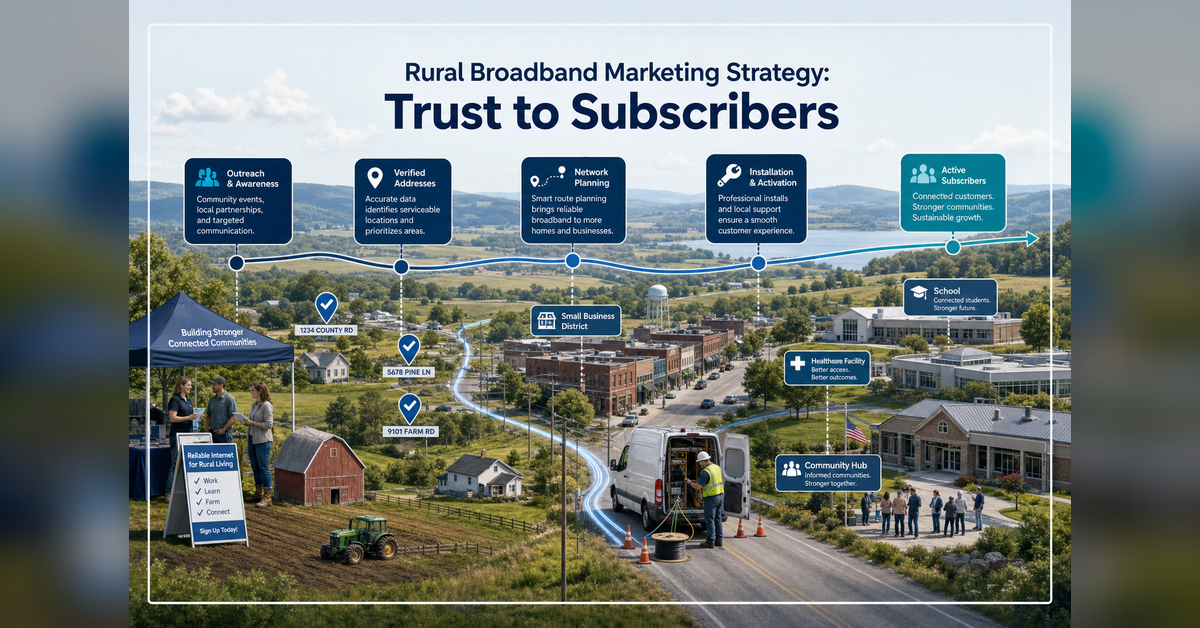

A Rural broadband marketing strategy must connect accurate serviceability, community trust, promotion, signup, installation, and retention. Advertising cannot repair a launch built on broad coverage claims, unclear timing, or an address check that leads nowhere.
The operating goal is not more impressions or preregistrations. It is a repeatable path from verified locations to completed installations, retained subscribers, attributable revenue, and gross profit.
See how Percepture works with telecom leaders
Percepture worked with Cody Clegg and OPTK Networks to connect a fiber company with a larger hyperscale and AI infrastructure story. The video shows how industry knowledge, search strategy, content, and execution can work together.
Important: The video shows a search visibility result. Website traffic, leads, pipeline, and revenue need separate analytics. No result is guaranteed.
Read the transcript and context
Transcript note: The source materials provide a crawlable summary, not word-for-word captions. This summary is written in plain language and keeps the meaning of the client account.
Cody Clegg and OPTK Networks: Percepture worked with OPTK on the Hyperscale Kings campaign. The work connected OPTK’s fiber and network knowledge with the people and companies building hyperscale and AI infrastructure.
What changed: The campaign became easier to find across search and AI-assisted discovery. It gave OPTK a clear story that buyers, partners, and search systems could understand.
What the result means: The video documents visibility. It does not prove traffic or sales by itself. Those outcomes must be measured through analytics, CRM records, and sales data.

Percepture does more than write about broadband






Updated: July 30, 2026. Serviceability, funding rules, pricing, construction timing, and channel policies can change. Verify current operating facts before launch.
What is a Rural broadband marketing strategy?
A Rural broadband marketing strategy connects serviceable addresses, community trust, local partners, clear offers, repeated outreach, simple signup, installation, and retention. Providers should begin before construction, promote outcomes rather than jargon, target only approved locations, and measure completed installations, active subscribers, take rate, churn, attributable revenue, and gross profit.
The executive view
Start with market truth
Network, construction, product, legal, operations, and marketing should agree on which addresses are ready, building, limited, survey-required, or unavailable.
Earn trust before promotion
Explain the project, timing, disruption, support path, and next action before applying heavy sales pressure.
Make the address check central
Every channel should send the buyer to a result that reflects current serviceability and provides a useful next step.
Measure activation and retention
Rural broadband marketing strategy decisions should follow completed installs, active customers, cohort retention, acquisition cost, and gross profit.
Who this guide is for
Provider leadership
CEOs, general managers, boards, and investors evaluating market readiness, adoption, reputation, and payback.
Revenue leadership
CMOs and sales leaders responsible for positioning, address-level demand, orders, attribution, and take rate.
Operating teams
Network, construction, installation, support, and community teams that must fulfill what marketing promises.
This guide focuses on the operating system behind rural subscriber growth and the controls a Rural broadband marketing strategy requires across leadership, revenue, and operating teams. Readers seeking a broader agency model can review Percepture’s telecom marketing capabilities.
How is rural broadband marketing different from urban marketing?
Rural buyers are not less informed. They compare prices, read reviews, ask neighbors, search online, and assess whether a provider will remain accountable after installation. The difference is that reputation often moves through tighter local networks while availability, construction timing, and installation paths vary by address. A Rural broadband marketing strategy must account for those local relationships and address-level operating differences.
| Decision factor | Rural market condition | Required control |
|---|---|---|
| Availability | Adjacent roads or properties can receive different results | Use an approved address-level eligibility source |
| Trust | Neighbors and institutions can strongly influence credibility | Listen locally and publish consistent project facts |
| Construction | Schedules and disruption affect expectations | Assign an update owner and communication cadence |
| Media | Digital and offline reach may be uneven | Combine search, mail, partners, events, and field outreach |
| Fulfillment | Travel, surveys, equipment, and crew capacity affect installs | Scale demand only where operations can fulfill it |
| Reputation | A missed promise can circulate quickly | Give every status a clear, honest next action |
“Trust travels differently in rural communities.”
Cody Clegg, Director of Sales & Marketing at OPTK Networks
Why Rural broadband marketing strategy starts with market truth
Marketing should not decide independently that a market is ready. The source of truth for a Rural broadband marketing strategy must combine the provider’s network, construction, product, capacity, pricing, survey, installation, and operating rules.
A passing is not automatically an orderable location. A preregistration is not an order. An order is not a completed installation. Treating these stages as interchangeable produces weak forecasts and frustrated residents.
Define each address state before launching demand
- Ready: The approved product can be ordered under current operating rules.
- Building: Construction is active or planned, but service is not yet orderable.
- Survey required: The location needs technical or installation review.
- Limited: Product, capacity, equipment, or installation constraints apply.
- Unavailable: The provider cannot accept an order under current rules.
Document the owner, source file, approval date, suppression rule, and next action for every state so the Rural broadband marketing strategy reflects current operating conditions. A disciplined strategy and planning process keeps media, sales, construction, and support aligned around the same market definition.

The address check should be the conversion authority for the Rural broadband marketing strategy. Broad maps can support orientation, but they should not replace a location-level result. If the data changes, active campaigns, sales lists, landing pages, and partner materials need a defined update path.
Score your market before spending more
Use a readiness review to test serviceability data, message consistency, conversion routing, installation capacity, and measurement. It is a practical first step for a Rural broadband marketing strategy that has not yet connected demand with fulfillment.
Run a Lead Quality DiagnosticHow do rural providers build trust before construction?
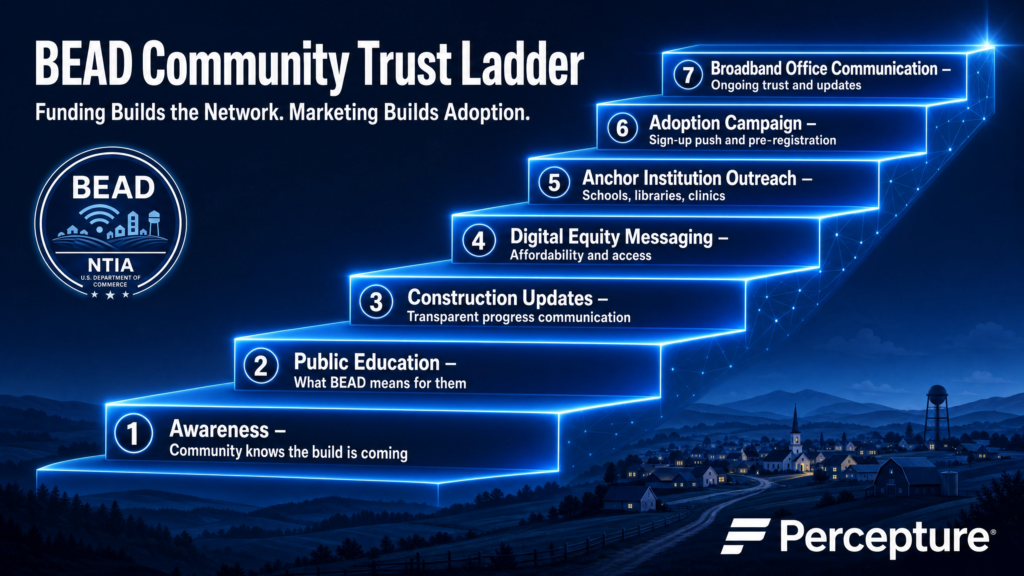
Begin by listening. Residents, businesses, schools, healthcare organizations, libraries, chambers, officials, nonprofits, and community leaders may each hold different concerns. Interviews and meetings should capture prior promises, local needs, common objections, trusted channels, and preferred ways to receive updates.
Then publish a shared fact set that the Rural broadband marketing strategy can use across every channel. It should answer who is responsible, what is being built, where current work applies, how timing is communicated, what disruption may occur, how restoration issues are handled, and whom residents can contact. Do not publish a date, product, price, speed, or coverage claim unless the responsible team has approved it.
Community communication is not a launch-week activity. Lessons from Percepture’s guide to infrastructure community engagement apply here: local concerns need an operating owner, not just a campaign response.
Choose the launch model that matches market readiness
The launch model should align the Rural broadband marketing strategy with current serviceability, trust, fulfillment capacity, and channel ownership.
| Model | Best fit | Main risk | Control |
|---|---|---|---|
| Community-led launch | New build or low-trust market | Sales pressure arrives before confidence | Use education and readiness milestones |
| Direct-response launch | Orderable service with install capacity | Demand exceeds fulfillment | Apply volume caps and daily suppression |
| Preregistration-first | Construction-stage addresses | Interest is reported as demand | Record address, consent, stage, and follow-up |
| Partner-led outreach | Markets with trusted institutions | Partners repeat outdated information | Issue an approved fact sheet and updates |
| Field outreach | Concentrated activation zones | Inconsistent claims or weak records | Use scripts, serviceability tools, and CRM logging |
| Hybrid local system | Regional providers using several channels | Fragmented ownership | Use one calendar, data model, and reporting owner |
The Rural broadband marketing strategy framework: Trust-to-Take-Rate
The Percepture Rural Broadband Trust-to-Take-Rate System is a seven-stage methodology for turning network-ready locations into informed communities, completed installations, retained subscribers, and financial performance.
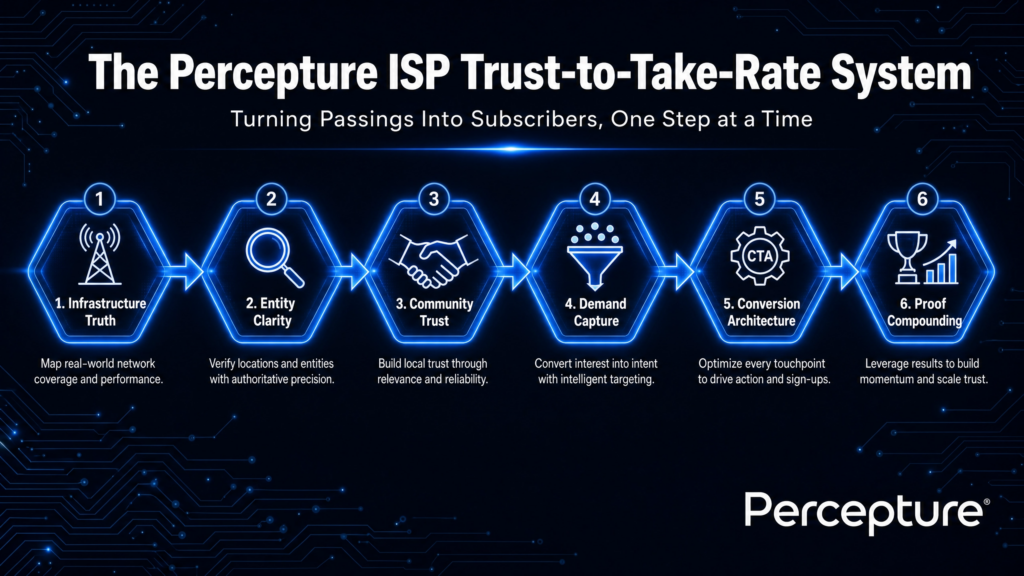
The sequence keeps the Rural broadband marketing strategy aligned with actual readiness. Awareness becomes education. Education becomes anticipation. Anticipation can become preregistration. Preregistration becomes an order only when the address and operating system are ready.
Audit the full serviceability-to-subscriber funnel
A Rural broadband marketing strategy should be evaluated as one system, from the approved location file through order, installation, activation, retention, and financial reporting. Review Percepture’s engagement options before selecting the scope.
Review Pricing OptionsWhich channels belong in the system?
No single channel carries the entire Rural broadband marketing strategy. Each channel needs a defined audience, serviceability control, approved proof, conversion event, metric, and failure rule.
Channel control scorecard
This scorecard assigns each channel a specific role and control within the Rural broadband marketing strategy.
| Channel | Primary role | Control | Conversion and metric | Common failure |
|---|---|---|---|---|
| Local SEO | Answer market, installation, support, and availability questions | Publish only verified local facts | Qualified address checks | Thin location pages or broad availability claims |
| GEO and AI search | Make provider facts easy to retrieve and cite | Use clear entities, dates, sources, and limitations | Qualified visits and assisted checks | Vague claims without supporting detail |
| PR and local media | Explain milestones, partnerships, and useful project information | Construction and legal review | Referral visits, branded search, and checks | Announcing before facts are stable |
| Paid search and social | Capture demand and reach approved segments | Address or zone suppression | Verified checks, orders, and CPGA | Buying impressions outside serviceable areas |
| Direct mail | Reach verified households and businesses offline | Match the list to the current location file | QR, URL, call, and order response | Mail arriving before service is ready |
| Email and SMS | Move consented contacts through updates and activation | Segment by address state | Checks, orders, installs, and recovery | Sending ready-to-order messages to pending addresses |
| Events and partners | Build understanding through trusted local channels | Approved fact sheet and update cadence | Verified interest and checks | Partners using outdated claims |
| Door-to-door and field | Reach concentrated activation zones | Live eligibility tool and scripts | Orders and completed installs | Unlogged promises or inconsistent terms |
| Reviews and referrals | Turn positive experience into local proof | Ask after confirmed positive service | Reviews, referred orders, and retention | Requesting advocacy before resolving problems |
| Retargeting | Recover informed visitors and abandoned checks | Suppress completed or ineligible outcomes | Recovered checks and orders | Repeating ads after an unavailable result |

Use enterprise SEO to manage scalable market content without creating doorway pages. Pair it with GEO services for answer-first entity coverage and digital PR for useful, approved authority signals.
Paid outreach should follow the same location controls. Percepture’s media buying service supports coordinated audience and placement decisions, while omnichannel marketing connects media, content, email, PR, and conversion paths.
For deeper channel planning, compare this model with Percepture’s digital infrastructure marketing guide and its analysis of digital infrastructure PR strategy.
How should preregistration and the address check work?
The address check should give the Rural broadband marketing strategy a useful state, not a dead end. A ready address moves to product selection and ordering. A building address receives an accurate project status and consent-based update option. A survey-required location enters a defined review queue. A limited address receives applicable choices or constraints. An unavailable address receives an honest answer.
Abandoned checks need a recovery rule based on consent and known status. Failed installations need a reason code, owner, customer update, rescheduling path, and feedback loop to marketing. Do not keep advertising an easy installation where the operating record shows unresolved constraints.
Conversion work should reduce friction without concealing facts. Percepture’s conversion-rate optimization service can evaluate the address check, landing page, order flow, calls to action, and recovery paths.
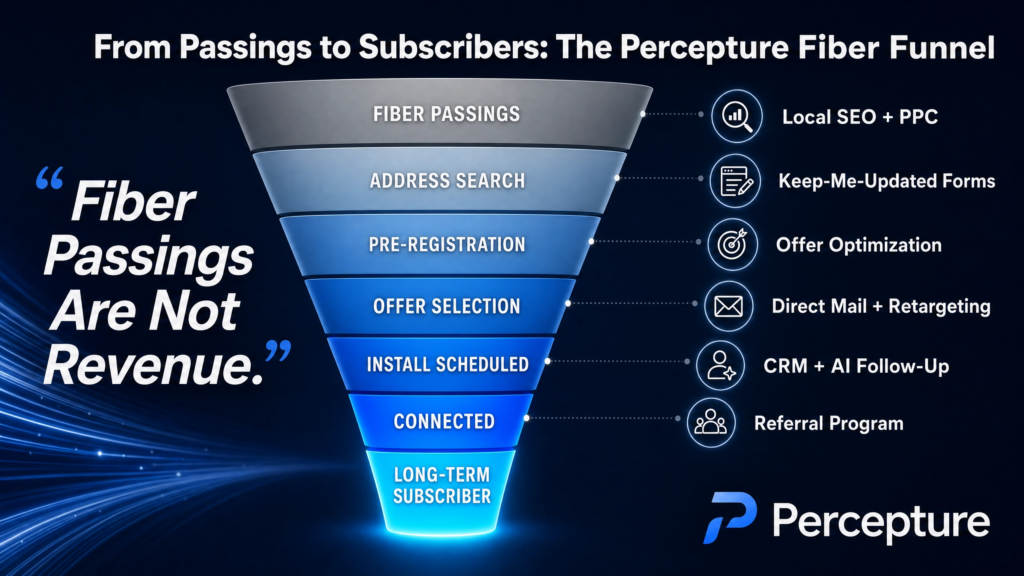
Route every location to a controlled next step
What should the first 90 days include?
A 90-day Rural broadband marketing strategy should move through controlled gates. The schedule is not a promise that every market can launch within 90 days. It is a management structure for resolving readiness, testing demand, and deciding whether to scale.
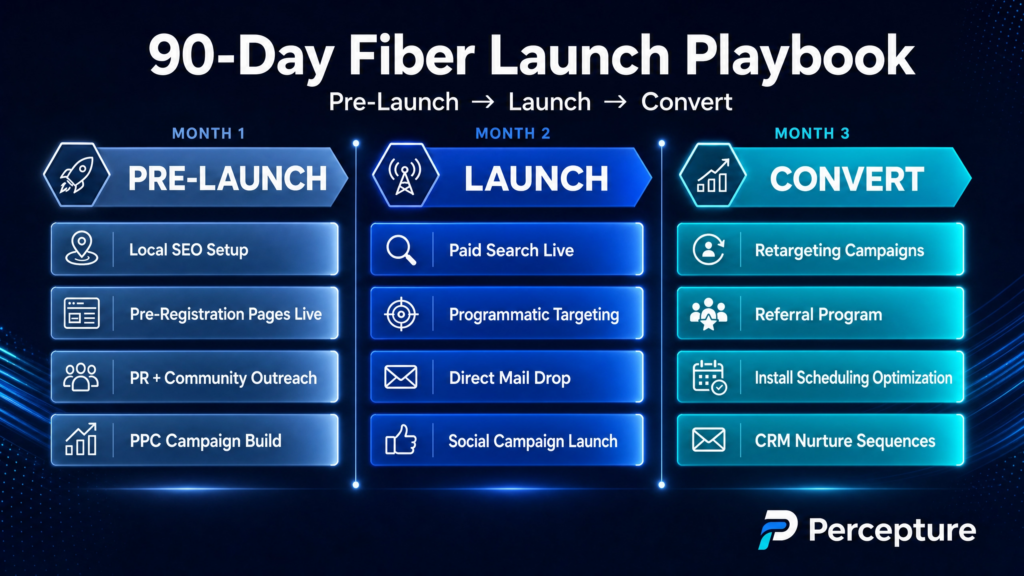
Days 1–15: Establish market truth
Reconcile GIS, location records, CRM data, construction status, products, pricing, capacity, survey rules, and installation constraints. Record the current funnel from exposure through activation so the Rural broadband marketing strategy begins with an approved operating baseline.
Gate: No campaign uses an unapproved coverage or construction file.
Days 16–30: Build community intelligence
Interview stakeholders and document needs, prior promises, objections, trusted channels, local calendars, contacts, disruption concerns, and update preferences.
Gate: The team can clearly answer who, what, why, where, timing, cost, installation, disruption, and support questions.
Days 31–45: Approve segments and routing
Segment addresses by readiness, product, buyer, need, and competition. Approve offers, proof, terms, creative, and routes for ready, pending, survey, limited, unavailable, abandoned, and failed-install outcomes.
Gate: Every campaign has a valid audience, conversion, owner, and operating path.
Days 46–60: Run a controlled pilot
Launch in selected zones. Coordinate mail, search, media, email, text, events, field outreach, partners, referrals, and retargeting. Review address matches, calls, orders, installation capacity, sentiment, and complaints.
Gate: Suppress demand when serviceability, scheduling, or network experience is weak.
Days 61–75: Improve activation
Refine pages, scripts, offers, follow-up, scheduling, and failed-install recovery. Publish accurate FAQs and project updates. Request reviews only after a positive experience.
Gate: Marketing cannot hide unresolved operating or customer problems.
Days 76–90: Validate and scale
Compare markets, segments, channels, creative, and partners. Calculate gross adds, CPGA, take rate, retention, attributable revenue, delivery cost, and gross profit.
Gate: Finance, operations, and marketing approve the denominator and attribution before scaling.
Rural broadband marketing strategy economics and ROI
Pricing should reflect the work required to establish market truth, build assets, coordinate channels, manage data, improve conversion, and measure activation. A Rural broadband marketing strategy may include research, meetings, creative, content, SEO, GEO, PR, paid media, data, mail, email, SMS, events, sponsorships, field sales, commissions, promotions, CRM, analytics, call tracking, installation support, training, and reporting.
Measurement framework
| Metric | Formula | What it controls |
|---|---|---|
| Cost per marketable location | Market preparation cost ÷ approved marketable locations | Readiness investment |
| Cost per verified check | Campaign cost ÷ checks matched to a valid result | Address-level demand efficiency |
| Preregistration-to-order rate | Orders from eligible preregistrations ÷ eligible preregistrations × 100 | Prelaunch conversion quality |
| Install completion | Completed installs ÷ scheduled installs × 100 | Fulfillment performance |
| CPGA | Total attributable acquisition cost ÷ activated gross adds | Acquisition efficiency |
| Take rate | Active subscribers ÷ approved serviceable-location denominator × 100 | Market penetration |
| 90-day retention | Mature gross adds active after 90 days ÷ mature gross adds × 100 | Early customer quality |
| Attributable gross profit | Attributable revenue − direct delivery cost | Financial contribution |
| Marketing ROI | (Attributable gross profit + verified savings − total program cost) ÷ total program cost × 100 | Program return |
The denominator used to evaluate a Rural broadband marketing strategy must remain consistent across the geography and measurement period. Do not mix passings, construction-pending locations, marketable addresses, and currently serviceable addresses without explaining the change. Use attribution and analytics to connect campaign exposure with verified checks, orders, installs, activations, retention, revenue, and gross profit.
Leads and preregistrations are useful funnel measures, but they are not final value. Reporting should follow the full chain: exposure, verified location, address check, status, order, installation, activation, retained subscriber, revenue, and gross profit.
What a fiber operator says about trust and adoption

Bob Generale interviewed Cody Clegg of OPTK Networks about rural relationships, construction communication, adoption, and the work required after a network passes a home or business.
“Awareness becomes education. Education becomes anticipation. Anticipation becomes preregistration.”
Cody Clegg
The interview focused on five operating questions: what makes rural marketing different, why trust matters before construction, which entry mistakes providers make, what strong community engagement includes, and how providers can improve adoption after passing homes and businesses.
The practical lesson for a Rural broadband marketing strategy is that promotion and operations cannot be separated. Community expectations, address status, construction updates, signup, installation, and early customer experience must reinforce the same promise.
Common failure patterns
Coverage becomes a promise
A broad map is used as proof that an individual address can order service.
Preregistration becomes revenue
Early interest is reported as if it were an order, installation, or active subscriber.
Channels use different facts
Partners, ads, mail, field teams, and support communicate conflicting timing or terms.
Demand outruns fulfillment
Campaigns continue while survey, scheduling, equipment, or crew constraints grow.
Marketing ends at signup
No team owns failed-install recovery, onboarding, early support, reviews, or referrals.
Local pages lack local value
Pages repeat generic copy without verified availability, project facts, contacts, or useful answers.
These failures weaken both execution and the visibility of a Rural broadband marketing strategy. Percepture’s explanation of corporate SEO shows why governance and shared standards matter when many teams publish or change customer-facing information.
Turn rural infrastructure into long-term adoption
Percepture can help build a Rural broadband marketing strategy around verified locations, community communication, coordinated demand, conversion routing, installation feedback, retention, and financial measurement.
Build a 90-Day Rural Broadband Growth PlanRural broadband marketing strategy FAQs
What is a Rural broadband marketing strategy?
A Rural broadband marketing strategy is a market-entry and subscriber-growth plan built around accurate serviceability, community trust, clear offers, repeated local outreach, easy signup, installation, and retention. It should measure activated and retained subscribers rather than treating impressions, leads, passings, or preregistrations as final value.
Why is address-level marketing important?
Nearby properties can receive different serviceability results, so a Rural broadband marketing strategy needs address-level controls. Address-level marketing reduces wasted spend, false expectations, failed orders, and reputational damage. It also routes each resident or business to ready service, a construction update, preregistration, a survey, a limited option, or an honest unavailable result.
When should rural broadband marketing begin?
Begin during planning by mapping stakeholders, learning local concerns, establishing contacts, correcting location data, and preparing project facts. Heavy offer promotion should wait until serviceability, timing, installation capacity, pricing, terms, and support paths have been approved by the responsible teams.
Which channels work best for rural broadband providers?
A Rural broadband marketing strategy can include local partners, direct mail, events, search, AI visibility, paid media, email, text, field outreach, reviews, referrals, and retargeting. The mix works only when every channel uses the same serviceability data, offer, timing, contacts, conversion path, and suppression rules.
How should providers market fiber, fixed wireless, or other access technologies?
Lead with understandable outcomes and disclose technology-specific facts when they affect eligibility, performance, equipment, installation, terms, support, or buyer choice. Do not hide meaningful differences, and do not let technical jargon replace a clear explanation of the product and its limitations.
How is rural broadband take rate calculated?
Take rate equals active subscribers divided by the approved serviceable-location denominator for the same geography and period, multiplied by 100. Define the denominator consistently. Do not combine passings, pending construction, marketable locations, and currently serviceable addresses without explaining the calculation.
How long does a rural broadband growth plan take to implement?
A 90-day plan can establish market truth, collect community intelligence, approve routing and offers, run a controlled pilot, improve activation, and evaluate whether to scale. Actual market timing depends on construction, serviceability, product readiness, installation capacity, support, data quality, and required approvals.
How should ROI be measured?
Rural broadband marketing strategy ROI should include approved media, research, creative, data, platforms, mail, events, commissions, promotions, technology, agency work, and activation support. Compare total cost with completed activations, retained subscribers, attributable revenue, direct delivery cost, gross profit, and payback. Leads remain interim funnel measures.