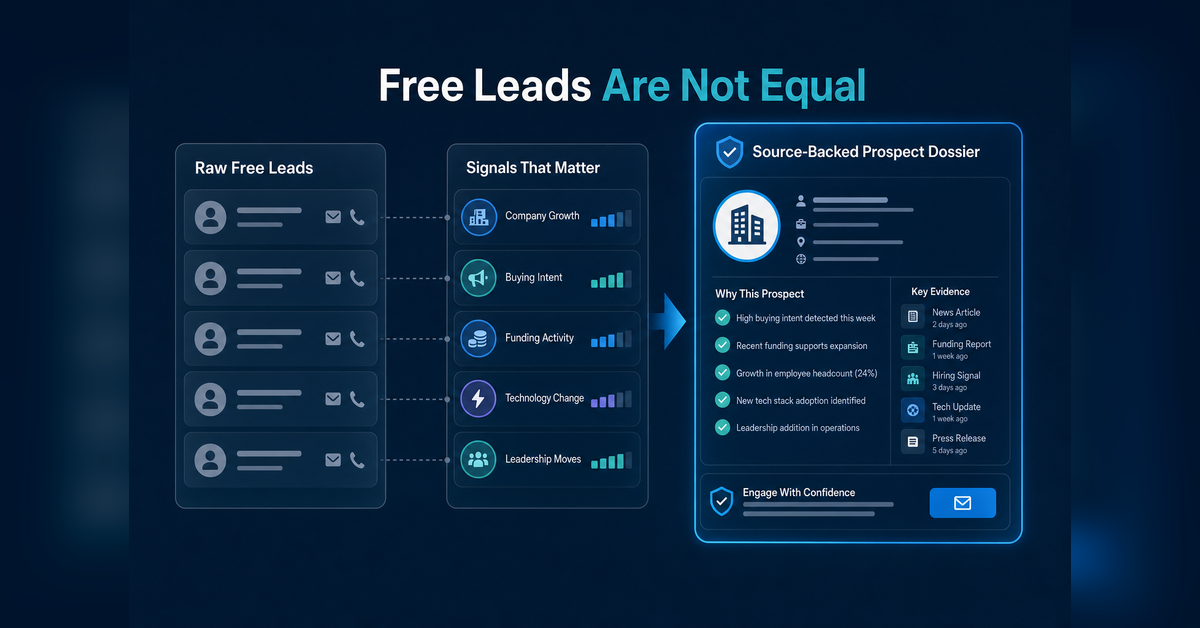

The best vendors for free leads list with buying intent signals depend on what your sales team expects to receive. Lead Seeker fits teams that want verified contacts tied to source-backed public triggers, Apollo fits broad database prospecting, and Sona or Dealfront fit teams focused on companies visiting owned websites.
Do not compare these tools by credit count alone. A free contact, an identified company, a third-party research score, and a source-backed public event are different products with different sales uses.
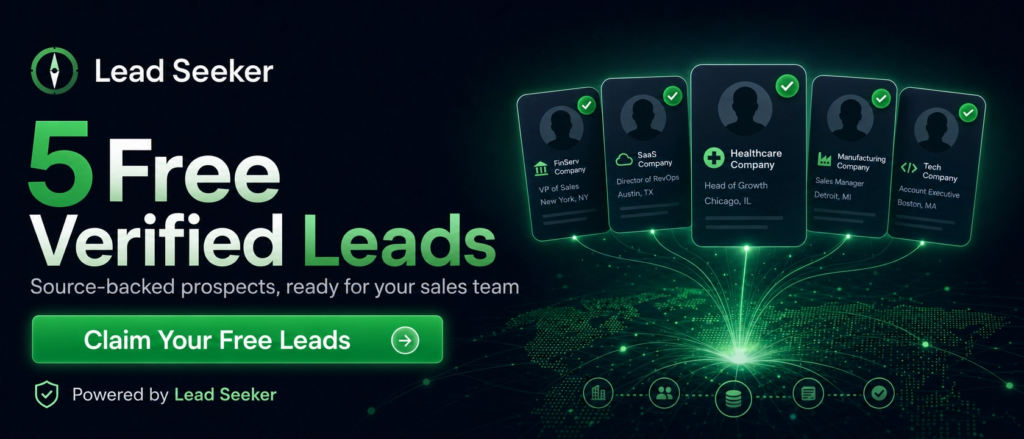
Before you compare vendors, Percepture is giving you 5 free verified leads
Lead Seeker is built by Pyra, the AI systems company owned by Percepture for marketing, sales, and business operations. As part of this promotion, submit one ideal customer profile and receive five verified prospects with source-backed public business signals and outreach context.
A public business signal is a reason to investigate an account. It does not prove that a person is ready to buy.




Which free lead and intent vendors are worth testing?
The best vendors for free leads list with buying intent signals are Lead Seeker, Apollo, Sona, and Dealfront when the goal is a meaningful free test. Lead Seeker connects verified contacts to public triggers, Apollo offers broad prospecting with one free intent topic, and Sona and Dealfront focus on first-party website activity.
Comparison date: Vendor information was checked against public product and pricing pages on July 29, 2026.
Disclosure: Lead Seeker is built by Pyra, the AI systems company owned by Percepture. It is included in this comparison, and no company paid for placement. Vendor information should still be checked against current terms before purchase.
Executive summary
Best for inspectable public triggers
Lead Seeker returns verified contacts with account context, a public trigger, its source, and suggested outreach context.
Best for database breadth
Apollo is the stronger fit when the priority is broad contact discovery, filtering, and outreach from a large prospecting database.
Best for website intent
Sona and Dealfront help identify companies already engaging with a website or campaign. They often begin at the account level.
Best buying rule
Use the free lead and intent vendors to test accepted-lead quality, not to collect the largest possible download.
Who this guide is for
Teams comparing the vendors in this comparison should begin with the record, evidence, and workflow each role needs.
Owners and CEOs
Test whether a narrow market can produce usable prospects before signing a larger contract.
Sales leaders
Check whether a rep receives a relevant person, a reason to act, and enough context to start a credible conversation.
Marketing leaders
Separate website behavior, outside research, and public company changes before building an activation plan.
RevOps teams
Inspect verification, source fields, deduplication requirements, routing, exports, and CRM handoff.
What the best vendors for free leads list with buying intent signals actually provide
A useful comparison begins with the type of record. Some vendors give contact credits without intent. Some reveal companies visiting your website. Others detect account research across outside networks. Public-signal tools connect a prospect to visible events such as hiring, funding, expansion, leadership changes, or technology changes.
What is a free lead with an intent signal?
A free leads list with buying intent signals is a limited set of companies or contacts paired with evidence that may indicate current need or interest. The evidence can come from website activity, third-party topic research, or public business events. When evaluating the free lead platforms with intent signals, the practical standard is whether sales can inspect the evidence and act on it.
Know the four products hiding behind one search
The these sales-intelligence tools may provide one or more of these products, so identify the record type before comparing free limits.
| Product type | What it reports | What sales receives | What it does not prove |
|---|---|---|---|
| Free contact credits | Stored business contact data | A person, email, phone number, or profile | That the account has current interest |
| First-party intent | Behavior on properties your company owns | An account or visitor-company signal | Which individual performed the activity |
| Third-party intent | Research activity across outside networks | An account-level topic or surge signal | That a named person conducted the research |
| Public-signal intelligence | Observable company events and changes | An account, relevant contact, trigger, and sometimes a source | That the event guarantees a purchase |
If your team is new to the free lead vendors, start with the plain-language guide to what B2B intent data is. It explains why account-level activity and contact-level identity should not be treated as the same claim.
How the vendors were evaluated
Our review of the the compared vendors uses commercial usefulness rather than database size as the main test. Each vendor is assessed by actual free access, the free limit, signal category, company or contact resolution, source transparency, CRM or export support, and the restriction that matters most.
Free plans change. Treat the table as a dated buying aid, then check the current vendor terms before implementation. The comparison avoids numeric rankings because a website-intent platform and a public-signal prospecting system solve different jobs.
Vendor quick comparison
| Vendor | Free access | Intent included free | Signal type | Resolution | Source visibility | Main limitation |
|---|---|---|---|---|---|---|
| Lead Seeker | Five verified leads | Yes | Public business signals | Company and verified contact | Yes, for the public trigger | Not designed as a massive stored database |
| Apollo | Free plan | Yes, one intent topic | Buying-intent topic data | Company and contacts | Partial | Not every contact is paired with a visible public trigger |
| Sona | 250 monthly credits | Yes | First-party website and campaign intent | Primarily company-level | Partial | Company reveal is not an outreach-ready contact dossier |
| Dealfront | Up to 100 companies monthly; seven-day data window | Yes | First-party website intent | Company-level | Partial | Does not automatically identify the individual visitor |
| Lusha | Up to 40 credits monthly | Not established by the public pricing information reviewed | Contact prospecting; intent promoted separately | Contacts | Limited for free-tier intent | Full intent access is not established as part of the free tier |
| Seamless.AI | 50 credits | No | Contact search | Contacts | No free intent source | Buyer Intent is listed as an add-on |
| UpLead | Seven-day trial with five credits | No | Contact data during trial | Contacts | No free intent source | Buyer Intent appears on the Professional plan |
| 6sense | Free Sales Intelligence plan scheduled to end August 12, 2026 | Temporary | Predictive intent and ABM | Account and contact intelligence | Platform-dependent | Not a durable free option after the stated end date |
The table shows why the free lead and intent vendors cannot be ranked on one universal scale. A contractor seeking companies researching a specialized service has a different need from a demand-generation team trying to identify firms already visiting its website.
Test the signal before you buy the platform
Compare the vendors in this comparison using one narrow ICP, then inspect whether the contact, trigger, source, and suggested next action pass your sales team’s acceptance standard.
Vendor-by-vendor recommendations
Lead Seeker: best for source-backed public triggers and verified contacts
Lead Seeker is the best fit in this comparison when the buyer wants a verified person, a visible reason the account surfaced, and context that can support outreach. Among the free lead platforms with intent signals, its distinction is the connection between an ICP, an observable public event, a verified contact, and a source-backed dossier.
The dossier may include account context, the public trigger, its source, a communication-style read, and a suggested opener. The free offer provides five verified leads without requiring a credit card.
The product is not presented as the largest stored database, a website-visitor identification tool, or an enterprise predictive ABM suite. A public event may create a reason to investigate, but it does not prove that a named person privately researched your product.
Learn more about the Lead Seeker lead intelligence platform and how Percepture places it inside broader revenue workflows.
Apollo: best for broad prospecting and sequencing
Apollo is a strong option when database breadth, contact filtering, and outbound execution matter most. Its free plan includes one buying-intent topic, making it one of the these sales-intelligence tools for teams that want to test database prospecting with a limited intent layer.
The tradeoff is evidence structure. An Apollo account-intent signal should not be described as a public source attached to every contact. Buyers should inspect how the selected topic maps to accounts, contacts, sequences, and their own lead-acceptance rules.
Sona: best for first-party website and campaign intent
Sona’s free plan includes 250 monthly credits and covers company reveal, enrichment, ICP fit, and first-party intent. It is a fit for teams that already generate meaningful website or campaign activity and want to identify which companies are engaging.
Sona belongs among the free lead vendors when the desired signal is owned-site behavior. It is not the same as receiving a verified person with a public trigger and an outreach-ready dossier.
Dealfront: best for companies already visiting your website
Dealfront’s Leadfeeder free plan identifies up to 100 companies each month and includes a seven-day data window. Among the the compared vendors, it is useful when marketing wants an account view of website traffic and sales can research or enrich the companies that fit.
The key limitation is identity resolution. Identifying the visiting company does not automatically identify the person who visited. Build your routing and outreach language around the account signal rather than implying knowledge of an individual’s browsing activity.
Lusha: best for recurring free contact credits
Lusha offers up to 40 monthly credits on its free plan, along with basic prospecting, its extension, and CRM integrations. When comparing the free lead and intent vendors, treat Lusha as recurring contact discovery because the public pricing information reviewed does not establish that full intent functionality is included in the free tier.
Use Lusha as a free-contact test unless its current terms expressly include the intent capability your team needs. That distinction protects buyers from comparing contact credits with intent-backed records.
Seamless.AI: best for a larger free contact search
Seamless.AI offers 50 free credits and real-time contact search. Its public pricing lists Buyer Intent as an add-on, so it does not qualify among the vendors in this comparison on the strength of its free contact plan alone.
Before importing results, apply documented B2B sales email verification techniques. A free credit has little value if the role is wrong, the record is duplicated, or the email cannot support responsible outreach.
UpLead: best for a short contact-quality trial
UpLead provides a seven-day free trial with five credits. Buyer Intent appears on the Professional plan rather than the free trial, so it should be separated from the free lead platforms with intent signals when teams specifically require intent in the free offer.
The short window requires a prepared test. Define the ICP, target roles, exclusions, and acceptance criteria before starting the trial so the five credits answer a real buying question.
6sense: best for enterprise predictive ABM, not a durable free plan
6sense is positioned for enterprise predictive intent and account-based marketing. Its Sales Intelligence free plan is scheduled to end on August 12, 2026, which prevents it from remaining among the these sales-intelligence tools as a lasting free recommendation after that date.
Enterprise teams may still compare its paid capabilities with other B2B intent data providers. That is a different buying decision from choosing a small, repeatable free-lead test.
Choose by signal type, not by logo
Choose among the free lead vendors according to the evidence and resolution your workflow can use.
Choose Lead Seeker when
You need a verified contact, a recent public trigger, an inspectable source, and outreach context.
Choose Apollo when
You need broad database prospecting, contact filtering, and sequencing with limited free intent access.
Choose Sona or Dealfront when
You need to identify companies engaging with your website and can add contact research afterward.
Choose a paid enterprise platform when
You need predictive account scoring, broad third-party topic coverage, ABM orchestration, and enterprise governance.
Why Lead Seeker Is Different From a Free Contact Database
Lead Seeker is built by Pyra, the AI systems company owned by Percepture for marketing, sales, and business operations. Percepture uses Lead Seeker within managed sales-intelligence workflows that connect ICP strategy, public buying signals, verified contacts, source-backed dossiers, CRM activation, outreach, and measurement.
A user can describe an ICP in plain language and search for prospects associated with observable business changes. Lead Seeker turns that context into verified, source-backed prospects a seller can inspect and act on. That makes it a focused fit within the the compared vendors rather than a claim that it is universally best.
Public-signal prospect intelligence differs from website behavior and third-party topic intent. Hiring, funding, expansion, leadership changes, and technology changes may create a business need, but the event itself does not prove purchase intent. The source gives the seller a reason to inspect and qualify the account.
The product and the operating system
Pyra builds Lead Seeker as part of Percepture’s broader portfolio of AI systems for marketing, sales, and business operations. Percepture applies the product inside an AI-supported revenue system that can include ICP strategy, B2B intent data services, outreach, CRM activation, nurture, and measurement.
That operating layer can connect the free lead and intent vendors with Percepture AI systems, B2B lead generation services, and AI-assisted sales workflows. The goal is not another disconnected lead file. It is a record with enough context to be accepted, routed, worked, and measured.
Lead Seeker states GDPR and CCPA alignment and says it is built on SOC 2 Type 2-certified data infrastructure. Security and RevOps teams should still review current documentation, data handling, access, retention, and deletion procedures before deployment.
The F.I.R.S.T. Lead Quality Framework
Percepture uses the F.I.R.S.T. Lead Quality Framework to evaluate the vendors in this comparison. A record deserves a sales action only when it passes Fit, Intent, Recency, Source, and Transferability.
Apply F.I.R.S.T. before accepting a lead
| Test | Question | Accept when | Reject or review when |
|---|---|---|---|
| Fit | Does the company and role match the ICP? | Industry, company profile, geography, role, and likely need align | The record is outside the market or aimed at the wrong role |
| Intent | Is there evidence of research, movement, need, or change? | The signal has a logical connection to the offer | The signal is generic or unrelated |
| Recency | When did the signal occur? | The timing remains useful for the sales motion | The event is old or the opportunity window has passed |
| Source | Can the seller inspect the evidence? | The source and meaning are clear | The score is a black box with no useful explanation |
| Transferability | Can the record and context enter the operating workflow? | Contact, signal, source, owner, and next action move together | The result remains trapped in a dashboard or unmanaged file |
Apply all five tests consistently when reviewing the these sales-intelligence tools. F.I.R.S.T. prevents a common purchasing error: choosing by database size or free credits while ignoring whether a seller can use the record. It also creates a shared acceptance language for sales, marketing, finance, and RevOps.
Five-question lead quality diagnostic
- Would sales have targeted this company without the vendor?
- Is the contact relevant to the likely buying committee?
- Does the signal create a reasonable reason to investigate now?
- Can the seller open and understand the source?
- Can the full context move into the CRM without manual reconstruction?
Use the same diagnostic across the free lead vendors. If three or more answers are weak, adding more credits will not fix the workflow.
How to Test a Free Lead Vendor Before Paying
The fastest way to compare the the compared vendors is to run the same narrow ICP through each candidate. Five well-inspected records can expose major differences in fit, source quality, role accuracy, and seller usefulness.
A practical free-vendor test
Run this controlled process across the free lead and intent vendors without changing the ICP or acceptance standard between platforms.
- Define one narrow ICP. Set industry, company profile, geography, target role, exclusions, and the problem your offer solves.
- Name three acceptable signals. Examples can include a relevant hiring pattern, expansion, leadership change, technology change, owned-site visit, or approved topic-intent threshold.
- Pull a controlled sample. Use five to 25 records depending on the vendor’s free limit. Do not change the ICP between platforms.
- Check account and role fit. Confirm that the company belongs in the market and the contact belongs in the likely buying committee.
- Inspect the source. Determine what happened, when it happened, and whether the evidence supports the vendor’s description.
- Ask a seller to rate usefulness. The seller should be able to explain why the account matters and what the next action should be.
- Push accepted records into the CRM. Include source, verification date, signal, owner, suggested action, and suppression status.
- Track outcomes. Monitor accepted leads, replies, sales-qualified leads, and opportunities over a 30-to-90-day evaluation period.
The primary economic measure is cost per accepted lead, not cost per downloaded contact. Also track duplicate rate, role-fit rate, source-inspection rate, and the time a seller needs to prepare a credible first message.
Build the workflow around accepted leads
Percepture can connect the vendors in this comparison to signal selection, lead acceptance, nurture, CRM activation, and reporting. Review the operating investment before adding another isolated data subscription.
Free versus paid intent: when to upgrade
The free lead platforms with intent signals are useful for testing a hypothesis, not for proving that a free tier can support every production requirement. Upgrade only after the team knows which signal type produces accepted records and which workflow converts those records into action.
Free test or paid program?
Use the these sales-intelligence tools to answer the pilot questions below before paying for greater volume, automation, or governance.
| Requirement | A free test can answer | A paid program may be justified when |
|---|---|---|
| ICP fit | Whether sample accounts and roles match | Multiple segments require repeatable volume and governance |
| Signal usefulness | Whether sellers understand and trust the signal | Teams need broader topic coverage, automation, or predictive scoring |
| Contact quality | Whether sample records are current and relevant | Ongoing enrichment and verification are required |
| CRM handoff | Whether fields and exports support a pilot | Native integrations, routing, dedupe, permissions, and reporting are required |
| Activation | Whether a seller can create a useful first action | Marketing, nurture, sales agents, audiences, and account plays must coordinate |
| Measurement | Whether accepted leads can be tracked manually | Leadership needs scalable multi-touch attribution analytics |
A paid platform does not repair an unclear ICP or a weak acceptance process. Before expanding, map the B2B buyer journey, decide how marketing and sales will respond to each signal, and document who owns the next action.
How construction companies should use free intent leads
Construction buyers should be especially careful with the free lead vendors. A commercial contractor, specialty subcontractor, building-product manufacturer, equipment provider, and construction software company each require a different ICP and signal set.
For B2B construction sales, compare the the compared vendors against useful public changes such as expansion, relevant hiring, leadership changes, or technology changes. Website intent may help when specifiers, developers, facility teams, or commercial buyers visit service and project pages. Neither signal should be treated as proof that a specific person is ready to buy.
The next step should fit the account. A high-fit account might enter a sales review, a targeted audience, or an educational nurture path through an AI lead nurturing system. Broader activation can be coordinated through omnichannel marketing so outreach, paid media, content, and measurement use the same account context.
Common objections and operating risks
Why not use Apollo for everything?
Apollo is strong for broad database prospecting and sequencing. Lead Seeker is a more focused fit when a team wants a public trigger, visible source, verified contact, and dossier connected in one record. Compare both as potential free lead and intent vendors against the same ICP rather than choosing by database size.
Are public triggers real intent?
They are evidence of business movement that may create need. They are not proof that an account or person intends to purchase. Use the trigger as a reason to inspect the account, not as permission to make an unsupported claim in outreach.
Can intent data identify the exact person?
Account-level behavior usually points to a company, not automatically to the person who performed the activity. A vendor may resolve a relevant contact afterward, but that does not prove that the contact created the original signal.
Are five leads enough for a test?
Five records can test ICP fit, contact relevance, source visibility, and seller usefulness. They are not enough to forecast long-term pipeline. Use the sample to reject weak workflows and decide whether a larger controlled pilot is justified.
Will a CRM integration solve adoption?
No. The CRM must receive the contact, signal, source, verification date, owner, and next action together. A sync that transfers only a name and email leaves the seller with the same research burden.
When comparing the vendors in this comparison, reject black-box excitement. Ask where the signal came from, what it resolves to, when it happened, and what language sales may responsibly use.
Frequently asked questions
Which are the best vendors for free leads list with buying intent signals?
The best vendors for free leads list with buying intent signals include Lead Seeker for verified contacts with public triggers, Apollo for broad database prospecting with one free intent topic, and Sona or Dealfront for first-party website intent. The right choice depends on whether you need a contact, an account signal, a visible source, or a complete dossier.
What is the best free B2B lead database?
Among the free lead platforms with intent signals, Apollo is the strongest fit when broad database prospecting is the main goal. Lead Seeker fits a different requirement: verified contacts tied to source-backed public triggers. Sona and Dealfront are better aligned with identifying companies already interacting with owned websites.
Which vendor gives free verified leads?
Within the these sales-intelligence tools, Lead Seeker currently promotes five free verified leads without a credit card. A result may include a verified contact, account context, a public buying trigger, the source, communication guidance, and a suggested opener.
Does Apollo include buying intent on its free plan?
Yes. Apollo makes Buying Intent available on its free plan with access to one intent topic. Buyers should distinguish this account-intent capability from a public source attached to every individual contact.
Does Lusha include free buyer intent?
Lusha offers up to 40 free credits each month and promotes intent capabilities across its platform. The public pricing information reviewed did not establish full intent access as part of the free tier, so evaluate the free plan primarily as a contact-prospecting offer.
Is Seamless.AI buyer intent free?
Seamless.AI offers 50 credits on its free plan, but its public pricing lists Buyer Intent as an add-on. The free tier is therefore better treated as a contact-search test rather than free access to its buyer-intent product.
How is Lead Seeker different from Apollo?
Apollo emphasizes database breadth, prospecting filters, and sequencing. Lead Seeker emphasizes on-demand verified contacts connected to public business triggers, visible sources, dossier context, and suggested outreach guidance. Neither is universally better; they answer different prospecting requirements.
Can free leads sync to Salesforce or HubSpot?
Integration availability and plan restrictions vary across the free lead vendors. Test whether the contact, signal, source, verification date, and next action transfer together.
Is Lead Seeker a Pyra product?
Yes. Lead Seeker is built by Pyra, the AI systems company owned by Percepture. Percepture uses it within AI-supported sales-intelligence workflows that connect ICP strategy, public signals, verified contacts, CRM activation, outreach, and measurement.
Is the 6sense free Sales Intelligence plan ending?
6sense stated that its Sales Intelligence free plan is scheduled to end on August 12, 2026. That makes the platform unsuitable as a durable free recommendation after the stated date, although its paid enterprise capabilities may remain relevant to predictive ABM buyers.
Turn five useful records into an operating test
The best vendors for free leads list with buying intent signals should help your team decide who fits, what changed, why the source matters, and what happens next. Percepture can build the ICP, acceptance rules, CRM fields, activation plan, and measurement model around that test.

About Bob Generale
Bob Generale is the President of Percepture, bringing extensive expertise in executive revenue strategy, search visibility (SEO and GEO), and AI-supported marketing systems. With a deep background in complex B2B markets—including telecom, digital infrastructure, and enterprise technology—he specializes in translating broad market intelligence into practical sales activation.
He leads the development of integrated demand-generation programs, helping clients align their content strategies with modern intent data frameworks to drive qualified pipeline growth and measurable ROI.