


If you are asking how to use intent data to identify sales qualified leads, start with a hard rule: activity is not qualification. A company may read, search, hire, expand, or attend an event and still be a poor sales target.
The better system connects buyer signals to ICP fit, timing, verified contacts, source-backed context, CRM routing, and a clear next sales action. That is where intent data becomes useful for CEOs, CMOs, RevOps teams, and sales leaders who need fewer bad leads and more trusted reasons to act.
How to use intent data to identify sales qualified leads
To use intent data to identify sales qualified leads, combine buyer signals with ICP fit, timing, contact relevance, source-backed context, and a clear next sales action. A lead is not sales qualified because it showed activity. It becomes sales qualified when sales can explain why the account fits, why now, who to contact, and what to do next.
Executive Summary for B2B Leaders
The core mistake
Many teams treat intent data as a list of active accounts. That creates noise unless the signal is tied to fit, timing, and sales context.
The better standard
How to use intent data to identify sales qualified leads comes down to one operating question: can sales act on this account with confidence today?
The Percepture method
Percepture connects B2B intent data services, LeadSeeker, verified contacts, source-backed dossiers, CRM workflows, and human operator review.
The outcome to measure
The goal is sales-ready prioritization, not vanity lead volume. Track accepted leads, reply quality, opportunity creation, and bad-fit leads removed.
Run a Lead Quality Diagnostic
Before you scale intent data, test whether your current signals can produce sales-ready accounts, verified contacts, and clear next actions.
Run a Lead Quality DiagnosticWhat Is Intent Data?
Intent data is information that suggests a company or buyer may be researching a problem, solution, product, vendor, or category. In B2B sales, intent data becomes more useful when it is paired with ICP fit, contact relevance, source-backed context, and a clear sales action.
First-party intent data comes from your own site, CRM, email, webinars, forms, and sales activity. Third-party intent data comes from outside platforms that observe market behavior. Public buying signals include hiring, executive changes, funding, expansion, event participation, vendor research, content activity, and other visible business movement.
For data center and digital infrastructure sellers, a useful signal might be expansion planning, new market entry, capacity demand, event activity, or leadership change. But how to use intent data to identify sales qualified leads is not solved by spotting the signal alone. The signal has to connect to the account, the buyer committee, and the sales motion.
Who This Guide Is For
CEOs
You want pipeline discipline without adding another noisy database to the tech stack.
CMOs
You need marketing signals that sales will trust, not reports that look active but fail in follow-up.
Sales leaders
You need a shorter list with better reasons, stronger contacts, and a clear path into outreach.
RevOps teams
You need signal logic, CRM routing, scoring rules, and review gates that can be repeated.
What Is a Sales Qualified Lead?
A sales qualified lead is an account or contact that meets the company’s fit criteria and has enough context for sales to take a useful next step. An MQL may have engaged with marketing. An SQL should be ready for direct sales attention.
The difference matters. A sales team does not need another giant list. It needs a shorter list with better reasons. That is why how to use intent data to identify sales qualified leads should always include both the signal and the reason sales should care now.
Why Intent Data Alone Does Not Create SQLs
Raw activity can create false positives. A student, competitor, analyst, vendor, or low-fit company can create the same surface-level signal as a real buyer. Old signals can also make an account look active after the need has passed.
The other common failure is contact mismatch. The right company is not enough if the contact is not tied to the buying decision. A score only matters when the rep can see the reason behind it, trust the source context, and know what action should happen next.
The Percepture Signal-to-SQL Framework
ICP Fit + Intent Signal + Timing + Contact Relevance + Source Context + Next Action = Sales Qualified Lead.
ICP Fit
Does the company match your ideal customer profile by market, size, operating model, location, need, and buying committee?
Intent Signal
What behavior or business change suggests possible buyer interest?
Timing
Is the signal recent enough to support outreach now?
Contact Relevance
Is the person connected to the decision, budget, research, or implementation path?
Source Context
Can sales explain why the account surfaced without relying on a black-box score?
Next Action
What should happen in CRM, sales outreach, or human review before the lead moves forward?
Step 1 — Define the ICP Before Looking at Signals
The first step in how to use intent data to identify sales qualified leads is to define the account you actually want. For a data center provider, that may include geography, facility type, buyer profile, capacity needs, partner ecosystem, contract size, and timing triggers.
Percepture’s workflow can connect this strategy work to LeadSeeker lead intelligence, where teams can move from natural-language ICP prompts to targeted lead research. The point is not to ask AI for a giant list. The point is to describe the buyer logic clearly enough that the system can help find accounts that fit.
ICP work also belongs in the broader customer journey mapping process. If you do not know what a buyer does before sales contact, you will overvalue weak signals and undervalue the business triggers that actually matter.
Step 2 — Map the Buying Signals That Matter
Buying signals vary by market. Search and content activity can suggest research. Hiring can suggest growth or operational need. Funding, expansion, new leadership, technology rollouts, conference attendance, and public announcements may indicate timing.
For data centers, public signals can include market expansion, interconnection needs, power or infrastructure planning, event participation, and procurement research. A financial services sales team may care about a recent CFO change. A hospitality sales team may care about contacts near a defined property or market. A technical B2B team may care about verified contacts tied to a specific operational need.
Percepture often connects this signal map to B2B lead generation strategy so the lead source, campaign message, and sales follow-up are aligned from the start.
Step 3 — Score Fit, Timing, and Trigger Strength
A simple score can help, but it should not replace judgment. Strong signals show fit, current timing, and a credible business reason. Medium signals may support nurture or human review. Weak signals should stay out of the sales queue until more context appears.
Disqualifying signals matter too. If the account is outside your market, too small, too large, already locked into a non-fit buying path, or attached to the wrong contact, it should not become an SQL. How to use intent data to identify sales qualified leads includes deciding which accounts not to send to sales.
Signal-to-SQL Scorecard
| Qualification factor | Sales-ready sign | Review needed | Do not route yet |
|---|---|---|---|
| ICP fit | Matches target account criteria | Partial fit or unclear segment | Outside target market |
| Intent signal | Relevant business trigger or buyer activity | Signal is relevant but weak | Activity has no buying context |
| Timing | Recent enough for outreach | Timing is possible but unproven | Old or stale signal |
| Contact relevance | Decision maker, influencer, or operator | Possible stakeholder | Wrong function or no role match |
| Source context | Rep can explain why the account surfaced | Context needs research | Black-box score only |
| Next action | Clear CRM, outreach, or review step | Action needs manager review | No clear next step |
Step 4 — Verify the Contact
The right account still needs the right person. Contact relevance includes title, function, decision authority, buying committee role, geography, and operational connection to the trigger. A VP of Operations, Head of Network, Director of Construction, CFO, or RevOps leader may all matter in different sales motions.
This is where the workflow should connect signal intelligence to contact intelligence. LeadSeeker is designed to support LeadSeeker lead intelligence, not just list collection. The goal is to reduce rep research time while improving confidence.
Step 5 — Build a Source-Backed Prospect Dossier
A source-backed prospect dossier gives sales the account, contact, signal, context, and recommended action in one place. It should show where the signal came from, why the account fits, why the contact matters, and what message angle makes sense.
That dossier is the bridge between intent data and outreach. Without it, the rep sees a score and guesses. With it, the rep sees a reason to act. Percepture can connect dossiers to AI sales agents and CRM routing without removing human review from important steps.
Where LeadSeeker Fits in the Intent Data Workflow
LeadSeeker helps connect natural-language ICP prompts, guided targeting, verified contact intelligence, company context, Lead Compass signal recommendations, and research-backed dossiers. It is built for B2B prospecting workflows where account fit and context matter.
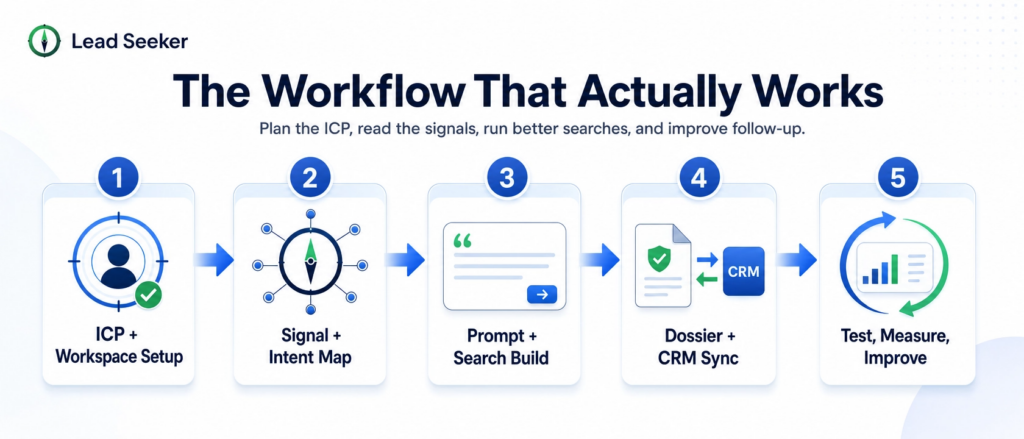
The practical path is: intent data to LeadSeeker, verified contacts where possible, source-backed dossier, CRM-ready follow-up, and sales action. Percepture can then connect the same logic to AI sales agents with guardrails, review rules, and approval gates.
Intent Data, Lead Scoring, Databases, and LeadSeeker Compared
| Method | What it does | Limitation | Best use |
|---|---|---|---|
| Intent data | Shows possible buyer signals | Can be noisy without ICP and context | Finding market movement |
| Lead scoring | Assigns points to fit and behavior | Can over-score activity without buying timing | Prioritizing known leads |
| Static lead database | Provides contact records | Data can age and lack current context | Broad list building |
| LeadSeeker | Turns ICP + signals into verified leads and dossiers | Requires clear target logic | Sales-ready prospecting |
| AI Sales Agent | Executes follow-up and CRM actions | Needs guardrails and approval | Scaling outreach and response |
How to Route Intent Data Into CRM and Sales Follow-Up
CRM routing should be boring and clear. Define what goes to Salesforce, HubSpot, a spreadsheet, a PDF brief, a Word brief, or a human review queue. Then define the handoff rule: who owns it, what the rep sees, and what action happens next.
How to use intent data to identify sales qualified leads becomes repeatable when the CRM record includes the account fit, signal type, source context, contact, recommended next action, and status. Connect the workflow to attribution and analytics so leaders can see which signals create accepted leads and which signals waste time.
Conversion work should not wait until later. Percepture can also connect the lead path to conversion rate optimization, so the page, proof, form, and follow-up support the same buyer logic.
Intent Data Examples for Data Centers and Complex B2B
In data centers and digital infrastructure, useful intent signals may include expansion research, colocation demand, interconnection needs, event participation, market entry, power planning, or new executive responsibility. A signal becomes more useful when it points to a company that fits and a person who can act.
Percepture’s data center content already supports buyer education around topics such as data center marketing, data center conferences, and data center financing structures. Those public research paths can support a stronger sales intelligence system when they are tied to signal logic.
Why Qualified Leads Matter More Than More Leads
Bad leads create hidden costs. Reps lose trust in the data, managers lose confidence in the funnel, and marketing has to defend activity instead of business value. Qualified lead growth is a better standard because it forces the team to prove fit, timing, and actionability.
Percepture’s Broadstaff qualified lead case study shows how search visibility and B2B strategy can support qualified lead growth. The lesson for intent data is simple: do not chase every signal. Build the system that surfaces the accounts sales can act on.
How Search, GEO, and Public Signals Strengthen Intent Data
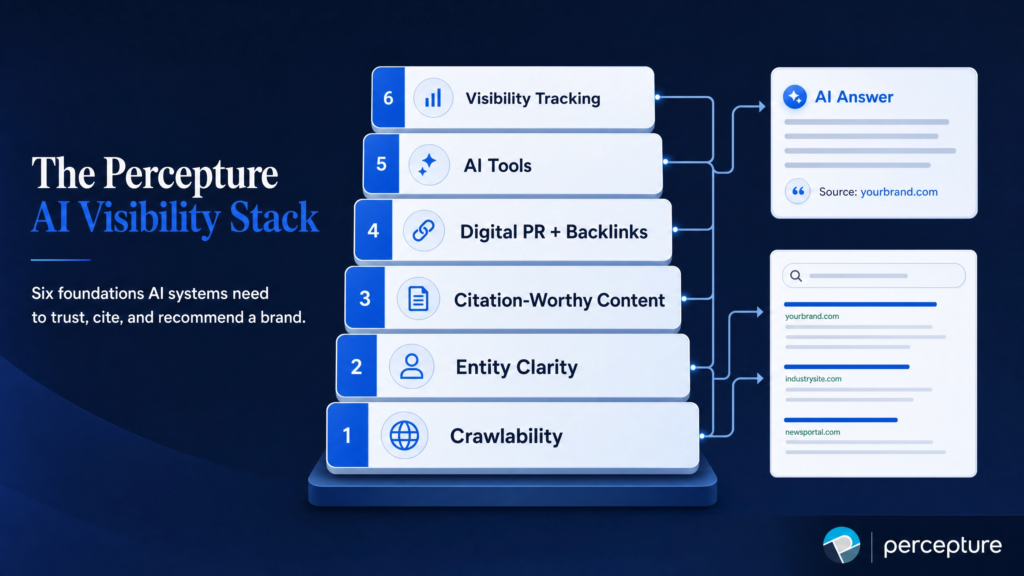
Intent data is stronger when buyers can also find credible public proof. Search visibility, content, digital PR, and AI-search visibility help create the trail that buyers and sales teams can reference during research and outreach.
Percepture connects generative engine optimization services, digital PR services, content, search, and sales intelligence so the buyer’s research path supports the sales team’s context. That is different from buying a list and calling it a pipeline system.
For teams with complex buying committees, omnichannel marketing agency helps keep the signal, message, proof, and follow-up aligned across channels.
Compare the Investment Before You Scale
Most teams should start with one ICP, one signal map, and one 4–8 week pilot before expanding the workflow across sales, marketing, and RevOps.
Review Pricing OptionsWhat to Measure After Launching an Intent-Data Workflow
Measure verified leads generated, contact accuracy, sales acceptance rate, reply quality, meetings booked, opportunities created, revenue influenced, and bad-fit leads removed. These metrics keep the team focused on quality, not activity.
If the workflow is working, sales should trust the signal more over time. If reps keep rejecting the leads, the issue is usually ICP fit, weak signal rules, stale timing, poor contact relevance, or missing source context.
Common Mistakes When Using Intent Data
The biggest mistake is treating activity as qualification. The next mistake is ignoring ICP fit. Teams also create problems when they send weak signals to sales, buy static lists and call them intent, skip CRM routing, or automate outreach without source-backed context.
A safer operating model is Percepture’s 20 / 60 / 20 approach: 20% strategy, 60% AI and data execution, and 20% human operator review. That balance helps keep the system practical, fast, and grounded.
Pricing and Pilot Considerations
Do not start by buying the largest data package. Start with one ICP, one signal map, one CRM workflow, and one review cycle. A focused pilot gives leaders enough evidence to decide whether the lead quality supports scale.
For regulated industries, teams should review compliance requirements before using any prospecting, enrichment, or outreach system. LeadSeeker is built for B2B prospecting workflows, and the sales process should still include governance, review, and responsible use rules.
The Practical Signal-to-SQL Build Plan
1. Build the signal map
Define the account profile, buying committee, public signals, first-party signals, and disqualifiers.
2. Create the dossier workflow
Use LeadSeeker to connect ICP prompts, verified contacts where possible, company context, source-backed research, and next actions.
3. Route and review
Send only sales-ready records into CRM, review rejected leads, and refine the signal logic before scaling.
Why Percepture
Percepture is not just looking at data in isolation. The work connects SEO, GEO, PR, AI systems, analytics, lead generation, and sales intelligence into one buyer workflow. That matters when the sale is complex and the cost of a bad lead is high.
How to use intent data to identify sales qualified leads is ultimately an operating question. Percepture helps build the operating system: strategy, signal logic, LeadSeeker dossiers, CRM routing, human review, and outreach-ready next steps.
FAQs About Intent Data and Sales Qualified Leads
What is intent data in sales?
Intent data in sales is information that suggests a company or buyer may be researching a problem, solution, vendor, or category. It can come from first-party activity, third-party data, or public business signals. It becomes useful when sales can connect the signal to fit, timing, contact relevance, and a next action.
How do you use intent data to identify sales qualified leads?
How to use intent data to identify sales qualified leads starts with the Signal-to-SQL standard: ICP fit, intent signal, timing, contact relevance, source context, and next action. If one of those pieces is missing, the account may still belong in nurture or review instead of the sales queue.
What is the difference between an MQL and an SQL?
An MQL is usually a lead that has engaged with marketing and appears worth nurturing. An SQL has enough fit, timing, contact relevance, and context for sales to take direct action. The handoff should be based on sales trust, not only form fills or activity points.
What are examples of intent data buying signals?
Examples include product research, category searches, webinar attendance, content engagement, hiring, funding, expansion, executive changes, technology rollouts, conference activity, market entry, and public procurement signals. The best signals vary by industry, so each team should build a signal map around its actual ICP.
How does LeadSeeker use intent data?
LeadSeeker helps teams move from natural-language ICP prompts to targeted lead research, verified contact intelligence where possible, company context, Lead Compass recommendations, and source-backed dossiers. It is designed to turn buyer signals into sales-ready context, not just another static list.
Can intent data integrate with Salesforce or HubSpot?
Intent data can support Salesforce, HubSpot, spreadsheet workflows, and sales brief formats when the routing rules are clear. The CRM record should show the account, contact, signal, source context, recommended next action, and status so sales can act without guessing.
What is first-party vs. third-party intent data?
First-party intent data comes from your own channels, such as website visits, forms, email activity, webinars, CRM records, and sales conversations. Third-party intent data comes from outside sources that observe broader market activity. Public buying signals can also add context when they are source-backed and current.
How do you avoid false positives in intent data?
Avoid false positives by requiring ICP fit, recent timing, relevant contacts, source context, and a clear action before routing a lead to sales. Also review rejected leads. If sales keeps rejecting a signal type, the scoring logic needs to be tightened.
How often should intent data be refreshed?
Refresh timing depends on your sales cycle and signal type. High-movement signals should be reviewed often enough that sales can act while the context is still useful. Older signals should move to nurture or review unless another current trigger supports outreach.
What is the best way to start with B2B intent data?
Start with one ICP, one signal map, and one short pilot. Define the disqualifiers before you scale. Then test whether the workflow creates accepted leads, useful conversations, and better follow-up. That is a safer path than sending every signal straight to sales.
Build a Signal-to-SQL Workflow With Percepture
Percepture can help you turn intent data into a practical sales workflow: ICP mapping, signal logic, LeadSeeker dossiers, CRM routing, and outreach-ready next steps.
Book a Strategy Conversation
About the Author: Bob Generale
Bob Generale is President of Percepture. He leads executive strategy for SEO, GEO, digital intelligence, and AI-supported growth systems that help B2B teams connect visibility, buyer signals, and qualified demand.