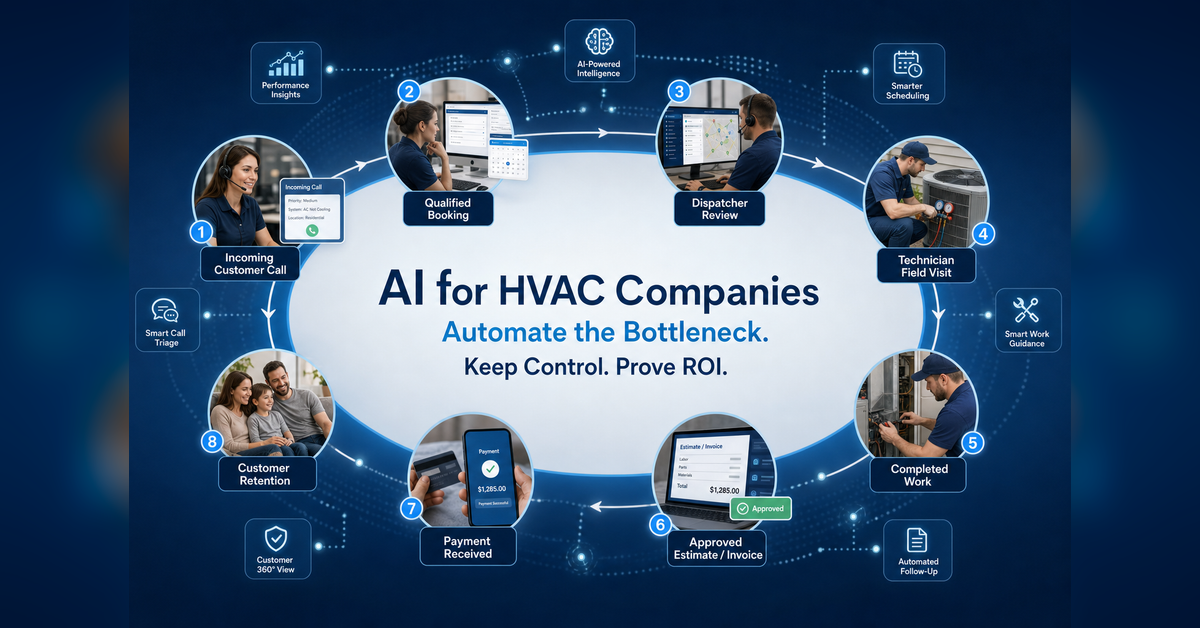

AI for HVAC companies can support calls, scheduling, dispatch, field documentation, estimates, follow-up and reporting. The right starting point is not the newest tool. It is the costly delay, missed handoff or repetitive task that can be measured and controlled.
This guide helps owners and operators choose a workflow, define the data it may use, keep people responsible for consequential decisions and judge the result through completed work, capacity, customer experience and profit.

 Founded in 2004
 Inc. 5000 recognized
 NMSDC certified
 AI, SEO, GEO and PR
What can HVAC AI do?
AI for HVAC companies can answer routine calls, qualify leads, schedule approved job types, suggest routes, retrieve technical information, draft notes, support estimates and manage follow-up. Start with one costly bottleneck, trusted source data, a human escalation path and a metric such as booked jobs, gross profit, response time or collection speed.
Executive summary
Start with the leak
Find the missed call, slow estimate, repeated dispatcher touch or delayed follow-up that has a measurable cost.
Control the answer
Name the system of record, permissions, immediate escalations and person responsible for quality.
Measure completed outcomes
Separate activity from qualified, booked, completed, paid and profitable work.
AI for HVAC companies works best as a narrow operating system with clear limits, not as an unsupervised layer across the whole business.
Who this guide is for
AI for HVAC companies affects each leadership role differently, so ownership should match the workflow, risk and metric being changed.
Owners and finance leaders
When evaluating AI for HVAC companies, use the ROI and stop rules to separate economic value from software activity.
Operations teams
Operations teams should evaluate AI for HVAC companies through workflow controls that reduce touches without removing dispatcher or technician authority.
Marketing leaders
Connect response, attribution and conversion instead of counting unqualified lead volume.
IT and security teams
Define minimum access, retention, logs, deletion, portability and downtime procedures.
What Is AI for HVAC companies?
AI for HVAC companies is software that uses machine learning, language models, optimization or automation to support business or equipment decisions. It can organize information, identify patterns, draft material, recommend an action or complete a permitted routine task.
There are three distinct types. Business operations AI supports calls, booking, dispatch, notes, estimates, billing and retention. Equipment or building AI uses sensor and operating data for fault detection, controls, maintenance and energy decisions. Marketing and search AI supports lead response, campaigns, customer education, reviews, reporting and visibility in search or answer engines.
These categories can connect, but they should not be treated as one product. A receptionist handling an after-hours call has different data, risk and ownership requirements from a building-control system analyzing equipment behavior. A marketing assistant drafting an email also has different permissions from a technician tool retrieving a manual.
AI is not a substitute for accurate schedules, service areas, pricebooks, customer records or equipment data. It does not remove accountability. Safety, diagnosis, code interpretation, repair scope, pricing, warranties and customer promises remain under qualified human control.
Find the first bottleneck worth testing
Score missed demand, repetitive touches, data quality, risk and measurable value before buying another platform. Use the diagnostic to judge whether AI for HVAC companies addresses a documented operating leak with enough value to justify a pilot.
Where Can an HVAC Company Use AI?
Percepture’s HVAC AI Job-Cycle Control Loop places AI at the most expensive point in the job cycle. Every stage identifies the task, source data, human owner, immediate escalation, first metric and common failure. This keeps AI for HVAC companies tied to operating performance rather than feature count.
The HVAC AI Job-Cycle Control Loop
- Capture demand: Handle calls, texts and forms while checking service area, urgency and live transfer rules.
- Qualify and schedule: Collect job details and book only approved appointment types against reliable availability.
- Dispatch and prepare: Suggest skill matches, routes and job summaries while preserving dispatcher override.
- Support field work: Retrieve manuals and history or draft notes while the technician verifies every technical conclusion.
- Document, quote and collect: Turn approved notes into customer-ready drafts while the pricebook and a person control scope and price.
- Retain, reactivate and measure: Support reviews, reminders and segmented follow-up within consent and suppression rules.
The human-control gate applies at all six stages: what AI may do, what it may recommend, what a person approves, what escalates immediately, which system controls the answer, how errors are logged and who owns the metric. For AI for HVAC companies, this gate prevents a routine automation from quietly taking authority over safety, price or customer commitments.
Job-cycle control table
| Workflow | Task and source | Owner and escalation | First metric | Common failure |
|---|---|---|---|---|
| Capture demand | Calls, forms, service area, hours and availability | CSR owner; escalate emergencies and complaints | Qualified booked calls | False availability or missed urgency |
| Qualify and schedule | Job types, duration, skills and customer status | Dispatcher owner; escalate unusual or commercial work | Booking accuracy | Incomplete intake or bad promises |
| Dispatch and prepare | Calendar, territory, skill, history and parts context | Dispatcher override for callbacks, overtime and service levels | Dispatcher touches | Wrong skill or inefficient routing |
| Support field work | Model, manual, history and field observations | Technician verifies measurements, diagnosis and safety | Search and documentation time | Unsupported technical conclusion |
| Quote and collect | Approved notes, pricebook, templates and payment status | Manager approves scope, price, warranty and margin | Estimate turnaround | Incorrect price or customer promise |
| Retain and measure | Consent, service history, agreement status and source | Marketing or service owner; suppress sensitive accounts | Qualified repeat work | Excess contact or weak attribution |
Use the table to compare AI for HVAC companies by operating stage, accountable owner and detectable failure rather than by feature list alone.
12 High-Value HVAC AI Use Cases
The best use cases for AI for HVAC companies have enough volume to matter, reliable data, clear ownership and a measurable first outcome. Each candidate should also have a failure path that the team can detect and correct.
1. Call answering and reception
What it does: Answers routine calls, collects contact details and routes requests. Best fit: Shops losing qualified demand when staff cannot answer. Data needed: Hours, service area, approved job types and live transfer rules. Human control: Emergencies, complaints and complex commercial requests. First metric: Qualified booked jobs from calls that would otherwise go unanswered. Common failure: Guessing availability or urgency. AI for HVAC companies is most useful here when live scheduling data and transfer rules govern every booking.
2. Qualification and booking
What it does: Collects equipment, symptom, location, customer and access details. Best fit: High-volume intake with repeatable appointment types. Data needed: Service rules, duration, skills and calendar. Human control: No unapproved diagnosis, price or arrival promise. First metric: Booking completeness and accuracy. Common failure: Sending weak information downstream.
3. Scheduling and dispatch
What it does: Suggests appointment placement and assignments. Best fit: Teams with clear territories, skills and job classes. Data needed: Calendar, location, technician capability and service level. Human control: Dispatcher override for emergencies, warranties and callbacks. First metric: Scheduling errors and dispatcher touches. Common failure: Optimizing distance while ignoring skill or priority. In dispatch, AI for HVAC companies should recommend assignments without overriding service priorities or dispatcher judgment.
4. Routing and capacity planning
What it does: Organizes routes and shows potential capacity gaps. Best fit: Multi-crew or multi-location operators. Data needed: Accurate addresses, shift rules, job duration and territory. Human control: Overtime, breaks and customer commitments. First metric: Drive time and late arrivals. Common failure: Treating estimated duration as certain.
5. Technician knowledge and troubleshooting support
What it does: Retrieves manuals, service history and possible diagnostic paths. Best fit: Field teams that lose time searching across sources. Data needed: Model information, approved documents and job history. Human control: The technician measures, diagnoses and recommends. First metric: Information-search time. Common failure: Presenting a suggestion as a verified diagnosis. In this role, AI for HVAC companies should expose the source behind a suggestion so the technician can verify it.
6. Field notes and documentation
What it does: Converts dictated or structured observations into a draft. Best fit: Teams with delayed or inconsistent notes. Data needed: Approved templates and technician input. Human control: Technician reviews accuracy before saving. First metric: Documentation time and correction rate. Common failure: Adding details that were not observed.
7. Estimates, options and proposals
What it does: Turns approved notes into option summaries and estimate drafts. Best fit: Businesses with a governed pricebook. Data needed: Scope, pricebook, templates, warranty and financing rules. Human control: A person approves price, margin and promises. First metric: Accurate estimate turnaround. Common failure: Using stale prices or unsupported scope. For estimates, AI for HVAC companies should draft from approved notes and current pricebook data rather than infer scope or price.
8. Predictive maintenance and fault detection
What it does: Reviews sensor data and operating patterns for conditions that deserve attention. Best fit: Connected equipment or managed commercial portfolios. Data needed: Reliable sensors, asset context and operating history. Human control: Technicians review alerts and determine action. First metric: Verified faults resolved. Common failure: Alert volume without a field process.
9. Marketing and AI search
What it does: Supports customer education, campaign analysis, lead response and search visibility work. Best fit: Teams connecting demand to booked work. Data needed: Analytics, call tracking, CRM outcomes, reviews and approved claims. Human control: Publication, budgets and attribution. First metric: Qualified pipeline or cost per booked job. Common failure: Producing activity the field cannot fulfill. In marketing, AI for HVAC companies should connect content and response activity to qualified, completed work.
10. Follow-up and reactivation
What it does: Prioritizes and drafts follow-up for estimates, lapsed customers or maintenance reminders. Best fit: A known backlog with consent and status data. Data needed: Customer history, stage, preferences and calendar. Human control: Frequency, suppression and sensitive accounts. First metric: Qualified replies and completed jobs. Common failure: Repeated contact after the customer’s situation changes. Review Percepture’s guide to AI outbound calling before adding an outbound voice workflow.
11. Reviews, memberships and retention
What it does: Triggers approved review requests, renewal reminders and service education. Best fit: Companies with clean completion and membership records. Data needed: Job outcome, consent, membership status and customer preference. Human control: Sentiment, timing and complaint handling. First metric: Renewals and repeat work. Common failure: Asking for a review after an unresolved problem.
12. Reporting and job costing
What it does: Summarizes operating and marketing data for review. Best fit: Leaders spending time joining reports across systems. Data needed: Defined fields, consistent job status and financial sources. Human control: Finance or operations validates definitions and exceptions. First metric: Reporting time and decision accuracy. Common failure: Combining fields that use different definitions. Reporting from AI for HVAC companies should preserve field definitions and show exceptions before leaders act on a summary.
AI Receptionist for HVAC Companies
An AI receptionist may answer calls or texts, collect customer details, confirm whether an address is in the service area and schedule approved job types against live availability. It can also send confirmations and transfer exceptions. Reception is one of the clearest entry points for AI for HVAC companies because booking accuracy and recovered qualified demand can be measured directly.
It should not guess whether a condition is safe, diagnose equipment, invent a price or promise an arrival time that the scheduling system does not support. Emergency language, complaints, existing commercial accounts, warranty questions and unusual requests need clear transfer rules.
Start with a narrow pilot. Limit the channel, schedule, location or appointment type. Review transcripts or records, transfers, booking accuracy, complaints and completed jobs. A narrow pilot keeps AI for HVAC companies within approved appointment types while the team checks whether the recovered work is economically useful. A high call count is not the result. The result is qualified work that was booked correctly, completed and economically useful.
Recording, disclosure, consent, identification, outbound contact and suppression requirements depend on the workflow and jurisdiction. Obtain appropriate legal guidance before deployment. The system should log actions and provide a fast human handoff.
What Is the Best AI for an HVAC Company?
There is no universal winner. The best AI for HVAC companies is the smallest controlled system that fixes a defined bottleneck and fits the current operating stack. Audit native features in the field-service, CRM, phone and marketing platforms before adding another vendor.
A small shop may need one dependable receptionist or reminder workflow. A multi-location operator may need stronger permissions, reporting, data separation and portability. A commercial contractor may place more weight on service levels, asset history, technician skills and account-specific escalation. Buyer fit for AI for HVAC companies therefore depends on operating model and control requirements, not company size alone.
Score each option on workflow fit, integration, source-of-truth access, HVAC context, permissions, security, reporting, human override, implementation effort, total cost, support and exit terms. Require the vendor to show what happens when data is missing, an integration fails or a customer asks for something outside the approved workflow.
AI for HVAC companies: Software Categories Compared
Comparison should begin with the workflow, not the product name. This vendor-neutral matrix shows where common categories fit and what buyers should verify. Inclusion in a category is not an endorsement of any specific vendor. The matrix keeps AI for HVAC companies tied to required inputs, human control and a concrete buying question.
HVAC AI software decision matrix
| Category | Best fit | Required inputs | Human control | Buying question |
|---|---|---|---|---|
| General assistant | Drafting, summarizing and internal knowledge tasks | Approved instructions and non-sensitive content | Review every customer or technical output | Can access and training use be governed? |
| FSM-native AI | Scheduling, dispatch, notes and job lifecycle | Clean calendar, customer and job data | Dispatch, scope, price and exceptions | Does the current plan already include the needed function? |
| Receptionist or communications AI | Calls, texts, intake and approved booking | Phone, schedule, service area and transfer rules | Emergencies, complaints and complex work | Does it use live availability and log transfers? |
| Technician knowledge tool | Manual, history and field-information retrieval | Model, documents, history and mobile access | All measurements, diagnosis, repair and safety | Can the technician see the source behind the answer? |
| Building or equipment AI | Fault detection, controls and predictive maintenance | Sensors, assets, schedules and operating context | Setpoint limits, alarms and maintenance action | How are alerts verified and resolved? |
| Marketing automation | Lead response, reactivation, content and reporting | Consent, CRM stage, analytics and approved claims | Targeting, publication, suppression and attribution | Can results connect to completed profitable work? |
| Governed custom agent | Defined work spanning approved systems | Minimum required systems and permissions | Approvals, logs, exceptions and rollback | Can components be replaced without rebuilding everything? |
When comparing categories of AI for HVAC companies, verify the current platform’s native capabilities before funding a separate integration or custom build.
For governed cross-system work, review Percepture’s AI sales agents approach. If the problem is broader than one agent, an omnichannel marketing strategy can connect visibility, response, nurture and measurement across the customer journey.
How AI Helps Technicians Without Replacing Them
AI can reduce search and paperwork. It may retrieve a manual, organize service history, draft notes, summarize observed symptoms or present possible diagnostic paths. Those functions can help a technician arrive better prepared and spend less time moving information between systems. For field support, AI for HVAC companies should shorten information retrieval without taking control of diagnosis or repair.
Licensed judgment, physical skill, field testing, safety accountability and the final recommendation stay with qualified people. AI does not inspect the installation, take measurements or adapt safely to every field condition. A confident response is not proof that a diagnosis is correct.
For AI for HVAC companies to earn technician trust, the source should be visible, feedback should be easy and corrections should improve the workflow. Do not measure adoption alone. Track search time, documentation time, corrections, callbacks and repeat visits while listening for added burden.
AI in HVAC Equipment and Buildings
Equipment and building AI is separate from office automation. It may use sensors, controls, schedules and asset history to detect unusual behavior, identify possible faults, support predictive maintenance or recommend adjustments within defined limits. In connected equipment settings, AI for HVAC companies requires reliable sensor context and a field process for verifying each alert.
Its value depends on sensor quality, context, thresholds and the process used to review alerts. A fault signal does not repair equipment. A technician or building operator must determine whether the signal is valid, assess safety and choose the response.
Residential business operations, field support and commercial building optimization also have different buying committees. A residential owner may focus on calls and bookings. A service leader may focus on technician preparation. A portfolio operator may focus on verified faults, downtime, comfort and normalized operating performance.
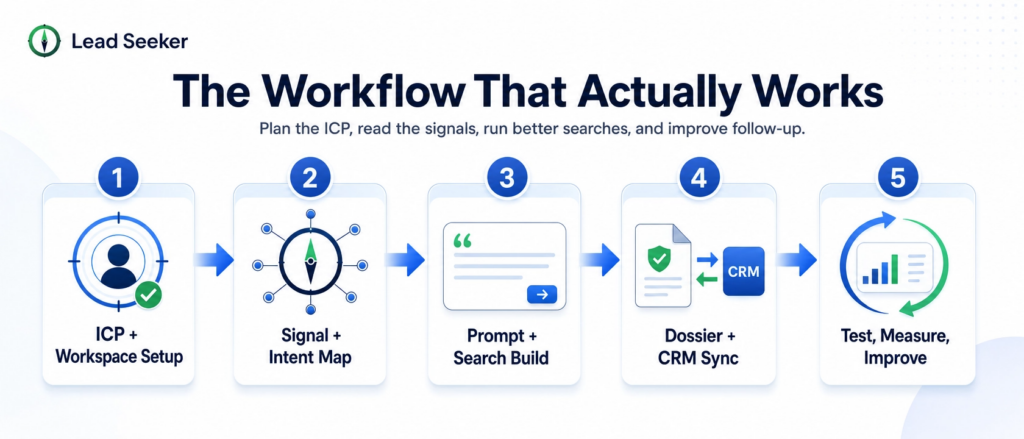
How to Choose HVAC AI Software
Use a weighted score before accepting a product demonstration as a buying case. AI for HVAC companies should pass the following checks:
- Bottleneck fit: Does it solve the measured problem?
- Integration: Can it read and write only the approved fields?
- Source of truth: Which schedule, pricebook or record controls the answer?
- HVAC context: Does it understand job types, service areas, skills and exceptions?
- Permissions: Can access be limited by role, location and task?
- Security and retention: How are data, subprocessors, deletion and model training handled?
- Reporting: Can actions, errors, escalations and overrides be audited?
- Human override: Can a person stop, correct or take over quickly?
- Total effort: Include setup, cleanup, integration, training, QA and management.
- Portability: Can data and workflow logic leave with the buyer?
Multi-location organizations should also assess governance and location-level reporting. AI for HVAC companies operating across locations needs role-based access, data separation and comparable reporting without erasing local exceptions. Percepture’s enterprise SEO services apply a similar source, ownership and measurement discipline to complex search programs.
How to Implement AI in an HVAC Business
A 90-day pilot gives the team time to baseline, test, measure and decide without forcing company-wide adoption. The objective is not to keep the software. It is to determine whether the workflow creates safe, repeatable economic value. A limited pilot also gives AI for HVAC companies a defined owner, scope and stop rule before permissions expand.
The 90-day implementation plan
- Days 1-15, baseline: Map first contact through payment or renewal. Measure volume, time, conversion, errors and economics. Name the owner, source systems, permissions and approvals.
- Days 16-30, design: Choose one use case and audit native features first. Build instructions, escalation rules and templates. Test normal, unclear, emergency, complaint, commercial, out-of-area and system-failure cases.
- Days 31-45, pilot: Limit the workflow by channel, schedule, location or job type. Log actions, errors, escalations, overrides and complaints. Review the records daily.
- Days 46-60, value: Compare equivalent periods. Count qualified, completed, paid and profitable outcomes while including review and management cost.
- Days 61-75, harden: Add roles, source precedence, correction, deletion, downtime procedures, training and ongoing QA ownership.
- Days 76-90, decide: Expand, revise or stop based on accuracy, economics, risk, adoption and auditability.
Fix source data and handoffs before spending weeks adjusting prompts. If emergency routing fails, trusted data is unavailable or cleanup keeps growing, stop the affected workflow and redesign it.
Cost and ROI for AI for HVAC companies
Total cost can include licenses, usage, setup, integration, data cleanup, training, quality review, support, management, compliance review and reporting. Public pricing alone rarely shows the operating cost of keeping a workflow accurate. ROI for AI for HVAC companies should include those ownership costs as well as errors, callbacks and added review time.
Build ROI from the bottleneck being changed. Do not assign cash value to every saved minute. Time creates financial value only when it removes a real cost, increases useful capacity or supports more completed profitable work.
HVAC AI value formulas
| Value area | Formula | Control |
|---|---|---|
| Missed-call recovery | Recovered qualified calls × booking rate × completed-job rate × average gross profit | Exclude spam, duplicates, cancellations and unpaid work |
| Speed to lead | Additional qualified contacts reached in the target period × attributable booking lift × completion × gross profit | Compare equivalent periods and account for seasonality |
| Office capacity | Verified hours removed × loaded hourly cost, less added review and exception time | Confirm that work was truly removed |
| Technician capacity | Minutes saved per job × completed jobs × loaded labor value | Adjust for whether saved time creates usable capacity |
| Estimate value | Additional approvals attributable to faster accurate follow-up × gross profit | Subtract discounts, cancellations and fulfillment cost |
| Retention value | Incremental renewals or repeat jobs × contribution margin | Use a valid baseline and defined attribution window |
| Total benefit | Incremental gross profit + verified capacity + avoided cost − total AI cost | Include errors, refunds, callbacks and management cost |
| ROI | (Net verified benefit − total AI cost) ÷ total AI cost | State assumptions and confidence limits |
Use attribution and analytics to connect source, response, booking and completed outcomes. Apply conversion rate optimization when demand exists but the booking path loses qualified customers.
Evaluate the full investment
Compare AI for HVAC companies against the cost of the bottleneck, the required controls and the value of completed outcomes. Pricing should include implementation and ownership, not only the subscription.
Risks and What AI Should Not Do
The highest risks appear when a workflow can affect safety, customer commitments, protected data, pricing or reputation. Permission should increase slowly as evidence improves. Risk controls for AI for HVAC companies should therefore become stricter as a workflow moves closer to diagnosis, pricing or autonomous customer action.
- Do not let AI approve a safety-critical diagnosis, repair, replacement or code conclusion.
- Do not let it invent prices, parts availability, warranties, rebates or arrival times.
- Do not provide more customer, employee or financial data than the task requires.
- Do not run recorded or outbound communication without reviewing applicable consent, disclosure and suppression requirements.
- Do not hide errors. Log actions, escalations, overrides, complaints and corrections.
- Do not depend on a system that lacks an export, downtime process or practical exit path.
Routine reminders can have narrower controls than emergency triage, diagnosis or customer pricing. Review data access, retention, deletion and vendor subprocessors with the appropriate security and legal advisers.
AI for HVAC Marketing and Search Visibility
Using AI inside an HVAC company is different from appearing in ChatGPT, Google AI features or other answer engines. Operational AI changes an internal or customer workflow. AI search visibility concerns whether trusted public sources describe the company clearly enough to be found, understood and cited.
Percepture’s generative engine optimization services address entity clarity, source coverage and answer visibility. Content marketing services can turn field knowledge into useful customer education, while digital PR services support credible third-party coverage.
Demand still needs a complete path to revenue. Lead generation services can connect targeting and response, while paid search services capture active demand. For industry context, see Percepture’s guides to digital marketing for contractors, digital marketing for construction companies, SEO for construction companies and content marketing for construction.
Frequently Asked Questions
How can I use AI for my HVAC business?
Start with one measurable bottleneck. Common first uses include after-hours calls, qualification, simple scheduling, job-summary preparation, note drafting, estimate follow-up and maintenance reminders. AI for HVAC companies should connect that workflow to trusted data, defined human approvals and completed-outcome measurement before expanding.
What is the best AI for HVAC companies?
No tool is best for every company. Choose by workflow, company size, current field-service or CRM platform, integration, control, total cost and first business metric. Compare booking accuracy, completed-job impact, errors and review effort instead of selecting by feature count.
Will AI replace HVAC technicians?
AI can reduce search, documentation, scheduling and administrative work. It does not replace physical skill, field measurements, licensed judgment, safety accountability or customer trust. The technician must verify the condition, diagnosis, repair and final recommendation.
Is AI useful for a small HVAC company?
Yes, when it fixes one bottleneck without creating a stack the team cannot manage. AI for HVAC companies can begin with missed calls, reminders, simple scheduling, notes or review requests in a small shop. Track jobs, errors or verified time savings and expand only after the workflow proves useful.
What does an AI receptionist do for an HVAC company?
It may answer calls or texts, collect details, confirm service area, identify urgency, schedule approved job types, send confirmations and transfer exceptions. It should use live availability and escalate emergencies, complaints, commercial accounts, warranty issues and unusual requests.
Can AI schedule and dispatch HVAC jobs?
AI can schedule approved appointment types and recommend assignments when service areas, durations, technician skills, availability and escalation rules are accurate. A dispatcher should retain override for emergencies, overtime, callbacks, warranties and complex commercial work.
Can AI diagnose HVAC problems?
AI can organize symptoms, retrieve manuals, compare service history and suggest a diagnostic path. A trained technician must verify measurements, safety, code, equipment condition and the final repair. A generated suggestion should never be treated as a confirmed diagnosis.
How much does HVAC AI cost?
Total cost may include license fees, usage, setup, integration, data cleanup, training, quality review, support, management and compliance review. Compare the full annual cost with verified missed-call, labor, estimate, collection or retention value. Check current vendor pricing directly.
What data does HVAC AI need?
The required data depends on the workflow. It may include service areas, hours, appointment rules, technician skills, schedules, pricebooks, equipment, customer history and job outcomes. Provide only the minimum needed and name the owner, source, retention rule and correction process.
How should an HVAC company measure AI?
Measure the step the workflow was designed to improve. Useful measures include qualified contacts, booked and completed jobs, dispatcher touches, drive time, documentation time, estimate approval, collection speed, renewals, gross profit, errors, complaints and human overrides.
Start With the Bottleneck, Not the Bot
The best AI for HVAC companies begins with a business problem that has a baseline, an accountable owner and a safe boundary. Map the workflow before selecting software. Name the source systems, permissions, approvals, escalations, first metric and stop rule.
Percepture can review the bottleneck and current systems, map data and handoffs, design a controlled pilot and recommend a native feature, integrated tool, custom agent or no AI. The decision stays tied to customer experience, useful capacity and economic value.
Request an HVAC AI Workflow and Growth Assessment
Find the first workflow worth automating. Percepture will map the bottleneck, data, human handoffs, measurement plan and growth opportunity before recommending a platform, integration, custom agent or no AI.