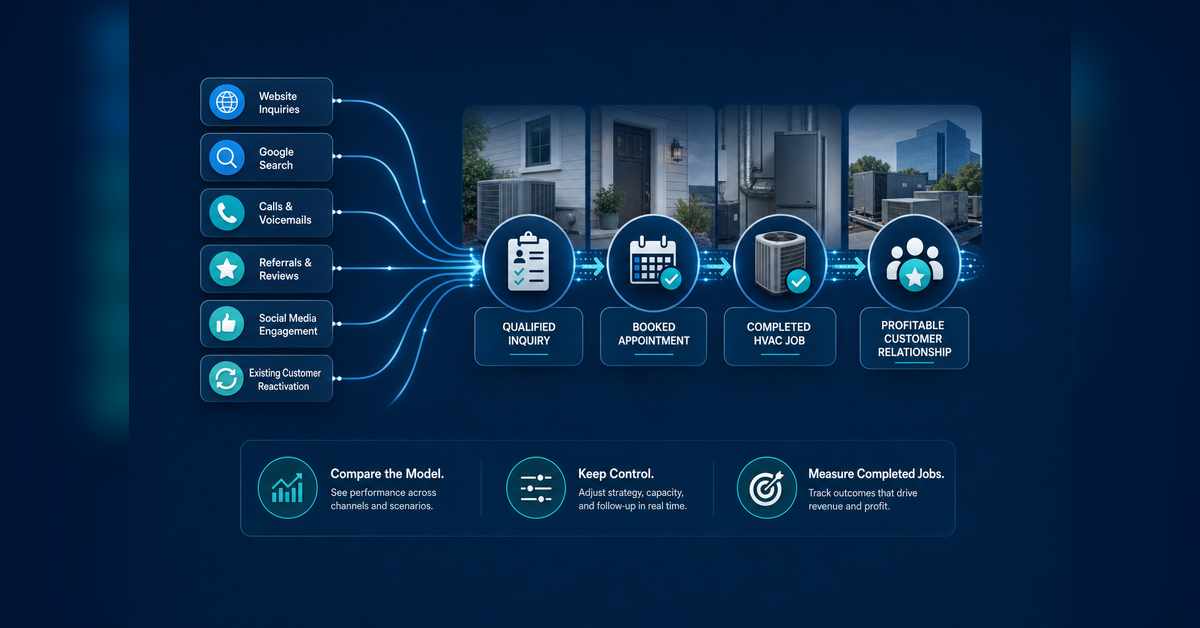

Choosing among HVAC lead generation companies is not a popularity contest. The right choice depends on the jobs you sell, the markets you cover, the demand assets you want to own, and how well your team can turn an inquiry into completed work.
This guide compares provider models rather than pretending every call, form, appointment, and organic inquiry is equal. It builds on Percepture’s broader guide to HVAC lead generation while keeping the focus on partner selection, buyer control, and measurable economics.
See how Percepture turns complex expertise into visible demand
OPTK Networks operates in fiber, telecom and data-center markets where buyers expect technical accuracy and clear commercial value. This case study demonstrates Percepture’s working method and client relationship. It is adjacent B2B proof, not a guarantee of HVAC lead volume or job results.

OPTK Networks
“They understand the technical side, but they also understand how to make the market care.”
That same discipline matters when HVAC companies need demand programs that connect marketing claims to service capability, ownership and measurable outcomes.
Built for contractor and infrastructure buyers





What is the best provider for an HVAC business?
The best HVAC lead generation companies match the contractor’s demand model, market, capacity, service mix, ownership needs, and measurement discipline. Compare an owned-demand agency, managed paid-media partner, booked-appointment firm, pay-per-call provider, marketplace, or commercial outbound team by qualification, portability, consent, attribution, contract terms, and cost per completed job.
Quick answers about HVAC lead providers
What type of provider is best?
The best model matches your service mix, market, capacity, ownership goals and ability to answer and close demand.
Are exclusive HVAC leads worth it?
They may be useful when exclusivity is defined in writing and the completed-job economics support the price.
Agency or purchased leads?
Use an agency to build contractor-controlled demand assets. Buy leads when flexible, near-term volume is the main need.
What should the contractor own?
Protect the domain, website, ad accounts, phone numbers, creative, audiences, analytics and exportable customer data.
How should quality be measured?
Track valid, qualified, booked, completed, paid and profitable work instead of stopping at calls or forms.
How long should a pilot run?
A controlled 30-to-90-day pilot can work when definitions, tracking, capacity, credits and stop rules are set before launch.
How to compare HVAC lead generation companies
Choose the model first
Before comparing HVAC lead providers, decide whether you need owned demand, controlled advertising, purchased calls, booked appointments, project leads, or commercial outreach. A provider can be capable and still use the wrong model for your business.
Define the billable event
Ask lead-generation partners to document what makes a lead valid, qualified, booked, completed, paid, and profitable. Those stages are not interchangeable, and the contract should not leave them open to interpretation.
Protect the assets
Confirm which assets HVAC demand partners control, including the domain, website, ad accounts, phone numbers, creative, audiences, tracking records, and customer data. Leaving a vendor should not erase the demand system you funded.
Measure completed work
Require providers in this category to connect each source to calls, forms, bookings, dispatches, completed jobs, collected revenue, callbacks, and acquisition cost. Cheap leads can become expensive when quality and fulfillment are ignored.
Editorial disclosure and limitations
Percepture publishes this comparison and offers lead generation, SEO, AI-search visibility, paid media, PR, content, conversion, and analytics services. Percepture is included only in the category that matches those services. Every company is reviewed under the same published criteria. Public vendor claims are labeled, pricing and terms are dated, and inclusion is not an endorsement or guarantee.
This comparison uses public and submitted information available on the listed research date of July 22, 2026. Providers may change prices, terms, territories, features, ownership, and policies. Percepture did not purchase every service or independently audit every lead. The framework is a decision-support tool, not a guarantee of quality or results.
No referral, affiliate, or sponsored relationship is used in this comparison.
Use the HVAC Lead Partner Scorecard
Compare ownership, qualification, routing, consent, reporting, contracts and completed-job economics before you schedule a sales call.
Use the Partner ScorecardBest HVAC lead generation companies by category
The shortlist below covers distinct models described on the companies’ supplied official pages. It does not declare one universal winner among HVAC lead providers. Use the category to narrow the field, then verify current terms in writing before making a decision.
| Company | Category | Potential fit | Primary diligence question |
|---|---|---|---|
| Percepture | Integrated owned demand and paid media | Contractors combining search, AI visibility, content, PR, paid demand, conversion, and attribution | Which assets, accounts, and data will the contractor control? |
| HVAC Webmasters | HVAC-focused website and search agency | Local contractors focused on website and organic search performance | What are the written ownership and termination terms? |
| Hook Agency | Home-services website, SEO, and paid search | Established contractors building a Google-centered demand system | How does reporting connect sources to completed work? |
| Rival Digital | HVAC and home-services digital agency | Contractors seeking an integrated specialist team | Which work is completed in-house, and who has account access? |
| LeadButler | Managed appointment and marketing partner | Larger teams with budget, capacity, CRM discipline, and fast follow-up | What exactly qualifies as a billable booking? |
| 99 Calls | Hybrid search lead provider | Local contractors seeking exclusive real-time demand | Who owns the website, domain, numbers, and organic assets? |
| Service Direct | Pay per call | Teams seeking adjustable inbound-call volume | What call, duplicate, service-area, and credit rules apply? |
| eLocal | Pay-per-call and lead network | Teams equipped to audit variable calls and manage credits | What source-level consent evidence accompanies each contact? |
| Modernize | Home-improvement marketplace | Replacement and installation teams with sales capacity | How many contractors receive each request? |
| Abstrakt | Commercial outbound demand generation | Commercial maintenance, retrofit, replacement, and project pipelines | How are target accounts, meeting quality, and opportunity stages defined? |
How we evaluated the shortlist
Most comparisons of lead-generation partners blur agencies, publishers, marketplaces, appointment setters, and software into one list. Our method separates them because the buyer controls, operating burden, delivery event, and economics differ. The same distinction matters when comparing an HVAC lead generation agency with a third-party lead seller.
A company entered the shortlist when the supplied research identified a current HVAC or home-services offer, a buyer-relevant model, and enough official detail to describe the service without guessing. Official pages establish what HVAC demand partners say they offer. They do not independently prove lead quality, booked jobs, profit, or fit for a specific contractor.
Material fields should be reviewed by two people when a real purchase is being considered. Conflicts should be resolved using the newest authoritative source. Missing evidence should lower confidence rather than become an invented score.
The Percepture HVAC Lead Partner Integrity Score
The HVAC Lead Partner Integrity Score gives HVAC lead generation companies a common 100-point evaluation structure. It tests whether demand can become qualified, bookable, measurable, and profitable work while protecting the contractor’s accounts, data, and exit options.
- 1Demand ownership and portability: 15 points.
Review domains, websites, ad accounts, numbers, creative, content, audiences, exports, and offboarding rights.
- 2Lead definition and verification: 15 points.
Define billing events, spam, bots, duplicates, existing customers, wrong services, wrong areas, verification, credits, and audit records.
- 3Exclusivity, territory, and source transparency: 10 points.
Document recipients, duration, territory, source, time window, and redistribution.
- 4HVAC and channel fit: 10 points.
Match residential or commercial work, repair, replacement, maintenance, service area, seasonality, and channel type.
- 5Speed, routing, and integration: 10 points.
Test delivery latency, call coverage, assignment, backup rules, CRM or field-service integration, and error handling.
- 6Attribution to business outcomes: 15 points.
Track valid, qualified, booked, dispatched, completed, paid, canceled, recalled, profitable, and retained stages.
- 7Pricing and contract transparency: 10 points.
Review retainers, media, setup fees, event fees, minimums, renewal, pause, cancellation, credits, and sample invoices.
- 8Proof and operating depth: 10 points.
Examine dated evidence, references, the delivery team, quality assurance, account management, and escalation.
- 9Consent, privacy, and platform controls: 5 points.
Check permitted contact methods, consent records, opt-outs, suppression, retention, deletion, and platform rules.
Integrity Score interpretation
| Band | Interpretation | Buyer action |
|---|---|---|
| 85 to 100 | Strong documented evidence and buyer control | Validate references, economics, capacity, and final contract language. |
| 70 to 84 | Viable with written conditions | Resolve material gaps before launch and add clear pilot limits. |
| 55 to 69 | Limited pilot only | Use one market or service line with tight spend and stop rules. |
| Below 55 | Major control or evidence gaps | Fix the gaps before signing or select another model. |
Do not assign providers in this category a pass or zero when evidence is absent. Record the field as unavailable, reduce confidence, and ask the provider to document it. A high category fit does not replace contract review, and a strong integrity band does not mean a provider fits every HVAC company.

Not sure which HVAC lead model fits your business?
We can review the provider model, ownership terms, lead definitions, routing, attribution and completed-job economics before you commit more budget.
- Identify the model that fits your services and capacity
- Find ownership, contract and attribution risks
- Define what should be measured before scaling
Company profiles: model, fit, and diligence
These profiles explain how the listed HVAC lead providers differ. They do not include unsupported numerical rankings, performance promises, or stale price figures.
Percepture: integrated owned demand and attribution
Model: Integrated marketing agency and publisher of this guide.
Public offer: Percepture provides lead generation services, paid search management, AI search visibility services, content marketing, public relations, conversion, and measurement services.
Potential fit: HVAC businesses that want to build demand assets while coordinating search, paid media, authority, conversion, and attribution. This model differs from lead-generation partners that sell only third-party calls or forms because the engagement can include contractor-controlled channels and assets.
Ask before signing: Confirm ownership, account administration, reporting fields, offboarding, HVAC scope, team responsibilities, and how source data reaches completed-job reporting. Percepture is not presented as best overall and receives no numerical score in this guide.
HVAC Webmasters: HVAC-focused website and search services
Model: HVAC-focused digital agency.
Public offer: The supplied official-page research describes custom websites, local SEO, content, paid advertising, Google Business Profile work, citations, analytics, and AI visibility.
Potential fit: Local contractors comparing HVAC demand partners because their main gap is owned search visibility or website performance. An agency model may be appropriate when the contractor wants demand to compound through a durable web presence rather than relying only on purchased leads.
Ask before signing: Request written terms for the domain, website, content, tracking numbers, advertising accounts, data exports, termination, and reporting. Ask how reporting distinguishes raw inquiries from booked and completed jobs.
Hook Agency: home-services website, SEO, and paid search
Model: Home-services digital agency.
Public offer: The supplied research describes websites, SEO, paid advertising, and lead-generation strategy for home-service companies.
Potential fit: Established residential contractors seeking a stronger website and Google-centered acquisition system. Buyers considering this model can also review the wider operating questions covered in Percepture’s guide to choosing an HVAC marketing agency.
Ask before signing: When comparing Hook Agency with other providers in this category, clarify minimum engagement terms, asset ownership, account access, HVAC delivery depth, call tracking, CRM integration, and reporting through completed work. Confirm what remains with the contractor after cancellation.
Rival Digital: HVAC and home-services integrated marketing
Model: HVAC and home-services digital agency.
Public offer: The supplied official-page research describes website, SEO, paid advertising, social media, local search, content, email, integrations, and AI-focused search services.
Potential fit: Contractors comparing integrated HVAC lead providers across several acquisition channels. The model can reduce coordination work, but the buyer still needs channel-level access and outcome-level reporting.
Ask before signing: Confirm delivery capacity, work completed in-house, account permissions, integration responsibilities, quality assurance, reporting depth, and escalation. Request a written list of assets the contractor owns during and after the engagement.
LeadButler: managed appointments and marketing
Model: Managed appointment and marketing partner.
Public offer: The supplied research describes funnels, advertising, Local Services Ads, SEO, tracking, follow-up, and marketing leadership. Launch-speed, appointment-speed, pricing, and provider-comparison figures on a vendor page should be treated as company-reported statements.
Potential fit: Larger contractors with budget, available capacity, reliable call handling, and CRM discipline. Appointment delivery may reduce follow-up work, but only when the booking definition matches the contractor’s service area, job type, schedule, and exclusions.
Ask before signing: Require LeadButler and comparable lead-generation partners to define a billable booking, no-shows, cancellations, out-of-scope appointments, asset ownership, media costs, account access, credits, and outcome reporting.
99 Calls: hybrid search leads
Model: Search-based lead provider using channels described in the supplied research as SEO, Google Ads, and Local Services Ads.
Potential fit: Local contractors comparing HVAC demand partners for real-time demand described by the provider as exclusive. Exclusivity should still be defined by consumer, source, territory, recipient, and time window.
Buyer consideration: A hybrid model can combine rented demand with websites or search assets. That makes ownership especially important because the contractor needs to know whether the domain, site, organic visibility, ad account, and phone numbers can be retained.
Ask before signing: Verify current cost calculations, credit rules, lead-count definitions, redistribution terms, website ownership, domain control, and data exports in writing.
Service Direct: flexible pay per call
Model: Pay-per-call provider.
Public offer: The supplied official-page research describes selected lead pricing, payment for valid leads, no setup fee, and no term contract. Those terms should be checked on the current agreement used for the buyer’s campaign.
Potential fit: HVAC teams evaluating providers in this category for adjustable inbound-call volume without building every acquisition channel first. This model requires disciplined call review because a billable valid call may not become a qualified, booked, completed, or profitable job.
Ask before signing: Define minimum call duration, duplicates, existing customers, wrong numbers, service area, job exclusions, recordings, disputes, credit windows, source reporting, and pause controls.
eLocal: pay-for-performance calls and leads
Model: Pay-per-call and lead network.
Public offer: The supplied research describes HVAC calls or leads, campaign controls, validity and credit policies, and shared or exclusive options.
Potential fit: Teams that can audit call quality, manage variable volume, submit credits on time, and trace each inquiry through the sales process. The network model makes source transparency and consent records important parts of diligence.
Ask before signing: When reviewing network-based HVAC lead providers, ask counsel to examine advertiser responsibilities. Request the originating source, consent language, permitted contact method, exclusivity definition, recipients, call criteria, credit procedure, retention policy, and suppression process for each campaign.
Modernize: home-improvement project demand
Model: Home-improvement marketplace or platform.
Public offer: The supplied research describes pre-screened HVAC projects, calls, CRM delivery, and seasonal or system controls.
Potential fit: Installation and replacement teams with enough sales capacity to contact and nurture project inquiries. Marketplace demand can provide speed, but the economics depend on how many contractors receive the request and how quickly the buyer responds.
Ask before signing: Confirm recipient count, project mix, fees, credit or replacement rules, delivery timing, contact permissions, CRM fields, existing-customer exclusions, and territory settings. Compare results at completed-job level rather than treating every project request as equal.
Abstrakt: commercial HVAC outbound
Model: Business-to-business appointment setting and demand generation.
Public offer: The supplied research describes phone, email, LinkedIn, digital outreach, qualification, and meetings with facility or property buyers.
Potential fit: Commercial mechanical contractors pursuing maintenance agreements, retrofit opportunities, replacement work, or project pipelines. Commercial demand should not be evaluated with residential lead logic because the unit is often an account, buying committee, need, and timing window.
Ask before signing: Define target accounts, roles, authority, active need, meeting acceptance, no-shows, account-data ownership, outreach permissions, opportunity stages, handoff, nurture, and what happens when a pilot misses its goals.
Which HVAC lead generation companies fit each buyer?
Small local shop
Small shops should compare lead-generation partners using one market, one profitable service, tight call coverage, and a model that can be paused. Avoid buying more volume than the team can answer or schedule.
Established residential contractor
When evaluating HVAC demand partners, consider an owned-demand agency, managed paid media, or a controlled hybrid. Protect the website, ad accounts, numbers, data, and brand while adding short-term demand where capacity exists.
Replacement-focused team
Replacement-focused teams can narrow providers in this category to marketplaces, paid search partners, or appointment providers when sales coverage is strong. Measure inspections, estimates, closes, completed installations, cancellations, and collected revenue.
Multi-location or franchise operation
Multi-location buyers should require HVAC lead providers to provide territory controls, location-level budgets, routing logic, duplicate handling, shared definitions, account governance, and reporting that rolls up without hiding local performance.
Private-equity platform
Private-equity platforms comparing lead-generation partners should prioritize account portability, common CRM fields, source governance, location comparison, acquisition integration, capacity controls, and a repeatable method for testing vendors across operating companies.
Commercial mechanical contractor
Commercial buyers should focus on HVAC demand partners with an outbound or account-based model built around organizations, decision-makers, active projects, contract timing, and opportunity stages. A residential form-lead definition will not be enough.
Enough leads but weak booking
Fix answer speed, scripts, routing, nurture, schedule access, and follow-up before buying more demand. Percepture’s conversion rate optimization services address the conversion layer rather than treating volume as the only lever.
Long-term owned demand
Combine a contractor-controlled website with organic SEO services, useful content, authority building, paid testing, and first-party measurement. This approach takes operating discipline but can leave the business with durable assets.
Agency vs. lead seller vs. marketplace
| Model | Typical delivery | Ownership potential | Speed | Operating burden | Best fit |
|---|---|---|---|---|---|
| Owned-demand agency | Website, search visibility, content, brand demand, and inquiries | High when contracts protect client assets | Builds over time | Moderate | Long-term growth and control |
| Managed paid media | Calls, forms, or bookings from governed advertising | Moderate to high with client-controlled accounts | Faster after setup | Moderate | Controllable demand and testing |
| Booked-appointment partner | Scheduled appointments | Varies by account and data terms | Can be fast | Lower before handoff, higher in sales QA | Teams with capacity and CRM discipline |
| Pay per call or lead | Defined calls, forms, transfers, or events | Usually limited | Often fast | High quality-control burden | Flexible incremental volume |
| Shared marketplace | Consumer project requests | Limited | Fast | High response and sales burden | Teams that can compete quickly |
| Commercial outbound | Accounts, conversations, or meetings | Varies by data contract | Pipeline develops over time | High strategic input | Commercial service and project sales |
| Conversion system | Routing, nurture, qualification, or booking for existing demand | Depends on platform and export rights | Improves existing flow | Moderate | Businesses losing inquiries after capture |
Owned demand is not automatically better, and purchased demand from providers in this category is not automatically wasteful. The question is what the business needs now, what it can operate well, and what it wants to keep. A contractor building a broader system can use Percepture’s guide to digital marketing for contractors to place lead acquisition inside the full customer journey.
What HVAC lead generation companies cost
HVAC lead providers can use a retainer, retainer plus media, percentage of ad spend, setup fee, pay-per-call fee, pay-per-form fee, transfer fee, appointment fee, marketplace credit, performance fee, or hybrid. A quoted event price is not the full acquisition cost.
| Pricing model | What triggers cost | Costs to add | Primary risk |
|---|---|---|---|
| Retainer | Monthly agency scope | Media, software, creative, call handling, and internal labor | Paying for activity without outcome-level reporting |
| Retainer plus media | Management scope and advertising spend | Landing pages, tracking, creative, software, and sales labor | Hidden fees or vendor-controlled ad accounts |
| Pay per event | Call, form, transfer, lead, or appointment | Invalid events, QA, credits, call handling, and closing labor | A loose billable-event definition |
| Marketplace credit | Purchased project request or account credit | Competition, follow-up, estimates, and uncredited invalids | Shared demand and delayed response |
| Commercial outbound | Program, contact, conversation, or meeting scope | Data, sales follow-up, travel, estimating, and long-cycle nurture | Meetings without authority, need, or timing |
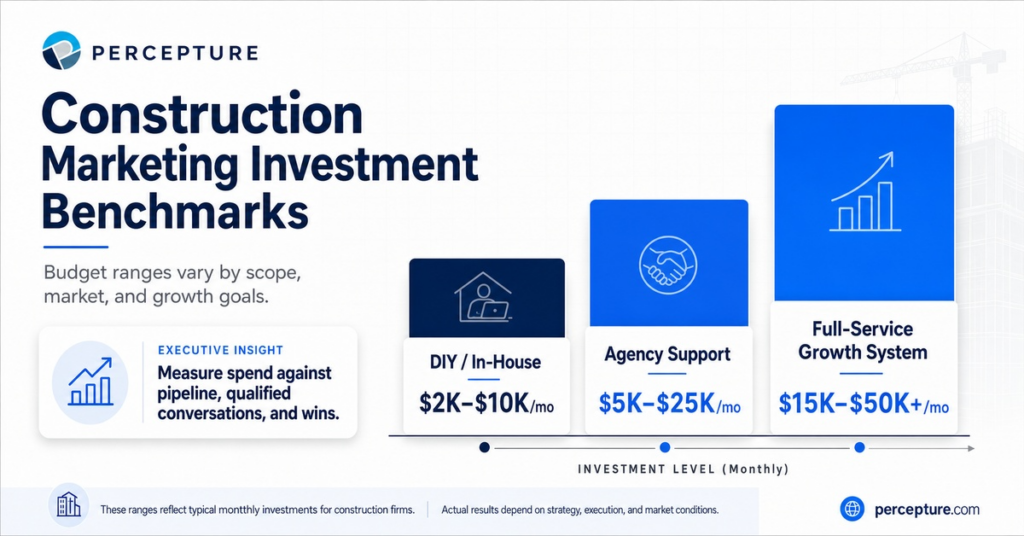
Total acquisition cost for lead-generation partners includes the provider, media, setup, software, pages, call handling, sales labor, quality review, unrecovered invalid events, integrations, and management time. For more detailed cost planning, use Percepture’s general marketing pricing overview and keep channel-specific costs separate.
- Cost per valid lead equals total cost divided by valid leads.
- Cost per qualified lead equals total cost divided by qualified leads.
- Cost per booked job equals total cost divided by booked jobs.
- Cost per completed job equals total cost divided by completed jobs.
- Contribution after acquisition equals collected revenue minus direct labor, materials, commissions, callbacks, discounts, and acquisition cost.
Never compare a shared form, exclusive call, live transfer, booked appointment, and owned organic inquiry as if they were the same unit. Use attribution and analytics to preserve the source and follow it through the operating system.
Questions to ask before signing
Use the same questions with every provider. Consistency makes comparisons fair and prevents HVAC demand partners from winning the discussion with a polished demo while leaving material contract gaps unresolved.
- Are you an agency, publisher, marketplace, network, appointment setter, or software platform?
- Which jobs, buyers, markets, and company sizes fit your model?
- What exact event triggers a charge?
- How do you define valid, qualified, booked, and completed?
- What does exclusive mean by consumer, source, territory, recipient, and time?
- How many businesses receive the same request?
- Which sites, ads, affiliates, or publishers create the inquiry?
- How are identity, intent, and consent documented?
- Which calls, texts, or emails did the consumer authorize?
- How do you handle duplicates, existing customers, wrong services, and wrong areas?
- Which CRM or field-service integrations are supported, and how are failures handled?
- Who owns the domains, accounts, pages, numbers, creative, audiences, and data?
- Can the contractor export raw records during and after the engagement?
- What is the credit policy, evidence requirement, and review window?
- What are all fees, minimums, renewal terms, pause rights, and cancellation rules?
- Can reporting follow a source through booked, completed, paid, and retained work?
- What dated evidence and references support the proposed scope?
- What happens if the pilot does not meet the written success rules?
Red flags that should slow the deal
These warning signs matter across agencies, marketplaces, networks, and other providers in this category because each can affect buyer control, lead validity, or completed-job economics.
- Jobs or revenue promised without documented conditions and operating assumptions.
- An undefined claim that leads are exclusive.
- Hidden media, setup, software, integration, or call-handling costs.
- No source record, consent record, invalid-event policy, or audit trail.
- A vendor-owned domain presented as the contractor’s permanent website.
- No administrator access to funded advertising or analytics accounts.
- A long automatic renewal with weak pause or cancellation rights.
- No usable export of lead, source, status, or consent data.
- Reports that stop at impressions, clicks, calls, forms, or cost per lead.
- No service-area, job-type, schedule, or capacity controls.
- Commercial meetings with no accepted definition of role, need, authority, or timing.
- Automated follow-up that does not respect opt-outs or suppression rules.
- A publisher ranking itself first without disclosing its commercial interest.
How to run a 30-to-90-day pilot
Set the operating map
Before testing HVAC lead providers, choose one market, service line, schedule, and capacity range. Record the current baseline, call coverage, average response process, exclusions, and source-to-job reporting fields before new demand arrives.
Write the rules
Define valid, qualified, booked, completed, paid, canceled, and credited. Document the budget, billable event, ownership, consent records, delivery timing, CRM mapping, dispute window, and stop conditions.
Review outcomes weekly
Listen to disputed calls, inspect forms, correct routing errors, and compare source cohorts. At the end, decide whether to scale, fix, pause, stop, renegotiate, or move budget into owned demand.
A pilot is not just a volume test. It also tests the provider’s reporting, responsiveness, source transparency, credit process, integration quality, and willingness to correct errors. Give lead-generation partners the same written rules so one provider is not judged on calls while another is judged on completed jobs.
Consent, source, and platform controls
When working with HVAC demand partners, buyers should know who collected the contact, what the consumer saw, which business or category was identified, and which contact methods were authorized. Purchased data and automated outreach can create legal and platform risk, so current counsel should review the actual program and jurisdictions.
Google states that Local Services Ads leads cannot be sold to another business. Contractors and providers using that channel should review the current Local Services platform policies rather than assuming a lead can be redistributed.
The Federal Trade Commission’s Telemarketing Sales Rule guidance is another starting point for compliance review. This article does not provide legal advice, and rules may differ by contact method, state, technology, and campaign structure.
Proof should match the decision
A case study from providers in this category can show that a team has used a method, but it does not prove the same result will occur for a residential HVAC contractor. Buyers should ask for the baseline, scope, period, method, outcome definition, source, limitations, and the factors the provider did not control.
Public B2B method evidence
Percepture’s public search visibility and qualified leads case study reports stronger search visibility and threefold qualified-lead growth for Broadstaff. It supports Percepture’s search and measurement method in a complex B2B setting. It is not residential HVAC performance evidence and does not predict HVAC lead or job results.

Evaluate proof by relevance
Logos and case-study graphics can establish context, but they should not replace scope, dates, definitions, and source-to-outcome records. The following supplied visual assets are presented as credibility references only.


See the full investment before you choose
Compare strategy, media, technology, pages, tracking, call handling and reporting before you compare proposals.
See Pricing OptionsBuild demand the business can keep
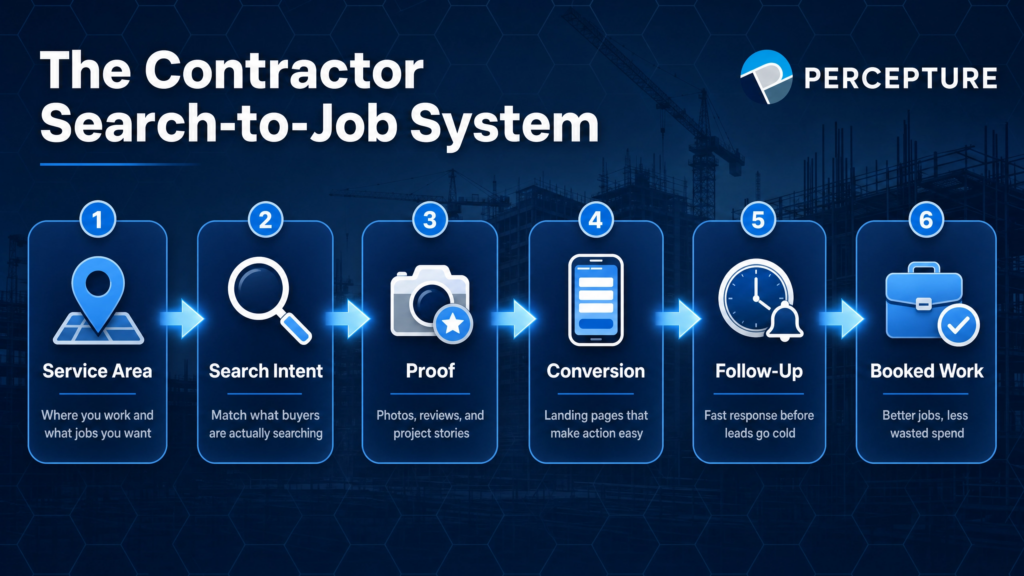
Purchased leads from HVAC lead providers can help fill immediate capacity. Owned channels can reduce reliance on a single vendor and give the contractor more control over messaging, audiences, data, and customer experience. Many businesses need both, but each channel should have a defined role.
Percepture’s omnichannel marketing approach coordinates demand across channels instead of letting each vendor report in isolation. For additional industry context, review Percepture’s guide to SEO for construction companies.
Frequently asked questions
What are HVAC lead generation companies?
HVAC lead generation companies create, acquire, qualify, deliver, nurture, book, or measure prospective HVAC demand. The category includes marketing agencies, paid-media managers, appointment setters, pay-per-call providers, lead networks, marketplaces, commercial outbound firms, and conversion systems. Buyers should identify the provider model before comparing price or volume.
Are HVAC lead companies worth it?
lead-generation partners can be worth the investment when the demand matches the service area, job mix, capacity, response process, and target economics. Value should be measured through qualified, booked, completed, paid, and profitable work. A low lead price does not establish value when the source, quality, or outcome cannot be traced.
Which companies provide exclusive HVAC leads?
Some HVAC demand partners describe leads as exclusive, but the term needs a written definition. Ask whether exclusive means one recipient, for which consumer, source, territory, service, and time window. Also ask whether the contact can be redistributed later. A marketing label alone is not enough to verify exclusivity.
Should an HVAC contractor use an agency or buy leads?
Use an agency when the goal includes building contractor-controlled websites, search visibility, campaigns, content, audiences, and measurement. Buy leads from providers in this category when flexible or fast incremental demand is the main need. A blended model can work when ownership, budgets, capacity, and source-level economics are clear.
How much do HVAC lead providers charge?
HVAC lead providers can charge retainers, media management, setup fees, ad spend, per-call charges, per-form charges, transfer fees, appointment fees, marketplace credits, or hybrids. Compare total acquisition cost rather than one quoted fee. Include software, call handling, sales labor, invalid events, integration, quality review, and management time.
What is the difference between a valid and qualified HVAC lead?
A valid lead meets the provider’s billing rule. A qualified lead also meets the contractor’s agreed service, area, need, buyer, timing, and exclusion rules. Neither term means the inquiry was booked, completed, paid, or profitable. Put each definition and the required evidence in the contract.
How long should an HVAC lead-generation pilot run?
A 30-to-90-day pilot can be used when it covers one market or service, has enough operating capacity, and starts with tested tracking. The decision should use written definitions and weekly quality review. Evaluate completed-job economics, reporting quality, credits, routing, and source transparency before scaling.
Can an HVAC lead company guarantee jobs or ROI?
A provider should not promise jobs or return without clear conditions, definitions, and assumptions. Results vary with market, service mix, season, budget, capacity, response time, pricing, offer, sales execution, and fulfillment. Evaluate documented controls and verified contribution after acquisition instead of relying on an unconditional promise.
What should an HVAC contractor own after ending a lead-generation contract?
The contractor should retain the domain, website, content, advertising accounts, analytics, phone numbers, audiences, creative and exportable lead and customer records that the agreement assigns to the contractor. Ownership and offboarding rights should be written before launch.
How fast should an HVAC company respond to a new lead?
Set a response target by source, service, urgency and operating hours, then measure actual answer and follow-up time. Faster response can help, but there is no universal time that guarantees a booking. Routing, staffing and call quality still matter.
Tell us what you are comparing
Use the form below to share the provider, lead model, markets, service lines and questions you need reviewed. Percepture can help you evaluate ownership, lead quality, conversion, attribution and completed-job economics before you scale.
Prefer a direct conversation? Schedule a call with Percepture.