
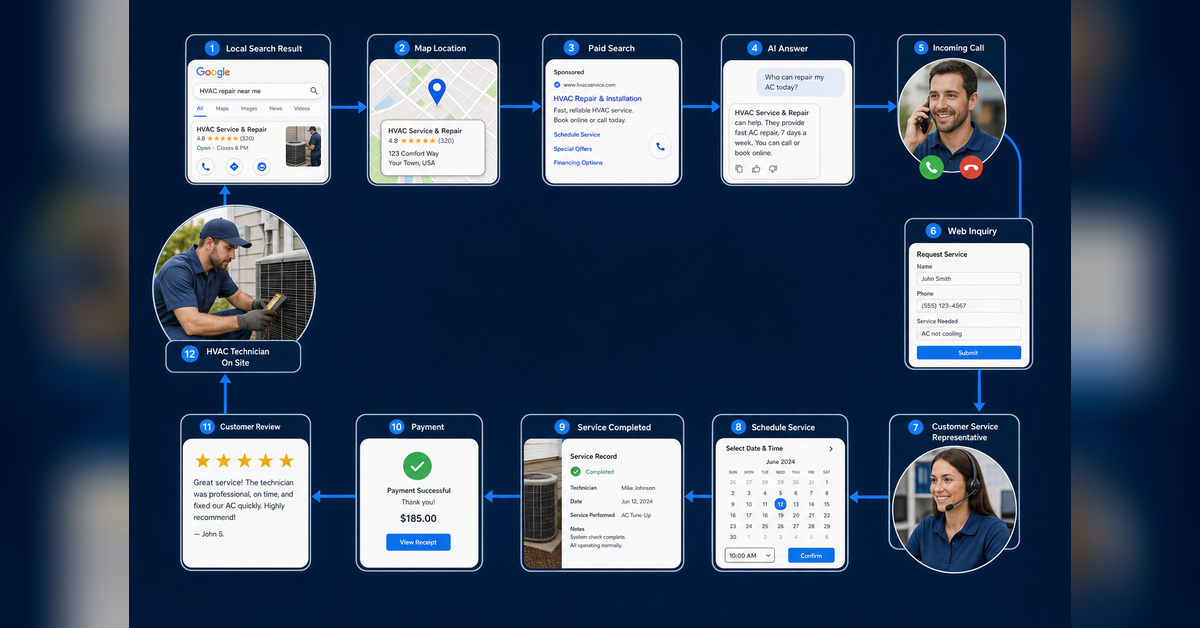

An hvac lead generation agency should help produce the right calls, conversations, and booked work, not just a larger pile of form fills. The real job is to connect demand with response, qualification, scheduling, completed service, and financial reporting.
That standard changes how an HVAC company should compare agencies, lead marketplaces, pay-per-call providers, appointment setters, and internal teams. The best fit depends on what the company can fulfill, which assets it wants to own, and where its current funnel loses value.
See how Percepture handles technical markets and high-value demand
OPTK Networks works across fiber, telecom, network and data-center markets. Those buyers overlap with commercial HVAC, critical-facility and infrastructure decision-makers. This case study shows how Percepture combines search, AI visibility and targeted campaigns in a specialized market.
Technical buyer language
Percepture understands long sales cycles, complex services and buyers who need proof before they contact a provider.
Connected visibility
Search, AI visibility, content and targeted media work together instead of being reported as separate activities.
Qualified demand over raw volume
The goal is not a larger lead pile. The goal is better-fit conversations that the sales and operations teams can turn into real work.

“They get it.”
Cody’s point is simple: a partner must understand the market, the buyer and the operating reality behind the campaign.
Show us where your lead funnel is getting stuck
Bring your service areas, target jobs, current channels and lead-handling process. Percepture will help identify the first problem worth fixing.
What should an HVAC lead generation partner deliver?
An hvac lead generation agency should attract suitable homeowners or commercial buyers, convert their interest, support fast response, define qualification, track bookings, and show which sources contribute to completed and profitable work. Marketing, call handling, CRM stages, sales follow-up, dispatch, and revenue reporting should use the same definitions.
The executive view
Define quality first
Write valid, qualified, booked, completed, and invalid-lead rules before judging volume.
Find the constraint
More demand will not fix missed calls, slow follow-up, poor routing, limited capacity, or weak scheduling.
Protect ownership
The HVAC company should retain appropriate access to its website, accounts, data, content, phone numbers, audiences, and reporting.
Measure beyond the lead
Compare channels using qualified contacts, booked jobs, completed work, acquired customers, and attributable gross profit where the data allows.
A full-funnel lead generation partner is most useful when marketing and operating teams are willing to share definitions, capacity signals, and outcome data.
Who this guide is for
Owners and executives
Evaluate growth, control, risk, capacity, and profit.
Marketing leaders
Connect channel performance with conversion and pipeline outcomes.
CSR and sales leaders
Improve routing, contact, qualification, and follow-up.
Operations and dispatch
Match campaigns to service areas, job types, skills, and available schedules.
Multi-location operators
Use shared definitions while diagnosing each market on its own facts.
Commercial HVAC teams
Separate inquiries and meetings from qualified account opportunities.
Use this guide to decide whether a lead generation partner fits the company’s ownership, capacity, qualification, and reporting requirements.
What Does an HVAC Lead Generation Agency Do?
A lead generation partner plans how demand will be created, captured, converted, qualified, tracked, and improved. Its work may include search optimization, local visibility, paid media, landing pages, content, public relations, call tracking, CRM workflows, reactivation, and source-to-outcome reporting. Percepture’s lead generation services approach this work as a connected system rather than a single campaign.
A lead generation partner should begin with the work the contractor wants and can fulfill. That includes service areas, target job types, operating hours, technician skills, commercial capabilities, exclusions, seasonality, and available capacity. Without those inputs, a campaign can generate contacts that look positive in a media dashboard but create poor fit for dispatch and sales.
The agency owns the work stated in its agreement. That may include research, campaigns, pages, tracking, reporting, testing, and workflow design. The HVAC company still owns essential operating inputs: accurate services, schedules, pricing policies, customer handling, field capacity, CRM discipline, and financial outcomes.
Channel delivery alone is incomplete. A paid campaign can generate a valid call, yet the caller may abandon after a long hold. Organic search can produce a replacement inquiry, yet poor routing may send it to the wrong location. A form can contain a real request, yet no one may follow up. A useful lead generation partner identifies these breaks instead of assigning every weak outcome to traffic quality.

What Counts as a Qualified HVAC Lead?
A raw inquiry is not the same as a qualified lead. The terms a lead generation partner uses should be defined in the agreement, CRM, dashboard, call-review process, and any credit policy. If marketing, customer service, sales, dispatch, and finance use different definitions, reports will create arguments instead of decisions.
HVAC lead-stage definitions
| Stage | Working definition | Common exclusions |
|---|---|---|
| Inquiry | A call, form, message, chat, or other response. | No exclusions applied yet. |
| Valid lead | Usable contact information, relevant HVAC intent, and no agreed invalid condition. | Spam, job seekers, vendors, wrong trade, or unusable contact data. |
| Qualified residential lead | A valid contact in the service area with a supported need, suitable property or decision role, and a reachable next step. | Unsupported service, duplicate, wrong geography, or no reasonable next action. |
| Qualified commercial lead | A valid company or facility contact with relevant need, geographic fit, role or influence, plausible timing, and an agreed next action. | Unmatched account, no relevant need, or no defined next stage. |
| Booked job or meeting | An appointment accepted under the company’s scheduling, geography, capacity, and customer rules. | Unaccepted requests or tentative activity outside the scheduling system. |
| Completed work | Work or a commercial sales step that reached the company’s agreed completion status. | Cancellations, no-shows, callbacks, warranty-only work, and other separately classified outcomes. |
Exclusivity is also easy to misunderstand. An exclusive lead is one that a provider agrees not to sell or route to another named buyer under defined terms. It does not automatically mean that the contact is accurate, reachable, urgent, qualified, or likely to book.
Ask a lead generation partner to report the movement between stages. A high inquiry count can hide a low valid-contact rate. A strong booking count can hide cancellations. Completed-job reporting can still hide poor job mix or weak margin. Each stage answers a different management question.
The HVAC Lead-to-Profit Control System
Percepture’s HVAC Lead-to-Profit Control System is a seven-gate method for connecting market fit, demand, conversion, response, qualification, fulfillment, profit, and retention. It gives the agency and client a shared way to find the largest constraint before increasing spend.
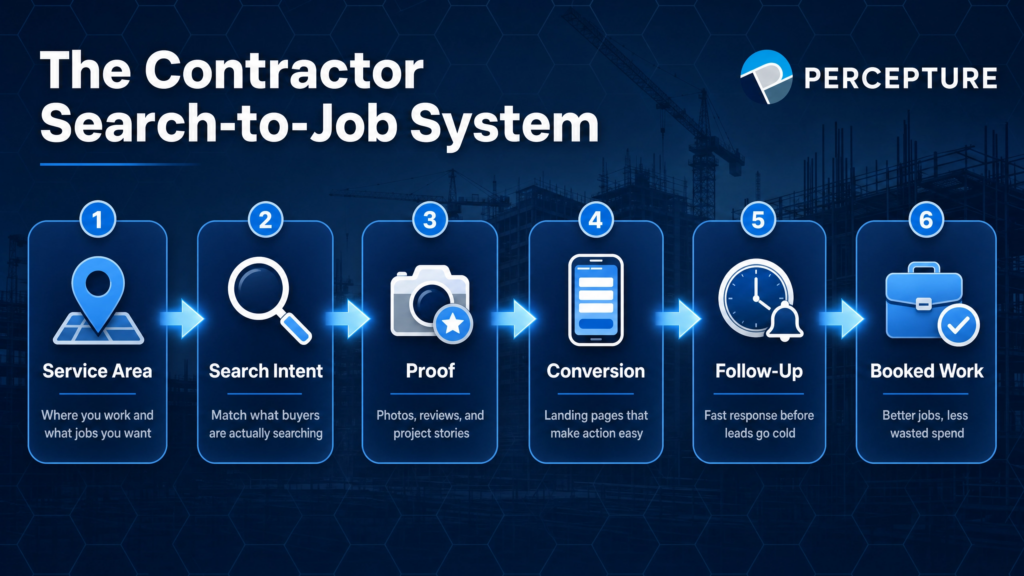
Seven gates for an hvac lead generation agency
| Gate | Agency duty | Client duty | First metric | Common failure |
|---|---|---|---|---|
| 1. Market and capacity fit | Translate target services, areas, and job mix into campaign rules. | Provide accurate capacity, skills, hours, margins, and exclusions. | Available capacity and job fit | Generating work the company cannot or should not fulfill. |
| 2. Demand capture | Select and manage channels around defined intent. | Supply market facts, access, offers, and operating changes. | Qualified demand by source | Buying clicks, calls, or names without a target. |
| 3. Conversion infrastructure | Improve pages, forms, calls, proof, and message match. | Confirm service facts, policies, financing context, and customer expectations. | Valid-contact conversion | Sending demand to generic, slow, or confusing pages. |
| 4. Response control | Design tracking, alerts, assignment, backup, and escalation. | Staff the response process and maintain accurate schedules. | Answer and contact rates | Calls and forms remain unanswered or unworked. |
| 5. Qualification and booking | Define stages, fields, dispositions, and reporting. | Use the definitions consistently and review exceptions. | Qualified-to-booked rate | Every call, form, or meeting is counted equally. |
| 6. Completion and profit | Connect source data with downstream outcomes where possible. | Provide dispatch, completion, invoice, payment, and job-cost data. | Cost per completed job | Cheap leads are favored despite weak completed value. |
| 7. Retention and compounding | Support reviews, reactivation, content, and recurring-demand programs. | Deliver the service experience and maintain customer records. | Repeat and referral contribution | The company repeatedly pays to reacquire existing demand. |
The control layer sits across all seven gates. It names the owner, source of truth, service level, lead-credit rule, review cadence, access policy, approval path, and scale, fix, hold, or stop decision. This keeps a lead generation partner from optimizing a channel without seeing the business outcome.
Find the leaks before you buy more leads
Check whether the problem is targeting, missed calls, slow follow-up, poor qualification or weak booking paths.
- Review service-area and job fit
- Find where calls and forms are being lost
- See which fix should come first
HVAC Lead Generation Services an Agency Should Provide
The right service mix from a lead generation partner follows the constraint. A company with missed calls may need response control before more advertising. A multi-location operator with weak organic coverage may need enterprise SEO services. A commercial team with a long sales cycle may need account targeting, authority content, and better CRM stages.
Core service areas and operating tests
Use these operating tests to determine which services the agency should prioritize first.
Market, service-area, and capacity planning
Purpose: Match demand to profitable work the company can perform. Inputs: Areas, job types, skills, hours, exclusions, and capacity. First metric: Qualified geographic and service fit. Failure: Campaigns ignore dispatch reality.
HVAC SEO and local search
Purpose: Capture service, repair, replacement, maintenance, commercial, location, comparison, and problem intent. Use organic SEO services with clear service-area and conversion paths. First metric: Qualified organic contacts. Failure: Traffic grows without suitable demand.
Technical website control
Purpose: Find crawl, speed, template, tracking, and conversion problems. A technical SEO audit service can identify barriers before content is expanded. First metric: Resolved high-impact issues. Failure: New pages inherit old defects.
Business Profile and reviews
Purpose: Keep services, hours, locations, service areas, photos, and customer-facing details accurate. First metric: Valid local contacts by location. Failure: Fake locations, inconsistent details, or unmanaged customer feedback.
Paid search and active demand
Purpose: Separate emergency, repair, replacement, maintenance, brand, commercial, and location intent. Paid search services should align keywords, negatives, schedules, geography, calls, landing pages, and capacity. First metric: Cost per qualified contact. Failure: Broad traffic hides poor job fit.
Landing pages and CRO
Purpose: Improve message match, mobile usability, proof, service-area clarity, forms, calls, and scheduling expectations. Conversion rate optimization should improve valid conversion rather than remove every qualifying question. First metric: Qualified-contact conversion. Failure: More forms create more invalid demand.
Call tracking and attribution
Purpose: Connect source, campaign, call outcome, qualification, booking, and revenue. First metric: Percentage of contacts with a source and disposition. Failure: Call duration is treated as proof of quality.
Speed-to-lead and CRM workflows
Purpose: Route, assign, alert, follow up, and surface unworked opportunities. Governed AI sales agents can support approved workflows with consent, suppression, stop-on-reply rules, and human escalation. First metric: Contact rate. Failure: Automation invents service facts or keeps messaging after a reply.
AI search, content, and digital PR
Purpose: Build accurate service facts, useful expert answers, and third-party authority. Combine generative engine optimization services, content marketing services, and digital PR services. First metric: Qualified referrals and assisted pipeline. Failure: One prompt or screenshot is treated as a lead program.
Commercial account targeting
Purpose: Select accounts by facility, geography, need, ownership, portfolio, trigger, and fit. First metric: Qualified opportunities with an agreed next action. Failure: List size, sends, or meetings replace opportunity quality.
Source-to-profit reporting
Purpose: Move reports from inquiry through valid, qualified, booked, completed, paid, profitable, and retained stages. First metric: Outcome coverage by source. Failure: The dashboard stops at raw leads.
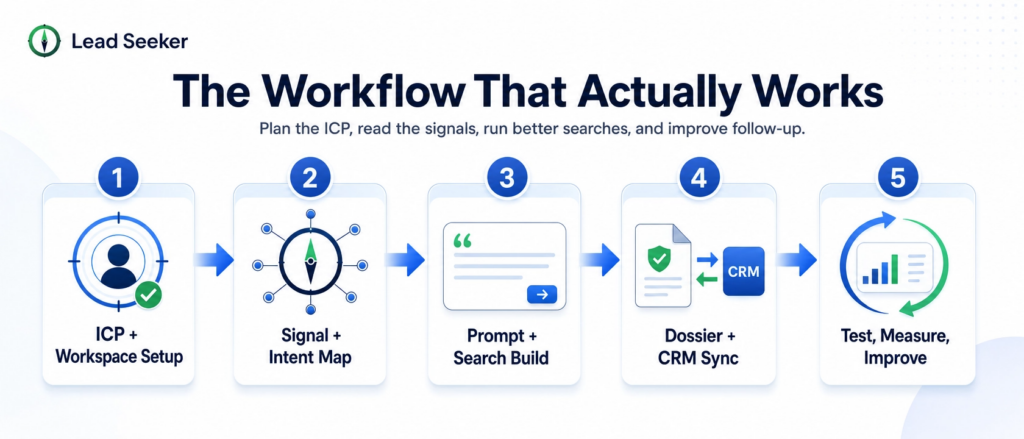
A capable lead generation partner does not need to provide every service at once. It should explain which constraint is being addressed, what both parties must supply, which metric will move first, and what evidence will justify the next investment.
HVAC Lead Generation Agency vs. Buying Leads
Buying leads can help fill short-term capacity or test a defined market, while a lead generation partner can build and improve owned demand. The decision should reflect speed, control, internal staffing, data access, asset ownership, qualification rules, and the ability to trace outcomes.
Engagement model comparison
| Model | Ownership | Channel control | Exclusivity | Data access | Asset created | Qualification | Attribution | Main risk | Best fit |
|---|---|---|---|---|---|---|---|---|---|
| Full-funnel agency | Contract-defined; client ownership should be documented | High across assigned channels | Not applicable to owned demand | Broad when systems are connected | Pages, content, data, workflows, and learning | Shared definitions | Can extend toward completed work | Requires access and operating cooperation | Durable demand and funnel improvement |
| Lead marketplace | Usually limited | Low | Varies by terms | Often limited | Little owned value | Provider terms | Often stops near delivery | Sharing, duplicates, dependence, and variable fit | Incremental or temporary demand |
| Pay per lead or call | Varies | Low to moderate | Must be defined | Varies | Limited unless included | Must be contractual | Often focused on billable events | Quantity may outrun bookings or profit | Defined services, areas, caps, and credit rules |
| Appointment setting | Client often owns CRM outcomes | Moderate for outbound | Not usually the core issue | Should include account and activity data | Lists, messages, and process learning | Account, role, need, timing, and next action | Should follow opportunity stages | Meetings lack authority, need, or timing | Commercial HVAC account development |
| In-house team | High | High | Not applicable | High | Internal capability | Internally governed | Depends on systems and expertise | Hiring gaps, turnover, and channel silos | Companies with leadership and specialist depth |
| Hybrid | Shared by agreement | Shared | Depends on source | Should be shared | Mix of internal and agency assets | Shared definitions | Can be strong with one source of truth | Blurred ownership and slow decisions | Companies retaining selected capabilities |
A lead generation partner is the stronger model when the company wants strategy, owned assets, conversion improvement, response design, and ongoing measurement. A lead source may be a better fit when the need is narrow, temporary, and governed by clear geography, service, caps, validity, exclusivity, and credit terms.
Residential vs. Commercial HVAC Lead Generation
For residential demand, a lead generation partner often manages local intent, immediate comfort problems, calls, mobile pages, reviews, service windows, repair-versus-replacement decisions, and financing context. Qualification should cover location, supported service, property fit, urgency, decision role, schedule fit, and agreed exclusions.
Commercial demand usually involves target accounts, facilities, contracts, multiple stakeholders, longer cycles, site information, proposals, references, and a defined next sales step. A meeting is not automatically an opportunity. The account, need, role, geography, timing, scope, and next action should be clear.
A lead generation partner should not force both motions into one funnel. Residential teams may optimize calls and booked service. Commercial teams may track account engagement, qualified meetings, site reviews, proposals, and stage progress. Multi-location operators need common definitions, but each market should still be diagnosed separately.
Trade-focused resources such as SEO for construction companies and digital marketing for contractors provide useful context for connecting search strategy with contractor buying behavior.
Why HVAC Leads Fail to Become Booked Jobs
A lead generation partner should trace lead loss to the specific break. The market may be wrong. The requested service may be unsupported. A shared lead may reach several contractors at once. The page may be slow or unclear. A call may go unanswered. A form may sit without an owner.
Lead-to-booking leak checklist
- Service area or job type does not match campaign targeting.
- The offer and landing page do not match the search or ad.
- Mobile visitors cannot quickly confirm service, coverage, or next steps.
- Calls are missed, abandoned, or routed to the wrong location.
- Forms and messages receive slow or inconsistent follow-up.
- Schedules cannot accept the promoted job type.
- Reviews and proof do not support the customer’s decision.
- Duplicates and invalid contacts are not classified consistently.
- The CRM lacks clear stages, dispositions, owners, and timestamps.
- Follow-up stops after one attempt without a defined reason.
- Capacity changes are not reflected in budgets, schedules, or geography.
- Source data is lost before booking, completion, or payment.
The job of a lead generation partner is not to hide these problems behind a lead count. It should separate marketing constraints from response, scheduling, sales, capacity, and data constraints. That lets the company fix the correct problem.
Content can also support conversion when it answers real buyer questions. Useful contractor examples include content marketing for construction and social media marketing for construction companies. Each channel still needs a path to a suitable service action.
How to Choose an HVAC Lead Generation Agency
Do not choose a lead generation partner from a channel list alone. Use a written evaluation that covers quality, ownership, operations, data, senior involvement, AI governance, onboarding, and exit rights.
15 questions to ask before hiring
- How do you define valid and qualified leads?
- Which channels and funnel stages do you own?
- Who owns accounts, phone numbers, content, creative, audiences, and data?
- How are spam, duplicates, wrong services, and invalid contacts handled?
- How do residential and commercial qualification standards differ?
- How are calls and forms connected to CRM stages?
- How do you measure booked and completed work?
- Can reporting reach gross profit or contribution when suitable data exists?
- How are service area, capacity, seasonality, and job mix used?
- Which actions require client authorization?
- What happens when lead quality or performance drops?
- Which work is performed or reviewed by senior staff?
- Where is AI used, and where is human review required?
- What should onboarding produce by days 15, 30, 60, and 90?
- What can the company export and retain when the relationship ends?
Red flags include guaranteed volume without operating inputs, unclear qualification, inaccessible accounts, provider-controlled phone numbers without portability terms, no call review, raw-lead-only reporting, hidden cost categories, one-size-fits-all geography, and no exit plan.
A trustworthy lead generation partner should explain its limits. It cannot control weather, every customer decision, technician availability, field performance, or all downstream data. It can define responsibilities, create measurement controls, surface risks, and change course when evidence shows a weak fit.
HVAC Lead Generation Agency Pricing
Pricing for a lead generation partner depends on scope and engagement model. Common structures include retainers, projects, setup work, media spend, pay-per-lead, pay-per-call, pay-per-appointment, performance components, hybrid fees, software, data, tracking, creative, content, landing pages, and integrations.
Compare total investment, not one fee
| Cost area | Questions to ask | Why it matters |
|---|---|---|
| Strategy and setup | Are research, access, measurement design, and launch planning included? | A low management fee can exclude the foundation required to measure outcomes. |
| Media | Is ad spend separate, and who owns the accounts and history? | Media should be visible and governed by service, geography, and capacity rules. |
| Website and creative | Are landing pages, copy, development, call paths, and testing included? | Traffic may underperform when conversion assets are outside the scope. |
| SEO, content, and PR | Which deliverables, reviews, distribution, and technical work are included? | Owned demand requires assets and maintenance, not only campaign management. |
| Tracking and systems | Are call tracking, CRM work, data connections, reporting, and AI usage separate? | Outcome reporting can require systems beyond the media platform. |
| Client labor | How much time is required from marketing, CSR, sales, dispatch, finance, and IT? | Internal time is part of the total investment and implementation risk. |
There is no responsible universal price for a lead generation partner without scope, market, service mix, capacity, baseline, systems, and ownership terms. Compare what is included, what the client must supply, how media and software are treated, which assets remain with the company, and how performance will be reviewed.
See what the right support may cost
Compare strategy, media, content, tracking, landing pages, software and support before choosing a program.
- See clear pricing paths
- Match the scope to your markets and goals
- Know what is included before work starts
How to Calculate HVAC Lead Generation ROI
ROI from a lead generation partner becomes more useful when the funnel separates raw, valid, qualified, booked, completed, paid, profitable, and retained outcomes. Use one attribution window and document source rules. Separate first touch, original lead source, assisting sources, and branded return visits where the systems support it.
Lead-to-profit formulas
| Metric | Formula |
|---|---|
| Cost per valid lead | Attributable acquisition cost ÷ valid leads |
| Cost per qualified lead | Attributable acquisition cost ÷ qualified leads |
| Cost per booked job | Marketing plus incremental handling cost ÷ booked jobs |
| Cost per completed job | Marketing plus incremental handling cost ÷ completed jobs |
| Customer acquisition cost | Attributable sales and marketing cost ÷ new acquired customers |
| Booking rate | Booked jobs ÷ contacted qualified leads |
| Completion rate | Completed jobs ÷ booked jobs |
| Attributable gross profit | Collected attributable revenue minus direct job cost under the company’s definition |
| Contribution after acquisition | Attributable gross profit minus acquisition and incremental handling cost |
| Marketing ROI | (Attributable gross profit minus total acquisition cost) ÷ total acquisition cost |
Include cancellations, refunds, discounts, callbacks, warranty work, invalid leads, bad debt, and direct job costs when they are relevant to the chosen metric. Weather, season, price changes, capacity, and location can also affect comparisons.
Ask the agency to state what is directly known, what is estimated, and what is unavailable. A clean-looking dashboard should not imply certainty that the underlying systems cannot support.
What the First 90 Days Should Look Like
A controlled onboarding sequence
Days 1 to 15: Baseline
Confirm services, markets, margins, capacity, customer types, exclusions, and hours. Audit the website, local profiles, advertising, search visibility, calls, forms, CRM, reviews, tracking, response, and reporting. Produce a baseline scorecard, access list, funnel map, measurement dictionary, and urgent-fix list.
Days 16 to 30: Foundation
Repair tracking, page alignment, response routing, CRM stages, dispositions, invalid-lead rules, and decision workflows. Build channel, content, local, GEO, CRO, and follow-up priorities. The output should be a measurement-ready funnel and launch plan.
Days 31 to 60: Controlled launch
Test selected markets, services, offers, audiences, or funnel repairs. Review search terms, calls, forms, qualification, bookings, cancellations, capacity, and follow-up. Use weekly quality reviews to choose the next test.
Days 61 to 90: Profit and scale
Connect completed work and financial outcomes where data permits. Compare sources at qualified, booked, completed, paid, and profit stages. Scale, hold, fix, or stop by service and market. Produce an executive review, risk register, scale conditions, and next-quarter plan.
After an initial inquiry, the agency should review fit, conduct discovery, request limited relevant access, map the lead-to-profit path, and recommend a next step. The right recommendation may be a full program, a focused project, a pilot, internal fixes, or no engagement.
Why Percepture?
Percepture was founded in 2004. Its work combines SEO, GEO, digital PR, paid media, content, analytics, conversion rate optimization, lead generation, and AI-enabled workflows. Relevant experience includes construction, engineering, infrastructure, data centers, telecom, staffing, and complex B2B markets.
Percepture’s position is simple: visibility, trust, response, conversion, pipeline, and measurement belong in one operating system. A lead generation partner should build owned demand, improve purchased demand, repair conversion and response leaks, and measure results beyond the initial contact.
The approach also connects channel strategy through omnichannel marketing. For follow-up and outbound governance, the guide on whether AI agents can make outbound calls explains additional operating and compliance questions.
Proof from infrastructure and specialized B2B markets
Commercial HVAC teams often sell into data centers, construction programs, telecom facilities and complex B2B accounts. These examples show how Percepture handles specialized buyers, technical services and longer sales cycles.


Frequently Asked Questions
What does an hvac lead generation agency do?
An hvac lead generation agency plans and improves the path from market demand to qualified contacts, bookings, completed work and measurable business outcomes. Its scope may include SEO, paid search, local visibility, landing pages, content, call tracking, CRM workflows, response design, qualification, follow-up and reporting.
What is a qualified HVAC lead?
A qualified residential lead is a valid contact in the service area with a supported need, suitable property or decision role, and a reachable next step. A lead generation partner should require a commercial lead to have account fit, relevant need, geography, role or influence, plausible timing, and an agreed next action.
Are exclusive HVAC leads always better?
No. Exclusivity only describes whether the provider agrees not to sell or route the lead to another named buyer under defined terms. It does not prove that the contact is accurate, reachable, suitable, urgent, qualified, or likely to become completed work.
Should an HVAC company buy leads or hire an agency?
Buying leads can fit a narrow or temporary capacity need. A lead generation partner is better suited to companies that want owned demand, channel strategy, conversion improvement, response control, tracking, and ongoing learning. Compare ownership, data access, qualification, total cost, and downstream reporting before choosing.
How should HVAC lead generation pricing be compared?
When pricing a lead generation partner, compare strategy, setup, management, media, website work, content, tracking, CRM, data, software, creative, integrations, reporting, and client labor. Also review account ownership, cancellation terms, portability, qualification rules, credit policies, and which assets the HVAC company keeps.
How long does HVAC lead generation take?
The timing depends on the channel, market, starting point, access, capacity, and technical condition of the funnel. Early work should establish definitions and repair measurement. Controlled tests can follow. Broader decisions should use qualified, booked, completed, and financial outcomes rather than a fixed universal promise.
Can AI improve HVAC lead follow-up?
AI can support routing, alerts, approved follow-up, reactivation, and identification of unworked contacts. It should operate with consent, suppression, stop-on-reply rules, human escalation, logging, and defined permissions. It should not invent prices, availability, credentials, service areas, diagnoses, or customer promises.
Which HVAC lead generation metric matters most?
No single metric answers every question for a lead generation partner. Valid and qualified leads show demand quality. Booking and completion rates reveal operating performance. Cost per completed job and attributable gross profit provide stronger financial context. The useful metric is the one tied to the decision being made.
Build a Lead System, Not a Lead Pile
A lead generation partner should not treat more inquiries as a guarantee of more profit. Start by defining suitable work, service areas, capacity, valid contacts, qualified leads, booked jobs, completed work and the financial outcome the company can measure.
Then identify the largest break. It may be visibility, targeting, page conversion, missed calls, slow response, weak qualification, schedule mismatch, follow-up, or attribution. Fixing the right constraint is often more valuable than adding another channel.
Build a lead system that books real work
The right hvac lead generation agency should connect visibility, response, qualification, booking and revenue. Percepture can review your current path and show you where the biggest leaks are.
- Map your strongest services and markets
- Find the biggest lead and booking leaks
- Build a clear 90-day action plan