
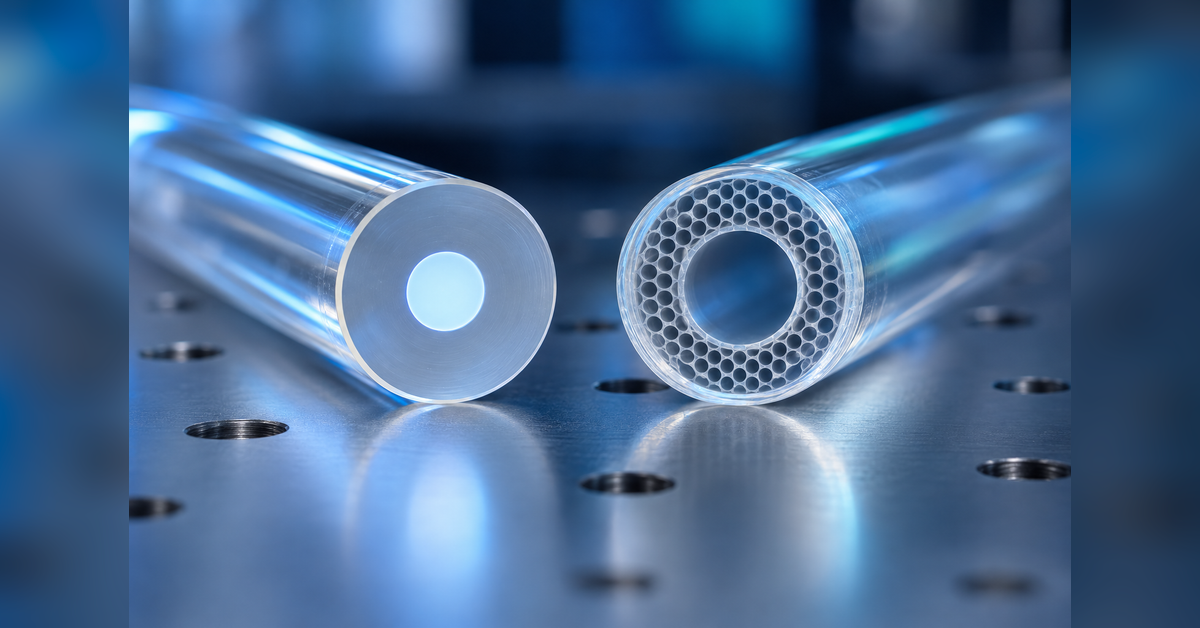

Hollow-core fiber can reduce the propagation delay created by solid glass, but faster light in the medium is not the same as a faster application. Business value depends on route length, workload design, equipment delay, field operations, and the value of each verified microsecond.
The right buyer question is not whether this technology replaces conventional fiber everywhere. It is whether a specific route, workload, and operating model can produce enough measurable value to justify a more demanding deployment.
OPERATOR TRUST
Telecom Expertise Has to Be Visible Before Buyers Can Trust It
Cody Clegg and the OPTK Networks team explain how Percepture helped turn telecom expertise into visible search, AI, and market authority. This establishes the operator relationship and Percepture’s telecom credibility; it is not technical validation of HCF performance.
Watch the OPTK Networks testimonial
Video summary: Technical companies earn trust when their expertise is easy for buyers, search engines, and AI systems to find and understand. Clear education, visible experts, and disciplined market positioning help buyers evaluate unfamiliar infrastructure categories.

OPERATOR PERSPECTIVE
“The first question is not whether hollow-core fiber replaces conventional fiber. The better question is where its performance creates enough economic value to justify deployment.”
Cody Clegg, Director of Sales & Marketing, OPTK Networks, a Nebraska fiber network provider
The Percepture Proof Stack

Operator relationships
Direct conversations with telecom leaders help Percepture separate useful buyer questions from broad technology promotion.

Infrastructure context
AI infrastructure decisions connect fiber, facilities, interconnection, power, financing, construction, and commercial demand.

Clear market education
Percepture turns expert knowledge into structured content, executive visibility, search coverage, and qualified commercial conversations.
What is Hollow-core fiber?
Hollow-core fiber is an optical fiber that guides most light through an air- or gas-filled core instead of solid glass. Its design can reduce propagation delay, nonlinear effects, and some material limits. The strongest early fit is likely to be selected latency-sensitive links where measured performance justifies added deployment and operating complexity.
Executive summary
Start with the workload
Measure how much of the current latency budget comes from the transmission medium before selecting Hollow-core fiber.
Separate a record from a specification
Require the Hollow-core fiber design, wavelength, length, cable state, splice state, test method, and limitation behind every performance figure.
Test field operations
A representative Hollow-core fiber pilot must cover installation, splicing, testing, monitoring, failover, repair, training, and support.
Use economic gates
Scale Hollow-core fiber only when verified application improvement and avoided costs exceed the incremental lifecycle cost and risk.
Who should evaluate this guide?
Network and data-center leaders
Teams evaluating Hollow-core fiber for AI campuses, metro links, interconnection, selected backbone segments, or premium low-latency routes.
Construction and operations teams
Leaders responsible for Hollow-core fiber cable handling, installation controls, splicing, testing, restoration, workforce readiness, and vendor support.
Executives and investors
Decision-makers who need a gated technical and financial case for Hollow-core fiber rather than a single speed claim.
Technical marketers
Manufacturers, operators, and suppliers that need to explain Hollow-core fiber accurately through expert-led technical content.
How does Hollow-core fiber work?
Conventional single-mode fiber guides light through a solid silica core. Hollow-core fiber instead guides most optical power through a hollow region surrounded by a microstructured glass cladding. The core may contain air or gas; it should not be described as a perfect vacuum.
The surrounding tubes or membranes confine the light. Anti-resonant designs use those structures to discourage light from escaping into the glass. Nested antiresonant nodeless fiber and double-nested variants add structural layers intended to improve confinement, although a design name alone does not establish the performance of a finished cable or installed link.
This difference matters because light travels more slowly through silica than through air or gas. It also means less optical power interacts with solid glass, which can reduce some material-related nonlinear effects. The design still has to meet practical requirements for attenuation, mode quality, bending, cabling, splices, connectors, cleanliness, testing, and repair.
The Fiber Optic Association’s HCF reference provides an installation-oriented introduction. Buyers should use such education as a starting point, then require specifications and acceptance criteria for the exact design being considered.
Is Hollow-core fiber really faster?
It can reduce propagation delay because the light spends most of its path in an air- or gas-filled region. That advantage applies to the transmission medium. It does not remove delay from geographic routing, transponders, switches, serialization, congestion, processing, storage, software, or the application itself.
A statement that light travels faster through a particular medium must not be converted into a claim that a network, AI model, or business process improves by the same percentage. End-to-end results must be measured between the actual endpoints with the proposed optics, route, workload, and operating conditions.
Propagation speed claim scorecard
| Claim level | What it measures | Evidence required | Buyer interpretation |
|---|---|---|---|
| Fiber medium | Light propagation through the Hollow-core fiber region | Design, length, test method, conditions, and source | Useful physical input, not an application outcome |
| Installed optical link | Delay across Hollow-core fiber cable, splices, connectors, and optical equipment | Bidirectional acceptance test on representative construction | Shows whether the link preserves the expected benefit |
| Network path | Route plus active network elements | Synchronized endpoint measurement and control path | Reveals routing or equipment bottlenecks |
| Application | Workload response, completion, or transaction time | Representative traffic and repeatable comparison | Determines whether users or economics improve |
How should route-level savings be calculated?
First measure the propagation delay of a comparable conventional link. Then measure the proposed Hollow-core fiber link under the same endpoint and test conditions. The difference is the verified propagation delay saved. Compare that figure with the total application improvement to learn how much of the outcome actually came from the fiber.
Route length matters. A short link may leave too little absolute delay to justify a more complex deployment. A longer path may create a larger propagation opportunity, but it also increases the importance of cable consistency, accumulated loss, splices, amplification, monitoring, and restoration planning.
What advantages should buyers test?
Potential advantages include lower propagation delay, reduced material nonlinearity, tolerance for different optical-power strategies, useful bandwidth across selected ranges, low loss in demonstrated designs, and longer unamplified reach in suitable systems. None should be treated as universal. Results vary by design, wavelength, manufacturing run, cable, bend environment, splice plan, equipment, and test conditions.
A buyer evaluating Hollow-core fiber should ask for an evidence package rather than a highlights slide. Each result should identify the fiber design, wavelength or band, test length, minimum or average measurement, cable and splice status, source, date, and known limitation.
From laboratory result to operating evidence
| Evidence stage | What it can establish | What it cannot establish alone |
|---|---|---|
| Research sample | A measured property under stated test conditions | Commercial cable consistency or field economics |
| Cabled test | Performance after a defined cabling process | Repeatable installation across routes and crews |
| Field pilot | Installed behavior on a representative path | Broad supply, restoration, or operating maturity |
| Limited commercial use | Operation for a defined customer or application | Universal fit or scaled ecosystem readiness |
| Repeatable operations | Documented supply, installation, monitoring, repair, and support | Economic value for every workload |
Nokia’s discussion of HCF for AI data-center interconnect describes a wider system opportunity involving latency, capacity, and reach. Its analysis should be evaluated as a vendor perspective, not as an installed specification for every product.
What are the disadvantages of Hollow-core fiber?
The main risks sit outside the headline physics. Buyers must examine manufacturing consistency, supply concentration, cable design, order requirements, connectors, fusion splicing, gas and contamination control, bend performance, test procedures, tool compatibility, workforce training, repair time, monitoring, amplification, warranty coverage, and long-term support.
Construction leaders should treat field readiness as its own approval gate. A successful fiber sample does not prove that crews can install, test, document, restore, and operate the same system repeatedly. Procedures must cover reel inspection, handling limits, cleaning, splice preparation, bidirectional measurements, acceptance thresholds, failure escalation, spares, and restoration.
Procurement also needs an exit plan. Contracts should address supply commitments, support response, documentation, training, remedies, replacement materials, software or test dependencies, and migration options. The objective is not to remove all uncertainty; it is to expose and price it before a production route depends on the system.
Check readiness before building the business case
Use a lead-quality and readiness diagnostic to organize the workload, route, Hollow-core fiber evidence, field ecosystem, buying committee, and commercial questions that must be answered before a pilot.
The Percepture Hollow-Core Performance-to-Value Control System
The Percepture Hollow-Core Performance-to-Value Control System is a seven-stage method for deciding whether Hollow-core fiber creates enough technical and financial value for a specific use case. A project advances only when workload, route, system evidence, field readiness, economics, pilot results, and operating controls pass together.
Seven gates from performance to value
- Workload and latency truth: Define endpoints, traffic, current latency, jitter, availability, service targets, and the economic value of improvement. Network, application, customer, and finance owners approve the baseline.
- Route and architecture fit: Compare route shortening, edge placement, conventional fiber upgrades, wireless options, coherent optics, and hybrid designs before selecting Hollow-core fiber.
- Fiber and system evidence: Validate attenuation, mode behavior, dispersion, nonlinearity, power, bends, cable, splices, connectors, optics, and test conditions with qualified optical review.
- Deployment ecosystem readiness: Assess production capacity, supply, reels, installation, cleaning, gas control, tools, testing, repair, training, spares, and support.
- Commercial and lifecycle case: Model product, construction, engineering, testing, training, equipment, operations, energy, downtime, support, financing, risk, and exit costs.
- Controlled pilot and acceptance: Install a representative link, retain a conventional control, test both directions, run real workloads, document failures, and enforce stop rules.
- Scale, operate, and prove: Standardize designs, procedures, monitoring, inventory, incident response, contracts, training, expansion gates, and approved public claims.
Control rule: A strong optical result cannot compensate for a weak workload case, unsupported operating model, or negative lifecycle economics.
Percepture does not manufacture, engineer, splice, certify, or operate HCF systems. Its role is to help technical companies organize evidence, explain the category accurately, and build buyer visibility through generative engine optimization services, search strategy, executive content, and public relations.
Where could Hollow-core fiber create value first?
Early use cases should have three traits: meaningful route distance, a strict latency or optical constraint, and enough economic value to fund a more controlled deployment. That points buyers toward selected AI scale-across links, data-center interconnect, financial trading, research networks, specialized optical delivery, and carefully chosen telecom segments.
AI campuses and data-center interconnect
Distributed compute sites exchange large volumes of data under workload-specific latency, capacity, and availability targets. A lower propagation delay may allow different site or route choices within the same latency budget. The pilot still needs to prove application behavior because switching, optics, software, and workload design may dominate the result.
Infrastructure suppliers also need an education strategy that connects technical evidence to facilities, construction, interconnection, and finance. Percepture’s guides to data center marketing and data center financing structures show why technical performance and commercial adoption must be explained together.
Financial trading and deterministic low-latency paths
A trading route may justify added investment when verified microseconds have measurable value and the advantage survives the full application path. Route diversity, restoration, competing paths, contract terms, and the durability of the advantage belong in the model. The medium-level gain alone is not the business case.
Research, edge, and specialized applications
Research networks and specialized optical applications may value reduced material interaction, different power behavior, or selected spectral properties. These projects require application-specific engineering. A result in one design or wavelength range should not be transferred to another without a controlled test.
Selected telecom backbone segments
Some intercity or backbone segments may merit an engineering study when latency, reach, power, amplifier sites, or route strategy could change. Operators should begin with a defined segment rather than a network-wide replacement thesis. Their market narrative should also align with an established telecom marketing strategy.
Hollow-core fiber comparison and adoption matrix
| Option | Primary purpose | Strongest fit | Main buyer concern | Practical posture |
|---|---|---|---|---|
| Hollow-core fiber | Guide most light through a hollow region | Selected latency-sensitive or specialized optical links | Field ecosystem, supply, lifecycle cost, and operating history | Representative pilot with hard acceptance gates |
| Conventional single-mode fiber | Carry light through a solid silica core | Broad access, metro, backbone, and data-center deployment | Whether propagation or nonlinear limits constrain the use case | Use as the baseline and control |
| Multicore fiber | Use multiple cores for capacity density | Space-division and capacity-density research or deployment | Distinct ecosystem and system integration questions | Evaluate separately from the HCF latency case |
| Hybrid HCF and conventional fiber | Apply HCF only to selected critical spans | New builds or routes with concentrated performance value | Interfaces, mixed procedures, monitoring, and restoration | Pilot when selective deployment lowers risk |
A hybrid architecture can limit exposure by reserving HCF for the span where its measured advantage matters. Conventional fiber can remain in routes or access segments where its mature supply, installation, testing, and repair ecosystem provides more value. Interfaces and mixed operating procedures must be included in acceptance testing.
Can it be spliced, tested, and repaired?
Hollow-core fiber can be spliced, but buyers should not assume that every conventional splicer, program, preparation method, or acceptance threshold works for every design. The approved process must address alignment, heat, structural integrity, gas behavior, cleanliness, inspection, loss, reflectivity, mechanical protection, and repeatability.
Testing should be bidirectional and tied to a documented gold plan. Teams need to know which conventional instruments and methods remain valid, which settings change, how unusual events are interpreted, and how results are stored. The acceptance package should connect reel data, construction records, splice records, endpoint measurements, environmental conditions, and workload results.
Field-readiness checklist
- The exact cable and fiber design is identified in every specification.
- Handling, bend, pulling, storage, cleaning, and environmental limits are documented.
- Approved splice equipment, programs, preparation, inspection, and protection are available.
- Bidirectional test methods and acceptance thresholds are agreed before installation.
- Crews and network operations staff are trained on normal and abnormal events.
- Spare cable, components, tools, technical support, and escalation paths are available.
- Repair time and restoration procedures are tested rather than assumed.
- Security-sensitive route, facility, splice, and restoration details remain protected.
What should a 90-day pilot include?
A gated 90-day pilot
- Days 1–30: Baseline and architecture. Define the workload, endpoints, current path, traffic, latency, availability, growth, and financial value. Compare route shortening, edge placement, optics, Hollow-core fiber, conventional upgrades, and hybrid options. Approve the evidence and commercial assumptions.
- Days 31–60: Install and characterize. Select a representative length, cable, splices, connectors, optics, workload, control link, support plan, and stop rules. Inspect reels, document handling, test both directions, train teams, and verify the installed link against written acceptance criteria.
- Days 61–90: Run, fail, and decide. Compare real workload latency, jitter, errors, stability, availability, failover, monitoring, repair, and operating effort. Calculate lifecycle cost and risk. Scale, revise, or stop based on the combined technical and financial result.
Engineering, construction, operations, security, procurement, legal, finance, and application owners should approve the pilot before installation. This prevents one team from declaring success while another inherits an unsupported operating or contractual risk.
Hollow-core fiber cost and ROI framework
There is no responsible universal price for Hollow-core fiber in this guide. A buyer needs a route-specific quote and a lifecycle model covering cable, order requirements, freight, conduit, installation, engineering, splicing, connectors, test tools, training, optics, amplification, power, monitoring, cleaning, spares, repair, support, insurance, downtime, integration, and upgrades.
Metrics that connect performance to economics
| Metric | Calculation | Control |
|---|---|---|
| Propagation delay saved | Comparable conventional-link delay minus measured Hollow-core fiber delay | Use the same endpoints and stated test conditions |
| Application improvement | Baseline application latency minus pilot application latency | Use representative workloads and repeated measurements |
| Cost per microsecond saved | Incremental lifecycle cost divided by verified microseconds saved | Exclude laboratory and roadmap benefits |
| Splice yield | Accepted splices divided by total splice attempts | Use the written field acceptance standard |
| Payback | Incremental investment divided by annual attributable cash contribution | Use measured revenue or avoided cost |
| Risk-adjusted ROI | Attributable gross profit plus verified avoided cost minus incremental program cost, divided by incremental program cost | Include supply, downtime, support, and exit risk |
Only measured outcomes belong in the financial model. Planned manufacturing, a laboratory record, a vendor roadmap, or an untested application benefit should not be monetized. Teams can compare program-level investment through Percepture’s marketing pricing overview after the technical evidence and market goals are defined.
Audit how your technical evidence appears in search and AI
Emerging optical technologies need clear entities, qualified claims, useful comparisons, visible experts, and connected proof. Review the investment options for building that authority across search, AI answers, content, and public relations.
THE FIBER FUTURES EXECUTIVE EXCHANGE
Bob Generale Interviews Cody Clegg on Hollow-core fiber
Percepture President Bob Generale interviewed Cody Clegg, Director of Sales & Marketing at OPTK Networks, about how the technology differs from conventional fiber, where ultra-low latency may create value, how deployment should be viewed, and how physical-layer latency may affect network planning.

1. What makes hollow-core optical fiber different from traditional fiber?
Cody Clegg: “That becomes especially interesting anywhere microseconds matter.”
2. What applications could benefit from it?
Cody Clegg: “The better question is where its performance creates enough economic value to justify deployment.”
3. How close is hollow-core technology to mainstream deployment?
Cody Clegg: “It is not to replace decades of existing infrastructure. It is to build the next generation of infrastructure.”
4. How could it change network architecture and planning?
Cody Clegg: “The latency characteristics of the physical fiber itself may become another major design consideration.”
What network leaders should take away
- Start with use-case economics rather than a replacement narrative.
- Measure results at the route and application layers.
- Treat physical-layer latency as one input within a larger architecture decision.
Interview conducted by Bob Generale. Cody Clegg’s responses were lightly edited for grammar, clarity, repetition, and flow while preserving his meaning. Statements reflect the speaker’s perspective.
Companies commercializing emerging infrastructure also need to distinguish education, pilot evidence, customer outcomes, and manufacturing announcements. Percepture’s digital PR services, enterprise SEO services, and B2B intent data services can connect technical authority with discoverability and buyer demand without turning a future capability into a present-tense claim.
Map your emerging-fiber authority strategy
If your company manufactures, tests, builds, funds, or operates emerging fiber infrastructure, Percepture can help organize the evidence, buyer questions, search architecture, executive visibility, and market narrative.
Hollow-core fiber FAQs
What is Hollow-core fiber?
Hollow-core fiber guides most optical power through an air- or gas-filled central region rather than a solid silica core. Microstructured glass around that region confines the light. The design can reduce propagation delay and some material-related effects, but installed performance depends on the exact fiber, cable, splices, optics, route, and operating conditions.
Why can light travel faster through HCF?
Light travels more slowly through silica than through air or gas. Guiding most light through a hollow region can therefore reduce the propagation delay contributed by the transmission medium. It does not remove equipment, routing, processing, software, storage, or geographic delay from the complete application path.
Does a faster medium make an AI workload faster by the same percentage?
No. A medium-level speed comparison is not an end-to-end workload promise. The result depends on route length and the share of total delay created by the fiber. Buyers should measure optical-link, network-path, and application performance against a conventional control before assigning business value.
Can hollow-core optical fiber be spliced?
Yes, but the approved preparation, alignment, fusion process, gas controls, inspection, protection, and acceptance criteria may differ from conventional fiber. Buyers should verify the procedure for the exact design and test splice yield, bidirectional loss, reflectivity, stability, and field repair during a representative pilot.
Is it ready for mainstream deployment?
It should be evaluated as a selective infrastructure option rather than a universal replacement. Buyers need to distinguish research samples, cabled tests, field pilots, limited commercial use, manufacturing scale, and repeatable operations. Readiness is use-case specific and includes supply, tools, training, support, repair, and economics.
Where may the technology fit first?
Potential fits include selected AI scale-across links, data-center interconnect, financial trading routes, research networks, specialized optical applications, and telecom segments where latency or another measured property has meaningful economic value. General access networks may not justify added complexity when the absolute benefit is small.
How should buyers compare suppliers?
Compare the precise Hollow-core fiber and cable design, attenuation spectrum, mode behavior, bends, splices, connectors, test methods, optics compatibility, manufacturing consistency, supply, warranty, training, repair support, field references, and lifecycle price. Require test conditions and limitations instead of comparing isolated record values.
How long should an initial pilot run?
A 90-day plan can provide enough structure to baseline the workload, compare architectures, install a representative link, characterize it, run production-like traffic, test failures, model lifecycle economics, and make a gated decision. The schedule should change if the route or operating risk requires longer observation.
About Bob Generale
Bob Generale is President of Percepture. His work focuses on executive strategy, public relations, SEO, GEO, and helping technical organizations turn expert knowledge into clear market education and qualified business conversations.