
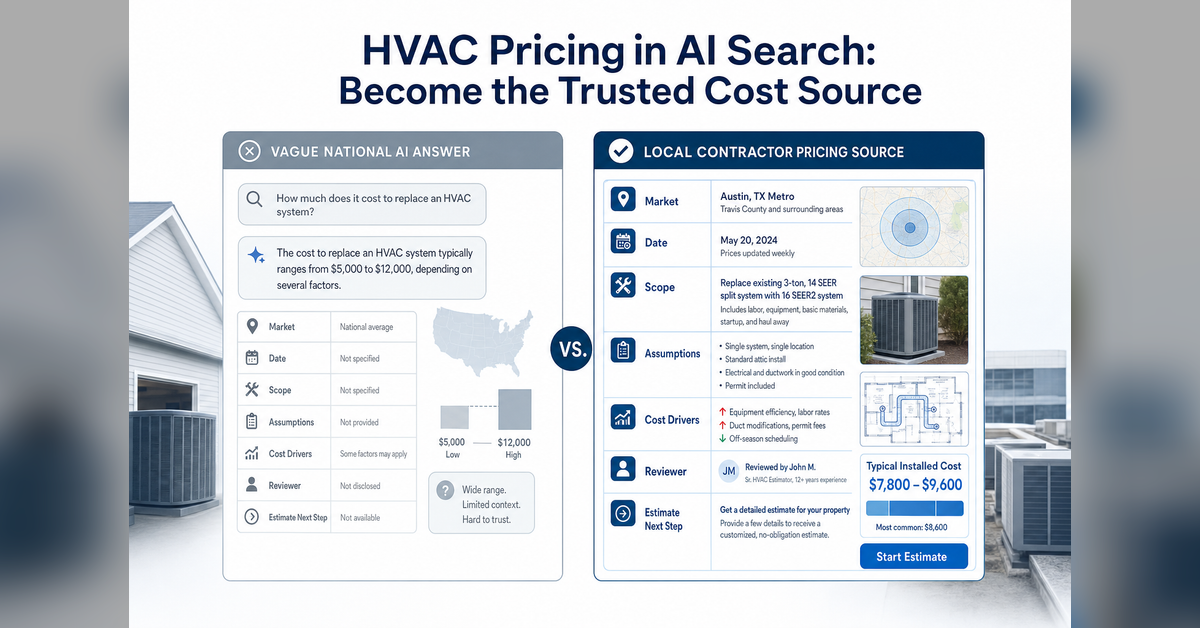

HVAC pricing AI search is the practice of publishing local, scoped, and reviewable cost information that search engines and AI assistants can retrieve. The goal is not to post the lowest number. It is to explain what a planning range includes, what changes it, and when a buyer needs a real estimate.
This guide is for HVAC owners, executives, marketers, sales leaders, estimators, and multi-location operators. It shows how to answer cost questions without turning a general range into a false quote, a margin problem, or a source of avoidable sales friction.
Built for accountable AI Search strategy
HVAC AI Search uses the same technical, content, authority, and conversion disciplines as AI Search in other industries, tailored to local service areas, buyer questions, and contractor economics.




What is hvac pricing ai search?
HVAC pricing AI search helps a contractor become a reliable source for cost questions by publishing a dated local range, its assumptions, inclusions, exclusions, price drivers, reviewer, and path to a scoped estimate.
A useful answer helps the buyer plan. It does not claim to diagnose equipment, calculate a final project price, or replace field review.
How much does HVAC AI Search cost?
HVAC AI Search uses Percepture’s standard AI Search and generative engine optimization pricing. The right plan depends on how many services, markets, buyer questions, pages, and authority signals need to be built and measured.
Mention this article when you meet with Percepture. New qualifying AI Search engagements receive 10% off the monthly program fee for the first six months.
Starting prices are subject to final scope. The article offer applies to new qualifying AI Search engagements, must be mentioned during the initial strategy conversation, and cannot be combined with another discount.
How Percepture helped OPTK reach #1 in 48 hours
OPTK Networks is a telecom and AI-infrastructure example, not an HVAC performance guarantee. It shows how Percepture combines search intent, industry language, authority, content, and conversion strategy to move quickly in a specialized market.
Executive summary
Publish conditions, not one cheap number
A price without market, scope, date, and exclusions creates an anchor that sales and operations may have to undo.
Separate answer types
A national benchmark, local planning range, scoped estimate, and binding proposal serve different jobs in hvac pricing ai search.
Use one governed source
Marketing, sales, service, finance, and operations should work from the same hvac pricing ai search definitions and update process.
Measure business value
Track hvac pricing ai search accuracy, qualified estimates, booked work, revenue, and margin. Citation counts alone do not show return.
Who this guide is for
Owner or CEO
You want hvac pricing ai search authority and lead quality without inviting a race to the lowest advertised price.
CFO
You need hvac pricing ai search governance, clear measurement, and protection against stale or misleading public numbers.
Marketing and sales
You need hvac pricing ai search content that earns attention while preparing buyers for a productive estimate conversation.
Estimator or operator
You need hvac pricing ai search content to state what is included, what changes the range, and when the range should not be used.
Why AI-generated HVAC price answers go wrong
An HVAC price question often looks simple but hides several decisions. The buyer may mean repair, replacement, installation, maintenance, emergency service, or a commercial project. The property, system, market, access, urgency, and required work can all change the answer.
National averages can remove the local context that makes a number useful. A residential replacement guide may also be applied to a commercial property even though the scope, approval path, controls, access, and commissioning needs are different.
AI systems may retrieve information from several sources and may interpret related questions around the original prompt. ChatGPT search can rewrite a prompt into more targeted searches, while location can affect search behavior. That makes clear market and service-area language important for hvac pricing ai search.
The most common failure is range-versus-quote confusion. A buyer sees a number, assumes it covers the whole job, and carries that assumption into the sales call. The contractor then has to explain missing ductwork, controls, permits, access work, disposal, electrical work, or other scope items.
Planning ranges in hvac pricing ai search
A planning range is not a quote. Each hvac pricing ai search answer type should state its owner, inputs, limits, and next step.
| Answer type | Purpose | Certainty | Inputs | Owner | Update frequency | Main risk | Best CTA |
|---|---|---|---|---|---|---|---|
| National benchmark | Early hvac pricing ai search education | Low | Broad category and general location | Publisher | When source data changes | Treated as a local price | View local assumptions |
| Local planning range | Budget preparation | Moderate | Market, service, system type, base assumptions | Contractor marketing and operations | After a material price or scope change | Treated as a complete estimate | Prepare for an estimate |
| Scoped estimate | Project evaluation | Higher | Property, equipment, site conditions, labor, options | Estimator or service team | Per project and validity period | Missing field conditions | Review estimate details |
| Binding proposal or change order | Authorize defined work | Highest within stated terms | Approved scope, terms, exclusions, schedule, changes | Authorized contractor representative | When approved scope changes | Unwritten assumptions | Approve or request revision |
The Percepture HVAC Price Trust Engine
The HVAC Price Trust Engine is a five-part method for turning a vague cost question into a local, scoped, evidence-backed answer. It makes hvac pricing ai search more useful to buyers while keeping the line between education and estimating clear.
1. Scope the question
Define the hvac pricing ai search service, property type, service area, system type, urgency, buyer stage, and known equipment details. Separate residential, light-commercial, commercial, and critical-facility questions instead of blending them.
2. Build the range
State the market and date for the hvac pricing ai search range. List the base assumptions, inclusions, and exclusions. Address items such as tax, permits, disposal, access, crane work, ductwork, electrical work, gas, controls, financing, warranty, after-hours labor, and commissioning when they apply.
3. Explain the drivers
Show why the number changes. Common categories include capacity, efficiency, configuration, airflow, electrical or gas work, controls, access, labor, permits, code, equipment availability, warranty, and commissioning.
4. Prove the source
Identify the hvac pricing ai search reviewer, methodology, last-updated date, service area, applicable credentials, model context, and correction process. Project examples should state their market, date, scope, method, and limits.
5. Convert the uncertainty
Give the buyer an estimate-preparation checklist and explain what the contractor needs to quote accurately. Connect form, phone, scheduling, estimate, booked-job, revenue, and margin data where the business has permission to do so.
Proof should explain its limits
A proof asset should say what was measured, where, when, and how. It should also say what the example does not prove. A non-HVAC example can demonstrate a method, but it cannot prove that an HVAC company will achieve the same outcome.



Score your current pricing source
Use the Lead Quality Diagnostic to examine whether your public hvac pricing ai search content prepares buyers for a useful sales conversation.
Run a Lead Quality DiagnosticWhat changes an HVAC price?
Residential and light-commercial drivers
Start with the service requested and the condition of the existing system. Equipment capacity, efficiency, configuration, ductwork, airflow, electrical service, gas work, access, permits, labor, disposal, warranty, and scheduling can affect scope.
A strong hvac pricing ai search source groups these drivers in plain language. It does not assign unsupported percentages or imply that every factor applies to every project.
Commercial and critical-facility drivers
Commercial work may involve controls, rooftop or restricted access, crane coordination, phased work, operating-hour limits, redundancy, documentation, commissioning, procurement, and approvals. The answer should identify the facility type and avoid borrowing a residential range.
How much pricing should an HVAC company publish?
There is no single publication level that fits every contractor. The right format depends on how stable the service is, how often inputs change, how accurately scope can be explained, and whether the sales team can support the promise.
| Format | Buyer usefulness | Maintenance | Sales effect | Margin risk | Best fit |
|---|---|---|---|---|---|
| No public price | Low | Low | More basic cost questions | Low public anchoring risk | Highly variable or poorly governed work |
| Starting at | Low to moderate | Moderate | Sets a minimum expectation | Can anchor buyers to the floor | Standard entry scope with clear limits |
| Narrow range | High when scope is stable | High | Supports stronger qualification | Higher if exclusions are weak | Repeatable services with controlled inputs |
| Wide range | Moderate | Moderate | Explains variability | Lower when drivers are clear | Projects with several common configurations |
| Calculator | High if inputs are sound | High | Creates an interactive planning step | High if presented as an estimate | Teams with maintained logic and caveats |
| Full pricebook | Varies | Very high | Can shorten some conversations | High when context or governance is weak | Defined offerings with strict ownership |
For many contractors, hvac pricing ai search works best with a local planning range plus strong assumptions. That gives buyers useful direction without publishing a universal price.
How to structure a trusted HVAC cost answer
- Question: State the exact service and market question.
- Short answer: Give the planning answer in plain language.
- Market and date: Identify where and when the information applies.
- Assumptions: Describe the base property, system, access, and service conditions.
- Range: Label it as a planning range rather than a quote.
- Inclusions: List what the range covers.
- Exclusions: List common items that require separate scope.
- Drivers: Explain what can move the number.
- Limits: State when the answer should not be used.
- Reviewer and source: Name the qualified reviewer and methodology.
- Last updated: Change the date only when the content is reviewed.
- Estimate CTA: Explain what information is required next.
This format makes hvac pricing ai search easier to audit because every important statement has a defined context and owner.
How local SEO and entity clarity support pricing
Pricing content should agree with the contractor’s public business facts. Service areas, services, hours, business name, contact information, licenses where applicable, and location details should be consistent across the site and maintained profiles.
Local pages should add real market information rather than swap city names into the same copy. Reviews can also reveal recurring buyer concerns, such as clarity, punctuality, communication, and whether the final scope matched expectations.
Use organic SEO services to connect useful cost content with sound page architecture. Contractors can also review broader SEO for construction companies principles without duplicating the pricing strategy on separate city or prompt pages.
Clear entities strengthen hvac pricing ai search by helping readers and retrieval systems understand which company, market, service, and property type the answer describes.
How GEO and AI search use pricing sources
Google states that its AI search features use core Search systems. Pages still need sound technical access, index eligibility, useful content, and normal snippet eligibility. Google also says there is no special AI schema that makes a page appear in its AI features.
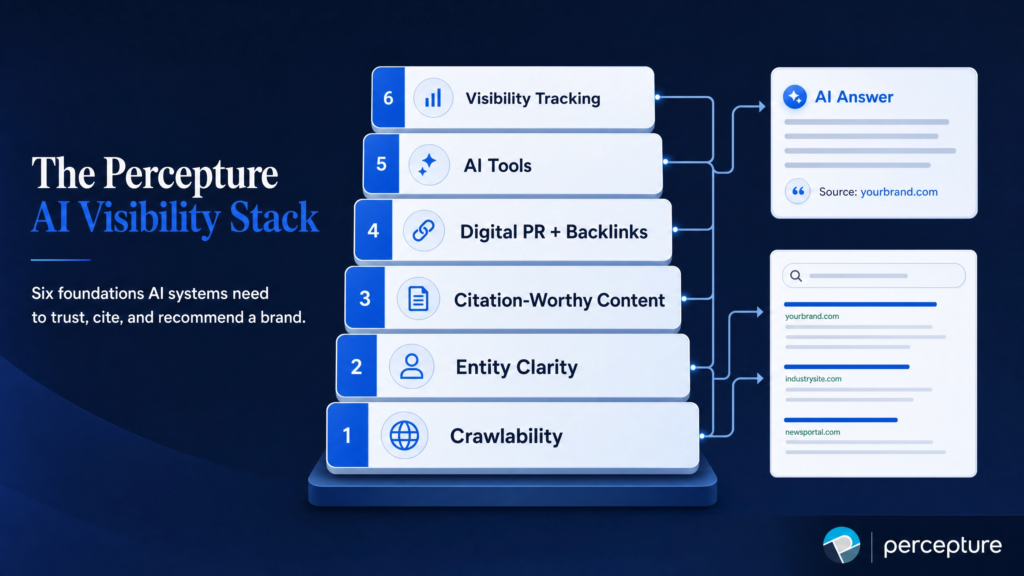
A technical SEO audit service can examine crawl access, indexing signals, internal architecture, response errors, and other barriers. Generative engine optimization services then address how facts, entities, answers, and corroborating sources work together.
GEO does not replace SEO. It adds source clarity, answer testing, entity consistency, and conversion analysis. No schema type, file, agency, or page structure can guarantee a citation or recommendation.
That is why hvac pricing ai search should be treated as a governed publishing system, not a markup trick. The source must remain useful even when an AI answer does not display it.
Contractors planning deeper educational assets can connect this work with content marketing for construction and an integrated omnichannel marketing strategy.
Why digital PR, reviews, and third-party sources matter
Digital PR services can help qualified experts contribute useful commentary to trade, local, manufacturer, utility, and business coverage. The goal is real corroboration, not planted mentions.
Third-party sources should support claims they are qualified to discuss. A utility may explain a program. A manufacturer may document equipment specifications. A licensing or government source may address rules. A contractor should explain the local field and estimate context it owns.
Purchased reviews, fake forum conversations, and unsupported studies create risk. Reliable hvac pricing ai search depends on consistent facts that can survive human review, not a large count of weak mentions.
For a wider authority plan, combine earned coverage with public relations strategy and relevant owned content rather than treating links as the only outcome.
How pricing content should convert
Good pricing content does not replace the estimate. It teaches the buyer what the estimate must include and what information the contractor needs next.
A quote path can ask for service type, location, property type, system details, urgency, known issues, and whether public ranges or an internal pricebook already exist. A short form may suit simple services. A multi-step path may suit larger or commercial projects.
Mobile usability, privacy language, phone access, scheduling choices, and clear response expectations reduce friction. Conversion rate optimization services can test the path, while guidance on digital marketing for construction companies helps connect the page to wider demand programs.
CRM fields should preserve the original source, market, service, estimate outcome, booked-job status, revenue, and margin information the company is authorized to use. This turns hvac pricing ai search from a visibility project into a measurable buyer journey.
How to measure HVAC pricing visibility
| Layer | What to track | What it answers |
|---|---|---|
| Technical access | Index status, crawl response, internal link discovery, eligible pages | Can search systems access the source? |
| Search visibility | Queries, impressions, clicks, landing pages, branded demand | Are relevant buyers discovering the content? |
| AI-answer quality | Answer presence, citation, factual accuracy, source diversity, market match | Is the retrieved answer useful and correct? |
| Engagement | Table use, scorecard clicks, CTA activity, form starts, calls | Does the source help the buyer take a next step? |
| Commercial outcome | Qualified leads, estimates, appointments, close rate, booked revenue, gross profit | Does the work support profitable demand? |
Citation count alone is not ROI. A cited answer can still be inaccurate, reach the wrong market, or produce poor-fit inquiries.
Use attribution and analytics to connect sessions and assisted interactions with later outcomes. Pair that work with lead generation services so visibility and demand quality are reviewed together.
A repeatable hvac pricing ai search baseline should record the prompt, platform, mode, date, market, result, cited source, factual accuracy, referral, and next test.
Review the investment path
Compare Percepture pricing options before selecting an hvac pricing ai search audit, strategy engagement, or integrated program.
Review Pricing OptionsA practical 90-day plan
Days 0 to 30: Establish the baseline
Audit hvac pricing ai search buyer prompts, existing sources, technical access, pricing pages, local entities, reviews, forms, calls, and tracking. Document factual errors and unclear scope.
Days 31 to 60: Build the source
Publish or improve the core hvac pricing ai search answer, assumptions, reviewer information, internal links, estimate path, and update process. Use paid search when appropriate to test pricing language against immediate demand without treating ad results as organic proof.
Days 61 to 90: Test and improve
Repeat prompts across controlled variables. Review accuracy, source diversity, sales feedback, lead quality, conversion friction, and weak sections. Refresh content only when the underlying evidence or market changes.
The plan does not promise a citation date. It gives hvac pricing ai search a defined owner, test protocol, correction path, and commercial measurement model.
Common mistakes to avoid
- Publishing one national number as if it applies to every local job.
- Hiding assumptions, exclusions, or the date of the range.
- Mixing residential and commercial scope.
- Copying an aggregator without documenting the source and method.
- Leaving incentives, products, or policy statements unchanged after the facts move.
- Publishing field terminology without qualified HVAC review.
- Creating one thin page for every prompt or city variation.
- Assuming schema or a crawler file guarantees an AI citation.
- Treating one screenshot as durable performance proof.
- Reporting traffic without estimates, booked work, revenue, or margin context.
Each mistake weakens hvac pricing ai search because the answer becomes harder to trust, maintain, or use during an estimate conversation.
Why Percepture
Percepture was founded in 2004. Its public service model brings together SEO, GEO, digital PR, paid media, content, conversion, lead generation, and analytics.
That integrated view fits hvac pricing ai search because the problem crosses several teams. Technical access affects retrieval. Content determines clarity. PR and third-party sources support authority. Conversion paths shape lead quality. Analytics connects attention to business outcomes.
The operating principle is proof before promotion. Start with the source, define what it can support, record its limits, and measure what happens after the buyer reaches the page.
Contractors comparing broader acquisition options can also review Percepture’s contractor SEO agency guide.
Frequently asked questions
What is hvac pricing ai search?
It is a contractor-side method for publishing scoped cost information that search engines, AI systems, and buyers can understand. A reliable hvac pricing ai search answer includes the market, date, assumptions, range, inclusions, exclusions, price drivers, reviewer, limits, and estimate path.
Should HVAC companies publish prices?
Some should publish planning information, but the right hvac pricing ai search format depends on service stability, local variation, maintenance capacity, and margin risk. A contractor does not have to publish one low number. A dated range with clear conditions may be more useful than either silence or a full public pricebook.
Can ChatGPT give an accurate HVAC estimate?
ChatGPT can summarize available hvac pricing ai search information, but a generated answer is not a field estimate. Accuracy depends on the prompt, location, available sources, scope details, and current facts. Buyers should use online answers for planning and obtain a contractor’s scoped estimate before making a project decision.
Why do HVAC replacement quotes vary?
Quotes may reflect different equipment, capacity, efficiency, ductwork, electrical or gas work, controls, access, permits, labor, warranty, commissioning, and exclusions. The right comparison is not just the final number. It is the complete scope, assumptions, terms, and responsibilities behind that number.
How should a contractor publish an HVAC price range?
For hvac pricing ai search, state the service, market, date, assumptions, range, inclusions, exclusions, major price drivers, reviewer, update date, and situations where the range should not be used. Label it as planning information and explain what the company needs to prepare a scoped estimate.
Does price transparency hurt margins?
It can when a bare number becomes a negotiation anchor. Scoped transparency works differently. It explains why prices vary and helps buyers compare complete work. The company should monitor lead quality, close rate, booked revenue, gross profit, and sales feedback rather than judging the policy by traffic alone.
Can schema make an AI system cite HVAC prices?
No. Structured data can help machines understand eligible page information, but it does not guarantee a citation, recommendation, or ranking. Google states that there is no special AI schema. The visible page, technical access, source quality, entity clarity, and supporting evidence still matter.
How is HVAC pricing visibility measured?
Measure hvac pricing ai search crawl and index status, search visibility, answer presence, citations, factual accuracy, source diversity, branded demand, AI referrals, calls, estimates, appointments, close rate, booked revenue, gross profit, and assisted conversions. Use repeated tests because AI answers and source selection can vary.
How much does HVAC AI Search cost with Percepture?
Percepture’s current AI Search and GEO packages start at $3,500 per month for Launch, $6,000 per month for Growth, $8,500 per month for Authority, and $10,000 or more per month for Enterprise. Mention this article during your first strategy conversation to receive 10% off the monthly program fee for the first six months on a new qualifying AI Search engagement. This is a gift from Bob.
Build your hvac pricing ai search baseline
Percepture can start with a data and access list, document the hvac pricing ai search prompt and source baseline, review the findings, and outline a focused 90-day plan. Implementation can follow after the priorities, owners, and measurement rules are clear.
Book a Strategy Conversation
Meet with Percepture and map the right plan
Bob Generale is President of Percepture. He works on executive strategy across SEO, GEO, public relations, paid media, conversion, and measurement. Percepture was founded in 2004.