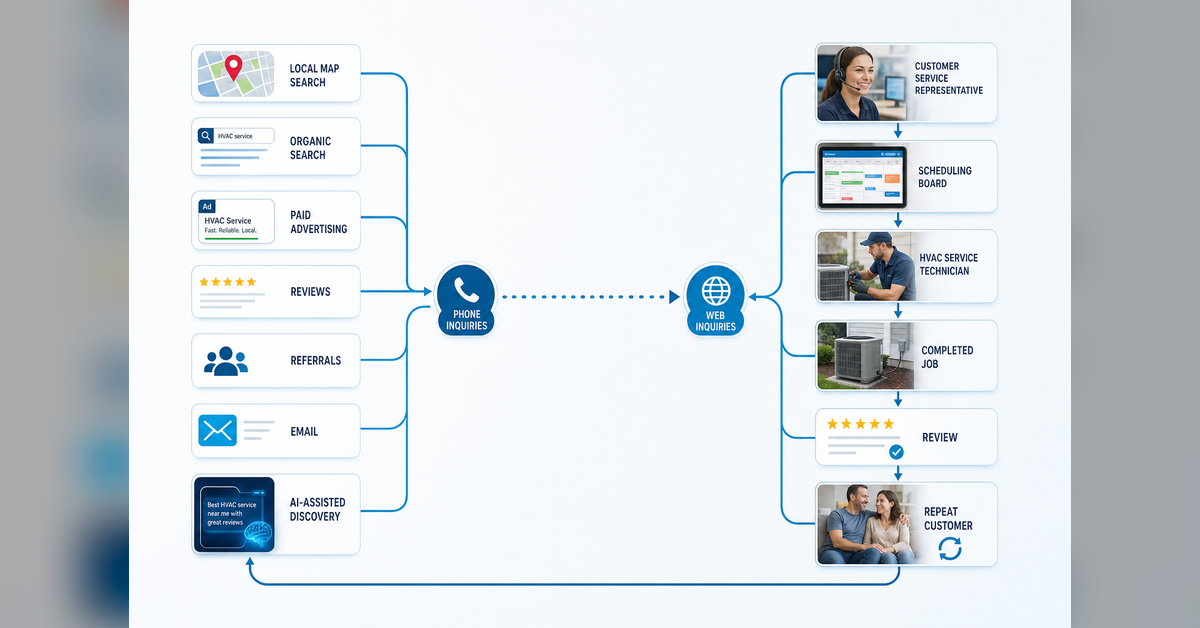

HVAC lead generation should bring in work your company wants and can fulfill. That means matching demand to service area, job type, technician skill, schedule, margin, and the customer experience after the first call or form.
More traffic will not repair missed calls, weak qualification, overbooked crews, or disconnected reporting. Fix those leaks first, then invest in the channels that can produce qualified, booked, completed, and profitable work.





What creates a reliable flow of HVAC jobs?
HVAC lead generation is the process of attracting homeowners or commercial buyers, earning trust, capturing a call or request, qualifying the opportunity, and turning it into booked and completed work. The strongest system blends owned channels, paid demand, referrals, fast response, service-area rules, CRM follow-up, and reporting that connects each source to real jobs.
The operating view
Choose the work
Define the services, markets, buyers, hours, skills, capacity, margin, and exclusions before creating demand.
Fix the handoff
Treat hvac lead generation as a shared system across marketing, customer service, dispatch, sales, operations, and finance.
Balance the mix
Use fast paid sources alongside owned assets such as the website, reviews, customer data, content, referrals, and brand.
Measure the job
Follow each inquiry through valid, contacted, qualified, booked, completed, paid, repeat, and referred stages.
How hvac lead generation should work
A practical hvac lead generation program starts with a clear definition of a lead. A valid lead has usable contact information, relevant intent, and no agreed invalid condition. A qualified lead also fits the company’s geography, services, buyer rules, timing, and next-step requirements.
That definition should be identical in the CRM, call review process, dispatch workflow, sales pipeline, dashboard, and finance report. If marketing calls every form a lead while operations excludes half of them, the company cannot compare sources or make sound budget decisions.
Percepture’s lead generation services approach the problem as a connected customer journey. Visibility creates the opportunity, but response, qualification, booking, delivery, and retention determine its business value.
Lead qualification scorecard
This scorecard gives marketing and operations one hvac lead generation standard for separating valid inquiries, qualified opportunities, booked work, and completed jobs.
| Stage | Residential test | Commercial test | Record in the system |
|---|---|---|---|
| Valid | Usable contact and relevant request | Usable account or contact information | Source, time, contact path, validity |
| Qualified | Service area, supported need, decision role, reachable next step | Facility, geography, need, role or influence, plausible timing | Fit fields, exclusions, next action |
| Booked | Appointment accepted under current capacity rules | Meeting, site review, or scoped next step accepted | Date, owner, service or opportunity stage |
| Completed | Work performed and completion status recorded | Agreed project or service milestone completed | Outcome, revenue status, loss or exception reason |
The HVAC Demand-to-Booked-Job Operating System
For hvac lead generation to remain controlled as demand changes, Percepture uses an eight-stage methodology. Each stage has an owner, a first metric, and a failure condition. The control layer covers access, service levels, lead rules, exceptions, testing, account portability, and scale, fix, hold, or stop decisions.
Eight stages from demand to completed work
The stages show where hvac lead generation creates value, where operational leakage occurs, and which owner must correct the first measurable failure.
| Stage | Primary duty | First metric | Common failure |
|---|---|---|---|
| 1. Choose profitable demand | Set service, market, buyer, capacity, skill, margin, hours, and exclusions. | Target-job definition | Generating work the company cannot or should not fulfill |
| 2. Build owned visibility | Improve the site, profiles, reviews, content, local evidence, relationships, and brand. | Qualified owned inquiries | Thin pages with weak proof or no clear action |
| 3. Capture active intent | Use local search, paid search, directories, referrals, calls, forms, and outreach. | Valid inquiry rate | Buying demand without targeting or exclusions |
| 4. Convert with trust | Match the message to the service, area, proof, buyer question, and next step. | Qualified conversion rate | Increasing form volume while lowering fit |
| 5. Respond and route | Assign an owner, backup, alerts, after-hours path, escalation, and human option. | Contacted lead rate | Missed calls, slow response, or broken routing |
| 6. Qualify and book | Apply residential or commercial fit rules and agree on a real next action. | Booking or accepted-opportunity rate | Counting every call or meeting equally |
| 7. Complete and learn | Connect dispatch, estimate, completion, payment, source, profit, and loss reason. | Completion rate | Optimizing raw lead cost instead of completed work |
| 8. Retain and compound | Build reviews, referrals, memberships, renewals, reactivation, and useful customer data. | Repeat and referred work | Ending acquisition work after one invoice |
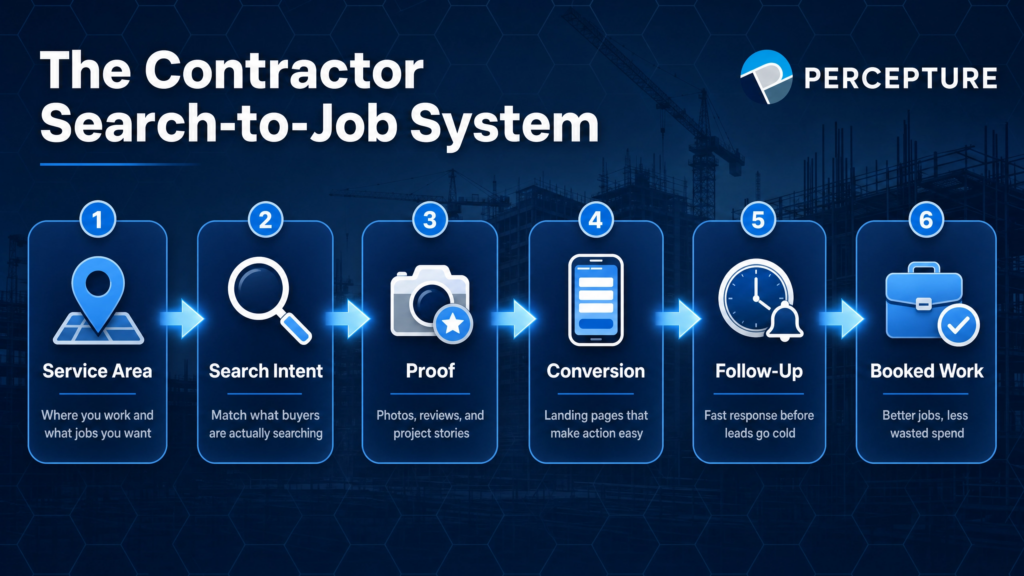
Find the first lead-quality gap
Score your current hvac lead generation process against target work, source quality, response, qualification, booking, completion, and account ownership.
HVAC lead generation channel comparison
A channel earns budget when it fits the buyer, job, market, capacity, speed requirement, and ownership goal. A sound hvac lead generation mix usually includes fast demand capture and slower assets that compound. It should not depend on one platform, marketplace, or campaign.
Lead-source decision matrix
Use the matrix to compare hvac lead generation sources by buyer intent, speed, asset ownership, operating prerequisites, and the first metric that can support a budget decision.
| Source | Intent and speed | Ownership | Prerequisite | First useful metric | Common failure |
|---|---|---|---|---|---|
| Business Profile and local search | High local intent; speed depends on existing visibility | Partial, with compounding reputation | Accurate services, areas, hours, categories, reviews, photos, links, and call handling | Qualified calls and bookings by location | Fake locations or unanswered calls |
| Organic search | High through educational intent; slow to medium | High and compounding | Technical health, service pages, local relevance, expert content, proof, links, and conversion paths | Qualified organic calls, forms, and assisted jobs | Traffic without service or geography fit |
| Local Services Ads | High active intent; fast after eligibility and setup | Low to medium | Accurate profile, services, markets, responsiveness, budget, and policy compliance | Valid rate, qualified rate, bookings, and completed jobs | Counting every charged contact as qualified |
| Paid search | High and controllable; fast | Medium when the company controls accounts and data | Queries, negatives, geography, schedule, tracking, landing pages, definitions, and budget | Qualified leads and bookings by campaign | Broad targeting and click-only reporting |
| Referrals and reviews | High trust; medium and compounding | High | Strong service, clear requests, issue handling, tracking, and lawful practices | Qualified referrals and assisted conversions | Passive requests or manipulation |
| Email, SMS, and reactivation | Fast with a clean permissioned customer list | High | Consent, segmentation, suppression, timing, history, and a human response path | Qualified replies, appointments, renewals, and reactivated work | One message for every customer |
| Content and digital PR | Research and trust; medium to long | High for owned content | Original expertise, useful evidence, distribution, links, and a relevant action | Qualified visibility, citations, links, and assisted inquiries | Generic content with no information gain |
| AI search and GEO | Research, comparison, and discovery; variable | The company owns its facts, not the answer interface | Crawlable expert content, entity clarity, accurate profiles, evidence, and measurement | Accurate mentions, citations, referrals, and assisted pipeline | Optimizing for one prompt or promising inclusion |
| Commercial outbound and partnerships | Proactive B2B pipeline; medium | High when relationships and data remain portable | Ideal accounts, roles, triggers, proof, approved outreach, CRM handoff, and sales ownership | Qualified conversations, site reviews, opportunities, and stage progress | Counting contacts, sends, or meetings as revenue |
Local visibility requires real operating facts, and local hvac lead generation depends on those facts remaining accurate. Distinct market pages should reflect actual services, areas, climate needs, capacity, projects, reviews, and conversion paths. Thin city pages do not solve a weak local offer. Use the principles in Percepture’s guide to digital marketing for contractors to connect search, reputation, content, and conversion.
Organic demand takes longer to build, but the company controls more of the asset. Strong programs combine organic SEO services, technically sound service pages, local evidence, and useful expert content. Construction firms can also apply the market and proof principles in this guide to SEO for construction companies.
Paid demand can create faster hvac lead generation signals when targeting and tracking are sound. Percepture’s paid search services connect query selection, exclusions, geography, schedule, landing-page fit, conversion tracking, and source quality. The company should control its ad accounts, billing access, tracking numbers, audiences, creative, and exports.
Trust-building content supports search, sales, referrals, and AI discovery. Useful field explanations, maintenance guidance, project evidence, buyer answers, and commercial use cases can be built through content marketing services. The same information-gain rules appear in Percepture’s guide to content marketing for construction.
Authority also comes from credible third-party visibility. Digital PR services can support expert commentary, useful research, earned references, and discoverable evidence. Social content then gives buyers more ways to see real people, real work, and practical education. See the related guide to social media marketing for construction companies.
How to fund hvac lead generation
Do not assign hvac lead generation budget using a universal cost-per-lead target. Compare each source using company-defined stages and the same cost rules. Include acquisition spend, incremental handling costs, completed work, direct job cost, cancellations, repeat value, and source concentration.
| Demand model | What the company gains | Main tradeoff | Best use |
|---|---|---|---|
| Rented demand | Faster access to active buyers | Visibility can stop when spend stops or platform access changes | Urgent capacity, controlled market tests, and high-intent services |
| Owned demand | Website, content, customer data, brand, reviews, and direct relationships | Requires time, upkeep, and operating discipline | Long-term market strength and reduced source dependence |
| Compounding demand | Continuing value from rankings, reviews, referrals, memberships, and relationships | Results build unevenly across markets | Stable acquisition, retention, and seasonal resilience |
| Blended portfolio | Speed plus durable assets | Requires shared definitions and cross-channel reporting | Companies with clear capacity controls and accountable owners |
Match the playbook to the buyer and operating model
The right hvac lead generation plan differs across residential service, commercial sales, and multi-location operations. Residential buyers often need a fast mobile path from search to call or short form. Commercial buyers may research for weeks or months before a site review, scope, proposal, procurement step, or contract.
Residential, commercial, and multi-location fit
Residential HVAC
Residential hvac lead generation should prioritize local search, Business Profile visibility, paid demand, reviews, referrals, memberships, reactivation, and simple mobile conversion paths.
Qualify location, service, property, urgency, system, decision role, and availability.
Commercial HVAC
Commercial hvac lead generation can use search, content, digital PR, partnerships, referrals, account research, email, events, and commercial outreach to build an opportunity pipeline.
Qualify account, facility, geography, system, need, role, scope, timing, procurement, and next action.
Multi-location and PE
Multi-location hvac lead generation requires one metric dictionary followed by separate market diagnosis. Compare capacity, reviews, competition, source quality, completion, cost, and margin.
Standardize measurement language without forcing every location into the same channel mix.
Residential hvac lead generation must follow the dispatch board. The team should know which job types, ZIP codes, technician skills, hours, and appointment slots are available before campaigns scale. Commercial teams need opportunity stages and detailed handoffs rather than residential booked-job reporting.
Large portfolios may need enterprise SEO services to manage shared standards, market differences, permissions, templates, and reporting. Portfolio averages should not hide a weak location, broken call path, or unprofitable service mix.
Seasonal capacity controls
| Period | Demand focus | Operating check | Decision |
|---|---|---|---|
| Pre-season | Prepare pages, profiles, budgets, campaigns, staffing, offers, phone coverage, nurture, and tracking. | Confirm areas, services, parts, schedule, negatives, routing, and expectations. | Prepare, repair, and test. |
| Peak heat or cold | Prioritize urgent local visibility and available high-value work. | Watch missed calls, response, bookings, cancellations, drive time, workload, and reviews. | Scale, hold, shift, or pause by capacity. |
| Shoulder season | Promote tune-ups, maintenance, memberships, indoor air quality, planned replacement, commercial inspections, and dormant estimates. | Segment customer history and avoid sending one offer to everyone. | Reactivate, retain, and build owned demand. |
Seasonal hvac lead generation should never create false urgency or promise service the company cannot provide.
Compare the investment before adding channels
Review hvac lead generation service options after the company has defined target work, capacity, funnel stages, ownership, and the first leak to fix.
Fix capture, response, and booking before scaling
Every hvac lead generation source should lead to a dependable contact path. At minimum, support phone, click-to-call, a short residential form, a commercial form, and an accessible message path. Offer online scheduling only when the schedule, service area, and follow-up process are reliable.
A short form can ask for name, contact method, ZIP code, residential or commercial need, service, urgency, and a brief description. Ask for equipment, property, facility, role, timing, or scope only when the information will change routing, qualification, or the next action.
Response and booking checklist
- Name the primary owner and a backup for every hvac lead generation inbound path.
- Define after-hours handling and emergency escalation without making unsupported promises.
- Capture source, campaign, first-response time, outcome, and loss reason.
- Stop automated sequences when a person replies or an exception appears.
- Code spam, vendors, job seekers, repeat callers, wrong markets, valid leads, qualified leads, bookings, cancellations, completed jobs, and losses.
- Confirm service area, next-step expectations, instructions, reminders, and rescheduling options.
- Send commercial sales the account, facility, role, need, timing, source, content viewed, and agreed next action.
Landing-page changes should improve fit, not just form volume. Percepture’s conversion rate optimization work aligns page message, proof, calls, forms, routing, and the next step. Automation can support alerts, summaries, routing, and follow-up, but it cannot repair an undefined process.
Governed AI sales agents can assist a defined workflow when allowed actions, data access, human escalation, logs, and stop conditions are clear. They should not invent prices, availability, service areas, credentials, diagnoses, guarantees, or customer promises.
Measure hvac lead generation through completed work
Raw traffic, calls, and forms are early signals. To judge hvac lead generation, connect audience, visit, inquiry, valid, contacted, qualified, booked, estimate or site review, completed, paid, profitable, repeat, and referred stages. Record known, estimated, modeled, and unavailable values separately.
Core funnel formulas
These formulas evaluate hvac lead generation using consistent denominators from initial validity through completed work and owned-demand contribution.
| Metric | Formula | What it diagnoses |
|---|---|---|
| Valid rate | Valid leads divided by all recorded leads | Source and targeting quality |
| Qualification rate | Qualified leads divided by valid contacted leads | Buyer, service, and market fit |
| Booking rate | Booked jobs divided by contacted qualified leads | Response, trust, availability, and booking execution |
| Completion rate | Completed jobs divided by booked jobs | Scheduling, cancellation, dispatch, and fulfillment |
| Cost per qualified lead | Attributable acquisition cost divided by qualified leads | Cost of useful opportunities |
| Cost per booked job | Marketing plus incremental handling cost divided by booked jobs | Acquisition and office efficiency |
| Cost per completed job | Marketing plus incremental handling cost divided by completed jobs | Source value after operational leakage |
| Owned-demand share | Qualified leads from owned sources divided by all qualified leads | Dependence on rented platforms |
Attribution rules should define first touch, meaningful assists, branded return visits, existing customers, duplicates, repeat calls, offline sources, and the reporting window. Percepture’s attribution and analytics work helps connect channel activity to pipeline and business outcomes without treating uncertain values as facts.
A practical 90-day implementation plan
The first 90 days should make hvac lead generation easier to control, not add a large stack of disconnected campaigns. Start by defining the work, repairing measurement and response, then run focused tests with clear scale conditions.
Four operating sprints
- Days 1 to 15: Define and find leaks. Choose target work, markets, margins, capacity, and exclusions. Audit hvac lead generation sources, profiles, reviews, calls, forms, CRM stages, tracking, response, ownership, missed calls, and loss reasons. Produce a source inventory, funnel map, metric dictionary, access list, and five priority leaks.
- Days 16 to 30: Fix the foundation. Repair routing, tracking, service areas, hours, profile facts, conversion paths, CRM stages, mobile experience, review requests, referral steps, reactivation, and response ownership. Produce a measurement-ready funnel and prioritized conversion backlog.
- Days 31 to 60: Run controlled tests. Improve or launch selected sources. Test one market, service, offer, page, audience, or leak at a time where practical. Review queries, calls, forms, qualification, bookings, cancellations, and capacity each week.
- Days 61 to 90: Connect work and profit. Link bookings to completion and finance where possible. Compare fast, owned, and compounding sources. Scale, hold, fix, or stop by market and service. Build the next seasonal and retention plan.
A smaller company should first track and answer inquiries, repair local facts and reviews, improve service-page truth, activate referrals and existing customers, test one paid source, and build organic assets. A broader omnichannel marketing program makes sense when the company can coordinate message, capacity, customer data, media, conversion, and measurement.
HVAC lead generation mistakes that waste budget
Most hvac lead generation waste starts when channel spending expands before response, capacity, qualification, measurement, or asset ownership is under control.
- Buying more demand before fixing response. Extra calls have little value if nobody owns them or routing fails.
- Using one definition for every contact. A spam call, repeat customer, wrong-market request, qualified opportunity, and booked job are not equal.
- Ignoring capacity. Campaigns should respond to appointment supply, technician skill, geography, hours, drive time, and margin.
- Reporting only cost per lead. A lower-cost source can still produce fewer completed or profitable jobs.
- Building thin local pages. Local content needs real services, market facts, proof, operating details, and conversion paths.
- Letting vendors own core assets. Keep company-controlled administration and exports for the domain, website, analytics, profiles, ad accounts, numbers, CRM data, creative, and customer lists.
- Treating software as strategy. Software can route a defined process. It cannot define the right market, offer, qualification model, or operating discipline.
- Automating an unclear process. Automation should follow tested rules, human escalation, consent controls, and exception handling.
How AI search fits the demand system
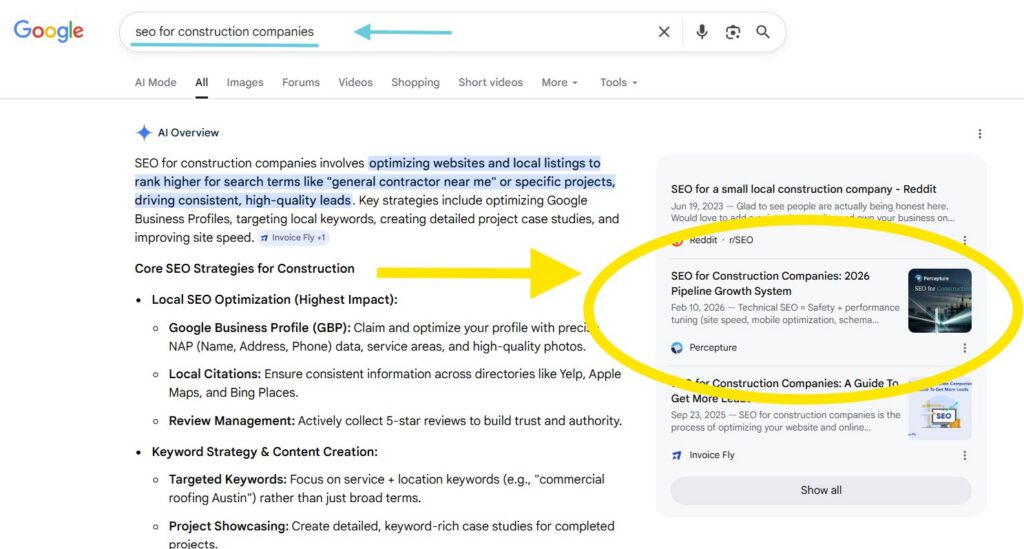
AI search can support research, comparison, and discovery. It does not replace technical SEO, useful pages, accurate business facts, credible evidence, or a strong conversion path. Google’s AI search guidance emphasizes established search fundamentals and helpful, accessible content.
Percepture’s generative engine optimization services focus on crawlable expert answers, clear entities, structured facts, useful media, and evidence that answer systems can interpret. No company controls whether an answer engine cites or recommends a page.
AI can strengthen hvac lead generation by helping organize content, route known requests, summarize calls, prepare follow-up, and identify missing data. The workflow still needs source controls, review rules, approved actions, privacy safeguards, logs, and a human path.
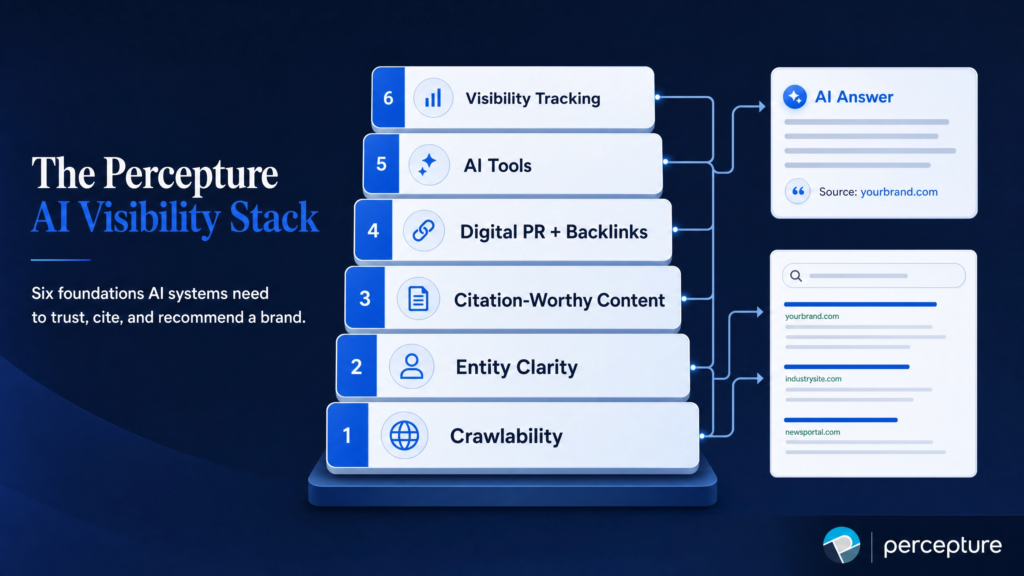
How Percepture handles proof
Percepture was founded in 2004 and combines search, GEO, digital PR, paid media, content, analytics, conversion, lead generation, and AI workflows. Its operating method connects visibility, trust, response, pipeline, and measurement.
Every performance example should include a source, period, definition, baseline, endpoint, attribution method, permission, and limitation. Without that support, the result does not belong in a buyer guide.

When outside help makes sense
Outside hvac lead generation help can be useful when the company lacks a shared funnel definition, channel ownership, measurement, response controls, specialist capacity, or time to coordinate the work. The buying decision should start with the business problem and operating gap, not a fixed channel package.
An agency review should cover target work, residential and commercial emphasis, service areas, capacity, source access, lead rules, call handling, CRM stages, data ownership, reporting, testing, and exit portability. Percepture’s guide to selecting a B2B SEO agency offers related questions for evaluating strategy, access, proof, and accountability.
Frequently asked questions
What is HVAC lead generation?
HVAC lead generation is the process of attracting a relevant residential or commercial buyer, earning trust, capturing contact information, qualifying fit, and moving the opportunity toward booked and completed work. A complete system includes channel selection, response, routing, qualification, booking, delivery, measurement, retention, and referrals.
How can HVAC companies generate leads?
HVAC companies can use local search, organic search, paid search, Local Services Ads, reviews, referrals, customer reactivation, email, social content, partnerships, commercial outreach, digital PR, and AI-search visibility. The best starting point depends on service mix, market, capacity, buyer type, speed, tracking, and existing assets.
What is the best HVAC lead source?
There is no universal best source for hvac lead generation. The right source produces qualified work that fits the company’s services, geography, capacity, skill, margin, and response process. Compare sources using valid rate, qualification, booking, completion, cost, profit, retention, ownership, and concentration risk rather than raw form volume alone.
How can an HVAC company get leads without buying them?
Owned hvac lead generation can come from useful service pages, local visibility, accurate profiles, reviews, referrals, memberships, customer reactivation, email, expert content, partnerships, community relationships, and brand demand. These sources still require time and investment, but they can reduce dependence on rented platforms.
Are Local Services Ads useful for HVAC companies?
They can provide access to high-intent local buyers when the provider is eligible and the profile, services, markets, budget, reviews, responsiveness, tracking, and lead-review process are managed well. Google explains that Local Services Ads can generate calls, messages, and other lead interactions. Evaluate valid, qualified, booked, and completed outcomes.
How can HVAC companies create slow-season demand?
Use tune-ups, maintenance, memberships, indoor air quality, planned replacements, heat-pump education, commercial inspections, dormant estimate follow-up, referrals, reviews, and permissioned customer reactivation. Pre-season work should also repair pages, profiles, tracking, phone coverage, campaigns, routing, and staffing before demand peaks.
What makes an HVAC lead qualified?
A qualified residential lead fits the service area, supported need, decision role, reachable next step, and company exclusions. A qualified commercial lead fits the account, facility, geography, need, role or influence, plausible timing, scope, and agreed next action. Both definitions should match CRM and reporting rules.
How should HVAC lead generation be measured?
Measure inquiries through valid, contacted, qualified, booked, completed, paid, profitable, repeat, and referred stages. Track source, response, qualification, booking, cancellation, completion, revenue, direct job cost, loss reason, repeat value, and owned-demand share. Document attribution rules and separate known values from estimates or modeled values.
When should an HVAC company hire an agency?
Consider an agency when internal teams cannot coordinate search, paid demand, content, conversion, response, analytics, data ownership, and testing. A suitable partner should define responsibilities, access, reporting, lead rules, proof standards, capacity controls, and exit portability before expanding the channel mix.
Build your hvac lead generation plan
HVAC lead generation should create more than inquiries. Percepture maps the work you want, the markets you serve, the channels buyers use, the trust they need, the response process after contact, and the data required to show which sources become booked and completed jobs.
Start with the work you want, the capacity you have, and the lead leaks you can verify.