

The biggest mistakes small business owners make when using SEO are starting without a sound technical foundation, targeting demand the business cannot realistically win, publishing disconnected content, relying on generic AI output and measuring traffic instead of qualified leads.
SEO takes time to compound. When the direction is wrong, six months of visible activity can lead to more months of repairs, rewritten pages and delayed demand.




Start with direction, not more deliverables. The fastest useful decision is identifying which constraint should be fixed first.
Meet With PerceptureWhich SEO errors create the greatest risk?
The mistakes small business owners make when using SEO usually begin with poor sequencing: publishing before fixing technical problems, selecting keywords without buyer intent, scaling generic AI content, neglecting internal links and reporting traffic without tracking qualified demand. The largest risk is lost time and delayed learning.
The executive summary
A sound small-business SEO program follows six operating priorities.
Foundation first
Indexation, page templates, tracking, forms and navigation must work before publishing scales.
Choose winnable demand
Search volume matters less than buyer intent, commercial value, competition and fit.
Build useful coverage
A service page may need supporting answers, comparisons, proof and buyer guidance.
Direct the AI
AI can speed research and production. It cannot supply missing business judgment.
Add authority
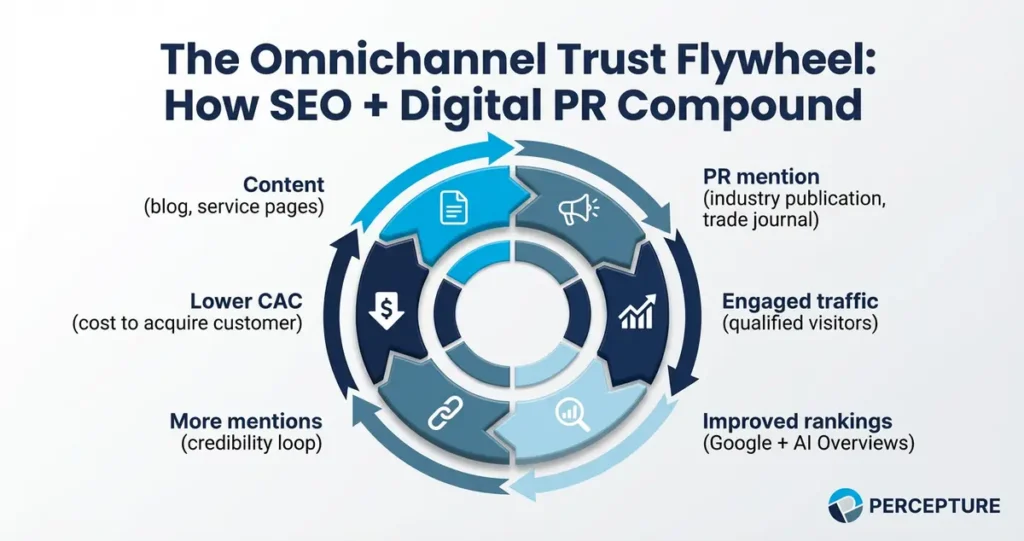
Content, internal links, earned media and relevant mentions should support the same priorities.
Measure demand
Rankings become commercially useful when they create qualified actions and attributable sales opportunities.
Who this guide is for
This guide is for an owner, CEO or marketing leader who needs to identify the SEO problems after trying DIY SEO, hiring a low-cost provider, using ChatGPT to produce content or receiving reports that do not explain business impact.
You are publishing but not progressing
The site has more pages, yet priority services are not gaining meaningful visibility.
You cannot explain the plan
No one can name the revenue pages, realistic opportunities or next implementation priorities.
You cannot trace demand
Rankings and sessions are reported, but calls, meetings, opportunities and sales are disconnected.
These warning signs often appear together because the SEO problems are usually system problems, not isolated title-tag errors.
The real danger is the lost year
The monthly fee is only one part of SEO risk. A weak program also costs missed leads, delayed learning, wasted content, rework and the authority competitors continue to build while the business waits.
The most expensive pattern is activity without a decision system. Articles are published because a calendar says they are due. Keywords are selected because a tool reports volume. Links are acquired without deciding which commercial page should benefit.
That is why the SEO failures must be diagnosed in order. Repairing a form will not solve poor targeting, and publishing another article will not fix a page that search engines cannot reliably index.
Find the three SEO mistakes costing you visibility
Compare your website against the foundation, opportunity and conversion criteria in this guide to identify the SEO problems before adding more pages to the publishing calendar.
Common small-business SEO questions
What should a small business fix first?
Fix crawlability, indexation, mobile forms, analytics and navigation before scaling content. Publishing more pages cannot repair a site that search engines or customers cannot use reliably.
Should SEO target the highest-volume keywords?
No. Prioritize buyer intent, service fit, commercial value, competition, location and the authority required to compete.
Can AI write an entire SEO strategy?
AI can assist research and production. A person still needs to supply business data, choose priorities, verify facts and approve what is published.
Does AI search replace traditional SEO?
No. Crawlable pages, clear entities, useful answers and credible outside support remain foundational across search and AI-answer systems.
How long should a business wait for results?
Set implementation, visibility and strategy review points in advance. Patience should be tied to completed work and leading indicators, not open-ended waiting.
What should SEO reporting measure?
Track the path from query and landing page to call, form, meeting, opportunity and sale. Traffic alone does not show whether the program created qualified demand.
12 Mistakes Small Business Owners Make When Using SEO
These errors usually compound. Fix them in sequence so technical repairs, content, authority and conversion support the same commercial priorities.
Publishing before fixing the foundation
A content calendar cannot compensate for crawl barriers, accidental noindex settings, duplicate URLs, weak templates, broken navigation or forms that fail on mobile. Publishing onto an unstable website adds inventory before the storefront works.
This is one of these SEO errors because content feels visible and productive. Technical repair happens behind the scenes, yet it determines whether pages can be found, understood and converted into action.
Better move: Audit crawlability, indexation, templates, mobile usability, analytics and conversion paths before increasing output. A focused technical SEO audit can organize those repairs by impact.
Choosing keywords by volume instead of business value
A large search volume can hide mixed intent, national competitors, directories and visitors who are researching without any buying need. The bigger number is not automatically the better opportunity.
Score a target by buyer intent, relevance, current position, revenue potential, competitive pressure, geographic fit and the authority required. A lower-volume service query can be more useful when it closely matches what the company sells. This scoring discipline exposes these SEO errors before resources are committed to an unrealistic target.
Better move: Map keywords to revenue pages and buyer needs. Use an enterprise SEO strategy when the website has many services, locations, templates or competing stakeholders.
Ignoring striking-distance opportunities
A striking-distance page already earns impressions and often ranks near the first page or within it. It has provided evidence that the topic and URL may be relevant, although no movement is assured.
These SEO errors often include abandoning these pages while chasing entirely new keywords. Existing pages may benefit from a clearer title, a stronger answer, better proof, useful internal links or outside authority.
Better move: Improve pages that have already earned a reason to be considered. Review the query, landing page and competing results before deciding what to change.
Trying to rank one page without building the topic
A service page may need support from definitions, pricing guidance, comparisons, use cases, locations, FAQs, case studies and buyer questions. Those assets help readers complete due diligence and clarify how the subject fits together.
A low-competition term may need one excellent page. A competitive service may require a complete cluster. The required scope depends on intent, competition, existing authority and the quality of the current site. Defining that scope helps prevent these SEO errors from turning into a calendar of unrelated articles.
Better move: Build supporting content around a commercial priority rather than publishing unrelated articles. Percepture’s content marketing services connect editorial coverage to buyer questions and revenue pages.
Using AI as the strategist
AI does not automatically know the company’s Search Console data, margins, sales objections, lead quality, website history, competitive limits or current priorities. A polished response can still point the team in the wrong direction.
Among these SEO errors, this one scales quickly. AI accelerates the direction it is given. It does not make a weak direction safe.
AI is useful for organizing research, comparing pages, drafting, finding gaps and repurposing expert knowledge. Experienced people still need to set targets, review facts and decide what deserves to be published.
Better move: Use human-directed systems and connect traditional search work with generative engine optimization services where AI-search visibility matters.
Scaling generic AI content
More pages do not automatically create authority, trust, citations or leads. Repetitive content can consume editorial time while adding little that a customer or search system could not find elsewhere.
Useful content adds information gain through direct experience, customer questions, examples, data, expert commentary, case studies, clear sourcing or a defensible point of view. The issue is not AI assistance; it is unreviewed, interchangeable output. Requiring a distinct buyer question and evidence standard keeps these SEO errors from multiplying through automated production.
Better move: Give every page a defined buyer question, evidence standard and commercial role. Remove pages that duplicate stronger answers without serving a distinct intent.

Treating SEO and AI search as separate programs
Google Search, Google AI Overviews, ChatGPT search, Gemini, Perplexity and Claude offer different experiences. That does not remove the need for crawlable pages, clear entities, useful answers and credible support.
These SEO errors now include creating an isolated “AI strategy” that ignores technical SEO and the website’s commercial structure. No schema type can guarantee an AI citation.
Better move: Build one evidence-led search program, then measure visibility by platform where reliable data is available. The guide to evaluating generative AI SEO agencies explains what buyers should compare.
Neglecting internal links and anchor text
Internal links help people discover related answers, clarify topic relationships and direct attention toward priority pages. A generic anchor such as “learn more” gives less context than a natural description of the destination.
These SEO errors also include forcing the same exact-match anchor across the site. Good linking varies language naturally and reflects how users describe the subject.
Better move: Use relevant query language from Search Console when it fits the sentence. Connect education to proof, pricing and the next buyer decision.
Competing with franchises on their terms
Large competitors may have years of links, reviews, locations, branded demand, content, media coverage and larger budgets. Copying their broad keyword strategy can force a small business into an expensive contest.
Narrow the battlefield by service, location, audience, industry, problem or comparison. A focused position gives the business a clearer answer to build and a more realistic group of competitors to study. This narrower choice corrects these SEO errors by matching the search plan to the company’s actual competitive position.
Better move: Own a defendable part of the landscape before expanding it. Local operators can see how that positioning works on Percepture’s Tampa SEO agency page.
Ignoring digital PR and outside authority
A company cannot validate every claim by repeating it on its own website. Earned media, relevant links, expert interviews, reviews, testimonials, partnerships and independent mentions can provide outside context.
PR and SEO work better when they support the same commercial categories. A disconnected publicity win may build awareness but provide little support for the pages the company needs buyers to find. Aligning authority with priority pages prevents these SEO errors from separating publicity activity from commercial search goals.
Better move: Align digital PR services and public relations strategy with priority topics, proof gaps and revenue pages.
Measuring traffic instead of qualified demand
The commercial path is query → landing page → call or form → meeting → opportunity → sale. Sessions and rankings describe the top of that path, not whether the business received a qualified outcome.
One of the costliest SEO errors is stopping the report at traffic. Lead quality, sales acceptance, close rate, revenue and source attribution reveal whether visibility is reaching the right people.
Better move: Connect search data with attribution and analytics. Review identifiable AI referrals separately, but do not treat a form submission as success until lead quality is assessed.
Stopping too early or staying wrong too long
Patience does not mean passive waiting. A responsible program should complete planned implementation and monitor leading indicators such as indexation, impressions, new queries, ranking movement, engagement, qualified actions and authority growth.
These SEO errors include cancelling before the work can compound and continuing indefinitely without evidence. Both decisions become easier when milestones and review points are set in advance.
Better move: Review implementation around 30 days, visibility signals around 60 days and strategic direction around 90 days. These are review points, not ranking promises.
The Lost-Year Search-to-Sales Framework
The framework organizes small-business SEO mistakes into five connected decisions. Its purpose is to stop disconnected activity from consuming months without creating a measurable path to qualified demand.
Foundation
Confirm crawlability, indexation, technical clarity, templates, analytics and conversion paths.
Opportunity
Prioritize buyer intent, commercial value, striking-distance rankings, competition, geographic fit and probability of movement.
Coverage
Build revenue pages, supporting answers, comparisons, pricing guidance, FAQs, case studies, locations and internal links.
Authority
Add digital PR, earned links, reviews, testimonials, expert commentary and third-party mentions where relevant.
Conversion
Measure calls, forms, meetings, opportunities, lead quality, revenue and source attribution.
Buying isolated articles or links may address one part of the system, but it does not automatically repair the other four.
Calculate the opportunity cost without inventing a forecast
The financial effect of a weak SEO direction depends on the company’s real lead volume, close rate and gross profit. A simple diagnostic can make that risk visible without presenting a guarantee.
Five missed qualified leads per month × 20% close rate × $5,000 average gross profit × 12 months = $60,000.
Illustrative example only. Actual results depend on lead volume, lead quality, close rate and customer value.
DIY or expert support for SEO problems
Use the matrix to decide whether the internal team can correct the SEO problems or whether guided execution would reduce implementation risk.
| Situation | DIY may work | Guided execution is safer | Agency support is recommended |
|---|---|---|---|
| Competition | Weak local competition and one narrow service. | The market has several established local competitors. | Franchises, directories or national brands control the results. |
| Website | A simple brochure site with stable templates. | The site has several services, locations or content owners. | Ecommerce, migrations, redesigns or indexing problems are involved. |
| Expertise | One person can research, write, implement and measure. | The team can execute but needs priorities and review. | No one owns both strategy and implementation. |
| Timeline | Learning time carries little financial risk. | Progress matters, but internal work is possible. | Each month without qualified demand has a material cost. |
| Tracking | Calls, forms, meetings and revenue are attributed. | Some tracking works, but sales feedback is inconsistent. | The business cannot connect marketing activity to sales. |
| Authority | Competitors have weak pages and limited outside support. | Content is competitive but authority is uneven. | Established brands and strong domains dominate page one. |
| AI use | An experienced person reviews strategy and facts. | AI assists production under an external process. | AI selects targets and publishes without supervision. |
| Previous failure | The team knows what went wrong and can correct it. | The diagnosis is incomplete but implementation is possible. | Six months or more have passed without a clear explanation. |
Eight-question SEO direction scorecard
Use this scorecard to see whether the SEO problems are present in the current program. Give one point for each question the team can answer clearly and support with evidence.
- 1Which three pages should create the most revenue?
- 2Which queries are already within striking distance?
- 3Are the priority pages indexed and internally reachable?
- 4Does each priority page serve one clear buyer need?
- 5Which supporting questions must the site answer?
- 6Why should a buyer or search system trust each answer?
- 7What should happen after an organic visitor lands?
- 8Can the business connect a query to a lead and a sale?
7–8 clear answers
The program has a structured direction. Focus on disciplined execution and measurement.
4–6 clear answers
Important gaps remain. Correct priorities before increasing production.
0–3 clear answers
More publishing may increase cost without correcting the direction.
The score measures decision clarity rather than activity, helping the team prioritize the SEO problems that are affecting revenue pages, buyer coverage or attribution.
For a practical execution model, review what an SEO sprint includes.
Cost and timing for correcting SEO problems
Compare the work before comparing the price. A smaller scope can be appropriate when it addresses the highest-impact constraint. A cheap plan becomes expensive when the work must be discarded or rebuilt.
A right-sized program should match the SEO problems with the technical priorities, opportunity mapping, revenue-page optimization, internal linking, supporting content, reporting and strategic direction required to correct them. The scope changes with website size, competition, implementation capacity and authority needs.
| Work type | What it should clarify | Timing expectation |
|---|---|---|
| Technical repairs | Indexation, templates, navigation, tracking and conversion barriers. | Some fixes can be implemented quickly, but impact varies by issue. |
| Striking-distance optimization | Whether an existing page can answer intent more clearly and credibly. | Movement may appear in days or weeks, with no assured position. |
| New-market growth | New pages, topic coverage and competitive differentiation. | New sites and competitive markets may require months. |
| Authority building | Relevant mentions, links, reviews and independent proof. | Authority usually compounds over a longer period. |
No responsible provider can assign one timeline to every keyword. Compare current SEO pricing packages, broader Percepture pricing options and the scope of a focused SEO sprint before selecting a model.

Not sure whether the problem is technical, strategic or conversion-related?
Percepture can review the website, priority services, striking-distance opportunities, content, authority and tracking before more time is committed to the wrong work.
- Identify the first three repairs
- Separate realistic opportunities from distractions
- Connect visibility to qualified demand
What happens when visibility is connected to qualified demand?
Broadstaff Global’s supplied public case-study materials report that 90% of tracked keywords reached page one and qualified leads increased threefold within 12 months. The work connected SEO, AI-search visibility, content and authority around qualified demand rather than traffic alone.

“What they’ve done for Broadstaff has been really nothing short of miraculous.”
Carrie Charles, Broadstaff Global
The result demonstrates why the measurement chain matters and offers a contrast to the a disconnected SEO program: visibility must be assessed against the quality of the demand it creates. Read the Broadstaff search visibility case study or the related B2B SEO case study.
See how search visibility became qualified leads
Review the Broadstaff program to compare the common SEO failures with an approach that connected page-one visibility, authority and measurement to demand rather than treating them as separate deliverables.
Why Percepture treats SEO as a search-to-sales system
Percepture approaches the SEO failures as connected failures across technical SEO, content, GEO, digital PR, analytics and conversion. Correcting only one component can leave the commercial problem in place.
- Understand the business and its sales economics.
- Identify the pages tied to priority revenue.
- Find realistic opportunities and current visibility.
- Repair the technical and conversion foundation.
- Build useful coverage around the priority topic.
- Strengthen outside authority where the market requires it.
- Measure qualified demand and sales feedback.
- Improve the system based on evidence.
The operating principles are proof before promotion, human-directed AI, right-sized execution and search working with PR. For broader acquisition planning, see Percepture’s omnichannel marketing services and conversion rate optimization services.
What happens after a strategy conversation?
1. Review
Percepture reviews website condition, priority services, existing visibility, competitive pressure and current tracking.
2. Prioritize
The team identifies immediate repairs, striking-distance opportunities, revenue pages, content gaps and authority needs.
3. Scope
The recommendation may include DIY actions, a focused sprint, a right-sized monthly program or broader SEO, GEO, content and PR support.
The first decision is which SEO problems are present and what should happen next. The process is designed to identify an appropriate scope rather than assume every business needs the same engagement.
Frequently asked questions
What are the biggest mistakes small business owners make when using SEO?
The biggest errors are starting without a technical foundation, choosing keywords by volume alone, publishing isolated or generic content, letting AI select the strategy, ignoring internal links and reporting traffic without qualified-demand attribution. The common thread is weak sequencing. A business can complete many SEO tasks while failing to improve the pages, authority and conversion paths that matter most.
Should a small-business owner do SEO without an agency?
DIY SEO can work when the website is simple, competition is limited and someone has time to research, write, implement and measure consistently. The SEO errors are harder to correct internally when the site has technical issues, multiple locations, strong competitors or unclear attribution. The decision should reflect the cost of learning time, not the assumption that every business needs an agency.
How long does SEO take for a small business?
There is no single timeline for correcting the SEO errors. Some technical repairs can produce early improvements, and an existing striking-distance page may move faster than a new page. New websites, competitive markets and authority building often require months. Review implementation, indexation, impressions, query growth and qualified actions along the way instead of waiting for one final ranking date.
Can ChatGPT do SEO for my business?
ChatGPT can assist with research, organization, drafting, comparison and repurposing. It does not automatically possess the company’s live Search Console data, margins, customer conversations, sales objections, website history or lead-quality feedback. A knowledgeable person should set the strategy, provide source material, check facts and approve publication. Without that oversight, AI can reproduce the SEO errors at greater speed.
Does AI search replace traditional SEO?
No. AI-search experiences differ from traditional search results, but useful, crawlable and credible website content remains foundational. Businesses should consider Google Search, Google AI Overviews and relevant answer platforms as connected discovery channels. Technical SEO, clear entities, strong answers and outside authority still matter. Structured data can clarify content, but it does not guarantee an AI citation.
How many articles does it take to rank for one keyword?
The answer depends on intent, competition, existing authority and the quality of the primary page. A narrow, low-competition query may need one excellent page. A competitive commercial topic may need supporting definitions, comparisons, pricing guidance, use cases, FAQs and case studies. Build the smallest useful cluster that answers the buyer’s real questions instead of choosing an arbitrary article count.
How much should a small business spend on SEO?
Budget should follow the work required, the competitive market, internal execution capacity and the financial value of qualified demand. Compare technical repair, opportunity mapping, revenue-page work, content, authority and measurement separately. A smaller focused scope may be appropriate. A low price is not a saving if the work lacks direction and must later be rebuilt.
Why are internal links important for small-business SEO?
Internal links help visitors find related answers, show how topics connect and direct attention toward priority pages. Descriptive anchors provide more context than generic phrases, but repeating the same exact-match anchor everywhere can feel forced. Use natural language, link only when the destination helps the reader and connect informational pages to relevant proof, service and decision resources.
What should small businesses track besides rankings?
Track the path from query and landing page to call or form, meeting, opportunity and sale. Useful measures include indexation, impressions, new queries, engagement, conversion actions, lead quality, sales acceptance, close rate, revenue and source attribution. These measures show whether the SEO errors are affecting visibility or the quality of demand. AI referrals can be reviewed where identifiable. A form fill should not be called a successful result until the business evaluates the lead.
What is the first SEO mistake a small business should correct?
Start with the constraint that prevents every later step from working. That is often crawlability, indexation, broken conversion tracking or a revenue page that does not match buyer intent. Fix the first blocking problem before expanding the publishing calendar.
Correct the mistakes small business owners make when using SEO before another quarter is lost
Use the form below to share the website, priority services, current provider or process and the results you expected. Percepture can help identify the first repairs, realistic opportunities and the right scope.
Prefer a direct conversation? Schedule a small-business SEO strategy review or review SEO pricing first.