

A strong B2B SEO case study should prove more than traffic growth. It should show how search visibility creates buyer trust, qualified demand, and sales conversations in markets where decisions are technical, expensive, and high risk.
This Broadstaff Global example shows how Percepture helped a specialized B2B staffing company strengthen search authority, reach page one for 90% of tracked keywords, and support 3x qualified lead growth across telecom, data center, fiber, wireless, and technical staffing categories.
What a B2B SEO Case Study Should Prove
A B2B SEO case study should show how search visibility created business outcomes, not just traffic. In this example, Percepture helped Broadstaff Global strengthen search authority, reach page one for 90% of tracked keywords, and support 3x qualified lead growth through SEO, GEO, content strategy, and proof-led positioning.
Broadstaff Is the Case Study. Complex B2B Visibility Is the Lesson.
Most B2B SEO work gets judged too narrowly. Rankings matter, but rankings alone do not prove the strategy is helping sales. In complex markets, search has to build confidence before a buyer fills out a form.
Qualified demand beats empty traffic.
The goal was not more visitors for vanity reporting. The goal was better visibility in the categories Broadstaff’s buyers actually use.
Technical markets need technical depth.
Broadstaff needed search coverage across data center, telecom, wireless, fiber, leadership, and technical staffing topics.
Proof compounds trust.
Case studies, ranking screenshots, testimonials, vertical pages, and authority content all became Trust Tokens before the sales conversation.
What Is a B2B SEO Case Study?
A B2B SEO case study is a proof-based breakdown of how search strategy improved visibility, lead quality, pipeline support, or buyer trust for a business-to-business company.
For complex B2B companies, the strongest case studies connect search performance to how buyers evaluate risk. That includes the phrases they search, the industries they care about, the proof they need, and the conversion paths that move them from research to conversation.
Built for Leaders Who Sell Expertise, Not Commodities
This guide is for CEOs, founders, CFOs, VP Marketing leaders, sales leaders, and operators who need search to support serious B2B growth. It is especially relevant if your buyers compare options slowly, involve multiple stakeholders, and need proof before they contact sales.
Telecom and data centers
Buyers search by infrastructure need, risk, urgency, geography, and technical role.
Staffing and recruiting
Search has to prove vertical knowledge, role fluency, and the ability to support specialized teams.
Complex B2B services
The buyer is not looking for generic content. The buyer is looking for confidence.
What Most B2B SEO Gets Wrong
Generic SEO chases traffic. Strong B2B SEO builds market visibility across the way buyers actually search. That difference matters in technical markets because the buyer often knows the problem before they know which vendor to trust.
The wrong approach
- Publishing broad blog posts with weak buyer intent.
- Optimizing one page and calling it a strategy.
- Separating SEO from sales proof, PR, and conversion paths.
- Reporting traffic without explaining lead quality.
The Percepture approach
- Map the buyer’s full search landscape.
- Build vertical authority around real buyer categories.
- Use proof assets to strengthen trust and conversion.
- Connect generative engine optimization services, SEO, PR, and sales intelligence.
Want to Know Where Your B2B Search Visibility Is Leaking Trust?
Percepture can review your search footprint across SEO, GEO, proof assets, technical pages, and conversion paths. The goal is to identify where buyers are searching but not finding enough confidence to take the next step.
The Client: Broadstaff Global
Broadstaff Global is a specialized B2B staffing company serving technical markets where buyers do not search casually. They search by role, project need, industry, deployment risk, and urgency.
That made Broadstaff a strong proof point for complex-market SEO. The search strategy was not built around one generic staffing keyword. It was built around category authority across telecom, data center, fiber, wireless, digital infrastructure, and technical recruiting topics.

Expertise Was Not Enough
Broadstaff had the expertise. The challenge was making that expertise easier for the right buyers to find, understand, and trust through search.
Buyers searched by industry.
Data center, telecom, wireless, fiber, broadband, and infrastructure buyers each had different search patterns.
Buyers searched by role.
Technical staffing demand often starts with role-specific searches for engineers, technicians, project managers, and field leaders.
Buyers searched by risk.
In high-stakes markets, the wrong hire can affect uptime, deployment speed, compliance, safety, and customer delivery.
The Strategy: Build Visibility Across the Buyer’s Landscape
Percepture’s strategy focused on Landscape Domination: showing up across the full buying landscape instead of relying on one keyword, one blog post, or one service page.
Data center staffing visibility
Content connected staffing to uptime, NOC support, critical facilities, AI infrastructure, edge computing, and mission-critical operations.
Fiber and broadband visibility
The strategy supported buyer intent around broadband deployment, last-mile fiber, field operations, and infrastructure reliability.
Wireless and 5G staffing visibility
Wireless content connected demand to RF engineers, FTTH technicians, wireless project managers, and telecom deployment teams.
Leadership and technical role visibility
Broadstaff needed visibility around the decision-makers and specialist roles that technical buyers search for when the stakes are high.
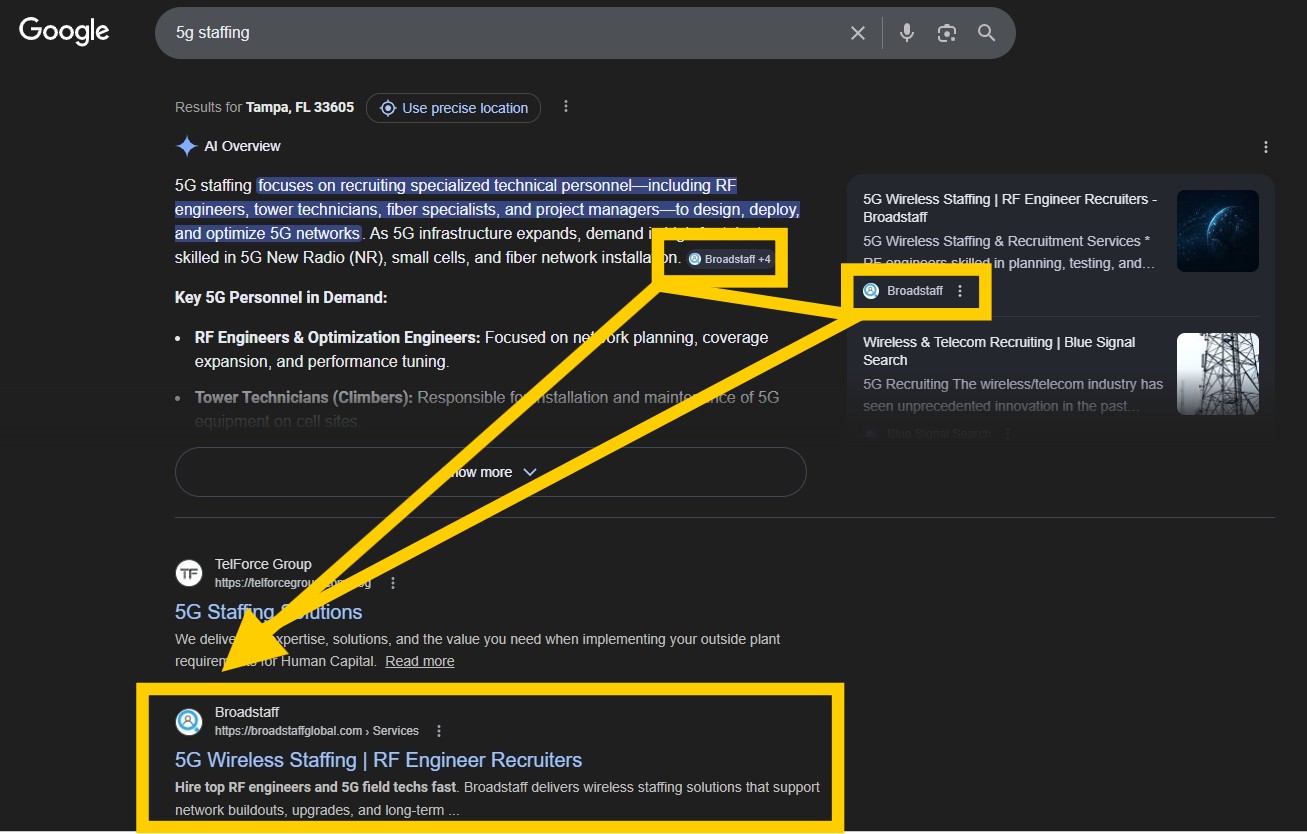
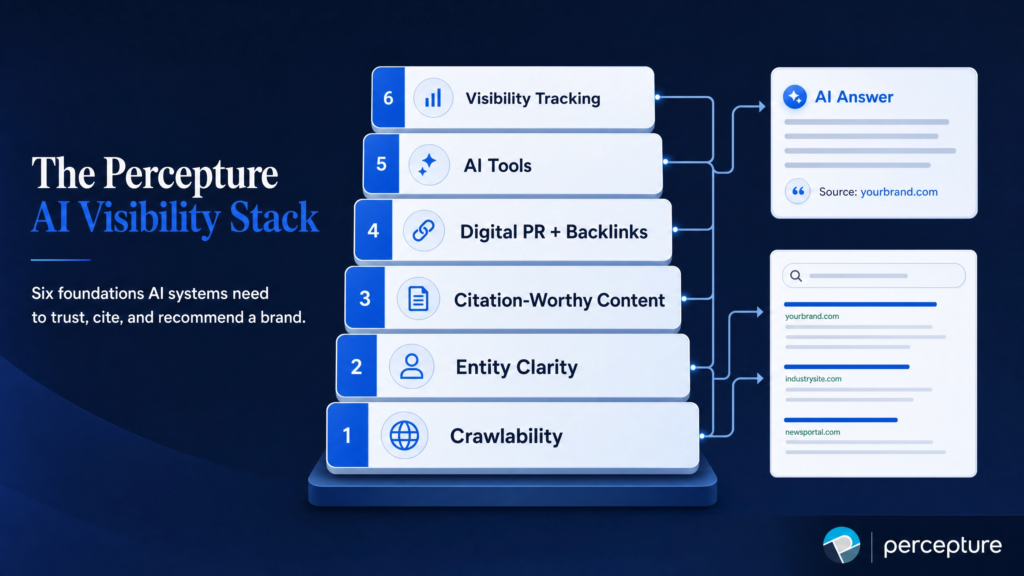
The Search-to-Trust Engine
The Search-to-Trust Engine is Percepture’s framework for turning visibility into buyer confidence. It connects rankings, AI-search visibility, case studies, testimonials, digital PR, sales intelligence, and conversion paths.
Map the buyer’s search landscape
Identify industry terms, role terms, service terms, pain terms, and proof terms.
Build vertical authority
Create pages that prove real fluency in the buyer’s market, not generic keyword coverage.
Add proof assets
Use case studies, ranking proof, testimonials, screenshots, and specific outcomes as Trust Tokens.
Connect SEO, GEO, and PR
Make the brand easier to find in Google, AI answers, industry conversations, and buyer research paths.
Convert visibility into conversations
Guide the buyer from search result to proof page to qualified next step.
Measure business relevance
Look beyond traffic and measure visibility, authority, qualified demand, and sales-readiness.
How This B2B SEO Case Study Answers Buyer Questions
AI search systems reward clear, structured information. This table turns the Broadstaff story into extractable answers for search engines, AI Overviews, ChatGPT, Gemini, Claude, Perplexity, and sales-led buyers.
| Buyer question | What Percepture did | Broadstaff proof | Why it matters |
|---|---|---|---|
| What should a B2B SEO case study measure? | Connected rankings to qualified demand, search authority, and conversion paths. | 3x qualified lead growth and 90% page-one visibility for tracked keywords. | It proves SEO supported business outcomes, not just traffic. |
| How did Percepture help Broadstaff improve search visibility? | Built content around data center, telecom, fiber, wireless, and technical staffing categories. | Broadstaff gained visibility across high-intent technical staffing terms. | Complex B2B buyers search through several paths before they trust a vendor. |
| Why does B2B SEO need GEO? | Connected SEO with AI-search visibility and entity-rich proof. | The strategy strengthened Broadstaff’s authority signals beyond standard page optimization. | Buyers now research companies through Google, AI answers, referrals, and social proof. |
| How does SEO support qualified leads? | Matched technical buyer intent to vertical pages, proof assets, and conversion routes. | Search visibility supported 3x qualified lead growth. | Better-informed buyers are more likely to become serious conversations. |
From Rankings to Qualified Leads
The strongest result was not one isolated ranking. The stronger story was that Broadstaff improved search authority, reached page one for 90% of tracked keywords, and supported 3x qualified lead growth.

See the Broadstaff Proof in Context
The full Broadstaff case study shows why complex B2B SEO has to connect search authority, proof, and qualified demand. Rankings matter more when they help a buyer believe the company understands the market.
Why This Worked for Broadstaff
The strategy worked because it matched how B2B buyers actually search. Technical buyers rarely move in a straight line from one keyword to one form submission. They research the market, compare proof, check credibility, and look for evidence that a vendor understands their world.
The content was vertical-specific.
It spoke to telecom, data center, fiber, wireless, and digital infrastructure buyers with more precision.
The proof supported the rankings.
Ranking visibility was reinforced with case-study evidence, client reaction, and sales-intelligence context.
The pages connected to conversion paths.
Search visibility was not left stranded. It pointed buyers toward proof and next steps.
That is also why technical SEO audit services, on-page strategy, authority content, and sales intelligence should work together. In complex B2B, every touchpoint is either building trust or leaking it.
What Makes This Different From Generic B2B SEO
Many SEO campaigns are designed to create content volume. Percepture builds search visibility that helps technical buyers trust the company before they raise their hand.
| Approach | What it chases | What it often misses | Best use |
|---|---|---|---|
| Traffic SEO | More sessions, more impressions, more articles. | Lead quality, buyer trust, vertical proof, and sales context. | Simple sites, publishers, or awareness-only campaigns. |
| Pipeline SEO | Qualified searches tied to pain, service need, and urgency. | AI visibility and authority signals if SEO is isolated. | B2B companies that need better sales conversations. |
| Trust SEO | Search visibility, proof, reputation, AI visibility, and conversion paths. | Nothing important when the system is maintained and refreshed. | Complex B2B markets with long cycles and high-stakes decisions. |
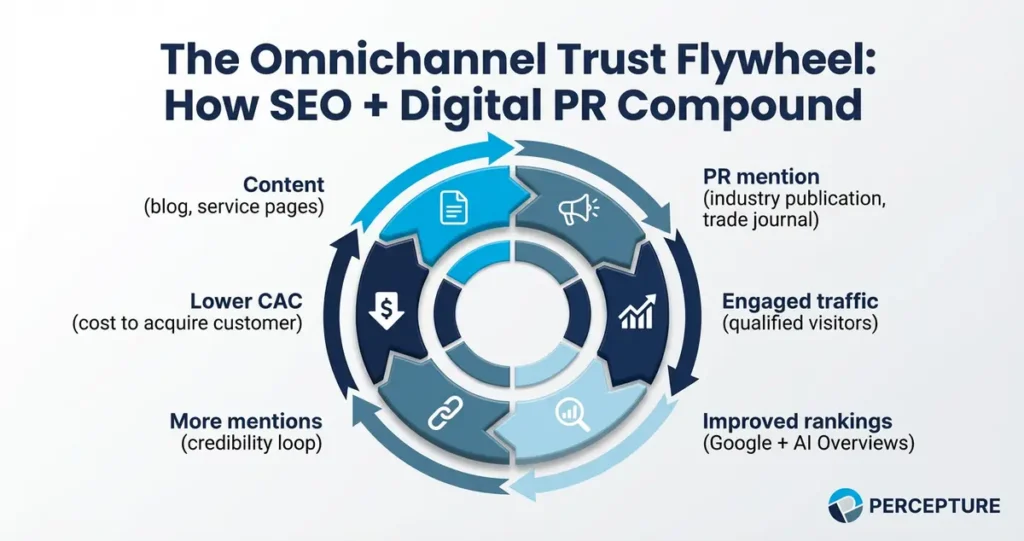
This is why Percepture connects digital PR services, SEO, GEO, and proof-led content. Buyers are not just asking whether a company ranks. They are asking whether the company deserves the conversation.
How This Applies to Other Complex B2B Companies
Broadstaff does not prove every industry works the same way. It proves that complex B2B buyers often behave the same way: they research deeply, evaluate risk carefully, involve multiple stakeholders, and need evidence before they trust a vendor.
Telecom and data centers
Buyers need infrastructure fluency, proof of operational understanding, and authority around reliability.
Construction and infrastructure
Search needs to support project trust, technical capabilities, local relevance, and proof of execution. See SEO for construction companies.
Healthcare and life sciences
Visibility must balance compliance, credibility, technical subject matter, and buyer confidence.
SaaS and technical services
Buyers compare platforms, features, pricing, reviews, integrations, and category leadership. See Percepture’s SaaS SEO agency guidance.
Private equity and portfolio companies
Search visibility can support value creation when portfolio companies need stronger positioning, demand, and authority.
Data center marketing
Search strategy needs to speak to real infrastructure decisions, not surface-level trend coverage. See the data center marketing guide.
What CEOs, CFOs, VP Marketing Leaders, and Sales Leaders Should Look For
Different leaders evaluate B2B SEO through different lenses. The best strategy should satisfy all of them.
CEO
Does this build category authority and make the company easier to trust?
CFO
Does this support qualified pipeline instead of vague awareness reporting?
VP Marketing
Can this strategy scale beyond one keyword and one campaign?
VP Sales
Are prospects better informed before they reach the sales team?
Operator
Is the content technically credible enough to survive a serious buyer’s review?
Founder
Does the strategy turn hard-earned expertise into searchable market authority?
That is where organic SEO services, GEO, digital PR, and sales intelligence become more powerful together than they are separately.
FAQs About B2B SEO Case Studies
What is a B2B SEO case study?
A B2B SEO case study is a proof-based explanation of how search strategy improved visibility, qualified demand, buyer trust, or pipeline support for a business-to-business company.
What results should a B2B SEO case study include?
It should include more than traffic. Strong B2B SEO case studies should show search visibility, ranking movement, qualified lead growth, conversion paths, proof assets, and how the strategy supported sales conversations.
How long does B2B SEO take to work?
Timelines vary by site authority, competition, content quality, technical health, and market complexity. In complex B2B, early improvements can appear in rankings and visibility, while stronger lead-quality gains usually depend on consistent execution and proof-led conversion paths.
What made the Broadstaff SEO case study successful?
The Broadstaff strategy worked because it was built around real buyer behavior. Percepture mapped technical markets, created vertical authority, added proof assets, and connected search visibility to qualified lead growth.
Why does B2B SEO need GEO?
B2B buyers now research companies through Google, AI answers, ChatGPT, Perplexity, referrals, social posts, and industry proof. GEO helps make content easier for AI systems to understand, summarize, and cite.
How does SEO support qualified leads?
SEO supports qualified leads by matching high-intent searches with credible pages, proof assets, technical relevance, and clear conversion paths. Better pages help buyers self-qualify before they contact sales.
What makes Percepture different from a traditional SEO agency?
Percepture connects SEO, GEO, digital PR, sales intelligence, proof assets, and conversion strategy. The goal is not just to rank pages. The goal is to build search visibility that increases trust and supports better business conversations.
Can this approach work for other complex B2B industries?
Yes, when the market has similar buyer behavior: long sales cycles, multiple stakeholders, technical evaluation, high switching costs, and a strong need for trust. The model applies well to telecom, data centers, infrastructure, SaaS, life sciences, healthcare, and specialized services.
Keep Building the Search-to-Trust System
Use these resources to go deeper into B2B SEO, AI search, and complex-market visibility.
Proof-Led Visibility for Complex B2B Brands
Percepture is built for companies that need more than generic SEO. The work connects market positioning, search visibility, AI visibility, digital PR, content systems, and conversion paths so buyers find proof before they talk to sales.
Work With Percepture on B2B SEO, GEO, and Search Visibility
If your company sells into a complex market, your search strategy should build trust before the first sales call. Percepture can help you map the buyer landscape, build vertical authority, strengthen AI visibility, and convert search demand into better conversations.
No guaranteed rankings. No generic traffic promises. The goal is a stronger visibility system tied to buyer trust and qualified demand.