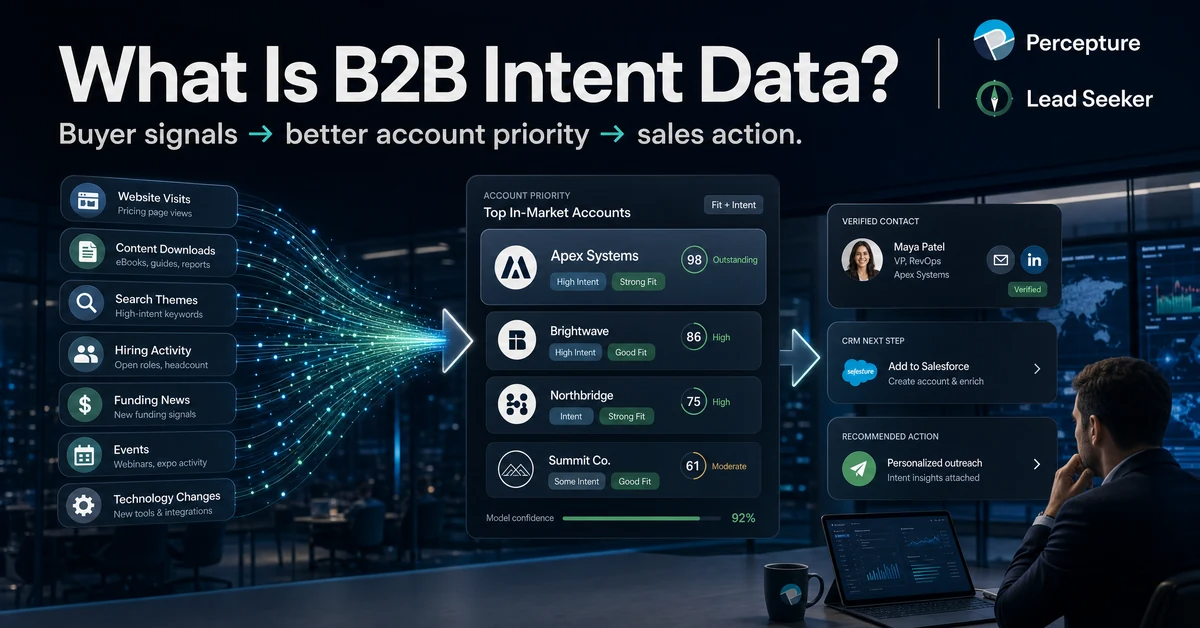

B2B intent data is information that helps sales and marketing teams see which companies may be researching a problem, product, service, vendor, or category. It can include website activity, content behavior, search themes, third-party research, public business signals, and account movement. The value is using those signals to prioritize better accounts.
This guide explains what B2B intent data is, how it works, where it fails, and how to turn buyer signals into real sales action.
Want to turn buyer signals into real sales action?
See how Percepture builds B2B intent data services for revenue teams.
Who This Guide Is For
This article is for:
- CEOs and founders evaluating sales intelligence tools
- VPs of Sales looking for better account prioritization
- VPs of Marketing building ABM or demand-gen programs
- RevOps leaders connecting data to pipeline
- Technical buyers evaluating data quality and compliance
If you want to understand what B2B intent data actually does—and what it does not do—this guide is for you.
What You’ll Learn
- What B2B intent data is
- How B2B intent data works
- The difference between first-party, third-party, and public signal data
- How sales teams use intent data
- What B2B intent data gets wrong
- How Percepture turns intent data into sales intelligence
- FAQs about B2B intent data
Definition: What Is B2B Intent Data?
B2B intent data is any information that suggests a company may be researching a topic, problem, product, or vendor. It is a probability signal, not proof of purchase intent.
Intent data can come from:
- Website visits
- Content downloads
- Search themes
- Review-site activity
- Hiring activity
- Funding news
- New facilities
- M&A activity
- Event attendance
- Technology changes
- Public company updates
The goal is to help sales and marketing teams focus on accounts that may be more likely to engage.
How B2B Intent Data Works
Most intent data follows a simple flow:
- Signal — Something changes. A company visits a page, downloads a report, or shows up in a topic cluster.
- Fit — The team checks if the company matches the ideal customer profile (ICP).
- Contact — The team identifies the right person to reach.
- Context — The team understands why this matters now.
- Action — The team decides what to do next.
This is the Signal-to-Sales Framework Percepture uses to help teams turn intent data into action.
| Step | Simple Question |
| Signal | What changed? |
| Fit | Is this company right for us? |
| Contact | Who should we reach? |
| Context | Why does this matter now? |
| Action | What should sales or marketing do next? |
Intent data is only useful when it helps the team answer all five questions.
What Are B2B Intent Signals?
A B2B intent signal is a single clue that a company may be researching a topic. Examples include:
- A target account visits your pricing page
- A company downloads a whitepaper on a topic you solve
- A company is mentioned in a topic cluster across publisher sites
- A company hires for a role related to your solution
- A company announces funding, expansion, or a new facility
- A company attends a conference in your space
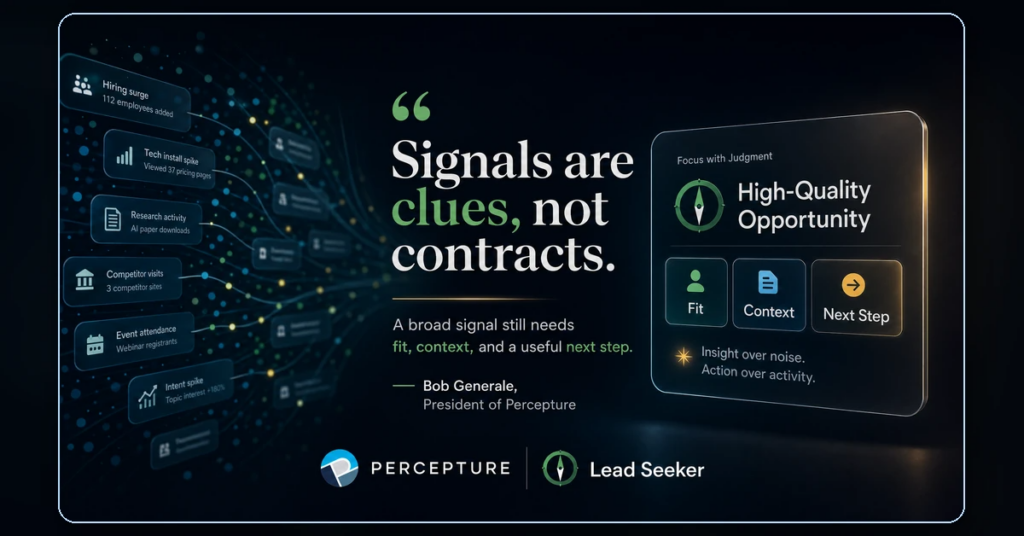
Not every signal means the company is ready to buy. Signals are clues, not contracts.
First-Party vs. Third-Party vs. Public Signal Data
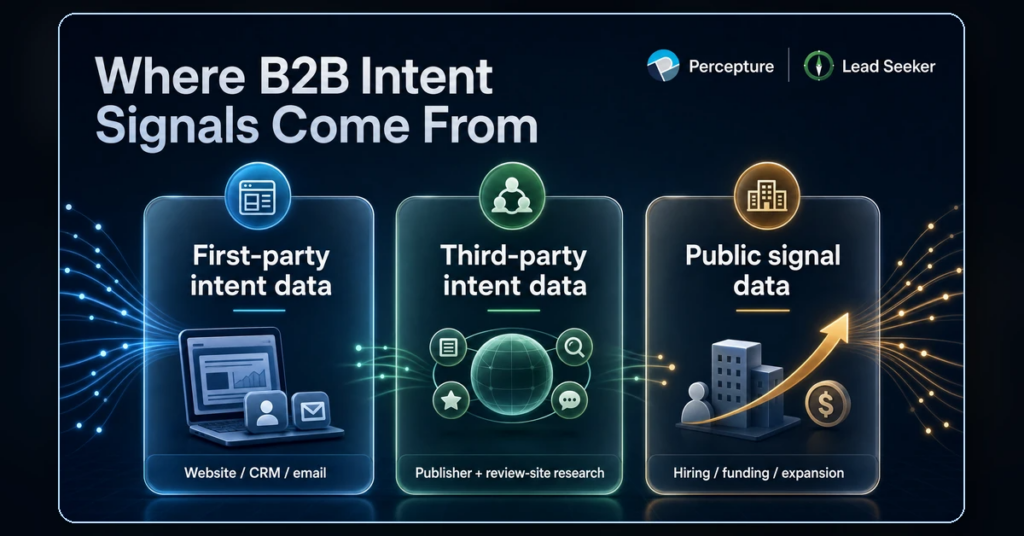
Most teams use a mix of all three. The key is knowing where the signal came from and how reliable it is.
B2B Intent Data vs. B2B Contact Data
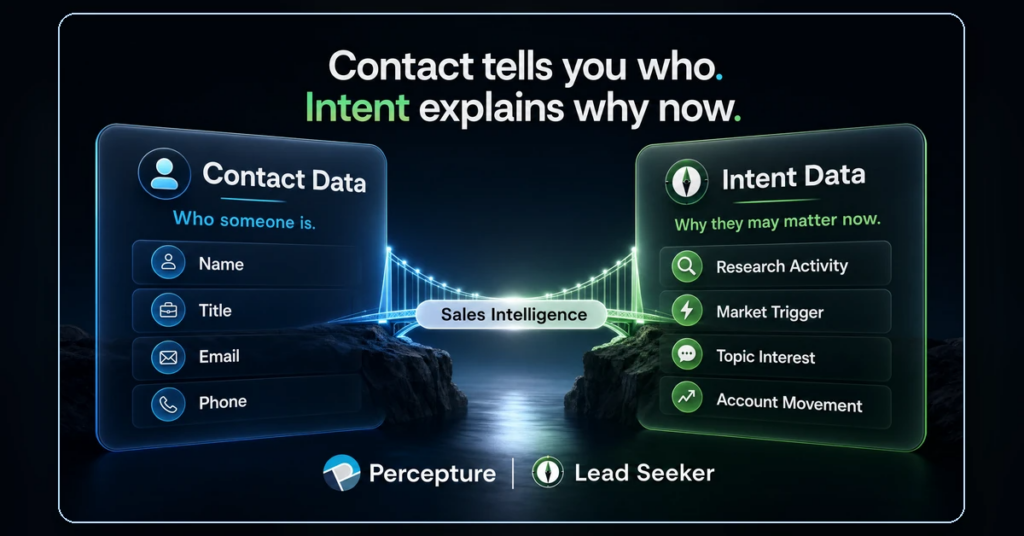
These are not the same thing.
- Contact data tells you who someone is: name, title, email, phone.
- Intent data helps explain why they may matter now: what they are researching, what changed, what signal appeared.
A contact list without intent data is just a list. Intent data without verified contacts is just a dashboard.
The best sales intelligence combines both: the right account, the right contact, and the right context.
How Sales Teams Use B2B Intent Data
Sales teams use B2B intent data to:
- Build better account lists
- Prioritize outreach
- Improve lead scoring
- Personalize first-touch messages
- Support ABM campaigns
- Plan event follow-up
- Improve CRM context
The goal is to spend time on accounts that are more likely to engage—and to start conversations with better context.
According to Demandbase, B2B intent data helps teams identify accounts that are actively researching a topic, which can improve targeting and timing.
What B2B Intent Data Gets Wrong
Intent data is useful, but it is not magic. Here is what it often gets wrong:
- A signal is not a sale. A company researching a topic may not be ready to buy.
- More data is not better data. A flood of signals without fit or context creates noise.
- A contact list is not intent data. Buying a list does not mean the accounts are in-market.
- Intent data still needs human judgment. The signal tells you something changed. It does not tell you what to say or who to call.
“A broad signal is not a sales strategy. You still need fit, context, and a useful next step.”
— Bob Generale, President of Percepture
The Signal-to-Sales Framework
Percepture uses the Signal-to-Sales Framework to help teams turn B2B intent data into action.
| Step | Simple Question |
| Signal | What changed? |
| Fit | Is this company right for us? |
| Contact | Who should we reach? |
| Context | Why does this matter now? |
| Action | What should sales or marketing do next? |
This framework is the difference between a dashboard full of names and a pipeline full of qualified conversations.
How Percepture Turns Intent Data Into Sales Intelligence
Percepture helps teams connect buyer signals to targeting, timing, and conversations. The B2B intent data services page explains how Percepture works with sales and marketing teams to:
- Identify in-market accounts
- Verify contacts
- Build source-backed dossiers
- Suggest outreach context
- Connect signals to CRM and sales workflows
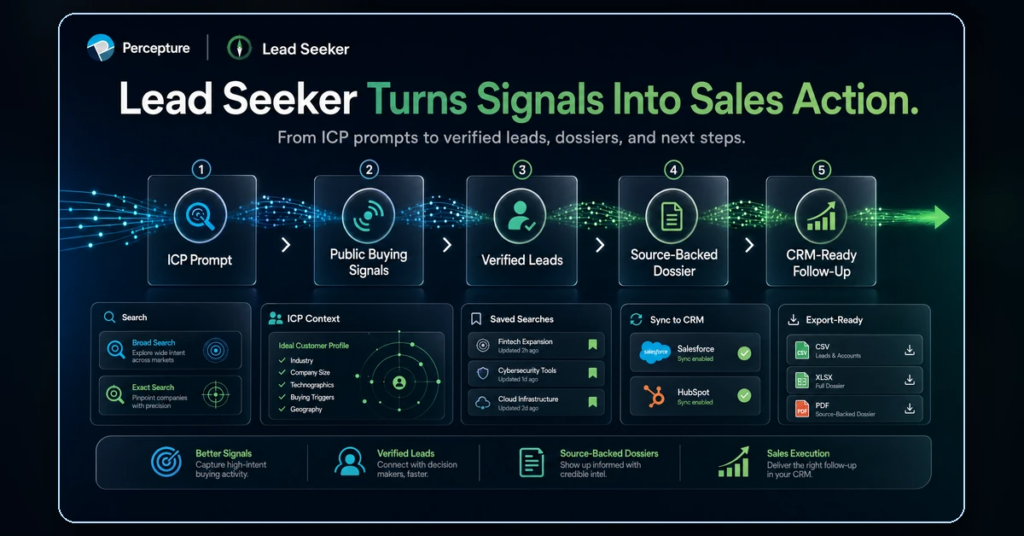
Percepture’s Lead Seeker lead intelligence platform turns ICP prompts into verified leads, public buying signals, source-backed dossiers, and CRM-ready follow-up.
Lead Seeker supports:
- Broad and exact search
- ICP context panels
- Prompt starters
- Saved searches
- Salesforce and HubSpot sync
- Spreadsheet, PDF, and Word exports
The goal is to help teams move from signal to action—without stale lists or black-box scoring.
Examples of B2B Intent Data in Action
Here is how different industries use B2B intent data:
- Data center company: “Who is expanding AI infrastructure?”
- Life sciences vendor: “Which CDMOs are growing?”
- Telecom provider: “Who needs network, colocation, or connectivity support?”
- Staffing company: “Which companies are hiring for hard-to-fill roles?”
- SaaS company: “Who is comparing tools in our category?”
In each case, the signal is a starting point. The value is turning that signal into a better account list, a better contact, and a better first conversation.
Cost and ROI Basics
B2B intent data pricing varies widely. Some platforms charge per seat, per account, or per signal. Others bundle intent data with contact data or CRM integrations.
Before buying, ask:
- What is the source of the data?
- How fresh is the data?
- Can I export the data?
- Can I verify the contacts?
- Can I pilot before committing?
Lead Seeker offers a $99 pilot with 50 Lead Units and 14 days to test. Paid plans start at $149/month with Salesforce/HubSpot sync and export features.
Mistakes to Avoid
- Buying a large platform before testing. Pilot first.
- Treating every signal as a hot lead. Signals are clues, not contracts.
- Ignoring fit. A signal from a bad-fit account is still a bad-fit account.
- Skipping contact verification. Stale contacts waste time.
- Expecting intent data to replace sales judgment. It is a tool, not a strategy.
How Percepture Helps Teams Win
Percepture has helped teams in telecom, data centers, life sciences, staffing, and enterprise B2B turn buyer signals into qualified pipeline.
See the qualified lead growth case study for an example of how Percepture helped a staffing company grow search visibility and qualified leads.
Want to test your ICP?
Claim 5 verified leads and see what Lead Seeker finds.
Claim 5 Verified LeadsFAQs About B2B Intent Data
What is B2B intent data?
B2B intent data is information that helps sales and marketing teams see which companies may be researching a problem, product, service, vendor, or category. It can include website activity, content behavior, search themes, third-party research, public business signals, and account movement.
What is B2B buyer intent data?
B2B buyer intent data is another term for B2B intent data. It refers to signals that suggest a company may be in a buying cycle or researching a solution.
What are B2B intent signals?
B2B intent signals are individual clues that a company may be researching a topic. Examples include website visits, content downloads, search themes, hiring activity, funding news, and event attendance.
Is intent data the same as a lead list?
No. A lead list is a collection of contacts. Intent data is information about what those accounts may be researching. The best sales intelligence combines both.
What is first-party intent data?
First-party intent data is signals from your own website, CRM, email, or events. For example, a target account visiting your pricing page is first-party intent data.
What is third-party intent data?
Third-party intent data is signals from outside your owned channels. For example, a company researching a topic across publisher sites is third-party intent data.
How do sales teams use intent data?
Sales teams use intent data to build better account lists, prioritize outreach, improve lead scoring, personalize first-touch messages, support ABM campaigns, and improve CRM context.
Can intent data help identify sales-qualified leads?
Yes, but intent data is a probability signal, not proof of purchase intent. It works best when combined with fit, contact verification, and context.
What does B2B intent data get wrong?
B2B intent data often overpromises. A signal is not a sale. More data is not better data. Intent data still needs human judgment to turn signals into action.
How does Lead Seeker use intent data?
Lead Seeker turns ICP prompts into verified leads, public buying signals, source-backed dossiers, and CRM-ready follow-up. It helps teams move from signal to action without stale lists or black-box scoring.
What to Do Next
If you want to understand how B2B intent data can help your team find better accounts and start better conversations:
- Review the B2B intent data services page.
- Explore the best B2B intent data providers guide.
- See how Lead Seeker turns ICP prompts into verified leads.
- Claim 5 verified leads and test your ICP.
About the Author
Bob Generale, President of Percepture
Bob Generale is President of Percepture, where he works across SEO, GEO, digital PR services, paid media, AI sales agents, lead generation, and complex B2B growth strategy. His work sits at the point where visibility, trust, buyer timing, and sales action meet.
Bob has supported complex sales and relationship-driven business development across data centers, telecom, life sciences, energy, big pharma, private capital, family offices, and enterprise technology. He has also helped coordinate high-stakes introductions and deal conversations involving family offices, portfolio companies, investment groups, military leadership, the best healthcare seo services, global consulting, and regulated industries.
For Percepture’s sales intelligence content, Bob focuses on a simple idea: data only matters when it helps a team choose the right account, understand why now, reach the right person, and start a better conversation.
Learn more about Percepture | Connect with Bob on LinkedIn