
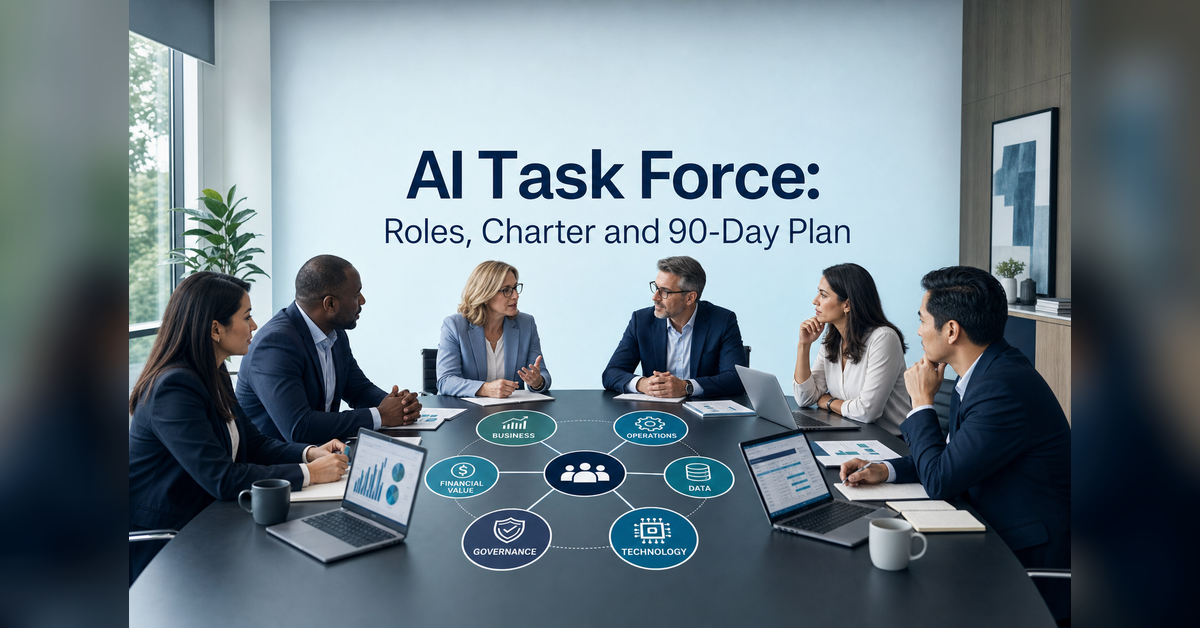

An AI task force should not exist to discuss tools. It should turn costly, slow or error-prone work into a controlled pilot, a measured business result and a clear decision about what happens next.
The best starting point is not a vendor shortlist. It is a workflow with a real owner, an established baseline, usable data and an outcome that finance and operations can evaluate.
Ranked in 48 hours
Watch Cody Clegg of OPTK Networks explain the campaign and working relationship behind the executive interview in this guide.
What this case study adds to the guide
The video gives readers direct client context before the operating guide begins. It also shows why the later conversation between Bob Generale and Cody Clegg is grounded in a real working relationship.
- Real telecom client and operator perspective
- Search, AI visibility and targeted campaign execution
- Direct context for Bob Generale’s interview with Cody Clegg
Important: This case study verifies the working relationship and campaign result. It is not a promise that every AI pilot or search campaign will move at the same speed.
What is an AI task force?
An AI task force is a cross-functional team that selects valuable AI use cases, sets governance rules, prepares data, runs controlled pilots, and measures business outcomes. It should include executive, operational, technical, legal, security, finance, marketing, and sales leaders, with clear ownership, human approval rules, and a 90-day implementation plan.
Reviewed and updated July 2026.
The executive brief
Start with friction
Map work that is slow, repetitive, costly or prone to correction. Record its current performance before testing technology.
Separate authority
Treat reading, recommending, preparing and executing as different permissions. Greater autonomy must be earned through evidence.
Measure the endpoint
Tool use is not the result. Measure accepted work, completed work, customer or operating outcomes, savings and attributable gross profit.
Make a decision
Every pilot should end with a documented choice to scale, revise, hold or stop.
Who this guide is for
Executive leaders
CEOs, founders and operating partners who need a cross-functional AI team with clear ownership, speed and an economic test.
Risk and technology leaders
CIOs, CTOs, CISOs and legal leaders who must define the systems, data access and accountability available to the program.
Workflow owners
Operations, finance, HR, marketing, sales and customer leaders who give the working group an accurate view of how the work is completed.
How the team works
It is a temporary or transitional cross-functional team formed to identify, govern, test and measure AI use cases. Its mandate is broader than policy and narrower than permanent enterprise ownership. The team coordinates a defined adoption period and creates an operating model that established functions can later own.
Its work begins with business problems. Members interview employees, map processes, inventory approved and unapproved tools, identify data sources, classify risk and choose a limited pilot. They then set permissions, testing rules, human approvals, success thresholds and stop conditions.
What does the team do?
The team creates a common intake path for proposed use cases. It prevents departments from buying disconnected tools without clear ownership, while still allowing useful experiments to move. A good intake process asks who owns the workflow, what data is required, what can go wrong, how value will be measured and who can stop the system.
This work should connect with existing business planning. Percepture’s strategy and planning services focus on turning broad goals into defined priorities, while omnichannel marketing shows why customer-facing workflows often cross several teams and systems.
Is the team permanent?
Not necessarily. The group can transition into an AI council, governance committee or center of excellence once standards, intake, controls and ownership are established. The point is to build a repeatable operating system, not preserve a permanent meeting.
Does your company need one?
Forming a cross-functional AI team is worth considering when several of these conditions are present:
- Employees use AI tools without a shared approval process.
- Departments are evaluating overlapping vendors.
- No one owns the financial result of proposed pilots.
- Sensitive information may enter unapproved systems.
- Leaders cannot see which experiments are active.
- AI outputs influence customers, employees or operating decisions.
- Promising pilots stall because data, integration or ownership is unclear.
- Marketing, sales and operations need the same approved knowledge.
A smaller company may not need a large committee. It still needs a sponsor, workflow owner, technical reviewer, risk reviewer and financial test. Existing leaders can fill more than one role as long as decision rights remain explicit.
Task Force vs. Steering Committee vs. Center of Excellence
| Operating model | Primary purpose | Authority | Best fit | Main risk |
|---|---|---|---|---|
| Temporary cross-functional team | Select and coordinate early use cases | Recommends and coordinates | Companies beginning structured adoption | Becoming a discussion group |
| AI steering committee | Approve priorities, budgets and major risks | Senior approval | Organizations managing several programs | Distance from daily work |
| AI governance committee | Oversee policy, privacy, security and accountability | Risk and policy control | High-risk or regulated environments | Slowing low-risk experiments |
| AI center of excellence | Maintain shared standards, platforms and expertise | Permanent enablement | Larger organizations scaling reusable capabilities | Central bottlenecks |
| Implementation squad | Build and test one workflow | Project delivery | Defined departmental pilots | Creating an isolated tool |
| Hybrid model | Combine internal ownership with specialist support | Shared | Organizations lacking selected capabilities | Fragmented accountability |
The models can coexist. A steering committee may approve the budget, a governance group may classify risk, and an implementation squad may build the workflow. The task force connects those decisions and keeps the business owner accountable for the outcome.
Who Should Be on the Team?
Membership should follow the workflows under review. The group needs enough range to see business value, technical limits and human consequences without turning every meeting into a company-wide forum.
| Role | Core responsibility | Decision owned |
|---|---|---|
| Executive sponsor | Protect focus, settle conflicts and secure resources | Priority and final scale decision |
| Task-force leader | Run use-case intake, cadence, records and gates | Process compliance and escalation |
| Workflow owner | Map work, provide a baseline and manage adoption | Business acceptance |
| Frontline employees | Expose exceptions, test outputs and document corrections | Operational feedback |
| IT and data | Review architecture, integration, quality and ownership | Technical feasibility |
| Security and legal | Classify risk, access, retention and accountability | Control approval |
| Finance | Validate costs, attribution and payback logic | Economic acceptance |
| HR | Address policy, training and employee impact | Workforce controls |
| Marketing, sales and customer experience | Protect claims, customer interactions and revenue workflows | Customer-facing acceptance |
The CIO should be a core member, but technology should not own the business result alone. The department receiving the benefit owns that result. IT, data, security and legal define how the work can be performed safely.
Marketing and sales deserve deliberate representation. Possible projects may involve B2B intent data, AI sales agents, customer communication or public claims. Each requires business context and controls beyond model performance.
Map your first five workflow problems
Start with the work, not the tool. Record the owner, baseline, data, risk and business result for each workflow.
- Name the workflow owner and baseline
- Check data, risk and human approval needs
- Define the business result before testing
What should the charter include?
The charter is the operating contract. It prevents confusion about what the group can approve, what remains with executives and which controls cannot be bypassed. Keep it short enough to use, but specific enough to govern a pilot.
Charter template
- Purpose: State the business reason for forming the group.
- Scope: Define included departments, workflows, systems and exclusions.
- Authority: Specify what the group may recommend, approve, pause or stop.
- Membership: Name the sponsor, leader, standing members and specialists.
- Decision rights: Assign business, technical, security, legal and financial approvals.
- Cadence: Set working meetings, gate reviews and executive reporting.
- Use-case intake: Require an owner, baseline, data inventory, risk class and value hypothesis.
- Vendor rules: Cover data ownership, access, retention, portability and support.
- Success metrics: Define operational, customer, financial and risk measures.
- Termination: Explain when the group ends or transfers responsibility.
The charter should also require a pilot record. That record includes the approved sources, test set, permissions, incidents, employee corrections, costs and final decision. It creates traceability without relying on meeting memory.
The Problem-to-Profit AI Task Force Loop
Percepture’s Problem-to-Profit AI Task Force Loop is a six-stage method for moving from business friction to a controlled pilot and a finance-reviewed decision. Governance is built into each stage instead of added after development.
1. Friction
Find slow, repetitive, costly or error-prone work. Interview the people doing it, map handoffs and record cycle time, cost, volume, errors, rework and customer impact.
Gate: The department owner confirms the problem and baseline.
2. Fit
Score business impact, data readiness, rule clarity, repetition, reversibility, risk, time to value and measurability.
Gate: The proposal has a sponsor, workflow owner and testable value hypothesis.
3. Foundation
Prepare approved documents, databases, procedures and permissions. Resolve conflicting sources, assign data owners and create a test set.
Gate: Data owners approve quality, freshness, access and restrictions.
4. Guardrails
Separate read, recommend, prepare and execute permissions. Add thresholds, escalation, logs, prohibited actions, rollback and shutdown procedures.
Gate: Security, legal, IT and the workflow owner approve controls.
5. Pilot
Limit users, data, workflow and authority. Compare results with the old process, record corrections and review employee trust.
Gate: Sensitive outputs remain human-approved while performance is tested.
6. Profit
Validate the operating result, full cost, verified savings, revenue influence, gross profit and risk outcome.
Gate: Finance and the workflow owner accept the attribution method before scale.
The same approved knowledge foundation can also support enterprise SEO, generative engine optimization services and digital PR services. Public content still requires editorial review, source support and approval of claims.
Compare AI strategy and implementation options
See how Percepture structures discovery, workflow design, knowledge readiness, guardrails, testing and measurement.
How Should the Team Select Use Cases?
The team should select a workflow, not a broad ambition. “Improve sales” is not testable. “Prepare a draft account brief from approved CRM and market data for a salesperson to review” defines the work, data and human control.
| Criterion | Question | Strong first-pilot signal |
|---|---|---|
| Business impact | Can the team tie the problem to cost, completed work, customers or revenue? | The outcome matters and has an owner |
| Data readiness | Are approved sources available and maintained? | Sources are accessible, current and attributable |
| Rule clarity | Can experts explain how good work is judged? | Acceptance and escalation rules can be tested |
| Repetition | Does the workflow recur often enough to evaluate? | Comparable cases exist |
| Reversibility | Can an error be corrected before harm occurs? | Outputs can be reviewed or rolled back |
| Risk | Could an error affect rights, money, safety or reputation? | Initial authority is narrow |
| Time to value | Can the workflow be tested without rebuilding core systems? | A limited test is practical |
| Measurability | Is there a baseline and business endpoint? | Old and new processes can be compared |
Use cases differ by industry. Data-center leaders evaluating infrastructure workflows can review AI tools for support-ticket triage. Private-equity operators can examine the ownership questions covered in AI agents for private equity. These are separate applications of the same workflow-selection method.
What Decisions Require Human Approval?
Human review should be specific. Saying that a person remains “in the loop” is not enough. The team must identify the named role, review point, evidence required and action available when an output is weak.
| Action | Initial authority | Human decision |
|---|---|---|
| Read approved sources | Permitted within defined access | Data owner approves sources and retention |
| Recommend a next step | Permitted in a limited workflow | Workflow owner accepts, changes or rejects it |
| Prepare customer-facing material | Draft only | Authorized employee approves claims and release |
| Change a system record | Restricted during early testing | System owner approves write access |
| Spend money or change terms | Not autonomous in the initial pilot | Authorized financial or commercial owner decides |
| Make employment, legal or high-impact decisions | Support only | Authorized people retain decision authority |
| Contact prospects | Controlled by channel and policy | Legal and sales leaders approve the operating rules |
Outbound communication deserves its own review. The practical and legal questions are explored in Percepture’s guide to whether AI agents can make outbound calls.
The control plan should follow least privilege, maintain source traceability and provide logs, escalation, rollback and manual shutdown. The NIST AI Risk Management Framework is a voluntary resource for incorporating trustworthiness considerations into AI design, development, use and evaluation.
What Should the First 90 Days Accomplish?
The first 90-day plan should establish the operating system and test one bounded workflow. It should not promise company-wide automation. Each phase has a gate that prevents enthusiasm from outrunning ownership, evidence or controls.
Days 1–15: Charter and baseline
- Name the sponsor, leader and members.
- Approve the charter and use-case intake.
- Inventory current tools and shadow use.
- Map five to ten workflow problems.
- Record baseline performance.
Gate: No pilot without a workflow owner and baseline.
Days 16–30: Selection
- Score candidate workflows.
- Identify data and integration needs.
- Classify risk and review legal and security effects.
- Select a primary and backup pilot.
- Set success and stop conditions.
Gate: A vendor demonstration is not selection evidence.
Days 31–45: Foundation and guardrails
- Prepare and reconcile source data.
- Create test cases.
- Define permissions, approvals and escalation.
- Establish logs, rollback and shutdown.
- Train pilot users.
Gate: Missing context must produce a safe failure.
Days 46–60: Controlled pilot
- Launch with limited users and authority.
- Log outputs and corrections.
- Compare the new and old workflows.
- Measure completion, time, rework and trust.
Gate: Adoption does not prove value.
Days 61–75: Value validation
- Calculate full cost.
- Verify saved time and completed work.
- Connect customer or sales outcomes.
- Review incidents and improve controls.
Gate: Finance approves attribution logic.
Days 76–90: Scale, revise or stop
- Review performance, trust, data, risk and cost.
- Name the long-term owner.
- Document the decision and remaining work.
Gate: Scale only when the result improved and ongoing value exceeds ongoing cost.
AI program cost and ROI framework
There is no responsible universal cost range. Cost depends on internal labor, workflow complexity, data preparation, risk review, integration, model usage, monitoring, training and ongoing human review. The budget must cover discovery and continued operation, not only software licenses.
| Cost group | Items to include |
|---|---|
| Internal labor | Sponsorship, meetings, workflow mapping, data preparation, testing and training |
| Risk and control | Legal review, security review, access controls, monitoring, logging and incident response |
| Technology | Software, models, storage, APIs, integration, hosting and security tools |
| Implementation | Process design, development, evaluation, change management and support |
| Ongoing operation | Model usage, maintenance, data updates, vendor support, retraining and human review |
Financial formulas
- Cost per valid use case: task-force and discovery cost ÷ use cases approved for controlled testing.
- Cost per accepted output: pilot cost ÷ outputs accepted without material correction.
- Cost per completed workflow: total pilot cost ÷ workflows completed to the business endpoint.
- Verified labor savings: baseline labor cost − AI-supported labor cost.
- Attributable revenue: revenue tied to supported opportunities × the approved attribution percentage.
- Attributable gross profit: attributable revenue − direct delivery cost.
- Pilot ROI: (verified savings + attributable gross profit + approved risk value − total program cost) ÷ total program cost × 100.
- Payback period: initial program cost ÷ average monthly verified financial benefit.
Finance should reject program activity metrics as final outcomes. Prompts, drafts, tools, training sessions and meetings may show adoption, but they do not prove value. The measurement chain is activity to accepted work, completed work, customer or operating outcome, financial value and gross profit.
Teams that need a stronger measurement layer can connect pilot records with attribution and analytics. Marketing leaders comparing broader visibility investment can also review AI search and SEO pricing.
How Should Vendors Be Evaluated?
The team should evaluate the operating model before selecting a product. Decide whether internal staff, a specialist, an integrator or a hybrid team will own discovery, implementation and maintenance.
| Evaluation area | Question for the vendor | Evidence to review |
|---|---|---|
| Primary capability | Which defined workflow does the product support? | Workflow-specific demonstration and limits |
| Data ownership | Who owns inputs, outputs, logs and derived data? | Contract and data terms |
| Security | How are identity, encryption and isolation handled? | Security documentation and architecture |
| Auditability | Can the company trace sources, outputs and actions? | Logs, records and export functions |
| Permissions | Can read, recommend, prepare and execute be separated? | Role and permission controls |
| Human approval | Where can authorized people review or stop work? | Approval and escalation design |
| Portability | Can data, prompts, evaluations and records be exported? | Export process and supported formats |
| Maintenance | Who monitors, updates and supports the workflow? | Named responsibilities and service terms |
| Total operating cost | What will the company pay as usage, integration and support change? | Complete commercial model |
Reduce lock-in by keeping source ownership, evaluation sets, process documentation and acceptance rules under company control. A vendor should support the operating model rather than become its only institutional memory.
Common AI program team mistakes
- Starting with a tool. Begin with expensive, slow or error-prone work.
- Leaving out frontline employees. They know the exceptions and correction burden.
- Choosing a project without a baseline. The team cannot demonstrate improvement without comparison.
- Using vague oversight. Name each approver and review point.
- Granting write access too early. Start with reading and recommendations.
- Ignoring data ownership. Models cannot repair unclear sources by themselves.
- Counting usage as ROI. Measure completed work and financial outcomes.
- Excluding maintenance costs. Include monitoring, updates and human review.
- Scaling despite user rejection. Correction time can erase the expected savings.
- Refusing to stop. End or redesign a pilot when risk, data or value fails the agreed test.
Knowledge work also creates public visibility risks. Teams managing approved content should coordinate with content marketing services and established editorial controls. Percepture’s guide to organic SEO services explains how durable search assets depend on useful, structured information rather than output volume.
Bob Generale and Cody Clegg on building the team

Cody Clegg is Director of Sales & Marketing at OPTK Networks, a Nebraska fiber network provider.
“Measure business outcomes, not how many AI tools you deployed.”
Bob Generale interviewed Cody about AI implementation and telecom operations. The transcript was lightly edited for grammar, clarity, repetition and flow while preserving Cody’s meaning and conversational voice.

If you were building the team from scratch, who would be on it?

Cody’s approach is cross-functional. It brings together executive sponsorship, technical and data skills, security and legal review, finance, department owners and employees close to the workflow.
What skills should companies prioritize?
Prioritize process knowledge, data judgment, technical feasibility, risk assessment and financial measurement. The group needs people who can define the problem and judge whether the result is usable.
How should the team measure ROI?
Measure business outcomes rather than the number of tools deployed. Useful endpoints can include ticket resolution, quote turnaround, forecasting, sales productivity, reduced manual work and revenue opportunities when the company can verify attribution.
What quick wins can it achieve in 90 days?
A practical first win is a bounded workflow with a baseline, available data, limited permissions and visible human review. The result should be stable enough to support a scale, revise or stop decision.
How should initiatives be prioritized?
Cody recommends scoring impact, feasibility, data readiness and time to value rather than selecting the most exciting project. This keeps attention on friction that the business can actually remove.
Telecom teams can place that advice in an industry context through Percepture’s telecom marketing expertise and its analysis of data-center marketing strategy.
Frequently Asked Questions
What should an AI task force do first?
Map repetitive, slow, costly or error-prone work. Choose one workflow with an owner, available data, clear rules, manageable risk and a measurable outcome. Record how it performs before selecting a model or vendor.
Who should lead the team?
A senior business or transformation leader can coordinate the team, backed by an executive sponsor. The workflow owner should remain responsible for the business result, while IT, security, legal and finance control their respective approvals.
How large should the group be?
There is no universal size. Use a compact standing team with the authority needed to move work, then bring in specialists for each use case. The group must cover business ownership, technology, data, risk, finance and frontline operations.
How often should it meet?
Set a working cadence that matches the 90-day plan, with separate gate reviews for selection, control approval, pilot launch and financial validation. Meetings should resolve decisions and exceptions rather than become general technology briefings.
What belongs in the charter?
Include purpose, scope, authority, membership, decision rights, cadence, use-case intake, risk classification, vendor and data rules, success metrics, reporting and termination or transition conditions.
Is the task force the same as AI governance?
No. Governance is one responsibility. The team also identifies opportunities, prepares data, coordinates implementation, supports adoption, evaluates vendors and measures results. A permanent governance committee may later take ownership of policy and risk oversight.
How should ROI be measured?
The team should compare the supported workflow with its baseline. Include all labor, technology, integration, security, monitoring, maintenance, training and human-review costs. Measure accepted work, completed work, savings, customer outcomes, attributable revenue and attributable gross profit.
When should a pilot stop?
Stop or redesign it when data is unreliable, risk exceeds the approved limit, users reject the workflow, correction work eliminates savings, a simpler automation is better or no measurable business result exists.
Should the team become permanent?
It can remain temporary or transition after the operating model is established. Ongoing responsibility may move to an AI council, governance committee, center of excellence or existing business and technology functions.
Ready to build your AI task force?
Bring the workflow problems, current tools, data sources and decision owners. Percepture can help turn them into a clear 90-day roadmap.