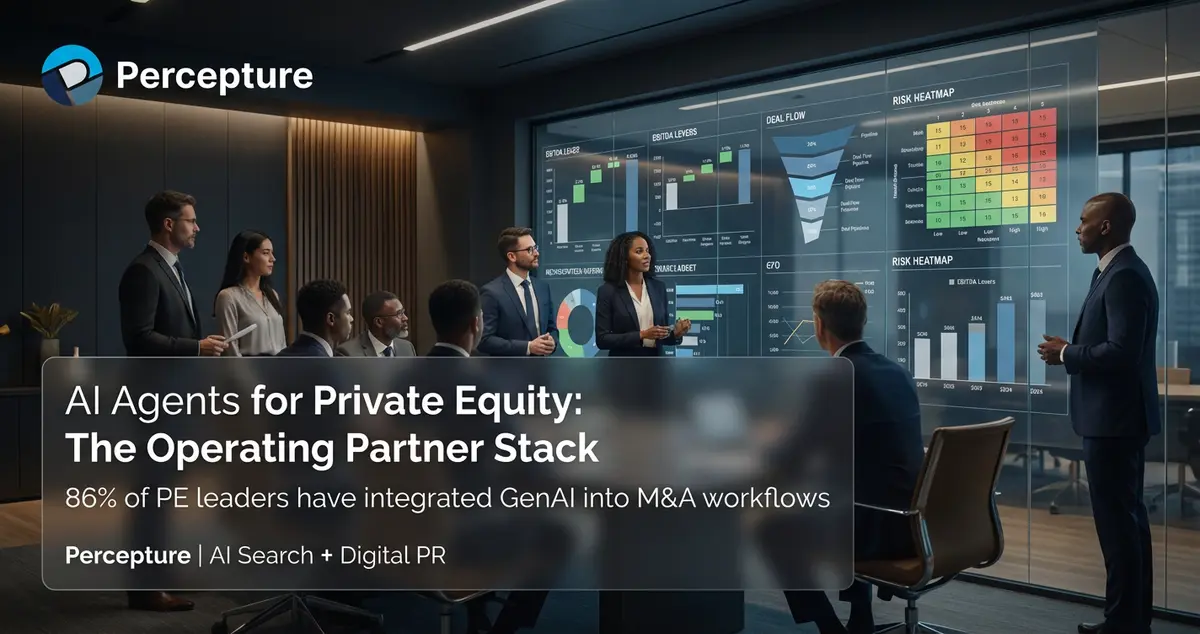

Private equity firms are deploying AI agents to win deals faster and drive portfolio EBITDA. The data is clear: 86% of corporate and PE leaders have integrated generative AI into M&A workflows, and approximately 9 in 10 PE dealmakers are using GenAI or agentic AI in M&A processes.
This is not about replacing your team. It is about giving Operating Partners, deal teams, and CFOs the tools to move faster, see deeper, and control outcomes.
Private Equity AI Deployment Guide
Updated July 12, 2026 · Reviewed by AI compatability team



What do AI agents do for private equity in 2026?
AI agents for private equity are autonomous software systems that complete multi-step workflows without constant human supervision. They monitor deal flow, extract diligence insights, flag portfolio risks, and generate board packs. Unlike chatbots, agents take action: they read contracts, compare comps, detect churn signals, and draft memos. They free your team to focus on judgment, relationships, and value creation.
At Percepture, we have been building technology for high-stakes industries since 2004. As a private equity marketing agency, we understand what PE firms need: speed, accuracy, repeatability, and governance. We build AI Sales Agents that connect directly to EBITDA levers and board-pack KPIs.
This guide shows you the PE Agent Stack, the 7 agents to build first, a 30-45 day rollout plan, and the governance framework that makes agents PE-grade.
Who this guide is for
Why AI agents for private equity matter right now
- 86% of PE and corporate M&A leaders have integrated GenAI into workflows , with 65% doing so in the past year. The heaviest use is in pre-sign activities like market assessment, screening, and diligence. (Deloitte 2025 GenAI in M&A Survey)
- ~9 in 10 PE dealmakers are using GenAI and/or agentic AI in M&A processes. (KPMG 2025 Mid-year M&A Pulse Survey)
- 79% of organizations say AI agents are already being adopted, and 66% of adopters report measurable value through productivity gains. (PwC AI Agent Survey)
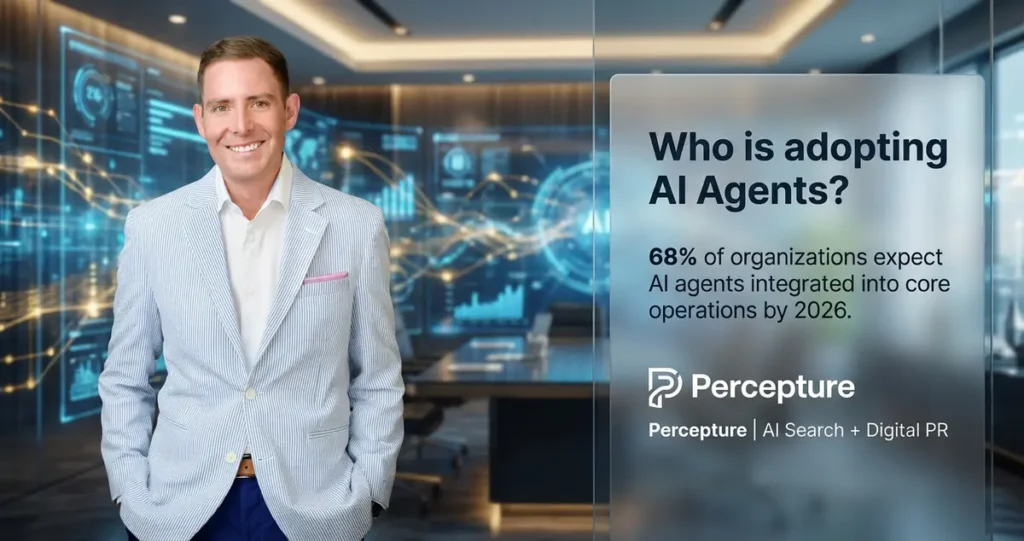
- 68% of organizations expect AI agents integrated into core operations by 2026. (Protiviti AI Pulse Survey)
- Finance leaders expect agentic AI adoption to increase sharply into 2026. (Wolters Kluwer Survey)
- Gartner predicts 60% of brands will use agentic AI for one-to-one interactions by 2028. ( Gartner Press Release )
The problems PE actually needs agents to solve
Deal team (Associates and VPs)
- Manually tracking 200+ targets across news, filings, and LinkedIn
- Spending 10+ hours per deal summarizing CIMs and data rooms
- Building comp tables and sensitivity models from scratch for every IC memo
- Automated target monitoring with sell-signal alerts
- Contract and financial extraction in minutes, not days
- Pre-populated IC memos with risk-ranked insights
- Proprietary deal flow (more deals, earlier access)
- Time to IC (compress diligence from 2 weeks to 3 days)
- Deal quality (fewer post-close surprises)
Operating Partners
- Chasing 12 portfolio companies for monthly reports in different formats
- Spotting margin erosion or churn spikes only after they cost a quarter
- Manually building board decks with stale data
- Real-time KPI dashboards across all portfolio companies
- Automated variance alerts (CAC up 30%, churn spiking, runway under 6 months)
- Auto-generated board packs with variance explanations
- Portfolio EBITDA (early intervention on margin and churn)
- Value creation velocity (faster identification of levers)
- Board prep time (10+ hours saved per company per quarter)
CFO and Finance leaders
- Reconciling data across QuickBooks, Salesforce, and spreadsheets
- Building quarterly narratives for LPs from scratch
- Auditing portfolio company financials manually
- Unified data layer with automated reconciliation
- AI-generated LP reports with variance commentary
- Continuous audit trails and anomaly detection
- Reporting accuracy (reduce restatements)
- LP satisfaction (faster, clearer updates)
- Audit readiness (always-on compliance)
Fund Ops and IR
- Answering the same LP questions across 50+ emails per quarter
- Preparing data rooms for fundraising or exits
- Tracking down documents across deals and portfolio companies
- AI-powered LP Q&A that pulls from fund docs, board decks, and financials
- Automated data room assembly with version control
- Centralized document search across the entire fund
- LP response time (minutes, not days)
- Fundraising velocity (faster due diligence for new LPs)
- Exit readiness (clean data rooms accelerate buyer diligence)
Start with an AI-agent opportunity map
Identify one workflow where repetitive effort, decision latency, and data fragmentation are already affecting deal speed or portfolio visibility. Percepture can help map the use case, owner, data sources, KPI, and approval gates before anything is built.
The PE Agent Stack
| Stage | Agent Name | What It Does | Inputs | Outputs | KPI It Moves | Time to Signal |
|---|---|---|---|---|---|---|
| Sourcing | Deal Flow Monitor | Tracks 10,000+ targets for sell signals (exec changes, declining growth, new CFO) | LinkedIn, SEC filings, news, Glassdoor, web traffic | Target alerts + outreach drafts | Proprietary deal flow | 1-7 days |
| Screening | Financial Screener | Analyzes financials, flags red flags, compares to benchmarks | CIM, financials, industry data | Risk-ranked summary + comp table | Time to no/yes decision | 1-3 days |
| Diligence | Diligence Copilot | Extracts terms from contracts, flags revenue concentration, identifies liabilities | Data room docs, contracts, financials | Risk summary + key terms extraction | Diligence quality + speed | 3-7 days |
| IC | IC Memo Builder | Drafts investment memos based on diligence findings and deal thesis | Diligence outputs, deal team notes, comps | Draft IC memo with risk/return analysis | Time to IC | 1-2 days |
| Value Creation | Portfolio KPI Tracker | Monitors 40+ KPIs across portfolio, flags anomalies | QuickBooks, Salesforce, GA4, custom dashboards | Variance alerts + root cause analysis | Portfolio EBITDA | Real-time |
| Reporting | Board Pack Generator | Auto-generates board decks with variance commentary | Portfolio KPIs, financials, strategic initiatives | Board deck + variance explanations | Board prep time | 1-2 days |
| Exit | Exit Readiness Agent | Prepares data rooms, generates buyer narratives, tracks diligence requests | Historical financials, contracts, strategic docs | Data room + buyer Q&A responses | Exit velocity | 7-14 days |
The Percepture Signal-to-EBITDA Agent Loop
A PE-grade agent should do more than generate text. It should move through a controlled loop that starts with a verified signal and ends with a measurable business outcome.
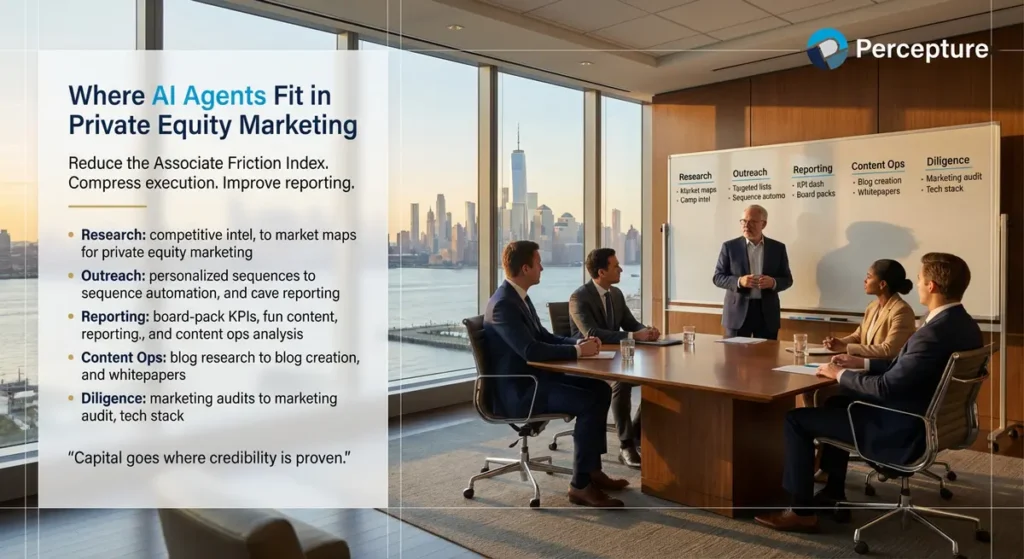
The 7 AI agents private equity firms should build first

Diligence Copilot
Job to be done: Read and summarize 500-page CIMs, 50 customer contracts, and 3 years of financials in hours, not weeks.
Data room documents, contracts, financial statements, industry benchmarks
Risk-ranked summary, key terms extraction, revenue concentration analysis, unusual clause flags
Compress diligence from 2 weeks to 3 days; track whether post-close surprises decline
Deal team VP or Principal
Required guardrails
- Source grounding: every claim links to a specific document and page number
- Audit trail: log every document accessed and every insight generated
- Human-in-the-loop: senior associate reviews all outputs before IC
Board Pack Builder
Job to be done: Generate board decks with KPI updates, variance explanations, and strategic commentary in 2 hours instead of 10.
Portfolio KPIs, financials, strategic initiatives, prior board decks
Board deck with variance analysis, trend charts, and narrative commentary
Save 10+ hours per portfolio company per quarter; improve board meeting quality
Operating Partner or Portfolio CFO
Required guardrails
- Data permissioning: only pull KPIs the board is authorized to see
- Audit trail: track which data sources fed each slide
- Human-in-the-loop: Operating Partner reviews and edits before distribution
Portfolio KPI Variance and Churn/Margin Risk Detector
Job to be done: Monitor 40+ KPIs across 12 portfolio companies in real time and flag anomalies before they cost a quarter.
QuickBooks, Salesforce, Google Analytics, custom dashboards
Variance alerts (CAC up 30%, churn spiking, cash runway under 6 months), root cause analysis, recommended actions
Earlier detection of margin erosion and churn; measure EBITDA protected
Operating Partner or Fund CFO
Required guardrails
- Monitoring and rollback: if an alert is a false positive, tune the threshold
- Human-in-the-loop: Operating Partner approves all interventions
- No data leakage: portfolio company data stays siloed
Deal Flow Monitor
Job to be done: Track 10,000+ targets for sell signals and alert the deal team when a target is ready to engage.
LinkedIn, SEC filings, earnings calls, Glassdoor, industry news, web traffic, hiring patterns
Target alerts with sell-signal summary, personalized outreach drafts, engagement timeline
Measure growth in proprietary deal flow and earlier target engagement
Deal team Associate or VP
Required guardrails
- Source grounding: every sell signal links to a specific data point
- Audit trail: log every target monitored and every alert sent
- Human-in-the-loop: Associate reviews outreach before sending
IC Memo Builder
Job to be done: Draft investment committee memos based on diligence findings, deal thesis, and comp analysis.
Diligence outputs, deal team notes, comp tables, financial models
Draft IC memo with executive summary, investment thesis, risk/return analysis, and downside scenarios
Reduce IC memo prep time from 20 hours to 4 hours; improve memo consistency
Deal team VP or Principal
Required guardrails
- Source grounding: every claim in the memo links to diligence findings or comps
- Audit trail: track which inputs fed each section
- Human-in-the-loop: Principal or Partner reviews and edits before IC
LP Q&A Agent
Job to be done: Answer LP questions by pulling data from fund docs, board decks, and financials in minutes, not days.
Fund documents, board decks, quarterly reports, portfolio financials
Drafted responses to LP questions with source citations
Reduce LP response time from 3 days to 30 minutes; improve LP satisfaction
Fund Ops or IR lead
Required guardrails
- Data permissioning: only pull data the LP is authorized to see
- Audit trail: log every question and every source used
- Human-in-the-loop: IR lead reviews all responses before sending
Exit Readiness Agent
Job to be done: Prepare data rooms, generate buyer narratives, and track diligence requests to accelerate exit velocity.
Historical financials, contracts, strategic documents, buyer Q&A logs
Organized data room, buyer narrative deck, Q&A response tracker
Compress buyer diligence from 8 weeks to 4 weeks; improve exit multiples through better storytelling
Deal team VP or Operating Partner
Required guardrails
- Data permissioning: only include documents approved for buyer access
- Audit trail: track every document added to the data room and every Q&A response
- Human-in-the-loop: Deal team reviews all buyer-facing materials
Need a custom agent for a proprietary PE workflow?
Use standard software for common workflows. Use custom agents where the firm’s diligence logic, sourcing process, portfolio data, or reporting structure creates competitive advantage.
Build vs. buy: what works across a portfolio
| Factor | Off-the-Shelf Tool | Custom Agents |
|---|---|---|
| Time to deploy | 2-4 weeks | 6-12 weeks |
| Governance and security | Vendor-dependent (check SOC 2, encryption) | Full control (on-premise or private cloud) |
| Portfolio repeatability | High (if tool fits your workflow) | Very high (tailored to your exact process) |
| Total cost of ownership | $50K-$300K annually | $200K-$800K (build + maintain) |
| When to choose it | Standard workflows (board packs, KPI dashboards) | Proprietary workflows (custom diligence, unique data sources) |
What makes an AI agent PE-grade?
The original Deloitte survey cited in this article found that data security and data quality were leading concerns for PE leaders. A production agent should meet the following standard:
Data permissioning
- Role-based access controls: agents only see data they are authorized to access
- Portfolio company data stays siloed (no cross-contamination)
Source grounding and citations
- Every insight links to a specific document, page number, or data point
- No unsourced claims in IC memos or board packs
Audit trail
- Log every document accessed, every insight generated, every action taken
- Audit trail is immutable and exportable for compliance reviews
Human-in-the-loop approvals
- High-stakes outputs (IC memos, LP reports, board decks) require human review before distribution
- Define approval gates in advance (who reviews what, and when)
Monitoring and rollback
- Track agent performance over time (accuracy, false positives, time saved)
- If an agent makes a mistake, tune the logic and redeploy
No data leakage / no training on your data
- Use vendors that do not train models on your data
- Deploy on-premise or in a private cloud for maximum control
Model choice policy
- Define which models are approved for which use cases (e.g., GPT-4 for diligence, Claude for board packs)
- Monitor model updates and test before deploying to production
A 30–45 day rollout plan

Week 1: Choose one workflow + define KPI + data access + guardrails
- Pick your first agent (we recommend Diligence Copilot or Board Pack Builder)
- Define success: What KPI will this agent move? (e.g., time to IC, board prep time)
- Map data sources: What systems does the agent need to access? (e.g., data room, QuickBooks, Salesforce)
- Set guardrails: Who reviews outputs? What is the audit trail? What are the approval gates?
Definition of done: One-page agent spec with KPI, data sources, and governance rules
Week 2: Prototype + test on historical deals or past board packs
- Build a prototype agent using a no-code platform or custom code
- Test on 3-5 historical deals or past board packs
- Compare agent output to human output: Is it accurate? Is it faster? What is missing?
Definition of done: Prototype that produces usable output on historical data
Week 3-4: Deploy in a controlled pilot + measure time-back + quality
- Deploy the agent on one live deal or one portfolio company
- Run the agent in parallel with your existing process (do not replace humans yet)
- Measure time saved, output quality, and team feedback
Definition of done: Pilot results showing time saved and quality metrics
Week 5-6: Harden + document + expand to next workflow
- Fix bugs and edge cases identified in the pilot
- Document the agent: how it works, what it does, who owns it, how to audit it
- Expand to the next workflow (e.g., if you started with Diligence Copilot, add Board Pack Builder next)
Definition of done: Production-ready agent with documentation and expansion plan
PE AI-agent deployment scorecard
A workflow is ready to scale when all five conditions are true:
How PE AI agents connect to EBITDA levers
| EBITDA Lever | Agent Impact | KPI to Track | Expected Time to Signal |
|---|---|---|---|
| Price | Identify pricing power opportunities in portfolio companies | Price realization, discount frequency | 30-60 days |
| Retention | Detect churn signals early (usage drops, support tickets spike) | Net revenue retention, churn rate | 7-14 days |
| Sales Efficiency | Optimize CAC by flagging inefficient channels or reps | CAC, sales cycle length, win rate | 30-60 days |
| SG&A | Automate reporting, board prep, and LP Q&A to reduce overhead | Hours saved per FTE, cost per report | 7-30 days |
Bottom line: agents should not be measured only by prompts completed or documents generated. Track earlier signals, hours returned, exceptions found, decisions accelerated, and revenue or margin protected.
That same operating discipline should extend to portfolio growth systems, including enterprise SEO, generative engine optimization services, digital PR, lead generation, and conversion rate optimization.
Three mistakes to avoid
Automating everything at once
Choose one repeated workflow, define success, prove the economics, and expand from evidence.
Skipping governance
Agents without source grounding, audit trails, access controls, and human approvals create avoidable risk.
Measuring activity instead of value
Do not celebrate output volume. Measure time returned, decisions improved, risk found, and EBITDA impact.
Why Percepture
Percepture has built technology and growth systems for high-stakes industries since 2004. The firm works across private equity, telecom, life sciences, and other markets where mistakes are expensive, buying committees are complex, and speed matters.
Frequently asked questions about AI agents for private equity
What are AI agents for private equity?
AI agents for private equity are autonomous software systems that complete multi-step workflows without constant human supervision. They monitor deal flow, extract diligence insights, flag portfolio risks, and generate board packs. Unlike chatbots that answer questions, agents take action: they read contracts, compare comps, detect churn signals, and draft memos. They free your team to focus on judgment, relationships, and value creation while handling the repetitive, data-heavy work.
What is agentic AI?
Agentic AI refers to AI systems that can perceive their environment, make decisions, and take actions to achieve specific goals. In private equity, agentic AI means agents that can monitor 10,000 targets, read a 500-page CIM, flag revenue concentration risk, and draft an IC memo—all without step-by-step human instructions. The key difference from traditional automation: agentic AI handles nuanced, judgment-based tasks and adapts to new information.
Can agents help with diligence?
Yes. AI agents can read contracts, extract key terms, flag unusual clauses, compare financials to benchmarks, and generate risk-ranked summaries. What used to take 2 weeks can now be completed in 3 days with better coverage and fewer post-close surprises. Agents do not replace diligence teams. They handle the extraction and summarization so your team can focus on judgment and strategy.
How do we prevent hallucinations?
Use source grounding: every insight the agent generates must link to a specific document, page number, or data point. If the agent cannot cite a source, it should not make the claim. Also use human-in-the-loop approvals: high-stakes outputs (IC memos, LP reports, board decks) require human review before distribution. This catches errors before they reach stakeholders.
What data do agents need?
It depends on the agent. A Diligence Copilot needs access to data room documents, contracts, and financials. A Portfolio KPI Tracker needs access to QuickBooks, Salesforce, and Google Analytics. A Deal Flow Monitor needs access to LinkedIn, SEC filings, and industry news. Most agents need structured data (financials, KPIs) and unstructured data (contracts, emails, call transcripts). The better your data quality, the better the agent output.
How do we measure ROI?
Track time saved (hours per week), deal flow increase (proprietary deals sourced), diligence quality (risks identified pre-close), and portfolio visibility (early detection of underperformance). For example: if a Board Pack Builder saves 10 hours per portfolio company per quarter, and you own 12 companies, that is 120 hours saved per quarter or 480 hours per year. At $200/hour (loaded cost of an Operating Partner), that is $96K in annual savings.
How long to deploy?
With the right partner, you can deploy your first agent in 30-45 days. Building in-house typically takes 6-12 months. The fastest path: start with an off-the-shelf tool for standard workflows (board packs, KPI dashboards), then build custom agents for proprietary workflows (diligence, deal sourcing).
Build vs buy?
Buy (off-the-shelf tool): Faster (2-4 weeks), lower cost ($50K-$300K annually), good for standard workflows Build (custom agents): Slower (6-12 weeks), higher cost ($200K-$800K), better for proprietary workflows where your process is your competitive advantage Most PE firms use a hybrid approach: buy for standard workflows, build for proprietary workflows.
Can agents work with confidential deal data?
Yes, if you use the right governance controls. Deploy agents on-premise or in a private cloud. Use vendors that do not train models on your data. Implement role-based access controls so agents only see data they are authorized to access. Many PE firms also require human-in-the-loop reviews for all outputs that contain confidential data.
What is a PE-grade audit trail?
A PE-grade audit trail logs every document accessed, every insight generated, and every action taken by the agent. The trail is immutable (cannot be edited after the fact) and exportable for compliance reviews. This is critical for LP reporting, regulatory audits, and post-close disputes. If an LP asks "where did this number come from," you can trace it back to the exact source document and timestamp.
How do agents help Operating Partners?
Agents give Operating Partners real-time visibility into portfolio performance. Instead of chasing 12 companies for monthly reports in different formats, agents pull KPIs from QuickBooks, Salesforce, and Google Analytics, then flag anomalies (CAC up 30%, churn spiking, cash runway under 6 months). This enables early intervention on margin erosion and churn, protecting 2-5% of portfolio EBITDA.
How do agents help Associates?
Agents free Associates from repetitive work (tracking targets, summarizing CIMs, building comp tables) so they can focus on judgment, relationships, and strategy. For example: a Deal Flow Monitor tracks 10,000 targets and alerts the Associate when a target shows sell signals. A Diligence Copilot reads 50 customer contracts and flags revenue concentration risk. An IC Memo Builder drafts the first version of the memo so the Associate can focus on refining the investment thesis.
What is the biggest mistake PE firms make when adopting AI?
Trying to automate everything at once. Start with one high-impact use case (Diligence Copilot or Board Pack Builder), prove ROI, then expand. Also: skipping governance. If you deploy agents without audit trails, source grounding, and human-in-the-loop approvals, you will create compliance risk and lose trust with LPs and boards.
How do I get buy-in from my investment committee?
Run a pilot on a live deal. Show side-by-side results: AI-generated diligence summary vs. manual process. Let the time savings and insight quality speak for themselves. Also: frame agents as risk mitigation, not just efficiency. Agents reduce post-close surprises by flagging risks that humans miss under time pressure.
Deploy the first agent around a real PE workflow
Bring one sourcing, diligence, portfolio, reporting, or exit-readiness bottleneck. Percepture will help define the use case, data requirements, governance model, KPI, and 30–45 day pilot path.

About Bob Generale
Bob Generale is President of Percepture, a five-time Inc. 5000 company founded in 2004. He works with private equity, telecom, data-center, B2B, and other complex-market leaders on AI systems, search visibility, digital PR, demand generation, and market-conditioning strategies.