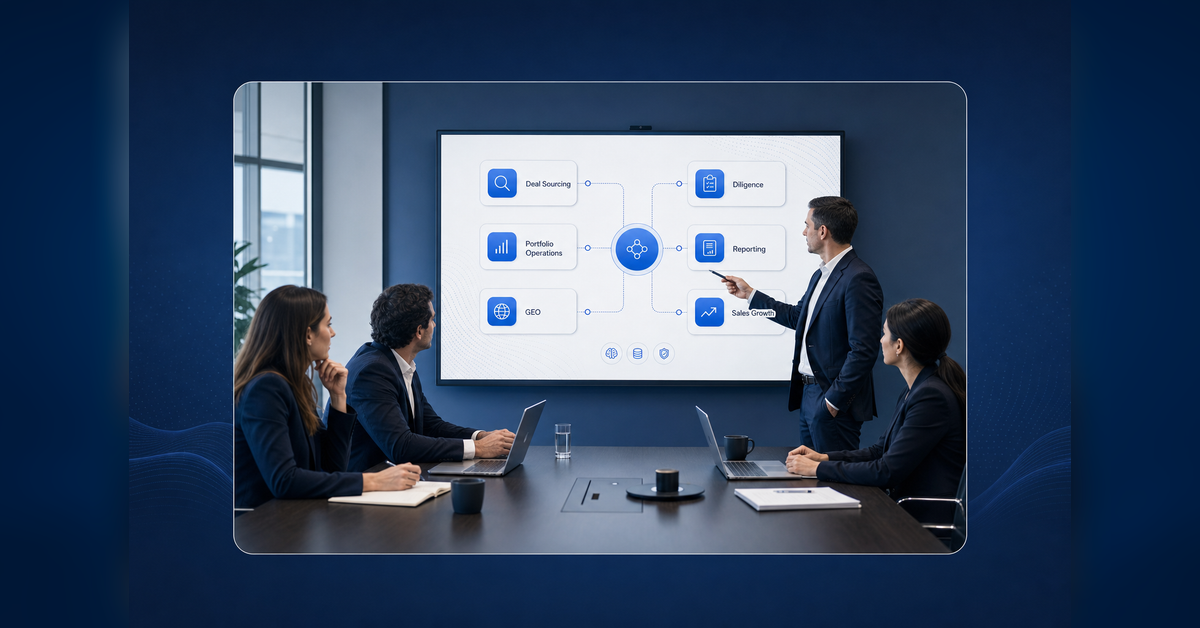

AI For Private Equity gives growth-minded service companies a practical way to connect local visibility, paid demand, reviews, content, and follow-up around qualified calls and booked jobs.
For data centers leaders, the definition workstream in AI For Private Equity should make the company easier to understand before a buyer compares options.
What Is AI for Private Equity?
AI for private equity is the use of artificial intelligence to improve how PE firms source deals, review companies, run diligence, monitor portfolio performance, create board reports, and support portfolio-company growth. The best use of AI in private equity is not replacing judgment. It is removing manual drag so deal teams, operating partners, and PortCo leaders can make better decisions faster.
Executive Summary
AI can support target research, document summaries, data-room review, and question preparation when humans validate sensitive findings.
The strongest first projects remove repeatable steps from research, CRM cleanup, reporting, content briefs, and sales preparation.
Most founder-led PortCos do not need a massive AI rollout. They need one safe workflow that proves value.
AI tools, copilots, agents, and custom workflows play different roles. The model is not the strategy. The workflow is the strategy.
Buyers, investors, and operators now use AI answers to compare companies. Entity clarity, proof, schema, and citations matter.
Approval rules, permissions, source review, error logging, and ownership should be built before a workflow scales.
Who This Guide Is For
Operating Partners
Use this to build repeatable playbooks, reduce PortCo inconsistency, and identify workflows that can scale across more than one company.
PortCo CEOs
Use this to protect control while testing AI in a narrow workflow with a clear owner and human review.
CFOs
Use this to keep AI projects measurable through time saved, cost avoided, reporting speed, lead quality, or manual steps removed.
VP Marketing
Use this to connect SEO, generative engine optimization services, content, proof, and conversion paths.
VP Sales
Use this to improve research, prospect fit, buying-signal detection, and handoff quality without turning outreach into spam.
Technical Operators
Use this to map permissions, integrations, model routing, data hygiene, and QA rules before automation expands.
AI for Private Equity Starts With Workflow Design
AI in private equity covers a wide range of work: summarizing market research, comparing companies, extracting terms from documents, monitoring portfolio signals, preparing sales dossiers, building content briefs, assisting reporting, and improving how buyers find a PortCo through search and AI answer engines.
The important point is that AI should be attached to a business workflow, not dropped into a company as a loose tool. A PE firm can have access to powerful models and still see weak adoption if the workflow, permissions, owner, and review process are unclear.
That is why Percepture treats private equity AI strategy as an operating design problem. The goal is not to chase novelty. The goal is to help deal teams, operating partners, and portfolio leaders decide what should be faster, what should be reviewed, and what should remain fully human.
Why AI Matters to PE Firms Now
PE teams already face compressed timelines, noisy markets, and pressure to support growth across the portfolio. AI can help when it speeds up repeatable research, standardizes reporting inputs, improves sales preparation, and helps PortCos become easier to find in Google and AI search.
A good PE AI plan should work once, then become a repeatable playbook the operating team can apply across more than one PortCo. That does not mean every company gets the same workflow. It means the firm has a consistent way to diagnose readiness, select use cases, assign owners, and review outputs.
Founder-led companies often need a different pace than mature platform companies. AI should not be dropped into a PortCo like a tool nobody asked for. It should start with one workflow, one owner, clear guardrails, and human review.
Get a Private Equity AI Readiness Review
Before a PE firm or PortCo buys another AI tool, it should know which workflow is worth improving first. Percepture can review sales, marketing, visibility, and reporting workflows to identify the safest first AI use case.
AI for Private Equity vs. AI Agents for Private Equity
This page is the broad strategy pillar. It covers where AI fits across the PE lifecycle and how to start safely. A separate implementation spoke explains AI agents for private equity, including autonomous and multi-step workflows.
The distinction matters. A copilot can help a person draft a memo. An agent can follow a defined process with goals, tools, rules, and review points. A custom workflow can connect agents, data, approvals, and reporting around the way a firm or PortCo actually works.
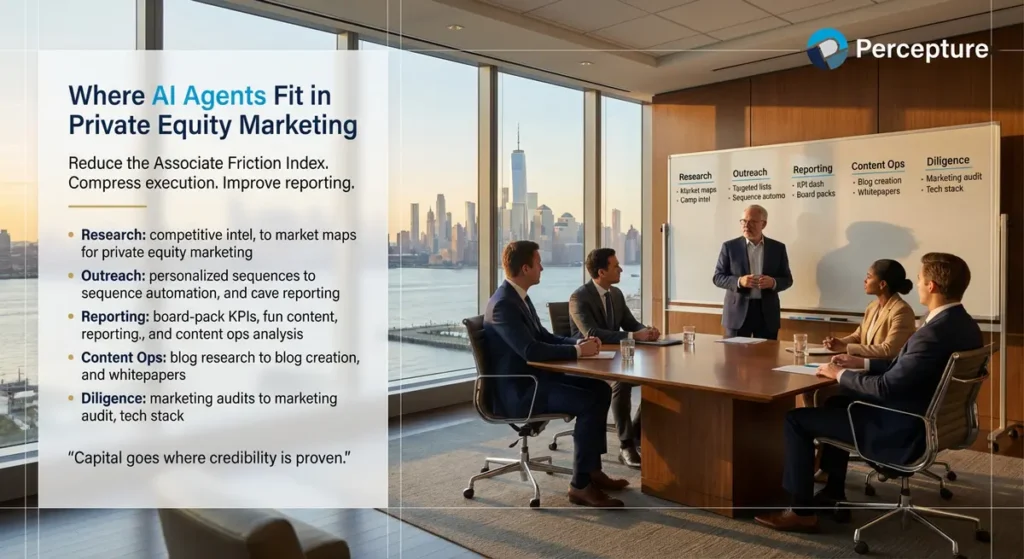
Main AI Use Cases in Private Equity
Deal Sourcing
Research targets, monitor market signals, prepare account dossiers, and help teams prioritize outreach.
Diligence
Summarize documents, extract key points, compare claims, and prepare review questions for human experts.
Portfolio Operations
Map workflows, reduce repetitive tasks, standardize reporting inputs, and improve operating visibility.
Sales and Marketing
Support ICP work, lead research, prospect dossiers, content briefs, campaign reporting, and follow-up preparation.
Board Packs
Draft performance narratives, consolidate metrics, and surface changes that leadership needs to review.
AI Search Visibility
Improve how a PortCo is understood, summarized, and cited by Google, ChatGPT, Perplexity, Gemini, Claude, and Copilot.
Reporting
Connect marketing, sales, source attribution, and performance data into clearer leadership views.
Workflow Automation
Move repeatable steps into controlled workflows while keeping sensitive approvals with people.
AI Tools vs. Copilots vs. Agents vs. Custom Workflows
| Category | What it does | PE use case | Risk | Best first step |
|---|---|---|---|---|
| AI tools | Help with specific tasks. | Research, summaries, extraction. | Tool sprawl. | Pick one workflow. |
| AI copilots | Assist human users. | Memos, analysis, reporting. | Overreliance. | Human review. |
| AI agents | Complete multi-step workflows. | Diligence, sourcing, monitoring, sales follow-up. | Governance gaps. | Clear guardrails. |
| Custom AI workflows | Fit firm-specific processes. | Board packs, CRM, portfolio dashboards. | Integration complexity. | Workflow map. |
| AI search / GEO | Improves visibility in AI answers. | PortCo growth, buyer research, market positioning. | Weak entity data. | Content + schema + citations. |
The PE AI Operating System
The PE AI Operating System is Percepture’s framework for helping private equity firms and PortCos identify the right AI workflows, apply the right level of automation, and keep humans in control while improving speed, visibility, sales, and reporting.
The workflow is the strategy.
The model matters, but the workflow matters more. A strong PE AI plan defines what AI can touch, where humans review, and which outcome proves the system is worth scaling.
AI should make the right work faster, not make unclear work look automated.
Map current sales, marketing, reporting, diligence, and operating workflows before choosing tools.
Review digital properties, analytics, CRM, AI-search visibility, content, and existing systems.
Use human strategy, AI execution, and human approval before expanding autonomy.
Use the right model or agent for the workflow instead of forcing every task through one tool.
Track outputs, approvals, citations, lead sources, workflow impact, and board-ready metrics.
This framework also supports SEO, GEO, and CRO. It improves entity clarity, page structure, FAQs, schema, content proof, lead quality, conversion paths, and reporting. For firms comparing growth partners, Percepture’s private equity marketing agency work connects operating visibility with market visibility.
The 20-60-20 AI Rollout Model
20% Human Strategy
Define the goal, owner, workflow, ICP, data access, approval rules, messaging, and risk limits.
60% AI Agent Execution
Let AI handle repeatable work: research, prospecting, enrichment, CRM updates, reporting support, content briefs, outreach preparation, and monitoring.
20% Human Review
Keep humans in the loop for approvals, client-facing decisions, sensitive language, final QA, and anything that affects trust.
Zero-touch operations should only come after the workflow proves quality, consistency, and trust.
Map Your First AI Workflow
Percepture can help identify one workflow where AI can save time, improve visibility, speed up reporting, or support better lead quality without losing human control.
AI for Deal Sourcing
Deal sourcing is a strong place to use AI because the work is research-heavy and often repetitive. AI can help teams scan target categories, summarize company information, compare positioning, identify market signals, and prepare outreach research for human review.
Sales intelligence also matters. Percepture connects AI workflows with buyer-intent thinking, including B2B intent data, prospect signals, verified contacts, and dossiers that help teams focus on better-fit conversations.
AI for Due Diligence
AI due diligence for private equity can help with document extraction, summaries, comparison tables, data-room organization, market research, and risk-question preparation. It can also help identify inconsistencies that a diligence team should review more closely.
This is not an area for unchecked automation. Sensitive legal, financial, operational, compliance, and valuation conclusions should remain under human review. AI can support judgment. It should not quietly replace judgment where accountability matters.
AI for Portfolio Operations
AI portfolio operations often starts with standardization. Many PortCos have uneven CRM hygiene, inconsistent reporting, manual status updates, disconnected analytics, and sales or marketing workflows that depend on a few people carrying the process in their heads.
The first AI project should be narrow enough to measure: time saved, cost avoided, lead quality improved, reporting speed increased, or manual steps removed. For PortCos building growth systems, private equity marketing services can connect operating improvements to demand generation and conversion.
AI for Sales, Marketing, and PortCo Growth
Sales and marketing workflows are often the safest first test because the work is measurable. AI can help define the ICP, research accounts, draft content briefs, personalize outreach preparation, clean CRM records, identify buying signals, and speed up handoff from research to a human rep.
The goal is not automated spam. The goal is better research, better timing, better fit, and faster handoff to a human rep. PortCos that need more qualified conversations can use Lead Seeker to analyze a company website, help define ICP and buying signals, generate prospect dossiers, verify contacts in real time, support intent tracking, and help sales teams find better-fit prospects.
Once qualified traffic reaches a PortCo website, the next question is whether it converts. Percepture’s conversion rate optimization work helps improve page paths, CTA clarity, form flow, and lead quality.
Need More Qualified Conversations?
PortCos that need more qualified conversations can use Lead Seeker to find verified B2B leads, build dossiers, and support smarter outreach.
AI Search Visibility and GEO for PortCos
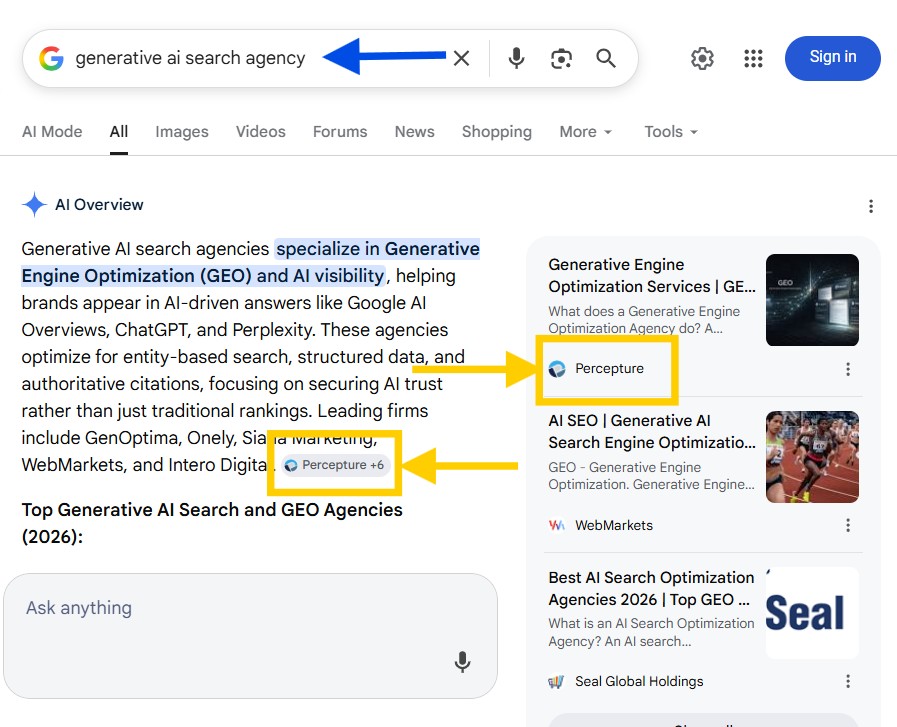
Search visibility creates leverage before a founder, buyer, investor, or competitor ever reaches out. That is even more important as buyers use ChatGPT, Google AI Mode, Perplexity, Gemini, Claude, and Copilot to compare vendors, markets, and companies.
AI content without proof is a liability. AI search visibility needs entity clarity, useful pages, structured data, and authority signals. Percepture can audit AI visibility across buyer questions and models, track mentions versus citations, measure share of voice, identify model-by-model gaps, and create or optimize content to improve AI visibility.
For PortCos, the company must be easy to understand: what it does, who it serves, where it operates, why it is trusted, which proof supports its claims, and which pages answer buyer questions. This is where SEO, generative engine optimization services, digital PR services, and proof-based content work together.
AI for Board Packs and Reporting
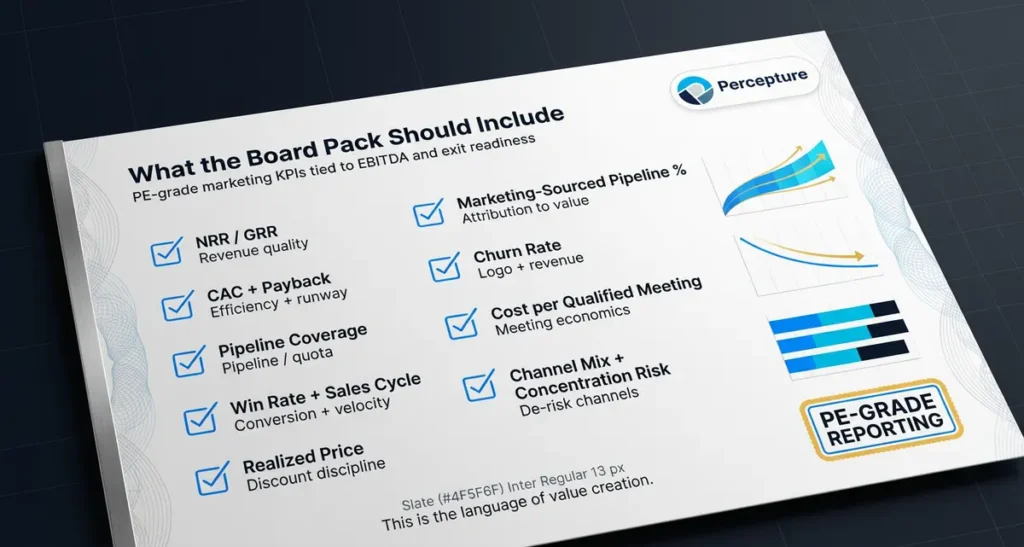
Board reporting is a practical use case because leadership needs clearer views, not more raw data. AI can help draft narrative summaries, identify changes, prepare questions, and consolidate performance inputs before executives review the final board pack.
AnalyticsIQ can consolidate campaign data across SEO, Google Ads, LinkedIn Ads, and AI-driven source attribution. That gives operating teams a cleaner way to connect marketing activity, lead quality, and reporting speed. For search-led growth, organic SEO services remain a core input because AI systems often draw from strong, crawlable web content.
AI Governance: What PE Firms Must Control
Workflow controls
- Who owns the workflow?
- What data can the AI access?
- What outputs need human approval?
- What cannot be automated?
- How are outputs checked?
Governance controls
- How are errors logged?
- How are sensitive documents protected?
- Which model is used for which task?
- How are citations, sources, and assumptions reviewed?
- What gets reported to the board or operating team?
The safest AI stack starts with workflow mapping, access controls, output review, and a clear decision about what AI is allowed to do.
What Not to Automate First
Do not automate these first:
Final investment decisions, valuation conclusions, final board recommendations, and sensitive diligence conclusions.
Legal conclusions, HR decisions, compliance-sensitive claims, and anything with unclear data permissions.
Client-facing emails, outreach, public claims, or founder communications that have not been reviewed by a human owner.
Anything that can damage trust if the output is wrong, incomplete, unauthorized, or missing context.
AI can support judgment. It should not quietly replace judgment where accountability matters.
30/60/90-Day AI Adoption Plan
0–30 Days: Diagnose
- Map workflows.
- Review CRM, analytics, content, and digital footprint.
- Identify bottlenecks.
- Run AI search visibility checks.
- Choose one high-value workflow.
- Define guardrails.
- Set success metrics.
31–60 Days: Pilot
- Build the first workflow.
- Set access permissions.
- Train prompts and agents.
- Run controlled tests.
- Review outputs.
- Measure time saved or quality improved.
- Prepare leadership reporting.
61–90 Days: Scale
- Expand the workflow.
- Add automation where safe.
- Connect reporting.
- Build dashboards.
- Identify the next PortCo use case.
- Create a repeatable portfolio playbook.
Scope Clarity: What a PE AI Engagement Can Include
Hard pricing should come after scope because a single PortCo workflow is different from a portfolio rollout. Most practical engagements fall into five buckets.
| Scope | What it answers | Best fit |
|---|---|---|
| AI readiness audit | Where should we start? | PE firm or PortCo evaluating first steps. |
| First-workflow sprint | Can one workflow prove value? | Teams that need a focused pilot. |
| AI agent implementation | Can repeatable work move into a controlled agent workflow? | Companies with mapped processes and review rules. |
| Portfolio rollout | Can the playbook work across more than one company? | Operating teams seeking repeatability. |
| Ongoing governance and optimization | How do we improve quality and reporting over time? | Teams scaling workflows safely. |
Mistakes PE Firms Make With AI
Strategy mistakes
- Buying tools before mapping workflows.
- Skipping governance because the pilot feels small.
- Automating sensitive work before trust is proven.
- Running AI without a human owner.
Growth mistakes
- Ignoring adoption by operators, founders, sales teams, or marketers.
- Ignoring AI search visibility while buyers are using answer engines.
- Using generic AI content without proof, citations, or entity clarity.
- Failing to define a reporting model before the pilot starts.
Proof: What Percepture Sees in the Market
In PE operating conversations, Percepture sees a familiar pattern: many founder-led PortCos are new to AI, lack standardized digital workflows, and need help knowing where to start.
That pattern is why Percepture starts with workflow discovery, not software shopping. The first project should be safe enough to adopt and specific enough to measure. From there, firms can decide whether to expand into AI agents, AI search visibility, reporting automation, or portfolio-wide playbooks.
Percepture’s search and demand work also supports technical B2B companies. In the 3x qualified leads case study, Broadstaff Global saw 90% of tracked keywords reach page one and qualified leads increase 3x within 12 months.
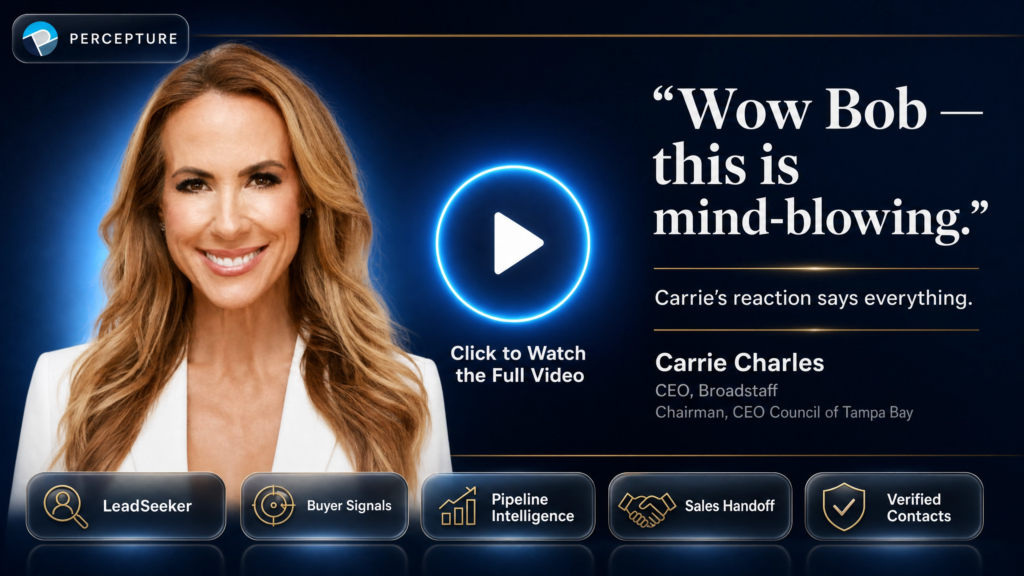
For teams evaluating broader visibility programs, Percepture combines omnichannel marketing, PR, SEO, GEO, analytics, sales intelligence, and website conversion into one operating view.
Build a 30/60/90-Day AI Adoption Plan
If your PE firm or PortCo needs AI workflows, AI search visibility, sales intelligence, reporting, or lead generation support, Percepture can help build a practical adoption plan.
FAQs About AI for Private Equity
What is AI for private equity?
AI for private equity is the use of artificial intelligence to improve deal sourcing, diligence, portfolio operations, board reporting, sales, marketing, and portfolio company growth.
How are private equity firms using AI?
Private equity firms use AI to research targets, summarize documents, review data rooms, monitor portfolio performance, support sales outreach, improve reporting, and identify workflow bottlenecks.
What are the best AI use cases for PE firms?
The strongest first use cases are narrow and measurable: prospect research, diligence summaries, CRM cleanup, lead scoring, board-pack drafting, AI search visibility audits, and sales workflow support.
What is the difference between AI tools and AI agents for private equity?
AI tools help with specific tasks. AI agents can complete multi-step workflows with defined goals, rules, and review points. Custom workflows connect AI to a firm’s actual process.
How can AI help portfolio companies?
AI can help PortCos standardize workflows, improve reporting, find better leads, speed up sales research, improve SEO/GEO visibility, and reduce repetitive manual work.
How can AI support deal sourcing and diligence?
AI can help monitor target signals, summarize markets, extract documents, compare information, flag gaps, and prepare diligence questions. Humans should still review sensitive conclusions.
How can AI help PortCo sales and marketing?
AI can support ICP development, buyer-intent research, lead verification, prospect dossiers, personalized outreach, content briefs, SEO/GEO visibility, and faster sales follow-up.
What AI risks should private equity firms manage?
PE firms should manage data privacy, permissions, hallucinations, approval workflows, tool sprawl, model selection, source review, and sensitive decision-making.
Where should a PE firm start with AI?
Start with one workflow that is repetitive, measurable, and low-risk. Define the owner, data access, guardrails, success metric, and human review process before expanding.
When should a PE firm bring in Percepture?
Bring in Percepture when a firm or PortCo needs help mapping workflows, improving AI search visibility, building AI agents, setting guardrails, or launching a 30/60/90-day AI adoption plan.
Final Takeaway
AI for private equity should remove manual drag, improve visibility, support better sales and reporting, and help PE firms make better decisions faster without weakening human judgment. The safest path is not a giant rollout. It is a narrow workflow, clear governance, proof of value, and a repeatable playbook.

About the Author: Bob Generale
Bob Generale is President and Partner at Percepture, a digital marketing and PR agency founded in 2004. Bob works with senior teams on SEO, GEO, digital PR, lead generation, reputation, analytics, and growth strategy for high-trust B2B markets.