

The best Perplexity SEO tracking software is not necessarily the dashboard with the largest visibility score. It is the platform that lets your team inspect the evidence behind every meaningful change.
That means preserving prompts, answers, source citations, brand recommendations and history in a form operators can audit, compare and act on.
What should the best Perplexity tracking software show?
The strongest fit is software that records the prompt tested, the answer returned, whether the brand appeared, which pages were cited, how the brand was described or recommended, and how those observations changed over time. The right choice then depends on workflow, reporting, export and access requirements.
The evidence-first verdict
There is no defensible universal winner without testing each platform against the same prompt set, location assumptions, account conditions and reporting requirements. A polished score can be useful, but it cannot replace the underlying response and source record.
Percepture’s supplied search snapshot surfaced buyer guides from WorkDuo, Omnia, and AY Rank alongside a Reddit discussion and a Perplexity use-case page. Those results help define the competitive field, but they do not provide a controlled, hands-on comparison of vendor output.
For that reason, this guide does not repeat vendor superlatives, prices or feature claims taken from search snippets. It gives buyers a consistent method for evaluating live demonstrations and trials.
Compare evidence, not just visibility scores
A buyer should be able to trace a reported result back to what was tested. If the platform says visibility improved, ask to see the prompts, responses, citation URLs and comparison dates that produced that conclusion.
| Decision criterion | What to inspect in a live demonstration | Why inspect it |
|---|---|---|
| Prompt record | The exact prompt, test date and available run settings | Check whether each score remains linked to the query that produced it |
| Answer preservation | The returned answer or a durable response record | Review context rather than relying only on a mention count |
| Citation detail | The cited URL, source domain and associated prompt | Compare brand visibility with source visibility |
| Recommendation context | The language surrounding a recommendation, comparison or exclusion | Classify a mention as commercially useful, neutral or unfavorable |
| History | Past observations at the prompt, page and brand level | Compare dated observations instead of relying on a single snapshot |
| Segmentation | Filters for prompt group, market, product, audience or campaign | Test whether distinct buyer journeys can be reviewed separately |
| Export and access | Raw-data export, user permissions and reporting options | Determine whether the evidence fits operating and executive workflows |
Citation tracking and recommendation tracking are different jobs
Citation tracking asks whether a page or domain was used as a source. Recommendation tracking asks how a company, product or approach appeared in the answer itself.
A brand can therefore investigate four distinct situations:
- It is mentioned and cited.
- It is mentioned without a citation to its own site.
- Its site is cited while another entity receives the recommendation.
- Neither the brand nor its pages appear in the observed answer.
Software should make those situations distinguishable. Review citation and recommendation records separately, then treat any combined score only as a summary.
Use the Golden Triangle to test platform fit
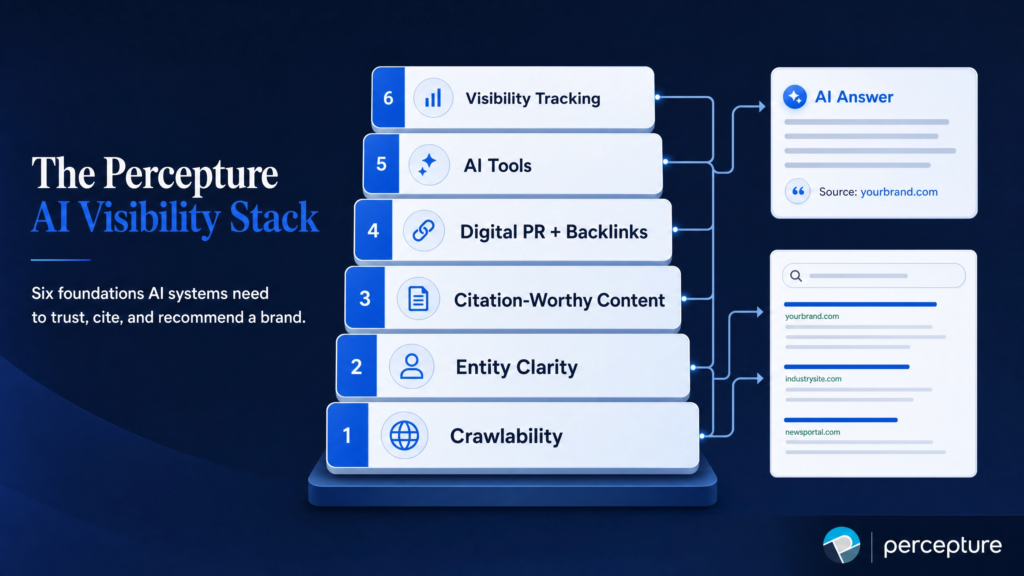
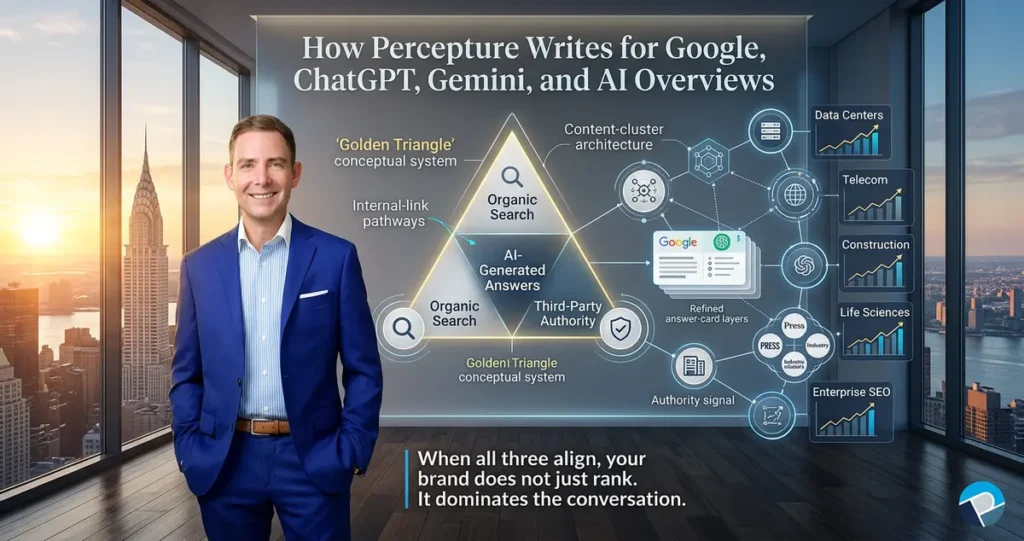
For this buyer guide, Percepture uses the Golden Triangle, Source-to-Entity Conversion Ladder and Six-State Visibility Ladder as decision frameworks—not as search-engine ranking factors.
The Golden Triangle
Source
Can the platform identify which page or domain supported an observed answer?
Citation
Can the team connect that source to the prompt, response and date on which it appeared?
Recommendation
Can the team see whether the brand was merely present or was actually framed as an option?
A platform passes the basic Golden Triangle test when it lets an operator move between all three records without reconstructing the evidence manually.
The Source-to-Entity Conversion Ladder
The Source-to-Entity Conversion Ladder turns monitoring into a diagnostic sequence:
- Prompt observed: The team has a defined question worth tracking.
- Answer retained: The resulting response can be reviewed.
- Source identified: The cited page or domain is visible.
- Entity connected: The team can see which company, product or person the source supports.
- Recommendation interpreted: The commercial context is classified for action.
Use this sequence to ask whether the evidence points to a content, entity, authority or recommendation issue. Check separately whether a source is present, whether the brand is associated with it and whether the answer recommends the brand.
A Six-State Visibility Ladder for reporting
Instead of relying only on a single percentage, classify each observed prompt into one of six reporting states:
- Unobserved: The prompt has not produced a retained record.
- Absent: A record exists, but the brand and owned sources are not present.
- Sourced: An owned page or relevant source is cited without a clear brand recommendation.
- Mentioned: The brand appears in the answer without a direct recommendation.
- Recommended: The brand is presented as an option for the stated use case.
- Preferred: The answer places the brand in a leading position for that specific prompt context.
This is a reporting model, not a promise that every prompt will progress neatly from one state to the next. Use it diagnostically to separate observations about sources, mentions and recommendations.
Run the same evaluation protocol for every candidate
A fair software comparison starts with one test plan. Do not allow each vendor to select the prompts, screenshots or date ranges that make its interface look strongest.
Perplexity tracking evaluation checklist
- Define the prompt set: Include category questions, problem questions, comparisons, alternatives and purchase-oriented prompts.
- Group by buyer journey: Keep awareness, evaluation and selection prompts separate.
- Use identical inputs: Give each platform the same prompt list and relevant market assumptions.
- Inspect raw records: Review the answer, citation URL, date and recommendation context behind the dashboard.
- Test history: Confirm how an operator compares observations across dates without relying on screenshots.
- Test exports: Export a sample and determine whether the fields are useful outside the platform.
- Review permissions: Match access controls to the people who will investigate, report and approve work.
- Document commercial terms: Record the quoted plan, usage boundaries and included support in writing.
Do not score decorative interface preferences alongside evidence requirements. First establish whether the records are complete enough to support a decision. Then compare usability, workflow and commercial fit.
Match the platform to the operating team
The same dataset can serve different buyers. The best fit depends on who will review the evidence and what they must do next.
Buyer-fit scorecard
In-house SEO team
Prioritize page-level citations, prompt grouping, historical comparison and exports that can be joined with existing search reporting.
Content and digital PR team
Prioritize source discovery, citation context and the ability to connect recurring prompts with authority and content opportunities.
Executive marketing team
Prioritize transparent summaries that retain a path back to the underlying prompt and response evidence.
Agency or multi-brand team
Prioritize account separation, permissions, repeatable reporting and manageable exports across multiple workstreams.
Teams that want outside support can review Percepture’s AI search optimization services and published GEO pricing and package information.

Compare the software cost with the operating work
Review Percepture’s published pricing paths while deciding whether to evaluate software, services or both.
Review Pricing OptionsProof to request before signing
Ask every shortlisted provider to demonstrate the following with live or retained records:
- One prompt that produced a brand mention.
- One prompt that produced a citation to an owned page.
- One prompt where a competitor was recommended instead.
- The history available for each observation.
- The raw fields included in an export.
- The controls available for teams, accounts and reports.
- Written commercial terms for the proposed usage level.
Also ask whether the publisher of any comparison has a financial, referral, partnership or ownership relationship with the vendors being ranked. Record any disclosed relationship as part of the evaluation context.
The final decision should answer a strategic question: does the platform merely tell leadership that visibility changed, or can the operating team use its evidence to determine what should change next?
Discuss an evidence-based AI search baseline
Use a strategy conversation to discuss the prompts, evidence fields and reporting states your team wants to evaluate.
Book a Strategy ConversationReference images