Choosing the best AI Overviews tracker starts with a measurement question, not a feature count. A useful platform should help your team distinguish ordinary organic position from appearance inside a Google AI Overview and preserve enough evidence to investigate what changed.
The right choice depends on whether you need basic monitoring, source-level research, local market checks or executive reporting. Compare each candidate using the same evidence-first method.
Which AI Overview tracker should you choose?
Choose the tracker that can preserve the evidence your team will actually use: the query, location, observation time, AI Overview presence, brand mention, cited URL, source domain and prior state. Shortlist products against that record first, then compare workflow, exports, access and current pricing directly with each vendor.
The decision in four checks
Separate the surfaces
Within this guide, organic listings and AI Overview appearances are recorded as separate observation types.
Inspect the evidence
Ask whether the platform retains the answer, cited page, source domain, query conditions and observation date.
Require history
A current-state dashboard cannot explain when visibility appeared, disappeared or changed.
Test your workflow
Run a controlled pilot using your own queries, markets and reporting requirements before selecting a plan.
Our evaluation methodology
This unranked shortlist is based on published descriptions, not hands-on product tests. Use the buyer test below to compare products against your requirements.
We evaluated the available descriptions against three buyer advantages:
- Information advantage: Can the buyer distinguish a mention, citation, cited URL, source domain and ordinary organic result?
- Evidence advantage: Can the team inspect and retain the underlying observation instead of relying only on an aggregate score?
- Decision advantage: Can the output support investigation, prioritization and reporting without implying causation?
The measurement model: six states that should not be collapsed
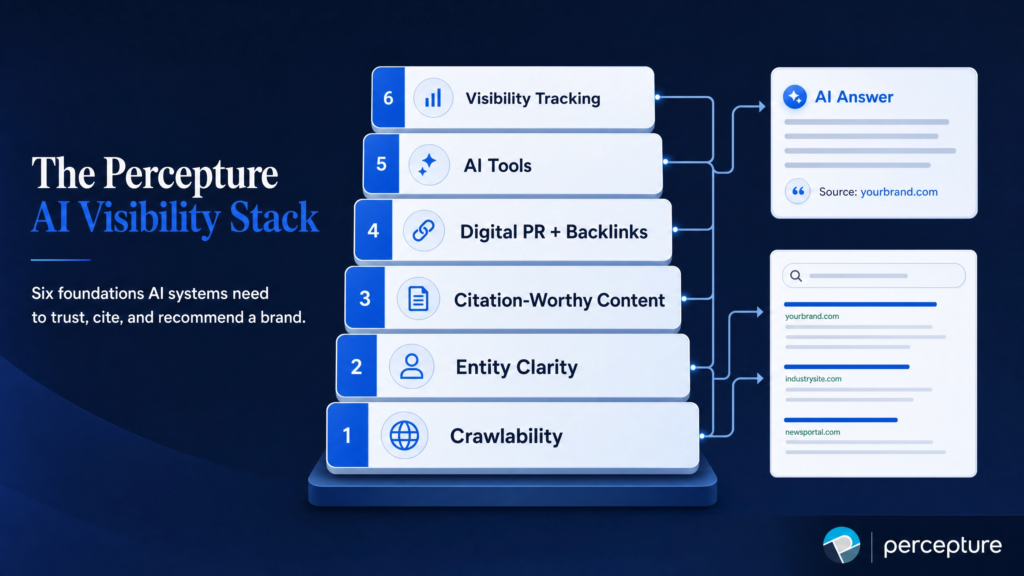
Percepture’s Six-State Visibility Ladder is a buyer-side measurement framework, not a Google ranking factor. It separates observations that can look similar in a summary dashboard but lead to different actions:
- Organic presence: your page appears in the conventional search results being observed.
- AI Overview detected: the tracked result contains an AI Overview.
- Entity mentioned: the observed answer names the company, product or tracked entity.
- Domain cited: the answer presents the tracked domain as a source.
- Specific page cited: the evidence identifies the exact URL used as a source.
- State changed: a later observation differs from the recorded prior state.
A team can be present organically without being cited in an AI Overview. It can also be mentioned without receiving a citation to its own domain. Your tracker should preserve those distinctions rather than compressing them into one visibility number.
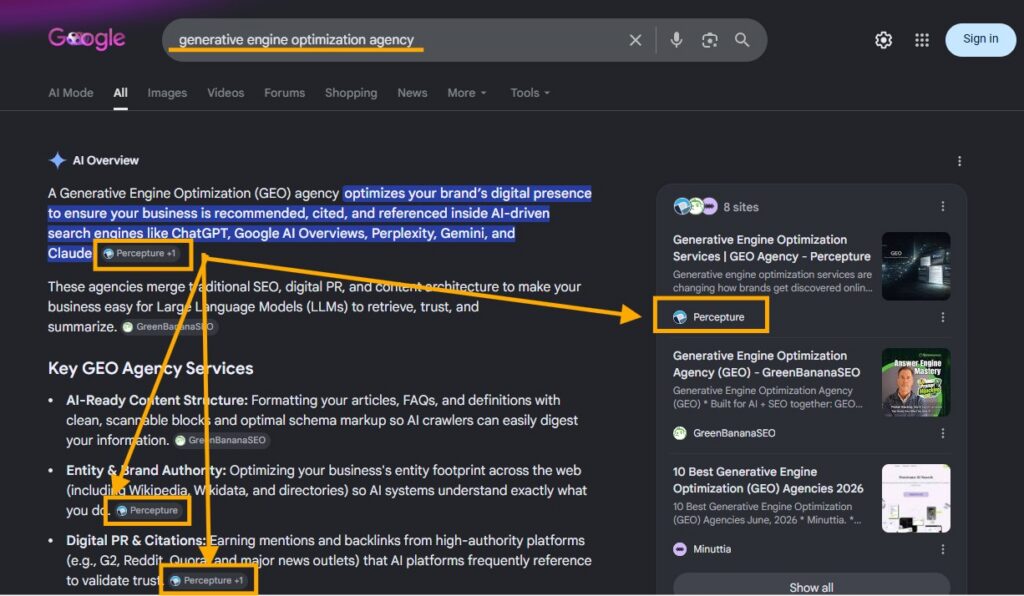
AI Overview trackers to evaluate
The following products form a starting shortlist. Their order below is not a performance ranking. Confirm the live interface, limits, coverage and commercial terms during a trial or vendor review.
Shortlist by stated use case
| Tool | Published description | Best first verification step |
|---|---|---|
| SE Ranking AI Overviews Tracker | SE Ranking’s result says its tracker monitors performance in Google Search AI Overviews and supports comparison of rankings, competitors and sources. | Inspect whether source and competitor records can be exported with query, location and observation dates. |
| AIOverviewTracker | AIOverviewTracker’s result says the tool tracks AI Overview search results across the USA, Europe and other countries. | Test the exact country and location controls needed by your reporting program. |
| Omnia | GetMint’s result describes Omnia as tracking brand presence across Google AI Mode, Google AI Overviews, ChatGPT and Perplexity. | Verify whether each surface has separate evidence records and comparable historical views. |
| Otterly.AI | SitePoint’s result describes Otterly.AI as tracking brand and content appearances in Google AI Overviews and ChatGPT. | Inspect the captured answer, cited URL and history behind any summarized visibility metric. |
This is not an exhaustive market inventory. The results also included comparison content about AI Mode tools, but an AI Mode tracker should not be assumed to provide identical evidence for AI Overviews. Buyers evaluating several answer engines may also need a broader category review of LLM visibility platforms.
What to verify in a live product demonstration
AI Overview tracker scorecard
| Test | Evidence to request | Why it matters |
|---|---|---|
| AI Overview detection | Captured result tied to a query and observation time | Shows what the platform classified as an AI Overview. |
| Brand mention | Visible answer text or an inspectable excerpt | Lets an analyst verify that the tracked entity was actually named. |
| Citation tracking | Cited domain and exact destination URL | Separates general mention visibility from source evidence. |
| Change history | Prior and current records for the same tracked conditions | Makes gains, losses and source changes reviewable. |
| Location controls | Documented country, market or location settings | Keep the location setting attached to each observation when reviewing local reports. |
| Exports and access | Sample export, API documentation or scheduled report | Shows whether evidence can enter the team’s operating workflow. |
| Query governance | Grouping, labels and retained query definitions | Keeps a changing prompt set from undermining trend comparisons. |
Score each item as verified, partial or not demonstrated. Avoid awarding points for a sales-page label alone. A feature name does not establish how the underlying observation is collected, retained or exported.
For a broader program, connect the tracker’s evidence to your attribution and analytics process. The purpose is not to force AI visibility into a last-click model; it is to keep measurement definitions consistent across teams.
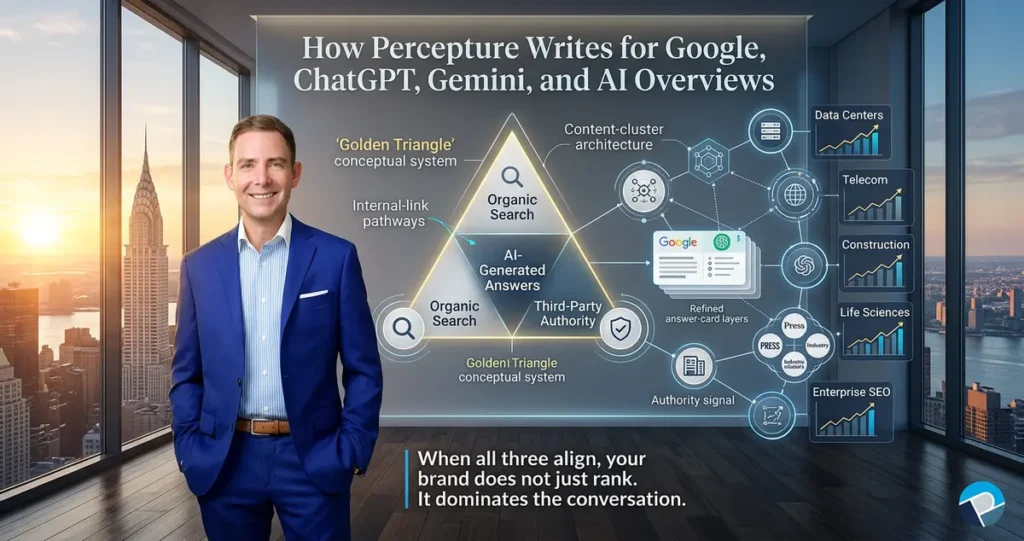
The Golden Triangle for tracker selection
Observation, evidence and action
Observation
What query, market, device context and time produced the recorded result?
Evidence
What answer, mention, source domain and cited page can an analyst inspect?
Action
What research or content decision follows, and who owns the next check?
Percepture calls this the Golden Triangle. It is an evaluation method for marketing operators, not a claim about how Google selects sources. A tracker becomes more useful when all three sides remain connected. An observation without evidence is difficult to audit; evidence without an operating decision becomes dashboard inventory.
The next layer is the Source-to-Entity Conversion Ladder: identify the sources appearing for a query family, map the entities and concepts those sources address, inspect your own coverage, improve the underlying material where evidence supports the change, and then monitor later observations. Within this framework, change history supplies follow-up questions rather than causal conclusions.
What an AI Overview tracker cannot prove
A tracker can record a sequence of observations. That sequence alone does not establish why Google generated an answer, selected a source or changed a citation. Website edits, source availability, query context and other unobserved conditions may differ between checks.
Use change history to form investigation questions, not causal verdicts. When a citation appears after a page update, record the timing and inspect competing explanations before reporting the update as the cause.
How to run a controlled tracker pilot
- Freeze a query set. Select representative branded, category, problem and comparison queries. Record the exact wording.
- Define tracked markets. Keep country and location settings consistent enough to compare later observations.
- Record the starting state. Save AI Overview presence, entity mentions, cited domains, cited pages and the observation date.
- Test evidence retrieval. Have an analyst move from a summary chart to the underlying captured result.
- Export a reporting cycle. Confirm that the fields your team needs survive the export or integration.
- Review changes manually. Investigate a sample of gains, losses and source changes before relying on aggregate trends.
If the platform cannot support this pilot, the issue is not necessarily that the product is poor. It may simply be designed for a lighter monitoring use case than your organization requires.
Connect tracking to an AI search program
Tracking becomes operational when the team can turn source and citation evidence into a prioritized research plan. Review Percepture’s Google AI Overview optimization services to see how measurement can fit a broader search program.
Questions to ask before signing a contract
- Can we inspect the captured result behind every visibility state?
- Does a citation record include the exact page, not only the root domain?
- How are query wording, location and observation dates preserved?
- Can we compare a current state with prior observations under the same conditions?
- Which Google surfaces are measured separately?
- What changes when we exceed the plan’s query or market limits?
- Can our analysts export the evidence needed for independent review?
- How does the vendor distinguish a brand mention from a cited source?
- Which capabilities shown in the demonstration are included in the quoted plan?
Ask the vendor to demonstrate these answers using your query set. A polished sample account can explain navigation, but your own terms expose whether entity matching, location coverage and evidence retention fit the work.
Frequently asked questions
How were the AI Overview trackers evaluated?
The guide used one methodology centered on observation context, mention evidence, citation evidence, source detail, change history and workflow fit. The descriptions are based on public listings, not hands-on tests.
Which AI Overview tracker is best for a different use case or budget?
There is no defensible universal winner without the buyer’s query volume, markets, reporting needs and current vendor terms. A light monitoring team may prioritize ease of use, while an analyst-led program may require captured answers, exact cited URLs, exports and historical comparison.
What proof should a buyer verify before choosing a tracker?
Verify a captured AI Overview tied to a query, market and time; the detected entity mention; the cited domain and exact page; and a prior record that demonstrates how history is retained. Then test the export or reporting path your team will use.
How current are the pricing and capabilities in this guide?
This guide does not publish vendor prices or unverified plan limits. Obtain current terms from each vendor and confirm that demonstrated capabilities are included in the plan under consideration.
Does a tracker prove that an optimization caused an AI Overview change?
No. A tracker can preserve observations and their sequence, but that sequence alone does not establish why a source, mention or citation changed. Use the history to investigate and avoid converting correlation into a causal claim.
Build an evidence-first AI visibility baseline
Percepture can help your team define the query set, evidence fields and review process before tool selection or program expansion.

About Bob Generale
Bob Generale is President of Percepture.